IHUB
IHUB
 Global Content Pulse (Webinars)


 Global Production Financing
(Webinars)
Global Production Financing
(Webinars)  LeaderSpeak Podcast
  Global Entertainment Digest (Newsletter)
  About Vitrina
 About VIQI
 Our Story
 Our Solutions 🔥
 Film+TV Projects Tracker 🚀
 Case Studies
 Our Profile
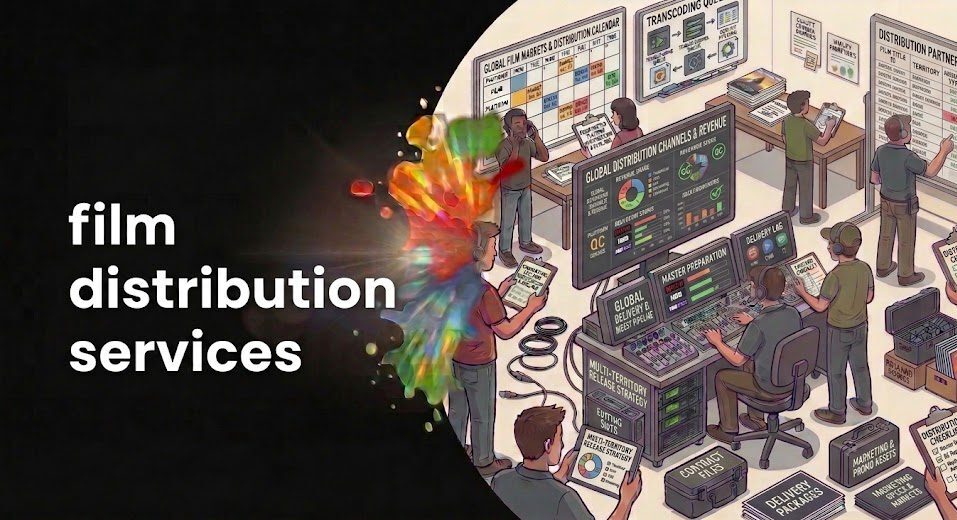
You’ve wrapped production, survived post, and now you’re staring at the single question that kills more indie careers than a bad first cut: where do you actually distribute this thing? The online film distribution services for indie films landscape has exploded over the past decade—and that’s both the opportunity and the problem.
More platforms, more aggregators, more “we’ll take your film” pitches than ever before. But more options don’t automatically mean better outcomes for your recoupment timeline or your backend.
Here’s what most distribution guides won’t tell you: the platform you choose matters far less than understanding what each service actually does with your film after you hand it over. Revenue share terms, windowing rights, exclusivity clauses, MG structures—these are the variables that determine whether your film earns money or just exists on a platform. We’ve broken down 7 of the most active online distribution platforms for independent filmmakers so you can make a decision that protects your P&A spend and accelerates recoupment.
In This Article
- Why Indie Distribution Went Digital—and Never Looked Back
- How We Evaluated These 7 Services
- Amazon Prime Video Direct
- Filmhub: Multi-Platform Aggregation
- MUBI: The Art House Premium Play
- Fandango at Home & Gravitas Ventures
- Quiver Distribution & IndieFlix
- Full Comparison Table
- The Revenue Window Problem No One Warns You About
- How to Find the Right Distribution Partner—Fast
- FAQ
- Your Distribution Decision Framework
Find Your Film’s Ideal Distribution Partner in 48 Hours
Ask VIQI—Vitrina’s AI intelligence layer—to map active distributors by genre, territory, and deal history. The same tool trusted by Netflix, Warner Bros, and Paramount sourcing teams.
No credit card required · Join 140,000+ film and TV companies on Vitrina
Why Indie Distribution Went Digital—and Never Looked Back
Ten years ago, your indie film distribution options were brutally narrow. You needed a theatrical deal—or you had nothing. Traditional distributors held all the cards, MG offers on low-budget independents were thin, and SVOD hadn’t yet rewritten the rulebook on windowing strategy.
Digital platforms changed that math permanently. Not always in your favor—but the optionality is real. Today, a filmmaker finishing a $500K feature has a genuine choice between self-distribution via aggregators, direct platform licensing, specialist indie distributors, and hybrid models that didn’t exist five years ago. The Fragmentation Paradox kicks in here, though: 600,000+ companies now operate somewhere in the global film and TV ecosystem, and knowing which ones actually move the needle for your genre, budget, and territory requires intelligence, not just a Google search.
There’s also the revenue window collapse to reckon with. Theatrical → home video → pay TV → free TV—that clean waterfall structure is gone. Platforms now negotiate overlapping windows, AVOD sits next to SVOD, and your film can cannibalize its own licensing value if you sequence rights poorly. We’ll get into the mechanics of that in a dedicated section. But first: the services themselves.
You’ll want to review our full guide on navigating theatrical, streaming, TV, and VOD film distribution channels alongside this comparison—because picking a platform without a windowing strategy is like casting without a script.

Your AI Assistant, Agent, and Analyst for the Business of Entertainment
VIQI AI helps you plan content acquisitions, raise production financing, and find and connect with the right partners worldwide.
- Find active co-producers and financiers for scripted projects
- Find equity and gap financing companies in North America
- Find top film financiers in Europe
- Find production houses that can co-produce or finance unscripted series
- I am looking for production partners for a YA drama set in Brazil
- I am looking for producers with proven track record in mid-budget features
- I am looking for Turkish distributors with successful international sales
- I am looking for OTT platforms actively acquiring finished series for the LATAM region
- I am seeking localization companies offer subtitling services in multiple Asian languages
- I am seeking partners in animation production for children's content
- I am seeking USA based post-production companies with sound facilities
- I am seeking VFX partners to composite background images and AI generated content
- Show me recent drama projects available for pre-buy
- Show me Japanese Anime Distributors
- Show me true-crime buyers from Asia
- Show me documentary pre-buyers
- List the top commissioners at the BBC
- List the post-production and VFX decision-makers at Netflix
- List the development leaders at Sony Pictures
- List the scripted programming heads at HBO
- Who is backing animation projects in Europe right now
- Who is Netflix’s top production partners for Sports Docs
- Who is Commissioning factual content in the NORDICS
- Who is acquiring unscripted formats for the North American market
How We Evaluated These 7 Services
Every service on this list was assessed against five criteria that matter to indie producers—not to platform marketing teams. These are: revenue share and MG availability, platform reach and audience fit, rights and exclusivity terms, submission and onboarding process, and transparency of reporting. We’ve also factored in what we’re seeing on Vitrina’s deal-tracking layer, where 159,223 active projects give us a live read on which distributors are actually acquiring in 2025.
A quick note before we dive in: none of these services is categorically better than the others. The right choice depends entirely on your film’s genre, your financing structure, and whether you need upfront capital or are playing a long backend game. Let’s break them down.
Amazon Prime Video Direct: The Broadest Reach Play
Amazon Prime Video Direct remains one of the few services that lets filmmakers submit content directly without a traditional distribution deal or aggregator intermediary. That’s genuinely valuable—but there’s a gap between access and visibility you’ll want to understand before you commit.
The platform operates across two lanes: SVOD (your film is bundled in Prime at no extra charge to subscribers) and TVOD (transactional rental/purchase). Revenue share for SVOD content is royalty-based, calculated per streaming hour—not per view. That’s an important distinction. A 90-minute drama can generate more royalty income than a shorter doc viewed by the same number of people. Amazon’s audience scale is unmatched, with Prime Video operating in over 200 countries. But discoverability without P&A support is the perennial problem.
Best for: Genre films (thriller, horror, action) with existing audience signals—festival reviews, social following, prior press. Not ideal for art house films without recognizable talent, since Prime’s recommendation engine favors content with strong early engagement metrics.
Filmhub: Multi-Platform Aggregation Made Simple
Filmhub functions as a tech-forward aggregator—meaning it’s your single submission point to distribute across 40+ streaming platforms simultaneously, including Tubi, Plex, The Roku Channel, and regional AVOD services. This is a fundamentally different model than direct platform deals. You’re not negotiating individual contracts; Filmhub manages the technical deliverables and revenue distribution on your behalf.
The revenue share structure is one of the more transparent in the aggregator space—filmmakers retain 80% of net revenues, with Filmhub taking the remaining 20%. No upfront submission fees. But “net revenues” is where you need to read the fine print—platform fees are deducted first, and AVOD CPMs on free streaming services are considerably lower than SVOD licensing rates. Expect modest returns unless your film drives high volume on AVOD platforms.
Best for: Completed films ready for immediate distribution that don’t yet have a theatrical or major SVOD deal. Strong play for documentaries and genre content with cross-platform appeal.
Track Which Distributors Are Actively Acquiring Your Genre
Vitrina’s live deal-tracking layer monitors 159,223 active film and TV projects globally. Filter by genre, budget range, and territory to see exactly which services are buying right now—before it hits the trades.
Get 200 Free Credits — No Credit Card Required
Trusted by Netflix, Warner Bros, Paramount and 140,000+ entertainment companies
MUBI: The Art House Premium Play
MUBI operates in a category of its own. It’s a curated SVOD platform that focuses exclusively on arthouse, festival, and critically acclaimed cinema—which means its subscriber base is far smaller than Amazon or Netflix, but far more engaged with the specific type of content you’re likely making if you’re an independent filmmaker reading this. The platform’s recent trajectory underscores its ambitions: Sequoia Capital led a $100 million investment in MUBI in 2025, valuing the platform at $1 billion—a clear signal that specialist streaming has serious institutional backing.
MUBI doesn’t have an open submission process. Curation is editorial, which means your film needs festival credentials, critical attention, or a relationship with MUBI’s acquisition team to get on the platform. But that selectivity is exactly what makes a MUBI license valuable—it signals prestige in a way that appearing on a hundred AVOD platforms simply can’t replicate. Licensing terms are negotiated case-by-case, with fixed licensing fees for defined windows typically ranging from 6 to 12 months.
Best for: Festival films, international co-productions, and auteur projects targeting a global cinephile audience. If your film played Sundance, Cannes Directors’ Fortnight, or TIFF—MUBI is a conversation worth having before you commit to a broad aggregator strategy.
Fandango at Home & Gravitas Ventures: The VOD Heavyweights
Fandango at Home (formerly Vudu) is a transactional VOD platform with deep retail integration and a strong position in the US home entertainment market. It’s not an open submission service—you’ll need to come via an aggregator or direct licensing deal. The appeal is TVOD economics: rental and purchase pricing on a successful independent film can generate meaningfully higher per-transaction revenue than SVOD royalties, especially in the first 90 days of release.
Gravitas Ventures, by contrast, is a specialist independent film distributor—one of the most active in the space. They’re not a platform; they’re a company that licenses your film to platforms on your behalf and takes a distribution fee, typically in the 15–25% range depending on the deal structure. What Gravitas offers that pure aggregators don’t is active marketing support and platform relationships that can land your film in better placement on Tubi, Amazon, and digital retailers. They also handle physical distribution if that’s still relevant for your title.
Best for: Films with completed festival runs, existing press coverage, and genre appeal (thriller, horror, action) are Gravitas’s sweet spot. For Fandango at Home specifically—any film seeking strong TVOD presence in North America.
Quiver Distribution & IndieFlix: Festival-to-Stream Pipelines
Quiver Distribution has carved out a strong niche as a festival-to-digital pipeline for independently produced features and documentaries. Their model bridges the gap between festival buzz and streaming availability faster than most traditional distributors—often getting films onto major platforms within 6 to 8 weeks of completing their festival run. They’ve built a reputation for working with international films, including African and South Asian independents seeking US market entry, which aligns with the broader Sovereign Hub content movement reshaping global film supply chains.
IndieFlix operates a subscription model specifically designed for independent films—think MUBI but broader and US-focused, with a strong documentary and short film catalog. It’s a community-driven platform with a deeply engaged indie audience, but licensing fees are modest. Revenue here is about long-tail presence rather than immediate recoupment.
For filmmakers navigating this landscape, our guide on how to find distributors for indie films in 5 steps maps out the full outreach and vetting process worth running before you commit to any single service.
Full Comparison: All 7 Services Side by Side
The Revenue Window Problem No One Warns You About
Here’s the thing producers consistently underestimate: choosing a platform is the easy part. The dangerous decision is the sequencing. Your film has a single shot at a theatrical window, a single shot at a premium VOD launch, and a single shot at an SVOD debut. Stack those in the wrong order—or sign an exclusivity clause you didn’t fully read—and you’ve permanently devalued your film’s licensing potential in markets that could’ve generated real recoupment.
Phil Hunt, CEO of Head Gear Films, broke this down with uncomfortable precision in his discussion of independent film’s structural challenges. He describes an industry that’s “shifted away from pre-sales” and where “revenue windows have collapsed due to the digital revolution”—meaning the orderly window sequence that once protected indie recoupment simply doesn’t function the way it did.
Watch Phil Hunt unpack the current independent film finance and distribution landscape in full:
Phil Hunt (CEO, Head Gear Films) — “The Big Crunch: Why Film Finance is Harder Than Ever”
What does this mean practically? A few things to build into your strategy before you sign anything:
- Exclusivity windows hurt more than they used to. A 12-month exclusive on one AVOD platform blocks you from the SVOD licensing deal that might have generated 3x the revenue.
- AVOD-first strategies suppress SVOD value. If your film is available free on Tubi and Plex, major SVOD platforms will lower their licensing offer—or pass entirely.
- International territory sequencing matters. Don’t bundle global rights to a single platform unless the MG justifies it. Territory-by-territory licensing typically generates more total revenue, even if it’s harder to execute.
- Festival windows are precious. Some platforms (particularly MUBI) will only license a film with an active festival run or within a certain period after premiere. Missing this window closes the door permanently.
For a full breakdown of how distribution deals are structured—including what to watch for in term sheets—our guide on negotiating film distribution contracts covers the key clauses that kill backend returns.
De-Risk Your Distribution Strategy With Real Deal Intelligence
Vitrina’s Concierge Service pairs your film with a dedicated industry expert who maps your optimal distribution path—platform sequencing, territory strategy, and active buyer contacts—before you commit to a single deal.
Used by indie producers and acquisitions teams at Netflix, Paramount, and Google TV
How to Find the Right Distribution Partner—Fast
The seven services above are a starting point, not an exhaustive list. The global distribution landscape includes hundreds of active buyers—specialist distributors, regional SVOD platforms, broadcast networks, and AVOD operators—many of whom are actively acquiring in your genre right now but aren’t running visible marketing campaigns. This is where the Fragmentation Paradox does real damage to indie filmmakers: 140,000+ active film and TV companies operate globally, but the information on who’s buying what, at what terms, in which territories, exists largely in relationship networks and deal databases that most independent producers can’t access.
Vitrina’s platform solves this directly. Rather than cold-pitching from a list of outdated contacts or waiting until AFM to find out who’s acquiring, you can use Vitrina’s Smart Pairing intelligence to identify active distribution buyers filtered by genre, budget, territory, and deal history—before it hits the trades. The platform tracks 159,223 projects in real time and maps acquisition activity across the global supply chain.
You can also explore our full database of best platforms for distributing independent films and cross-reference it with active deal data on Vitrina to identify which platforms are currently expanding their indie catalogs. That combination—platform research plus live deal intelligence—is what separates informed distribution decisions from expensive guesswork.
FAQ: Online Film Distribution Services for Indie Films
Wrapping Up: Your Distribution Decision Framework
Choosing between these seven online film distribution services for indie films isn’t really a platform decision—it’s a strategy decision. The platform you land on matters far less than the sequence you follow, the rights you protect, and the intelligence you use to identify which buyers are active before you commit. That’s the real competitive advantage in indie distribution right now: operating like an insider, not like someone working from a list of platform URLs.
Here’s your decision framework summarized:
- Mass reach, genre film, open submission: Start with Amazon Prime Video Direct or Filmhub’s aggregator model.
- Art house film with festival credentials: Prioritize a MUBI approach—the prestige positioning compounds over time.
- Need active marketing support: Gravitas Ventures or Quiver Distribution give you a partner, not just a pipeline.
- Strong TVOD economics are the goal: Build your strategy around Fandango at Home with aggregator support for ancillary platforms.
- Community-driven long tail: IndieFlix builds audience over years—combine with primary platform for full coverage.
And before you finalize any deal—check who’s actively acquiring in your genre on Vitrina. The information asymmetry between producers who know what platforms are buying right now and those who don’t is where most distribution value gets lost. Don’t let that be your film.
Start Your Distribution Search With 200 Free Credits
Vitrina maps active distributors, acquisition buyers, and platform deals in real time—across 140,000+ companies in 195 countries. Find your film’s distribution path today.
No credit card required
Need hands-on distribution strategy support?
Find Film+TV Projects, Partners, and Deals – Fast.
VIQI matches you with the right financiers, producers, streamers, and buyers – globally.
Producers Seeking Financing & Partnerships?
Book Your Free Concierge Outreach Consultation
(To know more about Vitrina Concierge Outreach Solutions click here)
Join Industry Briefings Trusted by Leaders
Unscripted Is Eating the World: The Multi-Billion Reality and Format Boom
Unscripted is the new prestige — inside the $19.8B global format boom reshaping how streaming platforms compete.
Unscripted Is Eating the World: The Multi-Billion Reality and Format Boom
Unscripted is the new prestige — inside the $19.8B global format boom reshaping how streaming platforms compete.
Scripted Without Borders
As global drama evolves, which stories travel, which stay local, and how are they getting financed?
What Film & TV Financiers Actually Want in 2026
What do Film and TV financiers look for before they invest? Join the briefing to understand how capital decisions are changing in 2026.