IHUB
IHUB
 Private Briefings (Webinars)


 LeaderSpeak Podcast
  Global Entertainment Digest (Newsletter)
  Premium Lists
 Premium Reports
 Membership Benefits
 About Vitrina
 Our Story
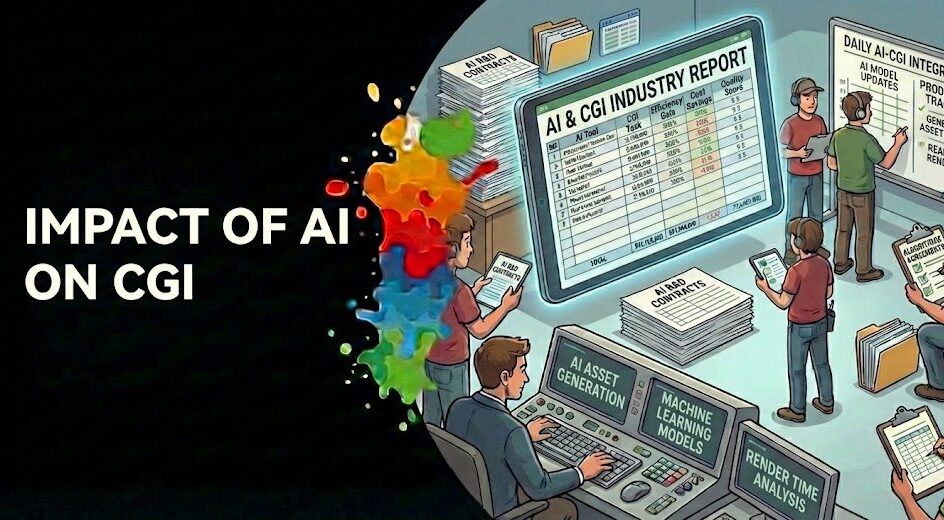
The impact of artificial intelligence on CGI isn’t coming. It’s here — and it’s moving faster than most studio budgeting models have caught up with. What used to take a team of 30 compositors six months can now be prototyped in days. Render times that once consumed weeks of farm compute are being slashed by AI-accelerated denoising pipelines. And de-aging — a VFX discipline that cost $10 million+ to execute convincingly just five years ago — has been democratized to the point where mid-tier productions are deploying it routinely.
But here’s what matters if you’re a producer, studio executive, or financier: the technology shift isn’t just a workflow story. It’s a cost structure story, a risk profile story, and increasingly an IP ownership story — and the decisions you make about how your production engages with AI-assisted CGI will affect recoupment timelines and completion bond insurability in ways that weren’t on anyone’s radar 36 months ago. This piece maps what’s actually changed, what it costs when you ignore it, and how the smartest operators are positioning themselves ahead of the next wave.
Find AI-Enabled VFX Studios Before Your Competitors Do
Trusted by Netflix, Warner Bros, and Paramount. Join 140,000+ companies tracking verified AI-capable VFX vendors across the global entertainment supply chain.
✓ 200 free credits | ✓ No credit card required | ✓ Full platform access
Why AI Is Hitting CGI Harder Than Any Other Production Discipline
Visual effects work is, at its core, pattern recognition and iterative refinement — which happens to be exactly what machine learning models do well. Unlike scriptwriting or directing, where the human creative judgment is irreducibly complex, many CGI tasks involve clearly defined inputs and outputs: clean up a wire rig, remove a boom mic from a background, generate realistic cloth dynamics, composite a crowd onto a stadium. These are problems with measurable quality standards. And AI can be trained on them at scale.
According to Variety, the global VFX market is tracking toward $20 billion by 2027 — with AI-assisted workflows cited as the primary driver of both market expansion and margin compression simultaneously. That’s the central paradox facing VFX studios right now. AI is making production cheaper. But it’s also making formerly-differentiated capabilities table stakes, which squeezes margins for studios that haven’t evolved their value proposition beyond raw execution.
Joseph Bell — a VFX veteran with more than two decades in the industry, including senior roles at Industrial Light & Magic — has spoken candidly about this dynamic. In his Vitrina LeaderSpeak conversation, he noted the industry’s evolving relationship with AI tools: not as a threat to craft, but as a fundamental redefinition of where human artistry is most valuable in the pipeline. That’s the frame every production executive should be applying.
Joseph Bell (VFX Industry Veteran, former Industrial Light & Magic) on where AI fits — and doesn’t fit — in the modern VFX pipeline:
8 Ways AI Is Transforming CGI and Visual Effects Right Now
1. AI-Accelerated Rendering: The Compute Cost Revolution
Traditional path-tracing renders are compute-intensive by design — physical accuracy requires simulating millions of light rays per frame. AI denoising, pioneered commercially by NVIDIA’s DLSS and adopted across tools like Arnold, Redshift, and RenderMan, has fundamentally changed this equation. Models trained on clean renders can reconstruct a high-quality final image from a render that’s 4–8x undersampled — meaning studios run their farm for a fraction of the time and cost.
The production math is significant. A major VFX sequence that might have consumed 200,000 core-hours of render farm compute two years ago can now be completed in 30,000–50,000 hours with equivalent quality. At typical render farm rates, that’s the difference between a $400K compute bill and a $90K one. On a 12-episode episodic VFX slate, those savings compound into numbers that genuinely move the EBITDA line.

Your AI Assistant, Agent, and Analyst for the Business of Entertainment
VIQI AI helps you plan content acquisitions, raise production financing, and find and connect with the right partners worldwide.
- List the top commissioners at the BBC
- List the post-production and VFX decision-makers at Netflix
- List the development leaders at Sony Pictures
- List the scripted programming heads at HBO
- Find active co-producers and financiers for scripted projects
- Find equity and gap financing companies in North America
- Find top film financiers in Europe
- Find production houses that can co-produce or finance unscripted series
- Who is backing animation projects in Europe right now
- Who is Netflix’s top production partners for Sports Docs
- Who is Commissioning factual content in the NORDICS
- Who is acquiring unscripted formats for the North American market
- Show me recent drama projects available for pre-buy
- Show me Japanese Anime Distributors
- Show me true-crime buyers from Asia
- Show me documentary pre-buyers
- I am looking for production partners for a YA drama set in Brazil
- I am looking for producers with proven track record in mid-budget features
- I am looking for Turkish distributors with successful international sales
- I am looking for OTT platforms actively acquiring finished series for the LATAM region
- I am seeking localization companies offer subtitling services in multiple Asian languages
- I am seeking partners in animation production for children's content
- I am seeking USA based post-production companies with sound facilities
- I am seeking VFX partners to composite background images and AI generated content
2. Automated Rotoscoping and Cleanup: The Labor Displacement That’s Already Happened
Here’s the thing about rotoscoping: it’s been the industry’s dirty secret labor category for decades. Outsourced to facilities in India, Bangladesh, and Vietnam, charged at hourly rates, and invisibly enabling blockbuster productions — roto is where the Fragmentation Paradox™ has historically been most acute. Producers working without real-time vendor intelligence routinely overpay by 20–40% for roto services simply because they don’t know the full market.
AI-powered roto tools — particularly platforms like Runway ML, Mocha Pro’s AI matte tools, and proprietary systems developed in-house at DNEG and Framestore — have automated 60–80% of standard roto tasks. What remains requires human refinement on complex edge cases: hair, fine detail, motion blur. But the volume of manual roto work on a typical production has dropped dramatically. Studios that haven’t adjusted their vendor selection strategies accordingly are still paying for a workforce-heavy model that the technology has largely superseded.
3. De-Aging and Digital Doubles: From Luxury to Standard Toolkit
Five years ago, convincing actor de-aging required a dedicated R&D pipeline, a top-tier VFX house, and a budget line that could absorb $8–15 million per film. The work Lola VFX did on The Irishman, and what Framestore delivered on various episodic projects, represented the ceiling of what was technically achievable at enormous cost.
That ceiling has collapsed. AI-trained facial reconstruction models — fed with existing archival footage of an actor — can now produce de-aged results that would have required months of skilled work two years ago. Studios like PhantomFX, which has built an AI-enhanced CGI pipeline serving Netflix, Amazon, and major global productions, are deploying these capabilities on mid-budget projects where they previously weren’t economically viable. The technology’s democratization is real. But so is the IP question it raises — and we’ll get to that.
4. Generative AI for Environment and Asset Creation
Concept art, environment design, and asset creation have historically been labor-intensive creative stages — expensive to iterate and slow to move through production. AI generative tools, including Midjourney, DALL-E, and purpose-built production tools from companies like Stability AI, are now being used in pre-visualization workflows at major studios. The result: iteration cycles that used to take two weeks of concept art production can now be compressed to 48–72 hours of AI-assisted generation and human refinement.
But — and this is where the Authorized AI™ question gets critical — the training data underpinning most public generative tools is legally contested. Studios increasingly require completed AI tools to carry verified licensed training data to protect chain of title. Disney’s landmark $1 billion partnership with OpenAI signals where the industry is heading: proprietary, authorized AI pipelines that don’t carry downstream IP exposure. Productions that use unauthorized generative tools risk creating content that’s uninsurable and potentially undistributable in markets with strict IP transparency requirements.
For a strategic breakdown of how the Authorized AI framework affects production risk, see our detailed analysis of AI’s impact on CGI and visual effects in the broader production context.
5. AI-Driven Motion Capture and Character Animation
Traditional motion capture requires purpose-built facilities, specialized suits, and post-capture cleanup that adds significant time and cost. AI-enhanced motion capture — using markerless systems like those developed by Move AI and RADiCAL — strips away the facility requirement and dramatically reduces cleanup time. Actors can now be captured in standard clothing, in any location, with results fed directly into animation pipelines.
For productions that rely heavily on digital characters or creature work — think franchise IP with high volumes of non-human performance — the cost reduction is material. But it’s not just about cost. Speed matters enormously in episodic television, where VFX schedules are notoriously compressed. AI-accelerated mocap cleanup can shave 3–5 weeks off a 10-episode series VFX schedule. That’s real money in talent holds, facility costs, and post-delivery buffer.
6. Neural Radiance Fields (NeRF) and 3D Scene Reconstruction
NeRF technology — which uses AI to construct photorealistic 3D representations of physical environments from standard camera footage — is beginning to transition from research novelty to production tool. The implications for CGI are significant: environments that previously required weeks of photogrammetry scanning, manual modeling, and texturing can potentially be reconstructed from existing footage in hours.
At Outpost VFX, CEO Duncan McWilliam has been publicly tracking how tools like NeRF fit into the studio’s evolving technology stack — not as replacements for skilled artists, but as force multipliers that allow smaller teams to handle larger scope. That’s the framing that matters. The studios winning in this environment aren’t the ones with the most AI tools. They’re the ones that have figured out which AI tools slot into which pipeline stages without creating quality or IP risks downstream.
7. AI Compositing and Smart Integration
Compositing — integrating CGI elements into live-action plates convincingly — is where craft and technology intersect most visibly. AI is now assisting in edge detection, spill suppression, color matching, and depth-of-field simulation in ways that reduce the manual workload on mid-tier composite tasks. Adobe Firefly, integrated into After Effects, and AI tools built into Nuke are being adopted across studios at different budget levels.
But here’s what the technology doesn’t fix: supervision judgment. John Kilshaw, Creative Director and VFX Supervisor at Framestore, has emphasized in his industry discussions the irreplaceable role of experienced supervisors in making creative decisions that determine whether a shot works emotionally, not just technically. AI handles execution. It doesn’t handle intention. Productions that conflate the two end up with technically clean but creatively inert VFX — and audiences have remarkably good instincts for spotting the difference.
8. Predictive Budgeting and VFX Complexity Scoring
This is the least visible AI application in CGI — and potentially one of the most financially significant. AI models trained on historical VFX data can analyze a script or shot list and generate predictive complexity scores that help producers budget VFX more accurately before production begins. Studios like MARZ have been building AI capabilities that extend beyond visual effects execution into production intelligence — helping productions understand their VFX exposure before it becomes a completion bond issue.
This matters enormously for financiers and completion guarantee providers, who’ve historically had to rely on experienced supervisors’ gut estimates to validate VFX budget assumptions. AI-assisted complexity scoring creates a verifiable, data-backed basis for those conversations — and the productions that can demonstrate it are finding it meaningfully easier to close financing discussions.
Track AI-Capable VFX Studios Across 140,000+ Verified Companies
Netflix UK found the right production partner through Vitrina in 48 hours. Vitrina’s verified database maps AI-enabled VFX studios by capability, territory, budget range, and current capacity — in real time.
✓ 200 free credits | ✓ No credit card required | ✓ Access 159,223 active projects
The IP and Chain-of-Title Problem No One Wants to Talk About
Let’s be direct about this. The most consequential issue created by AI’s impact on CGI isn’t workflow efficiency. It’s IP ownership. And the industry hasn’t resolved it yet.
When a VFX studio uses a generative AI tool to create a background environment, a crowd simulation, or a digital double, the ownership of that output depends entirely on what that tool was trained on, under what licensing terms, and whether those terms permit commercial production use. Most public-facing AI image generation tools were trained on scraped internet data — and the legal status of outputs derived from that training is actively contested in courts across the US, EU, and UK.
The Authorized AI™ framework — where studios only deploy AI tools with verified, licensed training datasets and explicit rights clearance for commercial output — is the direction the industry is moving. But it’s moving unevenly. And the productions caught on the wrong side of that line face a specific risk: content that can’t be insured under standard production policies, because completion bond providers are increasingly asking pointed questions about AI tool usage in their applications.
As reported by The Hollywood Reporter, major studios including Disney, Warner Bros, and Paramount are requiring vendors to disclose AI tool usage in contracts and verify the authorized status of any AI-generated content incorporated into deliverables. If your VFX vendor isn’t operating within that framework, you have an exposure that may not surface until distribution — which is the worst possible time.
The Fragmentation Problem in AI-Enabled VFX: Why the Intelligence Gap Costs You Real Money
Here’s a challenge that doesn’t get enough attention in discussions about AI’s impact on CGI: knowing which VFX studios have actually deployed these capabilities — versus which ones are claiming they have — is genuinely difficult without real-time intelligence infrastructure.
The VFX market has more than 10,000 companies globally. A producer without verified capability data knows 5–10 of them. That’s the Fragmentation Paradox™ at work: 10,000+ suppliers, operating in near-total opacity, and producers defaulting to the same small pool of known relationships — which means they’re paying premium rates for familiar names when equally capable (and sometimes superior) AI-enabled studios are operating at more competitive rates in India, Eastern Europe, and Southeast Asia.
The margin math is unambiguous. A production overpaying for VFX due to information asymmetry is absorbing a 15–20% unnecessary cost on that budget line — money that doesn’t need to be spent. On a $5M VFX package, that’s $750,000–$1,000,000 of EBITDA erosion through ignorance that’s entirely preventable with the right intelligence infrastructure.
For a detailed breakdown of how to evaluate and select the right AI-capable VFX studio for your production, our guide to AI-enabled VFX studios maps the current landscape by capability tier and territory. And if you’re navigating broader post-production positioning, this analysis of VFX studio ROI frameworks reframes how to think about vendor selection at the strategic level.
Sovereign Content Hubs Are Building AI-VFX Infrastructure Fast
The intersection of AI-driven CGI capabilities and the Sovereign Content Hubs™ build-out is one of the most strategically important dynamics in the current market. And it’s mostly being missed by executives focused on Hollywood-centric deal pipelines.
Saudi Arabia’s Vision 2030 initiative has allocated capital specifically for building VFX infrastructure — not just physical stages, but technology stack investment in AI-assisted post-production pipelines. The UAE’s production free zones are attracting AI-enabled VFX boutiques by offering favorable regulatory environments for AI tool development and deployment. And in India — already the world’s largest outsourced VFX market by volume — facilities like Prime Focus Technologies and Red Chillies VFX are investing in proprietary AI tools that compete directly with Western studios on capability, at a fraction of the cost.
South Korea’s government-backed content infrastructure push is similarly accelerating AI-VFX capability development, leveraging the K-drama streaming success to fund post-production technology investment that will ultimately serve global productions. Bejoy Arputharaj, Founder and CEO of PhantomFX, has discussed how AI integration is reshaping what’s possible in CGI — and how studios that combine AI tools with craft expertise are claiming an outsize share of international VFX work:
Bejoy Arputharaj (Founder & CEO, PhantomFX) on blending AI innovation with CGI artistry for Hollywood, Netflix, and global productions:
What This Means for Your Production Strategy: A CFO-Level View
So what do you actually do with all of this? Let’s get specific about the operational implications for producers, studio executives, and financiers navigating the AI-CGI transition.
Budget re-baseline immediately. If your VFX budget line items haven’t been updated to reflect AI-accelerated workflows in render, roto, and mocap, you’re almost certainly over-budgeting those categories with legacy assumptions — and potentially under-budgeting supervision and creative direction, where the human value has increased, not decreased. A proper re-baseline requires talking to studios that have already deployed these tools in production, not studios that are planning to.
Demand AI disclosure from every VFX vendor in your contract. This isn’t paranoia. It’s the same logic that makes you require E&O insurance documentation before distribution. If your vendor is using AI tools with contested training data and that surfaces during delivery review — or worse, post-release — you have a problem that delays recoupment and triggers costly legal review. The contract provision costs nothing. The absence of it can cost millions.
Weaponize the intelligence gap. Your competitors are still sourcing VFX through personal networks built on relationships that are, in many cases, five to ten years old. The AI-enabled VFX landscape has shifted dramatically in that time. Boutique studios with serious AI capability — operating at 60–70% of top-tier Western studio rates — exist in India, Eastern Europe, and Southeast Asia, and most producers have no systematic way to identify them. That asymmetry is your opportunity, if you have the infrastructure to exploit it.
Ask VIQI: Your AI-VFX Market Intelligence Engine
Which studios have verified AI-assisted CGI capability for your budget? Which are DNEG-level quality at a fraction of the cost? Ask VIQI — Vitrina’s vertical AI assistant trained on the global entertainment supply chain.
✓ 200 free credits | ✓ No commitment | ✓ Trusted by 300,000+ companies
The Revolution Is Already Priced In — For the Producers Who Moved First
The impact of artificial intelligence on CGI is not a future event. It’s a current condition that’s already embedded in the cost structures, risk profiles, and competitive dynamics of the VFX industry. The productions that moved early — that re-baselined their VFX budgets, required AI disclosure from vendors, and built intelligence infrastructure for sourcing AI-capable studios — are already banking the margin advantage. The ones waiting for clarity are paying for it.
But here’s the honest reality: the technology itself isn’t the moat. Render acceleration, automated roto, AI-enhanced compositing — these are becoming table stakes. The actual competitive advantage is knowing who has deployed them effectively, what quality they consistently deliver, and what they actually charge when you have benchmark pricing to negotiate from. That’s an intelligence problem. And it’s entirely solvable.
Key Takeaways
- Render cost compression is real and immediate: AI denoising reduces farm compute requirements by 4–8x — translating directly into production budget savings at scale.
- De-aging and digital doubles are now mid-budget tools: What cost $10M+ five years ago is now accessible to productions at significantly lower price points through AI-enhanced pipelines.
- Authorized AI is non-negotiable: Unauthorized generative tool usage creates chain-of-title exposure that threatens insurability and distribution — major studios are already requiring disclosure in vendor contracts.
- The Fragmentation Paradox™ is costing VFX buyers 15–20% margin: Producers sourcing from networks of 5–10 known studios are paying a preventable premium versus verified AI-capable alternatives operating globally.
- Sovereign Content Hubs™ are building AI-VFX infrastructure aggressively: India, MENA, and South Korea represent serious AI-capable production capacity that most Hollywood-centric sourcing strategies are systematically missing.
Frequently Asked Questions: AI’s Impact on CGI and Visual Effects
How is artificial intelligence changing CGI workflows?
AI is transforming CGI workflows across eight key areas: render acceleration through AI denoising (reducing compute costs by 4–8x), automated rotoscoping, AI-assisted de-aging, generative environment creation, markerless motion capture, NeRF-based scene reconstruction, intelligent compositing, and predictive VFX budget complexity scoring. Each of these applications reduces time and cost while shifting the premium on human talent toward creative supervision and judgment.
What is the Authorized AI framework and why does it matter for CGI production?
The Authorized AI™ framework refers to the use of AI tools trained on licensed, rights-cleared datasets with explicit permission for commercial production output. It matters because AI tools trained on scraped internet data create chain-of-title exposure — making AI-generated CGI content potentially uninsurable and undistributable in jurisdictions with IP transparency requirements. Major studios including Disney, Warner Bros, and Paramount are now requiring AI disclosure in vendor contracts.
How much has AI reduced VFX rendering costs?
AI denoising technology has reduced render farm compute requirements by 4–8x for equivalent quality output. A VFX sequence that previously required 200,000 core-hours of compute can now be completed in 30,000–50,000 hours using AI-accelerated pipelines. At standard render farm rates, this translates to compute cost reductions of 70–80% per sequence — a material budget impact across large VFX slates.
Which VFX studios are leading in AI-assisted CGI capabilities?
Leading AI-capable VFX studios include DNEG, Framestore, PhantomFX, MARZ, and Outpost VFX in Western markets, with strong AI-integrated capabilities also emerging from Prime Focus Technologies and Red Chillies VFX in India. However, the AI-enabled VFX market includes thousands of studios globally — accessing the full landscape requires real-time intelligence infrastructure rather than reliance on known networks.
How does AI affect VFX cost budgeting for producers?
AI significantly impacts VFX budgeting in two directions: it reduces execution costs in categories like render, roto, and mocap cleanup, while increasing the relative value of creative supervision and direction. Productions using legacy budget assumptions for AI-accelerated VFX categories are overspending on execution while potentially underfunding supervision. AI-powered predictive complexity scoring tools are also enabling more accurate pre-production VFX cost modeling, reducing completion risk.
Can AI replace VFX artists entirely?
No. AI automates repetitive, high-volume VFX tasks — rotoscoping, basic cleanup, standard compositing — but cannot replace the creative supervision, artistic judgment, and problem-solving that experienced VFX artists provide. The impact is a redistribution of labor toward higher-value creative work, not elimination. Studios that understand this distinction — and restructure their teams accordingly — are outcompeting those treating AI as either a complete solution or an existential threat.
How are Sovereign Content Hubs building AI-VFX capabilities?
Sovereign Content Hubs™ in India, MENA, and South Korea are investing government capital in AI-VFX infrastructure — physical post-production facilities, proprietary AI tool development, and international talent attraction. These hubs offer AI-capable CGI production at 60–70% of top-tier Western studio rates, representing significant margin opportunity for producers with the intelligence infrastructure to identify and vet them effectively.
Stop Overpaying for VFX. De-Risk Your CGI Vendor Selection Today.
Vitrina maps 300,000+ verified companies across the global entertainment supply chain — including AI-enabled VFX studios filtered by capability, territory, budget range, and current capacity. Stop sourcing from the same five relationships. Start operating with real intelligence.
✓ 200 free credits | ✓ No credit card required | ✓ Cancel anytime