About Innovation Hub
 Global Content Pulse (Webinars)


 Global Production Financing
(Webinars)
Global Production Financing
(Webinars)  LeaderSpeak Podcast
  Global Entertainment Digest (Newsletter)
  About Vitrina
 About VIQI
 Our Story
 Our Solutions 🔥
 Film+TV Projects Tracker 🚀
 Case Studies
 Our Profile
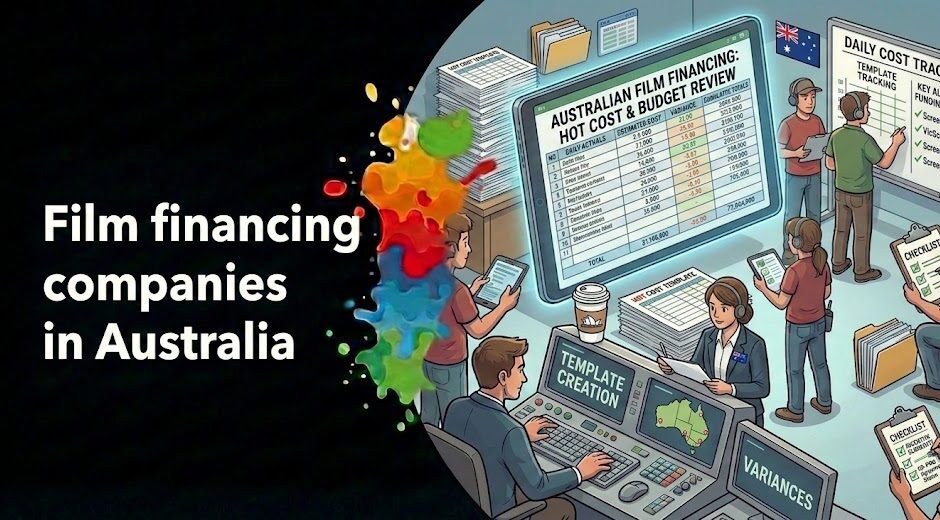
Film financing companies in Australia are operating inside one of the most attractive incentive environments on the planet right now. The federal Location Offset jumped from 16.5% to 30% in July 2024—nearly doubling overnight—and when you stack Queensland’s 15% regional top-up or New South Wales’ 10% on top, you’re looking at combined rebates that rival anything in Europe. If you’re a producer hunting capital for an English-language project in 2026, Australia deserves serious attention on your capital stack.
But here’s the thing: knowing the incentives exist and knowing who actually writes the cheques are two very different problems. Government rebates don’t greenlight your film. The mix of government bodies, private equity funds, gap lenders, and international co-producers that make up Australia’s financing market—that’s what this guide maps out.
You’ll get a clear-eyed picture of the key players, how to structure a capital stack that actually closes, and where Vitrina’s 140,000+ company database cuts the search time from months to days. Let’s get into it.
In This Guide
- Why Australia’s Film Finance Market Is Winning in 2026
- Government-Backed Financing Bodies
- Private Film Financing Companies in Australia
- How to Structure a Complete Capital Stack
- Co-Production Treaties: Australia’s Cross-Border Edge
- What Lenders Actually Want in 2026
- How Vitrina Accelerates Your Finance Search
- FAQ
Find Australian Film Financing Partners in 48 Hours
Ask VIQI—Vitrina’s AI—to surface funding bodies, co-producers, and gap lenders active in Australia right now. Netflix, Warner Bros, Paramount and 140,000+ companies already on the platform.
200 free credits · No credit card required
Why Australia’s Film Finance Market Is Winning in 2026
Australia’s incentive overhaul wasn’t cosmetic. When Canberra doubled the Location Offset to 30% in mid-2024, it sent an unambiguous signal: Australia is competing aggressively for international production spend. The numbers back that up—productions like the Thor franchise and multiple Disney+ series filmed in Sydney and Queensland demonstrated that Australian crews and facilities punch well above their weight globally.
And there are four structural advantages that don’t show up in the headline rebate rate:
- English-language friendly — no dubbing costs, no language barrier for US/UK co-productions
- Stackable regional incentives — combine federal offsets with state top-ups for effective rebates of 40–45%
- Mature crew base — Sydney, Melbourne, and the Gold Coast all have deep talent pools that don’t require extensive overseas hires
- Strong VFX capabilities — Australian VFX companies have worked on global tentpoles and qualify for the 30% PDV Offset
The Fragmentation Paradox™ is real here, too—Australia’s financing market involves federal bodies, six distinct state/territory agencies, private equity funds, international gap lenders, and broadcaster presales. Knowing which lever to pull first is what separates deals that close from projects that stall in development.
For more on Australian VFX capabilities and their relationship to the PDV Offset, check out Vitrina’s guide to top VFX companies in Australia 2025.
Government-Backed Film Financing Bodies in Australia
Most Australian features start here. Government money isn’t always the biggest piece of the capital stack—but it’s often the piece that de-risks the project enough to attract private capital.
Screen Australia
Screen Australia is the federal government’s primary funding body—and the competent authority for co-production treaty applications. For domestic productions, it offers development funding, production investment, and the Producer Offset administration (the 40% cash rebate for theatrical features). Its slate investment model means it takes equity positions in projects rather than providing straight loans, so expect to share upside.
Screen Australia also runs story development programs and has partnerships with international broadcasters including the BBC and Netflix. Getting Screen Australia attached early sends a signal to private investors—it’s the equivalent of a credibility stamp before it hits the trades.
State Screen Agencies
Don’t sleep on state bodies. They move faster than federal funding rounds and their incentives stack directly on top of federal offsets:
- Create NSW (Screen NSW) — 10% uplift for productions filming in New South Wales; also offers development and attraction funds for international productions committing to Sydney or regional NSW
- Film Victoria / Creative Victoria — 10% regional incentive with production attraction programs for Melbourne; strong post-production and animation cluster
- Screen Queensland — 15% Production Attraction Strategy, Queensland’s highest state rate; Village Roadshow Studios on the Gold Coast is one of the largest studio complexes in the Southern Hemisphere
- South Australian Film Corporation (SAFC) — 10% rebate plus development funding; SAFC has a strong track record backing Australian genre and drama projects
- Screenwest (Western Australia) — WA recently launched a 20% post-production incentive targeting VFX and finishing work
The strategic play: film principal photography in Queensland (15% state + 30% federal Location Offset = 45% combined) and finish post in WA (20% PDV). That’s a capital efficiency play most European jurisdictions can’t match.
Track 400,000+ Projects & Find Your Australian Co-Producers
Vitrina’s platform maps active productions, funding bodies, and co-production partners across Australia and 100+ countries. Join the producers, distributors, and financiers already using it.
No credit card required · Cancel anytime
Private Film Financing Companies in Australia 2026
Government money covers part of the capital stack. The rest comes from private financiers—and Australia has a growing pool of them, from local equity funds to international gap lenders with established Australian relationships.
Arclight Films
Arclight Films is an Australian-founded international sales and production financing company with a long track record across genre films and commercial action features. They operate at the intersection of presales and co-production—acquiring international territories while sometimes providing production financing against their own sales estimates. For producers targeting Asia-Pacific distribution alongside Western territories, Arclight is a natural first call.
Fulcrum Media Finance
Fulcrum Media Finance provides production lending against tax incentives and presales for Australian and international productions shooting in Australia. Their model is debt-based—lending against confirmed receivables rather than taking equity—which means faster deal execution and producers retain more upside. They’re particularly active in mid-budget features and high-end television in the AUD $5M–$30M range.
Transmission Films
Transmission Films is Australia’s most prominent independent theatrical distributor—and occasionally a financing partner through minimum guarantee advances. An MG from Transmission for Australian theatrical rights can anchor your domestic territory presale and unlock gap financing from international lenders who need to see domestic coverage confirmed.
International Gap Lenders (Active in Australia)
Australia’s mature incentive framework has attracted dedicated attention from international gap lenders. As Joshua Harris (President, Peachtree Media Partners) explains, his firm lends against film IP and confirmed receivables—including tax incentives—and will advance against future territory value before distribution deals are fully executed. Australia’s bankable Producer Offset and Location Offset make it one of the cleaner collateral positions for lenders like Peachtree.
Similarly, Phil Hunt (CEO, Head Gear Films)—one of the UK’s most active film financiers—has noted the structural shift in the independent market: presales have weakened globally, and tax incentive-backed lending has become the more predictable anchor for gap deals. Australia’s upgraded Location Offset arrived at precisely the right moment to capitalize on that trend. You can explore Australia’s position in the broader APAC financing context through Vitrina’s comprehensive guide to APAC film financing agencies.
Phil Hunt (CEO, Head Gear Films) discusses the structural shift in independent film financing—why tax incentive-backed deals have become the dominant structure and what lenders actually require before committing capital:

How to Structure a Complete Australian Capital Stack
Here’s what a realistic capital stack looks like for a AUD $10M feature shooting in Queensland with Australian content qualification:
| Source | Type | % of Budget |
|---|---|---|
| Producer Offset (federal) | Cash rebate | 40% |
| Screen Queensland attraction fund | State incentive | 15% |
| Screen Australia equity investment | Equity | 10–15% |
| International presales / MGs | Presales | 20–25% |
| Gap financing (international lender) | Debt | 10–15% |
| Private equity (domestic/international) | Equity | 5–10% |
The real insight here? The Producer Offset at 40% is doing most of the heavy lifting. When you can show a gap lender that 40 cents of every dollar comes back as a confirmed government receivable—audited, bankable, predictable—you’ve de-risked their position considerably. That changes the terms they’ll offer.
For a deeper look at how to navigate presale structures alongside incentive stacking, Vitrina’s 2024 Australian film financing overview covers the deal structures in detail.
Co-Production Treaties: Australia’s Cross-Border Finance Edge
Australia has active official co-production treaties with the UK, Canada, France, Germany, Italy, Israel, and several other countries. What this means in practice: a qualifying co-production can access incentives in both countries simultaneously. A UK-Australia co-production, for instance, can draw on Australia’s 40% Producer Offset and the UK’s 25% cash rebate—stacking incentives across two jurisdictions from a single project.
Screen Australia is the competent authority for treaty applications—they need to be approached at least 4 weeks before principal photography, with provisional approval ideally secured at the development stage. Don’t leave this until production commences.
The APAC angle is growing fast too. Australia-Asia co-production partnerships—particularly with South Korea and Singapore—are accelerating as streamers including Netflix continue heavy investment in APAC originals. An English-language Australian project with Asian creative elements can access both markets’ incentive programs while positioning for regional streaming acquisition. For more on co-production structuring, see Vitrina’s guide to global co-production partnerships.
Need Help Navigating Australian Film Finance?
Vitrina’s Concierge team works directly with producers to identify the right combination of Screen Australia, state bodies, and private capital for your project. Netflix, Paramount, Warner Bros and global co-producers use Vitrina to connect.
No commitment · Expert guidance for your project
What Film Financing Companies in Australia Actually Want in 2026
What the trades don’t always report clearly: the standards Australian lenders and equity investors apply haven’t softened despite the improved incentive environment. They’ve gotten sharper. Here’s what’s actually moving deals in 2026:
60–70% of your budget confirmed before you approach gap lenders. The Producer Offset and state incentives count as confirmed once approved—so a well-structured project can hit this threshold with government money alone, which is unusual globally. But you still need the package: director attached, key cast locked, production company with a track record.
A reputable sales agent is non-negotiable for gap financing. Australian gap lenders—and international lenders financing Australian-incentivised projects—require sales estimates from a recognised agent with a proven track record. Sales estimates need to be 1.5–2x the gap amount. First-time producers working with unknown sales agents will struggle here regardless of the incentive rate. According to Variety, the shift away from presales globally has made lender confidence in sales agent track records even more critical.
Completion bond in place. Standard requirement. Budget 3–6% of production costs for this—it’s not optional if you’re approaching any institutional lender. Deadline has covered several high-profile productions that lost financing at late stages due to bond complications; don’t let paperwork derail a closed deal.
Commercial genre with international appeal. Action, thriller, horror, and sci-fi close faster in Australia than character-driven domestic drama—not because Australian drama is weak, but because gap lenders are underwriting international territory value. The waterfall math works differently for a genre film with clear foreign sales versus a prestige local drama that depends on domestic theatrical performance.
How Vitrina Accelerates Your Australian Film Finance Search
The capital reality in 2026: finding the right combination of funders for an Australian project requires navigating federal bodies, six state agencies, private equity, international gap lenders, broadcaster presales, and potential co-production treaty partners simultaneously. That’s not a research problem you solve with a Google search.
Vitrina’s platform indexes 140,000+ companies and 400,000+ projects across the global entertainment supply chain—including active financing companies in Australia, APAC co-production partners, and international gap lenders with established Australian incentive expertise. You can filter by budget range, territory, content type, and current production stage.
But here’s where it gets tactical: VIQI, Vitrina’s AI, can surface the specific combination of funders most relevant to your project’s genre, budget, and timeline in a single conversation. Producers have identified qualifying Australian co-production partners in under 48 hours using the platform. That’s not a workflow improvement—it’s a structural advantage in a market where timing determines which deals get the call.
For a deeper dive into how to track Australian productions and find the right production partners, see Vitrina’s guide to tracking top producers in Australia on the platform.
Frequently Asked Questions
What is the Australian Producer Offset and who qualifies?
The Producer Offset is a 40% cash rebate (for theatrical features) and 20% (for television) available to Australian productions that meet the “significant Australian content” test administered by Screen Australia. It applies to qualifying production expenditure incurred in Australia and is paid as a refundable tax offset after the production delivers and an audit is completed. International productions filming in Australia under a service arrangement don’t qualify for the Producer Offset—they use the Location Offset instead.
What is the Location Offset and how much is it in 2026?
The Location Offset provides a 30% cash rebate on qualifying Australian production expenditure for international productions that choose to film in Australia. It was increased from 16.5% in July 2024—nearly doubling the effective incentive for inbound productions. The Location Offset targets Hollywood and European studios, streaming platforms, and international co-productions. State top-ups from Queensland (15%), New South Wales (10%), Victoria (10%), and South Australia (10%) can stack on top, pushing combined effective rates toward 40–45%.
Can Australian film financing companies fund international co-productions?
Yes—and this is one of the most underutilised structures in the market. Australia has official co-production treaties with the UK, Canada, France, Germany, Italy, Israel, and others. A qualifying co-production can draw on incentives in both countries. Screen Australia administers treaty applications and needs to be engaged early—provisional approval should be in place before principal photography. The practical implication: an Australia-UK co-production can access Australia’s 40% Producer Offset alongside the UK’s 25% cash rebate from the same project budget.
How do film financing companies in Australia approach gap financing?
Gap financing in Australia works similarly to international markets—lenders advance against unsold territorial rights, typically covering 10–30% of the production budget. Australia’s bankable Producer Offset and Location Offset are strong collateral because they’re government-backed receivables. Lenders typically require 60–80% of the budget already confirmed, a reputable sales agent with estimates 1.5–2x the gap amount, and a completion bond. The incentive environment post-2024 has made Australian projects more attractive to international gap lenders specifically because the incentive receivable is large and predictable.
What is the PDV Offset and who is it for?
The PDV (Post, Digital, and Visual Effects) Offset provides a 30% cash rebate specifically for post-production, digital, and visual effects work completed in Australia—even if the principal photography occurred elsewhere. This means international productions that shot overseas can still access Australian incentives if they bring their VFX and post work to Australian studios. Western Australia also launched a separate 20% post-production incentive targeting this same pipeline, giving Australian VFX companies a compelling pitch to international productions.
Which state offers the best film financing incentives in Australia?
Queensland currently offers the highest state-level production incentive at 15% through the Screen Queensland Production Attraction Strategy—the most competitive state rate in Australia. Combined with the federal Location Offset (30%), productions filming on the Gold Coast or in Brisbane can access a combined rebate approaching 45% of qualifying spend. New South Wales (10%), Victoria (10%), and South Australia (10%) offer lower state rates but have their own advantages—NSW has Sydney’s infrastructure and talent depth, Victoria has a strong animation and post cluster, and South Australia has a long track record with genre and drama production.
How does Vitrina help producers find film financing companies in Australia?
Vitrina’s platform indexes over 140,000 companies and 400,000+ projects across the global entertainment industry. Producers can filter by financing type, territory, budget range, and production stage to identify active Australian funding bodies, private equity investors, co-production partners, and international gap lenders with Australian expertise. VIQI—Vitrina’s AI assistant—can surface the most relevant financing options for a specific project’s profile in a single conversation. Access starts with 200 free credits and no credit card required at app.vitrina.ai.
Conclusion: Australia’s Film Finance Window Is Open—But Timing Still Matters
The 2024 Location Offset increase wasn’t a minor tweak—it repositioned Australia as a genuine competitor for international production spend at the highest level. Combined with the 40% Producer Offset, stackable state incentives, and a maturing private financing ecosystem, you’ve got a market where the structural fundamentals are genuinely strong.
But strong fundamentals don’t close deals. The producers who move fastest in 2026 will be the ones who’ve already mapped the full capital stack—federal, state, private, and international—before they’re in the room. That’s not a research task you want to be doing reactively.
Key takeaways:
- Australia’s incentives are among the most competitive globally: The 30% Location Offset (up from 16.5% in 2024), 40% Producer Offset, and 30% PDV Offset—plus stackable state top-ups—create effective rebates of 40–45% in the best-case structure.
- Government bodies start the stack, private capital closes it: Screen Australia, Screen Queensland, Create NSW, Film Victoria, SAFC, and Screenwest provide the foundation; international gap lenders and equity funds complete it.
- Co-production treaties multiply your options: Australia’s treaties with the UK, Canada, France, Germany and others allow you to stack incentives across jurisdictions from a single project—one of the most powerful structures in international film finance.
- Lenders’ standards haven’t softened: 60–70% confirmed budget, reputable sales agent, bankable package, and completion bond remain non-negotiable regardless of the incentive environment.
- Vitrina cuts the search time dramatically: Mapping 140,000+ financing companies, 400,000+ projects, and co-production partners across Australia and 100+ countries—what used to take months now takes hours.
Start Mapping Your Australian Capital Stack Today
Access 140,000+ film financing companies, Australian government bodies, and international co-production partners. Join producers from Netflix, Warner Bros, Paramount and 140,000+ entertainment companies already on Vitrina.
No credit card required · Cancel anytime
Need a Dedicated Finance Specialist?
Vitrina’s Concierge service provides hands-on support for producers navigating complex Australian financing structures—co-production treaty applications, incentive stacking, and partner identification.
Find Film+TV Projects, Partners, and Deals – Fast.
VIQI matches you with the right financiers, producers, streamers, and buyers – globally.
Join Industry Briefings Trusted by Leaders
Film & TV Production Financing: 2026 Trends
Production financing conditions are changing quickly. Understanding where money is moving and what buyers are backing is key to getting projects approved and funded in 2026.
Unreleased Film+TV Projects: Opportunities & Showcase
A curated view of unreleased Film and TV projects open for financing and collaboration
The Mid-Budget Comeback: Why Mid-Budget Films Is the Smartest Bet in the Room
Mid-budget films are attracting new capital. See why this segment is becoming one of the strongest bets in Film today.
Franchise Fatigue vs. IP Dependency: What Studios Should Be Betting On Now
s franchise performance softens, where will the next generation of valuable IP come from? Join the briefing.