About Innovation Hub
 Global Content Pulse (Webinars)


 Global Production Financing
(Webinars)
Global Production Financing
(Webinars)  LeaderSpeak Podcast
  Global Entertainment Digest (Newsletter)
  About Vitrina
 About VIQI
 Our Story
 Our Solutions 🔥
 Film+TV Projects Tracker 🚀
 Case Studies
 Our Profile
Summary: Securing an independent film greenlight in today’s highly scrutinized financial landscape is zero-sum. For independent producers navigating complex capital stacks, the completion bond in film isn’t a premium insurance luxury—it’s the non-negotiable legal mechanism that unlocks senior debt, shields investors from ruinous cost overruns, and turns a fragile package into an operational reality.
In this guide: How completion guarantees insulate senior lenders from production defaults, the precise metrics behind calculating a project’s strike price, and the exact underwriting criteria independent producers must satisfy to secure bonding before physical production begins.
You’ve attached a bankable director. You’ve fought for weeks at markets like Cannes or the European Film Market to lock in your lead attachments. The script is tight, and your local tax credits are provisionally approved. Yet, your senior lenders and equity financiers won’t advance a single dollar of cash to your production special purpose vehicle (SPV). Sound familiar? That’s the cold reality of independent packaging before a completion bond in film is underwritten.
Here’s the thing: financiers aren’t evaluating your creative ambition—they are mitigating default exposure. Without a structural guarantee that physical delivery will occur exactly to technical specifications, your finance plan remains theoretical paperwork. Lenders refuse to take the single biggest operational risk in media finance—the risk that a production simply runs out of money and stalls midway.
This structural guide strips away the industry fluff to explain how a completion bond in film functions under current market mandates. We’ll look at the exact pricing frameworks, due diligence benchmarks, and operational takeaways you need to navigate these agreements successfully. Let’s de-risk the capital stack.
Table of Contents
- Understanding Completion Bonds and Lender Protections
- The Four Layers of Protection in a Completion Guarantee
- Calculating the Strike Price and True Underwriting Costs
- Navigating the Guarantor’s Underwriting Protocol
- Operational Reality and Set Management Takeovers
- How Vitrina Helps with Completion Bond Planning
- Conclusion
- Frequently Asked Questions (FAQ)
1. Understanding Completion Bonds and Lender Protections
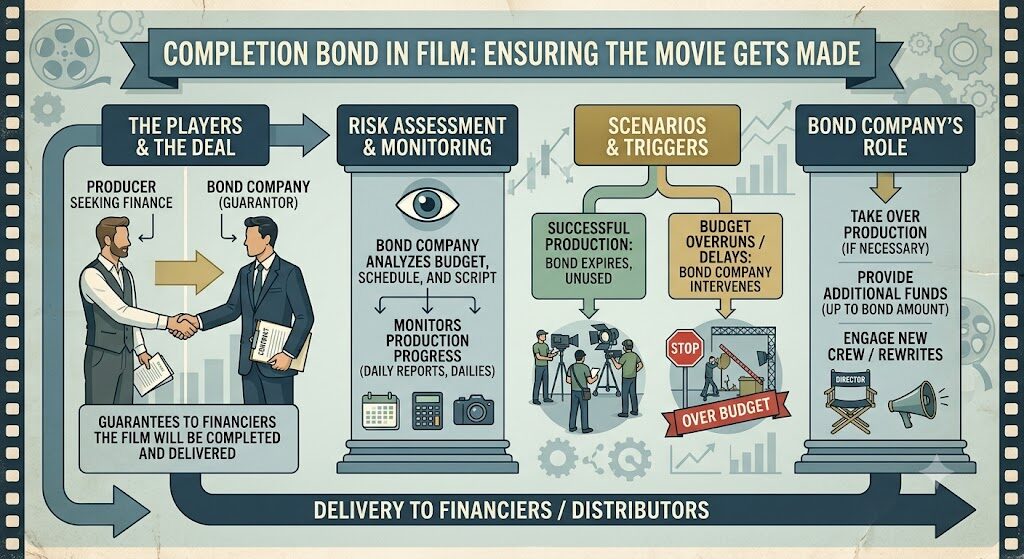
A completion bond in film is a specialized financial instrument issued by a completion guarantor that legally ensures a film production will be completed, delivered on time, and finished within budget to pre-determined delivery specs. Think of it as institutional collateral for your lenders. If the physical production goes over budget or is struck down by severe cost crises, the bond company steps in to either provide the excess capital or, in worst-case scenarios, repay the lenders’ committed capital stack entirely.
But let’s be honest about what this is not: a completion bond does not guarantee commercial success, high box office numbers, or streaming audience metrics. It’s strictly focused on physical delivery. For independent producers pitching to institutional debt financiers like Peachtree Media Partners or specialized film groups, moving capital without this protection is completely out of the question.
The structural rationale? Look at the regional landscape. According to analysis from unreleased production benchmarks, nearly 50% of unbonded independent films that enter active physical production globally stall out completely before post-production wraps up. Cash positions dry up midway through the shooting schedule, leaving financiers stuck with useless, unfinished digital assets that can’t be sold. The completion bond solves this by transferring total project completion risk from the bank to a commercial insurer.
2. The Four Layers of Protection in a Completion Guarantee
To write a clean finance plan, independent producers must grasp that a standard completion guarantee operates across a progressive hierarchy of operational remedies. The guarantor doesn’t simply cut a generic check when things go wrong on set—they step in structurally to save the asset. This hierarchy relies on four specific legal layers designed to protect the capital deployment window.
Layer 1: Guaranteed Technical Delivery. The baseline promise ensures that the film is wrapped and delivered in strict compliance with the pre-approved screenplay, shooting schedule, and delivery specs. Lenders gain peace of mind knowing the asset will reach its domestic and international distribution windows on time.
Layer 2: Production Management Takeover. If a filmmaker goes rogue, or the daily production reports reveal systemic cost overruns that threaten the budget stack, the guarantor has the contractual right to assume management control. They can pull the director out of the editing suite, replace key crew heads, or rewrite the remaining shooting schedule to protect the cash line.
Layer 3: Excess Cost Overrun Financing. When unavoidable crises strike—such as sudden weather delays, heatwaves, or talent illnesses—the completion guarantor covers the additional funds required to complete and deliver the picture. Lenders don’t suffer dilution, and independent producers aren’t forced to scramble for high-interest emergency gap facilities.
Layer 4: Financial Repayment / Abandonment. If the project hits a true catastrophe and can no longer be completed despite direct intervention, the guarantor exercises the final remedy: they step in to fully repay the lenders’ committed capital. This complete credit backstop makes your film project package bankable.
3. Calculating the Strike Price and True Underwriting Costs
Behind closed doors, the conversation between your line producer and the completion guarantor always centers on the “strike price” (sometimes labeled the production price). This is the absolute dollar amount that the completion guarantor determines is mandatory to safely finalize and deliver the project. Before a completion bond in film becomes active, the producer must prove that 100% of this strike price is fully secured and available in the production account.
The strike price calculation isn’t a single line item; it’s a sophisticated grouping of four primary production factors:
- The Production Core: All qualifying above-the-line and below-the-line production expenses, including labor, fringes, physical locations, and essential production insurance.
- Financing and Carrying Costs: Accumulated interest on your senior bank debt, legal fees, and loan origination fees that impact the cash pipeline across the production calendar.
- The Contingency Allowance: A separate financial cushion, historically calculated up to 10% of the production budget, set aside specifically for unexpected overruns.
- The Guarantor Fee: The premium charged by the bond company to underwrite the project’s risk profile.
Let’s map out the actual market fees. For a standard independent film project operating inside typical commercial underwriting parameters, the upfront premium scales dynamically based on total budget exposure:
| Production Budget Tier | Typical Premium Fee | Estimated Out-of-Pocket Floor |
|---|---|---|
| Under $1,000,000 | 3% – 5% of total budget | $30,000 – $50,000 |
| $1,000,000 – $10,000,000 | 2% – 3% of total budget | $50,000 – $200,000 |
| Above $10,000,000 | 1% – 2% of total budget | $200,000+ |
Worth noting: under official industry risk frameworks, both the completion bond premium and your built-in production contingency fund are excluded from qualifying base metrics. This allows producers to protect their budgets without accidentally triggering more restrictive financial thresholds.
4. Navigating the Guarantor’s Underwriting Protocol
Independent producers often view bond underwriters as cold critics trying to puncture their creative vision. But that’s the wrong perspective. Guarantors act as highly specialized risk analysts across four distinct operational pillars: physical production, digital workflow technology, legal chain of title, and financial accounting controls. To secure an institutional guarantee from market leaders like Film Finances Inc. (FFI) or Media Guarantors, your package must withstand rigorous cross-examination.
The due diligence pipeline requires a comprehensive delivery package before underwriting terms are issued:
- Locked Script and Final Screenplay: No more loose changes sketched on napkins. The screenplay must be locked and completely realistic relative to your budget line items.
- Granular Line-Item Budget: Wishful estimates are out. Underwriters track every line item against historical costs, ensuring you aren’t underpricing location fees or post-production delivery.
- Realistic Shooting Schedule: The schedule must specify exactly how many pages are being shot per day, featuring honest allowances for weather contingency buffers.
- Key Personnel Track Record: Underwriters closely evaluate the professional credits of your line producer, director, and unit production manager (UPM). First-time directors are heavily audited.
- Verified Financing Commitments: Signed equity agreements, executed pre-sale contracts, and locked tax incentives. Vaporware doesn’t pass the check.
And timing is everything. Do not expect to close a bond in 48 hours. The comprehensive due diligence process typically takes two to three months from initial submission to final contract execution. Smart producers initiate this conversation alongside their sales agents while structures are still fluid, long before principal photography cameras roll.
5. Operational Reality and Set Management Takeovers
The moment a completion bond in film is signed, the legal power dynamic on your set transforms overnight. Independent producers often forget that the guarantor holds immense contractual authority, overriding the creative choices of directors or production labels when budgets face existential risk. If the daily call sheets and financial cost reports point toward a cost overrun crisis, the bond company can step in instantly.
This intervention capability isn’t a passive policy—it’s active, operational oversight. Throughout production, representatives from the bond company monitor progress via daily logs, cost reviews, and unannounced set visits. If the shoot falls three days behind schedule, they have the contractual leverage to enforce script cuts, eliminate complex stunt sequences, or terminate non-essential visual effects workflows to keep the package under the strike price.
The takeaway for independent producers? Maintaining total transparent communication with your guarantor is your best defense against a sudden takeover. Treat the bond company as an institutional partner. Surfacing problems early—rather than hiding overruns until post-production begins—ensures you retain creative control over the final cut while satisfying the lenders’ delivery requirements.
6. How Vitrina Helps with Completion Bond Planning
Finding the right financial layer for an independent package requires precise data alignment. You can’t navigate the capital stack by relying on outdated contact directories or festival networking alone. Vitrina streamlines this journey by mapping out active global markets, verified financiers, and supply chain partners across a single intelligence operating layer.
- Database Access: Identify over 140,000 vetted production service providers, lenders, and financiers specializing in your target territories.
- Strategic Research: Use VIQI, Vitrina’s vertical AI, to query institutional parameters, regional fund cycles, and specific lending requirements.
- Frictionless Execution: Build outbound pipeline sequences or utilize the Vitrina Concierge team to secure introductions to qualified debt underwriters.
Conclusion
The modern independent film landscape is highly competitive, and lenders will not back projects built on loose projections or creative optimism alone. A completion bond in film remains the ultimate mechanism to de-risk production finance, reassuring senior debt holders and equity partners that physical delivery is legally guaranteed.
By understanding how the strike price is built, budgeting an honest 10% contingency, and initiating your underwriting due diligence early, you protect both your budget stack and your creative control. Do not wait until you’re weeks away from principal photography to approach guarantors. Build a bondable package from day one to ensure your project successfully transitions from script to screen.
- Lenders Stand Firm: Specialty senior debt institutions will not deploy capital into independent film SPVs without a completion guarantee in place.
- Pricing Realities: Anticipate a standard premium fee of 2% to 3% for mid-tier indie features, ensuring these out-of-pocket tracking costs are accounted for in your finance models.
- Due Diligence Timelines: Budget a clean two to three months to fully navigate a guarantor’s physical, legal, and financial audit pipeline before bond issuance.
- Creative Safeguards: Prevent sudden production management takeovers by maintaining strict transparency in your daily cost and schedule reporting.
Questions producers and executives are asking
If my independent film’s budget falls below $5 million, can I still get a stand-alone completion bond from top guarantors?
It is increasingly difficult. In the current market, stand-alone bonding for projects under the $5 million mark faces tight structural limits, as the minimum fee structures often make the underwriting process economically unviable for major providers. For smaller tiers, lenders may require alternative collateral or direct personal backstops.
What happens to our provisionally approved regional tax credits if the bond company takes over production?
The guarantor’s legal team will step in to closely maintain compliance rules, ensuring that any management shift or crew replacement doesn’t accidentally breach local qualifying spend thresholds or lose cultural certification parameters required to collect the rebate.
Does production insurance replace the need for a completion bond in film?
Absolutely not. Standard production insurance covers specific, isolated perils like weather disruptions, equipment theft, or cast medical issues. Only the completion bond structurally guarantees overall physical delivery of the finished project to its buyers, or cash repayment to the lenders if things collapse entirely.
Frequently Asked Questions (FAQ)
What is a completion bond in film?
A completion bond in film is a specialized insurance guarantee issued by a third-party guarantor that promises banks and equity financiers that a film will be completed, kept on schedule, and delivered according to pre-approved script and technical specifications. If the project is abandoned or runs out of money, the guarantor covers overruns or repays investors.
How much does a completion bond cost?
The upfront premium fee for a completion bond typically ranges from 2% to 3% of the total production budget for standard independent films in the $1 million to $10 million tier. Budgets exceeding $10 million can scale down to 1% to 2%, while micro-budget titles face higher percentages or fixed minimum floors.
Who pays for the completion bond in film production?
The independent producer covers the bond fee, factoring the out-of-pocket tracking cost directly into the overall production budget. Lenders typically withhold the premium cost from their initial financing advance to ensure the guarantor is paid before cameras roll.
Can a guarantor shut down or change my film’s director?
Yes. Under the contractual terms of a completion guarantee, the guarantor maintains the explicit legal right to take over the management of a production if serious schedule delays or budget overruns threaten delivery. This includes replacing the director or crew heads.
What documentation is required to underwrite a film bond?
Producers must submit a locked script, a line-by-line production budget, a detailed daily shooting schedule, track record bios of key crew heads, and executed financing proofs confirming that the strike price is fully covered.
How long does the bond application process take?
The complete due diligence pipeline typically requires two to three months from initial packager outreach to final contract execution. This timeline depends strictly on how clean and complete your financial and legal documentation is upon review.