IHUB
IHUB
 Private Briefings (Webinars)


 LeaderSpeak Podcast
  Global Entertainment Digest (Newsletter)
  About Vitrina
 About VIQI
 Our Story
 Our Solutions 🔥
 Film+TV Projects Tracker 🚀
Author: By Kunal Barai
Kunal Barai leads Global Markets at Vitrina.AI, working with producers and financiers across 100+ countries to facilitate content financing and co-production matchmaking. He recently hosted a roundtable on AI for Film Financing at MIP London 2026. Earlier, he spent 12+ years at Nielsen/Gracenote and completed MIT Sloan’s executive program on AI strategy.
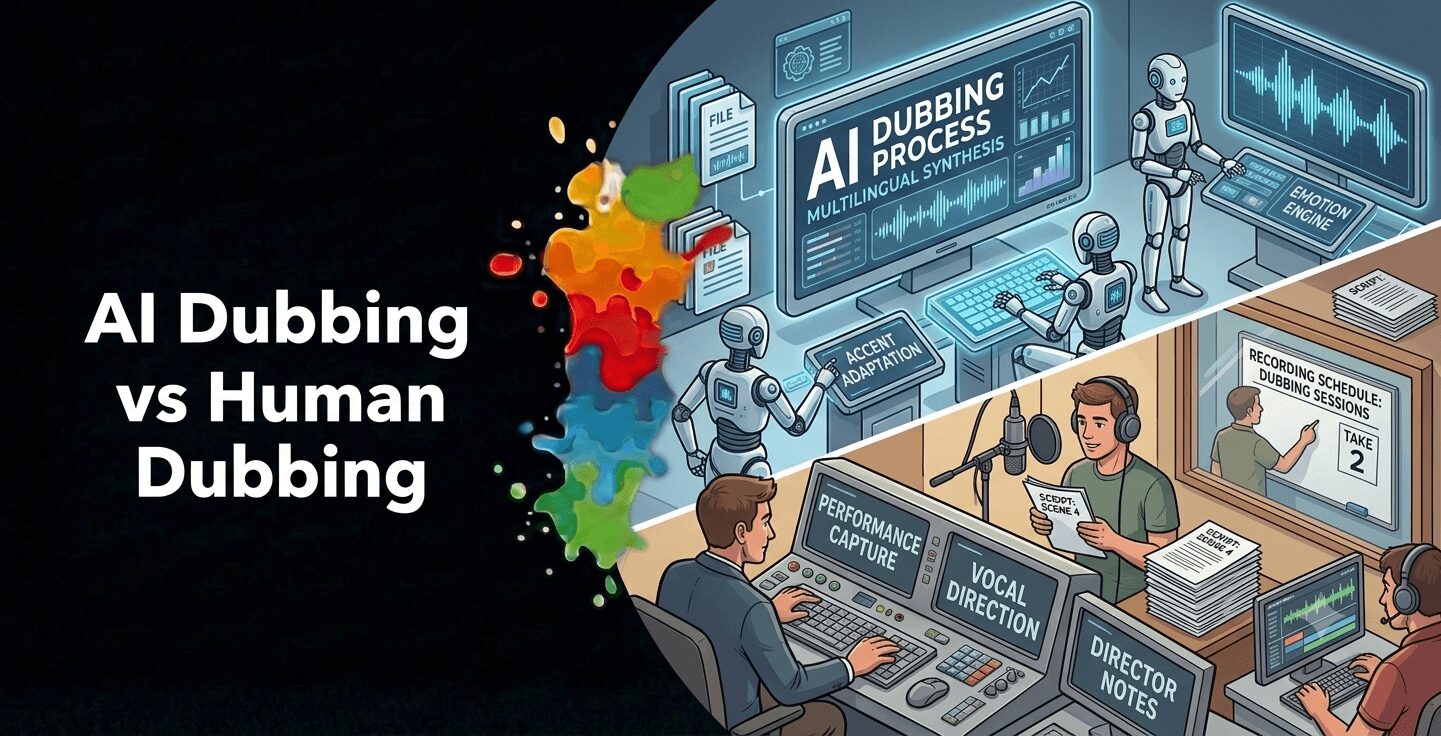
Summary: The localization bottleneck is officially broken, but the creative stakes have never been higher. As global streaming content spend crosses the $101 billion threshold, acquisitions and development executives face a structural choice: deploy AI dubbing for immediate library scale, or invest in traditional human dubbing to protect the emotional integrity of premium slates.
Behind closed doors, streaming executives aren’t debating whether to use artificial intelligence—they are calculating exactly where synthetic voices protect EBITDA and where they risk devaluing a multi-million dollar asset. The rapid globalization of digital media means a title released in Seoul must land in São Paulo simultaneously. But streaming audiences are highly sensitive to localization quality, and a subpar audio track can destroy an acquisition’s completion metrics within the first five minutes.
Based on Vitrina’s analysis of global localization data and platform operations, we have mapped the operational dividing line between AI dubbing and human artistry.
Table of Contents
The Economics of Scale: Cost and Speed Differentials
The financial reality of content localization has fundamentally changed. Traditional studio dubbing is sequentially structured and labor-intensive, pulling from a heavy stack of voice talent fees, director day-rates, studio rentals, and sound engineering hours. For a typical one-hour episode, professional human dubbing in a single language routinely commands between $5,000 and $15,000. If you are trying to unlock a multi-language rollout across European and Latin American territories, a single multi-season series can easily swallow hundreds of thousands of dollars before marketing expenses roll in.
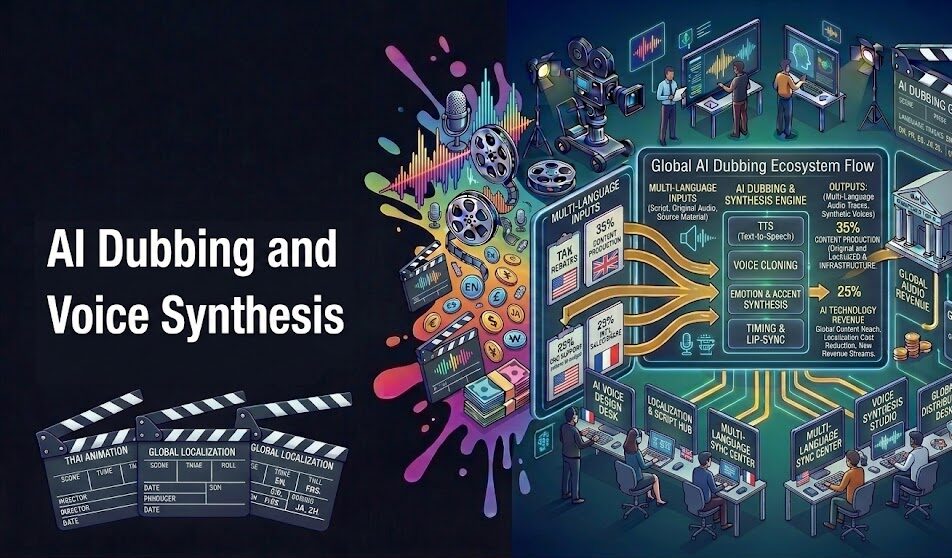
AI dubbing cuts through this legacy cost structure by eliminating the physical constraints of recording. Automated neural pipelines transcribe, translate, and synthesize speech concurrently. Instead of booking a physical space and coordinating talent schedules, cloud delivered platforms process multiple target languages simultaneously. The structural cost drops to $2 to $30 per minute, resulting in up to a 90% total budget reduction compared to the old model.
Time-to-market metrics show an even wider disparity. Traditional casting, recording, and manual mixing loops require weeks—sometimes months—per territory, creating extensive friction for global, same-day digital content releases. AI systems compress this timeline into minutes or hours. For acquisitions teams auditing massive back-catalog libraries, AI orchestration provides the only financially viable route to monetize thousands of hours of legacy content in secondary or tertiary markets.
The Quality Gap: Performance, Micro-Inflections, and Lip-Sync
But speed and cost-saving metrics mean nothing if viewer engagement drops off due to poor emotional resonance. This is where human dubbing maintains an ironclad defense. Acting requires creative judgment, subtext, and an innate understanding of cultural nuances that pure software struggles to interpret from a flat script. Professional voice actors deliver micro-inflections, calculated pauses, and improvisational changes that preserve character authenticity in high-stakes, performance-heavy storytelling.
AI voice realism has improved dramatically, utilizing voice cloning to analyze an actor’s original performance and recreate it fluidly in another language. Advanced neural networks can preserve the speaker’s original timbre and rhythm. Furthermore, 2026 platforms are integrating generative facial reconstruction via NeRFs (Neural Radiance Fields) to dynamically adjust an actor’s lip movements on screen to match the newly dubbed audio track.
Despite these technological leaps, synthetic voice generators still exhibit a subtle emotional compression. They can handle informational delivery flawlessly but often fail during intense dramatic peaks—such as scenes featuring crying, screaming, or rapid comedic timing. If a show’s success hinges on deep empathy or complex character interplay, relying purely on unassisted machine outputs introduces severe churn risk.
Strategic Framework: The Vitrina Localization Matrix™
To help streaming and development executives de-risk their localization pipelines, we have structured The Vitrina Localization Matrix™. This framework categorizes incoming content by asset value and performance complexity to determine the optimal deployment of capital.
The Vitrina Localization Matrix™
| Content Tier | Core Focus | Recommended Workflow | Target Metric |
|---|---|---|---|
| Tier 1: Premium Originals | High-stakes drama, prestige films, flagship series. | 100% Traditional Human Dubbing | Maximizing completion rates and award eligibility. |
| Tier 2: Mid-List Slates | Genre films, reality TV, procedurals, secondary markets. | Hybrid AI Orchestration (AI + Human QA) | Compressing time-to-market without margin erosion. |
| Tier 3: Volume & Library | Unreleased catalogs, documentaries, technical unscripted. | Automated AI Dubbing Pipeline | Unlocking long-tail library monetization at scale. |
Industry Implications: 3 Structural Conclusions for M&E Professionals
The polarization of localization workflows is driving a massive operational restructuring across global streaming systems. For development and technical executives, this evolution forces three clear conclusions:
1. Hybrid Orchestration is the New Operational Baseline
The choice is no longer binary. Savvy streaming platforms are increasingly standardizing a hybrid workflow: utilizing AI for the first-pass structural lift (transcription, machine translation, voice matching) and deploying human voice directors and linguists to polish cultural nuances and pacing. This hybrid approach gets you 80-90% of the way there instantly, slashing studio overhead while retaining a human quality-gate to de-risk localized dialogue.
2. Library Monetization Demands Automated Volume
The legacy model of choosing which library titles to localize based on prohibitive studio costs is officially obsolete. With global digital consumption rising, platforms can deploy fully automated AI dubbing pipelines to translate deep archives into underserved regional languages. At $2 to $30 per minute, titles that previously sat dark can be pushed into global catalogs, surfacing long-tail revenue with zero risk of upfront margin leakage.
3. Contractual Governance and Consent Take Center Stage
Weaponized distribution of synthesized content requires intense legal precision. The industry is rapidly pivoting toward strict ethical and transparent content creation practices. When deploying voice cloning or automated translation engines, securing explicit chain-of-title clearances and talent voice consent is a baseline corporate requirement. Executives must verify that their localized assets are processed through secure enterprise pipelines that guarantee data protection and avoid training public AI models.
Conclusion
The trajectory of global distribution proves that language is no longer an insurmountable barrier to content consumption—it is simply a software setting. Relying on legacy post-production timelines can cause you to miss tight market windows, allowing more agile platforms to capture immediate regional engagement. However, over-automating emotionally complex assets will backfire, leading to viewer drop-off on projects that require genuine human performance to succeed.
The real competitive advantage belongs to studios and streaming services that align their localization strategies with asset tiering. Protecting your margins on high-volume, informational slates through AI allows you to consolidate capital where it matters most: paying for premium human artistry on your flagship releases.
Frequently Asked Questions (FAQ)
What is the actual cost difference between AI dubbing and human dubbing?
AI dubbing generally costs between $2 and $30 per minute, eliminating legacy talent fees and studio overhead. Traditional human dubbing ranges from $50 to $200 per minute, or roughly $5,000 to $15,000 per hour for a single language track. AI orchestration can reduce localized delivery budgets by up to 90%, with marginal costs dropping further as additional target languages are processed concurrently through the automated pipeline.
How do turnaround timelines compare for global content rollouts?
AI dubbing pipelines compress post-production schedules from weeks or months down to minutes or hours, allowing for simultaneous, same-day global launches across dozens of territories. Traditional studio localization is sequential and constrained by human resources—requiring voice talent coordination, multi-day recording sessions, and extensive manual mixing for each specific market language track.
Can AI dubbing accurately match an original actor’s emotional delivery?
Not completely. While voice cloning technology successfully recreates an actor’s unique timbre and vocal identity across different languages, synthetic systems still face an emotional compression gap. High-intensity dramatic sequences—including crying, screaming, or rapid humor—lack the micro-inflections and subtle pauses that professional human actors use to establish an authentic audience connection.
What is a hybrid voice-over strategy and where should it be deployed?
A hybrid localization strategy pairs automated AI processing with human quality-gates. AI handles the first-pass transcription, translation, and synthetic voice generation, while human linguists and voice directors refine dialogue accuracy, pacing, and cultural sensitivity. This workflow is best suited for Tier 2 mid-list titles, procedural dramas, and reality TV, providing speed and cost efficiency without sacrificing creative credibility.
AI dubbing technology leverages machine learning, speech synthesis, and voice cloning to automate video localization pipelines. It reduces turnaround times from weeks to hours and slashes traditional studio recording costs by up to 90%, offering a highly scalable solution for global streaming platforms.
Key Stat
AI dubbing technology leverages machine learning, speech synthesis, and voice cloning to automate video localization pipelines. It reduces turnaround times from weeks to hours and slashes traditional studio recording costs by up to 90%, offering a highly scalable solution for glo
Key Stat
AI dubbing technology leverages machine learning, speech synthesis, and voice cloning to automate video localization pipelines. It reduces turnaround times from weeks to hours and slashes traditional studio recording costs by up to 90%, offering a highly scalable solution for glo
Key Stat
AI dubbing technology leverages machine learning, speech synthesis, and voice cloning to automate video localization pipelines. It reduces turnaround times from weeks to hours and slashes traditional studio recording costs by up to 90%, offering a highly scalable solution for glo
Traditional human dubbing utilizes professional voice actors, casting directors, and physical audio engineering environments. It remains the gold standard for high-stakes, emotionally rich storytelling because human performers capture subtle micro-inflections, cultural context, and script interpretations that software cannot replicate.
The optimal streaming strategy relies on programmatic asset tiering: deploying pure automated AI dubbing to monetize back-catalog libraries, standardizing hybrid AI orchestration with human reviews for mid-list titles, and reserving traditional dubbing to preserve the creative value of premium original content.