IHUB
IHUB
 Private Briefings (Webinars)


 LeaderSpeak Podcast
  Global Entertainment Digest (Newsletter)
  Premium Lists
 Membership Benefits
 About Vitrina
 Our Story
Author: By Kunal Barai
Kunal Barai leads Global Markets at Vitrina.AI, working with producers and financiers across 100+ countries to facilitate content financing and co-production matchmaking. He recently hosted a roundtable on AI for Film Financing at MIP London 2026. Earlier, he spent 12+ years at Nielsen/Gracenote and completed MIT Sloan’s executive program on AI strategy.
Navigating the modern entertainment supply chain requires a strict separation between deal flow discovery and structural liability de-risking. For producers navigating the complex global landscape of 2026, mistaking the role of an entertainment lawyer for that of a talent agent is an operational error that can paralyze packaging timelines and leak millions in downstream backend margins.
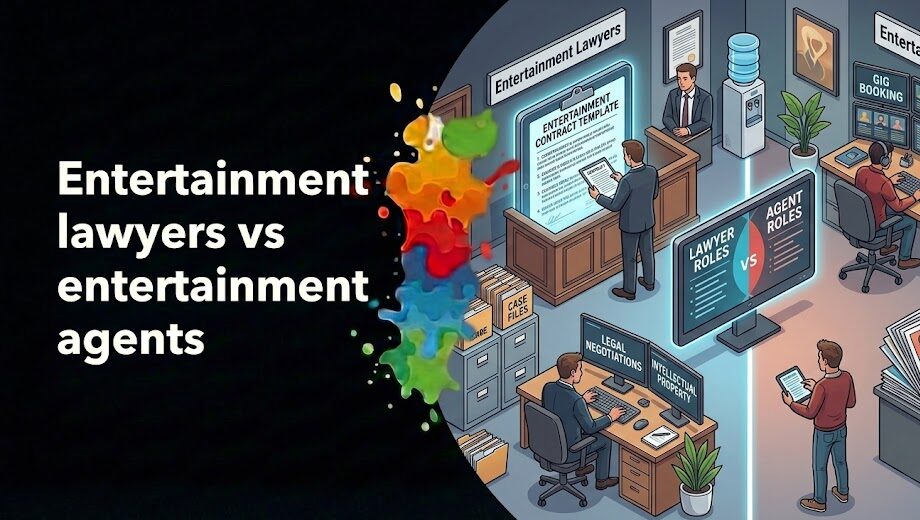
Behind closed doors, the line separating packaging from paperwork has blurred, yet the structural differences remain absolute. As an independent producer trying to close a greenlight, attach a bankable director, or secure equity and gap financing, you cannot treat your legal counsel and your talent representation as interchangeable resources. They serve entirely separate operational functions in your capital stack. An entertainment agent is a transaction engine; their focus is to uncover active market opportunities, create leverage, and attach talent to projects. An entertainment lawyer is a structural safeguard; their role is to protect intellectual property, build the clean chain of title required by completion bonds, and audit profit participation definitions.
The stakes have skyrocketed in 2026. The shift toward hybrid monetization models, international streaming mandates, and the emergence of government-backed production ecosystems has made corporate alignment more critical than ever. Relying solely on a traditional agent to review the financial realities of a complex multi-territory waterfall structure can leave your company exposed to severe margin leakage. Conversely, expecting a boutique law firm to source A-list talent without deep agency relationships ignores how premium deal flow is actually controlled.
To navigate the global film and TV landscape effectively, you must understand who to put in the room, exactly when to deploy them, and how their fee structures alter your production budget’s bottom line.
Table of Contents
The Operational Mandate of the Entertainment Agent
The core capability of an entertainment agency is the monetization of relationships through strategic attachments. In the film and TV ecosystem, top-tier global agencies—such as Creative Artists Agency (CAA), William Morris Endeavor (WME), and United Talent Agency (UTA)—generate over $4 billion in collective annual commission revenue by operating as the industry’s ultimate gatekeepers. If you are looking to attach an A-list actor or secure a pre-buy commitment from a major streaming platform, your primary path runs through a talent agent.
Agents understand current buyer preferences, shifting market trends, and immediate scheduling gaps before they ever hit the trades. They utilize this visibility to execute high-value attachments, bundling multiple agency clients—writers, directors, and lead performers—into a single, highly marketable package. While historical industry disputes with the Writers Guild shifted the mechanics of formal agency packaging fees, the fundamental leverage of aggregating talent remains the primary mechanism for moving projects from development to active pre-production.
However, an agent’s incentive structure introduces specific financial boundaries that independent producers must manage closely. Because agents operate primarily on a 10% commission model, they are inherently driven by deal execution and transaction volume. They are transaction-focused, meaning their financial performance is maximized when a deal closes quickly and at the highest possible headline number. While this drive is essential to generate production momentum, it means an agent may overlook granular legal pitfalls, complex intellectual property liabilities, or backend profit-participation metrics that directly affect your operating margin.
The Structural Safeguards of the Entertainment Lawyer
Entertainment lawyers enter the workflow to turn speculative deal points into rigid, enforceable contracts that protect your company from future liability. Unlike agents, entertainment attorneys are strictly bound by fiduciary duties that prevent them from taking conflicting financial positions across a deal. They do not hunt for gigs or pitch projects to broadcasters; instead, they focus on transaction drafting, regulatory compliance, and risk mitigation.
For independent studios, an entertainment lawyer frequently operates as production counsel, taking responsibility for the entire legal architecture of a film or television series. This responsbility includes papering corporate financing structures, drafting clear talent services agreements, and securing chain of title verification. Without clean chain of title documentation audited by a specialized lawyer, securing a completion bond or closing a gap debt facility is practically impossible. Legal decision-making in 2026 has transitioned to the front end of development due to evolving copyright regulations, digital replica consent laws, and strict international tax incentive compliance.
Lawyers typically charge via an hourly rate ranging from $400 to $900+ or take a flat 5% transactional fee on individual deal metrics. This model changes how they view a transaction. Because their compensation is not contingent on a quick close, an entertainment attorney has the flexibility to scrutinize indemnification clauses, force majeure provisions, and net profit definitions. They recognize that a deal with a massive headline number can still result in financial ruin if the backend waterfall structure allows the distribution platform to manipulate recoupment calculations.
The Vitrina Strategic Framework: Packaging vs. Protection Matrix™
To optimize your executive desk and manage transaction friction, Vitrina has developed the Packaging vs. Protection Matrix™. This framework defines exactly when to deploy each representative based on the maturity stage of your content slate.
| Production Stage | Primary Representative | Core Objective | Critical Risk Managed |
|---|---|---|---|
| IP Acquisition | Entertainment Lawyer | Option & Purchase Agreements | Chain of Title Contamination |
| Talent Attachment | Entertainment Agent | Securing A-List Commitments | Empty Pitch Rooms / Stale Packages |
| Financing & Gap Closing | Lawyer + Agent Blend | Structuring Capital Stacks | Intermediary Fee Overruns |
| Principal Photography | Entertainment Lawyer | Production Counsel Execution | Guild & Labor Non-Compliance |
Using this matrix allows producers to bypass the Fragmentation Paradox™—the systemic opacity where creators manually waste months filtering through thousands of unverified suppliers and legal frameworks without clear data context. By systematically matching the representative to the specific task, you ensure that high-priced legal hourly rates are never wasted on speculative networking, and fast-moving agency deals are never papered with dangerous legal gaps.
Industry Implications: Three Structural Conclusions
The global entertainment supply chain has grown highly complex, making old methods of informal deal-making obsolete. Independent producers face tight margins, meaning corporate efficiency must govern every negotiation.
1. Agents Open the Door, but Lawyers Build the Floor
An agent’s relationships are invaluable for getting your script onto the desk of a major streaming executive or attaching a bankable star. But remember: an agent’s email confirmation is not a binding contract. The deal is completely uninsurable until an entertainment attorney converts those basic deal points into a long-form contract that covers backend waterfalls, indemnification, and distribution windowing.
2. Fee Structures Dictate Representative Behavior
Because agents take a percentage of the deal, they are naturally incentivized to maximize the immediate, visible size of the acquisition or licensing fee. An independent studio, however, must focus on long-term EBITDA Protection™. Your lawyer’s hourly billing structure guarantees that they are looking for hidden costs, distribution overhead deductions, and gross corridor carveouts that an agent might gloss over in the interest of closing the deal.
3. Front-End legal Alignment Accelerates Recoupment
Waiting until post-production to hire an entertainment lawyer to fix your chain of title issues adds months of delay to your delivery timeline. By deploying production counsel early, you align your legal stack with international tax incentive frameworks and gap lending parameters right from the start. This structured planning directly results in Recoupment Acceleration™, compressing the timeline from project delivery to investor payout.
Conclusion
Independent production companies can no longer afford to operate using static, outdated relationship networks. In a landscape where global content spend is highly fragmented, understanding the exact boundaries between an agent’s packaging power and a lawyer’s protective counsel is a core business requirement. Balancing the 10% agency commission model with structural legal oversight is the only way to safeguard your company’s downstream revenues.
The producers who find consistent success do not treat transactional management as an afterthought. They recognize that leaving financial framing entirely to talent-focused representatives risks severe margin leakage before production even begins. By maintaining a clear operational loop between agents for project packaging and attorneys for corporate contract engineering, you position your slate to scale securely in a competitive international marketplace.
Frequently Asked Questions (FAQ)
How do the fee structures of entertainment lawyers and agents differ?
Agents operate strictly on a commission basis, taking exactly 10% of their client’s earnings from any deal they secure or package. Entertainment lawyers typically work on an hourly rate between $400 and $900+, or they may structure a transactional fee of 5% of the deal value, giving them a different financial alignment during negotiations.
Can an entertainment lawyer attach A-list talent to my film package?
While an entertainment attorney often maintains an extensive professional network of relationships within the industry, they do not pound the pavement to find or pitch talent for attachments. Securing commitments from premium actors, writers, and directors is the core mandate of a talent agent, who directly controls premium packaging deal flow.
What is production counsel, and when should a producer hire one?
Production counsel is an entertainment law firm or attorney hired by a production company to handle every single legal transaction on a film or TV show. This work includes papering financing stacks, tax incentive filings, location clearances, and cast/crew service agreements. You should retain production counsel during early development, well before principal photography begins.
Do agents or lawyers handle negotiations with global streaming platforms?
Both play critical, complementary roles. An entertainment agent generally initiates contact with the buyer, leverages market interest, and secures the headline pricing and distribution windows. An entertainment lawyer then steps in to negotiate the complex long-form licensing agreements, copyright provisions, and net profit definitions to ensure your backend margins are fully protected.