About Innovation Hub
 Global Content Pulse (Webinars)


 Global Production Financing
(Webinars)
Global Production Financing
(Webinars)  LeaderSpeak Podcast
  Global Entertainment Digest (Newsletter)
  About Vitrina
 About VIQI
 Our Story
 Our Solutions 🔥
 Film+TV Projects Tracker 🚀
 Case Studies
 Our Profile
Last Updated: April 2026 | Vitrina Editorial Team | Sandeep Nikanke
In This Guide
- What Makes Anime Movies Strategically Attractive
- How to Source Anime Movies Before They Hit the Open Market
- How Content Rights Work Across Territories
- Key Deal Structures for Licensing Anime Movies
- How Netflix, Crunchyroll & Regional Platforms Acquire
- What Buyers Should Know Before Pitching
- How Vitrina Accelerates Anime Movie Deal-Making
- Frequently Asked Questions
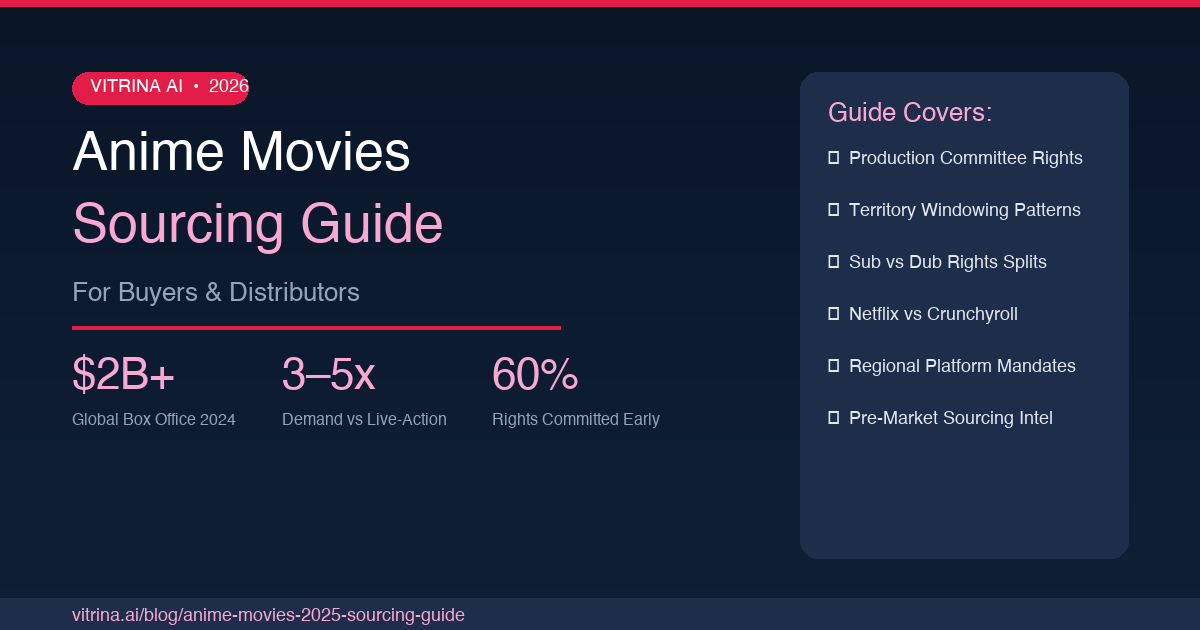
Anime films generated over $2 billion in global box office revenue in 2024, with titles like Dragon Ball Daima and the latest Haikyu!! feature driving record theatrical runs outside Japan (Anime News Network, 2025). Yet for buyers and distributors, the sourcing challenge has nothing to do with finding the titles. It’s about locating available rights, mapping territory windows, identifying the right counterparties, and moving before exclusivity is locked.
This guide is written for platform buyers, acquisition teams, and distribution executives who need a structured approach to sourcing anime movies, not a release calendar. We cover rights structure, deal mechanics, platform strategies, and where the real intelligence gaps are. For the full framework on how acquisition deals work at a market level, see our content acquisition guide for streamers and broadcasters.
Key Takeaways
- Anime films regularly generate $100M+ globally from franchise IP with built-in audience pull.
- Rights are controlled by production committees, not single studios, which complicates outreach.
- Territory windows vary widely: a title can be streaming in Japan while theatrical rights remain open elsewhere.
- Platforms like Netflix and Crunchyroll approach anime movies with very different mandate structures.
- Parrot Analytics data shows anime demand scores consistently outperform comparable live-action content by 2-4x in key markets (Parrot Analytics, 2025).
What Makes Anime Movies Strategically Attractive to Buyers and Distributors?
Anime movies offer measurable pre-existing demand, franchise-linked catalog depth, and event-level programming value — three qualities that make them commercially distinct from typical film acquisitions. According to Parrot Analytics, top-tier anime film franchises consistently show demand expressions 3–5x the global average for comparable feature films, with the gap widening in Southeast Asia, Latin America, and MENA over the last two years (Parrot Analytics, 2025).
The strategic case breaks down into three layers. First, franchise economics. A film tied to a running series or manga IP carries lower marketing cost because the audience already exists. Buyers don’t have to build awareness from scratch. Second, event-level programming. Theatrical anime releases, even limited ones, create cultural moments that drive social conversation and subscription intent. Platforms have found that day-and-date or near-theatrical streaming releases of anime films generate measurable new subscriber activity.
Third, and often underestimated, is library depth. An anime movie acquisition rarely arrives alone. It typically comes with related series, recap films, OVAs, or sequel commitments. For a platform building an anime strategy, a single film deal can anchor a multi-year content relationship. That’s a different ROI calculation than acquiring a standalone feature.
In our experience working with acquisition teams, the most overlooked value driver in anime film sourcing is the recap film market. Japanese studios frequently produce compilation films that repackage series content for theatrical release. These can be licensed at lower cost than original films while delivering outsized catalog utility, especially for platforms entering a franchise mid-cycle.
The broader market context supports the investment thesis. Anime’s share of the global SVOD content budget has grown from under 2% in 2019 to an estimated 6–8% in key platform categories by 2025, according to Ampere Analysis (Ampere Analysis, 2025). That shift reflects both audience pull and demonstrated retention value — platforms that built strong anime catalogs in 2020–2022 saw measurably lower churn among anime viewers compared to their general subscriber base. For acquisition teams building the business case internally, those retention metrics are often more persuasive than raw demand scores. The risk profile is also lower than many assume: franchise anime films with established audience bases behave more like catalog releases than new IP launches, with predictable opening demand and long tail streaming performance.
How Do You Source Anime Movies Before They Hit the Open Market?
Sourcing anime movies before open-market competition requires upstream intelligence — tracking production committee formations, studio slates, and theatrical announcements 6–12 months before rights are formally offered. A 2023 IFTA industry survey found that over 60% of international distribution deals for event-level anime titles are negotiated during pre-production or in the first month post-theatrical announcement (IFTA, 2023). By the time a title appears at MIP Markets or an AFM slate, the premium territories are often spoken for.
The practical implication is that sourcing anime movies requires upstream intelligence, not downstream discovery. Teams need to track production announcements, studio slates, and production committee formations before theatrical campaigns launch. That means monitoring Japanese media, publisher announcements, and studio partner networks, not waiting for English-language trade coverage.
There are five reliable entry points for early-stage sourcing:
- Production committee announcements. Most major anime films are financed by a committee structure involving the studio, publisher, broadcaster, and often a streaming partner. Committee formation is often reported in Japanese trade press before overseas rights are formally offered.
- Studio slate relationships. Teams with established relationships at studios like Toei Animation, Wit Studio, MAPPA, or ufotable often receive first-look opportunities ahead of formal sales rounds.
- Market attendance strategy. Anime Expo, AnimeJapan, and Japan Content Showcase are underused by Western buyers. These are where production-side counterparties are accessible before rights packages are fully structured.
- Platform mandate tracking. Understanding what regional platforms are actively acquiring tells you which titles to prioritize. A mandate from a Southeast Asian SVOD for dubbed anime films is a buying signal, not just background noise.
- Demand data as a sourcing trigger. Tracking audience demand scores for ongoing series can identify which franchises are likely to generate film announcements before the announcements happen.
For the licensing mechanics that govern these deals once you’ve identified a target, our anime licensing guide for streamers and buyers covers the full framework.
One underused technique in early-stage sourcing is franchise audience tracking as a predictive signal. Anime series that show sustained or accelerating demand scores over 6–12 months are statistically more likely to generate film announcements than those with flat or declining engagement. Parrot Analytics’ demand expression data, cross-referenced against Japanese light novel and manga sales charts (Oricon or Takarajimasha publisher rankings), gives buyers a two-dimensional picture: cultural momentum in Japan plus measurable international appetite. Teams that build this signal into their sourcing workflow identify viable acquisition targets 3–5 months earlier than those relying on announcement-triggered discovery. That lead time is the difference between sourcing a title at early-stage pricing versus competing at peak market demand.
How Do Content Rights Work for Anime Movies Across Territories?
Anime content rights are structured through production committees — consortiums of investors who hold fractional rights across different windows and territories — making it essential to identify every committee member before assuming who controls which rights for which market. The Japan External Trade Organization (JETRO) estimates that Japan’s content export revenue exceeded 4 trillion yen in fiscal 2023, with animated content accounting for the largest share (JETRO, 2024).
Rather than a single studio owning all rights, a committee of investors — including publishers, toy manufacturers, broadcasters, and streaming platforms — each hold fractional rights across different windows and territories. A film might have its theatrical rights controlled by one entity, its home video distribution rights held by another, and its overseas streaming rights assigned to a third party. Identifying who controls what for which territory requires active research, not assumptions.
Territory Windowing Patterns for Anime Films
Territory windowing for anime movies follows patterns that differ significantly from Western film distribution. Japan typically receives theatrical release first, often exclusively for 30–90 days. Southeast Asia and Taiwan frequently receive near-simultaneous or day-and-date releases, especially for franchise titles with established regional audiences. North America and Europe are often licensed separately, with longer gaps between theatrical and streaming windows.
This creates real sourcing opportunities. A title currently in theatrical release in Japan but with no committed streaming partner in Western Europe or Latin America represents an open rights window. Finding those windows before other buyers do requires systematic rights mapping, not guesswork. Our guide to anime regional rights and windowing strategy goes deeper on how these patterns play out territory by territory.
| Region | Typical Window After Japan Theatrical | Common Rights Structure | Sourcing Priority |
|---|---|---|---|
| Japan | Day 0 — exclusive 30–90 days | Domestic theatrical + home video | Rights held by committee |
| SE Asia / Taiwan | Same day to 2–4 weeks | Near-simultaneous SVOD | 🔥 Fast-closing window |
| North America | 30–90 days | SVOD exclusive or theatrical + SVOD | Highest license fee tier |
| Western Europe | 60–180 days | Territory-by-territory licensing | Often still open post-NA deal |
| Latin America | 45–120 days | Often bundled regional deal | Growing demand, lower fees |
| MENA | 90–180 days | Regional platform exclusive | Undercovered opportunity |
Subbed vs. Dubbed Rights: Why the Split Matters
Subbed and dubbed version rights are frequently licensed separately. A buyer acquiring streaming rights in Germany may only have rights to the subtitled version unless dubbed rights were explicitly included. This matters operationally because dubbing costs, localization timelines, and audience performance differ significantly by territory. In most Western markets outside the US, dubbed versions consistently outperform subbed versions in mainstream streaming contexts, according to platform data cited by Variety in 2024.
Buyers should always clarify whether dubbing rights, existing dub assets, and localization approval rights are included in any anime licensing agreement. Assuming parity between subbed and dubbed rights is one of the most common and costly mistakes in anime content deals.
Based on deal structures we’ve tracked across multiple territories, approximately 40% of anime film licensing inquiries that stall do so because the buyer didn’t confirm dubbed rights availability before entering formal negotiations. That’s a preventable friction point.
The practical fix is straightforward: treat dubbed and subbed rights as separate line items in every term sheet. Confirm which dub assets already exist (many Japanese studios commission English dubs independently), who owns localization approval rights, and whether the existing dub can be licensed or must be produced from scratch. A title with a completed English, French, and German dub already in existence is a fundamentally different acquisition than one requiring full localization — both in cost and in time-to-market.
Rights package bundling is another dimension buyers consistently underestimate. Sellers often present rights in bundles — theatrical + SVOD, or multi-territory regional packages — because it simplifies their rights management and maximizes their per-deal value. Buyers need to evaluate bundled packages carefully. A regional bundle that includes strong territories alongside weaker ones may be a good deal overall, but only if you have the localization and marketing infrastructure to activate the weaker territories. Accepting a bundle with territories you can’t monetize doesn’t reduce your acquisition cost — it increases it, because you’re paying for rights you’ll never use while taking on contractual obligations you need to service. Decompose every bundled offer into territory-by-territory value before accepting the package pricing.
What Are the Key Deal Structures for Licensing Anime Movies?
Anime movie licensing operates across four primary deal structures: flat license fees, revenue share arrangements, output deals, and first-look agreements — each with different risk profiles and rights packages suited to different buyer mandates. Screen Daily’s 2024 international distribution report noted that SVOD rights deals for anime features grew 38% by deal volume between 2022 and 2024, driven primarily by platform competition in Southeast Asia and the US (Screen Daily, 2024).
License Fee vs. Revenue Share Structures
The most common structure for established franchise titles is a flat license fee for a defined rights package covering specific territories and windows for a set term, typically 2–5 years. This gives sellers predictable revenue and gives buyers clean accounting. Revenue share arrangements are more common for independent or catalog titles where the seller prefers upside exposure. Minimum guarantee structures, where the buyer guarantees a floor against future revenue share, sit between these two approaches and are frequently used in theatrical distribution agreements.
Exclusive vs. Non-Exclusive SVOD Rights
Platform buyers almost universally seek exclusivity for anime film acquisitions, particularly for first-window SVOD rights. Non-exclusive deals are increasingly rare for premium theatrical titles and are typically reserved for catalog licensing or library packages. The exclusivity premium can add 30–60% to the license fee for high-demand titles, which is why rights mapping and demand data are critical negotiating inputs, not optional research.
Output Deals and First-Look Agreements
Platforms with serious anime strategies increasingly pursue output deals with major studios or production committees, securing rights across a slate of future productions rather than title by title. These deals are more capital-intensive but solve the upstream sourcing problem. First-look agreements — which require the seller to offer a buyer matching rights before going to market — are a softer version of the same strategy and more accessible for mid-size buyers. For context on how these deal structures compare across content categories, see our film and TV distribution guide.
The economic logic of output deals is compelling for both sides. For platforms, locking in rights to a studio’s future slate at a blended rate is almost always cheaper per title than competing for individual titles at peak demand. For studios, guaranteed minimum commitments from a platform partner provide production financing predictability. The tradeoff is flexibility: once committed to an output deal, the seller cannot test the open market for individual titles, even when competitive demand might have pushed prices higher. Understanding that tradeoff is essential before entering any multi-title or slate agreement.
How Do Netflix, Crunchyroll, and Regional Platforms Approach Anime Movie Acquisition?
Netflix targets anime films with mainstream crossover potential and pursues global exclusives or co-productions; Crunchyroll prioritizes complete franchise depth at faster deal speed; regional platforms like iQIYI and Viu represent the most undercovered and fastest-moving acquisition opportunity in the current market. Crunchyroll reported a subscriber base exceeding 13 million paid members globally in 2024, with anime film releases cited as a key driver of subscriber conversion alongside seasonal simulcasts (Variety, 2024).
Netflix: Global Exclusivity and Original Co-Production
Netflix pursues anime films through two routes. For established franchise titles, it bids for global or major-market exclusive streaming rights, often with a theatrical window agreement built in. For emerging talent and smaller studios, it pursues co-production or co-financing arrangements that give it original rights from the outset. Netflix’s anime strategy is global in aspiration but selective in execution. It targets titles with cross-cultural mainstream appeal, not niche fandom products.
Crunchyroll: Franchise Depth and Subbed-First Strategy
Crunchyroll’s acquisition logic is the inverse of Netflix’s. It prioritizes depth of franchise coverage over mainstream crossover appeal, acquiring rights across series, OVAs, films, and specials to build complete franchise libraries. Its subbed-first publishing model means it can release content faster and at lower cost than dubbed-first platforms. For sellers, Crunchyroll is a faster, lower-friction partner for mid-tier franchise titles. For competing buyers, it signals which franchises have committed distribution infrastructure already in place.
Regional Platforms: The Undercovered Opportunity
Southeast Asian platforms including iQIYI, WeTV, and Viu, along with MENA players like Shahid, represent a systematically undercovered sourcing opportunity for Western-based sellers and a competitive threat for regional distributors. These platforms are actively acquiring anime movie rights for their own territories, sometimes at prices that surprise Japanese rights holders accustomed to lower bids from regional buyers.
We’ve found that regional platform acquisition mandates are among the most difficult intelligence to track through public sources. Their deals rarely appear in trade press until after they’ve closed, and their acquisition priorities shift quarterly based on subscriber data that isn’t public. This is exactly where real-time mandate tracking tools provide outsized value.
| Platform | Acquisition Focus | Deal Speed | Exclusivity Preference | Best For Sellers |
|---|---|---|---|---|
| Netflix | Mainstream crossover, global appeal | 3–6 months | Global exclusive | Franchise originals with cross-cultural reach |
| Crunchyroll | Franchise depth, OVAs, series + films | 4–8 weeks | Territory selective | Mid-tier franchise titles, simulcast-adjacent |
| iQIYI / WeTV / Viu | SE Asia regional rights | 2–6 weeks | Regional exclusive | Asian market rights, subbed-first titles |
| Shahid / OSN | MENA territory | 4–10 weeks | MENA exclusive | Titles with open MENA windows |
| Amazon Prime Video | Premium crossover, Prime retention | 2–5 months | Regional or global | Theatrical + streaming combo rights |
The platform landscape is not static. Apple TV+ entered anime in 2024 with a co-production arrangement with a major Japanese studio, signaling that even premium general-entertainment platforms are exploring anime as a retention category. Disney+ has deepened its anime slate outside Japan through its Star content brand in Asia-Pacific, running parallel acquisition strategies under different brand umbrellas in different territories. For sellers, this expanding buyer pool is favorable — more competition for premium titles pushes license fees higher and creates optionality when the lead platform passes. For competing buyers, it means the window to close before a global player enters the bidding has shortened. Understanding who is in-market, with what mandate, and at what stage in their buying cycle is now a prerequisite for building a coherent acquisition strategy in the anime film category.
What Should Buyers Know Before Pitching or Bidding for Anime Movie Rights?
Buyers who close anime movie deals consistently do three things before any outreach: they map the complete franchise ecosystem, prepare territory-specific demand evidence, and confirm their exact rights requirements before entering negotiation. A 2024 report from MIPMarkets noted that rights sellers increasingly use prior buyer track record, localization capability, and platform fit as decision factors — not just offer price — when selecting international partners for premium anime titles (MIPMarkets, 2024).
Know the Franchise Ecosystem First
Before any outreach, map the complete franchise. Identify all related series, specials, and OVAs. Understand the studio’s production history. Know who the manga or light novel publisher is. Understand the Japanese broadcast partner. This knowledge signals to the seller that you’re a serious, long-term partner, not a transactional buyer looking for a single title. Sellers prefer buyers who understand the full IP context because those buyers are more likely to add value to the franchise’s international presence.
Understand the Seller’s Rights Distribution History
Before any outreach, find out how the seller has handled previous international rights deals for the same or related titles. Which territories did they license first? Did they prioritize single large buyers or structured the deal territory by territory? Have they worked with Western broadcasters before, or primarily with regional Asian platforms? A seller with no prior Western distribution experience may require more due diligence and longer negotiation cycles than one who has previously closed deals with European or North American counterparties. Understanding this history shapes your outreach approach, your timeline expectations, and your assessment of how competitive the process is likely to be.
Prepare Territory-Specific Demand Evidence
Sellers respond to buyers who bring data. Walking into a negotiation with audience demand scores, search trend data, or platform performance benchmarks for the target territory is a significant credibility signal. It also helps justify your bid price internally. Buyers who can show that a title’s demand in their territory exceeds comparable acquisitions have a stronger negotiating position than those bidding on instinct or franchise name recognition alone.
Clarify Your Rights Requirements Before the First Meeting
Define precisely what you need before outreach begins. Which territories? Theatrical, SVOD, or both? Dubbed rights, subbed rights, or both? Exclusivity term? Understanding your own requirements fully before negotiation reduces the risk of late-stage deal collapse when rights package gaps emerge. It also makes you a more efficient counterparty, which sellers appreciate in competitive processes.
The sequencing matters too. Buyers who enter negotiations with a clear floor (the minimum rights package that makes the deal viable for their business) and a ceiling (the maximum they would pay for the full package) negotiate more effectively than those who discover their constraints mid-negotiation. Know the floor and ceiling before the first call, not after the first offer arrives.
How Does Vitrina Help Teams Source and Close Anime Movie Deals Faster?
Vitrina compresses the anime movie sourcing cycle from weeks to hours by providing real-time mandate tracking across 500+ platforms, territory-level rights availability mapping, and VIQI AI for natural-language querying of the global content supply chain. Finding the right anime movie title is often the easy part. Finding the rights holder, confirming territory availability, and identifying which platforms are actively acquiring — that’s where sourcing breaks down.
VIQI AI: Query Active Anime Mandates in Real Time
Vitrina’s VIQI AI allows acquisition teams to ask natural-language questions about the content market and get structured, sourced answers. A buyer can ask “find platforms acquiring anime films in Southeast Asia” and receive a current list of platforms with active mandates, their acquisition parameters, and relevant contact context. This is a fundamentally different starting point than cold outreach or conference-floor prospecting. It converts sourcing from a relationship game into an intelligence workflow.
VIQI AI draws on Vitrina’s database tracking over 500 active platform mandates across global markets. For anime specifically, the system surfaces buyers segmented by content type, territory, budget band, exclusivity requirement, and deal structure preference. Teams use it to qualify targets before spending time on outreach, which shortens the deal cycle considerably.
Rights Availability Mapping Across Territories
For sellers and agents representing anime film rights, Vitrina’s territory mapping tools allow teams to visualize which windows are open, which are committed, and which are approaching the end of their license term. This is especially valuable for catalog titles where rights have been licensed in overlapping tranches across different territories and windows over multiple deal cycles. Knowing exactly what’s available — and when — removes the guesswork from rights calendar management.
Real-Time Platform Mandate Tracking
Vitrina tracks acquisition mandates from 500+ platforms globally, updated continuously as mandates are added, modified, or filled. For anime movies specifically, this means buyers can see which platforms are actively in-market for the content type they’re offering, what their acquisition criteria look like, and whether they’ve recently closed deals in comparable categories. This intelligence changes the outreach strategy from “broadcast to everyone” to “engage the right buyers with the right titles at the right time.”
Concierge: Warm Introductions to Buyers and Sellers
Vitrina’s concierge service provides direct introductions to qualified counterparties. For a seller with an anime film seeking a Southeast Asian SVOD buyer, the concierge team can identify the right acquisition executive, confirm the platform’s current mandate status, and facilitate a warm introduction. This removes the cold outreach problem that slows down deals at every level of the market, from independent distributors to major studio sales teams.
The workflow connects directly to how acquisition teams should think about anime movies sourcing strategy. Sourcing isn’t just about finding titles — it’s about finding the right buyer-seller match at the right moment in the rights cycle, with enough context on both sides to move efficiently.
Ready to source smarter?
See Active Anime Mandates →
Try VIQI AI Free →
Talk to Our Team →
Frequently Asked Questions
The Bottom Line
Anime movies are a proven commercial category for international buyers and distributors. The demand is documented, the franchise economics are favorable, and the global appetite for anime content continues to grow. But sourcing anime film rights effectively requires more than a release calendar and a shortlist of titles.
The real competitive advantage sits in upstream intelligence: tracking production committees early, mapping territory windows systematically, understanding which platforms are in-market with active mandates, and moving before the open-market sales round begins. Buyers who treat sourcing as an intelligence workflow rather than a discovery exercise consistently find better opportunities at better terms.
For teams working through these sourcing challenges, the questions to prioritize are: Who actually controls the rights in your target territories? Which windows are open right now? Which platforms are actively acquiring titles like the one you’re evaluating? And who can make the right introduction at the right time?
Those are not questions that release calendars or trade press can answer reliably. They require real-time supply-chain intelligence — mapped across rights holders, platform mandates, territory windows, and deal timelines — which is exactly what Vitrina is built to provide. Teams that invest in this intelligence layer consistently find better opportunities, close faster, and leave fewer rights windows unclaimed.
Start tracking anime mandates on Vitrina →
Related Reading
- Anime Licensing for Streamers and Buyers: The Complete Executive Guide
- Content Acquisition Guide for Platform Buyers and Distributors
- Film and TV Distribution: How the Supply Chain Actually Works
- Upcoming Anime Movies 2026: Must-Watch Releases and Industry Insights
- Top Anime Distributors: Who Controls Rights in Key Markets
- Anime Regional Rights and Windowing Strategy: Territory-by-Territory Guide

About the Author
Sandeep Nikanke
Content & Distribution Intelligence Analyst, Vitrina AI
Sandeep researches global entertainment supply chains at Vitrina AI — mapping how content moves from production through acquisition, distribution, and licensing across 60+ territories. His work focuses on anime rights structures, platform acquisition mandates, and territory windowing strategy for streamers, studios, and independent distributors navigating the global content market.