IHUB
IHUB
 Private Briefings (Webinars)


 LeaderSpeak Podcast
  Global Entertainment Digest (Newsletter)
  Premium Lists
 Membership Benefits
 About Vitrina
 Our Story
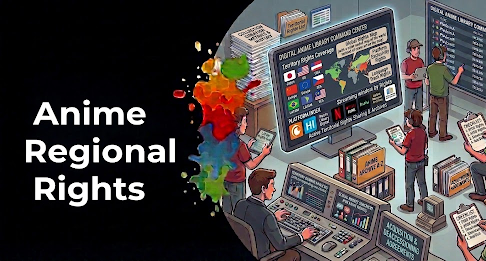
Anime regional rights determine which platforms and broadcasters can stream, broadcast, or distribute specific titles in each territory. Rights are licensed territory-by-territory, the same title can have five different licensees across five regions simultaneously, with Japan, North America, and Western Europe commanding the highest minimum guarantees.
Producers building a regional rights strategy can also reference our complete guide to how streaming platforms acquire exclusive anime rights.
Windowing is the sequential release strategy that moves a title from Japan broadcast → international simulcast → non-exclusive SVOD → AVOD → FAST → home video, with each stage governed by exclusivity provisions that determine which buyers can act and when.
If you’ve ever opened a streaming platform and found a popular anime unavailable in your country, or available only dubbed when the Japanese original exists, you’ve encountered territorial rights restrictions. For viewers, this is a frustration. For acquisition teams and rights holders, it’s the operational reality of a market structured entirely around territory-by-territory licensing.
This guide covers what acquisition executives actually need to know: how territories are tiered commercially, how the windowing sequence works from simulcast to FAST, how restrictions create specific problems for buyers, and how to build a regional rights strategy that maximizes value across your target markets.
Key Takeaways
- Anime rights are sold territory-by-territory, the same title may have five different licensees across five regions simultaneously
- North America and Western Europe command the highest minimum guarantees. APAC and LATAM are the fastest-growing markets by volume
- The windowing sequence, Japan broadcast → simulcast SVOD → non-exclusive SVOD → AVOD → FAST, determines revenue timing and buyer participation eligibility
- FAST channel windows now add meaningful incremental revenue for catalog titles with 100+ episodes and broad general-audience appeal
- Territorial fragmentation is the single biggest complication in anime library deals, rights sellers frequently hold incomplete or overlapping territory coverage
- Southeast Asia is the most underpriced major rights territory relative to its growth trajectory, Tier-2 markets growing 18–25% YoY with pricing gaps closing fast
Key Takeaways
- Territorial rights are not arbitrary. They are the commercial mechanism that lets a production committee sell the same title separately to a North American SVOD platform, a Southeast Asian platform, and a European broadcaster at different prices.
- Japan, North America, and Western Europe command the highest minimum guarantees, while APAC and LATAM are the fastest-growing markets by volume.
- Windowing moves a title through a defined sequence, Japan broadcast, international simulcast, non-exclusive SVOD, AVOD, FAST, and home video, and each stage carries its own exclusivity terms.
- Not every territory is priced or regulated the same way. China in particular restricts which titles clear for the market at all, independent of commercial demand.
- Vitrina tracks territorial rights availability and windowing status across major markets, which is the practical alternative to negotiating each territory from a cold start.
Vitrina Intelligence
For a detailed breakdown of how exclusivity affects deal structure, see our guide to exclusive vs non-exclusive anime licensing agreements.
Map territorial rights availability across every major anime market, SVOD, AVOD, FAST, and broadcast windows tracked in real time.
Why Territorial Rights Exist in Anime Licensing
Territorial rights restrictions in anime are not arbitrary, they’re the commercial foundation of how international content monetization works. Japan’s overseas anime revenue grew 26% to $14.1 billion in 2024, surpassing domestic revenue for the third consecutive year (Association of Japanese Animations via Anime News Network, 2025). That $14.1 billion flows through territorial licenses because different markets have different commercial characteristics, regulatory environments, and buyers who pay different prices for different rights.
When a Japanese production committee grants Crunchyroll exclusive SVOD rights for North America for 24 months, simultaneously grants a Southeast Asian platform rights for Indonesia and Thailand for 18 months, and grants a European broadcaster linear TV rights for Germany and France for 36 months, these are separate commercial transactions, separately priced, covering separately valuable markets. The territorial restriction that frustrates a viewer in Germany is the commercial guarantee that the German broadcaster paid to secure.
How Rights Carving Creates Market Value
Rights carving, licensing different rights to different buyers in different territories, maximizes total revenue by allowing the licensor to price each market according to its specific competitive dynamics. A title generating $2 million in a single global deal might generate $4–5 million through territorial carving across 15–20 separate regional deals, each priced at the competitive rate for that market.
For buyers, territorial carving creates opportunity: markets where the major platforms haven’t committed, territories where local platforms can outbid global competitors through local-language dubbing commitments, and regions where the licensor hasn’t established distribution relationships. The regions with the most open territorial availability today are typically the regions where the fastest subscriber growth is happening.
The Major Territory Tiers and What They’re Worth
| Territory Tier | Markets | Typical MG Range (Tier-1 Title) | Growth Rate |
|---|---|---|---|
| Tier 1, Premium | North America, Western Europe, Australia | $150K–$500K+ | Stable / Mature |
| Tier 2, Growth | Southeast Asia, Latin America, Eastern Europe | $20K–$80K | +18–25% YoY |
| Tier 3, Emerging | Middle East, Africa, South Asia | $5K–$25K | +30%+ YoY |
| China (standalone) | iQIYI, Bilibili, Youku | $30K–$300K (title-dependent) | Regulated, varies by title |
Anime rights territories are not priced equally. Commercial value reflects subscriber density, platform competition, willingness to pay, and the strength of existing anime fan communities. The tier structure tells buyers where to compete, where underpriced opportunities exist, and where to avoid overpaying for prestige rights that don’t generate proportionate return.
Tier 1, English-Language Markets
The United States, United Kingdom, Canada, and Australia form the highest-value territorial cluster. These markets combine large subscriber bases, high ARPU, established anime fan communities, and the most competitive bidding environment. North America alone is growing at 15.6–16.3% CAGR through 2030 (Grand View Research, 2025), making it simultaneously the most valuable and the most competitive market to secure.
Simulcast exclusivity in the US for a top-tier franchise title commands $100,000–$500,000+ per season at minimum guarantee, based on 2021 benchmarks from Anime News Network, a figure that has risen with market competition since. For buyers without the budget to compete directly with Crunchyroll and Netflix for English-language simulcast rights, strategic options include catalog acquisition, AVOD and FAST rights, or niche genre specialization in underserved categories.
Tier 2, Western Europe
France, Germany, Italy, Spain, and the Netherlands each have distinct anime markets. France is historically one of the world’s largest anime markets outside Japan, French-dubbed anime has been a cultural staple since the 1970s and 1980s, and French-language dub rights command a premium reflecting that market depth. Germany has a large and growing anime streaming audience with strong SVOD penetration.
European markets are typically licensed separately from English-language markets, giving regional platforms and specialist distributors opportunities to hold rights where Crunchyroll and Netflix don’t hold every title. French-language and German-language dub rights are negotiated as distinct grants and can be licensed independently of underlying streaming rights in those territories, adding deal complexity but creating additional revenue streams for rights holders who invest in localization.
Tier 3, Southeast Asia
Southeast Asia is the strategic opportunity in anime territorial rights, and the most underpriced major rights territory relative to its growth trajectory. The regional anime market was valued at $1.26 billion in 2024 and is projected to reach $2.60 billion by 2033 at an 8.4% CAGR (IMARC Group, 2024). Total paid streaming accounts across Indonesia, Thailand, Philippines, Malaysia, and Singapore exceeded 61 million in 2025, growing 19% year-over-year (Media Partners Asia via Variety, Feb 2026).
Despite this growth, territorial pricing for anime in Southeast Asia has not yet converged with demand. Titles commanding $300,000–$500,000 per season for US exclusivity are available across Southeast Asian territory packages for $30,000–$80,000. The pricing gap is closing, but buyers who move now on multi-year SVOD deals for Indonesian, Thai, and Philippine territories are locking in pricing that will look historically favorable within three to five years.
Intelligence Insight, Southeast Asia
Southeast Asia’s language fragmentation is both a complication and a competitive moat. Indonesia (Bahasa Indonesia), Thailand (Thai), Philippines (Filipino/Tagalog), and Vietnam (Vietnamese) each require separate dubbing investments to capture the majority audience, most viewers in these markets are not fluent English readers, making subtitle-only content commercially suboptimal. Platforms willing to invest in local-language simuldub for Indonesian and Thai markets are building audience loyalty advantages that subtitle-only competitors cannot replicate regardless of rights holdings.
Tier 4, Latin America
Brazil and Mexico are significant anime markets with large, passionate fan communities. Brazil has one of the world’s largest anime fan bases by absolute numbers, Portuguese-language dub rights for Brazil are distinct from Spanish-language rights for the rest of Latin America. This distinction is commonly misunderstood: buyers who assume “Latin America” is a single rights territory have caused commercial disputes when their Spanish-language license was interpreted to include or exclude Brazil. Always confirm Brazil explicitly in any Latin American rights grant.
China, A Market Apart
China represents a distinct licensing environment requiring specialized treatment. Rights are licensed to Bilibili, iQIYI, and Youku, three major platforms operating within regulatory constraints governing which content can be legally streamed in China. Not all anime titles are cleared for the Chinese market. Titles with content deemed inappropriate under Chinese regulations are either rejected or require cuts. Minimum guarantees are highly title-dependent ($30K–$300K), deal terms are Chinese-platform-specific, and regulatory clearance adds a layer of uncertainty that most territorial deals don’t carry. Treat China as a separate commercial conversation from the rest of Asia.
See Every Open Territory Window
Vitrina maps which anime titles have open territory windows in your target markets, and who holds the rights you need to acquire.
- ✓ Territory-by-territory rights availability by title
- ✓ Platform holdings and holdback expiry dates by region
- ✓ FAST and AVOD windows opening across Tier-1 and Tier-2 markets
$14.1B
Anime overseas revenue 2024
+25%
Tier-2 markets growth YoY
How Windowing Works in Anime: The Rights Sequence From Premiere to FAST
Windowing is the sequential release of a title across different platforms and distribution channels over time, with each window governed by exclusivity provisions preventing the rights holder from licensing to competing channels during a specified period. Anime titles typically pass through five to seven distinct windows between their Japanese premiere and full catalog availability.
Broadcast
SVOD
SVOD
FAST
/ EST
Typical anime rights windowing sequence, each stage carries separate pricing and exclusivity terms
Window 1, Japan Domestic Broadcast and Streaming
New anime premieres simultaneously on Japanese terrestrial broadcast (NHK, TBS, Fuji TV, TV Tokyo), cable and satellite channels, and Japanese domestic SVOD platforms (Amazon Prime Video Japan, Netflix Japan, d Anime Store, U-NEXT). Japan domestic rights are almost always retained by the production committee and are not part of international licensing conversations.
Window 2, International Simulcast (Exclusive SVOD)
The international simulcast window is the most commercially valuable for most anime titles. This is the period during which one platform holds exclusive rights to stream episodes internationally as they air in Japan. Exclusivity windows for major titles typically run 12–24 months from the first episode’s international release date. Premium franchise titles negotiate 36-month exclusivity. During this window, the licensor cannot offer the same rights to any competing platform in the covered territory.
Window 3, International SVOD (Non-Exclusive)
After the exclusivity window expires, SVOD rights typically convert to non-exclusive availability, allowing the licensor to license the same title to additional streaming platforms. This is when titles that Crunchyroll held exclusively begin appearing on Netflix, Amazon, and regional platforms, and when buyers who didn’t win the original simulcast bid can access the title at catalog pricing. Non-exclusive SVOD rights are priced 30–50% lower than exclusives and represent the primary acquisition pathway for smaller regional platforms building anime catalogs without simulcast budgets.
Window 4, AVOD and FAST
After SVOD exclusivity expires, anime titles enter the ad-supported windows. AVOD (ad-supported video on demand, accessed on-demand) and FAST (free ad-supported streaming TV, delivered in linear channel format) represent the long-tail monetization layer for anime catalogs. Crunchyroll’s deployment of anime on Pluto TV, Roku Channel, Amazon Freevee, and LG Channels marked anime’s formal entry into systematic FAST distribution, and created a new rights tier that most existing licensing agreements didn’t explicitly address (StreamTV Insider, 2025).
FAST rights are commercially valuable for catalog titles with 100+ episodes, the episode depth generates meaningful advertising inventory per engaged viewer session. A 500-episode franchise on a 24/7 FAST channel generates ad revenue continuously without requiring active subscriber acquisition. For rights holders and buyers who negotiate FAST rights explicitly, this is increasingly the correct long-term monetization layer for back-catalog anime that has passed through its premium SVOD windows.
Window 5, Home Video, EST, and Ancillary
Blu-ray, DVD, digital download, and EST (electronic sell-through) rights represent the final mainstream commercial window. Home video has declined significantly as a revenue source relative to the streaming era but remains commercially meaningful for premium franchise titles with dedicated collector fan bases, the Blu-ray market for titles like Demon Slayer, One Piece, and Attack on Titan remains active in Japan, the US, and Germany.
Structural shift: Japan’s overseas anime revenue grew 26% to $14.1 billion in 2024, surpassing domestic revenue for the third consecutive year and representing 56% of the total $25.1 billion anime market (Association of Japanese Animations Anime Industry Report 2025, via Anime News Network). Territorial rights management, maximizing license value across Tier-1, Tier-2, and Tier-3 markets simultaneously, is now the most commercially significant operational capability for any entity holding international anime rights.
FAST Is the Fastest-Growing Opportunity
FAST channel windows are opening across North America, Europe, and LATAM for hundreds of back-catalog titles, but only buyers with territorial visibility can act on them.
Vitrina tracks FAST and AVOD window availability across major markets as rights revert and new platforms launch, giving your team first-mover access to incremental revenue opportunities most teams don’t know exist.
How Territorial Restrictions Affect Buyers in Practice
Understanding territorial rights theory is less useful than understanding how restrictions create specific problems, and specific opportunities, in real acquisition scenarios.
The Holdback Problem
When a competitor holds exclusive rights in your target territory, you face a holdback, a period during which you cannot legally access the same content, regardless of subscriber demand. Holdbacks typically run for the duration of the competitor’s exclusivity window, which can be 12–36 months. During a holdback, you have three options: wait, sub-license from the rights holder if they’re willing, or build your catalog around adjacent titles that don’t carry the holdback restriction.
Platforms relying entirely on third-party rights are structurally vulnerable to holdbacks. The most durable strategy is a mixed catalog, some titles held through direct exclusive deals, some through non-exclusive arrangements, and some produced or co-produced in-house, so a competitor’s exclusive on one title doesn’t create a catalog gap that drives subscriber churn.
The Geo-Blocking Mechanics
Geo-blocking matches a user’s IP address to a territory map and blocks access to content the platform doesn’t hold rights to in that territory. From a rights holder’s perspective, geo-blocking compliance is a contractual obligation. Platforms that fail to implement it correctly face both legal exposure and licensor relationship damage.
VPN usage is a persistent challenge. Platforms are contractually required to implement reasonable geo-blocking measures but are generally not held liable for viewers who circumvent those measures through VPNs, as long as the platform actively blocks known VPN IP ranges. Licensors in major markets increasingly include geo-blocking compliance reporting requirements in their agreements.
The Simultaneous Release Pressure
Simultaneous global release reduces the window during which geo-blocked viewers turn to piracy or alternative access methods. Netflix’s model of global simultaneous release for its anime originals, Cyberpunk: Edgerunners, Pluto, Scott Pilgrim Takes Off, reflects this logic: a title available simultaneously in all territories generates a global cultural conversation that concentrates subscriber acquisition, social engagement, and press coverage in a single window rather than spreading it across staggered regional premieres.
For rights holders managing territorial carving, simultaneous global release creates negotiating tension: the licensor wants maximum revenue from territorial carving, but the buyer wants simultaneous availability to maximize cultural impact. The compromise is typically a coordinated simultaneous release date across all territorial licensees, even when different companies hold rights in different markets.
How Simulcast Deals Are Structured Across Japan, the US, and Southeast Asia →
How to Build a Regional Rights Strategy
For acquisition teams with limited budgets, territorial rights strategy is about sequencing, determining which territories to prioritize, which windows to target, and which markets offer the best return on rights investment at current pricing.
Start With Your Core Market
Secure exclusive SVOD rights in your primary market before expanding to secondary territories. A platform with clean exclusive SVOD rights in its home market has a defensible competitive position. A platform with non-exclusive rights in five markets has a more fragile one, any of those five markets can be disrupted by a competitor acquiring the same non-exclusive rights.
Build Territory Packages Around Dubbing Economics
Dubbing economics should shape territorial packaging. A French-language dub covers France, Belgium, Switzerland, and parts of Canada, four separate territorial markets from a single production investment. A Portuguese-language dub covers Brazil, Portugal, and parts of Africa. Platforms that acquire rights in territories covered by a single dub investment gain significantly more commercial coverage per dollar of localization spend than platforms acquiring territories requiring separate language investments.
Target Underpriced Growth Markets Early
Southeast Asia, Latin America outside Brazil and Mexico, and the Middle East all represent markets where current rights pricing has not converged with audience growth trajectories. Platforms that acquire multi-year SVOD rights in these markets today at current pricing are building catalog assets that will be valued at significantly higher rates when licensing terms come up for renewal.
Track Holdback Expiry Dates as a Pipeline Signal
The most underutilized signal in anime rights acquisition is holdback expiry dates. When a competitor’s exclusivity window expires, that title reverts to open availability, and teams that have tracked the expiry date can move on catalog pricing immediately, before the rights holder has completed a new sales campaign. Systematically monitoring holdback expiry across your target territory is a genuine first-mover advantage in catalog acquisition.
Vitrina Intelligence Platform
Build a Smarter Regional Rights Strategy.
Vitrina maps territorial rights availability, windowing status, holdback expiry dates, and active seller mandates, so your team identifies territory gaps and moves on them before competitors do.
No credit card required · Free tier available · Premium plans from day one
How Vitrina Solves the Territorial Intelligence Gap
The core challenge in anime territorial rights is visibility. Traditional research methods, trade publications, festival market attendance, cold outreach to sales agents, surface territory availability after the deals are already done. Vitrina’s intelligence platform tracks the global anime supply chain in real time, giving acquisition teams the data they need before rights go to market.
Project Tracker
Territory availability by title and platform
See which territories are open, which platforms hold rights in your target markets, and when holdback windows expire, for 15,000+ anime titles across 150+ countries.
VIQI AI
Query rights availability in plain language
Ask VIQI: “Which anime titles have open SVOD rights in Southeast Asia for Q3 2026?” Get verified territory intelligence in seconds, not weeks of manual research.
Vitrina Concierge
Verified introductions to rights holders
For senior executives who need a direct introduction to the right production committee or sales agent, not a database query. Concierge handles the research and makes the verified introduction.
The Fragmentation Paradox in Anime Rights
What’s actually happening across the global anime market is a textbook example of what Vitrina identifies as The Fragmentation Paradox™, where an abundance of content and suppliers creates less access, not more, due to information opacity and opaque deal structures.
Anime fans experience the consumer face of this paradox: titles split across 6-8 platforms, regions with no legal access to titles they want, and catalog gaps that seem inexplicable. Content professionals experience the business face: rights committees with fragmented interests, legacy deals blocking new acquisition windows, and rights holders who don’t always know which territories are unsold until someone asks.
The real dynamic here is that the anime rights market, despite its massive scale, still runs on relationship networks and manual research. There’s no centralized registry of “who holds rights to Title X in Territory Y.” Acquiring teams at streaming platforms piece this together through agent relationships and direct outreach to Japanese licensors. And gaps in that intelligence create both consumer frustrations and acquisition opportunities. For distributors tracking the full picture of global content acquisition across regional rights, the anime category remains one of the most complex to navigate.
Frequently Asked Questions About Anime Regional Rights
What are anime territorial rights?
Anime territorial rights define which geographic markets a platform is licensed to stream, broadcast, or distribute a specific title. Rights are carved by territory, the US, UK, and Australia are licensed separately from Southeast Asia or Latin America. Rights holders maximize revenue by licensing each territory independently to the highest bidder, allowing simultaneous multi-licensee structures where different platforms hold rights in different regions for the same title.
Why is the same anime available on different platforms in different countries?
Because territorial rights are licensed separately. A Japanese production committee may have sold North American SVOD rights to Crunchyroll, European broadcast rights to a French TV network, and Southeast Asian streaming rights to a regional platform, all at the same time. Each platform holds rights only in its licensed territory, creating the country-by-country availability differences viewers experience.
How does anime windowing work?
The typical anime rights window sequence is: Japan domestic broadcast → International simulcast (exclusive SVOD, 12–36 months) → Non-exclusive SVOD (30–50% of original MG) → AVOD and FAST (ad-supported free windows) → Home video and EST. Each window carries separate pricing and exclusivity terms, with simulcast commanding the highest premium and FAST representing the fastest-growing new tier.
How long do territorial exclusivity windows typically last for anime?
Standard SVOD exclusivity windows for simulcast deals run 12–24 months from the first episode’s international release. Premium franchise titles negotiate 36-month exclusivity. Broadcast deals often carry longer exclusivity windows, 36–60 months, because broadcasters need longer exploitation periods to recoup their investment. After exclusivity expires, rights become non-exclusive, allowing the licensor to sell to additional platforms.
Which anime territories are the most valuable?
Tier-1 markets, the US, UK, Canada, and Australia, generate 60–70% of total international anime licensing revenue. North America alone is growing at 15.6–16.3% CAGR through 2030. Southeast Asia is the highest-growth emerging tier, valued at $1.26B in 2024 and projected to reach $2.60B by 2033 at 8.4% CAGR. MENA and South Asia represent the next wave of growth at 30%+ YoY.
Can I acquire anime rights for Southeast Asia without covering all countries in the region?
Yes, Southeast Asian rights are typically available at the individual country level or in sub-regional packages (e.g., ASEAN-5: Indonesia, Thailand, Philippines, Malaysia, Singapore). Country-level acquisition is more expensive per title than regional packages but avoids paying for territories you don’t have the distribution infrastructure to serve. Indonesia and Thailand are the highest-value individual country markets given subscriber base size and growth rate.
What happens to territorial rights when a licensing agreement expires and isn’t renewed?
Rights revert to the licensor, the production committee or its authorized sales agent, who is free to offer them to any buyer. Reversion is also a risk: a platform whose licensing agreement expires while subscribers are mid-series faces both a content gap and potential subscriber churn. Most major agreements include renewal options at pre-agreed terms to prevent this scenario. Monitoring holdback expiry dates gives acquisition teams advance notice of reversion opportunities.
Are FAST channel rights covered by a standard anime SVOD license?
Not automatically. FAST rights are a distinct licensing tier requiring explicit agreement. A standard SVOD license grants on-demand streaming rights only. FAST distribution, placing content on 24/7 channel streams with advertising, requires a separate grant. Crunchyroll’s FAST channel deployments on Pluto TV, Roku Channel, and Amazon Freevee were structured through direct agreements with production committees, not through sublicensing of existing SVOD rights.
What is a holdback in anime licensing?
A holdback restricts a rights holder from licensing the same title to a competing platform in the same territory during the buyer’s exclusivity window. Standard Tier-1 holdbacks run 12–24 months. Weak or absent holdbacks are a red flag in acquisition due diligence, they signal the rights holder is multi-licensing aggressively and that your exclusive position is commercially compromised. Always verify holdback terms before completing an acquisition.
Conclusion: Territory Strategy Is Rights Strategy
Anime’s territorial rights structure isn’t a complication to manage around, it’s the commercial architecture that creates pricing differentials, timing windows, and market-specific opportunities for sophisticated buyers. The fastest-growing territories (Southeast Asia, MENA) are currently the most underpriced. The most valuable territories (North America, UK) are the most competitive. The emerging windows (FAST, AVOD) are the least contested because most rights agreements didn’t address them explicitly.
Buyers who build durable anime catalog advantages approach territorial rights as a strategic asset, securing exclusives in core markets, building regional packages around dubbing economics, tracking holdback expiry dates before competitors do, and identifying underpriced growth markets before pricing catches up with audience growth. The difference between moving in Q3 2026 and Q3 2027 in Southeast Asia isn’t a matter of taste, it’s a matter of price.
Anime Licensing for Streamers and Buyers: The Complete Executive Guide →
Content Acquisition: The Complete Guide for Streamers, Broadcasters, and Producers →

About the Author
Sandeep Nikanke
An analyst exploring the entertainment supply chain, from how media is made to how it reaches your screen. At Vitrina, Sandeep maps global acquisition workflows, rights structures, and platform strategies to help content buyers and distribution teams make faster, better-informed decisions.