IHUB
IHUB
 Private Briefings (Webinars)


 LeaderSpeak Podcast
  Global Entertainment Digest (Newsletter)
  Premium Lists
 Membership Benefits
 About Vitrina
 Our Story
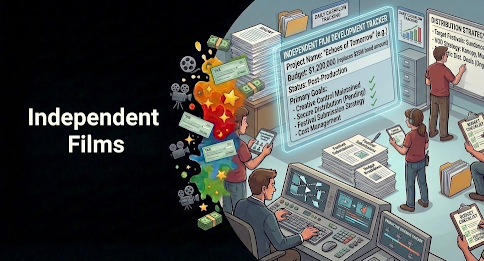
The most common reason an independent film fails to secure financing is not a weak script or the wrong genre. It is a financing structure that cannot withstand scrutiny. Based on Vitrina’s LeaderSpeak Podcast conversations with senior practitioners from HeadGear Films, Goldfinch, 91 Film Studios, and Lee & Thompson — and framed by the Vitrina Financing Playbook’s opening analysis — this article explains what stops most films from getting funded and what the ones that do have in common.
Author:
Kunal Barai leads Global Markets at Vitrina.AI, working with producers and financiers across 100+ countries to facilitate content financing and co-production matchmaking. He recently hosted a roundtable on AI for Film Financing: Unlocking Smarter Global Matchmaking and Funding Strategies at MIP London 2026. Earlier, he spent 12+ years at Nielsen/Gracenote and completed MIT Sloan’s executive program on AI strategy.
Ask most producers why their film hasn’t been financed and they will point to something external: the market is slow, investors are cautious, the timing isn’t right. Those things may all be true. But the more consistent answer, across every practitioner conversation in the Vitrina LeaderSpeak series, is simpler and more fixable: the structure around the project is unclear.
This is the central observation from the Vitrina Financing Playbook’s preface, and it is echoed by everyone in the LeaderSpeak series who actively deploys capital. “Projects stall not because creativity is weak, but because structure is unclear.” That is not a comment about the quality of the idea. It is a comment about the quality of the plan that sits behind it.
What follows is a breakdown of the specific structural reasons most independent films never get funded — drawn from practitioners who see hundreds of projects a year and have a clear picture of what separates the ones that close from the ones that don’t.
Table of Contents
What Actually Stops a Film from Getting Funded
Most financing conversations fail for one of four reasons. The budget doesn’t match what the market will realistically pay. The cast is not strong enough to give buyers confidence in the revenue. The financing structure itself — the ordered plan of who puts money in and who gets paid back first — is vague or undocumented. Or the project arrives at the conversation without any of the preparation a financier needs to say yes. Usually, it is a combination of all four. The films that do get funded have addressed all of them, not just the most obvious one.
1. The Market Doesn’t Support the Budget
Phil Hunt at HeadGear Films finances around 35 to 40 independent films per year. At that volume, he has a very clear picture of the gap that kills most financing conversations: the distance between what a producer thinks their film is worth and what the international market will actually pay for it.
Independent film finance depends heavily on international sales revenue, where buyers in different territories — the UK, Germany, Australia, Japan and others — pay for the rights to distribute a film in their market. Those pre-sales, along with tax incentives and any equity investment, make up the capital stack, the layered funding structure that pays for production. If the numbers that buyers will realistically pay do not come close to covering the budget, the capital stack cannot hold together.
HeadGear’s average budget sits around eight to nine million dollars, with most projects under ten million. Phil Hunt is direct about why: at that level, the structure is still manageable. When budgets rise without a corresponding increase in cast quality, sales forecasts, or deal structure to support them, financing becomes fragile. The solution, in his view, is to build a budget that the market can realistically support, not a budget that reflects what the production would ideally cost.
| “Cut the budget before you compromise on cast.”
— Phil Hunt, HeadGear Films, Vitrina LeaderSpeak Podcast |
This is not just about keeping costs down. It is about keeping the relationship between cost and expected revenue in proportion. A project that costs significantly more than what the market is likely to pay is not underfunded. It is wrongly sized.
2. The Cast Doesn’t Give Buyers Confidence
Star power remains one of the most important variables in independent film financing, not because names guarantee quality, but because they provide buyers with a recognisable anchor for their own marketing. In a market where buyers are choosing between dozens of projects, a film with a known name attached is simply easier to sell domestically than one without.
Phil Hunt’s observation is unambiguous: attaching a recognisable actor is no longer enough on its own, but without the right names, a film will not sell. Audiences consistently choose films with familiar faces over unknown alternatives, even when the unknown project may be stronger. That preference shapes buyer behaviour, and buyer behaviour shapes the pre-sales that anchor the financing structure. Weak cast equals uncertain pre-sales, which means uncertain financing.
The practical implication for producers is to treat cast as a financing question, not just a creative one. Before approaching any lender or equity investor, the project needs confirmed or strongly attached cast, a sales strategy that reflects current market behaviour, and a budget that is defensible against realistic revenue projections. Preparation at that level signals to financiers that the producer understands the market. Lack of it signals risk.
3. The Financial Structure Is Unclear
Goldfinch has deployed more than 250 million dollars across more than 300 projects with a zero-default track record. Kirsty Bell’s explanation of how that is possible is not complicated: they do not commit capital until the financial structure around the project is clear.
Her assessment process involves discounting projected sales by sixty percent before evaluating a project, then looking at what percentage of the investment is genuinely at risk in realistic scenarios rather than optimistic ones. What they are looking for is not a perfect project. They are looking for a project where the investor’s position is clearly defined, the recoupment order — the sequence in which different investors are paid back once revenue arrives — is documented, and the budget has been stress-tested rather than just assembled.
| “Creativity gets a project started. Structure is what gets it financed.”
— Kirsty Bell, Goldfinch, Vitrina LeaderSpeak Podcast |
Most projects that stall in the financing stage do not stall because the idea is weak. They stall because the financial structure cannot answer basic questions. Who gets paid first? What happens if sales come in below projection? Where does the investor’s money sit relative to the debt? When these answers are vague or inconsistent across documents, capital hesitates. When they are clear, financing conversations move quickly.
Goldfinch looks for four things in every project: a clear investor hierarchy, a defined repayment order, transparent reporting arrangements, and written agreements that reflect all of the above. When all four are present, the conversation starts from a position of confidence. When any of them is missing, even a strong creative project struggles to close.
4. The Project Runs Out of Money Before It Finishes
Naveen Chandra founded 91 Film Studios after identifying three structural failures that repeat across the independent film market. The first is completion: fifty percent of films that begin production never finish, because the financing runs short midway through. The second is distribution: fifty percent of films that do get completed never properly reach an audience, because no one has planned for the cost of getting the film to theatres. The third is access: many writers and producers have no structured pathway to capital at all.
| “Films is the most risky business. I want somebody else to also love the story and put in money. I divide the risk and I divide the spoils.”
— Naveen Chandra, 91 Film Studios, Vitrina LeaderSpeak Podcast |
These are not fringe cases. They are the statistical norm in independent film. Half of all projects that begin production do not complete. Of those that do, half never reach an audience. That means the vast majority of independent films funded with equity never generate the revenue that investors were counting on when they committed. The financial consequences fall first on the investors, and then on the producer’s reputation and future ability to raise money.
Naveen’s response to this at 91 Film Studios is to treat completion and distribution as financing questions from the start, not as production questions to be dealt with later. Every investment requires a co-producer who independently commits fifty percent of the financing, which validates the project and divides the risk. Capital planning must account for the full journey of the film, from production through to distribution, satellite rights, and the intellectual property value that persists beyond the first run. Projects that treat financing as only a production question are structurally incomplete before they begin.
5. The Legal Foundation Isn’t Ready
Sam Tatton-Brown at Lee & Thompson operates at the point where financing structures become legal documents. His view is direct: if the contracts are unclear, the financing is unstable, regardless of how strong the project looks on paper.
Before any lender or investor commits money, they need to know who owns the rights to the film, who has security over those rights, what the repayment order is, and what happens if the project runs into trouble. These are not questions that can be answered informally. The chain of title — the documented ownership trail showing that the rights have been properly acquired and assigned — must be clean. Security must be grantable. Recoupment schedules must be precise, consistent across every document, and legally enforceable.
| PRODUCER TAKEAWAY→ Chain of title must be clean — the documented ownership trail showing rights have been properly acquired and assigned
→ Security must be grantable: rights must be legally usable as collateral before any lender will commit → Recoupment schedules must be precise, consistent across every document, and legally enforceable — ambiguity creates disputes when revenue arrives → Only 3.8–4% of UK independent films reach net profits — equity investors must understand their position clearly before they commit |
His benchmark for understanding what is at stake: only 3.8 to 4 percent of UK independent films actually reach net profits, the point at which equity investors see returns above their initial investment. Equity investors sit at the bottom of the repayment stack, paid only after all debt has cleared. That means the great majority of equity investors in independent film will not see profit participation. They may recoup their investment depending on performance, but they will not see the upside. A well-documented waterfall — the written schedule defining who is paid at each stage and in what order — is what makes this position legible to investors before they commit. Without it, equity investment is risk without information.
Ambiguity in contracts does not just slow financing down. It creates the conditions for disputes when revenue eventually arrives. Financiers who have seen those disputes prefer to avoid the projects that look like candidates for them.
What the Ones That Get Funded Have in Common
Films that successfully close financing are not universally the most ambitious, the most creative, or the most original. They are the ones that arrive at financing conversations with the structural work already done. The budget is sized for what the market will realistically support. The cast is strong enough to anchor buyer confidence. The capital stack is clearly defined, with each participant’s position written down and legally enforceable. The recoupment schedule is precise and consistent across all documents. And the plan extends past production to include distribution and what happens if commercial performance falls short of projections.
None of this replaces creative ambition. What every practitioner in the Vitrina LeaderSpeak series is consistent on is that structure and creativity are not in tension. The structure is what allows the creativity to reach an audience. Projects that treat the financial plan as secondary to the creative vision tend to discover, at the point of financing conversations, that the market disagrees. Projects that treat both as equally important tend to close faster and with fewer complications.
The Vitrina Financing Playbook’s opening statement is the cleanest summary of this: “Projects stall not because creativity is weak, but because structure is unclear.” That is also, by inversion, the clearest description of why the ones that do get funded succeed. The structure is clear.
| “Projects stall not because creativity is weak, but because structure is unclear.”
— Vitrina Financing Playbook |
About This Article
This article is part of Vitrina’s LeaderSpeak Podcast programme, where senior practitioners across the entertainment supply chain share the structural realities of how their part of the business works. The voices in this article are drawn from LeaderSpeak Podcast conversations with Phil Hunt of HeadGear Films, Kirsty Bell of Goldfinch, Naveen Chandra of 91 Film Studios, and Sam Tatton-Brown of Lee & Thompson. The Vitrina Film Financing Playbook is the structured companion to these conversations, available for download.
Related reading: