IHUB
IHUB
 Private Briefings (Webinars)


 LeaderSpeak Podcast
  Global Entertainment Digest (Newsletter)
  Premium Lists
 Membership Benefits
 About Vitrina
 Our Story
Quick Answer
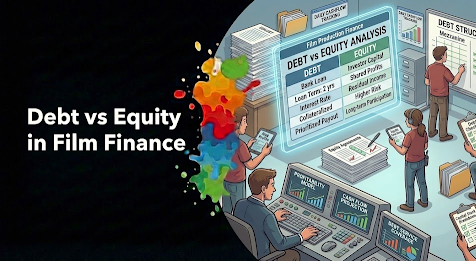
In film finance, debt is senior capital secured against pre-sales, tax credits, or completion bonds — typically interest-bearing at 8–14% APR with no creative equity. Equity is risk capital invested for a share of net profits and often creative input. Most mid-budget productions ($5–25M) use both: 30–50% debt to limit dilution, 50–70% equity to fill the gap above confirmed pre-sales.
_row]
A plain-English guide to the two primary instruments in independent film financing — what distinguishes them, how they behave differently when things go wrong, and why confusing the two leads to misaligned expectations on all sides. Based on Vitrina’s LeaderSpeak Podcast conversations with senior practitioners from Peachtree Media Partners, Goldfinch, and Lee & Thompson.
Author:
Kunal Barai leads Global Markets at Vitrina.AI, working with producers and financiers across 100+ countries to facilitate content financing and co-production matchmaking. He recently hosted a roundtable on AI for Film Financing: Unlocking Smarter Global Matchmaking and Funding Strategies at MIP London 2026. Earlier, he spent 12+ years at Nielsen/Gracenote and completed MIT Sloan’s executive program on AI strategy.
Most independent films are financed using a combination of two types of capital: debt and equity. These words appear together so often in financing conversations that producers sometimes treat them as interchangeable — two different ways of raising the same kind of money. They are not. Debt and equity behave differently, carry different expectations, sit in different positions in the financing structure, and have fundamentally different consequences when a film underperforms.
Understanding the difference is not a technicality. It is the foundation of every financing conversation you will have. A lender who expects to be repaid with interest by a defined date is operating under completely different assumptions from an equity investor who is hoping for profit participation over an undefined timeline. Treating either as if they were the other is how financing relationships break down.
This article explains what debt and equity are, how they behave in an independent film financing structure, and what practitioners from Peachtree Media Partners, Goldfinch, and Lee & Thompson say about how each instrument should be used.
Table of Contents
- What Debt and Equity Actually Are
- How Peachtree Approaches Debt — Collateral, Not Speculation
- How Goldfinch Approaches Equity — Assessed Risk, Not Assumed Return
- What Lee & Thompson Says About the Legal Distinction
- Mixing Debt and Equity — What Producers Get Wrong
- Matching Instrument to Project Type
- The Bottom Line
What Debt and Equity Actually Are
Debt in film finance is money that must be repaid. A lender advances capital against defined collateral — pre-sale agreements, distribution contracts, tax incentives, assigned rights — and expects to receive that capital back, plus interest, by a specific point in the revenue timeline. The film’s commercial performance is largely irrelevant to the lender’s return calculation. They get paid back through the collateral, not through the film’s profits.
Equity in film finance is investment that participates in the film’s revenue once all debt has been repaid. An equity investor puts money in and waits. They have no fixed return and no guaranteed repayment date. Their return depends entirely on how the film performs commercially, and on where they sit relative to other equity participants once the recoupment waterfall — the ordered sequence in which different investors are paid back — begins to flow.
Both instruments are necessary in most independent financing structures. Debt provides the leverage that makes the capital stack viable. Equity provides the flexible, risk-absorbing layer that supports the structure around the debt. The challenge is placing each correctly.
1. How Peachtree Approaches Debt — Collateral, Not Speculation
Peachtree Media Partners operates as a lender, not an equity investor. This distinction, as Joshua Harris makes clear in the Vitrina LeaderSpeak conversations, shapes everything about how they evaluate a project. Their first question is not whether the film will succeed creatively. It is what secures the loan.
Peachtree lends against identifiable assets: pre-sale agreements, distribution contracts, tax incentives, and assigned rights. The primary risk they carry is not whether they get repaid — their assessment of that is, in their own words, very high — but when. This is a meaningful distinction. Timing risk is a financing problem that can be managed. Repayment risk is an existential one.
For a producer approaching debt financing, the implication is clear. You are not making a case for the film’s creative strength or commercial potential. You are demonstrating that you have real, assignable collateral that a lender can take security over. Pre-sale agreements from credible distributors. A reliable, refundable tax credit. Distribution contracts in place or actively being negotiated. Without those, the debt conversation does not start.
2. How Goldfinch Approaches Equity — Assessed Risk, Not Assumed Return
Goldfinch approaches equity investment through assessed risk rather than assumed return. Kirsty Bell’s methodology is to discount projected sales by 60 percent when evaluating a project, and then assess what percentage of the investment is actually at risk in realistic — not optimistic — scenarios.
| “Creativity gets a project started. Structure is what gets it financed.”
— Kirsty Bell, Goldfinch, Vitrina LeaderSpeak Podcast |
This approach reflects the structural reality of where equity sits. Equity investors sit at the bottom of the capital stack. They are repaid only after all debt has cleared. In a typical independent film, that means they wait longer than lenders, absorb more uncertainty, and see their return only if the film generates revenue above the total of all invested capital plus costs.
Goldfinch’s zero-default track record across $250 million and more than 300 projects is built, in part, on their approach to structuring equity correctly. When Goldfinch looks at a project, they examine whether the budget is realistic, whether financial oversight is in place, whether recoupment is clearly documented, and whether investor positions are defined before capital is committed.
What they are looking for is not complexity. They are looking for clarity. Investors need to understand where their money is going, who is overseeing it, and how it returns to them. When that clarity is present, equity conversations move quickly. When it is absent, even strong projects struggle to close.
3. What Lee & Thompson Says About the Legal Distinction
From Lee & Thompson’s perspective, the distinction between debt and equity is not just financial — it is legal. Every layer of the capital stack must be clearly defined in contracts. It is not enough to agree verbally on who gets paid first. The recoupment schedule must be detailed, consistent across all documents, and legally enforceable.
Sam Tatton-Brown’s observation that only 3.8 to 4 percent of UK independent films actually reach net profits is a useful benchmark here. It means that equity investors in the great majority of independent films will not see profit participation. They may recoup their investment, depending on performance, but the net profit tier — the point at which equity investors see returns above their initial capital — is rarely reached.
This is not a reason to avoid equity investment. It is a reason to ensure that equity investors understand their position clearly before they commit. A well-documented waterfall structure — one that specifies who is paid at each stage, what the order is, and what happens in underperformance scenarios — protects everyone in the deal. It reduces the risk of disputes when revenue starts flowing, and it accelerates the financing process because lenders and investors can see exactly where they stand.
4. Mixing Debt and Equity — What Producers Get Wrong
The most common mistake producers make when combining debt and equity is treating one as if it were the other. This typically takes two forms.
The first is treating debt as flexible. Producers sometimes approach lenders with optimistic revenue projections, expecting the lender to share in the creative upside. Lenders do not. They have a fixed return structure, a fixed repayment expectation, and enforcement mechanisms if those obligations are not met. Treating debt as forgiving — as something that can be renegotiated if the film underperforms — leads to misaligned expectations and, ultimately, damaged relationships.
The second mistake is treating equity as patient without defining what that patience means. An equity investor who has not been given a clear recoupment schedule, a defined position in the waterfall, and transparent reporting commitments does not actually know what they have invested in. The absence of clarity is not neutrality — it is risk without information, and it tends to produce disputes when revenue eventually arrives.
| PRODUCER TAKEAWAY→ Never approach a debt lender expecting flexibility on repayment terms — lenders have fixed structures and enforcement mechanisms
→ Equity investors must have a clear recoupment schedule, a defined waterfall position, and transparent reporting commitments before they commit → The absence of clarity is not neutrality — it is risk without information, and it produces disputes when revenue arrives |
The Vitrina Film Financing Playbook’s Part II structural analysis is direct: understanding the distinction between debt and equity early allows producers to structure deals realistically. The capital stack only works when each participant understands what they have signed up for — and when that understanding is documented, not assumed.
5. Matching Instrument to Project Type
Not every project suits the same capital mix. The right balance of debt and equity depends on the collateral available, the budget level, and the risk profile of the production.
Debt-heavy structures work when collateral is strong: confirmed pre-sales in multiple territories, a reliable and sizeable tax credit, distribution agreements already in place. In these structures, a lender like Peachtree can advance against that collateral, and the equity requirement is reduced. The financing structure closes faster because the lender’s position is well-secured.
Equity-heavy structures become necessary when collateral is thinner: a project with limited pre-sales, a smaller or less-established incentive, or a creative package that has not yet attracted distribution interest. Equity investors accept the higher risk in exchange for a larger share of the upside. The challenge for producers in these structures is ensuring that equity investors genuinely understand their position — and that the deal is structured in a way that makes sense given the realistic revenue outlook.
For most independent films, the answer is some combination of both, with the relative proportions determined by what collateral is available and what risk the equity investors are willing to absorb. Getting that balance right — and documenting it clearly — is what makes a financing plan close.
The Bottom Line
Debt and equity are not two versions of the same thing. They carry different expectations, different risk profiles, and different legal obligations. A lender expects to be repaid with interest by a defined timeline, regardless of how the film performs. An equity investor accepts the possibility of waiting, or of not seeing profit participation at all, in exchange for upside if the film does well.
Producers who understand this distinction — and who build financing structures that make each participant’s position explicit — are in a fundamentally stronger position than those who approach capital without that clarity. The structure is not the obstacle. It is what makes the conversation possible.
| “The structure is not the obstacle. It is what makes the conversation possible.” |
About This Article
This article is part of Vitrina’s LeaderSpeak Podcast programme, where senior practitioners across the entertainment supply chain share the structural realities of how their part of the business works. The voices in this article are drawn from LeaderSpeak Podcast conversations with Joshua Harris of Peachtree Media Partners, Kirsty Bell of Goldfinch, and Sam Tatton-Brown of Lee & Thompson. The Vitrina Film Financing Playbook is the structured companion to these conversations, available for download.
Related reading:
Frequently Asked Questions
What is the difference between debt and equity in film financing?
Debt financing in film is senior capital — typically a bank or specialist lender — secured against confirmed assets like pre-sales, tax credits, or a completion bond. Equity is risk capital invested for a share of net profits and recouped only after debt is repaid. Debt is cheaper (no dilution of profits) but requires collateral; equity is more flexible but costs the producer more of the upside.
When should a producer use debt financing for a film?
Use debt when you have hard pre-sales or confirmed tax credits worth at least 60–70% of the debt amount. Banks and gap financiers like Peachtree lend against these confirmed receivables at interest rates of 8–12%. Without bankable pre-sales, lenders will not lend — and trying to use debt without sufficient collateral signals naivety to sophisticated financiers.
When should a producer use equity financing for a film?
Equity is used to fill the financing gap after debt, pre-sales, and soft money (grants, tax credits) have been deployed. Private equity investors take the most risk — they recoup last — and therefore require the highest potential return. Equity investors should only participate in projects where the sales agent has a credible view on total revenues that justify the equity risk premium.
What is a typical film financing structure for a mid-budget production?
A typical $10M mid-budget film might be structured as: 30% pre-sales against which the bank lends at 80% LTV (providing 24% of budget), 20% tax credit (lendable to provide further 16%), 10% completion bond-secured gap debt, and 50% equity split between an equity investor and the producer’s deferred fees. This stacks debt at the senior level and equity at junior to optimise the cost of capital.
How does the recoupment waterfall work in film financing?
The recoupment waterfall determines who gets paid first from box office and sales revenue. Typically: (1) distribution fees and P&A costs, (2) bank and gap debt repayment with interest, (3) completion bond premium recovery, (4) equity investor recoupment of principal, (5) equity investor’s negotiated upside, (6) producer’s deferred fees. Profits (net proceeds) are distributed only after all senior claims are satisfied.