About Innovation Hub
 Global Content Pulse (Webinars)


 Global Production Financing
(Webinars)
Global Production Financing
(Webinars)  LeaderSpeak Podcast
  Global Entertainment Digest (Newsletter)
  About Vitrina
 About VIQI
 Our Story
 Our Solutions 🔥
 Film+TV Projects Tracker 🚀
 Case Studies
 Our Profile
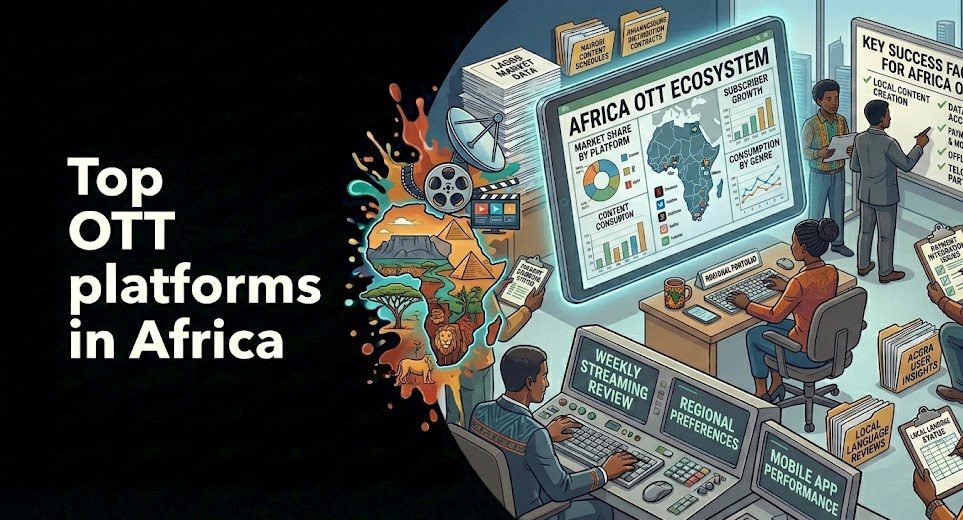
The race for Africa’s top OTT platforms is no longer a story about Western giants dipping a toe into new territory. It’s a full-scale land grab—and you need to know who’s winning, who’s bluffing, and where the real acquisition opportunities lie in 2026. Sub-Saharan Africa alone counts more than 1.4 billion people, a median age under 20, and mobile-first internet adoption that’s rewriting every assumption about how content gets consumed at scale. That’s not an emerging market. That’s the next major battleground.
But here’s what most content deals desks get wrong: Africa isn’t one market. It’s 54 distinct territories—each with its own language mix, regulatory framework, piracy profile, and audience appetite. The platforms that understand this fragmentation paradox are pulling ahead fast. The ones that don’t are burning cash on blanket licensing deals that never recoup. This guide cuts through the noise.
Table of Contents
Ask VIQI: Which African OTT platforms are actively acquiring content in your genre?
VIQI is Vitrina’s AI assistant—trained on 1.6 million titles, 360,000 companies, and 5 million entertainment professionals. Ask it which platforms are buying, what they’ve greenlit recently, and which territories are underserved.
✓ Included with 200 free credits | ✓ No credit card needed
Why Africa’s OTT Market Is Different in 2026
Forget what you think you know. Africa’s streaming market skipped the cable revolution entirely—it went straight from broadcast and satellite to mobile OTT. That’s not a disadvantage. It’s a structural shortcut that puts Nigeria, Kenya, South Africa, and Egypt ahead of legacy-burdened Western markets in terms of digital agility. And it’s exactly why platforms that move fast on local content are mopping up subscriber growth while Netflix figures out its continent-wide pricing strategy.
Nollywood produces more feature films annually than Hollywood. Not more expensive films—more films, full stop. Nigeria’s output tops 2,500 titles per year, and East African production hubs in Kenya and Ethiopia are scaling fast. South Africa runs a mature co-production ecosystem backed by the NFVF and a 25% local spend rebate that global platforms are increasingly exploiting. As reported by Variety, streaming subscriptions across sub-Saharan Africa grew by 34% in 2024—outpacing every other major region. That trajectory isn’t slowing.
But you can’t just pitch your content to “Africa.” You need to know which platform is buying drama for the Francophone West Africa market, which one is aggressively acquiring Swahili-language unscripted, and which is sitting on a content budget it needs to deploy before its licensing window closes. That intelligence lives in Vitrina’s ecosystem—and that’s what separates smart deals from expensive guesses. If you want a deeper look at Africa’s top film distribution companies in 2024, that guide covers the physical and digital distribution landscape in detail.

Your AI Assistant, Agent, and Analyst for the Business of Entertainment
VIQI AI helps you plan content acquisitions, raise production financing, and find and connect with the right partners worldwide.
- Find active co-producers and financiers for scripted projects
- Find equity and gap financing companies in North America
- Find top film financiers in Europe
- Find production houses that can co-produce or finance unscripted series
- I am looking for production partners for a YA drama set in Brazil
- I am looking for producers with proven track record in mid-budget features
- I am looking for Turkish distributors with successful international sales
- I am looking for OTT platforms actively acquiring finished series for the LATAM region
- I am seeking localization companies offer subtitling services in multiple Asian languages
- I am seeking partners in animation production for children's content
- I am seeking USA based post-production companies with sound facilities
- I am seeking VFX partners to composite background images and AI generated content
- Show me recent drama projects available for pre-buy
- Show me Japanese Anime Distributors
- Show me true-crime buyers from Asia
- Show me documentary pre-buyers
- List the top commissioners at the BBC
- List the post-production and VFX decision-makers at Netflix
- List the development leaders at Sony Pictures
- List the scripted programming heads at HBO
- Who is backing animation projects in Europe right now
- Who is Netflix’s top production partners for Sports Docs
- Who is Commissioning factual content in the NORDICS
- Who is acquiring unscripted formats for the North American market
The Top 10 OTT Platforms in Africa 2026
Here’s what matters: scale, content strategy, acquisition appetite, and territorial reach. We’ve weighted these platforms not just by subscriber count but by deal activity—because a platform with 5 million subscribers and aggressive buying is worth more to a seller than one with 15 million subscribers on a content freeze.
1. Showmax (MultiChoice) — The Incumbent
Territory: Pan-African (50+ countries). Subscribers: 3.9 million active (2025). Verdict: Africa’s most strategically positioned local platform—and it’s restructuring fast.
Showmax pivoted hard toward African originals after its 2023 relaunch with Comcast/NBCUniversal tech backing. It’s now buying Afrikaans drama, Nigerian crime thriller, Kenyan romcom—and it’s doing it on multi-year licensing windows that give IP holders real recoupment certainty. The smart pairing here is local-language originals with co-produced presales attached. Don’t pitch them English-language content without a compelling local hook.
2. Netflix Africa — The Global Player With Local Ambitions
Territory: All 54 African countries. Subscribers: ~9 million across Africa. Verdict: Scale leader, but selective—your content needs global-local crossover potential to get through the door.
Netflix has committed to African original content with productions in Nigeria, South Africa, Egypt, and Kenya. Their partnership with Canal+ expanded distribution into Francophone Africa—as covered in our analysis of the Canal and Netflix Africa partnership strategy. They greenlit Nigerian drama series *Blood Sisters* and South African thriller *Kings of Jo’burg*—both cleared six-figure production budgets. If you’re pitching Netflix Africa, your deck needs a clear reason why this story only works in Africa. No generic crime procedural. No diaspora-as-afterthought positioning.
3. Prime Video Africa — Scaling Quietly
Territory: 20+ African territories. Subscribers: Bundled with Prime (est. 4 million+). Verdict: Underrated acquisition target—less competition than Netflix, genuine commissioning appetite.
Amazon’s Prime Video has been quietly building an African slate without the fanfare Netflix generates. That’s actually your advantage. There’s less noise at the door. They backed Ugandan filmmaker Loukman Ali’s *The Delivery Boy* and have production partnerships in South Africa and Nigeria. Their commissioning brief in 2025-2026 skews toward action, thriller, and youth-facing unscripted—which means your Nollywood-adjacent crime drama or reality format may actually land here before it lands at Netflix.
4. Canal+ Africa — The Francophone Sovereign Play
Territory: 25 African markets (Francophone dominant). Subscribers: 7+ million Africa (pay TV + streaming). Verdict: This is the sovereign content hub play for Francophone West and Central Africa. No one else is buying here at scale.
Canal+ has deployed serious capital across Côte d’Ivoire, Senegal, Cameroon, and DRC. Their myCanal streaming app is the dominant OTT product across French-speaking Africa—and their commissioning pipeline runs through local production companies with whom they have first-look deals. If you want Francophone distribution, Canal+ isn’t just the best option. It’s often the only option at premium scale.
5. Startimes OTT — The Price-Sensitive Mass Market
Territory: 30+ African countries (East and Central Africa dominant). Subscribers: 15 million+ across pay TV and OTT. Verdict: Volume play—lower licensing fees but massive reach in underpenetrated markets.
StarTimes is China-backed and relentlessly focused on affordability—their OTT tier sits at price points Western platforms won’t touch. That’s not a weakness. It’s the strategy that’s given them dominance in Tanzania, Uganda, Rwanda, and Ethiopia. Content sellers who can negotiate library deals—not premium windows—can generate steady royalty income from StarTimes that recoup faster than a single premium platform deal that takes 18 months to close.
Track African OTT Platform Acquisitions in Real Time
Trusted by Netflix, Warner Bros, and Paramount. Join 140,000+ companies tracking the global entertainment supply chain—including which African platforms are buying, what genres, and at what deal values.
✓ 200 free credits | ✓ No credit card required | ✓ Full platform access
6. Buni TV — East Africa’s Local Champion
Territory: Kenya, Tanzania, Uganda. Content Focus: East African originals, Swahili-language content. Verdict: Niche but authentic—the first call for Swahili-language drama and factual.
Don’t underestimate Buni. It’s not trying to be Netflix. It’s the platform that Nairobi’s creative class actually watches. Their acquisition budget is modest but their audience loyalty metrics are exceptional—and they’ll give you a deal structure that a global platform never would. For East African indie producers, Buni represents something more valuable than scale: it represents a genuine commissioning relationship.
7. Africa Magic (DStv/MultiChoice) — Linear-to-Digital Powerhouse
Territory: Pan-Africa. Parent: MultiChoice. Verdict: The heritage brand with teeth—Africa Magic’s linear audience migrates to Showmax, making the two a combined ecosystem worth pitching together.
Africa Magic runs 7 dedicated channels across MultiChoice’s satellite and DStv Now digital platforms. Nollywood content is its lifeblood—it’s commissioned more Nigerian drama than any other platform in history. If you’re selling Nigerian scripted series or Ghanaian formats, the Africa Magic → Showmax pipeline is the most efficient route to pan-African distribution you’ll find.
8. iROKOtv — Nollywood’s Digital Home
Territory: Nigeria and diaspora (UK, US, Canada). Subscribers: ~1 million active. Verdict: The specialist platform with global diaspora reach—and a deal appetite that favors Nigerian IP owners directly.
iROKOtv pioneered the Nollywood streaming model a decade ago. Its founder, Jason Njoku, built a platform specifically for African diaspora audiences who couldn’t access local content abroad. The business model has evolved—they’re now co-producing originals rather than just aggregating catalogue—but their diaspora distribution moat is real. For Nigerian producers, iROKOtv offers something Netflix can’t: an audience that comes specifically to find you.
9. Viu Africa — The Asian-Backed Wildcard
Territory: South Africa, East Africa expansion. Parent: PCCW Media (Hong Kong). Verdict: Bringing Asian drama expertise and k-drama distribution to an Africa market hungry for non-Western content.
Here’s something your competitors haven’t figured out yet: k-drama has a growing African fanbase—particularly among South African youth demographics. Viu is the platform betting hardest on this crossover. Their model—freemium with premium tier—drives high DAUs, and their appetite for k-drama and Turkish dizi alongside South African originals creates unusual co-production opportunities for content owners who can package cross-cultural projects.
10. Kwesé Play / African regional OTTsion — The Aggregator Play
Territory: Southern and East Africa. Verdict: Aggregator-model platforms are the dark horses of African OTT—lower per-deal fees but volume of distribution your single-platform deal can’t replicate.
Aggregator-model platforms operating across Southern Africa—including SADC territory streamers—may not dominate headline subscriber counts, but they drive steady recoupment on library content. As we covered in our piece on tracking new film releases in SADC for regional streamers, the Southern African Development Community bloc represents an underpenetrated content opportunity that smart sellers are starting to exploit systematically.
Content Acquisition Reality: What These Platforms Actually Buy
You can have the most beautifully produced African drama series in the world. But if you don’t understand how these platforms actually structure deals—what windows they require, what they’ll pay for local vs. acquired rights, and what your recoupment timeline realistically looks like—you’re negotiating blind. Here’s what the acquisition reality looks like across the top platforms.
Netflix Africa typically structures deals as flat-fee acquisitions with 2-3 year exclusivity windows. They’re paying in the $50K-$500K range for acquisition rights depending on production value and talent attachment. But here’s what they won’t tell you in the room: they weight local cultural specificity far higher than they did in 2022. Generic pan-African positioning gets you rejected fast. As reported by Deadline, Netflix’s Africa team has greenlit more market-specific projects in 2024-2025 than any prior two-year period—particularly in Nigeria and Egypt.
Showmax is on a different trajectory—they’re co-producing more than they’re acquiring, which means your pitch needs to show up earlier in the development process. If you’re bringing them a finished series, you’ve missed the optimal window. Get them at treatment stage. Their commissioning team, which has been rebuilt since the 2023 relaunch, moves faster than its MultiChoice corporate parent implies.
Moses Babatope, co-founder of FilmOne Entertainment—the dominant theatrical distributor in Nigeria—has consistently made the point that Nigerian content needs to stop being treated as a niche product. Nollywood’s theatrical success at scale demonstrates an audience that wants high-quality production, not just familiar storytelling. Platforms betting against production value in African markets are betting wrong. You can explore Vitrina’s FilmOne and Nollywood cinema analysis for the full picture on how theatrical success translates to streaming demand.
The Fragmentation Opportunity for Sellers
Africa’s OTT fragmentation isn’t a problem to solve. It’s an opportunity to exploit—if you know how to navigate it. The Fragmentation Paradox is real: the same continent that has 10+ viable OTT platforms operating simultaneously is also the continent where most international content sellers approach distribution deals with a single “Africa” pitch deck. That’s leaving money on the table.
Think about it differently. Your Swahili-dubbed drama belongs on Buni, StarTimes, and Africa Magic simultaneously—not exclusively on Netflix. Your Francophone factual series belongs on Canal+ and potentially on France Télévisions’ international arm under a co-production treaty. Your South African thriller belongs on Showmax with a secondary window on Amazon and a SADC-wide TV syndication deal layered underneath. These aren’t competing deals. They’re stacked revenue streams—and none of them require you to negotiate blind if you’re working with real-time intelligence on what each platform’s acquisition desk is actually looking for right now.
The top local streaming platforms across all emerging regions—including Africa—are profiled in our comprehensive regional streaming platform guide. Cross-referencing African platforms against MENA and APAC equivalents reveals interesting co-distribution and format licensing patterns that aren’t visible if you only look at one continent at a time.
How to Approach African OTT Platforms Data-First
Let me show you the difference between a reactive pitch strategy and an intelligence-led one. A reactive strategy goes: “Let’s send the screener to Netflix Africa, Showmax, and iROKO and see who bites.” An intelligence-led strategy goes: “Showmax’s commissioning brief in Q1 2026 emphasizes thriller and procedural drama. Their last 6 acquisitions had a South African production element. Our project fits that brief. We approach them first, at development stage, with a co-production proposal attached.”
The difference in outcome? The first strategy gets you 6-week turnaround rejections and silence. The second gets you a conversation—and sometimes a deal. Vitrina’s platform tracks 400,000+ entertainment projects across the global supply chain, including what African OTT platforms have recently greenlit, what they’ve passed on, and—critically—which of their executives have moved into new acquisition roles in the past 90 days. Because in this market, the executive relationship often matters more than the content itself.
You want to know which African OTT platform is actively acquiring in your genre right now—not based on 6-month-old trade coverage, but based on real deal flow. That’s not a web search. That’s Vitrina intelligence. And it’s the difference between pitching the right person at the right platform at the right time versus spending your entire AFM budget on meetings that go nowhere.
Need African OTT Platform Introductions? We’ll Make Them.
Vitrina Concierge doesn’t give you a list—we make warm introductions directly to acquisition executives at the platforms actively buying your type of content.
- Nigerian drama producer → Showmax commissioning team (within one week)
- LA producer → Netflix UK, Fifth Season, Fox Entertainment (48 hours)
- Middle Eastern studio → Legendary Pictures (direct access)
Frequently Asked Questions
What are the top OTT platforms in Africa in 2026?
The leading OTT platforms in Africa in 2026 include Showmax (MultiChoice), Netflix Africa, Canal+ Africa, Prime Video Africa, StarTimes OTT, iROKOtv, Africa Magic (DStv), Buni TV, and Viu Africa. Showmax holds the strongest pan-African local content position with 3.9 million subscribers, while Netflix leads on scale with approximately 9 million African subscribers. Each platform targets different territories and content genres, meaning content sellers need a platform-specific—not a blanket Africa—strategy.
Which OTT platform dominates Africa?
No single platform dominates all of Africa—that’s the core challenge and opportunity. Netflix has the highest subscriber count across the continent, but Showmax dominates Sub-Saharan Africa’s local content proposition. Canal+ is dominant in Francophone West and Central Africa, where Netflix has limited market penetration. StarTimes leads in East and Central Africa on price-sensitive mobile consumption. True continental dominance doesn’t exist—which is why multi-platform distribution strategies consistently outperform single-platform approaches on ROI.
Is Netflix profitable in Africa?
Netflix doesn’t report Africa-specific profitability, but the trajectory is positive. Its mobile-only pricing tier—introduced specifically for African markets at approximately $3/month—drove significant subscriber growth in Nigeria, Kenya, and Egypt. Netflix’s local content investment in Africa, including multiple Nigerian series and South African originals, signals a long-term profitability commitment rather than an experimental play. The 34% streaming subscription growth across sub-Saharan Africa in 2024 (per Variety) suggests the economics are beginning to validate the investment.
How do I license content to African OTT platforms?
Licensing content to African OTT platforms requires a territory-specific strategy, not a pan-African blanket pitch. First, identify which platforms are actively acquiring in your genre and territory—Showmax for South African and Nigerian drama, Canal+ for Francophone Africa, Netflix for content with global crossover potential. Then time your pitch to their acquisition windows. Platforms like Showmax prefer pre-production engagement; Netflix typically acquires at delivery or near-finished cut. Using market intelligence tools like Vitrina lets you track live deal flow and approach the right acquisition executive at the right time—cutting the typical 6-18 month pitch cycle significantly.
What content genres perform best on African OTT platforms?
Genre performance varies significantly by territory. In Nigeria and West Africa, crime thriller, romantic drama, and reality formats consistently outperform. South Africa’s market skews toward crime procedural, drama, and Afrikaans-language content. East African audiences (Kenya, Tanzania) respond strongly to Swahili-language drama and unscripted. Across the continent, mobile-first consumption favors shorter episode runtimes (30-45 minutes) over prestige long-form. K-drama has a growing fanbase in South Africa. Local language availability—not just dubbing quality—is the single biggest predictor of content performance across all African OTT markets.
Is Showmax only available in South Africa?
No. Showmax is available across more than 50 African countries following its 2023 relaunch as a joint venture between MultiChoice and Comcast/NBCUniversal. While South Africa remains its largest single market, Showmax has active subscriber bases in Nigeria, Kenya, Ghana, Zimbabwe, Zambia, and other sub-Saharan territories. Its content strategy explicitly prioritizes pan-African originals across multiple language markets, making it the broadest local-content-focused OTT platform on the continent. New commissions are active across Afrikaans drama, Yoruba-language production, and Swahili content.
How does the Fragmentation Paradox affect OTT distribution in Africa?
Africa’s OTT market fragmentation—54 territories, multiple language groups, diverse regulatory regimes—creates what Vitrina terms the Fragmentation Paradox: the more platforms that exist, the harder it becomes to navigate the landscape without real-time intelligence. For content sellers, this paradox cuts both ways. The fragmentation makes it harder to find the right platform without deep market knowledge. But it also means less competition for territory-specific rights—a Swahili-language documentary can be licensed to multiple African platforms simultaneously without cannibalizing exclusivity windows. Sellers who understand this structure extract significantly more per-title revenue than those treating Africa as a single territory.
Conclusion: Africa’s OTT Market Rewards Intelligence Over Hustle
The top OTT platforms in Africa aren’t waiting for the world to discover them. They’re actively acquiring, commissioning, and building the most dynamic regional content ecosystem on the planet—right now. And the executives who’ll close the best deals in 2026 aren’t the ones with the most impressive screeners. They’re the ones who arrive at the acquisition meeting already knowing what the platform bought last quarter, what their commissioning brief says for next year, and which executive just inherited a new content budget.
Key Takeaways:
- No single dominant platform: Africa’s OTT landscape across 54 territories means multi-platform stacking consistently outperforms single-platform exclusivity on ROI.
- Territory matters more than scale: Canal+ owns Francophone Africa, StarTimes owns price-sensitive East Africa, Showmax leads local-language Sub-Saharan—know the map before you pitch.
- Streaming subscriptions grew 34% in 2024: Sub-Saharan Africa’s growth rate outpaces every major region—the acquisition window is now, not in three years.
- Co-production beats straight acquisition: Showmax and Netflix Africa are commissioning at development stage more than ever—get in earlier or lose the best deals to producers who did.
- Fragmentation is an opportunity: With 10+ viable platforms across linguistic sub-markets, sellers who structure territory-specific deals can generate 3-4x the per-title revenue vs. a single blanket Africa license.
The platforms are ready. The audience is there. The only question is whether your distribution intelligence is current enough to capture it—or whether you’ll spend another market season sending cold pitches into the void. Don’t let the latter happen.
Connect with African OTT Platform Acquisition Desks in 48 Hours
Trusted by Netflix, Warner Bros, Paramount, and Google TV. Track 400,000+ projects. Access 3 million verified executives. Ask VIQI strategic questions about the African OTT market.
✓ 200 free credits | ✓ No credit card required | ✓ Cancel anytime
Find Film+TV Projects, Partners, and Deals – Fast.
VIQI matches you with the right financiers, producers, streamers, and buyers – globally.
Join Industry Briefings Trusted by Leaders

Film & TV Production Financing: 2026 Trends
Production financing conditions are changing quickly. Understanding where money is moving and what buyers are backing is key to getting projects approved and funded in 2026.
Unreleased Film+TV Projects: Opportunities & Showcase
A curated view of unreleased Film and TV projects open for financing and collaboration

The Mid-Budget Comeback: Why Mid-Budget Films Is the Smartest Bet in the Room
Mid-budget films are attracting new capital. See why this segment is becoming one of the strongest bets in Film today.
Franchise Fatigue vs. IP Dependency: What Studios Should Be Betting On Now
s franchise performance softens, where will the next generation of valuable IP come from? Join the briefing.