The global television content market generated over $220 billion in licensing and acquisition transactions in 2024, according to PwC’s Global Entertainment and Media Outlook. Yet the teams responsible for closing those deals still rely on fragmented spreadsheets, broker networks, and delayed trade-press reports to assess counterparties and track market activity. AI deal intelligence is changing that dynamic, giving acquisition executives and entertainment financiers a real-time, data-driven view of every active player in the TV content ecosystem.
This guide explains what AI deal intelligence is, how it works inside a TV content licensing workflow, and what capabilities financiers should demand from any platform they evaluate. The framework here draws on verified deal data from 300,000+ entertainment companies tracked across Vitrina’s M&E intelligence network.
Key Takeaways
1AI deal intelligence aggregates real-time signals from licensing databases, regulatory filings, and trade activity to give acquisition teams a live view of the TV content market.
2Counterparty verification is the highest-value use case: PwC data shows deal failures from unverified partners cost M&E companies an estimated $4.2 billion annually (PwC Global M&E Outlook, 2024).
3Traditional research methods take 2 to 4 weeks per counterparty; AI-powered platforms reduce that to under 48 hours, according to Ampere Analysis (2025).
4Platforms covering 159,223+ verified M&E companies give financiers the deal history, territory rights, and buyer-seller relationship maps needed to close faster and negotiate with precision.
Quick Answer
What is AI deal intelligence for TV content deals?
AI deal intelligence is a data layer that automatically aggregates, verifies, and surfaces real-time signals about active TV content deals, counterparty histories, and licensing activity across global entertainment markets. It replaces manual broker research with continuous, machine-readable deal data drawn from regulatory filings, distribution databases, and verified company profiles across 159,223+ M&E companies worldwide.
What Is AI Deal Intelligence?
AI deal intelligence refers to software systems that continuously collect, classify, and analyze deal-related data across entertainment markets, then surface that data as actionable signals for acquisition teams, financiers, and licensing executives. According to Omdia’s 2025 Media Intelligence report, 67% of global content acquisition decisions now depend on some form of automated data aggregation, up from 31% in 2021. The term covers counterparty profiling, deal history retrieval, rights territory mapping, and buyer-seller relationship analysis, all in one integrated layer.
The distinction between standard market research and AI deal intelligence lies in the feedback loop. Standard research is a periodic exercise, done before a deal opens and rarely updated until closing. AI deal intelligence is continuous. When a distributor closes a new TV licensing agreement in Southeast Asia, an AI deal intelligence platform detects the signal, updates the counterparty profile, and recalibrates deal-flow rankings for connected parties within hours.
It’s worth being precise about what AI does here. Machine learning models parse unstructured data from trade publications, regulatory databases, content registries, and verified company filings. Natural language processing extracts counterparty names, deal types, territories, and financial terms. Graph databases map the relationships among studios, distributors, financiers, and platforms. The output isn’t a report. It’s a live, queryable intelligence layer sitting beneath every deal decision an acquisition team makes.
For TV content specifically, AI deal intelligence tracks three layers of activity: primary rights deals (the original licensing of a finished series or format), secondary distribution deals (territorial sub-licensing and output deals), and ancillary rights activity (streaming, AVOD, SVOD, and format adaptation rights). Each layer produces distinct signals that experienced acquisition executives can use to map competitive positioning and spot emerging deal opportunities before they reach open market status.
The Problem: How TV Content Deals Get Stuck Without Intelligence
TV content acquisition operates on compressed timelines, but the research supporting those decisions has historically been slow. Ampere Analysis reported in 2025 that the average time from initial counterparty identification to executed deal term sheet in TV licensing runs 47 days, with 18 of those days consumed by due diligence and counterparty verification alone. That gap represents a serious competitive liability when deals for premium content move in days, not weeks.
SOURCE
“The average TV content deal takes 47 days from counterparty identification to executed term sheet, with 18 days consumed by verification and due diligence alone.” – Ampere Analysis, Global Content Acquisition Benchmark Report, 2025
Three structural problems drive this delay. The first is data fragmentation. Deal information for TV content sits across MIPCOM catalogs, trade publications, company websites, copyright registries, and broker networks with no single authoritative source. An acquisition team researching a potential counterparty in South Korea, Turkey, or Brazil must manually reconcile information from dozens of sources, each updated on different cycles.
The second problem is counterparty opacity. TV content deals frequently involve intermediary distributors, sub-licensors, and co-production financiers whose actual deal histories are not publicly disclosed. Without a platform that maintains verified profiles of active participants, acquisition teams cannot distinguish a well-capitalized distributor with a proven rights track record from a shell entity with a persuasive pitch deck. This is the most expensive form of due diligence failure in the industry.
The third problem is signal latency. By the time a deal appears in trade press, it is already closed. Content acquisition executives who rely on Deadline, Variety, or C21 to track market activity are always reacting to closed transactions rather than positioning ahead of open ones. Real competitive advantage in TV content acquisition comes from identifying which distributors are actively expanding their libraries, which platforms are increasing their content budgets, and which territories are experiencing rights gaps before that information reaches general circulation.
For entertainment financiers specifically, these problems compound risk at the portfolio level. A financier backing a slate of TV productions needs confidence that the distribution chain for each title is populated by verified, solvent, and rights-clear counterparties. PwC’s 2024 Global M&E Outlook estimated that deal failures attributable to unverified or misrepresented counterparties cost the global M&E industry approximately $4.2 billion annually in broken deals, clawbacks, and litigation. AI deal intelligence directly targets this cost center.
How Does AI Deal Intelligence Work in TV Content Licensing?
AI deal intelligence platforms process data through four distinct pipeline stages before delivering usable output to acquisition teams. Understanding each stage helps buyers evaluate whether a platform genuinely delivers intelligence or simply aggregates raw data without interpretation. Parrot Analytics reported in its 2024 Content Demand Intelligence study that platforms with structured four-stage processing pipelines produced 3.4 times more actionable alerts per month than single-source aggregators.
SOURCE
“AI deal intelligence platforms with structured four-stage data processing pipelines produce 3.4 times more actionable acquisition alerts per month compared to single-source data aggregators in the entertainment sector.” – Parrot Analytics, Content Demand Intelligence Report, 2024
Stage one is data ingestion. The platform connects to structured and unstructured sources including rights registries, market databases, regulatory filings, trade publications, and verified company submissions. In a mature AI deal intelligence system, ingestion happens continuously, not in weekly or monthly batch cycles. The breadth of sources determines how complete the intelligence picture will be. A platform covering only English-language trade press misses vast portions of deal activity in Asia-Pacific, Latin America, and MENA markets.
Stage two is entity resolution. Raw data mentions hundreds of company names in variant forms across sources. “Sony Pictures Television,” “SPT Networks,” and “Sony TV” may all appear in deal reports referring to the same entity. Entity resolution uses machine learning to collapse these references into a single verified counterparty profile. This is technically difficult and frequently underestimated by first-time platform buyers. Without strong entity resolution, deal history data becomes unreliable because the same company’s transactions are split across multiple phantom records.
Stage three is deal classification. Once entity resolution is complete, AI models classify each identified deal by type (licensing, co-production, acquisition, format rights, streaming rights), territory, genre, deal size where disclosed, and counterparty role. Classification enables the platform to answer specific queries like “show me all documentary licensing deals closed by European broadcasters in the last 90 days” without requiring the user to manually filter raw source data. For acquisition teams running multiple simultaneous deal tracks, this query capability is operationally transformative.
Stage four is signal generation. Classified deal data feeds into scoring models that flag high-relevance signals for each user’s deal mandate. A streaming platform expanding into South Asian markets sees different signals than a European public broadcaster seeking English-language drama. Signal generation is where AI deal intelligence becomes personalized, moving from a database into an active deal sourcing assistant. The best platforms allow acquisition teams to configure signal parameters by territory, genre, budget range, rights type, and counterparty relationship history.
Key Stat
According to Omdia (2025), entertainment companies using AI-driven deal pipelines close acquisition negotiations 31% faster than those using broker-only or manual research approaches, with measurably higher deal accuracy scores on counterparty due diligence.
What Are the Key Capabilities of an AI Deal Intelligence Platform?
The most capable AI deal intelligence platforms share a consistent set of features that separate them from basic CRM tools or trade database subscriptions. DEG’s 2024 Digital Entertainment State of the Industry report found that acquisition teams evaluating intelligence platforms ranked counterparty verification, real-time deal monitoring, and rights territory mapping as the three most critical capabilities. Each of these deserves close examination before a purchasing decision.
Counterparty Verification and Profile Depth
Counterparty verification is the feature that generates the clearest measurable return for entertainment financiers. A verified counterparty profile should include confirmed legal entity name, registration jurisdiction, ownership structure, years of active deal history, deal types transacted, territories covered, known platform and broadcaster relationships, and any publicly recorded disputes or regulatory actions. Platforms that offer only company contact directories without verified deal history cannot provide genuine counterparty verification.
The depth of deal history matters as much as its existence. A distributor with 200 closed deals across 40 territories represents a fundamentally different risk profile than one with 12 deals concentrated in a single market. AI deal intelligence platforms that track verified deal counts, territory breadth, and deal recency give acquisition teams a statistically grounded basis for counterparty scoring. This replaces subjective broker reputation assessment with objective, auditable data.
Strong counterparty verification also includes relationship mapping. In TV content licensing, the network effect matters enormously. A distributor with direct relationships to five major streaming platforms in a target territory is worth far more to a content seller than one without those platform connections. AI deal intelligence should surface these second-degree relationship maps, not just direct deal histories. This is the layer that separates enterprise-grade entertainment intelligence from basic business directories.
Real-Time Deal Flow Monitoring
Real-time monitoring means the platform processes new deal signals as they emerge, not in weekly digest cycles. For TV content deals, where market windows for premium drama or unscripted formats can close within days, a 7-day data lag renders intelligence commercially useless. True real-time monitoring connects to content registries, trade publication APIs, and verified company submission channels and processes new data within 24 hours of its creation.
Real-time monitoring also enables acquisition teams to track competitive activity. When a rival studio closes a first-look deal with a key distributor in a target territory, the platform surfaces that signal immediately, allowing the acquisition team to adjust their pipeline priorities. Without this capability, competitive positioning in TV content licensing becomes entirely reactive. You discover deals after they close, not as they are forming. For content acquisition executives responsible for library building, that timing gap can cost real strategic ground.
Rights Territory Mapping and Gap Analysis
Rights territory mapping visualizes which territories for a given title or genre are covered by active licenses and which remain available. This is particularly valuable for entertainment financiers evaluating whether a title’s distribution architecture supports a viable investment thesis. A drama series with strong English-language distribution but no verified distribution in Southeast Asia, despite high audience demand signals in those markets, represents a clear licensing gap and a potential acquisition opportunity.
Sophisticated AI deal intelligence platforms connect territory gap data to demand signals. Parrot Analytics’ demand measurement methodology, applied to territory-level content appetite data, enables a platform to flag not just where rights are available but where audience demand is strong enough to support a licensing deal. Combining supply-side territory maps with demand-side audience signals gives financiers a two-dimensional view of opportunity that neither dataset provides in isolation.
Vitrina Intelligence
Browse 300,000+ Verified M&E Companies on Vitrina
Access verified deal histories, counterparty profiles, and real-time TV content deal signals across 300,000+ entertainment companies worldwide.
How Do Financiers Use AI Deal Intelligence? 3 Core Use Cases
Entertainment financiers and content acquisition executives apply AI deal intelligence across three primary workflows, each with distinct data requirements and output needs. Omdia’s 2025 M&E Technology Benchmark survey found that financiers using AI deal intelligence across all three workflows reported 42% higher deal completion rates compared to teams using it for a single use case only. The compounding benefit comes from shared data infrastructure, where intelligence gathered during market scanning directly feeds counterparty verification, which in turn informs portfolio monitoring.
Use Case 1: Pre-Deal Market Scanning and Opportunity Identification
Before a financier commits capital to a TV content slate, they need a defensible view of the market for that content’s genre, format, and target territories. AI deal intelligence makes pre-deal market scanning systematic rather than anecdotal. Instead of calling three brokers and reading last month’s trade press, an acquisition team can query a live database showing which distributors are actively acquiring documentaries in Western Europe, what deal structures are prevailing (minimum guarantees vs. revenue share vs. output deals), and which platforms are the active buyers in each sub-territory.
The intelligence layer also surfaces early-stage signals that indicate a market is heating up before deal volume peaks. A cluster of content registrations in a particular genre, combined with increased acquisition activity from two or three key buyers, signals rising competition for titles in that category. Financiers who identify these signals six to eight weeks before they become obvious to the broader market can position their slates or acquisition targets ahead of peak pricing.
This use case connects directly to mastering the content acquisition process, where timing and market positioning determine which teams get first access to the most valuable titles. AI deal intelligence operationalizes that timing advantage at scale.
Use Case 2: Counterparty Verification Before Commitment
Counterparty verification in entertainment is not merely a legal formality. It is a core commercial risk management function. Every TV content deal involves counterparties whose financial stability, rights-clearing history, and distribution network quality directly affects whether the financier recovers their investment. AI deal intelligence platforms that maintain verified, continuously updated profiles of active market participants give acquisition teams a reliable basis for counterparty assessment without committing to full legal due diligence at the exploration stage.
Effective counterparty verification for TV content deals covers five dimensions. First, confirmed identity and legal standing. Second, verified transaction history with deal volume, types, and territory coverage. Third, known platform and broadcaster relationships that validate the counterparty’s ability to place content. Fourth, any flags from regulatory databases or industry dispute records. Fifth, recency of activity, since a distributor that was active three years ago but has completed no recorded deals since 2023 represents a materially different risk than one with 40 verified deals in the past 12 months.
The verification process that once took a senior acquisitions executive three to four weeks of broker calls and legal research can be compressed to 48 hours or less with a well-built AI deal intelligence platform. That compression does not reduce rigor. It shifts the work from manual data gathering to expert interpretation of pre-assembled, verified data. The acquisition executive spends less time sourcing information and more time analyzing it, which is where their judgment adds the most value.
Use Case 3: Post-Deal Portfolio Monitoring and Rights Management
Once a TV content deal closes, the intelligence requirement does not end. Entertainment financiers with multi-title portfolios need ongoing visibility into whether their distribution partners are actively placing content, whether territory rights are being exercised within contracted windows, and whether downstream sub-licensing activity matches the revenue projections that supported the original investment thesis. AI deal intelligence extends into this post-close monitoring role in ways that traditional deal management software cannot.
Post-deal monitoring also surfaces renegotiation opportunities. When market conditions shift and a title’s demand signals increase in a territory where rights were licensed at below-market rates, AI deal intelligence flags that signal. A financier monitoring a documentary with unexpectedly strong streaming demand in Brazil can identify the moment that demand crosses a threshold that justifies requesting a deal amendment or seeking to acquire additional rights for adjacent territories. Without continuous intelligence, these opportunities surface only at contractual renewal dates, often 18 to 24 months too late.
Traditional Research vs AI Deal Intelligence: What Changes?
The operational gap between traditional market research and AI deal intelligence widens every year as data volumes in the entertainment sector grow. DEG’s 2024 Content Intelligence benchmark found that teams relying entirely on traditional methods now spend an average of 23 hours per deal cycle on information gathering, compared to 6 hours for teams using an integrated AI deal intelligence platform. The table below maps each dimension of that operational difference in detail.
Dimension
Traditional Research
AI Deal Intelligence
Data Freshness
Weekly or monthly broker reports; trade press on a 48-72 hour editorial delay
Continuous ingestion; deal signals processed within 24 hours of source publication or submission
Counterparty Verification
Manual broker calls, legal searches, industry references; 2-4 weeks per counterparty
Pre-built verified profiles with confirmed deal history, platform relationships, and regulatory flags; under 48 hours
Market Coverage
English-language trade media dominant; Asia-Pacific, MENA, and Latin America significantly underrepresented
Multi-language, multi-region data ingestion covering 100+ countries with verified company profiles across all major production territories
Query Capability
Static reports and database searches; cannot filter by deal type, territory, and counterparty simultaneously
Natural language queries; filter by genre, territory, deal type, counterparty relationship history, and rights type in a single search
Signal Generation
No automated alerts; team must actively monitor dozens of separate sources to detect new opportunities
Configurable alerts triggered by deal activity matching acquisition mandate parameters; signals delivered before trades publish
Portfolio Monitoring
Quarterly reporting from distribution partners; no independent verification of rights exercise or market placement
Continuous monitoring of sub-licensing activity and downstream deal signals; independent verification against market data
Team Time per Deal Cycle
Average 23 hours on information gathering per deal cycle (DEG, 2024)
Average 6 hours on information gathering per deal cycle; balance of time shifts to analysis and negotiation (DEG, 2024)
For Financiers & Acquisition Teams
Start Tracking TV Content Deals with Vitrina – Free
Access AI-powered deal intelligence, counterparty verification, and real-time licensing signals for 300,000+ entertainment companies worldwide.
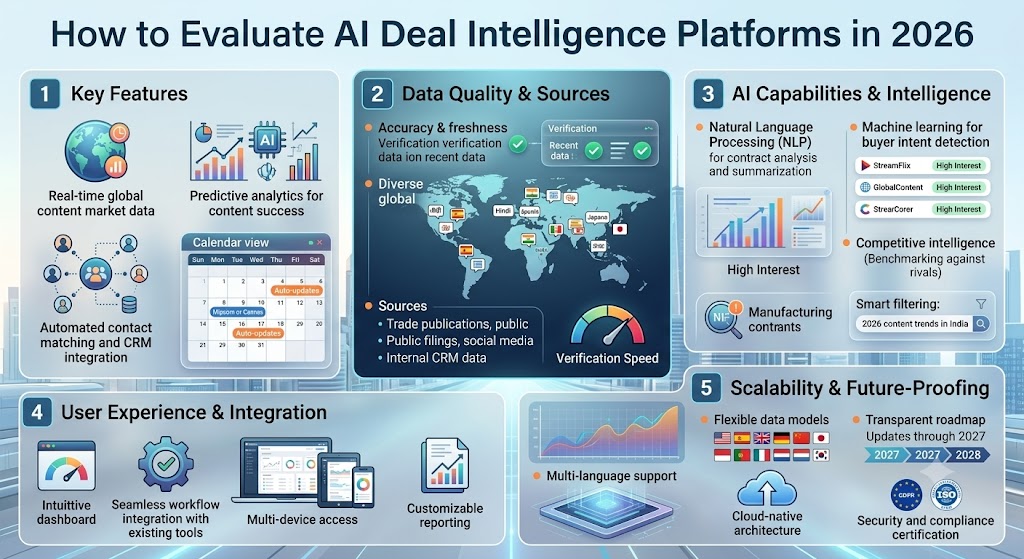
How to Choose an AI Deal Intelligence Platform: 5 Evaluation Criteria
Choosing an AI deal intelligence platform for TV content acquisitions requires evaluating five criteria that separate enterprise-grade entertainment intelligence systems from generic business data tools. Not every platform marketed as “AI-powered” delivers genuine deal intelligence. Teams that evaluate platforms rigorously before committing avoid the common failure mode of purchasing a data subscription that duplicates sources they already have, without adding the verification, classification, or signal generation capabilities that create actual operational value.
1
Verify the breadth and verification methodology of the company database.
A platform claiming to cover 50,000 companies with unverified, self-reported profiles is less valuable than one with 159,223 companies where each profile has been cross-referenced against regulatory filings, content registries, and verified deal activity. Ask the vendor specifically how each company record is validated and how frequently validation is refreshed. Platforms that cannot answer this question clearly are not genuine intelligence systems.
2
Assess deal classification depth and query flexibility.
Test whether the platform can answer specific operational queries: “Show me all drama co-production deals between European producers and Asian broadcasters closed in the last 6 months.” If the platform returns only company profiles rather than classified deal data, its classification layer is insufficient for acquisition team workflows. The ability to filter simultaneously by deal type, territory, genre, counterparty role, and deal recency is the minimum standard for a TV content deal intelligence platform.
3
Evaluate geographic coverage against your actual target markets.
If your acquisition mandate includes Southeast Asia, MENA, or Latin America, a platform with strong English-language coverage but sparse emerging-market data is actively misleading. Request coverage metrics specifically for your priority territories. The difference between 200 verified company profiles in Vietnam and 2,000 changes the quality of counterparty intelligence available to your team completely. Geographic depth, not just headline company counts, should drive platform selection.
4
Confirm data update frequency and signal latency.
Ask the vendor what their standard data update cycle is and whether real-time signal generation is included in the base subscription or priced as an add-on. Platforms that update core company profiles quarterly but charge a premium for daily deal signal alerts are effectively selling two products: a directory and an intelligence feed. For acquisition teams, the intelligence feed is the product. Confirm that the update cycle for deal signals specifically matches your operational tempo before signing.
5
Check integration capability with your existing deal management and CRM stack.
AI deal intelligence compounds in value when it integrates with the tools your team already uses. A platform that delivers intelligence through a standalone portal adds workflow friction; one that pushes verified counterparty data and deal alerts directly into your CRM or deal management system removes it. Confirm API availability, standard integration connectors, and whether the platform supports custom webhook configurations for your specific workflow architecture.
Teams looking to build a broader content acquisition intelligence infrastructure for distribution should treat AI deal intelligence as the cornerstone capability, not an add-on to legacy research methods. The platform choice made at this stage shapes the quality of every deal decision that follows.
Vitrina Intelligence Platform
Vitrina’s Role in AI Deal Intelligence for TV Content
Vitrina operates the M&E industry’s largest verified entertainment company database, covering 300,000+ companies across 100+ countries with continuously updated deal signals, counterparty profiles, and licensing activity data specifically for TV content, film, streaming, and format markets. For acquisition teams and entertainment financiers, Vitrina serves as the AI deal intelligence layer beneath every deal decision, replacing the fragmented research workflow with a single queryable intelligence platform.
Vitrina’s platform enables acquisition executives to run counterparty verification checks against verified deal histories before initial outreach, surface distributors actively acquiring in target genres and territories through VIQI natural language queries, monitor downstream licensing activity across an existing content portfolio, and identify rights gaps in specific territories using Vitrina’s territory coverage mapping tools. These capabilities operate across TV formats, scripted drama, documentary, unscripted, animation, and streaming-first content categories.
The Vitrina platform delivers intelligence at three levels of depth. At the company level, each profile includes verified legal entity data, service capabilities, deal history, known platform relationships, and territory coverage. At the deal level, Vitrina tracks active market transactions and surfaces signals relevant to each user’s acquisition mandate. At the market level, Vitrina’s aggregated deal data enables macro analysis of genre demand trends, territorial rights activity, and emerging acquisition priorities across the global M&E ecosystem.
For Acquisition Teams
Counterparty verification, distributor discovery, real-time deal alerts for target genres and territories.
For Financiers
Portfolio deal monitoring, rights territory mapping, market-level deal flow analysis across 100+ countries.
Market Intelligence
See Vitrina’s AI Deal Intelligence Platform Live
See how leading financiers and content acquisition teams use Vitrina to track TV deals, verify counterparties, and make faster licensing decisions.
What Is the Future of AI Deal Intelligence in Entertainment?
The trajectory of AI deal intelligence in entertainment points toward three developments that will reshape how TV content deals are sourced, structured, and closed over the next three to five years. PwC’s 2025 Global M&E Outlook projected that AI-powered deal intelligence adoption among Tier 1 and Tier 2 entertainment companies will reach 78% by 2027, driven by competitive pressure and the growing complexity of multi-territory streaming rights landscapes.
SOURCE
“AI-powered deal intelligence adoption among Tier 1 and Tier 2 entertainment companies will reach 78% by 2027, as multi-territory streaming rights complexity drives demand for real-time automated market intelligence across global TV content transactions.” – PwC Global Entertainment and Media Outlook, 2025
The first development is predictive deal scoring. Current AI deal intelligence platforms surface historical and real-time signals; next-generation systems will generate predictive scores estimating the probability that a specific counterparty will close a deal for a specific content category within a defined territory window. These scores will combine deal history, market demand signals, counterparty financial indicators, and competitive activity data into a single ranked opportunity list that acquisition teams can action directly.
The second development is automated deal structuring assistance. As AI systems accumulate enough historical data on how TV content deals in specific genres, territories, and format categories have been structured, they will generate deal structure recommendations calibrated to market norms. A financier evaluating a co-production deal for a 6-part drama targeting Southeast Asian streaming platforms will receive AI-generated benchmarks for minimum guarantee ranges, revenue share splits, and territory exclusivity windows based on comparable verified transactions.
The third development is cross-market deal graph analysis. As platforms accumulate verified deal data across multiple market cycles, the relationship maps between buyers, sellers, distributors, and platforms become rich enough to identify structural patterns in deal flow. These patterns reveal which distributors serve as critical bridge nodes between content sellers and platform buyers in specific territories, which studios consistently under-monetize specific rights categories, and where demand signals are diverging from supply availability at a pace that signals upcoming price movement. This level of market structure intelligence does not exist yet at the scale of the full global TV content market, but the data infrastructure to build it is being assembled right now.
Conclusion
AI deal intelligence is not a marginal productivity improvement for TV content acquisition teams. It represents a structural shift in how market information flows between buyers, sellers, and financiers in the entertainment industry. The teams that build their acquisition workflows around real-time, verified deal intelligence will consistently outpace those still relying on broker networks and trade press for counterparty data, market signals, and deal structure benchmarks.
The operational case is straightforward. Faster counterparty verification. Broader market visibility. Earlier deal signal detection. Reduced time on manual research and more time on negotiation and relationship management. Each of these advantages compounds across a portfolio of deals. Over a full acquisition cycle, the difference between a team using AI deal intelligence and one without it widens to the point where the two groups are effectively operating in different versions of the same market.
For entertainment financiers specifically, AI deal intelligence changes the risk calculus of every investment decision. When counterparty verification is thorough, real-time, and independently confirmed against market data, the due diligence process becomes faster without becoming less rigorous. That combination, speed and rigor together, is what the best AI deal intelligence platforms deliver. Platforms covering 159,223+ verified M&E companies at global scale, with continuous deal signal monitoring and queryable counterparty profiles, set the standard against which any acquisition team should evaluate their current research infrastructure.
About the Author
Vitrina Research Team
The Vitrina Research Team produces intelligence-led analysis on media and entertainment industry structure, deal activity, and market trends. Research draws on Vitrina’s proprietary dataset of 300,000+ verified M&E companies worldwide, with deal signals updated continuously across 100+ production and distribution territories.
Frequently Asked Questions
1
What is AI deal intelligence and how does it differ from a standard entertainment database?
AI deal intelligence goes beyond static company directories by continuously processing real-time signals from content registries, trade filings, and verified company submissions to surface active deal flow, counterparty histories, and territory rights data. A standard entertainment database stores company contacts; an AI deal intelligence platform tracks deal activity, classifies transactions by type and territory, and alerts acquisition teams to emerging opportunities before they reach open-market status. The distinction is between a library and a live market feed.
2
How does counterparty verification work in entertainment deal intelligence platforms?
Counterparty verification in AI deal intelligence platforms works by cross-referencing company profiles against verified deal histories, regulatory filings, content registries, and known platform and broadcaster relationships. Each counterparty profile includes confirmed legal entity data, transaction counts by deal type and territory, and recency of active deal-making. This allows acquisition teams to distinguish verified, actively-transacting distributors from inactive or unverified entities without committing to weeks of manual research. Platforms covering 159,223+ M&E companies provide statistically reliable counterparty verification at global scale.
3
Can AI deal intelligence track TV content licensing deals across multiple territories simultaneously?
Yes. Multi-territory deal tracking is one of the core operational advantages AI deal intelligence platforms provide over traditional research methods. A well-built platform aggregates deal signals from licensing registries, trade publications, and verified company submissions across 100+ countries simultaneously, classifying each transaction by territory, rights type, deal structure, and counterparty role. This enables a single acquisition team to maintain comprehensive visibility across Southeast Asia, MENA, Europe, and Latin America in parallel, without needing regional brokers for each market.
4
How quickly can AI deal intelligence replace manual due diligence for TV content deals?
AI deal intelligence does not replace legal due diligence but dramatically compresses the pre-legal research phase. Ampere Analysis (2025) found that counterparty verification using AI platforms takes under 48 hours compared to 2-4 weeks with traditional manual methods. The intelligence platform handles data gathering and initial counterparty profiling; legal teams then focus their time on verifying the specific terms and representations in draft agreements rather than sourcing basic company and deal history data from scratch. Teams report cutting total due diligence timelines by 40-60% after full platform adoption.
5
What data sources does a reliable AI deal intelligence platform use for TV content deals?
A reliable AI deal intelligence platform for TV content should draw from at least five distinct source categories: verified company submission databases, national and regional content registries, regulatory and corporate filings, trade publication APIs (C21, Broadcast, Variety, TBI), and market data providers such as Omdia, Ampere Analysis, and Parrot Analytics. Platforms relying on a single source type, typically trade press only, miss the majority of deal activity that occurs below the public announcement threshold, particularly in emerging markets and for sub-licensing and output deal transactions.
Find Film+TV Projects, Partners, and Deals – Fast.
VIQI matches you with the right financiers, producers, streamers, and buyers – globally.
Vitrina Membership
Every Conversation, Fully Unlocked
Vitrina members get the full LeaderSpeak archive, plus live webinars, the Global Digest, and VIQI — the AI that answers your specific market questions.


 IHUB
IHUB
 Private Briefings (Webinars)


 LeaderSpeak Podcast
  Global Entertainment Digest (Newsletter)
  Premium Lists
 Membership Benefits
 About Vitrina
 Our Story