IHUB
IHUB
 Private Briefings (Webinars)


 LeaderSpeak Podcast
  Global Entertainment Digest (Newsletter)
  Premium Lists
 Membership Benefits
 About Vitrina
 Our Story

Morocco’s film incentive rebate now returns 30% of eligible local spend to qualifying foreign productions, with no per-project cap, since the Centre Cinématographique Marocain (CCM) reformed the program in March 2022. For producers scouting desert, ancient, or Middle Eastern-adjacent settings, that rate — combined with decades of stand-in credibility from Gladiator, Game of Thrones, and the Mission: Impossible franchise — makes Morocco one of the more mature production economies in the MENA corridor. But the rebate mechanics, the CCM approval sequence, and the payout timeline are where most first-time applicants lose weeks they didn’t budget for.
This guide breaks down the current rate, what spend qualifies, how the CCM application actually works, and — because it is the question every finance department asks first — how long it really takes to get paid.
- Morocco’s foreign production rebate is 30% of eligible in-country spend, uncapped per project, in effect since the March 28, 2022 reform (up from 20%).
- Minimum eligibility: MAD 10 million (~$1 million) in Moroccan spend and at least 18 working days of shooting in Morocco, including set construction.
- Applicants must partner with a CCM-registered Moroccan production service company or co-producer — there is no direct-to-CCM route for a foreign entity alone.
- Initial CCM approval is issued within 30 days of a complete application; a 5% bank guarantee of the requested support is then required.
- Rebate payment is transferred within a maximum of 180 days after the CCM receives the complete post-production payment request file — historically slower in practice, though the CCM has worked to compress this window.
- Morocco also exempts qualifying production purchases from roughly 20% VAT, stacking on top of the cash rebate.
Morocco’s film incentive rebate refunds 30% of a foreign production’s qualifying local expenditure, with no cap on the total amount per project, provided the production spends at least MAD 10 million and films a minimum of 18 days in the country — administered by the Centre Cinématographique Marocain (CCM).
How Morocco’s Film Incentive Rebate Works and the Current Rate
Morocco’s incentive is a cash rebate, not a tax credit — the CCM reimburses a percentage of verified local spend directly to the production’s bank account after filming wraps and accounts are audited, rather than offsetting a domestic tax liability. That structure matters for producers with no Moroccan tax presence, which describes the overwhelming majority of foreign shoots.
The current rate is 30% of eligible expenditure incurred in Morocco, effective from the reform of March 28, 2022, which raised the previous 20% rate and removed the per-project cap that existed under the earlier scheme. The program is formally known as “Production Support for Foreign Cinema and Audiovisual Works” and is governed by Joint Order 2117-18, administered by the CCM’s foreign production unit.1
Because the rebate is uncapped per project, a large-budget series or feature can, in principle, recover a proportionally larger dollar amount than under capped MENA schemes — though the CCM’s annual disbursement fund is itself finite, which is worth understanding before assuming unlimited headroom (see Recent Program Changes below).
Qualifying Expenses and Eligibility Thresholds
To qualify, a production must spend a minimum of MAD 10 million (roughly $1 million) in Morocco and complete at least 18 working days of shooting in the country, which can include set construction and preparation days and can be split across multiple regions.2 Below either threshold, the project is not eligible for the rebate at all — there is no partial or reduced-rate tier for smaller shoots.
Eligible local costs generally include camera, grip, and lighting rental; generators and set construction materials; local crew wages; editing, Foley, ADR, color grading, and mixing performed in Morocco; and visual effects work invoiced by Morocco-based vendors. (Source: pulpscreen.com / CCM program summary, 2025.)
Costs that are invoiced outside Morocco, or paid to non-resident vendors for work performed abroad, do not count toward the qualifying spend base — a distinction that trips up productions that assume post-production farmed out internationally will still count. Above-the-line costs (director, principal cast, and producer fees) are typically excluded from the rebate base in Morocco’s scheme, consistent with most global cash-rebate models, though production companies should confirm exact line-item treatment with a Morocco-registered co-producer before locking a budget.
How to Apply Through the CCM
The application route runs through a Moroccan partner, not directly from the foreign production entity. A production must first engage a Moroccan production service company or co-producer registered with the CCM, then that partner submits the request on the production’s behalf, detailing the project’s nature, distribution plan, planned duration of work in Morocco, total investment program, and the specific financial support being requested.
Within 30 days of receiving a complete request, the CCM issues initial approval and requires the production to post a bank guarantee equal to 5% of the requested support, which is renewable once. (Source: broadway.ma / CCM application summary, citing Joint Order 2117-18, 2025.)
Once approved and the guarantee is posted, the production can proceed with filming. After wrap, the Moroccan co-producer compiles a full accounting of qualifying local expenditure — invoices, payroll records, and supporting documentation — and submits it to the CCM as the “payment request file.” This file is what starts the reimbursement clock, which is why assembling clean, audit-ready local invoices during production, rather than reconstructing them afterward, is the single biggest lever a production has over its own timeline.
Eligible content types span feature films, television series, docufiction, documentaries, and long-form fiction intended for internet distribution — a broader net than some MENA programs that restrict eligibility to theatrical features.
Comparing incentive economics across multiple countries at once?
Vitrina indexes 159,223 media and entertainment companies globally, including Morocco-registered production service partners and CCM-affiliated co-producers, so finance teams can vet local partners before an incentive application locks in a shooting plan.
Payout and Turnaround Timing
This is the question every producer and CFO asks before committing to Morocco, and it deserves a direct answer: the CCM is obligated to transfer the rebate payment within a maximum of 180 days (roughly six months) after it receives a complete payment request file, per the program’s governing regulation.3
Industry reporting notes that some productions historically waited up to a year for rebate funds to arrive, a delay the CCM has worked to compress toward the formal six-month ceiling, with hopes of shortening it further to three or four months. (Source: ScreenDaily, “Morocco tempts global productions,” industry feature.)
In practice, the real-world clock has two segments producers should budget separately. First, the post-wrap accounting window: productions are generally expected to submit a complete, itemized account of Moroccan expenditure within roughly three months of finishing the shoot. Second, the CCM’s own review-and-disburse window, capped at 180 days from when that file is deemed complete. Incomplete submissions — missing invoices, mismatched vendor registrations, unreconciled local payroll — reset or extend this clock, which is the most common reason a rebate that should have landed in six months stretches toward twelve.
The practical planning implication: treat the Morocco rebate as a cash-flow event roughly six to twelve months after wrap, not a same-year offset, and finance accordingly with a completion bond or bridge facility if the rebate is underwriting a meaningful share of the budget.
Recent Program Changes
The most consequential change remains the March 2022 reform that lifted the rebate from 20% to 30% and removed the prior per-project cap — the single biggest driver of Morocco’s renewed competitiveness against Gulf incentive schemes that followed with their own increases. Morocco hosted 48 foreign film and television productions in 2025, drawing more than MAD 1.21 billion (about $129 million) in inbound production investment, up sharply from roughly MAD 497 million ($53 million) in 2017 — evidence the uncapped structure is translating into real volume.4
Total cinema-sector investment in Morocco, including domestic production and infrastructure, reached nearly MAD 1.8 billion in 2025. The CCM’s own annual grant fund for Moroccan national productions is reported at roughly €10 million separately from the foreign production rebate fund — a reminder that the foreign rebate pool, while uncapped per project, still operates against an annual budget appropriation rather than an infinite guarantee.5 Morocco has also signaled a broader industry-policy shift, with officials at Berlinale 2026 framing the country’s ambition beyond being a filming location toward building its own content and IP — worth watching as it may eventually shape how incentive priority is allocated between service productions and Moroccan-led co-productions.
How Morocco Compares to Other MENA Incentives
Morocco’s 30% uncapped rebate is now the most conservative of the region’s major schemes on headline rate, even as it remains the most established in terms of production volume and crew depth. For context:
- Saudi Arabia raised its Film AlUla rebate to 60% in 2026, positioning it at the top of the global incentive landscape and well above typical European national caps of 25–40%.
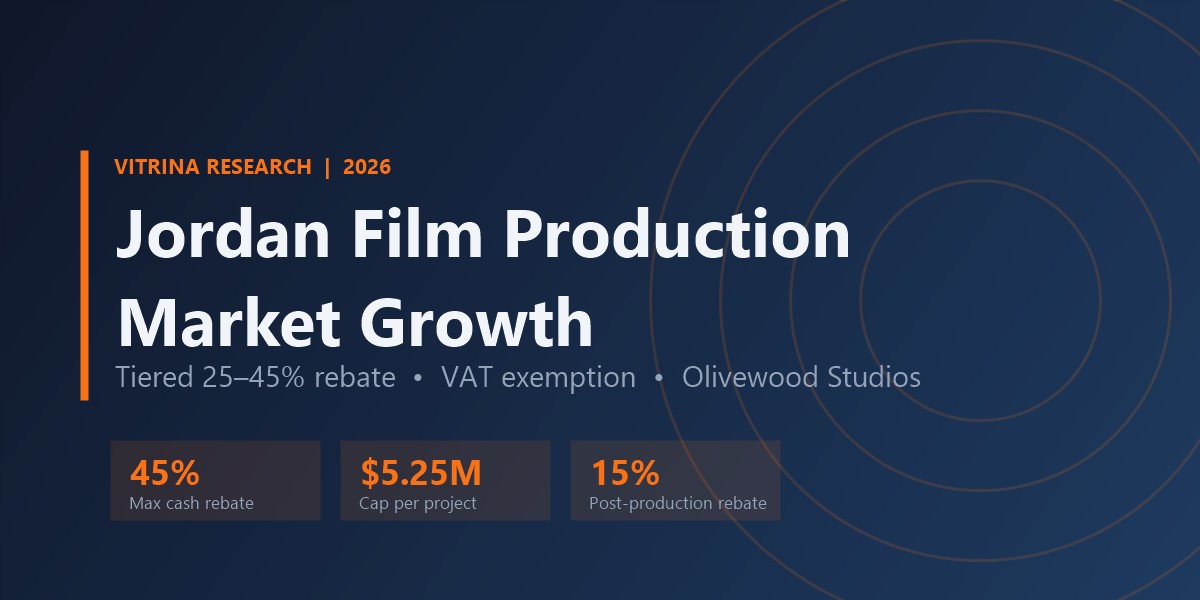
- Jordan operates a tiered, points-based rebate from 25% up to 45%, with the top rate reserved for productions over $10 million that incorporate Jordanian cultural content.
- Abu Dhabi (UAE) offers a 30% rebate as well, with some reporting suggesting the emirate is positioning to compete above 35%.
- Egypt has renewed inbound production interest but does not currently publish a comparably documented, standardized cash-rebate percentage — not publicly disclosed at a program level comparable to Morocco, Jordan, or Saudi Arabia.
The takeaway for producers: Morocco no longer wins on rate alone. Its case now rests on infrastructure maturity, crew depth, faster practical familiarity for line producers, and a longer, better-documented track record with the CCM bureaucracy than newer Gulf schemes still building out their administrative machinery.
Weighing Morocco against Jordan, Saudi Arabia, or Malta?
Vitrina’s database of 159,223 entertainment companies covers production service providers, VFX houses, and studio facilities across every major incentive jurisdiction — built for exactly this kind of side-by-side evaluation.
Why Productions Keep Choosing Morocco
Beyond the rebate rate, Morocco’s pull is infrastructural. Atlas Studios in Ouarzazate, established in 1983 and often cited as one of the world’s largest film studios by land area, still carries standing sets — Egyptian temple facades from The Mummy, Roman forum ruins from Gladiator, medieval fortress walls — that let productions shoot period and Middle Eastern-set material without building from scratch. Ouarzazate’s desert geography and light have made it the default stand-in for ancient Rome, biblical-era Middle East, and fictional desert kingdoms across decades of film and television, most visibly in HBO’s Game of Thrones and the Mission: Impossible franchise.
Crew depth compounds the location advantage. Roughly 80% of on-location movie staff in Ouarzazate are Moroccan, reflecting four decades of continuous industry activity that has built deep local expertise in construction, wardrobe, and specialty crafts tied to historical and desert productions. Labor and construction costs are frequently cited by production service companies as running at roughly half of equivalent European or U.S. rates, though exact figures vary by department and should be confirmed with a current local budget rather than treated as a fixed multiplier.
Combined with the rebate, the roughly 20% VAT exemption on qualifying production purchases, and direct flight access from major European hubs, Morocco offers a lower total cost of ownership for desert and historical productions than most competing jurisdictions — even where the headline rebate percentage trails Saudi Arabia or Jordan.
Common Pitfalls to Avoid
- Underestimating the minimum-spend and minimum-day thresholds. A shoot that falls short of MAD 10 million or 18 working days receives nothing — there is no reduced or prorated tier.
- Choosing a Moroccan partner late. Because the application must be filed through a CCM-registered Moroccan production service company or co-producer, selecting that partner should happen during early budgeting, not after the shooting schedule is locked.
- Sloppy local invoicing. Only spend invoiced locally by Moroccan-registered vendors counts toward the eligible base; post-production or VFX work routed through non-Moroccan entities will not qualify even if the creative work touches Moroccan footage.
- Underbudgeting for the payout lag. Treating the rebate as available at wrap, rather than six to twelve months later, creates avoidable cash-flow strain — plan bridge financing if the rebate underwrites a meaningful share of the budget.
- Incomplete payment request files. Missing invoices or unreconciled payroll documentation is the most common reason the 180-day clock resets or extends well past the formal ceiling.
How Vitrina Helps Producers Navigate Tax Incentives
Evaluating an incentive rate is only half the decision — the other half is knowing which local partners, service companies, and crew can actually deliver against the CCM’s eligibility requirements. Vitrina’s database of 159,223 media and entertainment companies worldwide lets production and finance teams identify CCM-registered Moroccan co-producers, VFX vendors, and studio facilities before an application is filed, reducing the risk of a late-stage partner swap that can delay both the shoot and the eventual rebate submission.
verified production companies in Morocco and MENA
Because incentive comparisons increasingly span multiple countries in a single greenlight decision — Morocco against Jordan, Saudi Arabia, or Malta, for instance — Vitrina’s platform is built to let teams cross-reference vendor capability, crew availability signals, and company track records across every major incentive jurisdiction in one search, rather than reconstructing that picture from a dozen separate consultancy PDFs.
how film tax incentive research works
Conclusion
Morocco’s 30% uncapped cash rebate remains a credible, well-tested incentive for productions built around desert, ancient, or Middle Eastern-adjacent settings — but it is no longer the highest rate in the MENA region, and its administrative process rewards early, careful preparation. Producers who lock in a CCM-registered local partner during initial budgeting, keep invoicing clean and locally documented throughout the shoot, and plan cash flow around a six-to-twelve-month payout window will get the most out of the program. Those who treat it as a same-year rebate with loose paperwork tend to be the ones still waiting past the 180-day mark.
global film incentive programs
Frequently Asked Questions
What is the current Morocco film incentive rebate rate?
The current rate is 30% of eligible local expenditure, uncapped per project, in effect since the CCM’s March 2022 reform raised it from the previous 20% rate.
What is the minimum spend to qualify for Morocco’s rebate?
A production must spend at least MAD 10 million (approximately $1 million) locally and shoot a minimum of 18 working days in Morocco, including set construction, to qualify.
How long does it take to receive the Morocco film rebate payment?
The CCM is required to transfer payment within a maximum of 180 days (about six months) after receiving a complete payment request file, submitted after post-production accounting is finalized. In practice, incomplete documentation has historically pushed some payouts closer to a year, though the CCM has worked to bring turnaround closer to the six-month ceiling.
Can a foreign production apply to the CCM directly?
No. Applications must be submitted through a Moroccan production service company or co-producer registered with the CCM — a foreign entity cannot apply on its own.
How does Morocco’s rebate compare to Jordan or Saudi Arabia?
Morocco’s 30% rate is now lower than Jordan’s tiered 25–45% rebate and well below Saudi Arabia’s 60% Film AlUla rebate introduced in 2026. Morocco’s advantage instead rests on established infrastructure, crew depth, and a longer administrative track record.
Does Morocco offer any incentive beyond the cash rebate?
Yes. Qualifying production purchases are also exempt from Morocco’s roughly 20% VAT, which stacks on top of the 30% cash rebate to further reduce net local production costs.
Vitrina’s research team tracks production incentive programs, company data, and market intelligence across the global media and entertainment industry, drawing on a database of 159,223 verified companies to help producers, financiers, and commissioners make faster, better-informed decisions.
Find the right partners for your next incentive-backed shoot
Search 159,223 production companies, service providers, and studios across every major film incentive jurisdiction on Vitrina.
Sources
1. Centre Cinématographique Marocain (CCM), “Production Support for Foreign Cinema and Audiovisual Works” — ccm.ma
2. Pulpscreen, “CCM Foreign Film Production Support — Morocco Production Incentive” — pulpscreen.com
3. Broadway.ma, “International Production Support Morocco: Cash rebate” — broadway.ma; ScreenDaily, “Morocco tempts global productions with spectacular locations, talented crews and improving cash rebate” — screendaily.com
4. Barlaman Today, “Morocco Hosted 48 Foreign Film and TV Productions in 2025” — barlamantoday.com
5. Morocco World News, “Moroccan Cinema Booms with MAD 1.8 Billion Investment in 2025” — moroccoworldnews.com
Additional reference: Deadline, “Jordan Bolsters Film Incentives; Raises Cash Rebate To 45%” — deadline.com; Variety, “Saudi Arabia Raises Film and TV Production Rebate to a Whopping 60%” — variety.com