IHUB
IHUB
 Private Briefings (Webinars)


 LeaderSpeak Podcast
  Global Entertainment Digest (Newsletter)
  Premium Lists
 Membership Benefits
 About Vitrina
 Our Story
By Vitrina Research Team | Published: October 13, 2026 | 10 min read
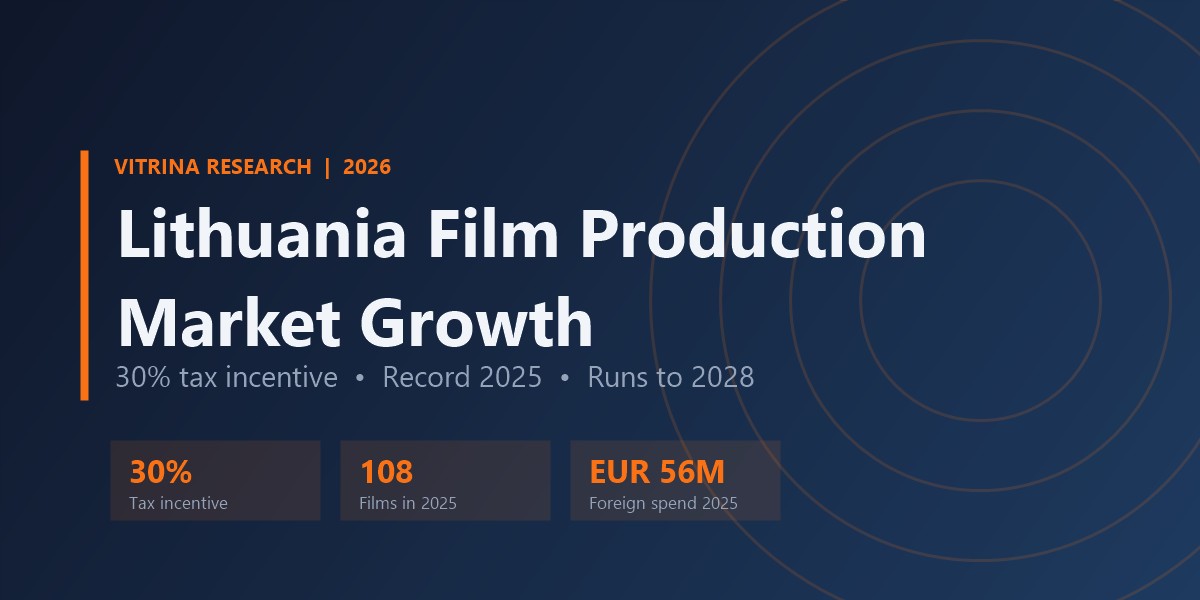
Lithuania film production market growth reached a new high in 2025. A record 108 films benefited from the country’s Film Tax Incentive, Lithuanian companies invested €25.6 million in productions through the scheme, and foreign filmmakers spent close to €56 million in Lithuania, according to the Lithuanian Film Centre, as reported by Cineuropa. For producers, financiers, and streaming executives, a Baltic country best known to international audiences for doubling as the Soviet Union in “Chernobyl” has become a dependable, incentive-backed production base.
The structure is unusual and stable. Lithuania’s incentive lets productions finance up to 30% of their budget through local corporate investors who receive a corporate tax benefit in return, and the scheme has been extended through 31 December 2028. Eligibility is set by clear rules published by the Lithuanian Film Centre: at least 80% of eligible costs incurred in Lithuania, a minimum eligible spend of €43,000, and a cultural test. For producers used to straightforward cash rebates, understanding how this investor-based model works is the key to using it well.
Key Takeaways
- Lithuania’s Film Tax Incentive covers up to 30% of a production budget through local corporate investors, who receive a corporate income tax benefit in return.
- The scheme runs through 31 December 2028, requires at least €43,000 of eligible local spend, and needs at least 80% of eligible costs incurred in Lithuania.
- In 2025, 108 films benefited (68 national films, 21 co-productions, 19 service projects), with €25.6 million invested through the scheme.
- Foreign filmmakers spent close to €56 million in Lithuania in 2025, led by season one of the U.S. series “Star City.”
- Vilnius hosted 22 feature films and series in public spaces in 2025, creating more than 2,200 temporary jobs, and launched a new city film fund.
Why Lithuania Is Emerging as a Baltic Production Hub
Lithuania built its international profile on period and Cold War drama. HBO’s “Chernobyl” used Vilnius and the decommissioned Ignalina nuclear plant to recreate 1980s Soviet Ukraine, and Netflix’s “Stranger Things” shot Soviet prison scenes for its fourth season in Vilnius. Earlier productions such as the BBC’s “War and Peace” and the HBO and Sky series “Catherine the Great” used Lithuanian palaces, streets, and crews.
Lithuania film production market growth now rests on three factors. First, an incentive that has run continuously since 2014 and was raised to 30% in 2019, giving producers a long and predictable track record. Second, versatile locations: Vilnius’s baroque Old Town, Soviet-era architecture, and modern districts can stand in for many European and Eastern Bloc cities. Third, a skilled, EU-based crew pool that has delivered for HBO, Netflix, and the BBC.
For producers and financiers, the question is how to structure the investor-based incentive and whether local crew capacity fits their project. The table below summarizes the essentials.
| Metric | Detail | Source |
|---|---|---|
| Incentive rate | Up to 30% of production budget via local corporate investors | Lithuanian Film Centre |
| Minimum local spend | €43,000 of eligible spend in Lithuania | Lithuanian Film Centre |
| Local cost requirement | At least 80% of eligible costs incurred in Lithuania | Lithuanian Film Centre |
| Scheme term | Extended to 31 December 2028 | Lithuanian Film Centre |
| 2025 results | 108 films; €25.6M invested; ~€56M foreign spend | Lithuanian Film Centre via Cineuropa |
How Big Is Lithuania’s Film Production Market?
Lithuania is a small market of under three million people, so production growth is measured by incentive use and inbound spend rather than box office. The 2025 numbers show steady expansion: 108 films benefited from the incentive, compared with 89 in 2024 and 101 in 2023. Service projects for foreign productions received €16.7 million of the €25.6 million invested. That balance, with strong national and co-production activity alongside service work, shows that Lithuania film production market growth is supported by both local filmmakers and international clients.
Films Benefiting from Lithuania’s Tax Incentive
Source: Lithuanian Film Centre, Film Tax Incentive results 2023–2025
How the 30% Investor-Based Incentive Works
Unlike a direct cash rebate, Lithuania’s incentive is funded by private companies. A local production company applies to the Lithuanian Film Centre and brings in one or more Lithuanian corporate donors, who contribute up to 30% of the production budget. In return, the donors reduce their corporate income tax, with an estimated net benefit of up to 12%. Eligible formats include feature films, TV dramas, documentaries, and animation. Projects must pass a cultural test, meeting at least two of eight criteria, shoot at least three days in Lithuania (animation excepted), and keep actor fees within 4% of eligible costs. Producers comparing it with regional schemes can review Vitrina’s Poland film tax incentive and co-production guide.
The Extension to 2028 and Vilnius Film Fund
Lithuania’s parliament extended the incentive for five years at the end of 2023, so it now runs to the end of 2028. Vilnius added its own layer of support in 2025 by creating a city film fund to attract international productions, which operates alongside the national scheme.
Studio and Crew Infrastructure
Lithuania’s production capacity is concentrated in Vilnius, where production service companies, equipment rental houses, and post-production facilities support both local and international projects. Much of the country’s appeal is location-based, using real streets, palaces, and Soviet-era buildings rather than large soundstages. Producers looking for local partners can start with Vitrina’s directory of top production houses in Lithuania.
Why International Producers Are Choosing Lithuania Now
The largest foreign project in 2025 was season one of “Star City,” a U.S. series that accounted for about €6.9 million of incentive support on its own, followed by the German production “Mozart” and the Polish production “Riot.” That mix shows Lithuania attracting both American streaming series and European co-productions.
Vilnius has also become more welcoming to productions. The city’s film office reported that 22 Lithuanian and international feature films and series shot in public spaces in 2025, along with 65 commercials, creating more than 2,200 temporary jobs. The new Vilnius film fund adds another incentive layer for productions basing themselves in the capital.
The incentive’s stability is the deeper reason producers return. Running since 2014, raised to 30% in 2019, and extended to 2028, it gives financiers a long record of the scheme working as promised. Producers building Baltic and Nordic co-productions often combine Lithuania with the funds covered in Vitrina’s Nordic co-production financing guide.
VITRINA INTELLIGENCE
Who’s Actually Producing in Lithuania Right Now?
Trade headlines show you the HBO and Netflix shoots. VIQI shows you the verified production companies, service vendors, and financiers behind them — searchable by capability, budget tier, and deal activity across 159,223 companies, instead of chasing referrals.
How Producers Access Lithuania’s Incentive and Local Partners
Because the incentive runs through a Lithuanian company and its corporate donors, the local partner is central to both financing and production.
Applying for the Film Tax Incentive
The Lithuanian production company submits the application to the Lithuanian Film Centre, with the budget, cultural test, and production plan. Once the project is approved, the production company signs agreements with corporate donors, who transfer funds and claim their tax benefit. Experienced service companies usually maintain relationships with donors, which makes arranging the investment much faster. Producers should confirm early which costs qualify, since development, marketing, distribution, and certain travel costs are excluded, and actor fees above the 4% limit do not count toward eligible spend.
Structuring Co-Productions and Local Partnerships
Foreign productions cannot apply directly, so they work with a Lithuanian service company or co-producer. As an EU member and Eurimages participant, Lithuania also offers European co-producers access to additional public funding. Producers should model the timing of donor investment alongside other financing so cash is available when spending begins. Because donors contribute during the tax year, the timing of corporate tax planning can affect when funds arrive, which is another reason to work with a partner who has arranged donor investment before.
What Are the Core Challenges in Producing in Lithuania?
Lithuania film production market growth brings two practical constraints that producers should plan for.
Crew Depth and Stage Capacity
Lithuania’s crew pool is skilled but small, and large productions can stretch it, especially when several shoot at once. Soundstage capacity is limited compared with larger European hubs, so stage-heavy projects need to confirm availability early or plan to work mostly on location.
Investor-Based Mechanics and Local Spend Rules
The donor model is less familiar to international financiers than a government-paid rebate, and the requirement to incur at least 80% of eligible costs locally can limit flexibility for projects shooting in several countries. Clear budgeting of which costs qualify is essential. Productions shooting across several Baltic or Nordic countries should map which departments and shooting days will be based in Lithuania before deciding how much of the budget to place there.
Which Regions Within Lithuania Are Attracting the Most Production?
Production activity is concentrated in three areas.
Vilnius: Crews, Services, and Versatile Streets
Vilnius is home to most crews and service companies, and its Old Town, Soviet-era districts, and modern architecture can double for many European cities.
Kaunas: Interwar Architecture and Industrial Sites
Kaunas offers interwar modernist buildings and industrial locations, useful for period dramas set in the early 20th century. The city’s mix of preserved interwar buildings and Soviet-era housing gives productions several decades of architecture within a compact area.
The Coast and Countryside: Dunes, Forests, and Soviet Sites
The Curonian Spit’s dunes, the Baltic coast, forests, and former Soviet sites, including the Ignalina nuclear plant used in “Chernobyl,” provide distinctive landscapes within a short drive of Vilnius.
What Makes a Production a Good Fit for Lithuania?
Lithuania film production market growth does not benefit every project equally, and fit should be checked early.
Budget Tier and Spend Profile
Projects that can concentrate most of their eligible spend in Lithuania benefit most, given the 80% local cost requirement. The low €43,000 minimum also makes the scheme accessible to documentaries, smaller co-productions, and animation.
Genre and Location Fit
Cold War and historical dramas, thrillers, and stories set in Eastern Europe or Russia make strong use of Lithuania’s architecture. Projects that need to double for other European capitals can also use Vilnius’s varied streets. Animated projects and documentaries also fit well, since the scheme sets lower requirements for animation and the minimum spend is accessible to smaller budgets.
How Lithuanian Service Vendors and Studios Are Getting Discovered by International Productions
With record incentive use, international producers considering Lithuania face a discoverability gap. There is no central, verified view of which service companies have donor relationships, which crews have streamer credits, and which vendors have capacity for a given schedule. Most introductions still run through the Lithuanian Film Centre, festivals, and referrals.
For Lithuanian production companies and vendors, being visible to international producers and platform sourcing teams is now a clear business development advantage, especially as competition among Baltic and Central European markets grows.
VITRINA INTELLIGENCE
Invisible to the Producers Looking at Lithuania?
International spend in Lithuania hit record levels in 2025, and most of it still moves through referrals. List your service company, studio, or vendor business on Vitrina and get found by the producers actively sourcing Lithuanian partners.
How Vitrina Helps Producers and Financiers Navigate the Lithuanian Market
Acting on Lithuania film production market growth requires knowing who is actively producing, which service companies can manage the incentive and donor process, and which co-producers and financiers are working in the Baltics. That intelligence has historically been scattered across trade coverage, festival catalogs, and personal networks. VIQI, Vitrina’s M&E intelligence platform, consolidates it into a searchable database of 159,223 verified companies worldwide.
Producers and financiers use VIQI to identify Lithuanian production companies, studios, and vendors by capability, budget tier, and deal activity, cutting partner research from weeks to hours. Film offices use it to understand which producers are evaluating their territory.
For Lithuanian studios and vendors, a VIQI listing puts their credits and capabilities in front of the international producers and streaming teams evaluating the market.
VITRINA INTELLIGENCE
Still Finding Lithuanian Partners by Cold Email?
See how producers and financiers use VIQI to go from weeks of cold outreach to a focused, hours-long search — verified production companies, vendors, and co-production partners across 159,223 companies.
Conclusion
Lithuania film production market growth is steady and well documented. A 30% investor-based incentive running through 2028, record use in 2025, close to €56 million in foreign spend, and a track record with HBO, Netflix, and the BBC make the country a reliable option for European and American productions.
The opportunity comes with conditions. Producers and financiers need to understand the donor model, meet the local cost requirement, and plan around a small crew pool. Lithuanian vendors are well placed to win more international work, if buyers can find them.
For producers and acquisition executives, the practical challenge is intelligence: who is producing in Lithuania, who holds verified local capacity, and who is structuring incentive-backed deals. That is the gap VIQI is built to close. Start your search for Lithuanian production partners today.
Frequently Asked Questions
What is the film tax incentive in Lithuania?
Lithuania’s Film Tax Incentive allows productions to finance up to 30% of their budget through Lithuanian corporate donors, who receive a corporate income tax benefit. Projects need at least €43,000 of eligible spend in Lithuania, must incur at least 80% of eligible costs locally, and must pass a cultural test.
What is driving Lithuania film production market growth in 2026?
A stable incentive extended to 2028, record results in 2025 with 108 films benefiting and close to €56 million in foreign spend, international series such as “Star City,” and the new Vilnius film fund for international productions.
Can foreign producers apply directly for Lithuania’s incentive?
No. Applications must be made by a Lithuanian production company, which brings in the corporate donors. Foreign producers usually work with an experienced local service company or co-producer.
What are the biggest challenges of producing in Lithuania?
A small crew pool and limited soundstage capacity are the main operational constraints. The investor-based model and the 80% local cost requirement also need careful planning for multi-country productions.
How can Lithuanian studios and vendors get discovered by international productions?
Many Lithuanian service companies and vendors still rely on the film centre, festivals, and referrals. Listing on an M&E intelligence platform like Vitrina’s VIQI puts verified credits and capabilities in front of producers and streaming platforms sourcing partners for Lithuanian shoots.
About the Author
Vitrina Research Team
The Vitrina Research Team produces intelligence-led analysis on media and entertainment industry structure, deal activity, and market trends. Our research draws on VIQI’s proprietary dataset of 159,223 M&E companies worldwide.