May 2025: Growth in Americas & EMEA Boosts Global Productions
May 2025 saw an upswing in global TV and film production, with both new project commissions and season renewals rising across most major regions. The Americas and EMEA led the growth, with broadcasters and global streamers like Netflix, Prime Video, BBC, and Channel 4 significantly ramping up activity.
- English-language content gained further prominence, continuing its lead across most markets.
- Formats remained the structure of choice, particularly among broadcasters.
- APAC reported a slight dip in overall volume, but continued to stay active with:
- Ongoing commissioning by Netflix
- Increased output in local languages like Hindi and Korean
- Genre trends showed subtle movement, with Comedy gaining traction globally.
Welcome to the latest edition of Vitrina’s global tracking of Film and TV production trends, providing insights across Movies and Feature Films, TV series, Animations, Documentaries, Scripted, and Unscripted projects.
Before we dive into May 2025 metrics, let’s recap the key Film and TV production trends driving the industry over the last 3 years & 4 months.
The Global Monthly Film + TV Production Report is curated by Vitrina experts with insights from our network. The audio podcast was generated with Deep Dive and reviewed by our team.
Global Film & TV Production: Updated for May-2025
![Vitrina Film+TV Production Insider [May 2025] 20 unnamed (17)](https://vitrina.ai/wp-content/uploads/2025/06/unnamed-17.png)
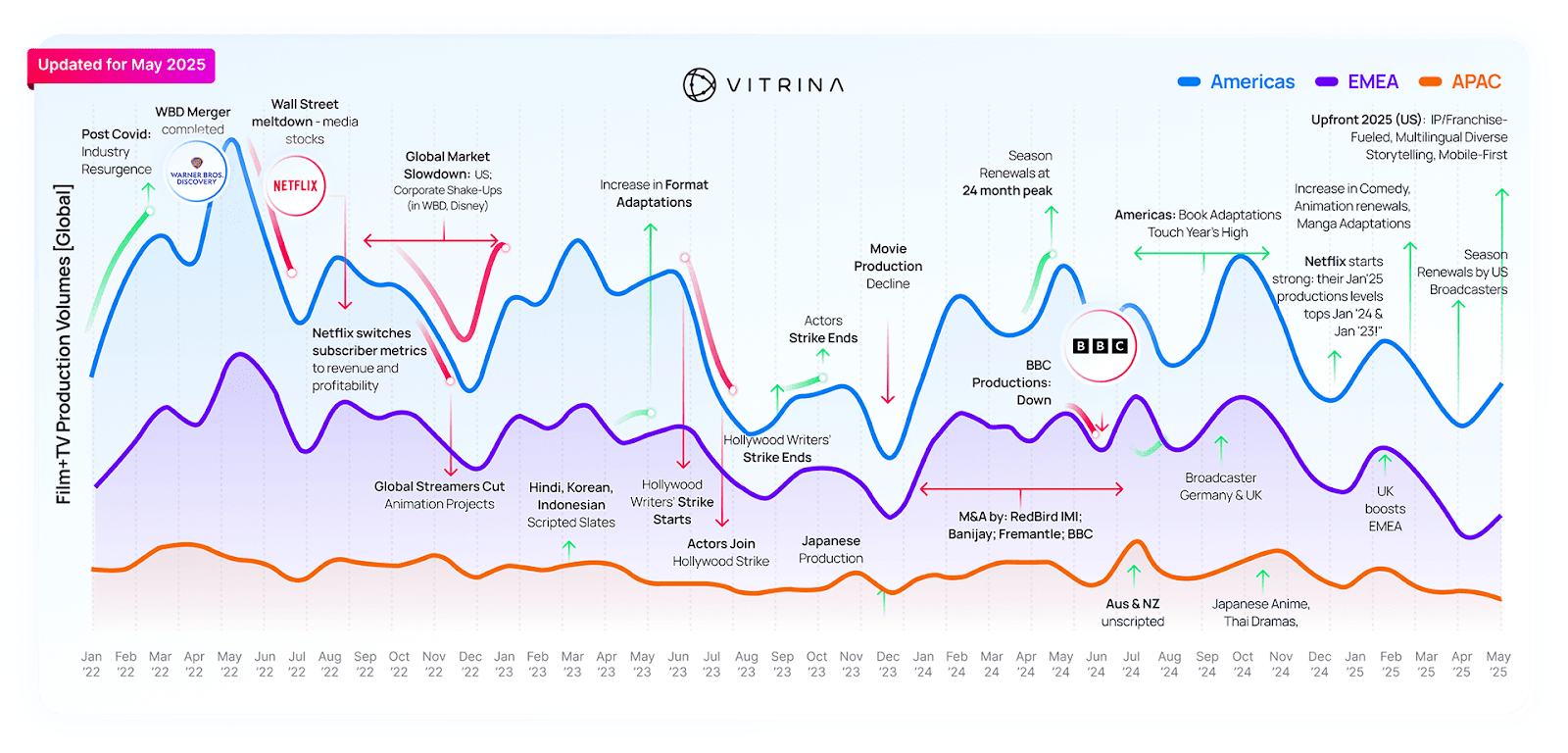
Source: Vitrina Daily Production Tracker. [X-Axis : Months starting from Jan 2021. Y-Axis Production Volumes : Production Volumes are the total number of projects greenlit or financed or commissioned in that month.
As is evident from the monthly trends monitored by Vitrina globally for Film+TV Productions that were commissioned, greenlit or financed – the last 3 years have been turbulent and eventful – to say the least! A quick summarized view would be:
2022: A year of extremes—an early-year “revenge production financing” surge fueled by post-COVID recoveries, followed by a sharp market correction on Wall Street’s market-cap reset for entertainment companies, leading to widespread budget tightening.
2023: Marked by Hollywood strikes, which froze scripted productions in the US & UK, forcing many studios to pivot toward unscripted content and international markets to keep productions moving.
2024: A year of stabilization with no major peaks, but regional surprises—Japan, ANZ, Germany, and Brazil saw production spikes, while broadcasters continued scaling back commissioning amid shifting business models.
Jan -May 2025 : From Jan’25 to May’25, Netflix led the global commissioning activity, well ahead of Prime Video, BBC, Channel 4, and Fox. Season Renewals and Book adaptations showed steady month-on-month growth during this period, both peaking in May. Broadcaster commissioning climbed until March, dipped in April, and began recovering in May’25, though overall production orders remained below the same period last year. German-language productions rose notably in Q1, with the top commissioning countries between this year being the USA, UK, India, Germany, Canada, and France.
Insights on Production Transaction Volumes
May’ 25 vs. April’ 25
Methodology: Vitrina monitors projects worldwide across all stages of the content lifecycle—development, production, post-production, and release—on a daily basis. We track various transactions and deal activities related to content financing, commissioning, co-productions, green-lighting, as well as early stage (content development) and late stage (licensing). These transactions between production houses, distributors, streamers, and broadcasters enable us to gain valuable insights into industry trends, key players, buyer behavior, and the specializations of production companies. Our monthly Film+TV productions chart serves as a bellwether of production financing and industry health.
Below are the key highlights for May Film+TV Production Volumes:
- Global Production Trends: Global productions grew by 20% in May ’25 compared to April. EMEA and the Americas reported strong gains, with increases of 29% and 34%, respectively. APAC saw a slight decline, but the overall impact was not significant due to its smaller production base. The month also saw a modest rise in both book adaptations and co-productions. The growth was largely driven by U.S.-based players, with global U.S. platforms actively commissioning new projects across the EMEA region as well.
- Genre and Language Trends: In May ’25, English-language productions saw a rise, driven by increased commissioning from U.S.-based companies, while Spanish and French content remained steady. Drama and Comedy continued to lead as the top genres, consistent with the previous month. The overall balance between scripted and unscripted content remained stable.
- Top Players Overall: Netflix continued to dominate the production landscape in May ’25, increasing its production announcements from April. Prime Video, BBC, Channel 4, ZDF, and ARD also retained their top-tier positions, each with higher commissioning volumes than the previous month. New entrants to the top 10 this month include Bravo, Apple TV+, and Allen Media Group, reflecting a broader expansion in activity. Fox Network remained among the top 10 platforms like previous month.
- Within AMERICAS: Americas saw a rise in overall and new productions in May ’25. Netflix, Prime Video, Bravo, Apple TV+, NBC, Peacock, Fox Network were key drivers of this growth. Language contributions remained largely consistent, with English continuing to dominate and Spanish and Portuguese holding steady.
Major players like NBCUniversal, TelevisaUnivision, Disney, Netflix, Amazon, and Warner Bros. Discovery and YouTube held Upfront 2025 presentations in May 2025, showcasing their 2025-26 content slates and advertising strategies. Apart from sports, there was a focus on unscripted content by global streamers; Disney and NBCUniversal leaned into star-driven projects and proven IP, mobile-friendly formats; while TelevisaUnivision announced multiple scripted micro-dramas. - Within EMEA: Productions increased in May ’25, with broadcasters taking on a more central role in commissioning. BBC, Netflix, Channel 4, ARD, ZDF, and UKTV were among the key players expanding their output. A rise in activity from UK-based companies and global U.S. platforms contributed to an increase in English-language productions.
- Within APAC: While overall production volume in APAC saw a slight dip in May ’25, the region still witnessed production activity from key players. Netflix ramped up its regional commissioning efforts, and Korean-language productions gained traction. Scripted content further solidified its lead, highlighting APAC’s continued focus on high-quality, narrative-driven programming.
Stay ahead of the competition by tracking the latest production trends and market moves.
Global Entertainment Leaders Speak
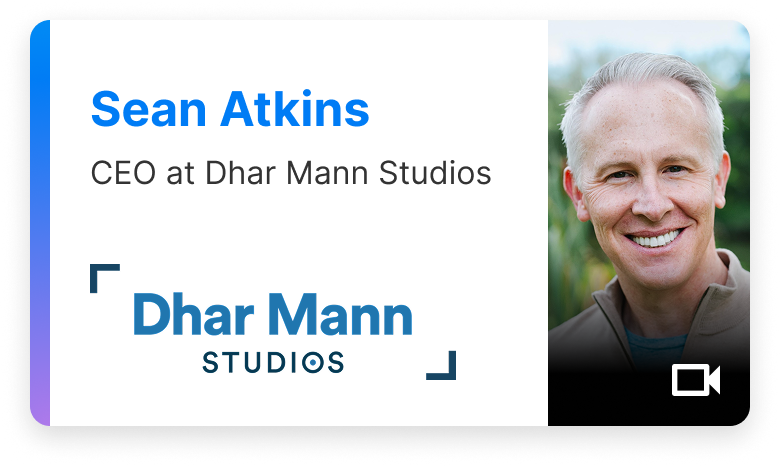
Dhar Mann Studios on The New Economics of Digital Studio Businesses
![Vitrina Film+TV Production Insider [May 2025] 21 Group 2600](https://vitrina.ai/wp-content/uploads/2025/06/Group-2600.png)
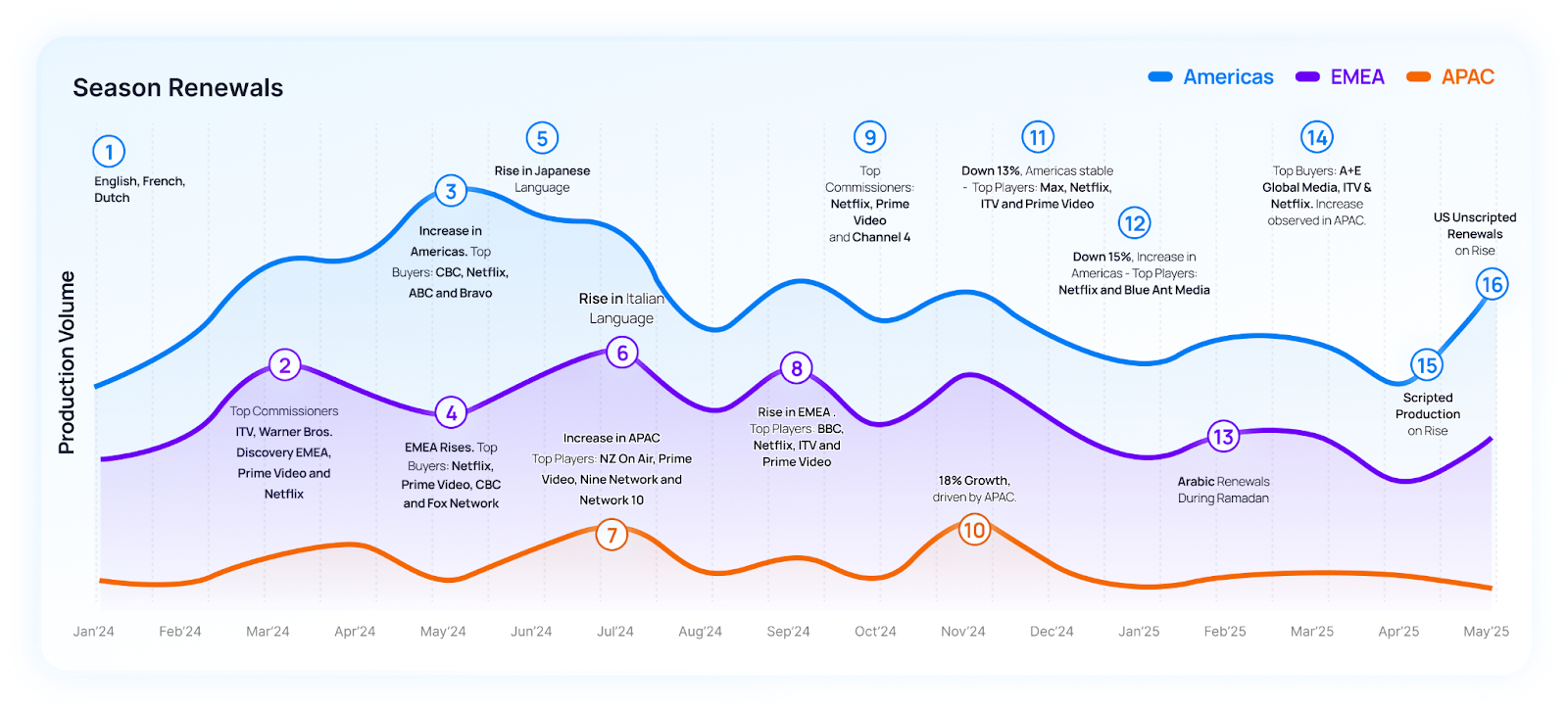
May 2025 Season Renewals: Shifting Dynamics Across Regions
Season renewals (TV Series, Formats, Animation Series, Docuseries) have been a cornerstone for both streamers and broadcasters, offering a reliable strategy for sustaining viewer engagement and ensuring operational stability across production and post-production. By securing ongoing content pipelines, renewals help streamline workflows, optimize resource allocation, and minimize the risks associated with launching entirely new projects. This continuity not only strengthens audience loyalty but also enhances efficiency across the entire content supply chain.
![Vitrina Film+TV Production Insider [May 2025] 22 unnamed (18)](https://vitrina.ai/wp-content/uploads/2025/06/unnamed-18.png)
Source: Vitrina Daily Production Tracker
Regional Insights – May 2025
Americas:
-
Season renewals surged in May, fueled by increased commissioning from top platforms including Netflix, Prime Video, NBC, Bravo, and Fox Network.
-
Language distribution stayed consistent, with English continuing to dominate and Spanish and Portuguese holding steady.
-
Genre rankings shifted slightly, with Drama and Reality rising to the top.
Notable season renewals in May ’25 included:
-
- The Floor (Fox Network) – Extended for Seasons 2 through 5 in partnership with Talpa Studios and Eureka Productions
- Bridgerton (Netflix) – Renewed for Seasons 5 and 6 with Shondaland and CVD Productions
- Chicago Med (NBC) – Renewed for Season 11 under Universal Television and Wolf Entertainment
EMEA:
-
Season renewals in EMEA saw strong momentum in May, doubling from the previous month.
-
Broadcasters were the primary drivers, supported by renewed activity from Netflix, Prime Video, and regional players.
-
English-language content saw a substantial uptick, while French-language content held steady.
-
Genre preferences remained stable, with Drama, Comedy, and Reality maintaining their lead.
-
The balance between scripted and unscripted content showed little change.
Notable renewals included:
-
- Vienna Crime Squad – Renewed for its 21st season by ORF and ZDF, produced by Satel Film
- Piglets – Renewed for Season 2 by ITV with Monicker Pictures and ITV Studios
- Doktor Ballouz – Greenlit for Season 4 by ZDF
- Gangs of London – Renewed for Season 4 by AMC+ and Sky, with Pulse Films and Sky Studios leading production
APAC:
-
APAC remained the lowest contributor to global season renewals, continuing a downward trend in May.
-
The decline was primarily driven by reduced activity from ANZ-based players, which also led to a shift away from English-language content.
-
In contrast, there was a rise in Hindi-language commissions.
-
Scripted formats gained significant ground, while unscripted content saw a sharp drop.
-
Drama emerged as the top genre, with Sci-Fi & Fantasy and Comedy also gaining traction.
Key renewals in APAC included:
-
-
Black Warrant (India) and Love on the Spectrum (Australia) – Netflix
-
Reborn Rich (Korea) – JTBC
-
AYAKA is in LOVE with HIROKO (Japan) – Season 2, MBS
-

Monitor season renewals and adjust your strategy with live insights.
Most Active Film Commissions in the Past 3 Months
Film commissions have become increasingly strategic players in the entertainment industry, stepping up efforts to attract productions, nurture local talent, and secure investments across filming, production, post-production, and animation. Their proactive initiatives have fueled regional economic growth, strengthened creative ecosystems, and fostered high-impact industry collaborations.
Several film commissions—along with national entertainment bodies and ministries of culture, communication, and commerce—have intensified their activities to support production. Governments worldwide are deploying aggressive measures to drive employment, support early-stage projects, and empower emerging content creators. To remain competitive and attract international productions, they have revamped tax incentive structures, introduced cash grants, expanded cashback schemes, and rolled out new tax breaks. Additionally, major trade events and strategic partnerships have been leveraged to position their markets as premier global production hubs.
Curious how Vitrina can help you? Try it out today!
Financing by Industry Bodies – May’25
In May 2025, several leading film commissions and associations globally financed early-stage projects:
-
Screen Australia supported over 15 English-language dramas, comedies, and kids’ series—including A Model Family, Junk Castle, and How to Human—often in partnership with Causeway Films, Photoplay Films, and Ludo Studio.
-
The Polish Film Institute backed titles like Dwie Dusze and Fatherland, and co-funded All the Boys Are Here with Screen Australia, supporting multilingual projects in Polish, English, German, and French.
-
Germany’s DFFF and FFF Bayern focused on local dramas and comedies such as Krux and Nichtsnutze, while co-financing the cross-border project Any Other Night with partners from the Netherlands and U.S.
-
Spain’s ICAA funded Spanish-language dramas and comedies with regional collaborators, while Russia’s Ministry of Culture invested in family-oriented titles across Eastern Europe.
-
Northern Ireland Screen was active in animation and kids’ content, often co-financing with Irish partners.
Vitrina Spotlight: Projects in Production / Planned Stage
213 New Projects
Announced Last Week! – across production financing, greenlit and season renewals.
Quick Market Snapshot:
59% Scripted, 41% UnScripted | Reality, Comedy and Documentary leading the genre mix 36 new projects have been commissioned – majorly by Crave and CBC
Key languages: English, French, Spanish and German
Americas: 64% of announced projects were scripted, with TV series making up 63%. English, German, and French were the top languages, and drama, documentary, and comedy led in genres. Crave, Prime Video, and CBC drove major activity, with 14 development deals and 59 season renewals.
Explore More Projects [Americas]..
EMEA: 11 projects were announced, including production financing and renewals. Prime Video, ZDF, and industry bodies led the way. Top languages were English, Spanish, and German, with drama, documentary, and reality as key genres
Explore more EMEA Projects..
APAC: Announcements included financing and a partnership with a New Zealand Prod Co. Bengali, English, and Japanese topped the language list. Animation made up 19%, with the rest focused on drama and comedy. All projects were scripted, and 53% were films
Explore more APAC Projects..
How the Industry Uses Vitrina
Vitrina For VFX and Post Companies:
Vitrina is helping VFX companies like PhantomFX, Crafty Apes, and Light Iron discover and secure new Film & TV projects by tracking unreleased productions across development, production, and post. With deep intel on production companies, crew-heads, and decision-makers—plus direct contact details—VFX teams can reconnect with past collaborators, pitch at the right time, and expand their network of high-potential leads. It’s smart, targeted business development made easy.
Vitrina For Production Companies & Indies:
Vitrina empowers production companies and indie creators to find the right financing and commissioning partners—globally. From early-stage tracking of co-production-friendly projects to surfacing the latest deals and investment themes, Vitrina helps match projects with relevant financiers, commissioners, and collaborators. With up-to-date preferences and verified contacts, creators can focus on pitching to the right people—saving time and increasing chances of success.
Vitrina For Streamers:
Streamers use Vitrina to navigate the global content supply-chain with clarity. By tracking unreleased slates, mapping competitive activity, and identifying trending genres, formats, and territories, Vitrina equips content and strategy teams with the intel to make proactive moves—whether it’s preemptive pre-buys, co-production deals, or vendor discovery. With insights drawn from markets like LATAM, APAC, and Europe, Vitrina helps streamers stay ahead of content trends and competitors alike.

Get In Touch with Vitrina Today:
-
- Feature your company and content announcements: Email us at updates@vitrina.ai
- Request production trends or competitive intel reports: Contact us at sales@vitrina.ai
Frequently Ask Questions
Yes, Vitrina provides buyers with direct access to the contact information of vendors. Our platform includes verified leadership and key decision-makers within vendor companies, along with their mapped departments, specializations, and accessible contact details.
The Vendor Reputation Rating on Vitrina is a comprehensive metric that incorporates various factors critical to buyers’ assessments of vendors, service providers, and suppliers. This rating is used by buyers to evaluate vendors’ qualifications and capabilities in the M&E supply chain. Vitrina’s Reputation Rating system provides buyers with valuable insights into vendors’ size, parentage, past work, quality of projects/clients, recency, specializations, strengths, and other factors that may affect the vendor’s suitability for the buyer’s project.
Yes, Vitrina can assist you in finding and shortlisting the ideal partners for your project. Our Partner-Finder team is experienced in running vendor recruitment and screening mandates that are specific to your needs. We can help you find the best vendors for your business by identifying niche and specialist companies in new markets. We stay up-to-date with the latest developments in the M&E supply chain, allowing us to continually identify and qualify the most innovative vendors. Additionally, our extensive network of storefront owners updates their latest projects, capabilities, and certifications on our platform. These sellers are highly engaged and active on our platform, allowing us to connect buyers with vendors who are best suited to meet their requirements. By working with Vitrina, you can access the latest solutions and expertise in Animation, Localization, VFX, Stages, Virtual Production, and gaming engines. Contact us today to learn more about how Vitrina can help you find the right vendors and partners for your business.
Vitrina is a private and exclusive business network designed for dealmakers in the Media and Entertainment (M&E) industry. Members are carefully screened to ensure they meet the network’s high standards for professionalism and integrity, and the platform is not open to the public or to search engines. This ensures that all information shared is kept confidential and private. Vitrina takes the privacy and confidentiality of its members very seriously and provides a secure platform for members to share valuable information and insights with a select group of vetted and verified buyers and sellers.
Trusted by top entertainment companies to scout partners globally
Top companies love Vitrina

Podcast Chapters
| Time Stamp | Chapters |
| 00:00 | Introduction to Extreme Reach |
| 01:40 | Understanding the Business Model of Extreme Reach |
| 17:24 | Contextual Advertising and Targeting Strategies |
| 19:00 | Trends in Ad-Supported Solutions in Entertainment |
| 25:44 | Clientele and Market Reach |
| 31:10 | Future Growth and Roadmap |
| 32:30 | Partnership Opportunities and Collaborations |
| 35:00 | Outlook for 2026 |
Key Takeaways: Advertising Workflow Management, Global Ad Payments
- “Extreme Reach (XR) orchestrates global ad and marketing operations.”
- “The business is split into XR Pay (payments) and XR Ads (asset management).”
- “XR manages $100 billion in ad spending and $1.5 billion in payroll annually.”
- “AI will increase complexity and ad versioning, a positive trend for XR.”
- “XR is prioritizing investment in CTV and addressable TV for brand building.”

Sound Bites:
- “What Salesforce has done for chief revenue officers and for sales ops is sort of what we do for ad ops and marketing ops and CMOs.”
- “Brands really rightfully want to make sure that they’re represented in these mass media in the best possible way. And that’s what we do.”
- “I think that sort of the living room continues to be… the ground on which a lot of these sort of brands build awareness.”
- “We think that there’s more content and that’s more complexity and we get hired to manage complexity.”
- “There’s an XR ID which is unique for each piece of content that we have at XR Extreme Reach.”
Why Partner With XR Extreme Reach?
- Massive Global Coverage: Partnering grants access to XR’s platform operating in 140 markets and delivering to 50,000 endpoints worldwide.
- Simplified Ad Complexity: The platform is built to manage the growing complexity and sheer volume of AI-driven ad versions.
- Guaranteed Quality Control: Brands rely on XR for consistently high quality, ensuring the right, pristine ad runs at the right time.
- Comprehensive Payment Hub: XR offers a single solution for paying talent, crew, and vendors, streamlining production finance.
- Contextual Targeting Power: The unique XR ID and metadata enable more precise ad targeting against specific content moments.
In Conversation with John Batter, CEO at XR Extreme Reach
This is a written summary for the interview with John Batter, CEO of Extreme Reach (XR), for a quick-read Q&A format, highlighting key insights on advertising, entertainment, and technology. The following is an 8-question summary of the transcript.
1. Vitrina: What is the core business of Extreme Reach (XR), and how does it relate to managing advertising and marketing operations?
John Batter: XR is the leading platform for managing advertising and marketing operations. This means we help brands predominantly manage all aspects of their ad creative, all the way from talent payments at the very front end onto rights, and then the delivery of the actual ads themselves so that every ad lands exactly how and where it should. One way to frame it is that “What Salesforce has done for chief revenue officers and for sales ops is sort of what we do for ad ops and marketing ops and CMOs“.
“What Salesforce has done for chief revenue officers and for sales ops is sort of what we do for ad ops and marketing ops and CMOs.”
2. Vitrina: Can you break down the two main parts of Extreme Reach’s business, XR Pay and XR Ads, and describe the services offered?
John Batter: Our business breaks down into kind of two pieces: a payments part, which we call XR Pay, and an advertising piece, XR Ads. The payment side traditionally focuses on paying the talent in front of the camera in TV commercials, where we are the largest player in that in the US. We are also moving into crew payments (talent behind the camera), paying vendors and influencers, providing kind of a one-stop shop for brands taking production in-house to handle all payments. XR Ads focuses on our global ad database for managing all advertising assets on behalf of big, global brands. We offer a number of services ranging from transcoding and closed captioning to management of rights, helping brands ensure their ads get to the right servers in pristine condition.
“The payment side of our business is, traditionally been focused on paying the talent… We’re also sort of been moving into crew payments. So the talent behind the camera. And we’ve been doing more of that and then paying vendors and influencers, et cetera.”
3. Vitrina: What is Extreme Reach’s client base and global reach, and what groups do you verticalize around in the ad business?
John Batter: We’re in about 140 markets today and have about 10,000 total customers. We handle around $100 billion a year of ad spending that flows through our system and process about $1.5 billion of payroll every year in our payments business. I would say off the top of my head, 75 or 80% of the Fortune 500 advertisers are clients of ours. In the ad business, we service brands, work with their agencies, and work with publishers. Our largest market is the US, followed by major European markets (UK, Germany, France, Spain, Italy, Nordics), as well as some major Asian markets and a few of the big markets in Latin America, like Brazil.
“I would say off the top of my head, 75 or 80 % of the Fortune 500 advertisers are clients of ours.”
4. Vitrina: What trends are you observing in the film and TV sector regarding production and advertising, including the shift towards digital?
John Batter: Within the payments space, we’re seeing more globalization and production, with work getting done all over the world and then stitched together. Entertainment is both a big producer of content and a big consumer of advertising. Regarding digital advertising, we see the trailer is the master print which then gets cut down into 30-second, 15-second, and now increasingly targeted seven-second spots. We are seeing lots of that, and I think AI is just going to take that from… 500, 5,000, 50,000, I think, over time, which makes the marketer’s job more difficult to manage all of that creative—and that’s where we come in.
“the trailer is the master print and the trailer is available both in theaters and on YouTube… Then the trailers get cut down into 30 second spots and 15 second spots and now increasingly targeted seven second spots.”
5. Vitrina: How is Extreme Reach addressing the technological complexity in advertising, particularly in light of AI and the dynamic ad-supported solutions in the entertainment space?
John Batter: We think AI is generally a positive trend for our business, as it leads to more content and more complexity, and we get hired to manage complexity. We’re spending quite a bit of time modernizing our platform, adding new functionality, and preparing ourselves for AI. The new trend is Dynamic Ad Insertion Solutions, where you can buy the composition plus the moment in time—the right ad at the right time—and we are providing the infrastructure to make that happen. Our focus is on contextual advertising, putting the right ad with the right content at the right time for the right audience. We supply the ecosystem with enough data attached to our XR ID that we can map to content metadata to get the right match.
“Complexity continues to grow. Varieties and versioning on the ads isn’t going away. It’s just going to increase. And so, you know, I think those are the… big mega trends.”
6. Vitrina: Can you describe your career journey leading up to Extreme Reach and how it connects to the company’s current business?
John Batter: The first sort of two-thirds of my career I spent on the content side, really making video games and animated movies. I then moved into the digital distribution of content at a joint venture between DreamWorks and Technicolor called MGO, and then to the discovery of that content at Gracenote. For the last eight years or so, I then moved to kind of much more of the ad-supported side of the business, into testing ads and now distributing ads, and paying the actors. This business is very similar to that [Gracenote] except built around advertising: “whereas there’s a grace note ID that is unique for each piece of content, there’s an XR ID which is unique for each piece of content that we have at XR Extreme Reach”.
“I spent on the content side, both in, as you pointed out, video games and animated movies, really making games and movies and getting them into the theaters.”
7. Vitrina: What are Extreme Reach’s plans for expansion in the entertainment sector, particularly in payments, and what kind of partners are you looking to connect with?
John Batter: We’ve been in entertainment payments for a while. We are investing in UI and optimizing the workflows to get people kind of on payroll and onboarded quickly and efficiently. We handle union wages and work with production companies to interpret the union contracts. We are looking to continue to grow in this marketplace by bringing new things to entertainment businesses to help them. We’re always interested to hear from creative agencies that are looking to move their ad content into the right networks. Also for production companies, our payments business, not only for talent, but for crew payments. That whole area—talent, crew, vendor payments—is an area where we’ve been investing in and will continue to invest in. If people are using AI to generate metadata for advertising, they can call us.
“Also for production companies, our payments business, not only for talent, but for crew payments… Talent crew vendor payments that whole area is an area where we’ve been investing in and will continue to invest in.”
8. Vitrina: What is the outlook for Extreme Reach into 2026, considering the broader ad and CTV environment?
John Batter: We are extremely hopeful for 2026 and expect it to be a better ad environment year. Our big brand clients will be focused on growth, and through growth, advertising, our businesses grow. International is for sure one of our growth factors. We continue to believe that the big screen in the house is where a lot of the important advertising still happens. I continue to be a big believer in Connected Televisions (CTV), both here and globally. The living room will continue to be the ground on which a lot of these sorts of brands build awareness. We think our ability to help both the brands and the publishers connect that for the best experience in the living room is a big growth opportunity for us, connecting linear television, CTV, and addressable television.
“the big screen or the living room or the big screen in the house, not the big screen in the theaters, but the big screen, is where a lot of the important advertising still happens.”
——————————————————————————————————————————–
Powering Ad Delivery Globally: XR Extreme Reach
Extreme Reach (XR) is the leading global platform for managing advertising and marketing operations. It handles the entire advertising workflow, from talent payments (XR Pay) to global asset delivery (XR Ads), processing approximately $100 billion of ad spending annually. XR focuses on managing complexity and providing quality control across digital, CTV, and linear TV.
More from LeaderSpeak…
Table of Contents
- The Film Financing Intelligence Gap
- What VIQI Provides for Financing Teams
- Mapping Active Entertainment Investors
- Co-Production Partner Intelligence
- Broadcaster Pre-Buy Opportunities
- Tax Incentives and Fund Intelligence
- Building a Complete Financing Stack
- VIQI Financing Workflow
- Frequently Asked Questions
Quick Answer
VIQI is the AI tool for film financing teams at production companies, studios, and independent producers. It maps active entertainment funds, film investors, co-production treaty partners, tax incentive programs, and broadcaster pre-buy opportunities across 159,223+ verified companies globally — helping financing professionals build complete funding structures faster and with better-matched partners.
The Film Financing Intelligence Gap
Film and television financing is among the most complex capital-raising exercises in any industry. A single project may require a funding stack built from a broadcaster pre-buy, a co-production partner in a treaty country, a tax credit from a regional incentive program, a soft fund from a national film agency, and equity from a private entertainment investor — each component with its own terms, timeline, and approval process.
Identifying which funds, investors, and partners are currently active and aligned with your project profile has traditionally required years of relationship-building, expensive legal and consulting fees, and painstaking manual research across dozens of sources. VIQI changes this — bringing the AI tool for film financing directly into the hands of any financing executive, producer, or development team at any stage of the financing process.
What VIQI Provides for Film Financing Teams
For financing executives and producers, VIQI delivers five categories of intelligence that directly accelerate the financing process:
- Active Investor Mapping: Identify funds, studios, and private investors currently deploying capital in content financing
- Co-Production Partner Intelligence: Find qualifying production companies in treaty countries aligned with your project’s genre and format
- Broadcaster Pre-Buy Opportunities: Surface broadcasters and platforms with pre-buy appetite for your content type
- Incentive and Fund Intelligence: Map national film funds, regional tax incentives, and soft money programs available for your project
- Deal Structure Intelligence: Understand typical deal terms, equity splits, and recoupment waterfall structures for your project type
This intelligence is grounded in Vitrina’s data graph — 159,223+ verified entertainment companies — making it the most comprehensive financing intelligence tool available to the independent and mid-level production sector.
Find Your Financing Partners Faster
Stop spending months identifying investors and co-production partners manually. VIQI maps active entertainment capital and co-production opportunities across 159,223+ companies globally.
Mapping Active Entertainment Investors With VIQI
The entertainment investment landscape is fluid. Funds that were actively deploying capital in 2022 may have paused new commitments, pivoted to different content types, or increased their focus on specific territories. VIQI tracks these shifts in real time — distinguishing between funds and investors who are actively writing checks and those who have moved to a different mandate or suspended new investments.
A VIQI financing search for a mid-budget drama series might surface:
- Regional broadcast presales funds currently accepting applications
- Streaming platform equity funds with active investment mandates in your genre
- Private equity and family office investors with entertainment portfolio exposure
- Studio-backed production funds offering development and production capital
- Territory-specific film commissions offering equity investment alongside tax incentives
Each investor profile in VIQI includes historical investment patterns, typical deal sizes, preferred content types, and where applicable, key contact information for the relevant investment executives. This turns cold outreach into targeted conversations grounded in verified intelligence about the investor’s actual current mandate.
“Global entertainment financing volumes reached $42 billion in 2024, with streaming platform production funds and regional co-production structures accounting for the largest share of new capital deployment.”
— Citation 1: Omdia Entertainment Finance Report, 2025
Co-Production Partner Intelligence
Co-production treaties between countries can significantly reduce the cost of production by unlocking tax incentives, soft money, and broadcaster licensing in partner territories. But identifying the right co-production partner is not simply a matter of finding a company in the right country — the partner must match your project’s genre and format requirements, have the production infrastructure to deliver their share of the work, and have an established relationship with the relevant broadcaster or fund in their territory.
VIQI searches co-production partner opportunities across treaty country pairs and filters by genre, production capacity, broadcaster relationships, and active fund eligibility. This turns a process that typically requires months of research and festival networking into a targeted shortlist generated in minutes. For a deeper look at how this works in practice, see how co-production teams use VIQI to structure international partnerships.
“Co-production agreements covered 38% of all European content production budgets in 2024, with treaty structures between France, Germany, Italy, and Canada accounting for the largest volume of cross-border financing deals.”
— Citation 2: EAO European Audiovisual Observatory, 2025
Broadcaster Pre-Buy Opportunities
A broadcaster pre-buy is often the anchor piece of a financing stack — providing both capital and a guaranteed distribution platform that makes subsequent financing conversations significantly easier. But identifying broadcasters with current pre-buy appetite for your specific content type and territory requires intelligence that is usually scattered across trade publications, market conversations, and network relationships.
VIQI aggregates broadcaster acquisition activity across its full database to identify which platforms and broadcasters are currently running pre-buy programs, what content types and budget ranges they are supporting, and what their typical pre-buy terms look like. This gives financing teams the intelligence to approach broadcaster pre-buy conversations with specific knowledge about the broadcaster’s current mandate — rather than generic pitches that waste both parties’ time.
The intelligence is directly connected to buyer tracking capabilities — so your financing team and sales team can share the same intelligence about broadcaster appetite rather than conducting redundant parallel research.
Tax Incentives and Film Fund Intelligence
The global landscape of film tax incentives, rebates, and soft money programs has expanded significantly over the past decade, with over 100 different programs now available across more than 40 countries. Identifying which programs your project qualifies for — and understanding the interaction between multiple incentives in a co-production structure — is complex enough to require specialist legal and financial expertise.
VIQI provides a first-pass map of incentive eligibility based on your project profile: territory of production, budget level, content type, and co-production structure. This gives your financing team a clear starting point for conversations with specialized tax counsel and production service companies — rather than beginning those conversations from zero.
Building a Complete Financing Stack With VIQI
The most powerful use of VIQI for financing teams is building a complete financing stack view — identifying all potential capital sources for a project simultaneously and understanding how they interact. A typical VIQI financing session for a €8 million drama series might map:
- 1–2 broadcaster pre-buy targets (covering 30–40% of budget)
- 1–2 co-production partner options in treaty countries (covering 20–30% of budget)
- Tax incentive programs in production territories (covering 15–25% of budget)
- Soft money programs from national film agencies (covering 10–20% of budget)
- Equity investors or completion guarantors for the remaining gap
Understanding this stack structure upfront — before any meetings are scheduled — allows financing executives to approach each component with full knowledge of where it fits in the overall structure, making every conversation more targeted and efficient. Teams using Vitrina’s intelligence platform consistently report that VIQI compresses their financing timeline significantly. Once the development team has validated the project with market data, the financing team can move immediately to identifying capital sources without duplicating research.
Build Your Financing Stack Faster
VIQI maps every component of your project’s financing structure — investors, co-production partners, broadcaster pre-buys, and incentives — in a single intelligence session.
“Film financing teams that use dedicated intelligence tools to map funding landscapes before initiating outreach report 35–50% shorter time to financing close, primarily by eliminating unqualified investor conversations early in the process.”
— Citation 3: PwC Global Entertainment & Media Outlook, 2025
VIQI Financing Workflow: From Gap to Close
Here is how financing teams structure their VIQI workflow from initial financing gap to closed funding stack:
Project profiling: Define the project profile in VIQI — genre, format, budget range, territories, and target delivery date. VIQI uses this profile to filter all subsequent intelligence to relevant opportunities only.
Capital landscape mapping: Run a full financing landscape query across all capital categories — broadcaster pre-buys, co-production funds, equity investors, tax incentives, and soft money. Build a ranked list of opportunities by feasibility and deal size.
Partner shortlisting: Filter the landscape to 3–5 priority targets in each capital category. For co-production partners, filter by genre match and broadcaster relationship. For investors, filter by current investment mandate and typical deal size.
Outreach preparation: Use VIQI’s contact intelligence to identify the right decision-makers at each target organization and prepare tailored outreach based on their known investment preferences.
Stack assembly: As each financing component comes together, use VIQI to verify that the overall stack structure is consistent with market terms for your project profile and to identify backup options if any component falls through.
Frequently Asked Questions
How does VIQI help film financing teams find active investors?
VIQI maps active entertainment funds and investors across 159,223+ companies, tracking which are currently deploying capital, their preferred content types, typical deal sizes, and key contact information. This distinguishes active investors from those who have paused or shifted their mandate.
Can VIQI identify co-production partners in treaty countries?
Yes. VIQI searches production companies across co-production treaty country pairs and filters by genre, format, production capacity, broadcaster relationships, and fund eligibility — generating a targeted shortlist of qualified co-production partners for your specific project.
Does VIQI cover broadcaster pre-buy opportunities?
Yes. VIQI aggregates broadcaster acquisition activity to identify platforms and networks currently running pre-buy programs, including the content types, budget ranges, and territories they are supporting — so your pitch is targeted to genuine current mandates.
What film tax incentive information does VIQI provide?
VIQI provides a first-pass map of incentive eligibility based on your project profile — production territory, budget level, content type, and co-production structure — covering programs across more than 40 countries as a starting point for specialist tax counsel conversations.
How does VIQI help build a complete financing stack?
VIQI maps all potential capital sources simultaneously — broadcaster pre-buys, co-production funds, equity investors, tax incentives, and soft money — giving financing teams a full stack view before any outreach begins, so each component conversation is targeted and efficient.
Is VIQI useful for independent producers or only studio financing teams?
VIQI is especially valuable for independent producers who lack the institutional relationships that studio financing teams rely on. It democratizes access to the same caliber of financing landscape intelligence that was previously available only to well-networked industry veterans.
Vitrina’s Role in Financing Intelligence
Vitrina is the intelligence infrastructure behind VIQI — the largest verified database of entertainment companies globally. The platform tracks 159,223+ companies across the full content value chain, including funds, investors, broadcasters, co-production partners, and film agencies worldwide. For financing teams, Vitrina’s data means that every capital source identified by VIQI is verified, currently active, and matched to the specific requirements of your project profile.
VIQI makes this intelligence available to any financing professional through an AI agent interface — no data science background required. The result is a financing process that is faster, more targeted, and more reliably connected to actual capital sources than anything possible with traditional research methods. Read what VIQI is and how it works to understand the full scope of the intelligence platform powering these financing capabilities.
Close Your Next Film Faster
Film financing is complex. VIQI simplifies the intelligence layer — mapping investors, co-production partners, pre-buys, and incentives so your team can focus on closing, not researching.

Production houses in South Korea have driven one of the fastest-growing content export industries in the world, anchored by Studio Dragon‘s global drama slate and Netflix’s $2.5 billion, four-year investment commitment in Korean content — even as 2025 brought a genuine commissioning slowdown alongside the post-Squid Game boom.
This directory lists verified production houses active in South Korea — sourced live from Vitrina’s global entertainment company database and verified for active production credits, facility capacity, and direct contact accuracy. Use the filters to narrow by hub and production focus, then connect directly with production decision-makers. For related markets, see our top production houses in Japan and top production houses in Asia directories.
- 1Studio Dragon (CJ ENM subsidiary) produces ~25 drama titles/year with a catalog of 278 IPs distributed to 200+ markets; market cap ~$460-470M as of mid-2026.
- 2K-content exports reached $14.9 billion in 2025 (+5.9% YoY), making cultural content Korea’s 12th-largest export category.
- 3South Korean TV commissioning dropped an estimated 20% from H1 2023 to H1 2025, with global-streamer commissions down over 40% in that window — a genuine “production lull” alongside the export growth.
- 4KOFIC’s national location incentive tops out around 20-25% for international productions — older sources citing “up to 30%” reflect historical, not current, guidance.
- 52026 is showing recovery signals: 60+ K-dramas aired in H1 2026, alongside a “mass migration” into short-form vertical drama by CJ ENM’s Tving, MBC, and KT Studio Genie.
The top production houses in South Korea include Studio Dragon (Seoul — CJ ENM’s global drama powerhouse), CJ ENM (Seoul — parent conglomerate, ₩1.4573 trillion film/drama revenue in 2025), and SLL (formerly JTBC Studios, Seoul — owns U.S. studio wiip). Seoul, Paju, and Busan remain Korea’s primary production hubs. Vitrina indexes verified South Korean production houses with direct contacts, facility details, and production credits.
Why South Korea Leads Global Drama Exports
South Korea’s production industry is built around a small number of vertically-integrated studio groups — CJ ENM/Studio Dragon, SLL, and a growing Netflix-commissioned pipeline — feeding a content-export machine that has made K-dramas the world’s second most-consumed content category behind English-language programming. Since Squid Game’s 2021 debut, Korean dramas have generated an estimated $3.4 billion in global Netflix subscriber revenue, but the underlying commissioning market has cooled even as exports keep growing.
Key Stat
CJ ENM’s Film & Drama division alone generated ₩1.4573 trillion (~$996 million) in 2025 revenue, driven by global streaming partnerships with Netflix, Amazon, and Warner Bros.
Studio Dragon operates via 8 subsidiary/affiliate studios with ~317 contracted creators, producing roughly 25 drama titles per year. SLL (renamed from JTBC Studios in 2023) owns U.S. studio wiip and has invested alongside its Plus M unit in global-format expansion. Netflix’s Korea operation, while not a studio itself, commissioned 30+ Korean originals for its 2026 slate. For comparison, see our top production houses in Japan directory.
Top Production Houses in South Korea — Full Directory
The companies below are verified production houses active in South Korea, sourced live from Vitrina’s global entertainment company database. Filter by hub and production focus. Click any company card to view the full profile, facility details, and direct contacts. Looking for comparison markets? See our top production houses in Japan directory.
WildBrain
The Walt Disney Company
Warner Bros. Discovery
CJ ENM
Vitrina Intelligence
Browse Verified Production Houses in South Korea
Filter by hub, facility capacity, and production type. See verified company profiles with direct contact details.
Korea’s Production Hubs: Seoul, Paju & Busan
Korean production capacity concentrates in three main hubs, each anchored by different infrastructure and specialization.
Seoul anchors Korea’s broadcast and drama-commissioning infrastructure at Digital Media City. Paju‘s CJ ENM Studio Center provides dedicated large-scale production facilities outside the capital. Busan hosts Korea’s largest studio complex and its most important industry co-production market via BIFF’s Asian Contents & Film Market. For regional benchmarking, see our top production houses in Japan directory.
How to Choose a Production House in Korea
Choosing the right production partner in South Korea starts with understanding the difference between a production house (develops and produces its own content, retaining creative and/or financial ownership) and a production services company (executes another party’s production on location without a creative or financial stake). International producers evaluating Korea should weigh five factors: studio group affiliation (CJ ENM/Studio Dragon vs. SLL vs. independent), IP ownership structure given how many Korean studios operate via webtoon/web-novel adaptation pipelines, facility access at Paju and Busan’s studio complexes, streaming platform relationships given Netflix’s dominant commissioning role, and current commissioning appetite given the documented 2023-2025 production lull.
Korean Film & TV Incentives: KOFIC and Beyond
Korea’s national location incentive is administered by KOFIC (Korean Film Council), though published rates vary meaningfully by source and year — producers should confirm current terms directly before budgeting.
Key Stat
$14.9B
Korea’s cultural content exports reached $14.9 billion in 2025 (+5.9% YoY per provisional KOCCA figures), making content Korea’s 12th-largest export category.
Producers should treat published incentive percentages as directional rather than contractual, and confirm current terms with KOFIC or the relevant regional film commission before budgeting a Korean shoot. For comparative benchmarking, see our top production houses in Japan directory.
2026 Trends: The Production Lull & Short-Form Pivot
A genuine commissioning slowdown accompanied the post-Squid Game export boom. South Korean TV show commissioning dropped an estimated 20% from H1 2023 to H1 2025, with global-streamer commissions down over 40% in the same window — described by Netflix’s own Korea content executives as a “production lull” at a June 2025 industry panel. This complicates a simple boom narrative even as export revenue kept climbing.
2026 is showing tentative recovery signals: 60+ K-dramas aired in H1 2026, alongside a notable “mass migration” into short-form/vertical drama by Showbox, CJ ENM’s Tving, MBC, and KT Studio Genie — tracking the global short-form video trend.
Webtoon-to-drama adaptation remains a core pipeline, with Kakao Entertainment and Naver’s Webtoon Entertainment/Studio N the two dominant upstream IP owners feeding new drama commissions into 2026.
Vitrina’s Role in Korean Production House Discovery
Vitrina’s global entertainment database is the most comprehensive B2B intelligence resource for finding and vetting production houses in South Korea and 100+ countries. The directory above surfaces verified Korean production houses filtered by hub and production type. Vitrina also covers top production houses in Japan, top production houses in Asia, and 100+ additional markets globally.
159,223
M&E Companies
100+
Countries
Daily
Database Updates
3
Major Hubs Covered
Conclusion
South Korea’s production industry in 2026 combines record content-export value with a genuine commissioning slowdown that peaked in 2025 and is now showing recovery signals. Studio Dragon, CJ ENM, and SLL each represent a distinct model — drama-factory scale production, diversified media conglomerate, and international studio-ownership expansion — against a backdrop of Netflix’s continued multi-billion-dollar investment and a fast-growing short-form drama pivot.
Use the directory above to explore verified South Korean production houses with direct contacts, and compare against our top production houses in Japan directory for benchmarking.
Related Reading
Frequently Asked Questions
What is Studio Dragon’s relationship to CJ ENM?
Studio Dragon is a KOSDAQ-listed subsidiary of CJ ENM, which holds a 54.46% stake. Netflix Worldwide Production LLC holds a 4.68% stake, reflecting the depth of the Netflix-Studio Dragon commissioning relationship.
Is Korea’s production market still growing after the Squid Game boom?
It’s mixed. Export revenue kept climbing to $14.9 billion in 2025, but actual TV commissioning dropped roughly 20% from H1 2023 to H1 2025. 2026 is showing recovery signals, including a pivot toward short-form vertical drama.
What incentive rate applies to international productions filming in Korea?
KOFIC’s national location incentive currently runs roughly 20-25%, though older sources cite up to 30% based on historical guidance. Regional commissions in cities like Incheon and Gwangju sometimes offer higher rates tied to a distribution-contract requirement.
What is SLL and how does it relate to JTBC Studios?
SLL is the current name for JTBC Studios, rebranded in 2023 as part of a global-expansion strategy. It remains a JoongAng Group subsidiary and owns U.S. studio wiip, producer of Mare of Easttown.
How do I find and vet a production house in South Korea?
Vitrina’s directory lists verified Korean production houses with direct contacts, filterable by hub and production credits — useful for confirming a company’s current commissioning activity and studio affiliation before committing to a shoot.
Vitrina Intelligence
South Korea Production Research · B2B M&E Data Platform
Compiled by Vitrina’s M&E intelligence team from CJ ENM/Studio Dragon financial disclosures, KOCCA export data, and industry trade reporting.

Production houses in Mumbai anchor India’s entertainment industry from Film City Goregaon’s 520-acre, 16-stage government complex to Bandra’s Mehboob Studios and Andheri’s Yash Raj Studios, and the city is also India’s undisputed capital of advertising film production — not just Bollywood cinema.
This directory lists verified production houses headquartered in Mumbai — sourced live from Vitrina’s global entertainment company database and verified for active production credits, facility capacity, and direct contact accuracy. Use the filters to narrow by production focus, then connect directly with decision-makers. For the broader national picture, see our top production houses in India directory.
- 1Film City Goregaon spans 520 acres with 16 sound stages and 42 outdoor shooting locations, government-run by the Maharashtra Film, Stage & Cultural Development Corporation.
- 2Yash Raj Studios signed a multi-year Netflix licensing partnership and a three-picture UK shoot deal announced during UK PM Keir Starmer’s 2025 Mumbai visit.
- 3Mumbai is India’s advertising-film capital — houses like Chrome Pictures and Corcoise Films have produced thousands of commercials for global and domestic brands.
- 4R.K. Studios, the iconic Raj Kapoor-founded facility in Chembur, was sold to Godrej Properties following a 2017 fire and is no longer an active production facility.
- 5Maadock Films’ horror-comedy universe (Stree, Bhediya, Munjya) generated roughly ₹1,300 crore in 2024 box office on a fraction of that in production budget.
The top production houses in Mumbai include Applause Entertainment (premium OTT drama, backed by Aditya Birla Group, 55+ titles produced), Maddock Films (Dinesh Vijan’s horror-comedy universe, ₹1,300 crore 2024 box office), and Balaji Telefilms (TV + film + OTT, ₹453 crore FY25 revenue). For advertising production, Chrome Pictures and Corcoise Films lead Mumbai’s commercial-film scene. Vitrina indexes verified Mumbai production houses with direct contacts and facility details.
Why Mumbai Is India’s Production Capital
Mumbai concentrates more film, TV, and advertising production infrastructure than any other Indian city. Beyond the Bollywood studios that dominate national headlines, Mumbai is home to India’s advertising-film industry, its largest OTT commissioning operations (JioStar, Netflix India, Amazon Prime Video India), and a dense network of post-production and VFX facilities. This article focuses specifically on Mumbai’s production landscape as distinct from India’s broader national market, covered separately in our top production houses in India directory.
Key Stat
Film City Goregaon spans 520 acres with 16 sound stages and 42 outdoor shooting locations — established in 1977 and still government-run by the Maharashtra Film, Stage & Cultural Development Corporation (MFSCDC).
Applause Entertainment exemplifies Mumbai’s premium OTT drama model, having produced 55+ titles for Netflix, JioHotstar, and Sony LIV since its 2018 launch. Maddock Films built a commercially dominant horror-comedy universe from its Mumbai base. Balaji Telefilms spans TV, film, and OTT (via ALTBalaji) with ₹453 crore in FY25 revenue. For India’s broader film and incentive landscape, see our top production houses in India directory.
Top Production Houses in Mumbai — Full Directory
The companies below are verified production houses headquartered in Mumbai, sourced live from Vitrina’s global entertainment company database. Filter by production focus and facility type. Click any company card to view the full profile, facility details, and direct contacts. See also our top production houses in India directory for the national picture.
Reliance Entertainment
Yash Raj Films
Zee Studios
Goldmines
Vitrina Intelligence
Browse Verified Production Houses in Mumbai
Filter by production focus and facility capacity. See verified company profiles with direct contact details.
Mumbai’s Studio Zones: Goregaon, Bandra & Andheri
Mumbai’s production infrastructure is spread across several distinct studio zones, each with a different ownership model and specialization.
Film City Goregaon remains Mumbai’s largest single production complex and the anchor of India’s government-run studio infrastructure. Yash Raj Studios offers India’s only fully soundproofed, air-conditioned studio complex with in-house post-production. Producers should note that R.K. Studios is no longer operational despite occasional outdated references online. For national context, see our top production houses in India directory.
How to Choose a Production House in Mumbai
Choosing the right production partner in Mumbai starts with understanding the difference between a production house (develops and produces its own content, retaining creative and/or financial ownership) and a production services company (executes another party’s production on location without a creative or financial stake). International producers evaluating Mumbai should weigh five factors: segment fit (film, TV, OTT drama, or advertising commercials each have distinct specialist houses), studio access given the finite number of fully-equipped complexes, facility booking lead time at high-demand facilities like Yash Raj Studios, single-window clearance eligibility for faster location permits, and streaming platform relationships given how much of Mumbai’s current commissioning flows through JioStar, Netflix, and Amazon Prime Video.
Maharashtra Incentives & Single-Window Clearance
Mumbai productions qualify under Maharashtra’s state-level incentive scheme, alongside a dedicated single-window permitting system built specifically to speed up shoots in the city.
Key Stat
Up to 30%
Maharashtra’s rebate covers up to 25% of eligible production expenses, plus a 5% bonus for Marathi-language or culturally significant films — 30% maximum, applicable to Mumbai productions under the state scheme.
Producers should note Maharashtra’s incentive structure is under active review as of 2026, with a state-appointed committee benchmarking current rates against other Indian states and international destinations. For the full national incentive picture, see our top production houses in India directory.
2026 Trends: OTT Commissioning & AI in Ad Production
OTT commissioning from Mumbai has scaled sharply. JioHotstar, formed via the 2025 merger of JioCinema and Disney+ Hotstar, now holds India’s largest content library, with its production arm Star Studio18 headquartered in Mumbai. Netflix’s 2025 India slate included 6 films, 13 series, and 5 unscripted titles, while Amazon Prime Video announced roughly 36-40 original titles for India in a single 2025 slate announcement — its largest single-country content commitment.
AI-assisted ad production is reshaping Mumbai’s commercial-film industry, with adoption reportedly compressing brief-to-broadcast timelines from months to days at some houses, alongside continued growth in vertical/short-form video and sustainability-driven production practices.
Mumbai majors are increasingly shooting internationally while remaining headquartered locally — Yash Raj Films’ three-picture UK deal, tied to the UK-India trade agreement and announced during PM Keir Starmer’s Mumbai visit, illustrates how the city’s biggest studios now combine a Mumbai home base with global production footprints.
Vitrina’s Role in Mumbai Production House Discovery
Vitrina’s global entertainment database is the most comprehensive B2B intelligence resource for finding and vetting production houses in Mumbai and 100+ countries. The directory above surfaces verified Mumbai production houses filtered by segment and facility type. Vitrina also covers top production houses in India, top production houses worldwide, and 100+ additional markets globally.
159,223
M&E Companies
100+
Countries
Daily
Database Updates
4
Major Studio Zones
Conclusion
Mumbai’s production industry in 2026 spans government-run studio infrastructure at Film City Goregaon, premium OTT drama houses like Applause Entertainment, commercially dominant film producers like Maddock Films, and India’s leading advertising-film houses like Chrome Pictures and Corcoise Films. The city’s studios increasingly combine a Mumbai home base with international co-production and shoot activity, from Netflix licensing deals to UK trade-linked film commitments.
Use the directory above to explore verified Mumbai production houses with direct contacts, and see our top production houses in India directory for the national picture.
Related Reading
Frequently Asked Questions
Is R.K. Studios still an active production facility in Mumbai?
No. The iconic Raj Kapoor-founded R.K. Studios in Chembur was sold to Godrej Properties for residential-cum-retail redevelopment following a 2017 fire. It should not be treated as a bookable production facility.
What makes Mumbai different from the rest of India’s production industry?
Mumbai concentrates India’s largest studio infrastructure (Film City Goregaon), its dominant OTT commissioning operations, and its advertising-film industry — a combination no other Indian city matches at the same scale.
What incentive rate applies to productions filming in Mumbai?
Mumbai productions fall under Maharashtra’s state incentive: up to 25% of eligible expenses plus a 5% bonus for Marathi-language or culturally significant films, for a 30% maximum. No separate Mumbai-municipal incentive exists beyond this state-level scheme.
Which Mumbai production houses lead in advertising/commercial production?
Chrome Pictures (4,000+ ad films produced) and Corcoise Films are among Mumbai’s most established commercial-production houses, both with international award recognition and multi-continent shoot experience.
How do I find and vet a production house in Mumbai?
Vitrina’s directory lists verified Mumbai production houses with direct contacts, filterable by segment and production credits — useful for confirming a company’s current facility access and output before committing to a shoot.
Vitrina Intelligence
Mumbai Production Research · B2B M&E Data Platform
Compiled by Vitrina’s M&E intelligence team from Maharashtra government documentation, studio operator records, and industry trade reporting.

Production houses in MENA are anchored by the UAE’s Abu Dhabi and Dubai, Saudi Arabia’s newly-launched incentive programme, and Morocco’s decades-old Atlas Studios — and the region just posted its biggest incentive headline yet: Saudi Arabia announced a cash rebate of up to 60% on qualifying production spend at Cannes in May 2026, the most aggressive incentive rate in the region (Variety, 2026).
This directory lists verified production houses active across the Middle East and North Africa — sourced live from Vitrina’s global entertainment company database and verified for active production credits, facility capacity, and direct contact accuracy. Use the filters to narrow by hub and production focus, then connect directly with production decision-makers. For related markets, see our top production houses in Africa and top production houses worldwide directories.
- 1Saudi Arabia announced a cash rebate of up to 60% on qualifying production spend at Cannes 2026 — the highest headline rate yet confirmed in the region (cap and budget threshold undisclosed at announcement).
- 2Abu Dhabi’s film commission offers a confirmed 35-50% cash rebate through twofour54, the region’s longest-running and most established incentive.
- 3Morocco’s Atlas Studios in Ouarzazate is being joined by a new ~$25 million “Cinema City” hub, expanding one of the world’s oldest desert-shooting locations.
- 4MBC Studios and Rotana Media Group remain the two largest pan-Arab content producers, both headquartered across Saudi/UAE-linked structures with region-wide distribution reach.
- 5Dubai’s incentive is reportedly around 40%, though this figure carries only moderate confidence compared to Abu Dhabi’s formally documented programme.
The top production houses in MENA include MBC Studios (Dubai/Riyadh — largest pan-Arab broadcaster and studio operator), Image Nation Abu Dhabi / twofour54 (Abu Dhabi — government-backed production and media zone), and Rotana Media Group (Riyadh — Saudi-owned pan-Arab content producer). Abu Dhabi, Dubai, Riyadh, Cairo, and Ouarzazate (Morocco) remain the region’s primary production hubs. Vitrina indexes verified MENA production houses with direct contacts, facility details, and production credits.
Why MENA Is Racing to Become a Global Production Hub
The Middle East and North Africa region has become one of the world’s most aggressively incentivized production markets, driven by government economic-diversification strategies in the Gulf states. The UAE built the region’s first mature infrastructure through Abu Dhabi’s twofour54 media zone and Dubai Studio City. Saudi Arabia entered later but with far larger ambition, backed by its Vision 2030 entertainment sector target, and its newly announced incentive rate now leads the region. Morocco and Jordan represent an older production tradition, built on decades of international location shooting rather than studio-zone incentives.
Key Stat
Saudi Arabia’s May 2026 Cannes announcement of a cash rebate of up to 60% on qualifying production spend positions the Kingdom as the most aggressively incentivized production market in MENA — though the specific spending cap and minimum-budget threshold were not disclosed at announcement.
MBC Studios operates as the region’s largest pan-Arab broadcaster-linked studio, with reach spanning Dubai and Riyadh. Image Nation Abu Dhabi / twofour54 represents the UAE’s government-backed model for co-production and media infrastructure. Rotana Media Group, Saudi-owned and long headquartered around Riyadh and Cairo, remains one of the largest Arabic-language content libraries in the world. For comparison, see our top production houses in Africa directory.
Top Production Houses in MENA — Full Directory
The companies below are verified production houses active across the Middle East and North Africa, sourced live from Vitrina’s global entertainment company database. Filter by hub and production focus. Click any company card to view the full profile, facility details, and direct contacts. Looking for comparison markets? See our top production houses in Africa directory.
Toonz Media Group
Keshet International
MBC Studios
Image Nation
Vitrina Intelligence
Browse Verified Production Houses in MENA
Filter by hub, facility capacity, and production type. See verified company profiles with direct contact details.
MENA’s Production Hubs: Abu Dhabi, Dubai, Riyadh & Ouarzazate
Production capacity across MENA spans five distinct hubs, each with a different infrastructure history and incentive model.
Abu Dhabi offers the region’s most reliably documented incentive. Dubai leans on broadcast infrastructure with a reported but less formally confirmed rate. Riyadh/AlUla now leads on headline incentive size following the 2026 announcement. Ouarzazate remains the region’s most tenured location-shooting hub. For regional benchmarking, see our top production houses in Africa directory.
How to Choose a Production House in MENA
Choosing the right production partner in MENA starts with understanding the difference between a production house (develops and produces its own content, retaining creative and/or financial ownership) and a production services company (executes another party’s production on location without a creative or financial stake). International producers evaluating MENA should weigh five factors: incentive maturity (Abu Dhabi’s confirmed programme vs. Saudi Arabia’s newly announced but not-yet-detailed rebate), facility capacity for studio-dependent projects, location diversity given Morocco and Jordan’s terrain-driven appeal, broadcast and distribution reach given MBC’s and Rotana’s pan-Arab footprint, and local content and co-production requirements that vary significantly by country.
MENA Film & TV Production Incentives: Complete Guide
MENA now hosts some of the highest headline incentive rates in the world, though confidence levels vary significantly by country and programme maturity.
Key Stat
Up to 60%
Saudi Arabia’s newly announced cash rebate rate is the highest headline production incentive currently confirmed anywhere in the MENA region, though the specific spending cap and minimum-budget threshold remain undisclosed.
Productions weighing incentive size alone should note that Saudi Arabia’s 60% headline rate lacks published cap and threshold detail, while Abu Dhabi’s more modest 35-50% rebate is backed by a decade of operational track record. For comparative benchmarking, see our top production houses in Africa directory.
2026 Trends: Saudi Arabia’s 60% Rebate & Morocco’s New Studios
Saudi Arabia’s Cannes announcement dominated regional headlines in 2026. The Kingdom unveiled a cash rebate of up to 60% on qualifying production spend, positioning it as the most aggressive incentive in MENA and among the highest globally. The move builds on Saudi Arabia’s long-standing $64 billion Vision 2030 entertainment sector target, first announced in 2018, now being operationalized through concrete production incentives rather than infrastructure spending alone.
Morocco is expanding its historic production base with a new roughly $25 million “Cinema City” studio hub in Ouarzazate, adding modern soundstage capacity alongside Atlas Studios’ decades of desert-location shooting for international productions.
Abu Dhabi continues to anchor the region’s most mature production ecosystem through twofour54 and Image Nation Abu Dhabi, while Dubai’s broadcast-driven model continues to attract commercial and episodic production, though its incentive terms are less formally documented than Abu Dhabi’s.
Vitrina’s Role in MENA Production House Discovery
Vitrina’s global entertainment database is the most comprehensive B2B intelligence resource for finding and vetting production houses across MENA and 100+ countries. The directory above surfaces verified MENA production houses filtered by hub and production type. Vitrina also covers top production houses in Africa, top production houses worldwide, and 100+ additional markets globally.
159,223
M&E Companies
100+
Countries
Daily
Database Updates
10+
MENA Markets Covered
Conclusion
MENA’s production industry in 2026 is defined by an incentive arms race between the Gulf states, with Saudi Arabia’s newly announced 60% rebate now leading a field previously anchored by Abu Dhabi’s long-established 35-50% programme. MBC Studios, Image Nation Abu Dhabi/twofour54, and Rotana Media Group each represent a distinct model — pan-Arab broadcasting, government-backed co-production infrastructure, and Arabic-language content libraries.
Use the directory above to explore verified MENA production houses with direct contacts, and compare against our top production houses in Africa directory for benchmarking.
Related Reading
Frequently Asked Questions
What is Saudi Arabia’s new production incentive rate?
Saudi Arabia announced a cash rebate of up to 60% on qualifying production spend at Cannes in May 2026 — the highest headline incentive rate currently confirmed in the MENA region. The specific spending cap and minimum-budget threshold were not disclosed at announcement.
How does Abu Dhabi’s film incentive compare to Dubai’s?
Abu Dhabi’s rebate of 35-50% through twofour54 is the region’s longest-running and most formally documented programme. Dubai’s incentive is reportedly around 40%, but carries only moderate confidence — producers should verify current terms directly before budgeting.
Why is Morocco still a major production destination?
Morocco offers a 30% uncapped rebate plus VAT exemption, and its Atlas Studios in Ouarzazate has hosted international productions for decades on the strength of its desert terrain. A new roughly $25 million “Cinema City” hub is now expanding modern soundstage capacity there.
Which are the largest pan-Arab production companies?
MBC Studios and Rotana Media Group are the two largest pan-Arab content producers and broadcasters, with reach spanning the UAE, Saudi Arabia, and Egypt. Image Nation Abu Dhabi and twofour54 lead the region’s government-backed co-production infrastructure.
How do I find and vet a production house in the UAE, Saudi Arabia, or Morocco?
Vitrina’s directory lists verified MENA production houses with direct contacts, filterable by hub and production credits — useful for confirming a company’s incentive eligibility and prior co-production history before committing to a shoot.
Vitrina Intelligence
MENA Production Research · B2B M&E Data Platform
Compiled by Vitrina’s M&E intelligence team from government incentive announcements, production credit databases, and industry trade reporting.

Production houses in Africa are led by Nigeria’s Nollywood, which produces an estimated 2,500+ films per year and in 2025 outsold Hollywood in domestic box office market share for the first time (49.4% vs. 48.8%), alongside South Africa’s studio infrastructure, which has generated R21 billion in economic impact over its first decade (TimesLive, 2026).
This directory lists verified production houses active across Africa — sourced live from Vitrina’s global entertainment company database and verified for active production credits, facility capacity, and direct contact accuracy. Use the filters to narrow by hub and production focus, then connect directly with production decision-makers. For related markets, see our top production houses in MENA and top production houses worldwide directories.
- 1Nigerian cinema box office hit ₦15.6 billion (~$10.4 million) in 2025, with Nollywood outselling Hollywood domestically for the first time.
- 2South Africa’s Foreign Film and Television Production Incentive offers 25% of Qualifying South African Production Expenditure, plus a 5% bonus for Black-owned service companies.
- 3Netflix’s One Piece live-action series filmed at Cape Town Film Studios, produced with local service company Film Afrika Entertainment.
- 4FilmOne Entertainment holds an estimated 75% market share of West African theatrical distribution, as the exclusive regional licensee for Disney, Warner Bros. Discovery, and Sony Pictures.
- 5Nigerian production houses Inkblot Productions and Filmhouse Group launched Kava, a new streaming platform, after Netflix and Amazon scaled back Nigerian content investment in 2024.
The top production houses in Africa include FilmOne Entertainment (Lagos, Nigeria — largest theatrical distributor in West Africa), MultiChoice / Showmax (pan-African — Africa’s largest original-content producer at ~6,500 hours per year), and Both Worlds Pictures (Cape Town, South Africa — international credits including a Prime Video feature). Lagos, Cape Town, Johannesburg, and Cairo remain Africa’s primary production hubs. Vitrina indexes verified African production houses with direct contacts, facility details, and production credits.
Why Africa Is a Fast-Growing Production Market
Africa’s production ecosystem is anchored by two very different models: Nigeria’s high-volume, low-budget Nollywood system that produces an estimated 2,500+ films per year and now outsells Hollywood domestically, and South Africa’s infrastructure-led model built around Cape Town Film Studios and a formal government incentive programme attracting major international productions. Kenya and Egypt round out the continent’s production capacity — Kenya as East Africa’s advertising and production hub, and Cairo as the historic center of Arabic-language cinema.
Key Stat
Cape Town Film Studios has generated an estimated R21 billion in economic impact and created over 98,000 jobs in its first decade of operation — the first purpose-built, world-class studio complex in sub-Saharan Africa.
FilmOne Entertainment dominates West African theatrical distribution from Lagos. MultiChoice / Showmax represents the largest pan-African original-content producer, operating across all 50 sub-Saharan African countries. Both Worlds Pictures shows the South African international-co-production model, with offices spanning Cape Town, Johannesburg, New York, and Paris. For comparison, see our top production houses in MENA directory.
Top Production Houses in Africa — Full Directory
The companies below are verified production houses active across Africa, sourced live from Vitrina’s global entertainment company database. Filter by hub and production focus. Click any company card to view the full profile, facility details, and direct contacts. Looking for comparison markets? See our top production houses in MENA directory.
Rok Studios
Moonlighting Films
Synergy
Film Clinic
Vitrina Intelligence
Browse Verified Production Houses in Africa
Filter by hub, facility capacity, and production type. See verified company profiles with direct contact details.
Africa’s Production Hubs: Lagos, Cape Town & Cairo
Production capacity across Africa is concentrated in a handful of national hubs, each built on a very different commercial and infrastructure model.
Lagos produces the highest volume of content on the continent by far. Cape Town and Johannesburg offer the deepest studio infrastructure and a formal government incentive. Nairobi remains an emerging market pending incentive legislation. Cairo serves the Arabic-language market with nearly a century of studio history. For regional benchmarking, see our top production houses in MENA directory.
How to Choose a Production House in Africa
Choosing the right production partner in Africa starts with understanding the difference between a production house (develops and produces its own content, retaining creative and/or financial ownership) and a production services company (executes another party’s production on location without a creative or financial stake). International producers evaluating Africa should weigh five factors: market model fit (Nollywood’s high-volume theatrical model differs fundamentally from South Africa’s international-service model), incentive eligibility where formal programmes exist, facility capacity for studio-dependent projects, distribution reach given FilmOne’s dominant West African theatrical position, and streaming platform relationships given recent shifts in Netflix and Amazon’s regional investment.
African Film & TV Production Incentives: Complete Guide
South Africa is currently the only African market with a fully operational, government-administered cash incentive verified against a primary source — other markets rely on grants, funds, or proposed legislation.
Key Stat
25-30%
South Africa’s Foreign Film and Television Production Incentive offers 25% of Qualifying South African Production Expenditure, rising toward 30%+ when the Black-owned service company and post-production bonuses apply.
Productions targeting Nigeria’s Nollywood market should plan around grants and lending facilities rather than a tax rebate, while South Africa remains the continent’s only market with a fully operational cash incentive. For comparative benchmarking, see our top production houses in MENA directory.
2026 Trends: Nollywood’s Rise & the Streaming Pullback
Nollywood reached a historic milestone in 2025. Nigerian cinema box office hit ₦15.6 billion (~$10.4 million), and for the first time Nollywood outsold Hollywood in domestic market share (49.4% vs. 48.8%). H1 2026 box office reached roughly ₦8.8 billion, with full-year 2026 projected to cross ₦20 billion.
Streaming platforms pulled back Nigerian investment in 2024, with both Netflix and Amazon Prime Video reportedly scaling back content spend amid weak subscriber economics. In response, Inkblot Productions and Filmhouse Group launched Kava, a new subscription streaming platform, explicitly positioned to serve the market where global platforms retreated.
South Africa continues attracting major international productions on the strength of its studio infrastructure — Netflix’s live-action One Piece series filmed at Cape Town Film Studios with local service company Film Afrika Entertainment, and a new R900 million studio development at Paardevlei is adding further capacity.
Vitrina’s Role in African Production House Discovery
Vitrina’s global entertainment database is the most comprehensive B2B intelligence resource for finding and vetting production houses across Africa and 100+ countries. The directory above surfaces verified African production houses filtered by hub and production type. Vitrina also covers top production houses in MENA, top production houses worldwide, and 100+ additional markets globally.
159,223
M&E Companies
100+
Countries
Daily
Database Updates
10+
African Markets Covered
Conclusion
Africa’s production industry in 2026 is defined by Nollywood’s historic domestic market-share milestone, South Africa’s continued rise as an international studio destination, and a structural realignment as global streaming platforms recalibrate their regional investment. FilmOne Entertainment, MultiChoice/Showmax, and Both Worlds Pictures each represent a distinct model — high-volume theatrical distribution, pan-African original commissioning, and internationally co-produced service work.
Use the directory above to explore verified African production houses with direct contacts, and compare against our top production houses in MENA directory for benchmarking.
Related Reading
Frequently Asked Questions
What is Nollywood, and how big is Nigeria’s film industry?
Nollywood is Nigeria’s film industry, producing an estimated 2,500+ films per year — the world’s second-largest by volume after Bollywood. In 2025, Nollywood’s domestic box office hit ₦15.6 billion (~$10.4 million) and outsold Hollywood in local market share for the first time.
Which African country offers the best production tax incentive?
South Africa is currently the only African market with a fully operational government incentive: 25% of Qualifying South African Production Expenditure, plus bonuses for Black-owned service companies. Nigeria has no confirmed national tax rebate, relying instead on grants and lending facilities.
How does South Africa’s Foreign Film and Television Production Incentive work?
It offers 25% of Qualifying South African Production Expenditure, capped at R25 million, with a minimum spend of R15 million and a requirement that at least 50% of principal photography take place in South Africa over a minimum of 21 shooting days.
Why are Netflix and Amazon adjusting their investment strategy in Nigerian content?
Both platforms reportedly scaled back Nigerian content investment in 2024 amid weak subscriber economics. In response, local industry leaders launched Kava, a new streaming platform positioned to fill the gap left by reduced global-platform commissioning.
How do I find and vet a production house in Nigeria, South Africa, or Kenya?
Vitrina’s directory lists verified African production houses with direct contacts, filterable by hub and production credits — useful for confirming a company’s prior international co-production history before committing to a shoot.
Vitrina Intelligence
African Production Research · B2B M&E Data Platform
Compiled by Vitrina’s M&E intelligence team from government incentive documentation, production credit databases, and industry trade reporting.

Production houses in Adria — the shared-language media market spanning Croatia, Serbia, Slovenia, Bosnia and Herzegovina, Montenegro, North Macedonia, and Albania — serve roughly 20 million people across a region where Zagreb’s historic Jadran Film studio just reopened in 2026 with 9 soundstages after a multi-year renovation (FilmNewEurope, 2026).
This directory lists verified production houses active across the Adria region — sourced live from Vitrina’s global entertainment company database and verified for active production credits, facility capacity, and direct contact accuracy. Use the filters to narrow by hub and production focus, then connect directly with production decision-makers. For related markets, see our top production houses in Europe and top production houses worldwide directories.
- 1Zagreb’s Jadran Film studio reopened in 2026 after expanding from 3 to 9 soundstages, showcasing the upgrade at Cannes 2026.
- 2Bosnia and Herzegovina (Sarajevo Canton) and Serbia both offer cash rebates of up to 30% — currently the region’s highest verified rates.
- 3Croatia’s Dubrovnik hosted Netflix’s The Witcher (Seasons 2–3); Serbia hosted Netflix’s Glass Onion: A Knives Out Mystery.
- 4HBO’s Success was billed as the first HBO production from the entire ex-Yugoslav region, distributed across all seven Adria markets plus Central Europe and Scandinavia.
- 5Serbia raised its incentive to 25% base (up to 30% for spend over €5 million) effective March 2026, with its annual budget roughly doubled.
The top production houses in the Adria region include Jadran Film (Zagreb, Croatia — historic “Little Hollywood” studio, recently expanded to 9 soundstages), PFI Studios (Simanovci, near Belgrade — 8 soundstages plus a 12.5-hectare backlot), and United Media (regional broadcaster group operating Nova TV across Croatia, Serbia, Slovenia, and Bosnia). Zagreb, Belgrade, and Ljubljana remain the region’s primary production hubs. Vitrina indexes verified Adria-region production houses with direct contacts, facility details, and production credits.
What Is the Adria Media Market?
Adria is an industry term for the shared-language media and entertainment market spanning Croatia, Serbia, Slovenia, Bosnia and Herzegovina, Montenegro, North Macedonia, and Albania — roughly 20 million people who speak closely related languages, allowing content produced in one country to travel across the whole region with minimal localization. Regional broadcaster United Media (owner of the Nova TV network) uses exactly this footprint — Nova TV Croatia, Nova Serbia, Nova BH, and Nova M — as its operating model. Production houses in Zagreb, Belgrade, and Ljubljana increasingly co-produce dramas that are sold not just regionally but to Western European broadcasters and global streamers.
Key Stat
Croatia, Serbia, Bosnia and Herzegovina, and Slovenia are all signatories to the Council of Europe’s Convention on Cinematographic Co-Production, easing cross-border qualifying co-productions across the region.
Jadran Film anchors Zagreb’s studio capacity following its 2026 expansion. PFI Studios represents Belgrade’s modern studio complex with an extensive standing-set backlot. United Media shows how a single broadcaster group can operate consistently across the entire Adria footprint. For comparison, see our top production houses in Europe directory.
Top Production Houses in Adria — Full Directory
The companies below are verified production houses active across the Adria region, sourced live from Vitrina’s global entertainment company database. Filter by hub and production focus. Click any company card to view the full profile, facility details, and direct contacts. Looking for comparison markets? See our top production houses in Europe directory.
RAI
Rai Cinema
Minerva Pictures
Mediaset
Vitrina Intelligence
Browse Verified Production Houses in Adria
Filter by hub, facility capacity, and production type. See verified company profiles with direct contact details.
Adria’s Production Hubs: Zagreb, Belgrade & Ljubljana
Production capacity in Adria is concentrated in three national capitals, each anchored by a studio complex with decades of history.
Zagreb offers the deepest studio legacy following Jadran Film’s 2026 expansion. Belgrade combines modern facilities with an extensive standing-set backlot. Ljubljana operates on a smaller scale with a real capacity constraint worth noting for larger productions. For regional benchmarking, see our top production houses in Europe directory.
How to Choose a Production House in Adria
Choosing the right production partner in Adria starts with understanding the difference between a production house (develops and produces its own content, retaining creative and/or financial ownership) and a production services company (executes another party’s production on location without a creative or financial stake). International producers evaluating the region should weigh five factors: hub alignment (studio capacity varies significantly between Zagreb, Belgrade, and Ljubljana), incentive eligibility and minimum spend thresholds, co-production treaty access under the Council of Europe framework, location suitability (Dubrovnik’s coastal architecture vs. Belgrade’s varied backlot sets), and regional distribution reach given the shared-language market’s built-in cross-border audience.
Adria Region Film & TV Production Incentives: Complete Guide
Incentive rates across Adria have converged around a 25-30% band, with Bosnia and Herzegovina and Serbia currently offering the highest verified rates in the region.
Key Stat
Up to 30%
Bosnia and Herzegovina’s Sarajevo Canton and Serbia’s large-spend tier (over €5 million) both offer up to 30% cash rebates — currently the highest verified rates across the Adria region.
Albania has also announced a new incentive scheme reported at up to 35%, though the exact current rate should be verified against official sources before relying on it for budgeting. For comparative benchmarking, see our top production houses in Europe directory.
2026 Trends: Studio Expansion & Regional Co-Productions
Studio infrastructure is expanding across the region. Jadran Film’s 2026 reopening in Zagreb (3 to 9 soundstages) was showcased at Cannes 2026. Serbia’s incentive increase to 25% base (up to 30% for large spend), effective March 2026 with a roughly doubled annual budget, signals continued government investment in attracting international productions.
International streaming productions continue choosing the region. Netflix’s The Witcher (Seasons 2–3) and Legendary’s The Machine both shot in Croatia and Serbia respectively, while Netflix’s Glass Onion: A Knives Out Mystery filmed in Serbia. UK-Ireland series Miss Scarlet and the Duke also used Serbian locations.
Regional co-productions are growing. The 2026 film 17 united production companies from North Macedonia, Serbia, and Slovenia — a concrete example of the Adria region’s shared-language market enabling genuinely cross-border productions rather than single-country co-financing.
Vitrina’s Role in Adria Production House Discovery
Vitrina’s global entertainment database is the most comprehensive B2B intelligence resource for finding and vetting production houses across the Adria region and 100+ countries. The directory above surfaces verified Adria production houses filtered by hub and production type. Vitrina also covers top production houses in Europe, top production houses worldwide, and 100+ additional markets globally.
159,223
M&E Companies
100+
Countries
Daily
Database Updates
7
Adria Countries Covered
Conclusion
Adria’s production industry in 2026 is defined by expanding studio capacity — led by Jadran Film’s Zagreb reopening and PFI Studios’ Belgrade complex — a converging 25-30% incentive band across the region’s seven markets, and continued international streaming production choosing Croatia and Serbia as filming destinations. Jadran Film, PFI Studios, and United Media each represent a different facet of the region’s production capacity, from historic studio legacy to modern facility investment to pan-regional broadcaster reach.
Use the directory above to explore verified Adria-region production houses with direct contacts, and compare against our top production houses in Europe directory for benchmarking.
Related Reading
Frequently Asked Questions
What is the Adria media market?
An industry term for the shared-language media and entertainment market spanning Croatia, Serbia, Slovenia, Bosnia and Herzegovina, Montenegro, North Macedonia, and Albania — roughly 20 million people, used by regional broadcasters like United Media’s Nova TV network.
Which Adria country offers the best film production incentive?
Bosnia and Herzegovina (Sarajevo Canton, up to 30%) and Serbia (up to 30% for spend over €5 million) currently offer the highest verified cash rebates in the region, ahead of Croatia and Slovenia at 25%.
Why do international productions film in Croatia?
Dubrovnik’s coastal architecture (used as King’s Landing in Game of Thrones), Zagreb’s Jadran Film studio capacity, a competitive 25%+5% rebate, and recent productions like Netflix’s The Witcher have made Croatia a consistent international shoot destination.
Is there a regional co-production treaty in Adria?
Yes. Croatia, Serbia, Bosnia and Herzegovina, and Slovenia are all signatories to the Council of Europe’s Convention on Cinematographic Co-Production, easing cross-border qualifying co-productions across the region.
What TV/film content has come out of the Adria region recently?
Notable recent titles include Success (Croatia’s first HBO series, distributed regionally and beyond), The Silence (sold to Netflix), Bad Blood, and The Last Socialist Artefact, a Croatian-Serbian-Slovenian-Finnish co-production.
Vitrina Intelligence
Adria Production Research · B2B M&E Data Platform
Compiled by Vitrina’s M&E intelligence team from national film body documentation, production credit databases, and industry trade reporting.

Table of Contents
- The Development Team’s Intelligence Problem
- What VIQI Provides for Development Teams
- Market Gap Analysis With VIQI
- Genre and Format Performance Intelligence
- Data-Backed Greenlight Decisions
- Competitive Development Landscape
- Territory-Specific Development Intelligence
- VIQI Development Workflow
- Frequently Asked Questions
Quick Answer
VIQI is the AI tool for content development teams at studios, production companies, and broadcasters. It maps genre performance across territories, identifies content gaps in buyer catalogues, tracks competing projects in development, and validates project greenlight decisions with data from 159,223+ verified entertainment companies — before a single dollar is committed to development.
The Development Team’s Intelligence Problem
Content development is where the entertainment industry’s biggest bets are placed — and where most money is lost. A development team that greenlights a drama series needs to be confident not just that the story is compelling, but that there is a genuine market for it: buyers willing to acquire it, territories where it will perform, formats that match current platform demand, and a budget structure that makes commercial sense. Getting this wrong at the development stage means sunk costs with nothing to show.
Traditional development research means reading trade publications, attending industry panels, and relying on the experience and gut instinct of senior executives. These approaches have value — but they are slow, expensive, and systematically blind to emerging market shifts that happen between trade markets. VIQI changes this by making the AI tool for content development available to every development professional — not just those with decades of industry relationships.
What VIQI Provides for Development Teams
For development executives and creative teams, VIQI delivers four categories of intelligence that directly inform greenlight decisions:
- Market Gap Analysis: Identify content categories where buyer demand is high but supply is low across specific territories
- Genre Performance Tracking: Monitor which formats and genres are gaining or losing buyer interest in real time across global markets
- Competitive Development Intelligence: Track competing projects in development at rival studios and production companies
- Buyer Appetite Validation: Confirm that your target buyer has current acquisition appetite for the specific content type and territory you are developing into
This intelligence is grounded in Vitrina’s data graph — 159,223+ verified entertainment companies covering every layer of the global content ecosystem. Unlike general-purpose AI tools that synthesize public information, VIQI’s development intelligence is derived from proprietary deal flow data, acquisition signals, and verified company profiles that reflect the actual state of the market.
Greenlight With Confidence
Stop making development bets based on gut instinct. VIQI gives your team real-time market gap analysis, genre performance data, and buyer appetite signals before you commit to development.
Market Gap Analysis With VIQI
The most valuable question any development team can answer is: where is buyer demand currently outpacing supply? VIQI answers this by cross-referencing acquisition patterns across its global buyer database against the content that is actually being produced and sold in the market.
A practical example: a VIQI analysis in early 2025 revealed a significant gap in co-produced crime drama specifically targeting Southeast Asian linear broadcast buyers — a category where acquisition mandates were active but very few international projects were being pitched. Development teams with VIQI access could identify this gap months before it became apparent from trade press coverage, giving them time to develop and pitch projects into an uncontested space.
This type of market gap intelligence transforms development from reactive (responding to buyer requests) to proactive (building into gaps before competitors identify them). For production companies competing for buyer attention, this time advantage is worth more than any incremental improvement in the scripts themselves.
“Global content commissioning has become increasingly data-driven, with 78% of major platform buyers reporting that genre performance analytics now influence at least 50% of their greenlight decisions.”
— Citation 1: Omdia Content Strategy Report, 2025
Genre and Format Performance Intelligence
Genre cycles in entertainment move faster than development cycles. By the time a studio identifies that Nordic crime drama is trending, commissions a development project, and brings it to market two years later, the window may have closed. VIQI compresses the signal-to-action timeline by tracking genre and format performance signals in real time — not two years after the fact.
Key genre intelligence that VIQI provides for development teams:
- Which genres are gaining acquisition activity across each major territory
- Format preferences by buyer type (SVOD vs. linear vs. AVOD vs. FAST)
- Episode length and season structure trends by territory and genre
- Language preferences — local language vs. English vs. dubbed/subtitled
- Production budget ranges that buyers are actively supporting by content type
This granular format intelligence allows development teams to not just identify the right genre — but to architect the project in the format most likely to attract buyer interest before the first pitch meeting. AI agents for entertainment like VIQI make this analysis continuous rather than episodic.
Data-Backed Greenlight Decisions
The greenlight decision is the most consequential moment in content development. It commits resources, timelines, and creative capital to a project that may take 18–36 months to bring to market. VIQI provides the intelligence layer that allows development executives to make this decision with empirical market validation rather than intuition alone.
A VIQI-backed greenlight analysis typically includes:
Buyer confirmation: Has VIQI identified at least 3–5 active buyers who match the content profile and have current acquisition appetite for this genre/territory/format combination?
Market gap confirmation: Is there a demonstrable gap in the buyer’s catalogue for this content type, or is the market already saturated with competing projects?
Competitive landscape: Are rival studios or production companies already in development on similar projects that could reach market ahead of yours?
Budget viability: Do the production budgets that buyers in this space are supporting align with the resources required to produce the project at the necessary quality level?
Validate Your Next Greenlight With Real Data
Every development bet carries risk. VIQI reduces that risk by giving you market gap data, buyer confirmation, and competitive landscape intelligence before you commit.
Competitive Development Landscape
One of the most powerful — and underused — capabilities of VIQI for development teams is competitive intelligence. Knowing what your competitors are developing before those projects reach market allows your team to either accelerate your own timeline (if you have a similar project), pivot to adjacent territory (if the market is about to be crowded), or identify what gaps will open up once your competitors’ projects launch.
VIQI tracks development activity at major studios, production companies, and streaming platform originals across all major markets. This is intelligence that historically required either deep industry relationships or expensive dedicated intelligence services. With VIQI, it is available as part of the same platform that powers your buyer research and market gap analysis. Learn how co-production teams use VIQI to complement development intelligence with financing and partner data.
“Studios and production companies that integrate market intelligence tools into their development process report a 45% improvement in greenlight accuracy — meaning projects that attract buyer commitments within 6 months of completion.”
— Citation 2: PwC Global Entertainment & Media Outlook, 2025
Territory-Specific Development Intelligence
Content development increasingly requires territory-specific intelligence from the earliest stages. A project that makes sense for North American SVOD may need substantial format modifications to work in the European co-production market or the MENA linear broadcast space. VIQI allows development teams to layer territorial intelligence into the project from the concept stage — rather than discovering incompatibilities after expensive development has already occurred.
For each territory, VIQI surfaces:
- Active acquisition mandates and budget ranges
- Regulatory and local content requirements
- Co-production treaty structures and their impact on budget architecture
- Key platform and broadcaster decision-makers for the relevant content type
- Recent deal terms and acquisition patterns in the territory
VIQI Development Workflow: From Concept to Pitch
Here is how development teams integrate VIQI into their workflow from concept through pitch:
Concept stage: Run VIQI market gap analysis on the genre, format, and territory combination under consideration. Identify 3–5 target buyers before any development resources are committed.
Development stage: Use VIQI’s competitive landscape data to monitor for competing projects. Track buyer appetite signals for ongoing validation that the market is still receptive to the project as it develops.
Pre-pitch stage: Use VIQI to build a buyer-specific pitch strategy for each target — understanding their acquisition history, deal preferences, and current content gaps to tailor the pitch for maximum relevance.
Pitch stage: Enter pitch meetings with verified intelligence about the buyer’s current mandate, rather than relying on generic market assumptions.
This workflow is a significant upgrade from the traditional approach where development and sales are treated as sequential stages. VIQI integrates market intelligence continuously throughout the development process — reducing the risk that a fully developed project finds no buyers. Teams using Vitrina’s intelligence platform consistently report shorter sales cycles because their projects are market-validated from the start. See how sales teams use VIQI to close these market-validated projects faster.
“The average development cost for a drama series pilot in 2025 exceeded $2 million for premium productions, making pre-development market validation a critical risk management practice for studios of all sizes.”
— Citation 3: EAO European Audiovisual Observatory, 2025
Frequently Asked Questions
How does VIQI help development teams identify content market gaps?
VIQI cross-references acquisition patterns across its database of 159,223+ entertainment companies against actual production and sales activity to identify categories where buyer demand exceeds current supply. This market gap analysis is updated continuously, not based on historical reports.
Can VIQI validate whether a project concept has genuine buyer interest before greenlighting?
Yes. VIQI allows development teams to identify specific active buyers for their content profile — genre, format, territory, budget range — before committing development resources. If fewer than 3–5 active buyers can be identified, the project concept may need revision or repositioning.
What genre performance data does VIQI track for development teams?
VIQI tracks acquisition activity by genre, format, episode length, season structure, language, and production budget range across all major territories. It monitors which genres are gaining buyer interest versus declining — providing trend intelligence in near real time rather than annual reports.
Does VIQI track competing projects in development at rival companies?
VIQI provides competitive development intelligence by monitoring project activity at studios and production companies across the global market. This allows development teams to identify competitive crowding before committing to projects that may arrive late to a saturated genre window.
How does VIQI support territory-specific development decisions?
VIQI surfaces territory-specific acquisition mandates, budget ranges, regulatory requirements, and co-production treaty structures that should inform project development from the concept stage. This prevents costly late-stage discoveries that require expensive project restructuring.
Is VIQI relevant for independent production companies or only large studios?
VIQI is designed for any content development team — from major studio development executives to independent producers developing their first international co-production. The market gap analysis and buyer validation are especially valuable for independent companies that lack the large relationship networks of major studios.
Vitrina’s Role in Development Intelligence
Vitrina is the data infrastructure behind VIQI — the largest verified database of entertainment companies globally. The platform tracks 159,223+ companies across every layer of the content ecosystem, from development-stage production companies to the world’s largest streaming platforms. For development teams, Vitrina’s data means that every market gap analysis, buyer validation, and competitive landscape report is grounded in verified, continuously-updated information rather than public web scraping or outdated market reports.
VIQI brings this intelligence to development teams in the form of an AI agent that any development executive can use without data science expertise. The result is a development process that is faster, more targeted, and more reliably market-validated than anything possible with traditional research methods. To understand the full scope of what VIQI tracks, read what VIQI is and how it works as an entertainment intelligence agent.
Make Every Development Bet Count
Development resources are precious. VIQI gives your team the market gap analysis, genre intelligence, and buyer validation to back every greenlight decision with real data — not guesswork.

Production houses in Los Angeles are navigating the toughest on-location filming environment on record — shoot days hit 19,694 in 2025, down 16.1% year-over-year and the lowest total outside the 2020 pandemic shutdown — even as soundstage capacity here remains the largest concentration in the world at 8.3 million square feet (FilmLA, 2025).
This directory lists verified production houses based in Los Angeles — sourced live from Vitrina’s global entertainment company database and verified for active production credits, facility capacity, and direct contact accuracy. Use the filters to narrow by studio lot and production focus, then connect directly with production decision-makers. For related markets, see our top production houses in the United States and top production houses in the Americas directories.
- 1LA on-location shoot days fell to 19,694 in 2025 (down 16.1% YoY), though Q1 2026 showed feature-film shoot days jumping 52.3% year-over-year to 687.
- 2LA soundstage occupancy averaged 62% in H1 2025, down from 90%+ occupancy rates common between 2016 and 2022.
- 3California’s Program 4.0 offers 35-40% tax credits, with an additional uplift for productions filming outside LA’s historic “30-mile zone.”
- 4Paramount Pictures is billed as the longest continuously operating and only remaining major studio physically located in Hollywood proper.
- 5SAG-AFTRA and the DGA are both headquartered in Los Angeles, along with several of IATSE’s largest below-the-line locals.
The top production houses in Los Angeles include Paramount Pictures (Hollywood — the only remaining major studio physically located in Hollywood proper, on a 65-acre lot with 29 soundstages), Sony Pictures Studios (Culver City — the historic MGM “Lot 1” site), and Legendary Entertainment (Burbank). Warner Bros. Studios Burbank, Universal Studios, and The Walt Disney Company also anchor the city’s studio infrastructure. Vitrina indexes verified LA-based production houses with direct contacts, facility details, and production credits.
Why Los Angeles Remains a Production Center Despite Decline
Los Angeles production houses operate inside a paradox: on-location shoot-day volume has fallen to historic lows, yet the city retains the largest concentration of studio infrastructure and corporate headquarters anywhere in the world. Warner Bros. Studios Burbank, Universal Studios, Paramount Pictures, Sony Pictures Studios, and The Walt Disney Company are all still physically headquartered in the LA area, alongside independent players like Legendary Entertainment and Blumhouse Productions. California’s Program 4.0 tax credit expansion, effective July 2025, is a direct policy response aimed at reversing the decline.
Key Stat
Q1 2026 feature-film shoot days in Greater LA rose 52.3% year-over-year to 687, with 21.8% of that volume coming from California tax-credit-approved projects — an early signal that Program 4.0 is beginning to influence production decisions (TheWrap/FilmLA, 2026).
Paramount Pictures remains the only major studio still physically located within Hollywood proper. Sony Pictures Studios occupies the historic MGM “Lot 1” site in Culver City. Legendary Entertainment represents the independent studio model out of Burbank. For comparison, see our top production houses in the United States directory.
Top Production Houses in Los Angeles — Full Directory
The companies below are verified production houses based in Los Angeles, sourced live from Vitrina’s global entertainment company database. Filter by studio lot and production focus. Click any company card to view the full profile, facility details, and direct contacts. Looking for the broader US market? See our top production houses in the United States directory.
Universal Television
CBS Studios
Paramount Pictures
MarVista Entertainment
Vitrina Intelligence
Browse Verified Production Houses in Los Angeles
Filter by studio lot, facility capacity, and production type. See verified company profiles with direct contact details.
LA’s Major Studio Lots: Burbank, Culver City & Hollywood
Los Angeles concentrates the world’s most historically significant studio real estate across a handful of specific neighborhoods, each anchored by a major lot dating back nearly a century.
Burbank hosts both Warner Bros. and Disney’s global headquarters. Universal City is home to the largest single lot by acreage. Hollywood proper retains only Paramount as a major studio still on-site. Culver City carries the historic MGM legacy under Sony’s ownership. For regional benchmarking, see our top production houses in the United States directory.
How to Choose a Production House in Los Angeles
Choosing the right production partner in Los Angeles starts with understanding the difference between a production house (develops and produces its own content, retaining creative and/or financial ownership) and a production services company (executes another party’s production on location without a creative or financial stake). International producers evaluating LA should weigh five factors: studio lot access and soundstage availability given current vacancy levels, California Program 4.0 eligibility and whether the 30-mile-zone uplift applies, guild affiliation (SAG-AFTRA, DGA, and IATSE’s major LA-based locals), corporate stability given ongoing consolidation (Paramount Skydance, Warner Bros. Discovery), and streaming platform relationships for co-financing structures.
California’s Program 4.0 & the 30-Mile Zone
California’s Program 4.0, signed via Assembly Bill 132 and effective July 1, 2025, expanded the state’s Film & TV Tax Credit to $750 million per year for five years ($3.75 billion total) — and its structure includes a mechanic specifically defined around LA’s geography.
Key Stat
30-Mile Zone
Productions filming outside this historic Hollywood studio-zone radius can qualify for an additional 2-5% incentive uplift under Program 4.0 — a geography-specific mechanic defined relative to LA itself.
The programme is fully refundable for all projects, and FilmLA reports 119 projects awarded credits since the programme’s 2009 launch. For comparative benchmarking, see our top production houses in the United States directory.
2026 Trends: Soundstage Vacancy & the Q1 Rebound
Soundstage occupancy has fallen sharply from pre-strike levels. LA soundstages averaged 62% occupancy in H1 2025, down from the 90%+ rates common between 2016 and 2022 — a direct result of the 2023 writers’ and actors’ strikes and subsequent studio spending pullback. Despite the slump, new facilities continue opening, including East End Studios’ Mission Campus in Boyle Heights and Cinespace’s Woodland Hills facility.
Early 2026 data shows tentative stabilization. Q1 2026 total shoot days rose 10.7% quarter-over-quarter to 5,121, though still down 3.3% year-over-year. Feature-film shoot days specifically jumped 52.3% year-over-year, with California tax-credit-approved projects (including Netflix’s *One Attempt Remaining* and Amazon MGM’s *Nightwatching*) accounting for 21.8% of that volume.
Studio lot ownership continues shifting. Television City, the historic Fairfax Avenue lot, faced a forced sale process after owner Hackman Capital defaulted on over $357 million in debt — a reminder that even legacy LA real estate isn’t insulated from the industry’s broader financial pressure.
Vitrina’s Role in LA Production House Discovery
Vitrina’s global entertainment database is the most comprehensive B2B intelligence resource for finding and vetting production houses in Los Angeles and 100+ countries. The directory above surfaces verified LA-based production houses filtered by studio lot and production type. Vitrina also covers top production houses in the United States, top production houses in the Americas, and 100+ additional markets globally.
159,223
M&E Companies
100+
Countries
Daily
Database Updates
5+
Major Studio Lots Covered
Conclusion
Los Angeles production houses in 2026 sit at the intersection of historic decline and structural resilience — record-low on-location shoot days and soundstage vacancy, offset by California’s expanded Program 4.0 incentive and the largest concentration of studio infrastructure anywhere in the world. Paramount Pictures, Sony Pictures Studios, and Legendary Entertainment each anchor a different part of the LA studio landscape, from Hollywood’s last remaining major lot to Culver City’s MGM legacy to Burbank’s independent-studio model.
Use the directory above to explore verified LA-based production houses with direct contacts, and compare against our top production houses in the United States directory for benchmarking.
Related Reading
Frequently Asked Questions
Is Hollywood still the center of the film industry?
Yes, in terms of corporate headquarters and union presence — Disney, Paramount, Sony, Universal, Legendary, and Blumhouse are all still LA-based, along with SAG-AFTRA and DGA headquarters. But on-location shoot-day volume has declined sharply, down 16.1% in 2025, as competing hubs and countries capture more actual filming.
Why is production leaving Los Angeles?
A combination of lingering effects from the 2023 strikes, high labor and location costs, and more competitive incentive packages in Georgia, the UK, and Canada have pulled production away, despite California’s own Program 4.0 expansion attempting to reverse the trend.
Which major studios are still based in Los Angeles?
Warner Bros. Studios (Burbank), Universal Studios (Universal City), Paramount Pictures (Hollywood), Sony Pictures Studios (Culver City), Walt Disney Studios (Burbank), Legendary Entertainment (Burbank), and Blumhouse Productions (LA) all maintain their physical headquarters in the LA area.
What is the “30-mile zone” and why does it matter for LA productions?
It’s the historical Hollywood studio-zone radius used by the California Film Commission. Productions filming outside this zone can qualify for an additional 2-5% tax credit uplift under Program 4.0 — a geography-specific incentive mechanic defined relative to LA itself.
Are LA soundstages still in high demand?
Not at pre-2023 levels — occupancy sits around 62% (H1 2025) versus 90%+ between 2016 and 2022, though LA still holds the world’s largest concentration of soundstage space at 8.3 million square feet, and new facilities continue to open.
Vitrina Intelligence
LA Production Research · B2B M&E Data Platform
Compiled by Vitrina’s M&E intelligence team from FilmLA reporting, production credit databases, and industry trade coverage.

Cake Entertainment CEO Ed Galton joins the podcast to unpack shifting viewing habits, non-exclusive distribution, brand partnerships, and innovative financing strategies transforming the global kids and family entertainment industry.
The model that Cake has adapted over time has been… to partner with other producers and production companies in order to allow shows to get produced and distributed.
Inside the Episode
Navigating the Evolving Kids’ Entertainment Ecosystem
Ed details how Cake Entertainment manages its global animation pipeline and adapts to market shifts across three core pillars:
-
Development & Co-Production: Balancing creative passion with commercial viability while co-developing projects with global production partners to share financial risk.
-
Brand & Digital Partnerships: Teaming up with non-traditional brands like Chick-fil-A and Crayola, along with digital powerhouses like El Reino Infantil, to build scalable IP.
-
Flexible Distribution & Financing: Implementing non-exclusive windowing models across linear and streaming platforms while exploring third-party finishing-fund capital.
Episode Timeline
| Chapter | Timestamp |
| Introduction and Welcome | 00:00 |
| The Cake Entertainment Elevator Pitch | 01:29 |
| Ed Galton’s Career Journey | 02:57 |
| Joining Cake Entertainment & Building Distribution | 08:26 |
| Shift from Pay TV to Streaming & YouTube | 10:23 |
| Challenges in Production Financing & Budget Adjustments | 14:47 |
| Development Slate & Commercial Viability Criteria | 17:48 |
| The Rise of Branded Content & Brand Partnerships | 23:46 |
| Digital-First Strategy & Partnering with Digital Creators | 30:52 |
| Non-Exclusive Distribution & Evolving Windowing Models | 35:23 |
| Navigating International Markets & China | 38:03 |
| Looking Ahead: Financing Experiments for 2026–2027 | 41:37 |
About CAKE Entertainment
Cake Entertainment is a leading independent UK-based kids and family entertainment specialist operating across production, distribution, and digital strategy. With a distribution catalog of over 3,200 half-hours, an active production arm, and the LA-based Popcorn Digital, Cake partners with top global creators and brands to build, finance, and scale impactful franchises worldwide.
Why Partner with CAKE Entertainment
-
End-to-End Expertise: Deep operational presence across animation development, international production, global distribution, and digital strategy.
-
Extensive Global Reach: A deep catalog of over 3,200 half-hours placed across leading international platforms.
-
Shared Commitment: Invests sweat equity and capital as an active co-production partner to mitigate partner risk.
-
Digital Division: Houses LA-based Popcorn Digital to optimize YouTube presence and monetize digital-first channels effectively.
-
Market Insight: Uses real-time commercial distribution data to refine early-stage IP and maximize global sales.
Highlights from this Episode

Production houses in India span Mumbai’s Bollywood industry alongside major regional-language centers in Chennai, Hyderabad, and Kolkata — an ecosystem now underpinned by JioHotstar’s ₹33,000 crore (~$3.85 billion) FY26 content commitment and Uttar Pradesh’s incentive of up to 50% for regional-language productions, among the most generous state-level programmes in Asia (Invest UP).
This directory lists verified production houses active across India — sourced live from Vitrina’s global entertainment company database and verified for active production credits, facility capacity, and direct contact accuracy. Use the filters to narrow by hub and production focus, then connect directly with production decision-makers. For related markets, see our top production houses in Asia and top production houses in APAC directories.
- 1JioHotstar, formed from the February 2025 merger of JioCinema and Disney+ Hotstar, holds roughly 31% of India’s SVOD market and committed ₹33,000 crore to FY26 content.
- 2India’s national incentive for foreign productions offers up to 30% of Qualifying Production Expenditure, plus a 5% cultural bonus (35% maximum), capped at ₹30 crore (~$3.6 million) per project.
- 3Uttar Pradesh offers subsidies of up to 50% for films in Awadhi, Braj, Bundeli, and Bhojpuri — among the most generous regional-language incentives in Asia.
- 4Dharma Productions sold a 50% stake to Serene Productions (Adar Poonawalla) for ₹1,000 crore (~$120 million), valuing the studio at roughly $240 million.
- 5Netflix has invested roughly $2 billion in India since 2021 and plans 50+ regional-language originals (Tamil, Telugu, Bengali, Kannada) by the end of 2028.
The top production houses in India include Yash Raj Films (Mumbai — ~₹4,925 crore cumulative box office across 76 films), Dharma Productions (Mumbai — recently valued at ~$240 million following a stake sale to Serene Productions), and Excel Entertainment (Mumbai — ~₹147 crore FY24 revenue, valued at ~$290 million with Universal Music as an investor). Mumbai, Chennai, Hyderabad, and Kolkata remain India’s primary hubs, each serving a distinct language market. Vitrina indexes verified Indian production houses with direct contacts, facility details, and production credits.
Why India Is a Major Production Market
India’s production ecosystem is defined by four language-market pillars operating largely independently: Mumbai’s Hindi-language Bollywood industry, Chennai’s Tamil-language Kollywood industry, Hyderabad’s Telugu-language Tollywood industry (home to Baahubali/RRR-scale infrastructure at Ramoji Film City), and Kolkata’s Bengali-language industry. Layered on top is a rapidly consolidating streaming market — JioHotstar’s formation from the JioCinema/Disney+ Hotstar merger, continued Netflix and Amazon Prime Video investment, and a wave of state-level incentives competing to attract regional-language production specifically.
Key Stat
JioStar (the JV behind JioHotstar) has raised its annual content investment from ₹25,000 crore (FY24) to ₹30,000 crore (FY25) to ₹33,000 crore (FY26) — a cumulative three-year commitment cited at over $10 billion.
Yash Raj Films anchors Mumbai’s studio-model production house with the deepest cumulative box office track record. Dharma Productions represents the premium Bollywood model, recently recapitalized via the Serene Productions stake sale. Excel Entertainment shows the fastest-growing filing-verified revenue trajectory among mid-tier houses. For comparison, see our top production houses in Asia directory.
Top Production Houses in India — Full Directory
The companies below are verified production houses active across India, sourced live from Vitrina’s global entertainment company database. Filter by hub and production focus. Click any company card to view the full profile, facility details, and direct contacts. Looking for comparison markets? See our top production houses in Asia directory.
WildBrain
The Walt Disney Company
Warner Bros. Discovery
CJ ENM
Vitrina Intelligence
Browse Verified Production Houses in India
Filter by hub, facility capacity, and production type. See verified company profiles with direct contact details.
India’s Production Hubs: Mumbai, Chennai, Hyderabad & Kolkata
Production capacity in India is organized by language market rather than a single national hub — each city serves a distinct audience with its own studios and star system.
Mumbai concentrates the largest studio-model production houses and the deepest capital access. Chennai and Hyderabad each produce 200+ films annually in their respective languages. Kolkata serves the Bengali-language market with its own distinct star system. For regional benchmarking, see our top production houses in APAC directory.
How to Choose a Production House in India
Choosing the right production partner in India starts with understanding the difference between a production house (develops and produces its own content, retaining creative and/or financial ownership) and a production services company (executes another party’s production on location without a creative or financial stake). International producers evaluating India should weigh five factors: language and market fit (Hindi, Tamil, Telugu, and Bengali are distinct commercial audiences), streaming platform relationships (JioHotstar, Netflix, Amazon Prime Video each commission differently), state-level incentive eligibility which can stack meaningfully on top of the national scheme, co-production treaty access for cross-border structuring, and facility capacity for the project’s scale.
Indian Film & TV Production Incentives: Complete Guide
India combines a national foreign-production rebate with state-level incentives that can stack on top — and rates vary notably by target language.
Key Stat
Up to 50%
Uttar Pradesh offers subsidies of up to 50% for films in Awadhi, Braj, Bundeli, and Bhojpuri — the most generous regional-language incentive tier in India, on top of flat grants of ₹1–2 crore for shooting a majority of days in the state.
State-level incentives in Uttar Pradesh and Maharashtra can be layered on top of the national scheme for eligible projects, making India’s effective incentive stack considerably deeper than the headline national rate alone. For comparative benchmarking, see our top production houses in Asia directory.
2026 Trends: JioHotstar, Netflix & the Regional-Language Push
JioHotstar’s consolidation reshaped India’s streaming landscape in 2025. Formed February 14, 2025 from the JioCinema/Disney+ Hotstar merger under the JioStar joint venture, the platform holds roughly 31% of India’s SVOD market and has raised its annual content investment to ₹33,000 crore for FY26, with cumulative three-year spend cited above $10 billion.
Netflix continues expanding its regional-language commitment, having invested roughly $2 billion in India between 2021 and 2024, and targeting 50+ regional-language originals across Tamil, Telugu, Bengali, and Kannada by the end of 2028. Regional programming viewership rose 30% year-over-year in 2025.
Amazon Prime Video maintains a dual-platform strategy — premium originals across 10 Indian languages on Prime Video, plus mass-reach mobile content on MX Player’s 250 million-plus users — with roughly a quarter of Prime Video’s Indian-content viewing coming from outside India, underscoring the diaspora market’s growing importance.
Vitrina’s Role in Indian Production House Discovery
Vitrina’s global entertainment database is the most comprehensive B2B intelligence resource for finding and vetting production houses across India and 100+ countries. The directory above surfaces verified Indian production houses filtered by hub and production type. Vitrina also covers top production houses in Asia, top production houses in APAC, and 100+ additional markets globally.
159,223
M&E Companies
100+
Countries
Daily
Database Updates
4+
Language Markets Covered
Conclusion
India’s production industry in 2026 is defined by JioHotstar’s consolidated streaming dominance, sustained Netflix and Amazon regional-language investment, and a layered incentive structure where state programmes in Uttar Pradesh and Maharashtra can stack on top of the national scheme. Yash Raj Films, Dharma Productions, and Excel Entertainment each represent a different model within Mumbai’s Bollywood ecosystem, while Chennai, Hyderabad, and Kolkata each sustain their own distinct language-market production houses.
Use the directory above to explore verified Indian production houses with direct contacts, and compare against our top production houses in Asia directory for benchmarking.
Related Reading
Frequently Asked Questions
Which Indian state offers the best production incentive?
Uttar Pradesh offers the highest single-category rate at up to 50% for regional-language films (Awadhi, Braj, Bundeli, Bhojpuri), though eligibility is language-restricted. Maharashtra offers up to 30% (25% base + 5% Marathi bonus) with broader eligibility. The national scheme caps at 35% but is capped at ₹30 crore regardless of budget size.
How do I hire a Bollywood production house for an international co-production?
India maintains bilateral audio-visual co-production treaties that can qualify projects for the national incentive scheme separately from the standard foreign-film rebate. Vitrina’s directory lists verified Indian production houses with direct contacts across Mumbai, Chennai, Hyderabad, and Kolkata.
What is the difference between Bollywood, Tollywood, and Kollywood?
These are language-based industry distinctions, not competing studios in one city: Bollywood is Mumbai’s Hindi-language industry, Tollywood is Hyderabad’s Telugu-language industry, and Kollywood is Chennai’s Tamil-language industry. Each has its own production houses, stars, and commercial audience.
Which Indian production house has the strongest box-office track record?
It varies by metric. Yash Raj Films and Dharma Productions lead on cumulative box office (roughly ₹4,925 crore and ₹4,569 crore respectively across their release histories), while Maddock Films and Excel Entertainment have posted stronger recent profit margins on smaller release slates.
How has streaming changed demand for Indian production houses?
JioHotstar’s ₹33,000 crore FY26 content commitment and Netflix’s continued regional-language push (targeting 50+ originals across four languages by 2028) have significantly increased commissioning demand for Indian production houses beyond traditional theatrical releases.
Vitrina Intelligence
Indian Production Research · B2B M&E Data Platform
Compiled by Vitrina’s M&E intelligence team from government policy documentation, registered company filings, and industry trade reporting.


![Vitrina Film+TV Production Insider [May 2025] 1 May 2025](https://vitrina.ai/wp-content/uploads/2025/06/App-Agenda-Presentation-5.png)
![Vitrina Film+TV Production Insider [May 2025] 19 Tune into Vitrina with Spotify (7) (1)](https://vitrina.ai/wp-content/uploads/2024/10/Tune-into-Vitrina-with-Spotify-7-1.png)
![Vitrina Film+TV Production Insider [May 2025] 23 Vitrina Film+TV Production Insider](https://vitrina.ai/wp-content/uploads/2025/06/°-1-1024x512-1.png)
![Vitrina Film+TV Production Insider [May 2025] 25 image 12](https://vitrina.ai/wp-content/uploads/2025/06/image-12-300x78.png)
![Vitrina Film+TV Production Insider [May 2025] 26 May 2025](https://vitrina.ai/wp-content/uploads/2025/06/App-Agenda-Presentation-5-1024x576.png)


![Global Film+TV Production Review [January, 2026] 65 film](https://vitrina.ai/wp-content/uploads/2026/02/Live-Session-Banners-2026-02-20T144719.881-1024x536.png)