About Innovation Hub
 Global Content Pulse (Webinars)


 Global Production Financing
(Webinars)
Global Production Financing
(Webinars)  LeaderSpeak Podcast
  Global Entertainment Digest (Newsletter)
  About Vitrina
 About VIQI
 Our Story
 Our Solutions 🔥
 Film+TV Projects Tracker 🚀
 Case Studies
 Our Profile
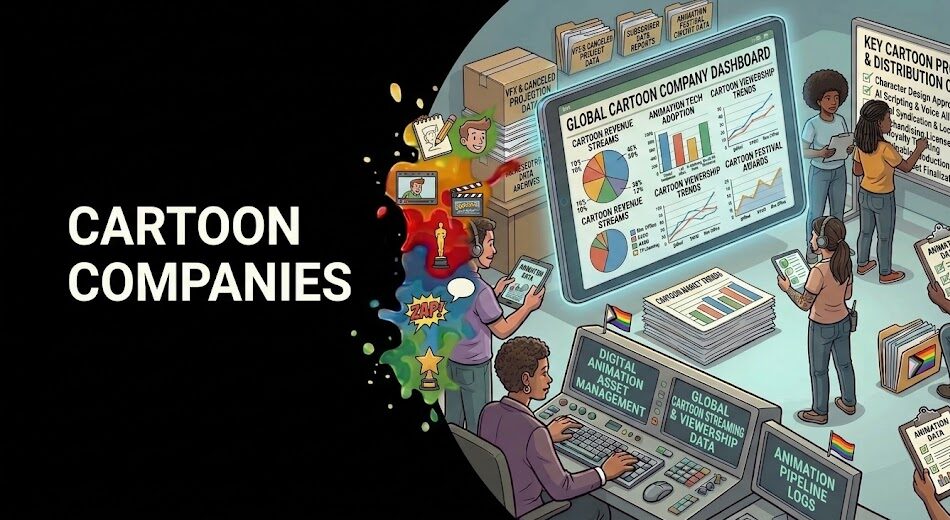
The top cartoon companies aren’t just making films—they’re building global IP empires. From Disney’s multi-billion-dollar franchise flywheel to Toonz Media Group’s 450-title library spanning over 100 countries, the animation industry has never been more competitive or more lucrative. Whether you’re a content buyer, a co-production partner, or a vendor trying to crack the right studio relationships, knowing who controls the space matters.
Here’s the reality behind closed doors: streaming platforms now commission animation at roughly 3x the rate of theatrical production. The deals that matter most are being structured in Mumbai, Tokyo, and Seoul—months before they surface in the trades.
This guide maps the 10 most significant cartoon production companies operating globally right now, with strategic intelligence on what makes each one worth your attention—and where opportunities exist for buyers, licensors, and co-production partners.
Table of Contents
Ask VIQI: Which Cartoon Studios Are Currently Available for Co-Production?
VIQI is Vitrina’s AI research assistant—trained on 1.6 million titles, 360,000 companies, and 5 million entertainment professionals.
✓ Included with 200 free credits | ✓ No credit card needed
What Separates Top-Tier Cartoon Companies from the Rest
It’s not just box office numbers. The best cartoon companies combine four things: a recognizable IP library, scalable distribution, franchise-extension capability, and—increasingly—a streaming-native strategy. Studios that can’t move content across theatrical, streaming, and licensing simultaneously aren’t competing at the top anymore. Full stop.
The metrics that matter to buyers and co-production partners are straightforward, but they’re rarely measured together:
- IP ownership depth — How many owned franchises does the studio actually control (not license)?
- Output volume — Hours of new content commissioned per year, not just delivered
- International footprint — Active distribution deals by territory count, not just “global”
- Franchise extension potential — Merchandise, gaming, theme park integration, live events
- Production cost efficiency — Return per dollar invested, not just gross revenue
And here’s what most rankings miss: production cost efficiency. Illumination Entertainment generates more revenue per dollar spent than almost any studio on this list. That ratio—not just box office—is why Universal keeps backing it. Smart buyers and co-producers pay attention to that number.
The Top 10 Cartoon Companies Reshaping Animation in 2025
1. Walt Disney Animation Studios
Walt Disney Animation Studios remains the benchmark—and it isn’t close. Frozen, Encanto, and Moana 2 aren’t just films. They’re billion-dollar franchise engines that integrate with Disney parks, consumer products, Broadway musicals, and Disney+. No other cartoon company has replicated that flywheel at scale. That said, Disney’s theatrical-versus-streaming calculus has shifted dramatically since 2020, and not all of that shift has been smooth.
What makes Disney untouchable at the top isn’t any single film—it’s the IP commercialization infrastructure surrounding every film. That’s a different competitive advantage than most studios can build.
2. Pixar Animation Studios
Pixar built its reputation on emotional storytelling delivered with technical precision. Its franchise catalog—Toy Story, The Incredibles, Cars, Finding Nemo—represents some of the most commercially durable animation IP anywhere. But Pixar’s identity has blurred somewhat since its COVID-era pivot to Disney+ releases. Audiences don’t always distinguish theatrical Pixar from streaming Pixar. The studio has been actively recalibrating its theatrical strategy, with films like Inside Out 2 proving theatrical Pixar still commands serious box office.
3. DreamWorks Animation
DreamWorks Animation—now operating under Comcast/NBCUniversal following its $3.8 billion acquisition in 2016—has built an animated entertainment catalog that delivers consistent licensing revenue across generations. Shrek, Kung Fu Panda, How to Train Your Dragon—these are genuine evergreen franchises. Its Netflix partnership for original series production has also produced global hits, most notably Puss in Boots: The Last Wish, which overperformed critically and commercially.
4. Illumination Entertainment
Illumination Entertainment is arguably the most financially disciplined major cartoon production company on this list. The Minions franchise is the highest-grossing animated franchise in cinema history—global box office exceeding $7 billion. But what Illumination does differently isn’t just IP creation. It keeps production budgets significantly lower than Disney or Pixar while generating comparable returns. That efficiency ratio is the real story. The Super Mario Bros. Movie in 2023 became the highest-grossing video game film ever, adding another franchise to a roster that was already elite.
5. Warner Bros. Animation
Warner Bros. Animation holds one of the deepest legacy cartoon catalogs anywhere in entertainment. Looney Tunes, the DC animated universe, Scooby-Doo, Tom and Jerry—these aren’t just brands, they’re generational cultural institutions. The challenge post-WBD merger has been consistent creative direction, but for buyers and licensors, the IP value remains extraordinary. As reported by Variety, WBD’s animation slate has undergone significant restructuring since 2022, reflecting broader platform consolidation pressures.
6. Cartoon Network Studios
Cartoon Network Studios defined a specific creative era. Adventure Time, Steven Universe, Regular Show, The Amazing World of Gumball—the studio’s identity was built on creator-driven, irreverent storytelling that resonated globally. Now operating within the WBD umbrella alongside Max, its future as a distinct label has been widely speculated about in the industry. But don’t underestimate the catalog. For content licensing and international distribution, these titles still perform.
7. Toonz Media Group
Toonz Media Group is the most underestimated top cartoon company in most Western buyers’ awareness—and that’s a competitive gap worth closing fast. Based in India with global operations, Toonz’s 450-title library reaches audiences in over 100 countries. The studio offers fully integrated production services: development, animation, post-production, and distribution. That makes it an unusually complete co-production partner for projects targeting emerging markets or seeking cost-efficient production without sacrificing quality.
In Vitrina’s LeaderSpeak interview, Toonz CEO Jayakumar P discussed how the company is integrating AI tools into its production pipeline and aggressively expanding into new genre territories beyond its preschool heritage. Watch the full conversation:
Jayakumar P (CEO, Toonz Media Group) on market expansion, AI integration, and global animation strategy:
8. Toei Animation
Toei Animation controls some of the most commercially durable cartoon IP on the planet. One Piece—in continuous weekly production since 1999—is one of the best-selling manga franchises globally with an anime adaptation that still pulls massive streaming audiences. Add Dragon Ball, Sailor Moon, and Digimon to that catalog, and you’re looking at licensing revenue streams that most Western studios would trade significant assets to access. For buyers targeting Asian markets especially, Toei’s catalog is essential territory to understand.
9. MAPPA Studio
MAPPA changed how the industry thinks about anime production quality. Attack on Titan: The Final Season, Jujutsu Kaisen, Chainsaw Man—the studio consistently delivers prestige-level animation that drives international streaming viewership at extraordinary scale. As The Hollywood Reporter has noted, anime’s global streaming audience has grown substantially—and MAPPA titles rank among the most-watched across Crunchyroll and Netflix. That’s not a niche position anymore. It’s a mainstream one.
10. Laika Entertainment
Laika Entertainment occupies a singular niche. It’s a premium stop-motion studio with a catalog of critically acclaimed films—Coraline, ParaNorman, Kubo and the Two Strings—that punch well above their production budgets in audience impact and critical prestige. Smaller output volume than the studios above it on this list. But Laika’s brand cachet is exceptional, and the visual distinctiveness of stop-motion is exactly what streaming platforms are hunting for to differentiate their catalogs. Don’t count it out because it’s not a franchise factory.
Track 360,000+ Animation Companies and Their Live Projects
Trusted by Netflix, Warner Bros, and Paramount. Discover animation co-production opportunities, verify studio capabilities, and connect with the right decision-makers—before the deal gets done elsewhere.
✓ 200 free credits | ✓ No credit card required | ✓ Full platform access
How Global Markets Are Reshaping Cartoon Production
The cartoon production landscape has fundamentally changed in five years. It’s not a Hollywood story anymore. Three forces are driving the shift—and buyers who haven’t adjusted their sourcing strategies yet are already behind.
Streaming platforms are commissioning locally. Netflix, Disney+, and Amazon Prime have built regional content strategies that prioritize culturally resonant animation over generic international product. Indian studios, Korean studios, and Brazilian studios are landing commissioning deals that would’ve been structurally impossible a decade ago. Toonz Media Group’s growth trajectory is a direct reflection of this.
Sovereign content hubs are investing in animation infrastructure. Saudi Arabia’s Vision 2030 includes animation as a cultural economy pillar. South Korea’s government has backed animation exports through targeted incentives for decades—and it’s paying off. MAPPA’s international success is partly a product of those foundations. These aren’t experimental programs. They’re competitive threats to Western studios that aren’t paying attention.
Production cost differentials are widening the competitive gap. Studios in India, Malaysia, Vietnam, and the Philippines now offer animation production at 40–60% lower cost than US equivalents—with comparable quality for many genres. For buyers, that arithmetic changes every co-production conversation. The question isn’t just “who makes the best cartoon?” It’s “which studio delivers the right IP at the right cost, for the right territory?”
That’s a fundamentally different question. And most sourcing workflows weren’t designed to answer it.

Your AI Assistant, Agent, and Analyst for the Business of Entertainment
VIQI AI helps you plan content acquisitions, raise production financing, and find and connect with the right partners worldwide.
- Find active co-producers and financiers for scripted projects
- Find equity and gap financing companies in North America
- Find top film financiers in Europe
- Find production houses that can co-produce or finance unscripted series
- I am looking for production partners for a YA drama set in Brazil
- I am looking for producers with proven track record in mid-budget features
- I am looking for Turkish distributors with successful international sales
- I am looking for OTT platforms actively acquiring finished series for the LATAM region
- I am seeking localization companies offer subtitling services in multiple Asian languages
- I am seeking partners in animation production for children's content
- I am seeking USA based post-production companies with sound facilities
- I am seeking VFX partners to composite background images and AI generated content
- Show me recent drama projects available for pre-buy
- Show me Japanese Anime Distributors
- Show me true-crime buyers from Asia
- Show me documentary pre-buyers
- List the top commissioners at the BBC
- List the post-production and VFX decision-makers at Netflix
- List the development leaders at Sony Pictures
- List the scripted programming heads at HBO
- Who is backing animation projects in Europe right now
- Who is Netflix’s top production partners for Sports Docs
- Who is Commissioning factual content in the NORDICS
- Who is acquiring unscripted formats for the North American market
How to Find the Right Cartoon Production Partner
Here’s what we see consistently: producers and buyers spend 3–6 months manually vetting animation partners—calling contacts, reviewing reels, chasing references. That’s not intelligence gathering. That’s the fragmentation paradox in action. And it costs you margin and time simultaneously.
The global animation vendor landscape has 10,000+ active studios. Most buyers have visibility into fewer than a dozen. The ones you don’t know might include your best co-production partner—but finding them through relationship networks alone takes years you don’t have.
What efficient buyers need isn’t more contacts. It’s verified data. Specifically:
- Verified capability data — What genres, formats, and budget ranges does the studio genuinely deliver? Not what their website claims.
- Capacity intelligence — Is the studio actually available for your production window, or booked through 2027?
- Hero project verification — Real credits, real delivery dates, real client relationships
- Financial stability signals — Will this studio still exist and be solvent when your project needs to deliver?
Vitrina maps these data points across 360,000+ production and animation companies globally—in real time, not from six-month-old trade reports. You can filter by genre, budget range, territory appetite, and current capacity. That compresses the partner-search process from months to days. For the full animation studio landscape, the platform covers everything from Tier 1 studios to boutique specialists you’d never find through traditional channels.
Need an Animation Partner Fast? We’ll Find One.
Vitrina Concierge doesn’t give you a list—it makes warm introductions directly to verified animation studios seeking your type of project.
- Korean animation studio → Netflix Adult Animation (week one)
- LA producer → Netflix UK, Fifth Season, Fox Entertainment (48 hours)
- Middle Eastern studio → Legendary Pictures (direct access)
Frequently Asked Questions
What are the biggest cartoon companies in the world?
The biggest cartoon companies by revenue and IP value include Walt Disney Animation Studios, Pixar, DreamWorks Animation, Illumination Entertainment, and Warner Bros. Animation. Outside the US, Japan’s Toei Animation and India’s Toonz Media Group command serious global reach—with catalogs spanning hundreds of titles across 100+ countries. The definition of “biggest” shifts depending on whether you’re measuring box office, licensing revenue, catalog depth, or streaming viewership.
Which cartoon company has the most valuable IP?
When you factor in merchandise, theme parks, and streaming, Walt Disney Animation Studios and Pixar—both under the Disney umbrella—likely hold the most commercially monetizable animated IP. But Illumination’s Minions franchise is the highest-grossing animated franchise by box office alone. Toei Animation’s catalog generates extraordinary licensing revenue across Asia and Europe that rivals anything in the Western market.
Are there top cartoon companies outside the US worth knowing?
Absolutely—and this is where most Western buyers leave money on the table. Japan’s Toei Animation and MAPPA Studio serve global streaming audiences in the hundreds of millions. India’s Toonz Media Group has a 450-title library reaching 100+ countries. South Korea’s animation sector has expanded significantly with government incentive backing. Emerging markets in Southeast Asia and MENA are building serious production infrastructure. The map isn’t Hollywood-centric anymore.
How do cartoon studios typically structure co-production deals?
Co-production deals in animation typically involve two or more studios sharing production costs in exchange for territorial rights splits—one party holds domestic rights, the other holds international. Co-financing is structured as equity stakes in the project. For formal co-productions accessing treaty benefits (UK, Canada, and Australia have the most active animation treaties), financial contributions must be proportional to creative contribution, usually a minimum of 10–20% from each party.
How is AI changing production at top cartoon companies?
AI is primarily impacting pre-production workflows—storyboarding, concept art, character design iteration, and script breakdown. Studios like Toonz Media Group are actively testing AI tools for pipeline efficiency. But as of 2025, no major cartoon production company has replaced core animation talent with AI—the technology assists, it doesn’t substitute. The legal landscape around authorized versus unauthorized AI training data is actively evolving, and IP-rich studios are watching this closely to protect their character libraries.
What’s the difference between a cartoon company and an animation studio?
In practice, the terms are interchangeable. “Cartoon company” often implies a focus on entertainment or children’s programming, while “animation studio” is broader—covering feature films, VFX, advertising, and educational content. All cartoon companies are animation studios, but not all animation studios specialize in cartoon content. For buyers and co-production partners, the distinction rarely matters. Capabilities and catalog are what count.
Where can I find cartoon companies available for licensing deals?
Film markets like MIPTV, MIPCOM, Kidscreen Summit, and TIFFCOM are traditional venues—but they’re increasingly supplemented by data platforms that provide year-round access. Vitrina’s network maps 360,000+ animation and production companies with verified capability data, active project status, and direct contact access. You can identify which studios have catalog available for licensing and reach the right decision-maker without cold outreach—starting with 200 free credits.
Can smaller cartoon studios compete with major studios in 2025?
Yes—but only in specific niches. Laika succeeds by doing what major studios won’t: high-craft, visually distinctive, creatively ambitious work that doesn’t look like everything else. The economics require discipline—small studios can’t absorb expensive failures the way Disney can. But streaming platforms are actively seeking differentiated content. There’s more real opportunity for independent animation than there’s been in decades, provided the studio has a clear creative identity and a realistic distribution strategy from day one.
Conclusion: The Animation Landscape Is Bigger—and More Global—Than You Think
The top cartoon companies list doesn’t start and end in Hollywood. It runs through Mumbai, Tokyo, Paris, Seoul—and increasingly through Riyadh and Kuala Lumpur. The studios building the next decade of animation IP are investing now, with infrastructure and streaming deals that will reshape global distribution long before most buyers recognize what’s happened.
Key Takeaways:
- Disney/Pixar dominate IP value, but streaming fragmentation is eroding the catalog moat advantage that made them untouchable for decades.
- Illumination’s efficiency model—lower cost, maximum return—is the template every other major studio is trying to replicate in 2025.
- Toei and MAPPA control anime audiences that rival any Western studio’s global streaming numbers—and they’re not slowing down.
- Toonz Media Group is the most underestimated studio on this list for buyers and co-production partners seeking cost-efficient, internationally distributed animation.
- Global market shifts mean your best animation partner may not be the studio you already know—it may be one you haven’t found yet.
The fragmentation paradox is real in animation: over 10,000 active studios globally, but most buyers operate with visibility into fewer than a dozen. That information gap costs you margin, time, and deals you didn’t even know existed.
Track 400,000+ Animation Projects Before They Hit the Trades
Trusted by Netflix, Warner Bros, Paramount, and Google TV. Access 360,000+ verified animation companies, 3 million executives, and real-time project intelligence.
✓ 200 free credits | ✓ No credit card required | ✓ Cancel anytime
Need warm introductions to animation studios? Explore Concierge Service →
Find Film+TV Projects, Partners, and Deals – Fast.
VIQI matches you with the right financiers, producers, streamers, and buyers – globally.
Producers Seeking Financing & Partnerships?
Book Your Free Concierge Outreach Consultation
(To know more about Vitrina Concierge Outreach Solutions click here)
Join Industry Briefings Trusted by Leaders

The Mid-Budget Comeback: Why Mid-Budget Films Is the Smartest Bet in the Room
Mid-budget films are attracting new capital. See why this segment is becoming one of the strongest bets in Film today.
Franchise Fatigue vs. IP Dependency: What Studios Should Be Betting On Now
s franchise performance softens, where will the next generation of valuable IP come from? Join the briefing.

Unscripted Is Eating the World: The Multi-Billion Reality and Format Boom
Unscripted is the new prestige — inside the $19.8B global format boom reshaping how streaming platforms compete.
How Co-Productions and Regional IP Are Reshaping Global Drama
As global drama evolves, which stories travel, which stay local, and how are they getting financed?