About Innovation Hub
 Global Content Pulse (Webinars)


 Global Production Financing
(Webinars)
Global Production Financing
(Webinars)  LeaderSpeak Podcast
  Global Entertainment Digest (Newsletter)
  About Vitrina
 About VIQI
 Our Story
 Our Solutions 🔥
 Film+TV Projects Tracker 🚀
 Case Studies
 Our Profile
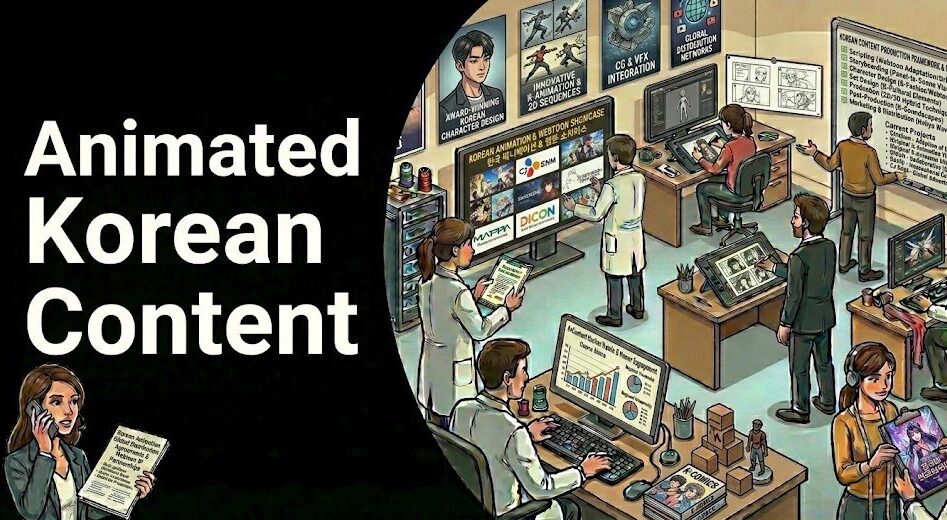
For decades, South Korea was the world’s animation back-office. Studios in Seoul and Busan handled the in-between frames for Hanna-Barbera, Disney, and Warner Bros.—invisible labor powering beloved Western properties while Korean studios built no IP of their own. That arrangement made economic sense at the time. And then it stopped making sense entirely.
Animated Korean content today is a Tier 1 global export category—not a service. Korean studios aren’t just executing Western visions; they’re developing original manhwa-derived IP, landing nine-figure streaming deals, and attracting co-production capital from Netflix, Disney, and sovereign wealth funds investing in the Korean creative economy. The shift from service provider to IP creator didn’t happen overnight. And understanding how it happened—and what’s accelerating it right now—is essential intelligence for any executive acquiring, co-producing, or financing animation in 2025.
This guide covers the full picture: the historical arc, the current studio ecosystem, the streaming catalyst, the AI tools reshaping Korean production pipelines, and how to find and vet Korean animation partners at scale. For the broader context on South Korean content internationally, our guide to South Korean anime’s global reach maps the live-action and animation overlap in detail.
In This Guide
- From Back-Office to IP Creator: The Historical Shift
- How the Hallyu Wave Unlocked Animation’s Global Moment
- The Korean Animation Studio Ecosystem Today
- Netflix, Streaming, and the $2.5B Catalyst
- Manhwa as the IP Pipeline: Why It Matters for Buyers
- AI Is Reshaping Korean Animation Production
- Co-Production Strategy: What International Partners Need to Know
- KOFIC and Government Backing: Korea as a Sovereign Content Hub
- Finding Korean Animation Partners at Scale
- Frequently Asked Questions
From Back-Office to IP Creator: The Historical Shift
South Korea’s animation industry was built on subcontracting. From the 1970s through the 1990s, Korean studios provided skilled labor for American productions at a fraction of Hollywood’s cost—clean line work, reliable delivery, low overheads. Companies like Dong Woo Animation, Sunwoo Entertainment, and DR Movie built enormous technical capability through this service economy. They mastered frame execution. They built the pipelines. They developed the craft.
But they didn’t own a frame of what they made.
The pivot started quietly in the 2000s, accelerated by two forces: the domestic success of Korean-originated animated properties and the government’s recognition that the creative economy was a national export opportunity. Studios that had spent twenty years executing other people’s visions began developing their own. The IP gap between “Korean-produced” and “Korean-created” started closing—slowly at first, then decisively.
Studio Mir became the most visible signal of this transition globally. Founded by veterans of the Korean animation service industry, Studio Mir went from executing outsourced animation to producing acclaimed work for Nickelodeon’s The Legend of Korra and Netflix’s Voltron: Legendary Defender—and then to producing The Witcher: Nightmare of the Wolf for Netflix as lead studio, with full production credit. That trajectory—from subcontractor to primary creative partner to increasingly independent IP developer—is the arc the entire Korean animation sector is now following.
The economics of this shift are real and measurable. Service animation generates margin on labor. IP ownership generates margin on rights—territorial licensing, merchandising, sequel participation, format sales. The difference in long-term EBITDA between a Korean studio that executes one episode for a flat fee versus one that co-owns a global animation franchise isn’t incremental. It’s structural.
Identify Korean Animation Studios Seeking IP Co-Production Deals
Ask VIQI—Vitrina’s AI assistant—which Korean animation studios are actively seeking co-production and IP licensing partners right now. Trusted by Netflix, Warner Bros, and 140,000+ companies on the platform.
Ask VIQI — No Credit Card Required
200 free credits included | Instant answers on K-animation deal flow
How the Hallyu Wave Unlocked Animation’s Global Moment
The Hallyu Wave—Korea’s cultural export phenomenon spanning K-pop, K-drama, and K-cinema—did something for Korean animation that a decade of government policy couldn’t: it pre-built an audience. By the time Korean animation studios began scaling original IP ambitions in earnest, a global fanbase already identified “Korean content” as a mark of quality worth seeking out.
That brand halo is commercially significant. When a Korean animated series arrives on a streaming platform, it doesn’t land without context—it arrives with the cultural credibility the Hallyu Wave established through music, drama, and film. Squid Game‘s global success in 2021 didn’t just validate Korean live-action storytelling; it accelerated every streaming platform’s appetite for Korean content across formats. Animation was the next logical frontier.
But there’s a subtler dynamic at work. The Hallyu Wave’s global reach proved that Korean storytelling conventions—its emotional directness, its genre blending, its willingness to subvert tropes mid-season—travel across cultural contexts. That’s exactly what animation buyers need to know before they acquire or co-produce. It’s not just technical quality. It’s narrative DNA that has demonstrably global appeal, now applied to a format with even greater international distribution flexibility than live-action.
And animation travels more cheaply than live-action. No location clearances, no talent visa complications, no dubbing challenges rooted in physical performance. Animation is localization-ready by design—which is why Korean animated content’s export ceiling is structurally higher than Korean live-action, not lower. According to Variety, the intersection of Hallyu’s audience development and animation’s format advantages has positioned Korean animated content as one of the most strategically acquired categories in global streaming deals since 2022.

Your AI Assistant, Agent, and Analyst for the Business of Entertainment
VIQI AI helps you plan content acquisitions, raise production financing, and find and connect with the right partners worldwide.
- Find active co-producers and financiers for scripted projects
- Find equity and gap financing companies in North America
- Find top film financiers in Europe
- Find production houses that can co-produce or finance unscripted series
- I am looking for production partners for a YA drama set in Brazil
- I am looking for producers with proven track record in mid-budget features
- I am looking for Turkish distributors with successful international sales
- I am looking for OTT platforms actively acquiring finished series for the LATAM region
- I am seeking localization companies offer subtitling services in multiple Asian languages
- I am seeking partners in animation production for children's content
- I am seeking USA based post-production companies with sound facilities
- I am seeking VFX partners to composite background images and AI generated content
- Show me recent drama projects available for pre-buy
- Show me Japanese Anime Distributors
- Show me true-crime buyers from Asia
- Show me documentary pre-buyers
- List the top commissioners at the BBC
- List the post-production and VFX decision-makers at Netflix
- List the development leaders at Sony Pictures
- List the scripted programming heads at HBO
- Who is backing animation projects in Europe right now
- Who is Netflix’s top production partners for Sports Docs
- Who is Commissioning factual content in the NORDICS
- Who is acquiring unscripted formats for the North American market
The Korean Animation Studio Ecosystem Today
Korea’s animation sector isn’t monolithic—it’s stratified by capability, IP ownership position, and strategic ambition. Understanding the layers is essential before you approach it for acquisition, co-production, or services sourcing.
Tier 1: Full-Production IP Developers
These are the Korean studios actively developing and co-owning original animated IP. Studio Mir sits at the top of this group globally—its track record across Netflix originals gives it both creative credibility and deal leverage that most Korean studios are still building. CJ ENM, South Korea’s largest entertainment conglomerate, is aggressively expanding its animation ambitions alongside its established live-action and format businesses. CJ ENM’s partnership with Disney Japan announced for its TVING streaming platform signals the kind of strategic alliance that transforms an animation company’s global distribution position overnight.
The most audacious move in this tier is Utopai Studios and Stock Farm Road‘s multi-billion-dollar AI venture specifically designed to globalize K-content at scale. That’s not incremental expansion—it’s a structural bet that Korean IP creation combined with AI-accelerated production can compete at Hollywood volume without Hollywood overhead.
Tier 2: Co-Production Specialists
A growing cohort of mid-size Korean studios sit in the co-production sweet spot—capable of significant creative contribution while structuring deals that share both IP rights and financial risk. These companies understand Korea’s bilateral co-production treaties and have relationships with KOFIC (Korean Film Council) that accelerate access to public funding and incentives. They’re the logical entry point for international animation buyers who want Korean creative DNA without anchoring a deal to one of the large conglomerates.
Tier 3: Service Studios with IP Ambitions
The largest group—and the most strategically interesting for international partners willing to structure deals creatively. Dozens of Korean studios with deep technical capability are actively seeking arrangements where service work on international productions comes attached to IP participation in Korean original development. They’ll execute your frames efficiently. But they want a stake in the next project. Understanding which studios in this tier are making that transition—and which are still primarily service-oriented—requires current market intelligence, not six-month-old trade information.
Seth Hallen and Craig German discuss how AI is transforming the animation supply chain—touching directly on the localization, scriptwriting, and post-production functions that are reshaping how Korean studios operate and compete globally:

Netflix, Streaming, and the $2.5B Catalyst
Netflix committed $2.5 billion to Korean content production—a figure that isn’t just significant for live-action drama. Animation is explicitly within scope, and Netflix’s track record of commissioning Korean animated projects has already established that this commitment flows into the animation sector. When the world’s largest streaming platform makes a multi-year, multi-billion-dollar commitment to a single country’s content ecosystem, the financial signal to every other buyer is clear: Korea is a Tier 1 content sovereign hub, not an emerging market experiment.
Track Korean Animation Projects in Development Right Now
Vitrina tracks 140,000+ active entertainment companies—including Korean animation studios with active development slates. Know what’s in production before it hits the trades. Used by Netflix, Paramount, and global content buyers.
But Netflix’s influence on Korean animation runs deeper than capital. It’s changed how Korean studios structure deals, think about IP ownership, and target global audiences. Pre-Netflix, Korean animation companies optimized for domestic broadcast windows first, with international sales as upside. Netflix inverts that logic entirely—global distribution is the primary market, and Korean cultural specificity is the competitive advantage, not the limitation. That reorientation has restructured how Korea’s best animation studios approach development from the first page of a script.
Amazon MGM Studios, Apple TV+, and regional streamers like Viu and Wavve have followed Netflix’s lead, creating multiple competing buyers for premium Korean animated content simultaneously. That’s not just good for Korean studios’ leverage in negotiations—it’s good for the quality of projects being developed, because studios with multiple acquisition paths can afford to hold out for better creative terms. Competition among buyers de-risks the development pipeline for producers. And for content acquirers, it means moving faster matters more than it used to.
The window between a Korean animated project reaching development maturity and landing its first streaming commitment has compressed dramatically. The studios watching these deals in real time—tracking which Korean properties have attached which streaming partners before the official announcement hits Variety or Deadline—are the ones positioning for acquisition before the price spikes. Our detailed breakdown in the strategic guide to Korean animation IP acquisition covers exactly how that intelligence advantage translates into deal positioning.
Manhwa as the IP Pipeline: Why It Matters for Buyers
Manhwa—Korean comics and graphic novels—has emerged as one of the most commercially productive IP pipelines in global animation and live-action adaptation. The reasons aren’t hard to understand: manhwa properties arrive with existing fanbases, tested narratives, pre-built visual languages, and—critically—established international audiences through digital manga platforms like Webtoon (which reports over 85 million monthly active users globally).
That’s not a niche audience. That’s a presold global fanbase. And for animation buyers, a manhwa adaptation means reduced market risk: you’re not introducing a new IP to cold audiences—you’re translating an already-beloved property into a new format. The adaptation logic mirrors what’s driven Hollywood’s IP-first strategy for the past twenty years. Korea now has its own version of that playbook, and it’s producing results.
What makes the manhwa pipeline particularly valuable right now is volume. Webtoon alone generates thousands of series across genres—action, romance, horror, fantasy, sci-fi—with real-time reader data showing which properties are resonating globally versus which are locally beloved but not yet proven outside Korea. For content buyers with access to that data, the acquisition opportunity is genuinely significant. You’re identifying animation-ready IP with proven global audience validation before studios have finished the development pitch.
But there’s a supply chain complexity here that buyers underestimate. Manhwa IP rights are often held across multiple stakeholders—original creators, platform rights holders, webtoon publishers—with different contractual structures than Western comic IP or traditional literary adaptation rights. Understanding who actually controls animation rights for a specific manhwa property, and whether those rights are clean and fully available, requires specific diligence that generic IP acquisition processes weren’t designed for.
AI Is Reshaping Korean Animation Production—Faster Than Most Buyers Realize
Here’s something that isn’t making it into enough acquisition briefs: Korean animation studios are adopting AI production tools at a pace that is materially compressing episode delivery timelines and reducing per-episode production costs. This isn’t theoretical. Studios already integrating AI across in-betweening, background generation, and color processing pipelines are reporting production efficiency gains that change the economics of co-production deals fundamentally.
The Utopai Studios / Stock Farm Road multi-billion-dollar AI venture is the highest-profile signal—but it’s not the only one. CJ ENM has publicly committed to AI-powered animation tools as part of its content expansion strategy. Smaller Korean studios are integrating AI into specific production stages where the ROI is clearest, building workflows that let smaller teams produce at volumes that previously required staff three times the size.
What does this mean for international co-production partners? A few things worth factoring into deal structures. AI-assisted production changes how you model delivery timelines in co-production agreements. It changes how you think about completion risk—when AI tools handle in-between frames, the bottleneck shifts from labor volume to creative direction and QC, which has different risk profiles. And it changes how you assess a Korean studio’s capacity claims: a studio with 40 staff and an advanced AI pipeline can plausibly commit to episode volumes that a headcount-only assessment would call impossible.
The IP and rights dimension of AI-generated content in Korean animation is also evolving—Korean creators and studios are actively working through Authorized AI frameworks that protect underlying IP while enabling production efficiency gains. Buyers should verify their prospective Korean partners’ AI governance frameworks as part of due diligence, not as an afterthought.
Co-Production Strategy: What International Partners Need to Know
Co-producing with Korean animation companies requires understanding the deal structures that actually work here—not the generic co-production model you’d apply to a European partner.
IP ownership is the central negotiation point. Korean studios increasingly insist on co-ownership rather than work-for-hire. That’s a structural shift from the service era—and it’s the right shift. Studios that co-own IP can participate in the upside of a hit property across its full commercial life. For international partners, co-ownership means sharing both upside and development risk, which requires more careful project selection but creates a genuinely aligned incentive structure on both sides of the deal.
Territory structuring matters enormously. Korean studios typically want to retain Korean theatrical and broadcast rights while partnering internationally for global streaming distribution. Understanding which rights a specific studio is willing to separate—and which they’ll hold regardless of deal size—shapes the entire negotiation architecture before the first term sheet draft.
KOFIC eligibility is a real financial variable. Korean co-productions qualifying for Korean Film Council support can access public funding that effectively reduces the total capital required from international partners. But KOFIC eligibility has specific requirements around Korean creative contribution, crew ratios, and production spend allocation. Building KOFIC compatibility into a co-production structure from the deal’s inception—not after—is how experienced Korean animation co-producers approach it.
According to Screen International, Korean animation co-productions involving international partners have increased substantially since 2022, driven by streaming platform mandates for Korean content and Korean studios’ expanded appetite for capital-sharing arrangements that accelerate original IP development. The pipeline of announced and in-development Korean animated co-productions going into 2025 is at its deepest point in the industry’s history. Our guide to mastering anime licensing and distribution covers the rights frameworks that apply across Korean and Japanese animation acquisitions.
Need Direct Introductions to Korean Animation Studios?
Vitrina’s Concierge Service makes verified introductions to Korean animation studios actively seeking co-production and IP licensing partners. Skip the cold outreach. Used by buyers whose deals have landed on Netflix, Warner Bros, and major global platforms.
KOFIC and Government Backing: South Korea as a Sovereign Content Hub
South Korea is one of Vitrina’s designated Tier 1 Sovereign Content Hubs—territories where government-backed capital has created vertically integrated production ecosystems capable of exporting content globally at scale. Korea sits in the most elite company in this framework: fully operational, internationally distributing, and strategically investing in the creative economy as a national priority.
The Korean Film Council (KOFIC) is the primary institutional mechanism—providing funding support, co-production facilitation, and international market access for Korean productions. But KOFIC sits within a broader government strategy that includes local content quotas driving domestic demand, bilateral co-production treaties with multiple international partners, and deliberate infrastructure investment in facilities and training programs that reduce the crew shortage constraints other sovereign hubs face.
What distinguishes Korea from aspiring sovereign hubs is infrastructure maturity. Modern production facilities. Advanced technology pipelines. Technically trained crews with decades of accumulated experience from the service era—now being redeployed on Korean originals. The country isn’t building a film industry from scratch; it’s redirecting an already-functional industrial base toward IP creation instead of IP execution.
For international partners, this matters because it de-risks the co-production calculation. You’re not betting on emerging market infrastructure that might not deliver—you’re engaging a fully operational production ecosystem backed by government stability, institutional support structures, and a workforce that has already proven its technical capability on some of the most demanding Western animated productions of the past thirty years.
The capital dynamics are also favorable. KOFIC co-production agreements can effectively reduce a project’s net cost to international partners while giving Korean studios meaningful participation. And unlike some sovereign fund incentive structures that require complex compliance mechanisms, KOFIC’s program has an established track record with international partners that reduces the legal and administrative overhead of structuring a qualifying deal.
Finding Korean Animation Partners at Scale—Without the Information Gap
Here’s the operational reality that too many animation buyers discover too late: Korea’s animation ecosystem is genuinely opaque if you’re approaching it without current, verified intelligence. There are hundreds of studios—ranging from boutique manhwa adaptation specialists to large-scale CG production houses—and the publicly available information on most of them is either months out of date, self-reported on company websites, or limited to the credits listed on IMDB for their most recent completed projects.
That’s the Fragmentation Paradox playing out in a single national market. Korea’s animation sector alone has enough suppliers, IP developers, and co-production specialists to generate information overload—yet the actionable intelligence on which studios have current capacity, which are actively seeking international partners for specific genres, and which have clean IP ownership structures for their development slate is exactly what static databases and six-month-old trade coverage can’t provide.
Vitrina maps over 140,000 active entertainment companies globally—including Korean animation studios segmented by production capability, genre focus, IP ownership status, deal history, and current project pipeline. You can identify which Korean studios are actively packaging manhwa-derived animated properties in your target genre, which have co-production frameworks already in place with international partners, and which are in active development for streaming platforms that match your distribution strategy. VIQI (Vitrina’s AI intelligence assistant) answers specific Korean animation queries in real time—genre, budget range, production stage, co-production openness—without the weeks-long research process that equivalent manual intelligence would require.
And for executives who need to move from intelligence to introductions—getting verified access to decision-makers at Korean animation studios before the next market or acquisition window closes—Vitrina’s Concierge Service delivers exactly that. Start with 200 free credits. No credit card, no commitment.
Frequently Asked Questions About Animated Korean Content
What distinguishes animated Korean content from Japanese anime in the global market?
Korean animation (sometimes called “manhwa animation” when adapted from Korean comics, or “K-animation” informally) differs from Japanese anime in both production history and current commercial positioning. Japan’s anime industry is organized around a committee (seishaku iinkai) financing model with deep domestic broadcast infrastructure. Korean animation is increasingly structured around streaming-first deals with international platforms like Netflix and Amazon MGM, with co-production capital from international partners playing a larger role. Korean animation also draws from manhwa’s distinct visual and narrative conventions—emotionally direct storytelling, genre-blending, and complex character dynamics that have proven to translate well across global audiences.
How much has Netflix invested in Korean content, and does that include animation?
Netflix committed $2.5 billion to Korean content production—a multi-year investment that explicitly covers Korean animated projects alongside live-action drama and film. Netflix has already commissioned Korean animated originals under this framework, and Korean animation studios with proven track records on Western animated productions are among the priority targets for Korean animation commissioning. The $2.5B commitment signals to other streamers that Korean content—across all formats—is a strategic priority, driving competitive acquisition behavior from Amazon MGM, Apple TV+, and regional platforms.
What is manhwa and why is it important for animation IP acquisition?
Manhwa refers to Korean comics and graphic novels—the equivalent of Japanese manga in the Korean creative tradition. Manhwa, particularly digital manhwa distributed through platforms like Webtoon (which reports over 85 million monthly active users globally), represents one of the most commercially significant IP pipelines in global animation right now. Manhwa properties arrive with proven global audiences, tested narratives, and pre-built visual identities. For animation buyers, adapting established manhwa properties dramatically reduces market risk compared to original IP development—audiences are already invested in the characters and world before the first episode releases.
What role does KOFIC play in Korean animation co-productions?
The Korean Film Council (KOFIC) is the primary government body supporting Korean film and animation production. For international co-productions, KOFIC eligibility can unlock public funding support that reduces total production capital requirements. KOFIC also administers Korea’s bilateral co-production treaties with partner countries—agreements that allow qualifying productions to access incentives and distribution benefits in both territories simultaneously. Building KOFIC eligibility into a Korean animation co-production structure from the deal’s earliest stages (not after term sheets are drafted) is how experienced international co-producers maximize the financial efficiency of Korean partnerships.
How are Korean animation studios using AI to change production economics?
Korean animation studios are integrating AI across in-betweening, background generation, color processing, and localization workflows—compressing episode delivery timelines and reducing per-episode production costs significantly. Major initiatives like the Utopai Studios / Stock Farm Road multi-billion-dollar AI venture are explicitly targeting K-content globalization through AI-accelerated production. CJ ENM has committed to AI-powered animation tools as part of its content expansion strategy. For co-production partners, AI adoption changes how you model delivery schedules, assess capacity claims, and structure completion risk provisions in co-production agreements.
What IP ownership structures do Korean animation studios typically seek in co-production deals?
Korean animation studios increasingly seek co-ownership arrangements rather than work-for-hire structures—a meaningful shift from the service era. Typical deal structures involve Korean studios retaining Korean theatrical and broadcast rights while partnering internationally for global streaming and ancillary rights. Manhwa-derived IP has additional complexity: rights often involve original creator agreements, platform licensing structures (especially for Webtoon-originated properties), and sometimes separate merchandise and format rights holders. International partners should conduct specific IP rights diligence on any manhwa adaptation rather than applying standard literary adaptation rights frameworks.
How does South Korea’s status as a Sovereign Content Hub affect animation investment decisions?
South Korea’s Tier 1 Sovereign Content Hub status—backed by KOFIC institutional support, local content mandates, Netflix’s $2.5B commitment, and a mature production infrastructure—de-risks Korean animation investment compared to genuinely emerging markets. Government backing provides policy stability and institutional support structures that reduce co-production complexity. Infrastructure maturity means you’re working with crews and facilities that have decades of proven capability—not betting on developing-market logistics. And the Hallyu Wave’s demonstrated global reach means Korean animated IP has a pre-built audience infrastructure that other content categories can’t match at the same scale.
How can Vitrina help me find Korean animation studio partners?
Vitrina maps over 140,000 active entertainment companies globally—including Korean animation studios segmented by production capability, genre focus, IP ownership status, deal history, and current project pipeline. VIQI (Vitrina’s AI intelligence assistant) answers specific Korean animation queries in real time: which studios are actively seeking co-production partners in your genre, which have clean IP ownership structures, which are currently in production versus development. For direct introductions to verified decision-makers at Korean animation studios, Vitrina’s Concierge Service provides qualified access without the months-long cold outreach process.
The Bottom Line on Animated Korean Content’s Global Rise
Korean animation’s global moment isn’t a prediction—it’s a present tense reality accelerating into a structurally larger future. The service-to-IP transition is largely complete at the top tier. Streaming capital from Netflix and multiple competing platforms has validated Korean animation as a commercial priority, not a niche bet. Manhwa provides a pipeline of pre-proven IP that most other national animation industries can’t match. And AI-driven production efficiency is allowing Korean studios to produce at volumes that change the unit economics of co-production deals fundamentally.
The executives capturing value from all this won’t be the ones who wait for Korean animation to become conventional wisdom in acquisition briefs. They’re the ones who are already tracking the development slates, securing co-production conversations before the first market announcement, and using supply chain intelligence to find the right studios rather than the famous ones.
Key Takeaways:
- The service-to-IP transition defines modern Korean animation — studios that spent decades executing Western productions have built the technical capability to develop and co-own globally competitive original IP.
- Netflix’s $2.5B Korean content commitment is a market-wide signal — it drives competing acquisition behavior from every major streaming platform and de-risks Korean animation as an investment category.
- Manhwa is a pre-proven IP pipeline with 85M+ monthly active global readers — animation adaptations arrive with built-in audiences, making them commercially lower-risk than cold IP development.
- AI is compressing Korean animation production timelines and unit costs — co-production deal structures need to reflect new delivery realities and capacity capabilities that headcount-only assessments will underestimate.
- Supply chain intelligence is the competitive advantage in this market — the Fragmentation Paradox applies here; knowing which studios have current capacity, clean IP, and open co-production interest requires real-time data, not trade publication lag.
Access Korean Animation Intelligence Before Your Next Acquisition Window
Join 140,000+ entertainment companies using Vitrina to track Korean animation studios, manhwa IP pipelines, and active co-production opportunities. Start with 200 free credits—no credit card, no commitment.
Or Get a Direct Studio Introduction →
Trusted by Netflix, Warner Bros, Paramount, and 140,000+ global entertainment companies
Find Film+TV Projects, Partners, and Deals – Fast.
VIQI matches you with the right financiers, producers, streamers, and buyers – globally.
Join Industry Briefings Trusted by Leaders
Unreleased Film+TV Projects: Opportunities & Showcase
A curated view of unreleased Film and TV projects open for financing and collaboration

The Mid-Budget Comeback: Why Mid-Budget Films Is the Smartest Bet in the Room
Mid-budget films are attracting new capital. See why this segment is becoming one of the strongest bets in Film today.
Franchise Fatigue vs. IP Dependency: What Studios Should Be Betting On Now
s franchise performance softens, where will the next generation of valuable IP come from? Join the briefing.

Unscripted Is Eating the World: The Multi-Billion Reality and Format Boom
Unscripted is the new prestige — inside the $19.8B global format boom reshaping how streaming platforms compete.