About Innovation Hub
 Global Content Pulse (Webinars)


 Global Production Financing
(Webinars)
Global Production Financing
(Webinars)  LeaderSpeak Podcast
  Global Entertainment Digest (Newsletter)
  About Vitrina
 About VIQI
 Our Story
 Our Solutions 🔥
 Film+TV Projects Tracker 🚀
 Case Studies
 Our Profile
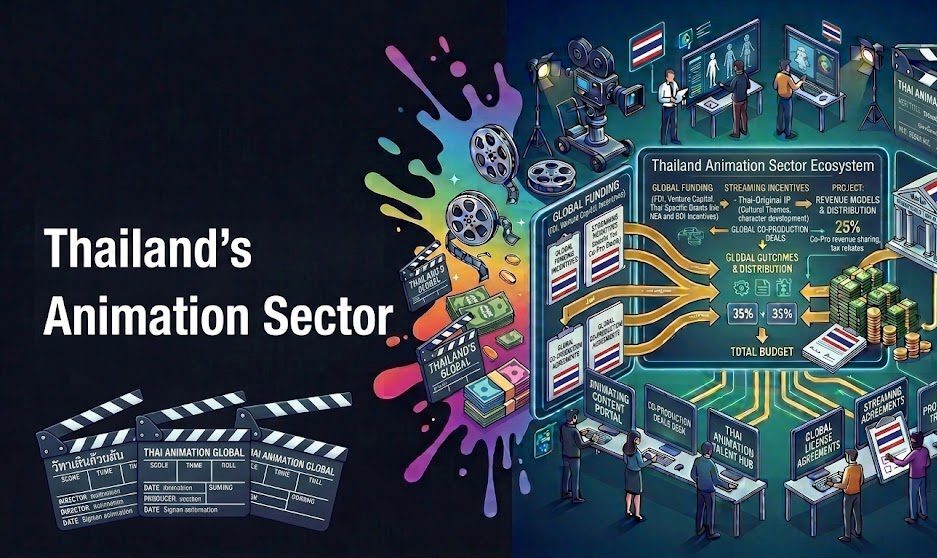
Something shifted quietly in Bangkok over the past two years. And if you haven’t noticed yet, your competitors probably have.
Thailand animation outsourcing has stopped being a niche workaround for budget-strapped indie producers—it’s now a deliberate strategic decision made by major studios, streaming platforms, and content buyers who need quality output without the crushing overhead of Los Angeles or London pipelines.
Here’s the thing: production budgets aren’t getting easier. They’re getting harder. Hollywood’s traditional animation cost structure has become genuinely unsustainable for all but the biggest tentpoles—and even those are starting to crack.
The writers’ and actors’ strikes of 2023 rewired how studios think about labor. Post-COVID inflation compounded it. And now, with streaming platforms finally enforcing content ROI discipline, every dollar in your capital stack matters more than it did three years ago.
Thailand doesn’t just offer lower costs. It offers a combination of government incentives, growing crew depth, modern infrastructure, and active streaming investment that’s hard to find anywhere else in Southeast Asia right now. But finding the right partners in a market of thousands of animation vendors? That’s where most producers stumble.
This guide breaks down exactly why global studios are outsourcing animation to Thailand in 2026—and how you can de-risk the process before you commit a single dollar of your production budget.
Table of Contents
- The Fragmentation Paradox Hitting Animation Supply Chains
- What’s Actually Happening in Thailand’s Animation Sector
- 1. Labor Costs That Compress Your Capital Stack
- 2. Government Incentives Built for International Studios
- 3. A Growing Pool of Animation-Trained Talent
- 4. Infrastructure Built for High-Volume Production
- 5. Netflix and Streaming Giants Are Already Betting on Thailand
- 6. Thailand as Southeast Asia’s Animation Sovereign Hub
- 7. Smart Pairing: Finding Verified Thailand Animation Studios
- How to De-Risk Your Thailand Animation Partnership
- FAQ
- Conclusion
Discover Verified Animation Studios in Thailand—in Minutes
Netflix, Warner Bros, and Paramount already use Vitrina to track production partners across 140,000+ companies worldwide. Ask VIQI—our AI research engine—anything about Thailand animation capabilities right now.
✔ Free to explore | ✔ No credit card needed | ✔ Real-time studio intelligence
The Fragmentation Paradox Hitting Animation Supply Chains
Let’s be blunt about something most producers won’t say out loud: the global animation vendor market is a mess. More than 600,000 companies operate across the entertainment supply chain—and animation studios alone number in the thousands across Asia. But they operate in siloed markets with opaque pricing, inconsistent quality standards, and zero standardized credentialing.
This is what Vitrina calls the Fragmentation Paradox. The more vendors exist, the harder it is to find the right one. Your network—built on festival dinners and LinkedIn introductions—covers maybe 0.1% of the actual market. That information asymmetry costs producers an estimated 15–20% in margin leakage through opaque markup structures and suboptimal partner selection.
Thailand sits right at the center of this problem. It’s a market with real capability—but verifying that capability without on-the-ground relationships has historically been a nightmare. And that’s exactly why producers who can navigate it effectively are gaining a genuine competitive edge on their recoupment timelines.
What’s Actually Happening in Thailand’s Animation Sector
Thailand’s creative industry didn’t stumble into international attention. It was built toward it—deliberately. The Thai government’s Board of Investment (BOI) has been quietly expanding its incentive framework for digital content and animation companies for several years, and the results are now visible in the production credit rolls of projects you’re already watching.
HBO’s The White Lotus filming in Thailand put the country’s technical capabilities on the radar of every international studio exec. That wasn’t an accident—it was the product of years of infrastructure investment and government coordination. And while live-action gets the headline coverage, the country’s animation and VFX pipeline has been developing in parallel, drawing Thai-trained animators back from stints at studios in Tokyo, Seoul, and Los Angeles.
As reported by Variety, Southeast Asia’s production sector is seeing accelerating investment from both local governments and streaming platforms. Thailand’s animation studios now handle 2D frame-by-frame work, 3D character animation, background art, motion graphics, and full post-production pipelines—often at a fraction of what equivalent work costs in Western markets. You can also explore our broader guide to animation studios in Thailand to see how the market maps out in detail.
1. Labor Costs That Compress Your Capital Stack
This is the number most producers want first. And it’s significant—but not in the way you might expect.
Experienced Thai animation artists typically work at rates that are 40–60% below comparable talent in the US or UK, depending on specialization and project complexity. But here’s what gets overlooked: that differential doesn’t reflect a quality gap. It reflects a cost-of-living gap. Bangkok’s infrastructure and talent pool have matured considerably—what you’re getting is Hollywood-adjacent output at emerging market pricing.
For a mid-budget animated series with 13 episodes, that cost differential on labor alone can move your EBITDA margin by several percentage points. That’s not a rounding error—that’s the difference between a project that recoup on streaming rights alone and one that needs an aggressive presales strategy just to break even.
But cost advantage only matters if you’re not destroying it in coordination overhead and quality failures. Which is exactly why vendor verification—before you commit—is non-negotiable.
2. Government Incentives Built for International Studios
Thailand’s cash rebate program for international productions has been quietly competitive in Southeast Asia for several years—and it was recently strengthened to attract higher-value projects. While the specific qualifying criteria vary by production type and budget tier, the structure is designed to stack with BOI tax exemptions for digital content companies operating inside designated promotion zones.
Compare that to the APAC incentive landscape generally: Japan offers up to 50% but caps qualifying expenditure at approximately $6.7 million per project. India’s federal incentive sits at 40% with solid coverage for animation and VFX. Australia’s Location Offset jumped to 30% after its 2024 increase. Thailand’s program isn’t the most aggressive number in the region—but it’s competitive, accessible, and increasingly structured to welcome animation-specific co-productions that don’t require filming on location.
And that matters. Animation work often qualifies for incentive capture without the logistical complexity of physically moving a production crew. You get the soft money without chartering flights to Bangkok. That’s a material difference in your capital stack efficiency—especially if you’re structuring a co-production treaty alongside the incentive.

Your AI Assistant, Agent, and Analyst for the Business of Entertainment
VIQI AI helps you plan content acquisitions, raise production financing, and find and connect with the right partners worldwide.
- Find active co-producers and financiers for scripted projects
- Find equity and gap financing companies in North America
- Find top film financiers in Europe
- Find production houses that can co-produce or finance unscripted series
- I am looking for production partners for a YA drama set in Brazil
- I am looking for producers with proven track record in mid-budget features
- I am looking for Turkish distributors with successful international sales
- I am looking for OTT platforms actively acquiring finished series for the LATAM region
- I am seeking localization companies offer subtitling services in multiple Asian languages
- I am seeking partners in animation production for children's content
- I am seeking USA based post-production companies with sound facilities
- I am seeking VFX partners to composite background images and AI generated content
- Show me recent drama projects available for pre-buy
- Show me Japanese Anime Distributors
- Show me true-crime buyers from Asia
- Show me documentary pre-buyers
- List the top commissioners at the BBC
- List the post-production and VFX decision-makers at Netflix
- List the development leaders at Sony Pictures
- List the scripted programming heads at HBO
- Who is backing animation projects in Europe right now
- Who is Netflix’s top production partners for Sports Docs
- Who is Commissioning factual content in the NORDICS
- Who is acquiring unscripted formats for the North American market
3. A Growing Pool of Animation-Trained Talent
Five years ago, Thailand’s animation talent pool had a genuine depth problem. Studios could handle work at volume, but finding senior-level animators and art directors who’d worked on internationally distributed projects? That was harder.
That’s changed. Institutions like Chulalongkorn University and King Mongkut’s University of Technology Thonburi have significantly expanded their digital arts and animation programs. More importantly, a generation of Thai animators who went abroad for training—to Japan, South Korea, the US—are returning home. They’re bringing pipeline fluency, software mastery, and international production standards with them.
The result is a talent base that can execute across 2D hand-drawn animation, 3D CGI, motion capture cleanup, and compositing pipelines—not just rotoscoping and in-between frames. That’s a qualitative shift, not just a quantitative one. And it’s why studios who explored Thai outsourcing in 2019 and walked away are now coming back with larger mandates.
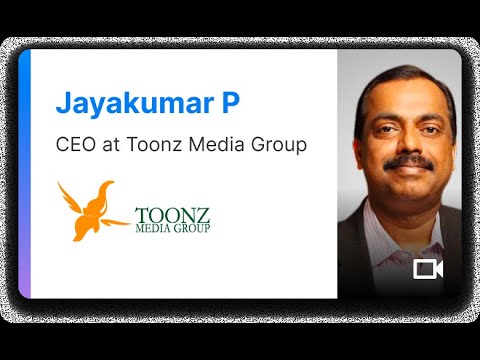
Jayakumar P, CEO of Toonz Media Group, has spoken extensively about how Asia’s animation talent infrastructure is reshaping global production supply chains—touching directly on the kind of market development now visible in Thailand and neighboring markets. Here’s that conversation:
Find Verified Thailand Animation Studios in 48 Hours
Trusted by Netflix, Warner Bros, and Paramount. Join 140,000+ companies using Vitrina to source verified animation partners across Southeast Asia—before your competitors close the deal.
✔ 200 free credits | ✔ No credit card required | ✔ Full platform access
4. Infrastructure Built for High-Volume Production
Infrastructure is where Thailand genuinely surprised the market. Bangkok’s production ecosystem—studios, rendering infrastructure, connectivity—has been quietly modernized over the past several years with both private investment and BOI-backed development in digital content zones.
You’re not looking at artisan studios with a handful of workstations. Some of Bangkok’s animation houses now operate render farms with capacity comparable to mid-tier studios in India’s Hyderabad corridor. They run industry-standard pipelines on Autodesk Maya, Blender, Toon Boom Harmony, and Adobe Animate. Deliverables are formatted to broadcast and streaming spec. And turnaround times—for the right vendors—compete favorably with Korean and Indian alternatives.
What’s still developing? Senior-level production management depth. You’ll find extraordinary talent at the artist and technical director level—but if your project requires a full Thai EP or showrunner team for a 52-episode children’s series, you may need to plan for hybrid oversight. That’s not a dealbreaker; it’s a structuring consideration. And it’s exactly the kind of nuance that separates smart outsourcing decisions from expensive ones.
5. Netflix and Streaming Giants Are Already Betting on Thailand
When Netflix makes a regional production bet, it’s not speculative—it’s ROI-driven. And Netflix’s sustained investment in Thai originals, including drama, thriller, and genre content, has created something producers often overlook: a downstream effect on the animation and post-production supply chain.
Netflix’s commissioning activity in Thailand has attracted international-grade production service companies to the Bangkok market. That brings higher technical standards to the whole ecosystem—not just to the specific projects Netflix is funding. Studios competing for streaming work upgrade their pipelines, adopt new workflows, and recruit internationally trained talent to stay competitive. That’s the rising-tide dynamic that’s now benefitting animation outsourcing clients who aren’t streaming platform buyers.
And there’s a credibility signal you shouldn’t ignore: platforms like Viu and iQiyi have also expanded their Thai content investment, creating a multi-platform production environment that would’ve been inconceivable in Bangkok five years ago. As Screen International has tracked, Southeast Asia’s streaming investment is accelerating—and Thailand is consistently cited as one of the region’s primary production hubs. See also our analysis of top VFX and post-production vendors in APAC to understand how this investment maps to the wider vendor landscape.
6. Thailand as Southeast Asia’s Animation Sovereign Hub
In Vitrina’s strategic framework, Sovereign Content Hubs are production markets where government backing, infrastructure investment, local talent development, and international platform interest converge simultaneously. Not all of them are in MENA. And not all of them look like Saudi Arabia’s NEOM-scale ambitions.
Thailand is an emerging animation Sovereign Hub in the APAC region—smaller in scale than South Korea’s K-content machine, but significantly more accessible for international producers who don’t have Seoul relationships and can’t navigate Korean co-production treaty requirements.
But here’s what makes it strategically interesting for animation specifically: Thailand sits in a regional timezone that bridges India and Japan. It’s English-workable in ways that some APAC markets aren’t. It has co-production treaty relationships with multiple Western markets. And its content culture—influenced heavily by Japanese anime and Korean manhwa—means Thai animation studios are fluent in the visual languages that drive the most commercially successful animated content globally right now.
That’s not a coincidence. That’s why producers from France, the UK, Canada, and Australia are all showing up in Bangkok. If you’d like more context on how animation companies across Southeast Asia are positioning for international co-production, our guide to selecting animation companies in Southeast Asia covers the full regional picture.
7. Smart Pairing: Finding Verified Thailand Animation Studios
Here’s the problem most producers hit when they decide to explore Thailand animation outsourcing: the market is opaque. Google searches return a mix of legitimate studios and aggregators with no capability verification. Festival contacts give you introductions to whoever they’ve met personally—which is a fraction of the actual market. And cold outreach to Bangkok studios without any relationship takes months to yield anything actionable.
What you need is what Vitrina calls Smart Pairing—matching your production requirements (budget tier, episode count, style, timeline) against verified studio capabilities in real time. Not five studios that someone’s cousin worked with. All studios with verified credits, current capacity status, and benchmark pricing data.
Paul Robinson, President of Kartoon Studios—whose career spans the BBC, the Walt Disney Company, and NBCUniversal—has spoken about how cross-border animation collaboration requires exactly this kind of verified intelligence to function. You can’t greenlight a partner you haven’t vetted. And vetting takes time you often don’t have, especially if your financing is already moving and you need to attach a studio to close the deal.
The good news: Vitrina’s platform tracks 400,000+ projects and 140,000+ companies globally, including animation studios across Thailand and Southeast Asia. You can filter by specialization, run VIQI queries in natural language, and surface verified partners in the same time it used to take to draft an introductory email.
Accelerate Your Thailand Animation Partner Search
Join 140,000+ companies—including Netflix, Warner Bros, and Paramount—who use Vitrina to discover, vet, and connect with animation studios across Southeast Asia. Get full platform access with 200 free credits today.
✔ 200 free credits | ✔ No credit card required | ✔ 400,000+ projects tracked
Need direct introductions to verified Bangkok studios? Explore Concierge Service →
How to De-Risk Your Thailand Animation Partnership
Let’s not be romantic about this. Outsourcing animation to any emerging market carries execution risk—and Thailand isn’t immune. Quality control across time zones requires structure. IP ownership terms need explicit drafting. Payment milestones should be tied to deliverable acceptance, not calendar dates.
But the biggest risk is one most producers underestimate: selecting the wrong studio in the first place. A technically capable studio with poor project management culture will cost you more in revision cycles and timeline overruns than you’d ever save on day rates. That’s why verifying a studio’s actual credit history—not their pitch deck—before you sign anything is the single highest-leverage decision you’ll make.
And it’s why the Fragmentation Paradox matters so much here specifically. In an opaque market with thousands of vendors, the producers who win aren’t the ones with the deepest Rolodex—they’re the ones with access to verified intelligence about who’s actually delivered at what level, on what timelines, for which platforms. Our framework for pre-vetting production vendors in emerging markets walks through exactly how to structure that evaluation before you commit budget.
Also worth your time: reviewing co-production structures that can run alongside your outsourcing arrangement. Thailand’s treaty relationships offer real upside if your project qualifies—and structuring this correctly at greenlight is far easier than trying to retrofit it later. See our analysis of co-production opportunities in Southeast Asia for the full strategic picture.
Frequently Asked Questions
Why is Thailand animation outsourcing growing so fast in 2026?
Several forces converged simultaneously. Netflix and streaming platforms validated Thailand’s production ecosystem through sustained original content investment. The Thai government strengthened its cash rebate program and BOI incentives for digital content companies. And a generation of internationally trained Thai animators returned home with skills that match Western pipeline requirements—creating a talent pool capable of handling high-volume, quality-critical animation work at significantly lower rates than US or UK alternatives.
What types of animation work are Thailand studios best suited for?
Thai animation studios have demonstrated strong capability across 2D character animation, 3D CGI production, background art, motion graphics, and post-production compositing. Studios operating at the top tier can handle full series pipelines for children’s entertainment, action-adventure, and genre animation. High-end photoreal CGI for feature-length theatrical remains more limited—but mid-range streaming and television formats are well within established Thai capability.
How do Thailand’s animation cost advantages compare to India or the Philippines?
All three markets offer meaningful cost advantages over Western production hubs. India—particularly Hyderabad and Mumbai—has the deepest talent pool and most mature VFX infrastructure in the region, with a 40% federal incentive now covering animation work. The Philippines has strong English-language capability. Thailand’s advantage is a combination of competitive rates, improving English-language workflow integration, government incentive support, and a creative culture fluent in the anime-influenced aesthetics driving global streaming demand right now.
What are the main risks of outsourcing animation to Thailand—and how do you mitigate them?
The primary risks are vendor selection failure, IP protection gaps, and timeline slippage. All three are manageable—but only if you structure contracts correctly and verify studio capabilities before committing budget. Milestone-based payments tied to deliverable acceptance (not calendar dates) are non-negotiable. IP ownership terms need explicit drafting under Thai law. And studio vetting—beyond a demo reel—should include verifiable credit history on comparable international projects.
Can Thailand animation outsourcing work with co-production treaty financing?
Yes—and this is an underutilized structure. Thailand has bilateral co-production treaty relationships with multiple Western markets, and combining treaty-based financing with animation outsourcing can allow your project to capture both the soft money benefit and the cost-efficiency advantage simultaneously. The key is structuring this at greenlight, not retrofitting it post-development. Your legal and financing team needs to be involved from the moment Thailand enters your capital stack conversation.
How do I find verified Thailand animation studios without spending months on due diligence?
This is exactly what Vitrina’s platform is built for. Rather than relying on festival introductions or Google searches—both of which surface a tiny fraction of the actual market—you can query 140,000+ verified companies filtered by specialization, budget tier, and geographic location. VIQI, Vitrina’s AI research engine, can return a shortlist of qualified Thailand animation studios in minutes, with verifiable credit history and current capacity data.
What government body oversees Thailand’s film and animation incentive program?
Thailand’s primary incentive programs for international productions are administered through the Thailand Film Office (cash rebate program) and the Board of Investment of Thailand (BOI), which handles tax incentives and investment promotion for digital content companies, including animation studios. BOI promotion certificates can exempt qualifying companies from corporate income tax for up to 8 years—making Thailand genuinely competitive for studios thinking about establishing a permanent Southeast Asia base alongside a project-specific outsourcing relationship.
Is Southeast Asia animation outsourcing a trend that’s likely to continue past 2026?
All indicators point to yes—and accelerating. Netflix, Viu, iQiyi, and other streaming platforms are increasing their APAC content investment. ASEAN governments are actively competing for production dollars with improving incentive frameworks. And the talent pipeline—animators trained internationally now returning to home markets—will only deepen over the next decade. Southeast Asia’s animation outsourcing growth isn’t a cycle. It’s a structural shift in how the global entertainment supply chain produces animated content.
Conclusion: Thailand Isn’t a Backup Plan—It’s a Primary Strategy
The producers treating Thailand animation outsourcing as a fallback option for when Western budgets don’t close are misreading the market. The studios gaining real competitive advantage right now are the ones who’ve made Thailand a deliberate first choice—built into their capital stack from greenlight, not bolted on when costs spiral.
Key Takeaways:
- Labor cost advantage: Thai animation talent runs 40–60% below US/UK comparable rates—a meaningful EBITDA improvement for mid-budget series.
- Government incentives stack: Thailand’s BOI tax exemptions and cash rebate program can be structured alongside co-production treaty financing for maximum soft money capture.
- Talent depth is real: Internationally trained Thai animators returning home have raised the quality floor significantly since 2020—2D, 3D, and compositing pipelines are all viable.
- Streaming platforms validate the market: Netflix, Viu, and iQiyi investment in Thailand creates an infrastructure quality lift that benefits all outsourcing clients.
- Verification is non-negotiable: The Fragmentation Paradox means most producers see only 0.1% of the actual Thai animation market. Real-time intelligence—not festival introductions—is the competitive edge.
Thailand’s moment as Southeast Asia’s primary animation Sovereign Hub is already here. The question isn’t whether to engage—it’s whether you have the intelligence infrastructure to engage smartly. Start with verified data. Start with Vitrina.
Start Sourcing Thailand Animation Studios With Verified Intelligence
Netflix, Warner Bros, and Paramount use Vitrina to track 400,000+ projects and 140,000+ companies across the global entertainment supply chain. Join them. Get full platform access—no credit card required.
✔ 200 free credits | ✔ No credit card required | ✔ Cancel anytime
Find Film+TV Projects, Partners, and Deals – Fast.
VIQI matches you with the right financiers, producers, streamers, and buyers – globally.
Producers Seeking Financing & Partnerships?
Book Your Free Concierge Outreach Consultation
(To know more about Vitrina Concierge Outreach Solutions click here)
Join Industry Briefings Trusted by Leaders

The Mid-Budget Comeback: Why Mid-Budget Films Is the Smartest Bet in the Room
Mid-budget films are attracting new capital. See why this segment is becoming one of the strongest bets in Film today.

Franchise Fatigue vs. IP Dependency: What Studios Should Be Betting On Now
s franchise performance softens, where will the next generation of valuable IP come from? Join the briefing.

Unscripted Is Eating the World: The Multi-Billion Reality and Format Boom
Unscripted is the new prestige — inside the $19.8B global format boom reshaping how streaming platforms compete.

How Co-Productions and Regional IP Are Reshaping Global Drama
As global drama evolves, which stories travel, which stay local, and how are they getting financed?