About Innovation Hub
 Global Content Pulse (Webinars)


 Global Production Financing
(Webinars)
Global Production Financing
(Webinars)  LeaderSpeak Podcast
  Global Entertainment Digest (Newsletter)
  About Vitrina
 About VIQI
 Our Story
 Our Solutions 🔥
 Film+TV Projects Tracker 🚀
 Case Studies
 Our Profile
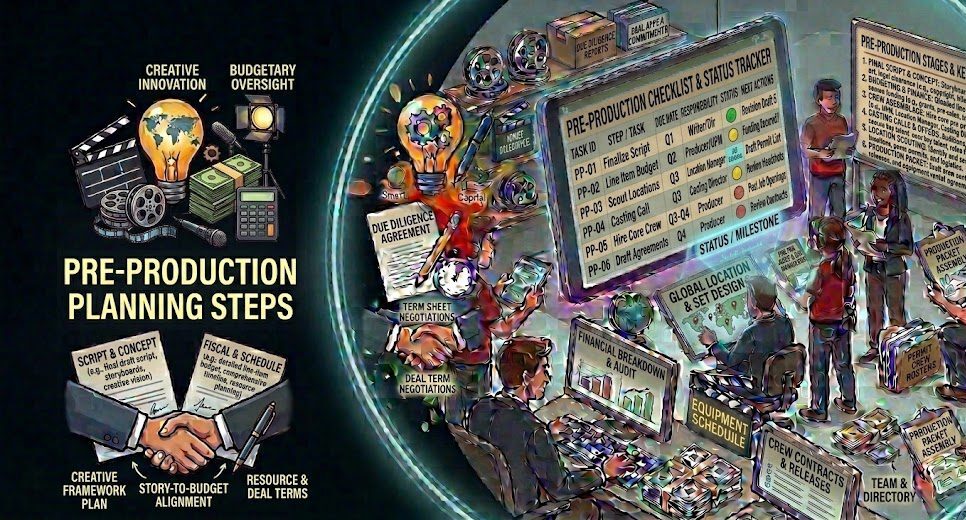
Most films that never get made don’t die in post. They die in pre-production planning—or rather, in the messy gap between a greenlighted idea and a shoot-ready production. No locked script. No attached cast. No financing stack that pencils out. Just a producer who keeps saying “we’re close” while the project quietly slides into development hell.
Here’s the thing: pre-production planning isn’t about checklists. It’s about de-risking every step before cameras roll. The productions that reach principal photography—on budget, on schedule—treat pre-production as a strategic discipline. And the ones that fall apart? They rushed it. Or worse, they got the sequence wrong.
These 9 steps separate the films that actually get made from the ones that don’t.
Ask VIQI: Which Producers Are Greenlighting Projects Like Yours Right Now?
Netflix UK, Warner Bros, and 140,000+ companies use Vitrina to discover partners, vendors, and co-production opportunities. VIQI—our AI intelligence layer—is trained on 400,000+ projects across 100+ markets.
✓ 200 free credits | ✓ No credit card required
What Is Pre-Production Planning?
Pre-production planning is everything that happens between greenlight and the first day of shooting. It covers script development, packaging, budgeting, financing, casting, crew hiring, location scouting, scheduling, and all the legal and logistical groundwork that holds a production together.
Done right, pre-production takes 10 to 26 weeks depending on budget and complexity. Done wrong—or rushed—you’re paying for it on set, where a single unplanned shooting day can consume 3 to 5% of an indie film’s total budget and a mid-to-large production can lose $50,000 to $300,000 per delayed day.
The Vitrina Pre-Production Readiness Framework™ maps nine sequential phases that tell you exactly where your project stands before you commit to a start date. Work through them in order. Skipping ahead is precisely how development hell starts.
Step 1: Lock Your Script Before Anything Else
Everything flows from the script. Not a draft. Not “a version we can work with.” A locked script.
Here’s why this matters financially: gap financiers, sales agents, and completion bond companies all evaluate your project based on the final script. Steve Vitolo, founder and CEO of Scriptation—whose Emmy-winning platform has served productions including Game of Thrones and Saturday Night Live—explains in the Vitrina LeaderSpeak series how active script revisions directly impact production timelines and costs. A production still juggling script changes 6 weeks before shoot hasn’t actually greenlighted anything.
Your script lock triggers every downstream planning step: budget creation, script breakdown, cast offers, director conversations, and bond company engagement. It’s not just a creative milestone—it’s a financing prerequisite.
Step 2: Build Your Package—Cast, Director, and Key Attachments
Financiers don’t buy scripts. They buy packages.
A fully packaged project means a locked script, bankable cast attachments, a director with a demonstrable commercial track record, and ideally a reputable sales agent already engaged. Joshua Harris, co-founder of Peachtree Entertainment, is direct about what he wants to see before committing capital: projects need a reputable sales agency attached, along with key cast—“A-list and B-list cast attachments that drive actual economic value.”
That’s not just a funder’s preference. It’s the market signal that tells every buyer at AFM, Cannes Marché, or EFM Berlin that your project is real. Bankable talent converts to territory values. Territory values unlock presale contracts. And presale contracts are what gap lenders advance against.
Build your package strategically. Think about which cast combination opens which international territories—and work backwards from there. You can start by identifying the right talent company for your project using verified production data, not guesswork.
Step 3: Create a Realistic Budget—Not a Wishlist
Most first budgets are wishlist budgets. They assume everything goes right—no weather delays, no schedule slippage, no deal complications. They also tend to underestimate below-the-line costs and overestimate what contingency will cover.
A production-grade budget includes a 10% contingency minimum, fully loaded above-the-line costs with all deferments documented, below-the-line with actual vendor quotes (not estimates), and a clear P&A allocation if you’re targeting theatrical. And don’t forget: your budget determines which financing instruments are available to you. A $1.5M micro-budget attracts fundamentally different capital than a $12M international co-production.
Get the number right early. Changing it mid-financing costs time you simply don’t have. Our guide to budgeting and financing TV productions breaks down exactly how to structure each budget tier.
Step 4: Secure Financing Before You Scout a Single Location
This is where most projects get the sequence badly wrong. Teams start scouting locations, hiring department heads, even beginning production design—before financing is confirmed. Then the deal falls apart and you’ve burned 6 weeks and meaningful development budget on work that may need to be completely redone.
Financing should be substantially locked before any hard pre-production spend. That means equity committed and documented, primary tax incentives confirmed with a qualified incentive consultant, presale strategy mapped with your sales agent, and gap financing discussions active if needed. According to The Hollywood Reporter, the average independent film now combines 3 to 4 financing sources—presales, equity, tax incentives, and gap—requiring more structured coordination than ever before.
Phil Hunt (CEO, Head Gear Films), who finances 35 to 40 films annually, is direct about today’s market: the days of pre-selling off a pitch deck are long gone. And Andrea Scarso at IPR.VC confirms what sophisticated investors want to see—projects that arrive either very early in creative development or already “about to start shooting” with capital largely assembled. What nobody wants is a project stuck in the middle, burning development budget without locked financing.
Explore every avenue with our breakdown of the top 10 ways to secure film and television financing.
Track How Comparable Projects Are Being Financed and Packaged Right Now
Trusted by Netflix, Warner Bros, and Paramount. Join 140,000+ entertainment companies using Vitrina’s production intelligence platform to monitor 400,000+ projects across all stages.
✓ 200 free credits | ✓ No credit card required | ✓ Full platform access
Step 5: Scout Locations in Alignment with Your Incentive Strategy
With financing confirmed and a locked script, location scouting can begin in earnest. But here’s what experienced producers know—you’re not just evaluating aesthetic fit. You’re evaluating which locations serve your capital stack.
A 35% UK cash rebate or Saudi Arabia’s 40% rebate can materially reshape your financing structure. But both require meeting minimum local expenditure thresholds and satisfying specific qualifying requirements. Scout with your incentive consultant in the room, not just your production designer. Your location decision and your financing structure must align—or you leave money on the table.
Lock your production window 8 to 12 weeks before start date. That commitment drives crew deals, facility bookings, cast availability windows, and bond company engagement. Move it later and you’re writing kill fee checks.

Your AI Assistant, Agent, and Analyst for the Business of Entertainment
VIQI AI helps you plan content acquisitions, raise production financing, and find and connect with the right partners worldwide.
- Find active co-producers and financiers for scripted projects
- Find equity and gap financing companies in North America
- Find top film financiers in Europe
- Find production houses that can co-produce or finance unscripted series
- I am looking for production partners for a YA drama set in Brazil
- I am looking for producers with proven track record in mid-budget features
- I am looking for Turkish distributors with successful international sales
- I am looking for OTT platforms actively acquiring finished series for the LATAM region
- I am seeking localization companies offer subtitling services in multiple Asian languages
- I am seeking partners in animation production for children's content
- I am seeking USA based post-production companies with sound facilities
- I am seeking VFX partners to composite background images and AI generated content
- Show me recent drama projects available for pre-buy
- Show me Japanese Anime Distributors
- Show me true-crime buyers from Asia
- Show me documentary pre-buyers
- List the top commissioners at the BBC
- List the post-production and VFX decision-makers at Netflix
- List the development leaders at Sony Pictures
- List the scripted programming heads at HBO
- Who is backing animation projects in Europe right now
- Who is Netflix’s top production partners for Sports Docs
- Who is Commissioning factual content in the NORDICS
- Who is acquiring unscripted formats for the North American market
Step 6: Build Your Crew—Department Heads First
You’re not hiring a crew. You’re building a production architecture. Start with the 5 critical department heads: Director of Photography, Production Designer, Line Producer, 1st Assistant Director, and Sound Mixer. These 5 hires shape every downstream crew decision—and their availability calendars will constrain your shoot window more than any other single factor.
The intelligence challenge is real. Finding department heads with the right combination of genre credits, budget experience, and geographic availability—especially for international co-productions—takes more than recommendations from a network. Vitrina’s platform covers 140,000+ companies across the entertainment supply chain, including pre-production studios and crew networks across 100+ countries, with verified contacts and project histories that compress the discovery process from weeks to days.
Step 7: Complete Your Script Breakdown and Strip Board
Your production breakdown turns the locked script into a shoot schedule. Every scene gets tagged by location, cast, props, costumes, special effects, VFX requirements, stunts, extras, and day/night designation. Those tags drive your strip board—the visual scheduling tool that organizes shoot days for maximum efficiency.
This is where AI-powered script breakdown tools are genuinely changing the pre-production game. Josh Klein, CEO of Scripto, discusses in the Vitrina LeaderSpeak series how cloud-based platforms with live data are compressing breakdown timelines—work that once took a 1st AD two to three weeks can now be completed in days. But the breakdown is only as good as the locked script underneath it. Breakdowns built on unlocked scripts get rebuilt. And rebuilt breakdowns cost money.
Steve Vitolo (Founder & CEO, Scriptation) dives into how script workflow tools are transforming pre-production efficiency for major productions—from collaboration to version control to shooting schedule integration:

Step 8: Lock Permits, Insurance, and Legal Clearances
The unsexy work. But missing any of it shuts your production down faster than a weather delay.
Your legal pre-production checklist includes: chain of title cleanup and E&O insurance application, production insurance covering cast, equipment, and general liability, location permits for every filming site, music and archive clearance where applicable, completion bond application and approval, and union and guild agreements (SAG-AFTRA, IATSE, DGA) if required.
Budget 6 to 8 weeks for completion bond approval on a mid-budget project. Bond companies want to see your locked script, full budget, confirmed financing, key cast and director contracts, and production schedule before issuing a bond. Don’t let the bond process become your critical path item. According to Variety, productions that rush the clearance phase routinely face delivery complications that delay or reduce distribution revenue—and retroactive E&O clearance costs are punishing.
Step 9: Use Production Intelligence to De-Risk Every Decision
Here’s the practical reality of pre-production right now: the information problem is real. Finding the right co-production partner in the right territory, identifying which crew has the right genre credits, tracking which projects are competing in your window—none of that’s easy from a static database or a cold LinkedIn search.
Vitrina’s platform covers 400,000+ projects across all production stages and 140,000+ companies across the entertainment supply chain. Netflix UK found qualified vendors in 48 hours using Vitrina. Productions using Vitrina’s Smart Pairing technology cut partner discovery timelines by weeks, not days. And VIQI—Vitrina’s AI intelligence layer—lets you ask natural-language questions: which producers are greenlighting thrillers right now, which territories are buying documentary series, which VFX vendors have credits on comparable budgets.
Strategic players understand that pre-production planning isn’t just logistics. It’s intelligence. The producers who consistently get their projects to principal photography aren’t just well-organized—they’re better informed than the competition. And behind closed doors, that information edge is what separates a production that closes in 12 weeks from one that spends a year in development hell.
Ask VIQI: Who’s Actively Seeking Projects in Your Genre and Budget Range?
Netflix, Warner Bros, Paramount, and 140,000+ entertainment companies trust Vitrina’s production intelligence platform. VIQI gives you real-time answers about the market—no cold outreach required.
✓ 200 free credits included | ✓ No credit card required
The 9-Step Pre-Production Planning Checklist
- Lock your script — final draft, not “working” or “close”
- Build your package — cast, director, and sales agent attached
- Create a production-grade budget — 10%+ contingency, real vendor quotes
- Secure financing — equity, tax incentives, presales confirmed before hard spend
- Scout locations with incentive alignment — know your rebate structure before committing
- Hire the 5 department heads first — DP, Production Designer, Line Producer, 1st AD, Sound Mixer
- Complete script breakdown and strip board — tags drive schedule efficiency
- Lock permits, insurance, and bond — budget 6 to 8 weeks for bond approval
- Use production intelligence — verified data accelerates every partner and vendor decision
Pre-Production Is Where Films Win or Lose
Pre-production planning isn’t the phase you rush through to get to the interesting part. It’s where your film either gets built on solid foundations—or starts accumulating the cracks that turn into disasters on set. Every decision you make in pre-production either de-risks the shoot or adds a variable you’ll be managing under pressure.
The most experienced producers—whether they’re packaging a $3M indie or a $35M international co-production—treat pre-production as the highest-leverage work they do. Get the production lifecycle right from the start, and principal photography becomes execution—not improvisation.
Key Takeaways:
- Script lock is a financing prerequisite, not just a creative milestone
- Package your project around market demand and territory value, not personal preference
- Never commit hard pre-production spend before financing is substantially confirmed
- Location scouting must align with your tax incentive strategy from day one
- Production intelligence tools — like Vitrina’s 400,000+ project database — compress partner and vendor discovery from weeks to days
Start Your Pre-Production Smarter—Track 400,000+ Projects on Vitrina
Netflix, Warner Bros, and Paramount trust Vitrina’s entertainment intelligence platform. Discover co-production partners, crew, vendors, and market comps across 100+ countries with verified data that static databases can’t match.
✓ 200 free credits | ✓ No credit card required | ✓ Cancel anytime
Frequently Asked Questions: Pre-Production Planning
What are the essential steps of pre-production planning?
The 9 essential steps are: locking the script, building your package (cast, director, sales agent), creating a realistic budget, securing financing before hard spend, scouting locations in alignment with your incentive strategy, hiring department heads first, completing your script breakdown and strip board, locking permits and insurance, and using production intelligence to de-risk partner and vendor decisions. Work through them sequentially—skipping steps is how productions fall apart.
How long does pre-production planning take?
Pre-production typically takes 10 to 26 weeks depending on budget, complexity, and co-production structure. A micro-budget indie might complete pre-production in 10 to 12 weeks. A mid-budget international co-production with multiple financing partners and complex VFX requirements often needs 20 to 26 weeks. Rushing below these timelines—especially on completion bond approval and financing lock—is one of the most common causes of production failure.
What is a production package in film financing?
A production package is the combination of creative and commercial attachments that make a project financeable. It typically includes a locked script, bankable cast with demonstrable territory value, a director with a commercial track record, and a reputable sales agent. Financiers—including gap lenders, equity investors, and presale buyers—evaluate the package to assess commercial viability and risk. A fully packaged project is significantly more likely to close financing than an unpackaged script alone.
What does pre-production planning include for a TV series?
TV pre-production includes all the same core elements as film—script lock, packaging, budgeting, financing, location scouting, crew hiring, breakdown, and scheduling—plus additional complexity around episodic structure, broadcaster or streamer requirements, and production windows spanning multiple episodes. TV pre-production often involves managing separate line producers per shooting block, coordinating multiple directors, and aligning with a commissioning broadcaster’s technical delivery specifications (IMF, HDR, audio stems) from the outset.
When should you start looking for a co-production partner?
Start identifying co-production partners at the packaging stage—before financing is locked, not after. Co-production partners influence your tax incentive strategy, territorial presale potential, and access to local crew and facilities. Waiting until after you’ve structured financing often means decisions have already been made that a co-producer can’t reverse. Use tools like Vitrina’s Smart Pairing to find partners in target territories based on genre history, budget range, and current activity—ideally 12 to 16 weeks before your target shoot date.
What is a script breakdown in pre-production?
A script breakdown is the process of tagging every production element in each scene of the locked script: cast, locations, props, costumes, stunts, VFX, extras, vehicles, and day/night designation. These tags generate the strip board—the visual scheduling tool that organizes shoot days for maximum efficiency and minimum cost. AI-powered breakdown tools now automate much of this process, compressing a two to three week task into days.
Why is pre-production planning important for independent films?
Pre-production is especially critical for independent films because budget overruns can’t be absorbed the way they can on studio productions. A single unplanned shooting day can consume 3 to 5% of an indie film’s total budget. Beyond cost control, thorough pre-production is what makes a project financeable—gap lenders, equity investors, and presale buyers all want evidence of disciplined planning before committing capital. Well-prepared projects close financing faster and on better terms.
How can Vitrina help with pre-production planning?
Vitrina’s entertainment intelligence platform supports pre-production planning across multiple critical steps. Its database of 140,000+ companies and 400,000+ projects helps producers identify co-production partners, crew, and vendors with verified credits and contact information. VIQI—Vitrina’s AI intelligence layer—answers questions about which producers are active in your genre, which territories are buying comparable content, and which vendors have credits on similar budgets. Netflix UK found qualified vendors in 48 hours using Vitrina’s platform.
Find Film+TV Projects, Partners, and Deals – Fast.
VIQI matches you with the right financiers, producers, streamers, and buyers – globally.
Producers Seeking Financing, Co-Pros, or Pre-Buys?
Vitrina Concierge helps producers reach the right financiers, commissioners, distributors, and co-production partners — with precision outreach, not cold pitching.
Join Industry Briefings Trusted by Leaders

Micro-Dramas & Mobile-First Storytelling
Micro-dramas are building real audiences and revenue. Understand the platforms, buyers, and economics behind the growth.

Navigating Global Content Licensing Trends
How global content licensing is shifting beyond flat fees to flexible, deal-driven models.
Film & TV Production Financing: 2026 Trends
Production financing conditions are changing quickly. Understanding where money is moving and what buyers are backing is key to getting projects approved and funded in 2026.
Unreleased Film+TV Projects: Opportunities & Showcase
A curated view of unreleased Film and TV projects open for financing and collaboration