About Innovation Hub
 Global Content Pulse (Webinars)


 Global Production Financing
(Webinars)
Global Production Financing
(Webinars)  LeaderSpeak Podcast
  Global Entertainment Digest (Newsletter)
  About Vitrina
 About VIQI
 Our Story
 Our Solutions 🔥
 Film+TV Projects Tracker 🚀
 Case Studies
 Our Profile
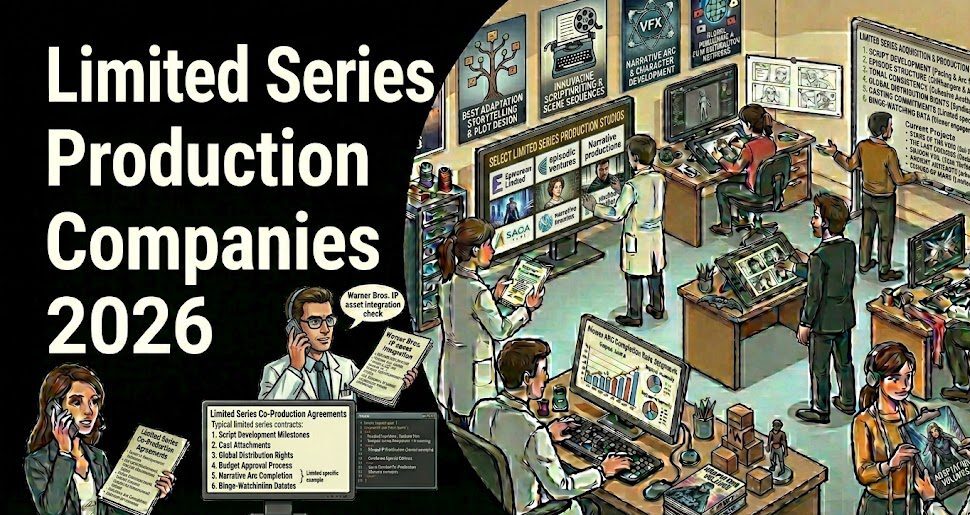
The limited series production companies reshaping television in 2026 don’t look much like the ones that defined Peak TV three years ago. That era — when Netflix, HBO, and Apple TV+ were each spending north of $6-8 billion annually on original content with virtually no ceiling on per-episode budgets — is over. What’s replaced it is more interesting, and more complicated, than the trade headlines suggest.
Here’s the thing: the limited series format is actually stronger than ever as a commissioning priority. But the companies getting greenlit, and the structures financing them, have fundamentally shifted. If you’re a content buyer looking to acquire prestige limited series, a financier evaluating production partner risk, or a producer trying to package your project for a platform sale — the landscape you need to understand isn’t the one described in last year’s roundups.
This guide maps the limited series production company ecosystem in 2026: who the real commissioners are, which independent producers are consistently closing deals, how financing structures have evolved, and where the Fragmentation Paradox™ is costing operators real money right now.
Find Verified Limited Series Production Companies in 48 Hours
Trusted by Netflix, Warner Bros, and Paramount. Ask VIQI which production companies are actively packaging limited series in your genre — and get sourced answers instantly.
✓ 200 free credits | ✓ No credit card required | ✓ Real-time intelligence
Why Limited Series Dominate the 2026 Commission Slate
The economics are clean. A limited series — four to eight episodes, defined story arc, no obligation to renew — gives a platform a prestige event without an open-ended P&A commitment. It gives a production company a single capital stack to close rather than season-on-season budget renegotiations. And it gives talent — writers, directors, A-list cast — a finite commitment that doesn’t lock them into a multi-year exclusive deal they’ll later resent.
As Deadline noted in its most-anticipated 2026 TV preview, platforms are programming fewer but more ambitious series — with limited formats specifically designed for global audiences and awards eligibility windows. That’s not an accident. The platforms are de-risking their content slates by concentrating spend on defined-end formats rather than open-ended series that could need eight seasons at $15M per episode to pay off.
But here’s what the headline trends miss: the production companies that actually get these commissions aren’t always the ones with the biggest brand names. The Fragmentation Paradox™ in limited series production is real — 600,000+ companies globally claim production capability, and buyers who aren’t working with verified current intelligence are making partnership decisions on two-year-old reputation data. By the time a company’s MIPCOM profile gets updated, their development slate, their commissioner relationships, and sometimes their leadership have entirely changed.

Your AI Assistant, Agent, and Analyst for the Business of Entertainment
VIQI AI helps you plan content acquisitions, raise production financing, and find and connect with the right partners worldwide.
- Find active co-producers and financiers for scripted projects
- Find equity and gap financing companies in North America
- Find top film financiers in Europe
- Find production houses that can co-produce or finance unscripted series
- I am looking for production partners for a YA drama set in Brazil
- I am looking for producers with proven track record in mid-budget features
- I am looking for Turkish distributors with successful international sales
- I am looking for OTT platforms actively acquiring finished series for the LATAM region
- I am seeking localization companies offer subtitling services in multiple Asian languages
- I am seeking partners in animation production for children's content
- I am seeking USA based post-production companies with sound facilities
- I am seeking VFX partners to composite background images and AI generated content
- Show me recent drama projects available for pre-buy
- Show me Japanese Anime Distributors
- Show me true-crime buyers from Asia
- Show me documentary pre-buyers
- List the top commissioners at the BBC
- List the post-production and VFX decision-makers at Netflix
- List the development leaders at Sony Pictures
- List the scripted programming heads at HBO
- Who is backing animation projects in Europe right now
- Who is Netflix’s top production partners for Sports Docs
- Who is Commissioning factual content in the NORDICS
- Who is acquiring unscripted formats for the North American market
Tier 1: Studio-Affiliated Limited Series Producers
These are the production operations with embedded platform relationships — first-look deals, overall deals, or direct studio affiliation — that give them a structural advantage in getting limited series greenlighted. They’re not the most interesting co-production partners for independent financiers (they typically retain IP), but they define the content landscape.
HBO Productions and Bad Wolf
HBO remains the gold standard for prestige limited series commissioning in 2026 — even as the Paramount-WBD acquisition moves through regulatory review. The platform’s track record (Big Little Lies, The White Lotus, Sharp Objects, Chernobyl) defines what buyers mean when they say “prestige limited.” Bad Wolf, the Cardiff-based producer co-founded by Jane Tranter and Julie Gardner, has become one of HBO’s most consistent limited series partners — producing His Dark Materials across three seasons and maintaining the relationship through executive team changes on both sides. Their model — UK-based production accessing Welsh tax relief and co-production treaty frameworks while delivering for US premium platforms — is increasingly the template other independent producers are trying to replicate.
Anonymous Content and Blumhouse Television
Anonymous Content sits at an interesting structural position — it’s a management and production company that packages IP from its own client roster, giving it a first-mover advantage on optioned literary properties and life rights. Their limited series track record includes Sharp Objects and 13 Reasons Why. Blumhouse Television has built its limited series operation on a high-efficiency model: lower budgets, genre-specific programming (horror, psychological thriller), and a brand identity strong enough to function as a commissioning signal to platforms. Their ability to produce at 30-50% below Tier 1 pricing while maintaining prestige aesthetic is the operational thesis that’s attracted multiple streaming platform deals in 2025-2026.
Legendary Television and Fifth Season
Legendary Television operates with deep film-to-TV IP bridges — adapting cinematic franchise properties for limited series treatment. Their Fallout series (with Amazon Studios) demonstrated that the model works: franchise IP, limited series format, global platform, event-level marketing. Fifth Season (formerly Endeavor Content) occupies a fascinating structural niche — it’s both a sales agency and a production partner, meaning it can package limited series projects as financier, producer, and sales agent simultaneously. That vertical integration compresses the deal timeline significantly and gives independent producers access to a platform relationship that typically takes years to build independently. As we explored in our analysis of co-commissioning and streamer-studio partnerships, this convergence of roles defines the most competitive production companies in the current market.
Track Which Production Companies Are Actively Packaging Limited Series
140,000+ entertainment companies. 400,000+ projects tracked. See in-development limited series before they close — by genre, territory, and commissioning platform.
✓ 200 free credits | ✓ No credit card required | ✓ Cancel anytime
Tier 2: The Independent Limited Series Producers Getting Deals Done
This is where the intelligence gap — and the opportunity — actually lives. Independent limited series producers without embedded platform deals have to close their capital stacks differently, navigate more complex distribution windows, and work harder for every greenlight. The ones doing it successfully in 2026 share specific operational characteristics. Understanding those characteristics is how you identify viable co-production and financing partners before their next deal is announced.
Goldfinch: The Financial Architecture Model
Goldfinch, led by founder and CEO Kirsty Bell, is one of the more instructive case studies in what independent limited series production looks like when built on disciplined financial architecture rather than platform relationships. Bell came from the financial world — not the creative side — and designed Goldfinch’s model around diverse revenue streams: vertical series, brand integration, and global creative economy partnerships across the Middle East, Africa, and Asia. That approach insulates the company from the commissioning volatility that’s taken out less diversified independents. Their Sovereign Content Hub™ positioning — actively cultivating production partnerships in MENA and APAC markets where government-backed incentives can reduce a budget by 30-50% — gives them a competitive cost structure on limited series that pure UK or US operations simply can’t match. In her LeaderSpeak interview, Bell specifically noted how this diversification model bridges art and enterprise in ways that purely creative-driven companies can’t sustain through market downturns.
Head Gear Films: Volume as Risk Mitigation
Most production companies in the limited series space are operating single-project pipelines — which means one greenlight delay or one platform pivot can derail an entire year. Head Gear Films, co-founded by Phil Hunt, operates differently. With 550+ productions financed and a current volume of 35-40 projects per year — more than most major studios — Head Gear has built a structured lending and packaging business that treats volume itself as a risk mitigation tool. Hunt has been candid about the current market: the “Big Crunch” following post-COVID production excess has made it materially harder to get limited series off the ground. Finance plans that would have worked in 2022 are getting rejected as unrealistic. Budgets need to come down. The producers who survive are the ones with the operational infrastructure to package correctly — not just the creative instinct to develop well. Hunt’s framework, refined over nearly 25 years in the UK market, is particularly relevant for international co-production structures where treaty compliance and incentive stacking require precision that creative-only producers often lack.
MRC Entertainment and Entertainment One
MRC Entertainment operates as an independent studio with its own distribution infrastructure — which means it can finance, produce, and sell limited series without platform dependency at every step. Their track record (House of Cards, Ozark, Knives Out franchise) gives them enough marketplace credibility that platform relationships are partnerships rather than dependencies. Entertainment One (eOne), now under Lionsgate, brings a different structural advantage: a deep content library that functions as financing collateral, allowing the company to carry development slate risk that pure independents can’t sustain. For co-production partners evaluating risk, eOne’s balance sheet backing and Lionsgate’s global distribution infrastructure represent a materially different risk profile than an unaffiliated independent producer.
What makes the current limited series market particularly interesting — as Screen International reported in its analysis of independent studio models — is that the new streaming “walled gardens” owned by rival corporate giants have actually created fresh commissioning opportunities for production companies that don’t compete with those mega-companies’ own in-house operations. The strategic implication: you don’t always want the platform relationship with the most infrastructure behind it. Sometimes the more productive relationship is with the platform that needs your independent production capability to fill a content gap their internal operations can’t address.
How Limited Series Are Getting Financed in 2026
The capital stack for a limited series in 2026 looks materially different from 2021. Platform license fees — which once covered 80-90% of production costs on streamer commissions — have recalibrated. Platforms are increasingly offering deficit financing models rather than cost-plus deals, meaning production companies must bring a larger share of the budget to the table themselves and retain more backend upside (or risk) accordingly.
Here’s what a workable modern limited series capital stack actually looks like in practice.
Tax Incentive Stacking as the First Line of Defense
Smart limited series producers now build tax incentive optimization into the project from the day IP is optioned — not six weeks before principal photography. The UK’s Audio-Visual Expenditure Credit (AVEC) offers 34% on qualifying UK spend for high-end TV productions (minimum £1M per broadcast hour). Canada’s treaty network — covering 60+ countries with Telefilm Canada administering bilateral co-production agreements generating over $500M CAD annually — creates significant stacking opportunities. And the MENA Sovereign Content Hubs™ that have emerged over the past three years now offer rebates of 40-50% in territories like Abu Dhabi and Saudi Arabia for qualifying productions that meet local spend thresholds.
Andrea Scarso, Managing Partner at IPR VC (IPR Venture Capital), frames this precisely: in their equity financing model, looking at co-production opportunities in territories where you can maximize local incentives, tax credits, and local pre-sales has become “crucially more important” in the current market — especially in Europe, where the co-production system allows local partners who understand their own markets extremely well to bring additional resources to the table while managing downside risk. IPR VC’s London-Helsinki-Paris infrastructure specifically bridges North American content producers with the European incentive and co-production ecosystem — the kind of operational bridge that saves independent limited series producers six months of treaty navigation.
Pre-Sales and the Territory-by-Territory Stack
The collapse of the traditional pre-sales market — where a single major territory anchor deal would unlock gap financing — has not eliminated pre-sales as a financing mechanism. It’s just made them more complex. Limited series producers in 2026 are building their pre-sale stacks territory by territory, with Tier 2 European broadcasters (Canal+, ARD, RAI, NRK) providing the anchor pre-buy while Tier 3 APAC and MENA output deals fill the remaining gap. The minimum guarantees on those Tier 2 deals have compressed — which is exactly why the incentive stacking described above is now structural rather than optional. You need the soft money to cover what the pre-sales no longer cover. As Phil Hunt noted in his LeaderSpeak discussion, the finance plans that look unrealistic right now are the ones that still assume pre-sale values at their 2021 peak. The ones that work start from current market MG rates and build back up through stacked incentives and equity.
For a comprehensive view of how pre-sales currently function within limited series financing, see our detailed breakdown of the international pre-sale ecosystem by territory.
Phil Hunt (Founder & CEO, Head Gear Films) — whose company has financed 550+ productions over nearly 25 years — discusses the current production financing crunch and what it means for limited series producers navigating the 2026 market:

International Co-Production: The Limited Series Advantage
Limited series are structurally ideal for international co-production treaty structures — in ways that returning series simply aren’t. A finite story arc with a defined delivery schedule maps cleanly to the treaty application timelines required by Telefilm Canada, the BFI, or the CNC. Creative contribution requirements — directors, writers, key cast — can be negotiated upfront rather than managed across open-ended season commitments. And the episodic format typically generates enough qualifying spend in each co-producing territory to unlock the maximum incentive rate rather than just the minimum threshold.
Belgium, notably, has built its production economy almost entirely on co-production: 72% of films produced in Belgium are official co-productions under bilateral treaty frameworks. That model — where co-production is the default structure rather than a fallback when domestic financing falls short — is increasingly what the most sophisticated limited series producers are applying globally. The key operational insight is that you need to identify your co-production partners at the packaging stage, not after you’ve already structured the capital stack. Treaty applications require a minimum four weeks before principal photography, but the actual partner matching, contribution structuring, and compliance planning takes months. Producers who treat international co-production as a late-stage add-on consistently leave incentive value on the table.
Sovereign Content Hubs™ as Limited Series Co-Production Partners
The rise of Sovereign Content Hubs™ — government-backed production centers in Saudi Arabia, UAE, South Korea, and across APAC — has created a specific limited series co-production opportunity that most Western producers haven’t fully mapped yet. Saudi Arabia’s Vision 2030 has specifically targeted entertainment as a GDP diversification vehicle, with $1 billion allocated to film infrastructure and an Entertainment Authority mandate that actively seeks international limited series co-productions that feature Saudi locations, talent, and stories. UAE’s 50% rebate in Abu Dhabi represents the most generous single-territory incentive available to qualifying international productions. And South Korea — whose drama production infrastructure has been proven at global prestige level by Squid Game, Pachinko, and The Glory — offers a co-production ecosystem with trained international-standard crew, modern facility infrastructure, and a regional streaming platform network eager for premium limited series originals.
For limited series producers specifically, these Sovereign Hub partnerships aren’t just financing vehicles. They’re distribution amplifiers — securing a co-producer in Saudi Arabia or South Korea often unlocks the regional platform pre-buys (OSN for MENA, Disney+/Viu/Wavve for APAC) that would otherwise take years of relationship building to access independently.
How to Actually Source Limited Series Production Partners in 2026
Let’s be direct about how the sourcing problem actually works — because the official answer (“go to MIPCOM, take meetings, use your network”) is true but dangerously incomplete in the current market.
The Fragmentation Paradox™ costs you real money here. A content buyer evaluating limited series acquisition targets, a financier building a co-production slate, or an independent producer seeking a packaging partner — all three are working with the same fundamental intelligence deficit. The market has 600,000+ production company entities globally. Of those, the number with verified limited series credits, current commissioner relationships, and active development slates in your specific genre and budget range is far smaller — but the verification layer between “claims limited series capability” and “has actually produced limited series at platform level” is opaque in ways that cost time and capital.
The operators who close deals fastest aren’t attending more markets. They’re using better intelligence. Vitrina tracks 400,000+ projects across 140,000+ companies globally — with verified credits, current production status, active commissioner relationships, and deal flow updated in real time. A content buyer can identify which limited series production companies are actively developing in a specific genre with a specific platform as co-commissioning partner, in under 48 hours. That’s not a capability traditional relationship networks provide — even the best-connected executives are working with information that’s weeks or months behind actual deal flow.
For deeper context on how production company intelligence drives financing decisions, see our analysis of market intelligence strategy for the media industry.
Get a Curated List of Limited Series Production Partners for Your Project
Vitrina’s Concierge team maps verified production companies, financiers, and co-production partners specifically matched to your genre, territory, and budget range.
✓ Used by teams at Netflix, Paramount, Apple TV+, and leading independents
✓ No commitment required to start
What the Platforms Are Actually Buying Right Now
The commissioning signals for 2026 limited series are clearer than the trade coverage suggests. Cut through the noise and here’s what the buyers are actually prioritizing.
Netflix is commissioning limited series with built-in global audience signals — IP with pre-existing fanbases (literary adaptations, true crime events, recognizable franchise extensions) and genre content with proven multi-territory performance (thriller, crime, historical drama). Their acquisition of new limited series IP is increasingly tied to data-validated demand signals — which means production companies that can demonstrate genre performance data from comparable titles have a structural advantage over those presenting pure creative pitch packages. Netflix’s $30 billion annual content spend (across the industry) as of 2024 has become more selective, not larger, post-Peak TV. Budget ceilings on limited series are tighter than three years ago.
Apple TV+ remains the most distinctive buyer in the limited series market — commissioning at genuinely high per-episode budgets (Ted Lasso, The Morning Show, Severance all produced at $10-15M+ per episode) but with a significantly smaller volume of greenlights. For a production company, an Apple limited series commission is transformational — but the path to getting one without a prior Apple relationship is longer and less navigable than most producers publicly acknowledge. FX / Hulu has consistently produced the most critically admired limited series work in the US market over the past decade — The People v. O.J. Simpson, The Assassination of Gianni Versace, Dopesick, The Bear. Their commissioning model prioritizes showrunner relationship and IP distinctiveness over franchise extension. And Amazon MGM Studios has built its limited series strategy around global scale — productions that can anchor their international SVOD expansion in LATAM, MENA, and APAC while delivering domestic US engagement.
Beyond the US majors: Canal+ in France is the most active European co-commissioning partner for English-language limited series with European settings or casts. Channel 4 in the UK has consistently backed prestige limited series (It’s a Sin, Fleabag before its BBC move) with a distinctive commissioning identity. And OSN, the MENA premium platform operating across 23 countries, is actively seeking limited series with authentic regional stories that can anchor Arabic-language content strategy without sacrificing production value standards.
The Intelligence Advantage in a Fragmented Market
The limited series production landscape in 2026 isn’t harder to navigate than it was at the height of Peak TV — it’s just different. The budgets have rebalanced. The platform dependencies have shifted. The financing structures have gotten more complex. And the co-production opportunities — particularly through Sovereign Content Hubs™ and treaty stacking — have gotten more valuable, not less.
But none of that complexity helps you if you’re working with a six-month-old picture of who’s actually active in the limited series production market. The companies that are packaging deals right now, the commissioners who’ve moved to new platforms, the financiers who’ve pivoted their investment thesis — that intelligence changes faster than any static database or annual trade survey can track.
Don’t let the Fragmentation Paradox™ cost you this cycle. The deals that matter in 2026 are closing before the press release — with production partners who were identified, verified, and engaged before the rest of the market realized they were available.
Key Takeaways
- Limited series dominate 2026 commissioning: Platforms favor defined-arc formats that de-risk open-ended series spend — but per-episode budgets have tightened from Peak TV peaks.
- The best independent producers combine financial discipline with creative infrastructure: Companies like Goldfinch and Head Gear Films succeed because they’ve built operational systems, not just creative instincts.
- Tax incentive stacking is now structural, not optional: UK AVEC (34%), Canadian treaty networks ($500M CAD+ annually), and MENA Sovereign Hub rebates (40-50%) are essential components of any workable 2026 limited series capital stack.
- International co-production matches the limited series format perfectly: Treaty applications, defined creative contribution requirements, and finite delivery schedules align structurally with bilateral co-production frameworks in ways returning series don’t.
- Real-time intelligence resolves the Fragmentation Paradox™: Vitrina’s 140,000+ companies and 400,000+ tracked projects give buyers, financiers, and producers verified current intelligence — not six-month-old relationship data — on who’s actually packaging limited series right now.
Frequently Asked Questions: Limited Series Production Companies 2026
What is a limited series production company?
A limited series production company specializes in developing, packaging, and producing television content with a defined, finite story arc — typically four to eight episodes — rather than open-ended returning series. These companies structure their development operations, financing relationships, and platform deals specifically around the limited series format’s distinct creative and commercial requirements. The format’s defined delivery schedule and single-season capital stack make it structurally different from recurring drama production.
Which production companies are best for limited series in 2026?
The leading limited series production companies in 2026 include studio-affiliated operations like HBO Productions, Anonymous Content, Blumhouse Television, Legendary Television, and Fifth Season — which have embedded platform relationships. Among independents, Goldfinch, Head Gear Films, Bad Wolf, MRC Entertainment, and Entertainment One (under Lionsgate) consistently close limited series deals through disciplined financing structures and international co-production expertise. The right company for your specific project depends on genre, territory, budget range, and target commissioning platform — verified current intelligence is essential because capabilities and relationships change faster than static directories reflect.
How are limited series typically financed in 2026?
Limited series financing in 2026 typically involves a stacked capital structure: a platform license fee (now more commonly a deficit financing deal than a cost-plus commission), tax incentives from co-producing territories (UK AVEC at 34%, Canadian provincial credits, or MENA sovereign hub rebates up to 50%), international pre-sales territory by territory, and equity from production company investors or co-producers. Single-source financing from a platform alone — the model common during 2020-2022 — has become increasingly rare. The most efficient limited series capital stacks combine two to four financing sources from packaging stage onward.
What platforms are commissioning limited series in 2026?
The primary limited series commissioners in 2026 include Netflix (genre content with global audience signals, literary IP, true crime), Apple TV+ (high-budget, distinctive creative vision), Amazon MGM Studios (global scale, international expansion anchors), FX/Hulu (critically ambitious, showrunner-relationship driven), and HBO/Max (prestige drama standards, event programming). European co-commissioners including Canal+ and Channel 4 are also active limited series buyers for English-language and bilingual content. In MENA, OSN covering 23 countries is actively commissioning Arabic-language limited series originals with premium production standards.
How do international co-productions benefit limited series projects?
International co-production structures offer limited series projects access to stacked tax incentives from multiple territories, access to local funding bodies and broadcaster pre-buys, crew and facility cost advantages, and cultural authenticity for internationally-set stories. Canada’s treaty network (covering 60+ countries) and the European Convention (covering 43 European states) are the most established frameworks. MENA Sovereign Content Hubs including Saudi Arabia and UAE offer up to 50% rebates for qualifying productions. The limited series format’s defined delivery schedule and finite creative scope map particularly cleanly to treaty application requirements.
What budget range do limited series production companies work with?
Limited series budgets in 2026 range considerably by platform and genre. Apple TV+ commissions at the top end — $10-15M+ per episode on flagship series. Netflix and Amazon commission prestige limited series at $5-10M per episode for high-end projects, with a second tier of $2-5M per episode for genre limited series. European broadcasters and SVOD platforms typically commission at €1-3M per episode. Blumhouse Television and similar genre-specialist producers consistently deliver at 30-50% below Tier 1 pricing while maintaining prestige production standards — which is why their model has attracted significant platform interest in the current budget-conscious commissioning environment.
How do I find limited series production partners for my project?
Finding verified limited series production partners requires current intelligence — not static databases or annual market directories. Vitrina tracks 400,000+ projects across 140,000+ production companies globally, with verified credits, active development status, and commissioner relationships updated in real time. VIQI, Vitrina’s AI-powered intelligence tool, allows buyers, financiers, and producers to identify production companies actively packaging limited series in a specific genre, territory, and budget range — with answers delivered in under 48 hours. The Vitrina Concierge service provides bespoke company matching for complex sourcing requirements. Access starts with 200 free credits, no credit card required.
What is the difference between a limited series and a miniseries?
The terms are often used interchangeably, but in current industry usage, a limited series typically refers to a structured story told across four to eight episodes with a defined narrative conclusion — designed and commissioned from the outset as a finite creative work. A miniseries, in traditional usage, often refers to a shorter two-to-four part format, frequently adaptations of single literary works (a novel or biography). For production company purposes and platform commissioning, the distinction is less important than the underlying creative structure: a defined arc, finite episode count, and single-season capital commitment.
Access the Intelligence Layer the Industry’s Best Use
140,000+ verified companies. 400,000+ projects tracked globally. Find your next limited series production partner before they close with someone else.
✓ 200 free credits | ✓ No credit card required | ✓ Full platform access from day one
Find Film+TV Projects, Partners, and Deals – Fast.
VIQI matches you with the right financiers, producers, streamers, and buyers – globally.
Producers Seeking Financing, Co-Pros, or Pre-Buys?
Vitrina Concierge helps producers reach the right financiers, commissioners, distributors, and co-production partners — with precision outreach, not cold pitching.
Join Industry Briefings Trusted by Leaders

The New Deal Room: A 2026 Playbook for Global Content Licensing
How global content licensing is shifting beyond flat fees to flexible, deal-driven models.
Film & TV Production Financing: 2026 Trends
Production financing conditions are changing quickly. Understanding where money is moving and what buyers are backing is key to getting projects approved and funded in 2026.
Unreleased Film+TV Projects: Opportunities & Showcase
A curated view of unreleased Film and TV projects open for financing and collaboration