About Innovation Hub
 Global Content Pulse (Webinars)


 Global Production Financing
(Webinars)
Global Production Financing
(Webinars)  LeaderSpeak Podcast
  Global Entertainment Digest (Newsletter)
  About Vitrina
 About VIQI
 Our Story
 Our Solutions 🔥
 Film+TV Projects Tracker 🚀
 Case Studies
 Our Profile
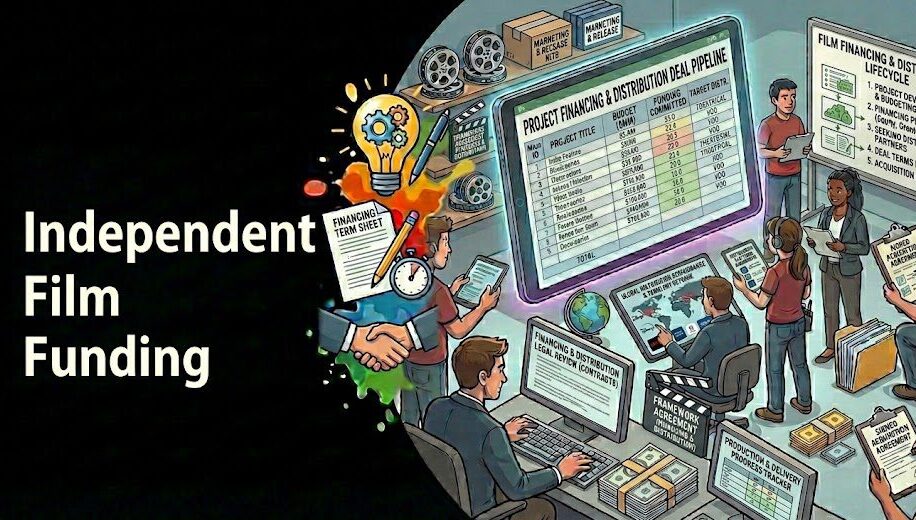
Your script is locked. Your director is attached. And you still can’t close the budget. Sound familiar? Independent film funding isn’t a mystery—but it is a system. And if you’re approaching it piecemeal, you’re leaving real money on the table and burning time you don’t have before the market moves on.
Here’s the reality in 2025: Phil Hunt, Founder and CEO of Head Gear Films—a company that has financed 550+ movies and processes 35–40 films per year—has been frank about the current climate. The industry, he says, has become “much, much harder in terms of getting movies off the ground and getting movies sold.” That’s not a pessimistic take. That’s intelligence from someone who’s closed more deals than most studios.
But films are still getting made. Deals are still closing. The producers doing it aren’t luckier than you—they’re more systematic. This guide walks you through 7 proven strategies for securing independent film funding, from pre-sales and tax incentives to gap financing and co-production deals. Real mechanisms. Real capital stack logic. No fluff.
In This Guide
- Why Independent Film Funding Is Harder Than Ever in 2025
- The Capital Stack: Your Blueprint for Film Financing
- Pre-Sales: Turn Unsold Territories Into Production Capital
- Tax Incentives: The Free Money Most Producers Leave Behind
- Equity Investment: What Film Financiers Actually Want
- Gap Financing: Closing the Final 15–30% of Your Budget
- Co-Production Deals: Unlock Multiple Funding Streams at Once
- Building a Winning Financing Package
- How Vitrina Accelerates Your Path to Funding
- Frequently Asked Questions
Find Your Film’s Finance Partners in 48 Hours
Join 140,000+ entertainment companies—including teams from Netflix, Warner Bros, and Paramount—already using Vitrina to discover financiers, co-producers, and sales agents by project type, budget, and territory. 200 free credits. No credit card required.
Why Independent Film Funding Is Harder Than Ever in 2025
Let’s not sugarcoat it. The post-COVID “revenge production” surge created a dangerous illusion: that capital was abundant and buyers were ravenous. Between 2021 and 2022, money flowed into independent film at unsustainable rates. Now we’re living through the correction—what industry insiders call the Fragmentation Paradox, where content demand has never been higher globally but the infrastructure to finance and distribute that content is splintered across hundreds of buyers, platforms, and territories.
Pre-sales? They’ve contracted sharply. Buyers are more conservative. The distributors who used to commit to a title off a concept and a name attachment now want finished or nearly finished cuts. And the commercial banks—firms like City National, which historically anchored film lending—have pulled back from the space. Joshua Harris, President and Managing Partner of Peachtree Media Partners, has been direct about this: City National’s retreat created “an enormous gap in the marketplace” that private capital is still scrambling to fill.
None of this means the money’s gone. It means it’s moved—and you need to know where to look. The producers closing budgets right now are working the full capital stack, not relying on a single investor or a single presale to carry them. That’s the shift. And that’s exactly what this guide is about.
The Capital Stack: Your Blueprint for Independent Film Financing
Before you chase a single dollar, you need to understand the architecture. A well-structured film financing plan combines multiple sources—each with a different risk profile, cost of capital, and repayment position. Think of it like a building: each layer supports the next.
For a typical $10M independent feature, the capital stack looks something like this:
The goal? Secure 65–80% of your budget from pre-sales and tax incentives before you approach gap lenders. That’s the threshold that de-risks the project enough to unlock the remaining capital. Every strategy below feeds into this architecture.
Stop Guessing Who’s Financing. Get Targeted Outreach.
Stop searching and start getting funded. We identify the exact decision-makers currently backing projects like yours, turning raw data into risk-aligned capital partnerships.
Major Studios
Scouting early stage projects, IP, and Regional partners for global studio pipelines.
IP Owners & Leads
Connecting creative leads with qualified financiers and major streaming platforms.
Streamers
Securing high-value pre-buy content and discovering early-stage global IP for platforms.
Indie Producers
Bridging the gap for indie filmmakers to reach executive production partners and capital.
Global Financing Ecosystems
Mapping complex markets and pairing projects with disciplined, risk-aligned capital across global territories worldwide.
Strategy 1: Pre-Sales — Turn Unsold Territories Into Production Capital
Pre-sales are distribution agreements you close before—or sometimes during—production. A foreign distributor commits a minimum guarantee (MG) for the rights to a specific territory. You take that contract to a bank, which advances 70–90% of the MG value. That cash funds production.
The case study everyone in the business knows: Richard Linklater’s Hit Man closed 15 presale contracts before cameras rolled—territories spanning Canada, Italy, Poland, Turkey, and the Middle East. Why did those deals happen? Linklater’s name. Glen Powell’s rising star power. And a commercial concept that buyers could price confidently. The film later sold to Netflix domestically, making early territory sales even more lucrative.
But here’s what most producers don’t hear: not every project qualifies. Banks rate distributors by territory—Germany’s Constantin Film and France’s Pathé sit in Tier A; others may not qualify for financing at all. You need a reputable sales agent with proven gap-financing relationships providing sales estimates at 1.5–2x the gap amount. Without that, the bank won’t lend against your contracts.
The major markets are your target: Cannes Marché du Film (May), the American Film Market (November), and the European Film Market Berlin (February). Your sales agent circulates packages to buyers 2–3 weeks before the market—not during it. That’s when decisions get made. By the time the market opens, you want conversations already in progress.
Track 400,000+ Active Projects. Find Your Sales Agent Today.
Vitrina maps 140,000+ verified entertainment companies—including foreign sales agents, co-producers, and film financiers—filtered by genre, budget range, and territory. 200 free credits. No credit card required.
Strategy 2: Tax Incentives — The Free Money Most Producers Leave Behind
This is arguably the most underutilized layer of the capital stack. Film tax incentives—cash rebates, refundable credits, transferable credits—are government programs designed to attract production spend. And in 2025, competition between jurisdictions is fierce.
The UK’s High-End Television and Film Tax Relief offers up to 40% on qualifying production spend. VFX gets an additional 5%—a total of 29.25% on visual effects costs specifically. Georgia (USA) offers a flat 30% transferable tax credit. Ireland’s Section 481 delivers 32% on qualifying Irish spend. These aren’t marginal—on a $5M budget shooting in the right jurisdiction, you’re talking $750,000–$2M back in your pocket.
But you can stack them. A UK–Ireland co-production, structured correctly, can access both jurisdictions’ programs simultaneously. That’s the kind of capital efficiency the Sovereign Hubs strategy is built on—identifying production locations that offer not just incentives, but stable infrastructure and talent pipelines that support your schedule.
Two critical mechanics to understand. First: most incentives are backend money, paid after delivery and audit. You’ll need to finance against them during production—a “rebate loan” at roughly 80–90% of the incentive’s face value. Second: qualifying production expenditure (QPE) definitions vary dramatically. Above-the-line costs like cast and director fees qualify in some jurisdictions but not others. Get a local entertainment accountant involved before you lock your budget—not after.
Strategy 3: Equity Investment — What Film Financiers Actually Want to See
Equity is the most expensive capital in your stack—and the most misunderstood. Equity investors sit at the bottom of the waterfall: they recoup after distribution fees, P&A, senior debt, and gap financing are all repaid. They carry the highest risk. So their return expectations reflect that: typically 120–125% of principal minimum, with upside on backend.
Andrea Scarso, Managing Director at IPR VC—a Helsinki-based fund that provides equity financing for film and TV through institutional investors and family offices—puts it plainly: “The challenge isn’t deal flow. It’s the quality of investing and how you structure the investment.” Translation: don’t come to equity investors with a passion project. Come with a business case.
What does a strong equity pitch include? A detailed business plan with comparable revenue analysis—not just comps you cherry-picked, but honest genre benchmarks. Waterfall modeling showing investors their recoupment scenario under three conditions: conservative, base, and upside. Clear distribution strategy with named buyers already in conversation. And—this matters more than most producers realize—transparent accounting structures. Investors have seen enough Hollywood accounting to know when they’re being set up for “net profits” that never arrive.
And talent still moves capital. A proven director or A-list cast attachment doesn’t just raise presale value—it directly reduces equity risk, which means lower ROI demands from investors and more favorable terms. That’s the compounding effect of a strong package.
Find the Financiers Backing Your Genre
Stop searching and start getting funded. We identify the exact decision-makers currently backing projects like yours, turning raw data into risk-aligned capital partnerships.
Strategy 4: Gap Financing — Closing the Final 15–30% of Your Budget
Gap financing is a debt facility secured against a film’s unsold territorial distribution rights. It’s typically the last piece of your capital stack—covering the 10–30% of budget that presales and incentives don’t reach. And it’s genuinely the mechanism that closes deals that would otherwise stall.
But gap lenders price risk aggressively. Upfront fees run 7–15% of the loan amount. Interest is charged from initiation to repayment at prime plus 3–8%. On an 18-month loan, your effective cost of capital can hit 22% of the original loan. That’s not a reason to avoid gap financing—it’s a reason to price it into your budget and ROI models honestly, and to plan fast repayment from early revenues.
The qualification threshold is the piece most producers underestimate: you need 60–80% of your budget already secured before gap lenders engage. Sales estimates from your agent must be 1.5–2x the gap amount—because lenders only count major territories (Germany, France, Japan, UK) and apply conservative haircuts of 50–70% on agent projections. And you need a completion bond in place. No bond, no gap loan. Full stop.
Phil Hunt (Founder & CEO, Head Gear Films) breaks down the current gap financing landscape, structured lending, and what independent films actually need to close in today’s market:

It’s worth watching all of it—especially Hunt’s candid take on why the post-COVID financing crunch has made structured lending the dominant model for volume operators. Head Gear’s 35–40 film annual cadence is possible precisely because they’ve systematized this stack.
Need a Financing Partner Match—Not Just a Search?
Vitrina’s Concierge Service connects your project directly with verified gap lenders, equity funds, and co-production partners from our network of 140,000+ companies. Used by Netflix, Paramount, and independent producers worldwide. No commitment required to start.
Strategy 5: Co-Production Deals — Unlock Multiple Funding Streams at Once
International co-productions are one of the most powerful—and underused—tools in independent film financing. Done right, a co-production with a qualifying foreign partner doesn’t just split costs. It gives you simultaneous access to two (or more) government incentive programs, two broadcaster relationships, and two distribution territories with local credibility.
Co-production treaties are the mechanism that makes this work. The UK has active treaties with 47 countries. Canada has treaties with 58 countries. A qualifying UK–Canada co-production can access the UK Film Tax Relief and the Canadian Production Services Tax Credit simultaneously—potentially stacking incentives that cover 50%+ of your combined budget before a single presale lands.
But co-production is relationship-dependent. You need a partner who genuinely contributes—creative, financial, and talent—not a shell arrangement that auditors will scrutinize. The due diligence is real. Finding the right partner used to take 6+ months of festival circuits and market attendance. Today, platforms like Vitrina compress that search dramatically. You’re not browsing 500 French production companies hoping for a fit—you’re surfacing verified companies with confirmed project history, current capacity, and alignment with your genre and budget range.
Strategy 6: What a Winning Financing Package Actually Looks Like
Every serious lender, equity investor, and distribution partner will ask for the same core package—and the quality of this package determines not just whether you get funded, but the terms you get. Here’s what needs to be air-tight before you’re in the room.
Your chain of title must be clean and complete—any ambiguity in underlying rights ownership can kill a deal in due diligence. Your detailed line-item budget needs to include contingency (10% minimum) and completion bond costs (3–6% of budget). Without the completion bond, most lenders won’t proceed.
Your sales estimates need to come from a reputable agent—not internal projections you assembled. Lenders know which agents they trust, and which ones inflate numbers. A conservative estimate from a credible agent beats an aggressive one from an unknown. And your cast/crew package should include signed deal memos, not letters of intent that have a 50% chance of falling through before production.
The King’s Speech ($15M budget, $400M+ worldwide gross) closed its gap financing against exactly this kind of disciplined package—not against Oscar predictions. The financiers looking at that project were underwriting the unsold territories and the talent attachment, not the artistic vision. That’s the mindset shift that separates funded projects from permanently “in development” ones.
Strategy 7: How Vitrina Accelerates Your Path to Film Funding
The central problem in independent film funding isn’t that capital doesn’t exist. It’s that the information infrastructure to find the right capital—for your budget, your genre, your territory—has historically been fragmented, relationship-locked, and slow. That’s the Fragmentation Paradox at its most operational: the deals that don’t happen aren’t because of bad projects. They’re because of information asymmetry.
Vitrina’s platform maps 140,000+ verified entertainment companies across 400,000+ active projects—including gap lenders, equity funds, co-production partners, and foreign sales agents. Verified capabilities. Confirmed project history. Current capacity signals. You can discover financing partners filtered by the exact criteria that matter for your project—without the six-month festival circuit.
And VIQI—Vitrina’s AI intelligence layer—lets you query the entire entertainment supply chain conversationally. Ask who’s actively financing action thrillers in the $3–8M range right now. Ask which UK sales agents have closed AFM deals in the past 18 months. Ask who’s co-producing in your target territory. You get answers in minutes, not months. That’s the intelligence edge that successful indie film financing increasingly depends on.
Frequently Asked Questions About Independent Film Funding
What is independent film funding?
Independent film funding refers to the combination of financing sources—pre-sales, tax incentives, equity investment, gap loans, grants, and co-production deals—that producers assemble to cover a film’s production budget outside the major studio system. Unlike studio financing, independent producers build a capital stack from multiple parties, each with a different risk position and repayment priority in the revenue waterfall.
How much does it typically cost to fund an independent film?
Independent feature films range widely—from micro-budget projects under $1M to mid-range productions of $5–20M. The financing structure changes significantly at each level. Films under $2M have very limited access to gap financing and pre-sales. The $3–10M range is the sweet spot for accessing the full capital stack: pre-sales, tax incentives, equity, and gap financing. Above $10M, studio co-financing or broadcaster pre-buy partnerships typically enter the picture.
What is gap financing in independent film production?
Gap financing is a debt facility that covers the funding shortfall between your secured financing (pre-sales, tax incentives, equity) and your total production budget. It’s typically secured against a film’s unsold territorial distribution rights and represents 10–30% of the budget. To qualify, most lenders require 60–80% of the budget already secured, a reputable sales agent providing market estimates, a completion bond, and recognizable talent attached to the project.
How do pre-sales work in independent film financing?
Pre-sales are territorial distribution agreements—minimum guarantee (MG) contracts—that producers close before production begins. A foreign distributor commits to pay for the rights to release the film in their territory. That MG contract is then taken to an entertainment bank, which advances 70–90% of the contract’s value as production capital. Pre-sales are most valuable for action, thriller, and horror genres with name talent attached. A reputable foreign sales agent is essential to generate and validate the contracts that lenders will accept.
What tax incentives are available for independent film production?
Major film-producing jurisdictions offer significant incentives: the UK provides up to 40% tax relief on qualifying spend, with an additional 5% for VFX. Georgia (USA) offers a 30% transferable tax credit. Ireland’s Section 481 delivers 32% on Irish qualifying spend. Canada’s programs vary by province but range from 16–25% of eligible labor. These incentives are typically backend money—paid after production and audit—so producers often use rebate loans (advances at 80–90% of the incentive value) to access capital during production.
What do equity investors look for in an independent film?
Equity investors want a clear business case: a detailed budget, transparent waterfall structure, conservative revenue projections based on comparable films, confirmed talent attachments, and an experienced producer with a track record. They typically target 120–125% return on principal, given their last-money-in position in the recoupment waterfall. Generic pitch materials focused on artistic vision don’t move capital. Investors need to see how their money comes back—and on what timeline.
How does co-production help secure independent film funding?
Co-production with a qualifying foreign partner unlocks simultaneous access to multiple government incentive programs, shared production costs, and distribution credibility in both partner territories. The UK has active co-production treaties with 47 countries; Canada with 58. A properly structured UK–Canada co-production, for example, can access incentives from both jurisdictions—potentially stacking coverage to more than 50% of the combined budget before pre-sales or equity are factored in.
How can Vitrina help me find film financing partners?
Vitrina maps 140,000+ verified entertainment companies—including gap lenders, equity funds, foreign sales agents, and co-production partners—across 400,000+ active projects. You can filter by genre, budget range, territory, and project history. Vitrina’s AI assistant VIQI lets you ask specific financing queries conversationally, surfacing verified partners matched to your project’s profile. What traditionally takes 6+ months of festival networking can be compressed to days. The platform is free to start with 200 credits, no credit card required.
Conclusion: The System Behind Every Independent Film That Gets Made
The producers closing independent film funding in 2025 aren’t the ones with the best scripts. They’re the ones who treat financing as an architecture problem—building a capital stack layer by layer, with each piece positioned to unlock the next. Pre-sales de-risk the project for gap lenders. Tax incentives reduce the equity burden. Co-production opens new incentive programs and territory relationships. And a clean, complete financing package is what actually gets you into the room.
The market is harder. Phil Hunt is right about that. But “harder” doesn’t mean “closed.” It means the information advantage matters more than it ever has—and right now, that advantage is accessible.
Key Takeaways
- Build the full capital stack: Pre-sales + tax incentives + equity + gap financing is the architecture, not a menu of alternatives.
- Secure 65–80% first: Gap lenders won’t engage until the majority of the budget is confirmed—plan your fundraise sequence accordingly.
- Tax incentives are stackable: Co-productions structured through treaty countries can access multiple government incentive programs simultaneously.
- Your package is your pitch: Clean chain of title, signed cast memos, a reputable sales agent, and a completion bond determine your terms—not just whether you get funded.
- Information asymmetry is the real barrier: Finding the right financing partner for your project, genre, and budget used to take 6+ months; platforms like Vitrina compress that to days.
Start Building Your Film’s Financing Network Today
Join 140,000+ entertainment professionals using Vitrina to find verified gap lenders, equity investors, co-production partners, and foreign sales agents—filtered by project type, budget, and territory.
200 free credits. No credit card required.
Find Film+TV Projects, Partners, and Deals – Fast.
VIQI matches you with the right financiers, producers, streamers, and buyers – globally.
Join Industry Briefings Trusted by Leaders

The New Deal Room: A 2026 Playbook for Global Content Licensing
How global content licensing is shifting beyond flat fees to flexible, deal-driven models.
Film & TV Production Financing: 2026 Trends
Production financing conditions are changing quickly. Understanding where money is moving and what buyers are backing is key to getting projects approved and funded in 2026.
Unreleased Film+TV Projects: Opportunities & Showcase
A curated view of unreleased Film and TV projects open for financing and collaboration
The Mid-Budget Comeback: Why Mid-Budget Films Is the Smartest Bet in the Room
Mid-budget films are attracting new capital. See why this segment is becoming one of the strongest bets in Film today.