IHUB
IHUB
 Private Briefings (Webinars)


 LeaderSpeak Podcast
  Global Entertainment Digest (Newsletter)
  Premium Lists
 Membership Benefits
 About Vitrina
 Our Story
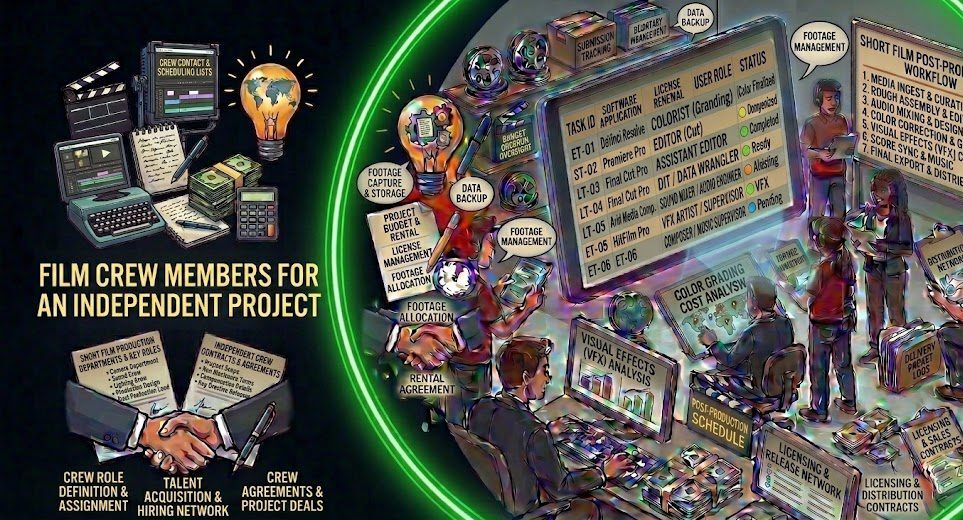
You’ve got your script, your budget sketch, and maybe a shooting location. Now comes the part that separates the projects that get made from the ones that stall before day one: finding reliable film crew members who’ll show up, deliver, and not detonate your schedule in week two. It’s not glamorous. But it’s the work that determines everything.
Quick Answer
To find reliable film crew for an independent project: start with department heads (DoP, AD, sound mixer), verify credits via IMDb and union directories, use platforms like ProductionHUB and Mandy.com for freelancers, and check Vitrina’s directory of 300,000+ verified M&E companies for vetted production service providers.
Below-the-line costs—your crew, your technical talent, your department heads—typically represent 40–60% of an independent film’s budget. That’s not a supporting character in your capital stack. That’s the lead role. Get it wrong and you’re burning cash on delays, reshoots, and relationships you’ll never recover. Get it right and you’ve built the engine that drives your production from pre-production to delivery.
This guide walks you through a 5-step process to find, vet, and lock reliable film crew for your independent project—before a single camera rolls. Whether you’re working with a $200K micro-budget or a $5M indie feature, the process is the same. The stakes just scale with it.
In This Guide
- Why Your BTL Team Defines Your Film’s Fate
- Map Your Crew Needs Before You Search
- Step 1: Build Your Key Department Heads First
- Step 2: Where to Actually Find Vetted Film Crew
- Step 3: Vet Candidates with Real-World Evidence
- Step 4: Navigate Rates and Agreements
- Step 5: Lock Crew Before Production Begins
- How Vitrina Accelerates Your Crew Search
- Red Flags That Cost Independent Producers Everything
- FAQ
Ask VIQI: Who Are the Right Crew Companies for My Project?
VIQI is Vitrina’s AI assistant—trained on 1.6 million titles, 300,000+ companies, and 5 million entertainment professionals. Ask it which production service companies match your genre, budget, and territory.
✓ Included with 200 free credits | ✓ No credit card needed
Why Your BTL Team Defines Your Film’s Fate
Here’s what we’re seeing from producers across the independent film space: the biggest source of production failure isn’t a bad script or a missed tax incentive. It’s the crew. Specifically, it’s hiring crew on relationships alone—without the due diligence to confirm they can actually deliver at your scale, within your timeline, and inside your budget.
Joshua Harris, President & Managing Partner at Peachtree Media Partners, puts it plainly when evaluating projects for financing: the first thing he looks at is the team. Not the script, not the star attachment—the team. Because capable crew signals a capable production, and capable productions protect the capital stack. That same logic applies when you’re the one building the crew.
The real dynamic in independent film is that BTL hires have an outsized effect on ROI. A $300K DP you can’t afford becomes less expensive than a $150K DP who costs you 3 days of reshoots. Margin erosion in indie production is almost always a crew-quality problem disguised as a budget problem.
Map Your Crew Needs Before You Search
Don’t start searching until you’ve mapped the full crew skeleton. Most indie producers start with the department heads and work outward—which is right—but they don’t document their requirements in enough detail to actually vet candidates meaningfully.
What you need to define before any outreach:
- Budget tier — The difference between a micro-budget ($300K or below) and a mid-range indie ($1M–$5M) changes every conversation about rates, deferments, and union vs. non-union status.
- Shooting schedule — Exact dates and shoot days. Crew have commitments. If you’re vague about your window, you’ll lose candidates or get lied to about availability.
- Genre-specific technical needs — Action thrillers need different camera operators than slow-burn dramas. Specify the look you’re going for.
- Location and travel requirements — Shooting on location in Eastern Europe is a different hire profile than a Los Angeles stage shoot.
- Union/guild status — Whether you’re SAG-AFTRA, IATSE, or non-union shapes your hiring pool dramatically. Know this before your first call.
As we cover in our guide to hiring film production crew and professional services, the producers who move fastest through the hiring process are the ones who arrive with a fully articulated crew plan—not a vague wishlist.

Your AI Assistant, Agent, and Analyst for the Business of Entertainment
VIQI AI helps you plan content acquisitions, raise production financing, and find and connect with the right partners worldwide.
- List the top commissioners at the BBC
- List the post-production and VFX decision-makers at Netflix
- List the development leaders at Sony Pictures
- List the scripted programming heads at HBO
- Find active co-producers and financiers for scripted projects
- Find equity and gap financing companies in North America
- Find top film financiers in Europe
- Find production houses that can co-produce or finance unscripted series
- Who is backing animation projects in Europe right now
- Who is Netflix’s top production partners for Sports Docs
- Who is Commissioning factual content in the NORDICS
- Who is acquiring unscripted formats for the North American market
- Show me recent drama projects available for pre-buy
- Show me Japanese Anime Distributors
- Show me true-crime buyers from Asia
- Show me documentary pre-buyers
- I am looking for production partners for a YA drama set in Brazil
- I am looking for producers with proven track record in mid-budget features
- I am looking for Turkish distributors with successful international sales
- I am looking for OTT platforms actively acquiring finished series for the LATAM region
- I am seeking localization companies offer subtitling services in multiple Asian languages
- I am seeking partners in animation production for children's content
- I am seeking USA based post-production companies with sound facilities
- I am seeking VFX partners to composite background images and AI generated content
Step 1: Build Your Key Department Heads First
Your Director of Photography (DP), Production Designer, and 1st AD aren’t just hires—they’re co-architects. Lock these three before anyone else. And do it early. The best DPs in any given production window are booked 8–12 weeks out. If you’re coming to them 3 weeks before your start date, you’re already competing from a disadvantaged position.
Once your HoDs are in place, two things happen. First, they’ll often bring recommendations from their own trusted networks—and crew referrals from department heads are the highest-signal hires you’ll make. Second, your package becomes easier to pitch to talent, financiers, and sales agents. A confirmed DP with recognizable credits changes the conversation entirely.
Don’t underestimate the 1st AD. On an independent project running a lean schedule—18–25 shoot days is typical for micro-budget—your 1st AD is the difference between a production that finishes on time and one that bleeds overtime costs through the final week.
Discover Verified Production Service Companies Worldwide
Trusted by Netflix, Warner Bros, and Paramount. Join 300,000+ companies on Vitrina—the only platform where independent producers find qualified crew, service companies, and production partners in one place.
✓ 200 free credits | ✓ No credit card required | ✓ Full platform access
Step 2: Where to Actually Find Vetted Film Crew
This is where most indie producers waste the most time. The Fragmentation Paradox™ is real in crew hiring—there are over 600,000 production service companies and professionals fragmented across opaque directories, LinkedIn profiles, informal networks, and local guild referrals. That opacity costs you time and de-risks nothing.
Here are the channels that actually work, ranked by signal quality:
Trusted Referrals from Producers You Know
Highest signal. Bar none. A DP who delivered on a $700K thriller two years ago for a producer you trust is worth 20 cold LinkedIn profiles. Build these relationships at festivals, markets, and through production service directories before you need them—not during pre-production when you’re running on adrenaline.
Verified Production Databases
Platforms like Vitrina give you access to verified production service companies—crew service providers, local production houses, post facilities—filterable by territory, capability, and project type. This is how you surface the right options in territories you don’t know well. A producer shooting in Prague for the first time shouldn’t be guessing on local crew from a Facebook group.
Film Commission Directories
Most film commissions maintain curated crew directories for their region. These aren’t comprehensive, but they’re a reliable starting point for local hires—and film commission staff can often tell you informally which names come up repeatedly on shoots in their territory. Use that intelligence.
Union and Guild Rosters
IATSE, BECTU, and their regional equivalents maintain member rosters. If you’re planning a union shoot or working under a modified low-budget agreement, these are non-negotiable starting points. Non-union doesn’t mean lower quality—plenty of highly skilled crew work outside guild structures on indie projects—but guild membership does signal a professional track record.
For more on structuring your production partnerships beyond just crew, see our resource on partnering with production houses for independent projects.
Step 3: Vet Candidates with Real-World Evidence
A strong showreel isn’t a hire. It’s an introduction. The real vetting happens through credits, references, and very specific conversations about their experience on projects that resemble yours in budget, genre, and complexity.
What to actually check:
- IMDb credits with verified productions — Unverifiable credits are a yellow flag. Look for projects with real distribution—festival releases, platform acquisitions, theatrical runs.
- Producer references, not director references — Directors speak to creative alignment. Producers speak to schedule, budget discipline, and professional conduct under pressure. You want both, but start with the producer.
- Budget-scale alignment — Someone whose recent credits are all $20M+ studio co-productions may not adapt easily to the resource constraints of a $500K indie. Ask directly how they’ve worked at your scale before.
- Conflict history — Ask references: “Was there ever a significant disagreement on set, and how did they handle it?” The answer tells you more about professionalism than five glowing endorsements.
Strategic players understand that a 30-minute reference call done properly is worth more than three rounds of interview meetings. Ask specific questions. Get specific answers.
Step 4: Navigate Rates and Agreements
Here’s the thing: rate negotiation on indie projects is its own discipline. You’re often asking experienced professionals to work below their going rate in exchange for a combination of creative opportunity, backend points, deferred fees, or the integrity of the project itself.
That trade-off works—but only when it’s transparent and documented. Ambiguity around deferment structures or backend participation has killed more post-production relationships than almost anything else in independent film. For a broader framework on vendor and crew sourcing across productions, see Vitrina’s guide to entertainment procurement strategy.
As Deadline has documented repeatedly in its independent film coverage, the productions that maintain crew loyalty through a long shoot are ones where compensation conversations happen early, honestly, and in writing.
Practical rate ranges to understand going in:
- Director of Photography: $1,500–$6,000/day depending on experience and budget tier
- 1st AD: $800–$2,500/day
- Production Designer: $1,000–$4,000/day
- Sound Mixer: $750–$2,000/day
- Gaffer / Key Grip: $600–$1,800/day
These ranges shift based on territory. A DP in Budapest works at different rates than a DP in Los Angeles—and that differential is a meaningful lever in your budget. Our analysis of cost vs. quality when hiring creative services covers how to optimize this balance without sacrificing production value.
Step 5: Lock Crew Before Production Begins
A verbal commitment isn’t a locked crew. It’s a polite intention. You need signed deal memos—or at minimum, written confirmations of terms—before you announce your production start date publicly. Why? Because the moment your project gets visibility in the trades or through social channels, you’ll have competing inquiries pulling at your crew’s availability.
Insiders recognize that this is where first-time producers lose the most experienced crew members: they assume a positive conversation equals commitment. It doesn’t. Lock it in writing.
Your locking checklist before principal photography:
- Signed deal memos for all department heads
- Confirmed availability windows with specific start/wrap dates
- Rate agreements in writing including overtime provisions
- Deferment or backend terms documented if applicable
- Kill fees established — protect both parties if the production delays
Find Qualified Production Service Companies in 48 Hours
A Los Angeles producer connected with Netflix UK, Fifth Season, and Fox Entertainment in 48 hours using Vitrina’s Smart Pairing. Join 300,000+ companies already navigating the global entertainment supply chain.
✓ 200 free credits | ✓ No credit card required
How Vitrina Accelerates Your Crew Search
Finding film crew through informal networks and scattered directories is expensive in the one currency you can’t recover: time. The Fragmentation Paradox™ in production services means that the most capable companies—line producers, camera services, grip and lighting providers—aren’t always the most visible ones. They’re buried in local databases, guild lists, and second-degree referrals.
Vitrina‘s platform indexes over 300,000+ companies across the global entertainment supply chain, filterable by service type, territory, project scale, and genre specialization. For an independent producer shooting in a territory you don’t know—or looking for production service partners outside your immediate network—this is the fastest way to surface verified options that match your spec.
The Smart Pairing function takes it further: instead of passive browsing, it actively matches your project profile against companies in the database looking for exactly your type of production. That’s how producers de-risk the discovery process without spending weeks on outreach campaigns that yield three useful responses from fifty emails.
For a deeper look at how to qualify vendors using the platform’s metadata, see our guide to qualifying production vendors with deep metadata.
Red Flags That Cost Independent Producers Everything
You’re going to be pitched. Some of those pitches will be from talented people. Others will be from talented people who have no business running a department on your project. The difference is visible—if you know what to look for.
Watch for these:
- Vague credit descriptions — “Worked on 30+ films” without named, verifiable titles is a flag. Real credits are specific.
- Reluctance to provide producer references — They’ll offer director and cast references but dodge the question when you ask for producers they’ve worked under. That dodge means something.
- Overconfidence on budget constraints — Someone who says “I can make anything work on any budget” hasn’t had the conversation about your actual number yet. Probe it.
- No experience at your scale — A DP whose only credits are commercials and music videos hasn’t necessarily managed a feature narrative arc. Verify the relevant experience specifically.
- Slow communication in pre-production — If they’re unresponsive to prep-phase questions, they’ll be unresponsive on set. Communication rhythm is a direct signal of professionalism.
As Variety‘s coverage of the independent production space consistently highlights, the projects that blow up on set almost always show these warning signs in pre-production. They’re visible. Most producers just move too fast to see them.
Frequently Asked Questions: Finding Reliable Film Crew
Conclusion: Crew Is the Investment, Not the Overhead
Independent film is defined by resource constraints. But the producers who consistently deliver—across budget tiers, across territories, across genres—treat their crew search as a capital allocation decision, not an administrative task. The right DP doesn’t just capture beautiful images. They protect your schedule, your budget, and your ability to finish the project at all.
Start early. Map your needs before you search. Vet against real evidence. Lock in writing. And use every tool available—networks, commissions, platforms, AI—to surface options beyond your immediate field of vision.
Key Takeaways:
- BTL costs represent 40–60% of your indie budget—crew quality directly determines production ROI, not just creative output.
- Lock your DP, 1st AD, and Production Designer 10–14 weeks out—the best candidates are already booked if you come to them 3 weeks before shoot.
- Producer references outperform director references for evaluating BTL hires—ask specifically about budget discipline and conflict resolution.
- Platforms like Vitrina surface verified production service companies globally—the Fragmentation Paradox™ means the most qualified crew aren’t always the most visible ones.
- Verbal commitments aren’t hires—deal memos and written confirmations before your shoot date are non-negotiable.
Start Finding Production Partners Today—Free
Join 300,000+ companies on Vitrina, trusted by Netflix, Warner Bros, and Paramount. Search verified production service companies worldwide, filtered by budget, territory, and specialty.
✓ 200 free credits | ✓ No credit card required | ✓ Cancel anytime
Need Crew Partners for Your Project? We’ll Find Them.
Vitrina Concierge is your Virtual Agent. We make warm introductions directly to production service companies and decision-makers actively seeking your type of project—not a list, but actual connections.
Frequently Asked Questions
Where do independent filmmakers find reliable film crew?
The most effective channels are industry platforms like ProductionHUB, Mandy.com, and Crew United, plus union directories (IATSE, BECTU, DGC) for vetted professionals. Vitrina AI also indexes production service companies across 180+ territories, useful for location shoots that require local crew.
How much does it cost to hire a film crew for an indie project?
For a low-budget independent film (under $1M), expect to pay DoPs $1,500–$5,000 per day, ADs $800–$2,500/day, and sound mixers $600–$2,000/day. Union minimums apply if you sign with SAG-AFTRA or similar guilds. Many indie crews accept deferred payment on passion projects.
What should I check before hiring film crew?
Verify at least three recent production credits (via IMDb Pro or personal references), confirm equipment ownership or rental access, check availability for your full shooting window, review any guild or union affiliations, and ensure they’ve worked on similar budget-level productions before.
How do I hire a film crew in a foreign country?
For international shoots, start with the local film commission to get a vetted vendor list, then verify crew through local professional associations. Vitrina AI provides a directory of 300,000+ M&E companies globally, including local production service companies that can supply or recommend crew.
What is the most important crew hire for an independent film?
The First Assistant Director (1st AD) is arguably the most critical hire — they manage the schedule, set logistics, and crew communication. A strong 1st AD can save a low-budget production from going over schedule more than any other single hire. Lock your 1st AD before any other BTL position.