About Innovation Hub
 Global Content Pulse (Webinars)


 Global Production Financing
(Webinars)
Global Production Financing
(Webinars)  LeaderSpeak Podcast
  Global Entertainment Digest (Newsletter)
  About Vitrina
 About VIQI
 Our Story
 Our Solutions 🔥
 Film+TV Projects Tracker 🚀
 Case Studies
 Our Profile
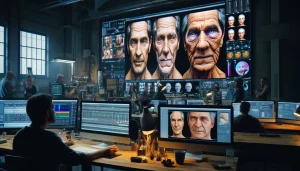
Your lead actor has a 30-year arc. Your director wants seamless transitions between 25 and 55—on screen, in the same scene. You’re evaluating aging and de-aging VFX studios, and you already know the difference between a showreel that dazzles in a pitch and a team that can actually deliver on a $150M feature under a hard delivery date. The wrong call here doesn’t just blow the budget. It lands your film in trades for the wrong reasons.
Studios like Industrial Light & Magic (ILM), DNEG, and Framestore have raised the bar on what’s technically achievable. But here’s the thing—those names don’t automatically mean they’re the right fit for your production’s budget structure, timeline, or creative vision. And with AI-assisted de-aging pipelines reshaping turnaround windows across the board, the market’s moving fast.
This guide gives you the 7 criteria that actually separate capable studios from expensive disappointments—before you’re six weeks from delivery and out of options.
Table of Contents
Ask VIQI: Which Aging VFX Studios Are Active on Projects Like Yours Right Now?
VIQI is Vitrina’s AI assistant—trained on 1.6 million titles, 360,000 companies, and 5 million entertainment professionals. Ask it which studios have current capacity, what budgets they typically service, and which are attached to productions similar to yours.
✓ Included with 200 free credits | ✓ No credit card needed
What Makes Aging and De-Aging VFX So Technically Demanding?
Most VFX specialisms are about adding things to a frame. Aging and de-aging are about transforming something the audience already knows—a familiar face—in a way that holds up under close scrutiny at 4K, in skin pores, in the natural micro-movement of a blink.
The uncanny valley isn’t just a theoretical problem here. It’s a commercial one. When a studio gets this wrong, you don’t just lose critical marks—you generate the kind of social media noise that shapes opening weekend. Ask anyone who worked on certain high-profile Marvel releases.
What’s actually happening technically? De-aging typically involves a combination of reference scan data (often from archive footage or 3D facial scans of the actor at a younger age), machine learning models trained on the specific actor’s facial geometry, and frame-by-frame compositing that tracks through performance. Aging forward—adding wrinkles, texture changes, jowling—tends to be somewhat more predictable but still demands a studio with serious digital makeup VFX chops layered on top of solid compositing.
And unlike most VFX categories, you can’t just buy more compute to solve your problems. The artistry—and the ability to iterate with a demanding director—matters just as much as the pipeline.
For projects requiring parallel character work, you’ll often need these capabilities integrated with digital doubles VFX studios—especially where a character needs to perform stunts the actor can’t physically execute at either age.

Your AI Assistant, Agent, and Analyst for the Business of Entertainment
VIQI AI helps you plan content acquisitions, raise production financing, and find and connect with the right partners worldwide.
- Find active co-producers and financiers for scripted projects
- Find equity and gap financing companies in North America
- Find top film financiers in Europe
- Find production houses that can co-produce or finance unscripted series
- I am looking for production partners for a YA drama set in Brazil
- I am looking for producers with proven track record in mid-budget features
- I am looking for Turkish distributors with successful international sales
- I am looking for OTT platforms actively acquiring finished series for the LATAM region
- I am seeking localization companies offer subtitling services in multiple Asian languages
- I am seeking partners in animation production for children's content
- I am seeking USA based post-production companies with sound facilities
- I am seeking VFX partners to composite background images and AI generated content
- Show me recent drama projects available for pre-buy
- Show me Japanese Anime Distributors
- Show me true-crime buyers from Asia
- Show me documentary pre-buyers
- List the top commissioners at the BBC
- List the post-production and VFX decision-makers at Netflix
- List the development leaders at Sony Pictures
- List the scripted programming heads at HBO
- Who is backing animation projects in Europe right now
- Who is Netflix’s top production partners for Sports Docs
- Who is Commissioning factual content in the NORDICS
- Who is acquiring unscripted formats for the North American market
The 7 Criteria That Actually Matter When Evaluating Studios
Let’s get into it. These aren’t hypotheticals—they’re the filters that production teams who’ve navigated this process use to separate capable studios from expensive risks.
1. Proven Actor-Specific Reference Work
Ask for examples where the studio worked on a named, recognizable actor—not just a generic de-aging showreel on an unknown face. The technical bar shifts dramatically when audiences already have years of pattern recognition built around that person’s face. ILM’s work on The Irishman (3 lead actors, over 300 de-aged shots) and DNEG’s contributions on franchise features set the benchmark. But boutique studios with 20–50 specialist staff have done equally credible work for a fraction of the cost—if you know where to look.
2. Shot Volume Capacity vs. Your Timeline
Don’t conflate “they’ve done great de-aging work” with “they can do your volume of shots on your timeline.” A studio with outstanding craft but a current capacity of 15 shots per week can’t deliver your 180-shot sequence in 8 weeks—no matter how talented they are. Get hard numbers on concurrent project commitments before you’re in their pipeline.
3. AI Integration vs. Traditional Frame-by-Frame Pipeline
This is where studios are diverging fast in 2025–2026. Some are running predominantly AI-assisted pipelines where machine learning handles the heavy lifting on skin texture synthesis and facial track refinement. Others still rely on traditional rotoscoping, compositing, and digital makeup layers. Neither is automatically superior—but the choice dramatically affects turnaround speed, revision flexibility, and how well the result holds up under different lighting conditions and focal lengths in your cut.
4. On-Set VFX Supervision Capability
This one’s consistently undervalued until it’s too late. If the aging VFX studio doesn’t have—or can’t collaborate with—a strong on-set VFX supervisor, your data capture during production will be incomplete. That means painful reconstruction work in post. Lighting reference, facial tracking markers, witness cameras—these aren’t nice-to-haves on a character-transformation project. They’re essential infrastructure.
5. Director Iteration Workflow
Creative directors often can’t articulate what’s wrong with a de-aged face—they just know when it looks “off.” Find out how the studio structures its review-and-revision loops. How many rounds are included before additional costs kick in? What does their client-facing review tool look like? Can you do side-by-side comparisons of age states in the same interface? Studios that treat revisions as a cash cow on this kind of work will destroy your contingency budget fast.
6. Reference Material Requirements and What Happens If You Don’t Have Them
For de-aging specifically, reference material from the target age period is gold. Archive footage, photographs, earlier film work. But what if you’re de-aging to an age where that material simply doesn’t exist? Ask explicitly how the studio handles constructed reference—whether they use photogrammetry and artistic reconstruction versus a purely algorithmic approach. The answer tells you a lot about their methodology.
7. Price Per Shot Transparency and What’s Actually Included
Quote structures on aging/de-aging VFX can be notoriously opaque. Some studios quote per shot with a fixed complexity tier—straightforward profile shot, complex 3/4 turn with hair interaction. Others quote per day of artist time. Make sure you’re comparing apples to apples. And nail down exactly what’s included in a “complete shot”—finishing and grain matching alone can be a significant additional cost if it’s scoped separately.
Find Aging VFX Studios Before Your Competitors Do
Trusted by Netflix, Warner Bros, and Paramount. Join 140,000+ companies tracking the global entertainment supply chain on Vitrina—filter VFX studios by specialty, territory, current project load, and platform relationships.
✓ 200 free credits | ✓ No credit card required | ✓ Full platform access
Why Showreel Doesn’t Tell the Whole Story
Every studio that’s done any credible aging or de-aging work has one hero shot they’ll lead with. That shot might have taken 14 months, 8 iterations, and a director who was physically on-site for 3 weeks of reviews. That process doesn’t scale to your production—and the showreel won’t tell you that.
What you actually want are reference projects with comparable parameters to yours: similar shot count, similar facial complexity, comparable timeline, comparable budget tier. Ask for them specifically. A studio that hesitates or deflects to their best single shot is a studio you should probe further.
As Variety noted in its 2025 VFX industry analysis, the gap between top-tier studio output and boutique studio output has narrowed significantly due to AI-assisted tooling—but production teams often don’t know it because they’re evaluating on showreel alone rather than on process and throughput. That’s a market intelligence gap you can actually weaponize if you’re sourcing broadly enough.
Joseph Bell (VFX Industry Veteran, formerly Industrial Light & Magic) discusses what separates great VFX studios from the rest—and how the landscape is shifting with AI-driven tools:

The Technology Stack: AI vs. Traditional Pipeline Approaches
Here’s where the industry is genuinely bifurcating—and your choice matters more than most producers realize.
AI-accelerated pipelines use deep learning models—often trained specifically on your actor’s facial data—to automate large portions of the skin synthesis, wrinkle redistribution, and facial muscle simulation that used to be entirely artist-driven. Studios like MARZ (Monsters, Aliens, Robots, Zombies) have built proprietary tools here. Matt Panousis, Co-Founder and COO of MARZ, has spoken publicly about how their VFX-to-AI pivot fundamentally changed what’s achievable in shorter windows. You’re looking at potential time reductions of 30–50% on core shot throughput compared to purely traditional approaches.
But. AI pipelines have real failure modes. They can struggle with extreme angles, unusual lighting setups, and faces with highly distinctive features—precisely the kind of talent you’re often casting. And the “fix it in review” problem gets compounded when a model is confidently generating wrong results at scale. Traditional artist-driven pipelines give you more granular control per shot, but that comes with timeline and cost implications.
The smartest studios are running hybrid approaches—AI for the throughput-heavy, consistent shots; traditional craft for the hero close-ups and emotionally critical frames. Ask any studio you’re evaluating specifically which shots they’d handle with which methodology. That answer separates the technically sophisticated from the marketing-polished.
You’ll also want to cross-reference which studios are equipped with both aging capabilities and strong digital makeup VFX expertise—the two disciplines overlap significantly on practical character transformation work.
Budget Realities: What Aging and De-Aging VFX Actually Costs
Let’s be direct about numbers, because the range here is enormous and that spread creates budgeting problems.
On a major studio feature, a single fully realized de-aged close-up shot from a tier-1 VFX house can run anywhere from $15,000 to $40,000—depending on complexity, revision rounds, and whether full hair and body interaction is required. Multiply that across 200 shots and you’re looking at a line item that can rival entire production departments on a mid-budget feature.
Boutique studios with AI-accelerated pipelines are changing this math. Credible work—for sequences with less extreme technical demands—is being delivered in the $5,000 to $15,000 per shot range by studios with 15–40 specialist staff who’ve invested in proprietary tooling. That’s a real ROI consideration if you’re structuring your capital stack carefully.
Tax incentives add another dimension to this. According to Screen International, VFX-specific incentives in markets like the UK (up to 34% on qualifying VFX spend under the revised AVEC program), Australia (30% PDV offset), and Canada make the effective cost of commissioning from specialist studios in those markets materially different from headline quotes. A $25,000 per shot quote from a UK studio with AVEC eligibility can land closer to $16,500 effective cost after recoupment—which is a number worth running before you assume a UK studio is out of your budget.
For producers navigating AI-enabled VFX options more broadly, our guide to the best AI-enabled VFX studios maps which facilities are actually running mature AI pipelines versus those who use it as a marketing term.
Track 400,000+ Projects—Know Which VFX Studios Are Actively Engaged
Netflix, Warner Bros, Paramount, and Google TV use Vitrina to track the global entertainment supply chain. You can filter 400,000+ projects and 140,000+ companies to see which aging VFX studios are on active productions—and which have current capacity.
✓ 200 free credits | ✓ No credit card required | ✓ Cancel anytime
How to Vet Aging VFX Studio Capabilities on Vitrina
Vitrina’s platform indexes over 140,000 entertainment companies—including VFX studios categorized by specialist capability. You can filter specifically for studios with aging and de-aging credits, see what projects they’re currently attached to, and identify decision-maker contacts before you send your first outreach.
Here’s how sophisticated production teams are using it: rather than waiting for shortlists from reps (which tend to reflect relationships more than fit), they’re running their own searches filtered by budget tier, territory, recent project type, and platform relationships. If a studio has recent credits on Netflix or Amazon Prime Video productions with similar transformation work, that tells you something about their technical bar and their ability to meet platform delivery requirements—which are substantially more demanding than theatrical alone.
VIQI, Vitrina’s AI assistant, can compress the research phase significantly. Ask it which studios have aging VFX credits on features similar to yours, and it’ll surface relevant results faster than manual trawling through credits databases. That’s not just time saved—it’s information asymmetry you can act on before it reaches the trades.
For a broader view of how to identify the right technical partners across the full VFX landscape, see our guide to finding top visual effects companies for your project.
Red Flags to Watch Before You Sign the Contract
A few things should give you immediate pause when evaluating studios for aging and de-aging VFX:
- They can’t name the lead artist on your project upfront. De-aging quality is highly dependent on senior artist talent. If they’re vague about who’d actually be doing your work, the showreel might not represent your outcome.
- Their revision policy is verbal, not contracted. Get revision rounds, response time commitments, and overage pricing explicitly in writing before the first frame is touched.
- They’ve never done a character with a dedicated audience. De-aging a public figure or beloved franchise character is categorically different from transforming an unknown face. Don’t let them learn on your project.
- No clear on-set consultation process. If they’re not asking about your shooting format, lighting rig, and reference capture plan before production, they’re planning to work harder (and bill more) in post.
- Their quote doesn’t specify what “complete” means. Confirm whether grain matching, color grade integration, and final composite delivery are included—or if those are separate billing categories.
But honestly? The biggest red flag is speed. A studio that’s over-eager to close before they’ve asked the right questions about your production is a studio that’s pricing for their workflow—not yours. The right aging VFX partner will push back on your brief, ask uncomfortable questions about your reference material, and tell you early if your timeline is unrealistic. That friction in the shortlisting phase is exactly what you want.
Frequently Asked Questions
What is the difference between aging VFX and de-aging VFX?
Aging VFX involves digitally adding age markers to an actor’s appearance—wrinkles, skin texture changes, hair thinning, and facial structure shifts that make a younger performer appear older. De-aging VFX is the reverse: smoothing skin, redistributing facial volume, and altering features to make an older actor appear younger. Both require deep expertise in digital makeup compositing, facial tracking, and photorealistic skin synthesis. De-aging is generally considered the more technically challenging of the two, particularly when working with well-known actors whose younger appearance is embedded in audience memory from earlier films or archival footage.
How much does de-aging VFX cost per shot?
Cost varies significantly based on complexity, studio tier, and pipeline approach. Tier-1 studios (ILM, DNEG, Framestore) typically charge $15,000–$40,000 per fully finished shot for complex facial de-aging. Boutique studios with AI-assisted pipelines are increasingly delivering credible results in the $5,000–$15,000 range. VFX tax incentives in the UK (AVEC), Australia (PDV offset), and Canada can reduce effective costs by 25–34% on qualifying spend, making international studios competitive even after currency considerations.
How do I evaluate an aging VFX studio’s capabilities before hiring them?
Go beyond the showreel. Request reference projects with comparable parameters to yours—similar shot count, timeline, and subject. Ask specifically about the revision policy, who the lead artist on your project would be, what reference material they need, and how they handle AI vs. traditional methodology across different shot types. Use platforms like Vitrina to cross-reference current project attachments and see what productions they’ve recently completed for comparable budget tiers and platform clients.
Which studios specialize in aging and de-aging VFX?
The most recognized names for high-complexity de-aging include Industrial Light & Magic (ILM), DNEG, Framestore, and Lola VFX—the latter having built a specific specialism in facial transformation work. MARZ has pioneered AI-assisted approaches for faster throughput. Beyond the large houses, a number of boutique studios globally have developed strong aging VFX capabilities, particularly in the UK, Canada, Australia, and India, where VFX tax incentives make them competitive on mid-budget features. Vitrina indexes 140,000+ companies including specialist VFX studios categorized by capability—search by aging/de-aging specialism to build a longlist appropriate to your budget.
What reference material does an aging VFX studio need?
For de-aging, the gold standard is archival footage or photographs of the actor at the target age—even raw home video can be useful for facial geometry reference. High-resolution 3D facial scans of the actor at their current age are also essential. Some studios supplement this with photogrammetry, especially for actors being de-aged to periods where no archive exists. On-set data capture—witness cameras, lighting reference balls, tracking markers—is equally critical and needs to be coordinated before shooting begins, not retrofitted in post.
How long does aging VFX take per shot?
Turnaround time depends heavily on complexity, pipeline approach, and revision cycles. A straightforward profile or mid-shot de-aging might take 1–3 weeks per shot in a traditional artist-driven pipeline. Complex close-ups with hair interaction and extreme age transformation can run 4–8 weeks. AI-assisted pipelines have compressed throughput significantly—some studios report 30–50% faster turnaround on standard shots versus traditional methods. But hero shots for key scenes will always require significant artist time regardless of AI involvement.
Can aging VFX work be done remotely or does it require the studio to be near production?
Post-production aging VFX work is largely remote—studios in the UK, Canada, India, and Australia regularly deliver for productions shooting in other territories. The critical phase that benefits from proximity is on-set VFX supervision during principal photography, where data capture needs to happen in real time. Some studios manage this by embedding a local on-set supervisor while the main team works remotely. The key is establishing clear communication protocols and a robust review pipeline before your shoot begins—regardless of geography.
What’s the difference between aging VFX and prosthetic makeup?
Prosthetic makeup and aging VFX are increasingly complementary rather than competitive. Prosthetics deliver physical transformation that reads authentically in wide shots and under practical lighting—but can restrict performance and add hours to makeup calls. Digital aging VFX handles close-ups, extreme angles, and subtle transitions more cleanly, with full flexibility in post. Most major productions with significant age arcs now use a hybrid approach: practical prosthetics for wider shots and background plates, digital aging VFX for close-ups and emotionally critical scenes where the performer’s full range needs to come through.
Conclusion: The Right Aging VFX Partner Starts With the Right Research
Choosing the right aging and de-aging VFX studio isn’t a box to check—it’s a strategic production decision that affects your schedule, your budget, your director’s creative latitude, and ultimately your film’s reception. And the studios that do this work best aren’t always the ones with the biggest marketing presence.
Key Takeaways:
- 7 criteria matter most: Proven actor-specific work, shot capacity vs. your timeline, AI vs. traditional pipeline, on-set supervision, director iteration workflow, reference material strategy, and transparent pricing.
- Showreel is a starting point, not an evaluation: Ask for reference projects with comparable parameters—shot count, timeline, budget tier—rather than hero clips.
- Cost range is enormous: $5,000–$40,000 per shot depending on complexity and studio tier; VFX tax incentives in UK, Australia, and Canada can reduce effective cost by 25–34%.
- AI-assisted pipelines are real: Studios like MARZ have demonstrated 30–50% throughput improvements on standard shots—but hybrid approaches (AI for volume shots, traditional craft for hero close-ups) remain the industry standard for quality-critical work.
- Vitrina accelerates the shortlisting: Filter 140,000+ companies by VFX specialty and see current project attachments—so you know who has capacity before you’re negotiating under deadline pressure.
The studios that deliver on aging and de-aging VFX consistently—not just once, on the right project—are the ones asking you hard questions before the contract is signed. Find them before your competitors do. Your production’s timeline, and your opening weekend, may depend on it.
Find Your Aging VFX Studio—Before It’s Too Late to Be Selective
Trusted by Netflix, Warner Bros, Paramount, and Google TV. Track 400,000+ projects. Access 3 million verified executives. Ask VIQI which aging VFX studios are active on productions like yours—right now.
✓ 200 free credits | ✓ No credit card required | ✓ Cancel anytime
Find Film+TV Projects, Partners, and Deals – Fast.
VIQI matches you with the right financiers, producers, streamers, and buyers – globally.
Producers Seeking Financing & Partnerships?
Book Your Free Concierge Outreach Consultation
(To know more about Vitrina Concierge Outreach Solutions click here)
Join Industry Briefings Trusted by Leaders
The Mid-Budget Comeback: Why Mid-Budget Films Is the Smartest Bet in the Room
Mid-budget films are attracting new capital. See why this segment is becoming one of the strongest bets in Film today.
Franchise Fatigue vs. IP Dependency: What Studios Should Be Betting On Now
s franchise performance softens, where will the next generation of valuable IP come from? Join the briefing.

Unscripted Is Eating the World: The Multi-Billion Reality and Format Boom
Unscripted is the new prestige — inside the $19.8B global format boom reshaping how streaming platforms compete.

How Co-Productions and Regional IP Are Reshaping Global Drama
As global drama evolves, which stories travel, which stay local, and how are they getting financed?