IHUB
IHUB
 Private Briefings (Webinars)


 LeaderSpeak Podcast
  Global Entertainment Digest (Newsletter)
  Premium Lists
 Membership Benefits
 About Vitrina
 Our Story
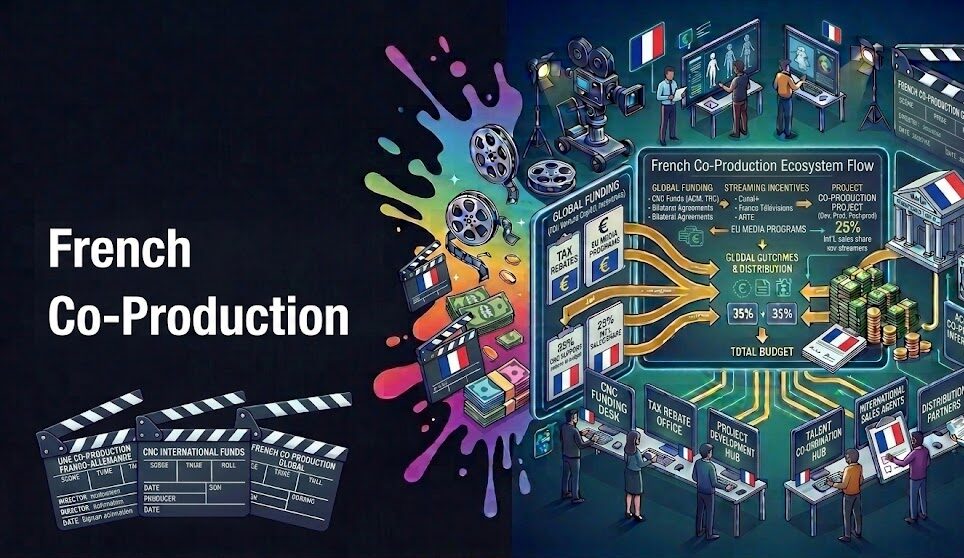
If you’re financing a film or TV project internationally and you haven’t seriously mapped a French co-production strategy yet, you’re almost certainly leaving money in the room. France operates the most extensive bilateral treaty network on the planet—61 official co-production agreements, more than any other country. Every one of those treaties is a potential funding lever. And most international producers are only pulling one or two of them.
Here’s what makes European content funds different from other regional incentive structures: they’re not just tax rebates. They’re an interlocking system—national film funds, multilateral European bodies, broadcaster pre-buy obligations, and bilateral treaty frameworks—that, when structured correctly, can cover a genuinely substantial portion of your production budget with soft money before you’ve touched a single dollar of equity or gap financing.
But “structured correctly” is doing a lot of work in that sentence. The complexity is real. France’s Centre national du cinéma et de l’image animée (CNC) administers a sophisticated funding ecosystem with eligibility rules that trip up even experienced producers. Eurimages, the Council of Europe’s multilateral film fund, has its own application logic. And finding the right French production partner—one whose creative profile, financial capacity, and network actually serve your project—is where most international producers hit the Fragmentation Paradox head-on.
This is the guide that maps all of it: what’s available, what it costs to access, and how to build a capital stack that makes European co-production genuinely worth your time in 2026.
Table of Contents
- Why France Is the Gateway Into European Content Financing
- France’s 30% Cash Rebate—and When It Becomes 40%
- The CNC: How France’s Film Body Structures Co-Production
- Eurimages and the European Multilateral Framework
- How the Capital Stack Works in a French Co-Production
- The Fragmentation Paradox in French Co-Producer Matching
- Creative Europe MEDIA—What It Actually Funds
- Beyond France: Germany, Italy, UK and the Stacking Opportunity
- The Application Timeline Most Producers Get Wrong
- FAQ
- Conclusion
Map Your European Co-Production Options Before the Financing Window Closes
Netflix, Warner Bros, and Paramount use Vitrina to track 300,000+ companies across the global entertainment supply chain. Ask VIQI—our AI research engine—to surface verified French and European co-production partners for your project right now.
✔ Free to explore | ✔ No credit card needed | ✔ Real-time partner intelligence
Why France Is the Gateway Into European Content Financing
France didn’t accidentally become the center of gravity for European co-production. It was built that way—through decades of deliberate policy, a sophisticated national funding body, and a cultural commitment to cinema that’s constitutionally embedded in the country’s identity. And the numbers reflect it: Belgium, which participates extensively in French co-productions, sees 72% of its films structured as co-productions. The French system is so well-developed that neighboring countries’ industries have essentially grown around it.
But the real structural advantage for international producers isn’t cultural—it’s financial. A successful French co-production gives your project national film status in France, which unlocks the CNC funding ecosystem, broadcaster pre-buy obligations, access to Eurimages, and the ability to layer France’s cash rebate onto financing from your home territory simultaneously. That’s not one incentive. That’s a stack.
And France’s treaty network is genuinely global. 61 bilateral agreements means France has treaties with territories across North America, South America, Sub-Saharan Africa, the MENA region, and APAC—not just with its European neighbors. If your project has any international element, there’s almost certainly a French co-production structure that applies. The question is whether you know where to find the right partner and how to structure the deal before your financing window closes.
For a deeper map of how European film production companies are positioning themselves for international partnerships in 2026, our analysis of European film production companies and global co-production is worth reading before you approach the French market.
France’s 30% Cash Rebate—and When It Becomes 40%
France’s International Production Tax Rebate is a 30% cash rebate on qualifying French expenditure—one of the most straightforward and competitive incentive programs in Western Europe. It’s not a transferable tax credit (which requires a secondary market) and it’s not a points-based cultural test system (which can become a bureaucratic minefield). It’s a clean cash-back mechanism on what you actually spend in France.
But here’s what most producers don’t structure for from the start: that rate climbs to 40% if French VFX expenditure exceeds €2 million. For any project with meaningful visual effects work—which increasingly means most genre content, animation, and premium drama—this is a material difference. A €5M French VFX spend at 40% returns €2M into your capital stack. At 30%, it’s €1.5M. That’s €500K that belongs in your recoupment waterfall, not your margin leakage column.
The key qualification: you must engage a French production services company as the local partner. That company handles the qualifying spend, maintains the French production infrastructure requirements, and is the entity through which the rebate flows. This isn’t a paper exercise—it requires a real operational relationship with a legitimate French production entity, which is exactly why partner selection matters so much before you start structuring.
One more thing worth noting: despite significant French government budget pressure in 2025, film subsidies were specifically protected from the cuts. That’s not accidental—France’s political establishment treats its film industry as a strategic cultural and economic asset. The policy stability is real, and it matters for your multi-year financing models.
“Nowadays, looking at co-production opportunities—especially in those territories where you can maximize some of the local incentives, some of the tax credits, or local subsidies or local pre-sales—has become crucially more important. Especially here in Europe, there is a great system of co-productions.
— Andrea Scarso, Managing Partner, IPR VC (Vitrina LeaderSpeak Ep. 70)
The CNC: How France’s Film Body Structures Co-Production
The CNC (Centre national du cinéma et de l’image animée) is France’s competent authority for co-production approvals and the administrator of the country’s primary film funding mechanisms. If you’re structuring a French co-production, everything routes through the CNC—treaty certification, rebate applications, selective aid decisions. Understanding how it actually operates is non-negotiable.
France’s cultural eligibility uses a dual-scale framework: a project must be European enough and French enough simultaneously. Treaty partners automatically count toward the European qualification, which is one reason the treaty network matters so much. But the “French enough” dimension requires genuine creative contribution from French nationals—director, screenwriter, lead cast, or a combination depending on the project’s profile. This isn’t a checkbox exercise you can engineer around; the CNC is experienced at identifying projects that are structurally compliant but creatively hollow.
The CNC also administers selective aid (aide sélective)—discretionary funding for projects with distinctive artistic merit—and automatic aid (aide automatique), which is triggered by prior qualifying production in France. The automatic aid system is particularly interesting for producers building a long-term European strategy, because each qualifying production generates credits toward future projects. It rewards sustained engagement with the French market rather than one-off transactional relationships.
And there’s a practical timeline reality you must build into your schedule: CNC applications for co-production certification need to be submitted at least 4 weeks before principal photography—and in practice, earlier consultation is strongly recommended. The CNC won’t certify a project post-hoc. If you miss the window, you don’t get the benefits. This isn’t a flexible guideline; it’s a hard gate. Our dedicated guide to the CNC’s benefits and eligibility criteria covers the application mechanics in detail.

Your AI Assistant, Agent, and Analyst for the Business of Entertainment
VIQI AI helps you plan content acquisitions, raise production financing, and find and connect with the right partners worldwide.
- List the top commissioners at the BBC
- List the post-production and VFX decision-makers at Netflix
- List the development leaders at Sony Pictures
- List the scripted programming heads at HBO
- Find active co-producers and financiers for scripted projects
- Find equity and gap financing companies in North America
- Find top film financiers in Europe
- Find production houses that can co-produce or finance unscripted series
- Who is backing animation projects in Europe right now
- Who is Netflix’s top production partners for Sports Docs
- Who is Commissioning factual content in the NORDICS
- Who is acquiring unscripted formats for the North American market
- Show me recent drama projects available for pre-buy
- Show me Japanese Anime Distributors
- Show me true-crime buyers from Asia
- Show me documentary pre-buyers
- I am looking for production partners for a YA drama set in Brazil
- I am looking for producers with proven track record in mid-budget features
- I am looking for Turkish distributors with successful international sales
- I am looking for OTT platforms actively acquiring finished series for the LATAM region
- I am seeking localization companies offer subtitling services in multiple Asian languages
- I am seeking partners in animation production for children's content
- I am seeking USA based post-production companies with sound facilities
- I am seeking VFX partners to composite background images and AI generated content
Eurimages and the European Multilateral Framework
Eurimages is the Council of Europe’s multilateral film support fund—and it’s the mechanism that transforms a bilateral French co-production into a genuinely pan-European financing structure. 43 European countries participate in the European Convention on Co-production framework that Eurimages operates within, creating a multilateral ecosystem that revised its rules in 2018 to make access more flexible for smaller production companies and non-European partners.
The 2018 revision matters practically. Under the old framework, multilateral co-productions required a minimum 10% contribution from each co-producing country. The revised convention dropped that floor to 5%—which meaningfully opens the door for smaller production entities and allows more flexible financial structures. Maximum contribution limits also expanded, from 70% to 80%, giving lead producers more latitude in how they architect the capital stack.
But Eurimages isn’t just about lower minimums. It’s about strategic fund stacking. A French-German-Italian trilateral structure, for example, can access Eurimages support alongside France’s CNC funding, Germany’s DFFF/GMPF grants, and Italy’s transferable tax credit simultaneously. Each layer individually is meaningful. Stacked correctly, they can represent 40–55% of a mid-budget European feature’s total financing in soft money—before you’ve touched pre-sales, gap, or equity. For producers who’ve been relying on a single national fund plus a broadcaster pre-buy, this is a fundamentally different financial architecture.
For current Eurimages co-production support caps and eligibility requirements, our dedicated breakdown of Eurimages co-production support, eligibility, and 2025 caps has the current program details.
Phil Hunt (Founder & CEO, Head Gear Films) — who has financed over 550 films across European and international markets — breaks down exactly how the current independent film financing landscape has changed, and why co-production structuring has become more critical than ever:
How the Capital Stack Works in a French Co-Production
Here’s where producers consistently stumble—not on the eligibility criteria, but on the sequencing. A French co-production capital stack doesn’t get built the same way a straightforward US independent financing gets built. The funding mechanisms have interdependencies that require a specific construction order.
A working model for a mid-budget French co-production with an international partner might look like this: CNC selective or automatic aid anchors the French soft money layer (typically 10–20% of budget depending on project profile). France’s 30–40% cash rebate sits on top of that, applicable to qualifying French expenditure. Eurimages contributes a multilateral top-up if a third country is structurally involved. Then broadcaster pre-buys from France Télévisions or Canal+ (which carry mandatory French content investment obligations) can add a further pre-sale tranche.
What’s left—usually 25–40% of total budget—gets covered through a combination of the international co-producer’s national incentives, equity, and potentially gap financing against unsold territories. As Andrea Scarso, Managing Partner at IPR VC, explained in a recent Vitrina LeaderSpeak episode: the key is having your co-production structure in place from the moment you start thinking about packaging—not retrofitting it once other financing has already been committed. IPR VC, which navigates exactly this territory from offices in London, Helsinki, and Paris, has seen firsthand how producers who build European co-production logic into their project from greenlight consistently outperform those who treat it as a supplementary option.
In the recoupment waterfall, soft money from national funds typically recoup ahead of equity—which improves the risk profile for your equity investors and potentially reduces the cost of that capital. It’s a genuine EBITDA protection mechanism, not just a financing convenience. Our breakdown of the film capital stack and recoupment waterfall covers how each layer interacts in practice.
Find Verified French Co-Production Partners Before Your Deal Window Closes
Trusted by Netflix, Warner Bros, and Paramount. Join 300,000+ companies using Vitrina to discover and vet production partners across France and Europe—with real-time project tracking and verified capability data.
✔ 200 free credits | ✔ No credit card required | ✔ 159,223 projects tracked
The Fragmentation Paradox in French Co-Producer Matching
Let’s be direct about the problem that sits behind every conversation about French co-production: most international producers know 2 or 3 French production companies. They know them because they met at Cannes, or because a sales agent made an introduction, or because they saw a credit on a project they admired. Meanwhile, France has 500+ active production companies—and the one that’s the right fit for your specific project, budget tier, genre, and creative profile is almost certainly not in your existing network.
This is the Fragmentation Paradox at work. The market is massive and opaque. Information asymmetry doesn’t just cost you time—it costs you margin. Producers who settle for a suboptimal French co-producer because it’s the relationship they have access to routinely close deals at 15–20% below optimal value: worse CNC aid positioning, weaker broadcaster relationships, and limited Eurimages application experience. The gap between the right partner and the convenient partner is measurable in euros.
And there’s a timing dimension to this that’s genuinely dangerous. The CNC application window—4 weeks before principal photography minimum—means you don’t have 6 months to explore your options once the project is moving. You need to have already identified, evaluated, and legally partnered with your French co-producer before your shooting schedule is finalized. That’s a radically compressed window for due diligence in an opaque market.
It’s why Vitrina’s platform—which maps 300,000+ active companies globally, including France’s full production landscape with verified credits and deal history—compresses what used to be a 6-month partner search into days. You’re not limited to who you’ve met at festivals. You’re querying the actual market.
Creative Europe MEDIA—What It Actually Funds
Creative Europe’s MEDIA programme is the EU’s primary audiovisual funding mechanism, operating alongside (not instead of) national film fund systems like the CNC and Eurimages. It’s not a production financing fund in the conventional sense—and producers who approach it as one usually walk away frustrated. But for what it actually does, it’s genuinely useful.
MEDIA funds development, distribution, promotion, and training—the parts of the production lifecycle that national funds often underprioritize. Its development grants for fiction features, documentary, and animation can provide up to €30,000 for single projects and higher for slate applications from qualified companies. Development money that arrives before you’ve committed to a production structure is some of the most valuable capital in your pipeline—because it preserves optionality while reducing your own cash exposure at the riskiest stage.
MEDIA’s distribution support—specifically its Selective Distribution scheme and Automatic Distribution guarantee—funds the theatrical release of European films in non-domestic markets. For a French co-production with international distribution ambitions, this is a meaningful distribution de-risking mechanism that improves your sales estimates and therefore your capacity to secure gap financing against those unsold territories.
The eligibility requirement: your production company must be established in a Creative Europe participating country and have demonstrated audiovisual production activity. French production entities qualify automatically. For your non-European co-producer, the relevant access point is typically through the French partner—which is another reason that partner’s institutional experience with EU-level funding matters significantly to your overall financing architecture.
Beyond France: Germany, Italy, UK, and the Stacking Opportunity
France isn’t the only European co-production lever worth understanding. The real strategic opportunity—what Vitrina would characterize as weaponizing your distribution structure across multiple Sovereign Content Hubs simultaneously—is stacking incentives across two or three European territories in a single financing structure.
Germany increased its DFFF and GMPF rebate from 25% to 30% in 2024 and extended both programs through 2025 and beyond. The diversity requirement that previously complicated eligibility was removed from German film law. For a project already structured with a French co-producer, adding a German production services element through a German co-producer can layer 30% German rebate onto qualifying German expenditure alongside the French 30–40% rebate on French spend.
Italy offers a 30–40% transferable tax credit that can be monetized through Italian banks—which means you can access the cash value of the credit during production rather than waiting for post-completion payment. And Italy and France operate a bilateral joint fund worth €1 million annually for projects qualifying under both countries’ criteria. That’s a dedicated soft money layer for France-Italy co-productions that most non-European producers have never heard of.
The UK sits at 25% base (rising to 29.25% for VFX work as of April 2025), with the cap on qualifying VFX expenditures removed for UK work. Post-Brexit, the UK maintained its bilateral treaty with France through the BFI, so UK-France co-productions remain fully viable. For projects with significant VFX elements split across UK and French facilities, the combined incentive capture can be substantial. As reported by Screen International, UK-European co-production volumes have stabilized in the post-Brexit period as producers adapted to the new bilateral framework.
The key strategic insight: a France-Germany-UK trilateral structure, structured through the European Convention’s multilateral framework, can generate three simultaneous rebate/credit positions across qualifying expenditure in each territory—all while accessing Eurimages as a multilateral top-up. That’s a genuinely different financial architecture than any single-territory production structure can achieve. Our guide to the future of film and TV financing explores how these multi-territory structures are reshaping the independent production landscape.
The Application Timeline Most Producers Get Wrong
Phil Hunt, Founder and CEO of Head Gear Films—which has financed over 550 productions in its 25-year history—has been explicit about how dramatically harder the current financing environment has become. Getting a European co-production off the ground in 2026 requires what used to be done informally—partner relationships, fund applications, broadcaster conversations—to now happen in parallel and on compressed timelines.
Here’s the timeline reality, working backwards from principal photography:
- CNC co-production certification: Minimum 4 weeks before shoot, but earlier consultation recommended—ideally 3–4 months before photography to allow for document preparation and any required revisions to your co-production agreement.
- Eurimages application: Submitted to Council of Europe, typically evaluated in plenary sessions held 3–4 times annually. Miss the plenary before your shoot and you wait for the next one—which can be a 3-month delay.
- Broadcaster pre-buy negotiations: France Télévisions and Canal+ have their own commissioning cycles. Both require sufficient development to evaluate, and Canal+ in particular moves on slate commitments rather than individual project conversations.
- French rebate application: Filed through the French production services partner, typically concurrent with the shoot—but the qualifying expenditure planning must be locked before you arrive in France.
- Gap financing (if needed): Secured against unsold territories, requires your rebate approval and presales to already be in place. Gap lenders won’t move on projections alone—they need executed documents.
The practical conclusion: if you’re planning to shoot in 12 months and you haven’t yet identified your French co-producer and begun the CNC conversation, you’re already running behind. And as Deadline has noted in its coverage of the post-strike production market, financing timelines across the independent film sector have tightened significantly—lenders and funds are more selective, which means your application needs to be better prepared, not less.
Accelerate Your European Co-Production Partner Search
Join 140,000+ companies—including Netflix, Warner Bros, and Paramount—who use Vitrina to discover, vet, and connect with verified production partners across France and Europe. Get full platform access with 200 free credits today.
✔ 200 free credits | ✔ No credit card required | ✔ 159,223 projects tracked
Need direct introductions to French production companies? Explore Concierge Service →
Frequently Asked Questions
What is French co-production and how does it differ from a standard service deal?
A French co-production is an official treaty-based partnership between producers from France and at least one other country, granting the project national film status in both territories. This unlocks access to local funding bodies (CNC), broadcaster pre-buy obligations, Eurimages, and France’s 30–40% cash rebate. A production service agreement (PSA), by contrast, doesn’t grant national status and limits incentive access to a single territory. The co-production structure is significantly more complex to establish but offers far more financing leverage.
How many co-production treaties does France have, and which territories are most valuable for international producers?
France has 61 bilateral co-production treaties—more than any other country—covering territories across Europe, North America, Latin America, Africa, the Middle East, and APAC. For international producers, the most valuable treaty relationships are typically those that create maximum soft money stacking: France-Canada structures can combine CNC funding with Telefilm Canada support; France-UK structures work under the revised bilateral BFI framework; France-Germany structures access both DFFF/GMPF and CNC simultaneously. The joint France-Italy fund (€1M annually) is a specifically valuable mechanism for projects that can qualify under both countries’ criteria.
What is the minimum financial contribution required in a bilateral French co-production?
Under bilateral frameworks, the minimum contribution from either co-producing party is typically 10% of total production budget, with a maximum of 80–90%. The financial contribution must be proportional to the creative and technical contribution—personnel, shooting locations, and post-production services from each country must reflect each party’s financial stake. This proportionality requirement is where many structural problems arise; the CNC evaluates genuine creative parity, not just financial ratios on paper.
Can a US producer access French co-production benefits directly?
This is a nuanced situation. The US has no formal bilateral co-production treaties with any country—so US producers cannot access official treaty co-production benefits directly. However, a US producer can participate in a French co-production by working through a qualified production entity that does have treaty access. Canada, for example, has a treaty with France; a Canadian production company can lead the co-production structure and bring in a US producing partner in a non-treaty capacity. The US producer accesses French market benefits through the structure, not directly. This is a common architecture for North American projects seeking European soft money.
What does Eurimages actually fund, and how much can a project receive?
Eurimages provides co-production support for feature films, documentaries, and animation projects that involve producers from at least two of the 43 member countries. Support amounts vary by project budget tier and type, but typically range from €100,000 to €500,000+ for qualifying feature films. The fund operates on a selective basis—applications are assessed at plenary sessions held 3–4 times per year. Eligibility requires that all co-producing countries be Eurimages members and that the co-production meets the revised 2018 European Convention criteria (minimum 5% multilateral contribution, maximum 80%).
How does France’s cultural test work in practice for co-production eligibility?
France uses a dual-scale cultural assessment: a project must qualify as sufficiently European and sufficiently French simultaneously. Treaty co-production partners automatically count toward the European qualification. The “French enough” dimension requires genuine creative contribution from French nationals or residents—typically evaluated across director, screenwriter, lead cast, and crew composition. Unlike the UK’s formal points-based cultural test (18 of 35 points required), France’s system is more evaluative and less mechanical—which gives the CNC more discretion and makes experienced local legal counsel especially valuable in structuring the application.
How does France’s 30% rebate interact with other country incentives when stacking?
Each country’s incentive applies to that country’s qualifying expenditure—they don’t conflict or reduce each other. France’s 30% rebate (40% with VFX >€2M) applies to French spend. Germany’s 30% DFFF/GMPF rebate applies to German qualifying expenditure. Italy’s 30–40% transferable tax credit applies to Italian spend. These stack naturally in a multilateral co-production because each country’s claim is calculated independently against its own territory’s costs. The structural challenge is ensuring each territory receives sufficient qualifying expenditure to make its incentive capture meaningful—which requires deliberate production planning, not accidental benefit capture.
How do I find a verified French co-production partner efficiently—not just the companies I already know?
Most international producers know 2–3 French companies. France has 500+ active production entities. Vitrina’s platform maps 300,000+ companies globally, including France’s full production landscape with verified credits, deal history, and current project capacity. Rather than relying on festival networks or introductions that cover less than 1% of the market, you can query verified partners filtered by genre specialization, budget tier, CNC funding history, and Eurimages track record—returning a qualified shortlist in days, not months. The time compression alone is often what makes the difference between hitting the CNC application window and missing it.
Conclusion: French Co-Production Is a System, Not a Single Incentive
The producers who consistently extract maximum value from French co-production and European content funds aren’t the ones with the deepest Cannes networks. They’re the ones who’ve built European co-production logic into their financing architecture from greenlight—treating the CNC, Eurimages, Creative Europe, and bilateral treaty stacking as deliberate capital stack components, not afterthoughts discovered in post-development.
Key Takeaways:
- France’s treaty network is unmatched: 61 bilateral agreements mean there’s almost certainly a qualifying co-production structure for your project—the question is whether you’ve identified the right French partner to access it.
- The 30/40% rebate differential is real money: Structuring your VFX spend to exceed the €2M French threshold moves your rebate from 30% to 40%—a difference worth hundreds of thousands of euros on mid-budget projects.
- Eurimages turns bilateral into multilateral: Adding a third Eurimages-member country to a France co-production structure unlocks multilateral soft money that can cover 5–10% of total budget.
- Germany, Italy, and UK stack cleanly: Each applies its incentive to its own qualifying spend independently—creating a multi-territory soft money architecture unavailable in any single-country structure.
- Timing is the constraint most producers miss: The CNC’s 4-week minimum application window before principal photography means your partner needs to be identified and legally structured months earlier—not weeks.
European co-production isn’t a back-office function. It’s a strategic financing discipline. And the producers who weaponize it—building verified European partnerships into their capital stacks before the market moves—are the ones protecting EBITDA while their competitors are leaving soft money on the table. Start with real intelligence. Start with Vitrina.
Build Your European Co-Production Strategy With Verified Intelligence
Netflix, Warner Bros, and Paramount use Vitrina to track 1.6 million+ projects and 300,000+ companies across the global entertainment supply chain. Get full platform access—no credit card, no commitment, 200 free credits to start.
✔ 200 free credits | ✔ No credit card required | ✔ Cancel anytime