About Innovation Hub
 Global Content Pulse (Webinars)


 Global Production Financing
(Webinars)
Global Production Financing
(Webinars)  LeaderSpeak Podcast
  Global Entertainment Digest (Newsletter)
  About Vitrina
 About VIQI
 Our Story
 Our Solutions 🔥
 Film+TV Projects Tracker 🚀
 Case Studies
 Our Profile
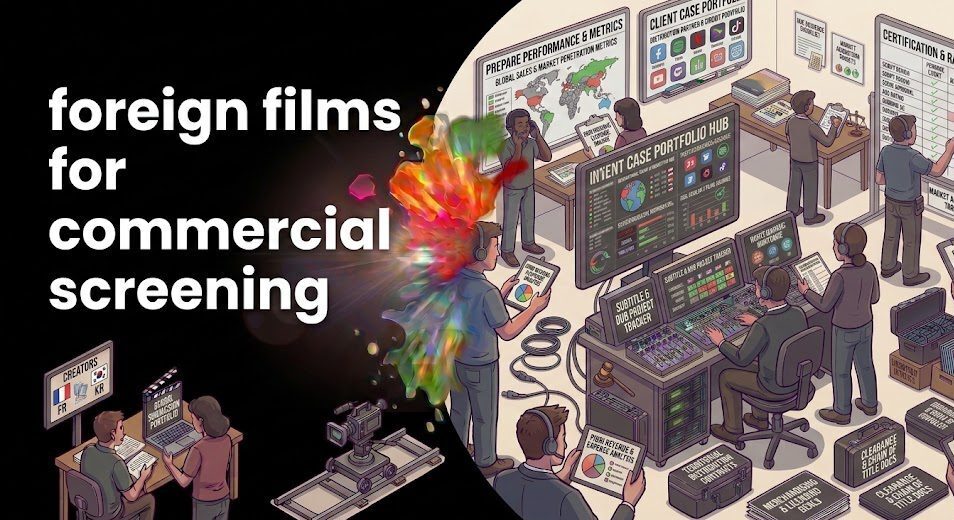
You want to screen a foreign film commercially — at a cinema, a film club, a festival, a university venue, or an event space. You’ve identified the title. Now you hit the wall that trips up most buyers: figuring out who actually holds the rights for your territory, and how to reach them without spending three months chasing cold leads through a fragmented supply chain of 600,000+ companies that don’t exactly advertise their acquisition contacts.
Here’s the thing: buying foreign films for commercial screening is genuinely more complex than most exhibition buyers expect. The rights landscape is fractured by territory, by window (theatrical, SVOD, AVOD), and by licensing structure. A French arthouse title might have its US theatrical rights held by a specialist distributor, its streaming rights with a platform that acquired them separately, and its educational screening rights sitting with yet another party. Know which channel to approach for which right — and you cut months off your timeline.
This guide maps 7 specific channels where content buyers, programmers, and exhibitors can source and acquire foreign film rights for commercial use — from international film markets to digital rights platforms, sales agents, and direct licensor outreach.
In This Guide
Find Foreign Film Rights Holders Across 140,000+ Companies — Fast
VIQI maps active rights holders, distributors, and acquisition leads across 400,000+ projects globally. Used by content teams at Netflix, Warner Bros, and Paramount to accelerate acquisition decisions.
Ask VIQI About Foreign Film Rights
200 free credits · No credit card required
What “Commercial Screening Rights” Actually Covers
Before you approach any seller, get clear on exactly what type of commercial screening right you need. This isn’t semantic — rights are licensed in specific combinations, and requesting the wrong bundle either costs you money on rights you don’t need or leaves you unlicensed for a use you do need.
- Theatrical screening rights: Commercial exhibition in a cinema or licensed venue. Typically requires a formal theatrical distribution deal or a screening license from the US theatrical rights holder for the film’s territory.
- Non-theatrical/public performance rights: Commercial screenings in non-cinema venues — universities, corporate events, film clubs, galleries, hotels. Often licensed separately from theatrical rights, sometimes at lower MG thresholds. This is frequently the correct right for venue-based exhibitors who aren’t cinemas.
- Festival rights: Short-term screening rights granted specifically for film festivals. Usually licensed through the producer, sales agent, or theatrical distributor — not the same as a commercial public performance license.
- Educational/institutional screening rights: Schools, universities, and educational institutions screening films in a non-commercial or limited commercial context. Often licensed through specialist educational licensing intermediaries.
Each of these right types involves different licensing parties and deal structures. And as our complete guide to buying film and TV rights in 2026 covers, rights for a single film are almost always held by different parties across different territories — which is exactly why identifying the correct rights holder for your specific territory is step one of any acquisition process.
7 Channels to Buy Foreign Films for Commercial Screening
1. International Film Markets
Film markets are where the industry actually transacts. Cannes Marché du Film (May), American Film Market/AFM (November, Santa Monica), European Film Market/EFM (February, Berlin), MIPCOM (October, Cannes), and TIFF (September, Toronto) are the five primary venues where international rights are bought and sold at scale. Sales agents bring their slates. Buyers — theatrical distributors, cinema programmers, festival programmers, streaming platforms — walk the floors making deals.
But here’s what most buyers don’t realize: the pre-market window is often more valuable than the market itself. Sales agents send packages to their known buyer network 2–3 weeks before the market opens. If you’re not on those lists, you’re reacting to what’s left rather than accessing the full slate. Building relationships with sales agents before you need them — not at the moment you want to buy a specific title — is the single most effective structural change a content acquisition team can make to its workflow.
For buyers focused specifically on commercial screening rights (as opposed to full theatrical distribution), film markets are also where you’ll find direct producer representation for independent foreign titles that haven’t been picked up by a US distributor — which means the rights are still available and you can negotiate directly with the sales agent.
2. International Sales Agents
Sales agents are the primary gatekeepers to foreign film rights outside their home territory. Companies like Wild Bunch (France/Germany), MK2 Films (France), Protagonist Pictures (UK), The Match Factory (Germany), Coproduction Office (France/Germany), and Fortissimo Films (Netherlands) represent slates of foreign language and international films and license territorial rights to buyers globally.
For a buyer wanting to screen a specific foreign title commercially in the US, the correct first call is to the film’s international sales agent — not the filmmaker and not the foreign distributor. Sales agents track which territories are available, which have already been licensed, and what the current asking price is. They’ll tell you within 24–48 hours whether the US theatrical, non-theatrical, or public performance rights are free and what licensing looks like.
Finding the correct sales agent for a specific film is where the fragmentation problem bites hardest. There’s no single public registry. Trade publications like Variety and Screen Daily cover major sales deals and attach agent names to titles — which is why monitoring trade coverage for the specific markets where your target titles premiere is part of a serious acquisition workflow. You can also explore our guide to which companies handle international film distribution rights for a mapped overview.
Rolla Karam (SVP Content Acquisition, OSN) breaks down how a major multi-territory platform approaches acquiring international content across 23 countries — from sourcing foreign titles to deal structure with global studios. Essential context for any buyer navigating international rights.

Identify Active Rights Holders for Any Foreign Title in Minutes
Vitrina tracks deal flow, rights assignments, and acquisition activity across 140,000+ entertainment companies globally — including which sales agents hold rights to specific titles and which territories are still available. Start with 200 free credits.
Join 140,000+ companies · No credit card required
3. US Theatrical Distributors With Foreign Language Slates
If a foreign film has already been acquired for US theatrical release, the US theatrical distributor holds the commercial screening rights domestically. Companies like Sony Pictures Classics, Neon, Kino Lorber, Cohen Media Group, Music Box Films, and Janus Films specialize in acquiring and distributing foreign language and arthouse titles in North America.
For commercial screening buyers, these distributors are the correct contact for any title already in their catalog. Most maintain booking departments that handle both theatrical and non-theatrical licensing. The deal structure for a non-theatrical commercial screening typically involves a flat screening fee (ranging from a few hundred dollars for a single screening to several thousand for an extended run) or a percentage of box office receipts for theatrical venues. Kino Lorber, for example, maintains an extensive catalog of world cinema titles available for non-theatrical licensing directly through their platform.
4. Digital Rights Marketplaces and Licensing Platforms
The emergence of digital rights marketplaces has meaningfully lowered the barrier to acquiring foreign film rights for certain types of commercial use. Platforms like MUBI (which licenses arthouse and world cinema), FilmHub, and Cinando (the digital platform of the Cannes Marché du Film) provide searchable access to rights-available titles with direct contact to rights holders.
Cinando is particularly valuable — it’s the professional database used by film industry buyers at Cannes and maintains one of the most comprehensive catalogs of international film rights availability. A professional subscription gives you direct access to 80,000+ films, rights holder contact details, and festival screening histories. For buyers sourcing foreign titles outside of market periods, Cinando is the closest thing the industry has to a centralized rights marketplace.
For non-theatrical and public performance rights specifically, platforms like Swank Motion Pictures and Criterion Pictures operate as licensed intermediaries in the US and Canada, handling public performance licensing for thousands of titles — including foreign films — on behalf of rights holders. If you’re an exhibitor needing a quick non-theatrical screening license for a foreign title without going direct to a sales agent, these intermediaries are your most efficient route. See our full breakdown of media rights marketplaces for acquisition leads in 2026 for a broader comparison.
5. Film Festival Acquisition Pipelines
Film festivals are acquisition events, not just cultural ones. Sundance, Tribeca, SXSW, Hot Docs (Toronto), and True/False are where foreign and independent titles surface to buyers before distribution has been secured. If you’re a programmer or cinema operator looking to acquire a foreign title before it gets locked up in a distribution deal, festival world premieres — and the acquisition activity that follows — are your early-window opportunity.
The practical play: attend or monitor festival acquisition announcements through Deadline and Variety coverage. When a foreign title premieres without a US distribution deal attached, the sales agent is actively pitching to buyers. That’s the moment your approach lands with maximum relevance. Post-acquisition, once a distributor is attached, your leverage as a smaller exhibitor decreases — you’re now negotiating with a distributor’s booking department rather than directly with the rights principal. Timing matters enormously here. Our guide to film acquisition catalogs and festivals covers this timing strategy in detail.
6. Direct Outreach to Foreign Production Companies
For titles that haven’t been picked up by a sales agent or US distributor, direct outreach to the producing company is the correct channel. This is common for recent independent productions from sovereign content hubs — Brazilian films from companies like Globo Filmes, South Korean productions from CJ ENM, and Indian regional films that haven’t been packaged for international distribution. Rights are still with the producer, often unlicensed in your territory, and directly negotiable.
But this is where the fragmentation paradox hits hardest. Identifying which production company made a specific foreign title, finding the correct rights contact within that company, and verifying that the commercial screening rights for your territory are actually available — that’s not a five-minute task without the right intelligence infrastructure. The Fragmentation Paradox costs buyers an estimated 15–20% in margin through time spent on manual research and suboptimal partner selection. It’s worth building a systematic approach to production company intelligence rather than treating each acquisition as a cold-start research project.
7. National Film Institutes and Cultural Bodies
This channel is underused by commercial buyers and shouldn’t be. National film institutes and cultural organizations actively facilitate international distribution of their country’s cinema — and they maintain direct relationships with the production companies and sales agents behind their national titles. The French Institute, Goethe-Institut (Germany), Instituto Cervantes (Spain), Korea Foundation, and the Japan Foundation all run film programming arms that can connect commercial buyers with rights holders for titles in their national catalogs.
For smaller commercial exhibitors — cinema clubs, cultural venues, universities — these institutes are a practical shortcut. They’ve already done the work of maintaining relationships with producers and distributors in their national markets, and they have a direct interest in facilitating legitimate commercial screening of their country’s films internationally. In some cases they can facilitate introductions within 48–72 hours that would otherwise require weeks of cold outreach through commercial channels.

Your AI Assistant, Agent, and Analyst for the Business of Entertainment
VIQI AI helps you plan content acquisitions, raise production financing, and find and connect with the right partners worldwide.
- Find active co-producers and financiers for scripted projects
- Find equity and gap financing companies in North America
- Find top film financiers in Europe
- Find production houses that can co-produce or finance unscripted series
- I am looking for production partners for a YA drama set in Brazil
- I am looking for producers with proven track record in mid-budget features
- I am looking for Turkish distributors with successful international sales
- I am looking for OTT platforms actively acquiring finished series for the LATAM region
- I am seeking localization companies offer subtitling services in multiple Asian languages
- I am seeking partners in animation production for children's content
- I am seeking USA based post-production companies with sound facilities
- I am seeking VFX partners to composite background images and AI generated content
- Show me recent drama projects available for pre-buy
- Show me Japanese Anime Distributors
- Show me true-crime buyers from Asia
- Show me documentary pre-buyers
- List the top commissioners at the BBC
- List the post-production and VFX decision-makers at Netflix
- List the development leaders at Sony Pictures
- List the scripted programming heads at HBO
- Who is backing animation projects in Europe right now
- Who is Netflix’s top production partners for Sports Docs
- Who is Commissioning factual content in the NORDICS
- Who is acquiring unscripted formats for the North American market
What to Negotiate Before You Sign Any Commercial Screening License
Once you’ve identified the rights holder and confirmed availability, the licensing negotiation for commercial screening rights is usually more straightforward than a full distribution deal — but it still has levers worth pulling. Here’s what to address before you sign:
- Scope of use: Is the license for a single screening, a limited run (e.g., 3–5 screenings within 30 days), or an extended period? Fees scale with use — get the scope right upfront to avoid renegotiation or violation.
- Territory specificity: Even for non-theatrical rights, territory matters. A US non-theatrical license doesn’t cover Canadian venues. Be explicit about every geographic location covered.
- Ticket-sale permission: Some licensing structures distinguish between free public screenings and commercially ticketed events. If you’re charging admission, ensure the license explicitly permits it.
- Subtitling and dubbing provisions: Foreign language films screened commercially typically need subtitles. Confirm whether the licensor provides a subtitled print/DCP or whether you need to source and pay for subtitling separately. Many foreign films released through US distributors come with English subtitles included in the DCP; direct-from-producer licenses often don’t.
- DCP versus streaming delivery: Most commercial venues require a DCP (Digital Cinema Package). Confirm the delivery format before signing — receiving a screener file when you need a DCP is a deal-killing logistical problem that surfaces at the worst possible time.
- Attribution requirements: Some rights holders — particularly cultural institutes and national film bodies — require specific attribution language in all marketing materials for the screening. This is typically non-negotiable and easy to honor if you know about it in advance.
Where the Best Foreign Content Is Coming From in 2026
If you’re building a commercial programming slate around foreign cinema, understanding where production investment is flowing globally is genuine acquisition intelligence. Sovereign content hubs — regional markets backed by government investment, local content mandates, and aggressive tax incentive regimes — are producing some of the most commercially viable international content available to buyers right now.
South Korea has been the dominant story for a decade: the post-Parasite global appetite for Korean cinema hasn’t faded, and production companies like CJ ENM and Lotte Entertainment are generating commercially viable genre titles at scale. India — particularly South Indian cinema out of Tamil Nadu and Telangana — is exporting action and drama titles that are finding genuine international theatrical audiences well beyond the diaspora. Saudi Arabia‘s Vision 2030 investment has allocated over $1 billion specifically for film infrastructure, with the Kingdom actively seeking international exhibition partnerships for domestically produced titles. And Brazil’s Globo Filmes continues to generate telenovela and drama content that commands commercial licensing fees in Portuguese-speaking markets and beyond.
These aren’t emerging market curiosities. They’re operational production centers exporting to global audiences — and the buyers who have established direct relationships with their sales agents and production companies are accessing genuinely differentiated content before it gets picked up by major US distributors and priced accordingly.
Need Expert Help Sourcing Foreign Film Rights for Your Venue?
Vitrina’s Concierge team works directly with cinema programmers, festival buyers, and exhibition venues to identify rights holders, accelerate acquisition outreach, and de-risk licensing decisions. Trusted by teams at Netflix, Warner Bros, and Paramount.
No commitment · Confidential · Fast turnaround
Frequently Asked Questions
Do I need a license to screen a foreign film commercially?
Yes — in virtually every jurisdiction, any public screening of a film for which admission is charged, or any screening in a non-domestic commercial context, requires a valid screening license from the rights holder or their authorized representative. Screening without a license constitutes copyright infringement, regardless of whether the film originated in a foreign country. Rights are territorial, not universal.
How much does it cost to buy foreign film rights for commercial screening?
Pricing varies enormously based on the film’s profile, territory, and type of commercial use. A non-theatrical screening license for a single event at a smaller venue might cost $200–$800 through a licensing intermediary like Swank Motion Pictures. A limited theatrical run with a specialty distributor might involve a flat fee of $1,500–$10,000+ or a revenue share (typically 30–50% of box office to the rights holder). Full theatrical distribution rights for a territory are a separate, much larger negotiation involving minimum guarantees and advance payments.
How do I find out who holds the commercial screening rights to a specific foreign film?
Start with the film’s producer or production company (usually credited on the film’s IMDb or official website). If a sales agent is attached, their name typically appears in festival catalog listings and trade coverage. For US rights specifically, check whether a US theatrical distributor has acquired the title — US specialty distributors’ websites list their catalogs. Cinando (the Cannes film market database) is the most comprehensive professional resource for identifying international rights holders. Vitrina’s VIQI intelligence engine can surface rights holder information across its database of 400,000+ projects.
Can I screen a foreign film if it’s not available in my country?
Yes — the fact that a film hasn’t been commercially distributed in your territory typically means the rights are either unsold (available to acquire) or held by a party that hasn’t yet activated them. In either case, you can approach the international sales agent or original producer to acquire the commercial screening rights for your territory directly. Unsold territorial rights are frequently licensed at lower prices precisely because no local distributor has committed to a formal release.
What is the difference between theatrical and non-theatrical commercial screening rights?
Theatrical rights cover commercial exhibition in licensed cinemas and film theatres — venues classified as commercial exhibition spaces. Non-theatrical (public performance) rights cover commercial screenings in other venues: universities, event spaces, hotels, corporate facilities, galleries, clubs, and similar non-cinema commercial contexts. These rights are often held and priced separately. Many foreign films available for non-theatrical licensing are not yet in theatrical release in your territory, giving non-theatrical buyers access to content their local cinema audience can’t yet see.
What format do I need to screen a foreign film commercially?
Commercial cinemas and most licensed screening venues require a DCP (Digital Cinema Package) — the industry-standard digital projection format. Non-theatrical venues may also accept digital files in approved formats (ProRes, H.264 at broadcast resolution), depending on their projection equipment. Always confirm the available delivery format with the rights holder before completing your licensing agreement — receiving a streaming screener when your venue requires a DCP is a logistical failure that can cancel your event. Some distributors (particularly specialty distributors like Kino Lorber) provide DCP delivery as part of non-theatrical licensing fees; others charge separately.
Conclusion: The Right Channel Cuts the Deal Cycle in Half
Buying foreign films for commercial screening isn’t structurally complicated — but it’s operationally fragmented. The film industry’s 600,000+ active companies across the global supply chain don’t make it easy to trace a specific title’s rights from production company through sales agent to territorial distributor. That opacity is the problem, and the buyers who build systematic approaches to closing it — through film market relationships, Cinando access, trade monitoring, and direct production company intelligence — consistently access better content, at better prices, faster.
And don’t sleep on the timing dimension. A foreign title at its world premiere festival with no US distribution attached is at peak availability and minimum price. Six months later, after a Sundance acquisition buzz cycle, the same title costs three times more and has half the screening rights available. The insider advantage in foreign film acquisition is timing your approach — and you can’t time it if you’re not watching the right signals.
Key Takeaways
- Know your right type first: Theatrical, non-theatrical, festival, and educational rights are licensed separately — and by different parties.
- Sales agents are the primary channel: For foreign titles without US distribution, the international sales agent holds and prices the territorial rights you need.
- Cinando is your best research tool: The Cannes market database provides rights holder contacts, availability, and screening history for 80,000+ international titles.
- Time your approach to the festival window: Pre-distribution acquisitions are faster, cheaper, and leave more rights options open than post-distribution negotiations.
- Sovereign content hubs are the sourcing frontier: South Korea, India, Saudi Arabia, and Brazil are producing commercially viable foreign cinema that remains underlicensed in most Western markets.
Find Foreign Film Rights Holders Before Your Competition Does
Vitrina maps active rights holders, deal flow, and acquisition leads across 400,000+ projects and 140,000+ entertainment companies. Start your search with 200 free credits — no credit card required.
Need hands-on acquisition intelligence for a specific title or slate?
Find Film+TV Projects, Partners, and Deals – Fast.
VIQI matches you with the right financiers, producers, streamers, and buyers – globally.
Producers Seeking Financing, Co-Pros, or Pre-Buys?
Vitrina Concierge helps producers reach the right financiers, commissioners, distributors, and co-production partners — with precision outreach, not cold pitching.
Join Industry Briefings Trusted by Leaders

Micro-Dramas & Mobile-First Storytelling
Micro-dramas are building real audiences and revenue. Understand the platforms, buyers, and economics behind the growth.

Navigating Global Content Licensing Trends
How global content licensing is shifting beyond flat fees to flexible, deal-driven models.
Film & TV Production Financing: 2026 Trends
Production financing conditions are changing quickly. Understanding where money is moving and what buyers are backing is key to getting projects approved and funded in 2026.
Unreleased Film+TV Projects: Opportunities & Showcase
A curated view of unreleased Film and TV projects open for financing and collaboration