About Innovation Hub
 Global Content Pulse (Webinars)


 Global Production Financing
(Webinars)
Global Production Financing
(Webinars)  LeaderSpeak Podcast
  Global Entertainment Digest (Newsletter)
  About Vitrina
 About VIQI
 Our Story
 Our Solutions 🔥
 Film+TV Projects Tracker 🚀
 Case Studies
 Our Profile
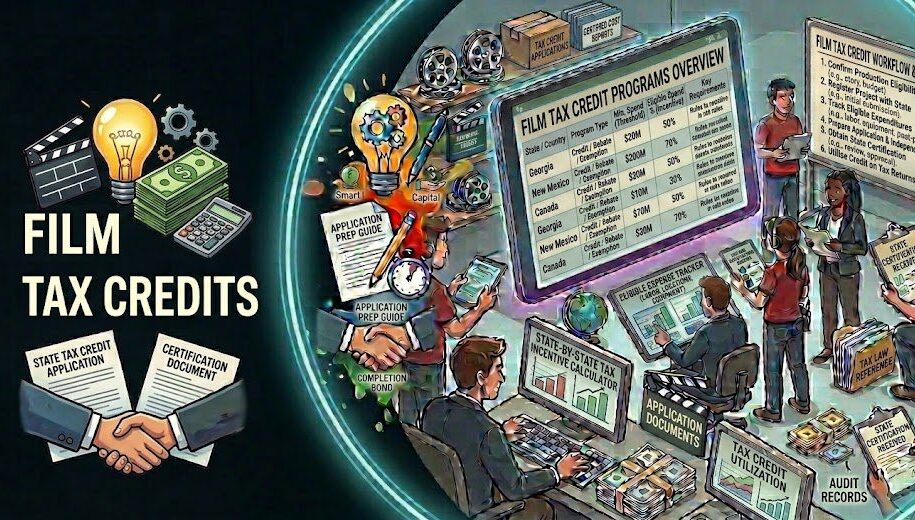
Every serious producer knows that film tax credits aren’t a bonus—they’re a structural part of the capital stack. Get your incentive strategy right and you’re covering 20–50% of your qualifying spend before a single pre-sale closes. Get it wrong and you’re leaving real money on the table, or worse, building your budget around an incentive you don’t actually qualify for.
But here’s the problem: most guides on this topic read like government documentation. Dry. Generic. Missing the context that actually matters to a producer trying to close a capital stack before EFM or Cannes. This guide is different—it explains how film tax credits work mechanically, which programs are genuinely competitive right now, how to stack them, and how to access that capital during production rather than waiting 6–18 months post-wrap.
We’ve pulled together data from over 40 jurisdictions plus direct expert insights—including an interview with Andrea Scarso (Managing Partner, IPR VC), who navigates European tax incentives and co-production structures daily. Whether you’re a first-time producer or a seasoned line producer optimizing a multi-territory shoot, you’ll find something actionable here. Let’s get into it.
In This Guide
- What Are Film Tax Credits? The 5 Types Producers Use
- How Film Tax Credits Benefit Your Production Financially
- The World’s Most Competitive Film Tax Credit Programs (2026)
- How to Qualify: The Non-Negotiables
- Incentive Stacking—The Strategy Most Producers Underuse
- How to Access Your Tax Credit During Production
- Common Mistakes That Kill Your Incentive Claim
- How Vitrina Helps You Find the Right Incentive
- FAQ
Ask VIQI: Which Film Tax Credit Program Fits My Project?
VIQI is Vitrina’s AI assistant—trained on 1.6 million titles, 360,000 companies, and 5 million entertainment professionals. Tell it your budget, genre, and shoot locations—it’ll map the incentive landscape for your specific project.
✓ Included with 200 free credits | ✓ No credit card needed
What Are Film Tax Credits? The 5 Types Producers Actually Use
Film tax credits are government programs designed to attract production spending to specific jurisdictions by returning a percentage of qualified local expenditures to the producer. Governments offer them because productions create jobs, stimulate local economies, and build permanent infrastructure. You benefit because you can reduce your effective budget by anywhere from 15% to 50%—depending on jurisdiction and how smartly you structure your shoot.
But not all incentives work the same way. The mechanics matter enormously—especially when it comes to timing and liquidity. Here are the five types you’ll encounter:
1. Cash Rebate
A direct government refund—typically a wire transfer—representing a percentage of your qualified local spend. It’s the simplest and most internationally accessible mechanism. You complete production, an independent auditor verifies your spend, and the government writes the check. Most international producers prefer this because there’s no tax complexity in a foreign jurisdiction. Ireland, France, the UK, Australia, and Saudi Arabia all operate versions of this model.
2. Refundable Tax Credit
This reduces your company’s tax liability in the jurisdiction. If the credit exceeds what you owe, the excess is refunded as cash. It functions almost identically to a cash rebate for most producers. This is widely regarded as the “gold standard” of incentive types—and it’s what makes New Mexico, New York, and Canada’s federal credit so attractive. You don’t need ongoing operations in the jurisdiction to benefit.
3. Transferable Tax Credit
The credit can be sold to a third party with tax liability in that jurisdiction. Georgia is the classic example—its 30% transferable credit (plus an additional 10% for including the Georgia promotional logo) powers one of the most active production ecosystems on earth. Producers who can’t use the credit directly sell it to a broker or tax buyer at 80–95 cents per dollar. That discount is the price of liquidity. It’s still a powerful incentive but requires a secondary market to function.
4. Non-Refundable, Non-Transferable Tax Credit
The least valuable type—and increasingly rare in competitive markets. This only offsets your own tax liability in the jurisdiction, can’t be sold, and can’t be converted to cash. Unless you have significant ongoing business operations there, it’s effectively worthless. Avoid building your capital stack around one of these.
5. Grant
Direct government payment—no tax filing required. Often discretionary, tied to cultural criteria, and highly competitive. Grants from bodies like Screen Australia, the BFI, or regional European film funds fall here. They’re non-repayable, which makes them extremely valuable to a capital stack—but they’re not primarily structured around production spend. Think of them as a separate layer, not a substitute for tax incentives. Our guide to the film financing ecosystem for independent filmmakers covers the relationship between soft money and production financing in more depth.
Stop Guessing Who’s Financing. Get Targeted Outreach.
Stop searching and start getting funded. We identify the exact decision-makers currently backing projects like yours, turning raw data into risk-aligned capital partnerships.
Major Studios
Scouting early stage projects, IP, and Regional partners for global studio pipelines.
IP Owners & Leads
Connecting creative leads with qualified financiers and major streaming platforms.
Streamers
Securing high-value pre-buy content and discovering early-stage global IP for platforms.
Indie Producers
Bridging the gap for indie filmmakers to reach executive production partners and capital.
Global Financing Ecosystems
Mapping complex markets and pairing projects with disciplined, risk-aligned capital across global territories worldwide.
How Film Tax Credits Benefit Your Production Financially
Let’s make this concrete. You’re budgeting a $10M independent feature. You plan to shoot primarily in the UK with VFX work in London. Here’s what a well-structured incentive approach does to your capital stack:
Without that UK credit, your gap financing requirement jumps from $1.6M to $3.5M—nearly doubling it. That’s a harder deal to close, at higher cost, with more lender scrutiny. The tax incentive doesn’t just save money; it de-risks the entire financing structure. It’s why experienced producers treat location selection as a financing decision, not just a creative one.
And it compounds from there. A confirmed tax incentive improves your negotiating position with pre-sale distributors (they know you’re less desperate). It reduces the gap financing percentage, which lowers your interest burden. It boosts your EBITDA projection on the project because you’re recovering more capital. Every dollar of incentive you leave unclaimed is a dollar your equity investors could have kept, or a dollar of gap you didn’t have to borrow at 15–22% effective cost.
Andrea Scarso (Managing Partner, IPR VC)—whose fund has been structuring film and TV investments across Europe and North America for over a decade—puts it plainly: looking at co-production opportunities, especially in territories where you can maximize local incentives and tax credits, has become crucially more important. It needs to be part of thinking from the very start of packaging—not an afterthought when you’re already in pre-production.
Andrea Scarso (Managing Partner, IPR VC) discusses how tax credits and co-production structures fit into the broader financing picture—and why producers need to think about incentives from day one:

Track Every Active Film Tax Credit Program Globally
Trusted by Netflix, Warner Bros, and Paramount. Join 140,000+ companies on Vitrina tracking production incentives, co-production partners, and the global entertainment supply chain.
✓ 200 free credits | ✓ No credit card required | ✓ Full platform access
The World’s Most Competitive Film Tax Credit Programs in 2026
The global race to attract production spending has accelerated significantly. Jurisdictions are raising rates, removing caps, and adding VFX-specific uplifts. Here’s where the action is—organized by region, with the numbers that matter.
North America: The US State Competition Is Fierce
Georgia remains the dominant US production state—$4.2 billion in production spend in 2024 alone, driven by an unlimited 30% transferable tax credit (40% with the Georgia promotional logo) and no cap on above-the-line costs. But it’s not the only player. New York has increased its annual program to over $700M and added a new $100M fund specifically for indie films. New Mexico runs 25–40% refundable credits with no annual program cap—which is why Oppenheimer shot there. New Jersey extended its program to July 2039, with Netflix developing a $900M+ production facility there. And California is proposing to increase its annual cap from $330M to $750M for 2025–26 as part of its effort to recapture runaway productions.
In Canada, British Columbia offers 33–35% refundable credits on resident labour—making Vancouver a perennial major production hub. Quebec runs 36–40% for services to foreign productions, with Montreal as a strong post-production centre. Our guide to British Columbia’s tax credit structure covers the provincial mechanics in detail.
Europe: Established Hubs Raising Their Game
The UK’s Audio-Visual Expenditure Credit (AVEC) pays 25% on qualifying spend—and as of April 2025, VFX work in the UK earns 29.25% with the cap on qualifying VFX expenditures removed entirely. The UK generated £4.2 billion ($5.3 billion) from film and TV production in 2023, with major titles including Jurassic World 4, Mission: Impossible, and Fantastic Four all qualifying. UK studios also benefit from 40% business rate relief through to 2034. For a full breakdown, see our analysis of UK tax credits for film and TV.
Ireland’s Section 481 offers a 32% base + 8% uplift for films under €20M—meaning smaller independent features can access a full 40% credit. France runs a 30% international production rebate, jumping to 40% if French VFX exceeds €2M—a deliberately designed VFX uplift that’s pulled significant work to Paris. Germany’s DFFF and GMPF programs increased from 25% to 30% in 2024. And Spain’s Canary Islands offer the highest headline rate in all of Europe at 45–50%.
Eastern Europe competes hard too. Czech Republic raised its cap to $19M (nearly tripled) effective January 2025 and runs 35% for animation and digital work. Greece allocated €105M for 2025 with a 40% cash rebate. Hungary continues to attract tentpole productions—Blade Runner 2049 and Mission: Impossible both shot in Budapest—on a 30% tax credit.
Middle East, Africa & APAC: The New Competitive Tier
The most dramatic incentive growth is happening in the Middle East. Abu Dhabi now offers up to 50% cash rebate—among the highest rates globally—with 0% taxation for 50 years in its free zones. Saudi Arabia’s Vision 2030 Film Fund runs a 40% rebate with a $1B annual allocation for film and TV infrastructure, including new soundstages in Riyadh. The NEOM incentive programme adds another dimension for projects shooting in the region—our dedicated overview of NEOM’s 40% cash rebate programme covers qualification criteria in depth.
In APAC, Australia’s Location Offset jumped from 16.5% to 30% in July 2024—a significant increase that immediately repositioned Australia as a competitor for mid-to-large international productions. On top of that, producers can stack state-level incentives: New South Wales adds 10%, Victoria 10%, Queensland 15%. Japan launched an incentive reaching up to 50% (capped at $6.7M) that’s already attracted projects like Tokyo Vice Season 2. India increased its federal incentive from 30% to 40% with an additional 5% for significant Indian content. Colombia offers 35–40% with scenery that ranges from Amazon rainforest to major cities—Colombia’s CINA incentive guide walks through the application process.
Find the Financiers Backing Your Genre
Stop searching and start getting funded. We identify the exact decision-makers currently backing projects like yours, turning raw data into risk-aligned capital partnerships.
How to Qualify for Film Tax Credits: The Non-Negotiables
The headline rate is only part of the story. What actually determines how much you receive—or whether you qualify at all—is the fine print on qualifying expenditures and eligibility thresholds. Don’t build a budget around an incentive you haven’t verified you can access.
Minimum spend thresholds. Most programs require you to spend a minimum amount locally before qualifying. These range from as low as $10,000 to as high as $2.5M depending on jurisdiction and content type. Portugal requires a €2.5M minimum budget. British Columbia requires C$1M for features. Smaller productions need to target programs designed for their budget tier—not attempt to shoehorn into large-slate programs.
Above-the-line vs. below-the-line rules. This distinction is critical. Some programs—like Georgia—allow above-the-line costs (cast, director, producer fees) to qualify. Others restrict the credit to below-the-line spend only (crew, facilities, equipment). A program that excludes ATL costs can dramatically reduce your effective incentive value if your cast is expensive. Read the definition of Qualified Production Expenditure before you commit to a location.
Cultural tests. The UK and Canada both use points-based cultural testing systems. For the UK’s AVEC, you need a minimum score—earned through UK cast and crew, UK subject matter, and UK facilities. Official co-productions through UK treaty partnerships automatically pass the cultural test, which is one reason the co-production route for independent filmmakers is so strategically valuable. Fail the cultural test and your entire claim is void.
Residency requirements. Some programs only credit resident cast and crew—meaning non-resident talent fees don’t qualify at all. Others are more flexible. New Mexico, for instance, allows non-resident ATL costs up to its $40M cap. But British Columbia’s credit is specifically tied to resident labour. Know which costs are actually bankable before your line producer locks the budget.
Pre-qualification timing. You typically need to apply for certification of eligibility before principal photography begins—not after. Miss that window and you lose the incentive entirely. Some jurisdictions recommend consultation as early as development. Plan accordingly.
Incentive Stacking—The Strategy Most Producers Underuse
Here’s where the real capital efficiency lives. Stacking means combining multiple incentive programs from different levels—federal, state/regional, local—on the same production. Done right, it can push your effective recovery rate significantly above any single headline number.
A production filming in Georgia, for instance, can stack the 30% state transferable credit with 10% local incentives from Savannah—reaching a 40% effective incentive on qualifying spend. Australia’s system is explicitly designed for this: the 30% Location Offset at the federal level can be stacked with Queensland’s 15% state incentive—potentially reaching 45% on spend in that state. Spain layers its federal credit with Canary Islands or Basque Region programs, which is why productions keep turning up in both locations.
But stacking isn’t universally available. Some jurisdictions explicitly prohibit double-dipping—where the same expenditure qualifies for two programs simultaneously. Others allow it but require careful accounting to separate the eligible spend for each program. And the interaction between a cash rebate and a co-production treaty can introduce complexity around which country’s credit takes precedence. Work with a production accountant who knows these specific programs—not just someone with general international experience.
The most powerful stack involves combining national tax incentives with a bilateral co-production treaty. When a production qualifies under a UK–Canada or UK–Australia treaty, it can access incentives from both countries on the portions of the budget spent in each. Andrea Scarso at IPR VC identifies this as one of the primary reasons co-production structures have become more important in European financing: you’re not just sharing creative resources—you’re multiplying your access to soft money across jurisdictions simultaneously.
How to Access Your Tax Credit During Production (Not 18 Months Later)
Here’s the problem with tax incentives as a cash flow tool: you spend the money during production, but the incentive doesn’t pay out until 6–18 months after wrap—after you’ve submitted your cost report, passed a third-party audit, and cleared the film commission’s review process. That’s a long time to have a significant capital position frozen.
The solution is a rebate loan—sometimes called incentive financing or tax credit bridging. A bank or specialist lender advances 80–90% of the expected incentive value during production, against the confirmed credit. You access the capital when you actually need it. The lender charges interest from drawdown until the incentive pays out. Interest runs typically at prime + 2–5% on these structures—lower risk than gap financing because the government credit is highly predictable collateral.
Not all incentives are equally “bankable” for this purpose. Refundable tax credits and cash rebates from established programs (UK, Canada, Australia, Georgia) are readily accepted by specialist entertainment lenders. Newer programs or those with a history of administrative delays may attract more conservative advance rates—or no lender interest at all. If you’re planning to use a rebate loan as part of your production cash flow, confirm lender appetite for that specific jurisdiction early in your financing process. As reported by Variety, lenders are increasingly comfortable financing against established programs—but remain cautious about newer or politically exposed incentive structures.
Common Mistakes That Kill Your Film Tax Credit Claim
The audit process is where underprepared productions lose money they thought they’d already secured. These are the mistakes that show up most consistently:
Building the budget without a production accountant who specializes in that specific program. General accounting expertise doesn’t transfer cleanly. The definition of qualifying costs varies dramatically between programs—and the difference between including or excluding certain line items can swing your incentive by six figures. Hire local, hire specialized. Your entertainment attorney can recommend the right person, and so can the film commission itself.
Assuming what qualifies without reading the program guidelines. “30% on local spend” sounds simple. It isn’t. ATL inclusion, residency requirements, minimum spend rules, cap structures, and content restrictions all shape what your actual qualifying base looks like. Some programs exclude above-the-line entirely. Others have per-item caps on travel or accommodation that aren’t obvious until you’re in the audit. Read the guidelines before you budget, not after.
Failing the cultural test due to poor advance planning. In the UK and Canada especially, the cultural test is binary—you pass or you don’t. And the points decisions are locked early: who’s directing, where the subject matter originates, which crew members hold residency. Changing these after production starts to “fix” a cultural test problem is often impossible. Model your points score during development, not in pre-production.
Missing the pre-qualification window. Apply late and you’re not eligible. Most programs have hard deadlines before principal photography begins. Some require applications weeks or months ahead. The film commission will tell you upfront—but only if you ask before production starts. This is a simple calendar error that costs productions their entire incentive claim. Don’t be that production. Our resource on independent film financing timelines covers how to sequence your applications properly.
Treating the incentive as confirmed financing before it’s approved. An application is not an approval. Producers who build tight capital stacks assuming the full incentive value before receiving certification of eligibility are taking on real risk. Treat the incentive as confirmed only once you have written approval—and plan your cash flow accordingly. As Screen International has noted, applications that lack proper cost documentation are routinely reduced at audit—often by more than producers expect.
Need Help Structuring Your Incentive Strategy? We’ll Do It With You.
Vitrina Concierge connects you directly with production accountants, entertainment attorneys, and co-production partners in your target jurisdiction—not a list, but warm introductions to specialists actively working these programs.
- LA producer → Netflix UK, Fifth Season, Fox Entertainment (48 hours)
- Korean studio → Netflix Adult Animation (week one)
How Vitrina Helps You Find the Right Incentive for Your Project
The Fragmentation Paradox of film production incentives is real: over 40 active jurisdictions are competing for your production right now, each with different rates, qualification rules, caps, and cultural requirements. The information exists—but it’s scattered across government websites, film commission PDFs, and legal white papers that update constantly.
Vitrina consolidates that intelligence. With 140,000+ companies across the global entertainment supply chain—including production accountants, line producers, and legal specialists who work specific incentive programs—you can identify not just which program fits your project, but who can actually execute on it. VIQI, Vitrina’s AI assistant, can model your incentive options against your budget, genre, and location constraints in real time.
But here’s the thing Smart Pairing makes possible that pure database search doesn’t: we match your project to co-production partners in treaty jurisdictions who can unlock additional incentive access you wouldn’t reach alone. That’s the difference between a 25% UK credit and a stacked UK-Canada co-production structure that pulls from both programs—a meaningfully different capital stack outcome for the same project.
Frequently Asked Questions
What are film tax credits and how do they work?
Film tax credits are government programs that return a percentage of your qualifying local production spend—typically as a cash rebate, refundable tax credit, or transferable credit. You spend money in the jurisdiction, document the expenditures, pass an independent audit, and receive a payment or credit. Rates range from 15% to 50% depending on the program. The incentive is designed to attract productions, create local jobs, and develop permanent infrastructure in the jurisdiction.
Which country has the best film tax credit?
There’s no single best—it depends on your budget, genre, crew requirements, and shoot schedule. For headline rate, Abu Dhabi (up to 50%), Japan (up to 50%), and Spain’s Canary Islands (45–50%) rank highest globally. For volume and infrastructure, the UK (25%), Georgia (30%), and Canada (33–40% depending on province) are the most consistently active. The best program is the one you can actually qualify for and execute within your production parameters.
Can you stack film tax credits from multiple jurisdictions?
Yes—stacking is one of the most powerful tools in production finance. You can combine federal and state/regional programs in many jurisdictions (Georgia + local city rebates, Australia Location Offset + state incentives, Canada federal + provincial). Co-production treaties take this further, potentially qualifying the same production for incentives in two countries simultaneously. Check each program’s specific stacking rules—some restrict double-counting of the same expenditure.
How long does it take to receive a film tax credit payment?
The total timeline from production wrap to payment is typically 6–18 months. You’ll need to submit a final cost report, complete a third-party audit, and pass the film commission’s review. Established programs like the UK and Georgia tend to move faster; newer or smaller programs may take longer. If you need capital during production, a rebate loan advances 80–90% of the expected incentive value against the confirmed credit—at a lower interest rate than gap financing.
What’s the difference between a cash rebate and a tax credit?
A cash rebate is a direct government payment—no interaction with the local tax system required. A tax credit reduces your company’s tax liability; if it’s refundable, any excess is returned as cash. For international producers, the practical outcome is similar, but cash rebates are simpler to administer in foreign jurisdictions. Transferable credits add a third layer—you sell the credit to a local taxpayer at a slight discount and receive cash immediately rather than waiting for the filing cycle.
Do above-the-line costs qualify for film tax credits?
It depends entirely on the jurisdiction. Georgia’s transferable credit includes ATL costs with no cap—one of its most attractive features. New Mexico caps ATL at $40M but otherwise allows it. British Columbia’s credit applies specifically to resident labour costs. The UK restricts its credit to qualifying UK production expenditure, which can include ATL for UK-based talent. Always verify ATL treatment for any specific program before building your budget—it can significantly affect your total incentive value.
Are there film tax credits specifically for VFX work?
Yes—and this is a growing trend. The UK raised its VFX rate to 29.25% as of April 2025 and removed the VFX expenditure cap entirely. France offers 40% for productions where French VFX exceeds €2M. The Czech Republic runs 35% for animation and digital work. Australia’s PDV (Post, Digital, VFX) Offset pays 30%. Producers with large VFX budgets can substantially reduce costs by routing that work into a jurisdiction with a VFX-specific uplift, separate from where principal photography occurs.
How do film tax credits interact with gap financing?
Directly and powerfully. A confirmed tax incentive reduces the budget portion you need to fund from other sources—which shrinks your gap financing requirement and reduces the interest cost of borrowing. Gap lenders also view a confirmed incentive favourably because it demonstrates production is fully funded and reduces overall project risk. Experienced producers de-risk the capital stack with incentives first, then use gap financing to close only what remains—rather than treating both as parallel processes.
The Bottom Line: Incentives Are a Financing Decision, Not a Location Decision
That framing—treating tax credits as a location perk rather than a capital instrument—is the single most expensive misconception in independent production finance. Your incentive choice shapes your capital stack, your gap financing requirement, your cash flow timeline, and your equity investors’ ROI. It’s a CFO-level decision that too many producers leave to post-production accounting.
The global landscape in 2025 has never been more competitive. Jurisdictions are raising rates, removing caps, adding VFX uplifts, extending programs to 2034 and 2039. Abu Dhabi at 50%, UK VFX at 29.25%, Georgia with no ATL cap, Czech Republic nearly tripling its per-project ceiling. There has never been more incentive infrastructure available to a producer who knows where to look—and how to stack it.
Key Takeaways:
- Five incentive types exist—cash rebates and refundable credits are the most valuable; non-refundable non-transferable credits are rarely worth building around.
- Rates range from 15% to 50% globally, with the most active programs in the UK (25%/29.25% VFX), Georgia (30–40%), Abu Dhabi (50%), Ireland (32–40%), and Australia (30% + state stacking).
- Stacking is where the real efficiency is—federal + regional combinations and co-production treaties can push your effective recovery rate above any single headline number.
- Rebate loans solve the cash flow problem—access 80–90% of your incentive value during production via specialist lenders, rather than waiting 6–18 months post-wrap.
- The most expensive mistake is building in the incentive before you’ve qualified for it—apply before principal photography, document everything, and hire local specialists who know the specific program.
Map Your Film Tax Credit Strategy Across 40+ Jurisdictions
Trusted by Netflix, Warner Bros, and Paramount. Join 140,000+ companies on Vitrina—the global intelligence platform for the entertainment supply chain.
✓ 200 free credits | ✓ No credit card required | ✓ Cancel anytime
Find Film+TV Projects, Partners, and Deals – Fast.
VIQI matches you with the right financiers, producers, streamers, and buyers – globally.
Producers Seeking Financing, Co-Pros, or Pre-Buys?
Vitrina Concierge helps producers reach the right financiers, commissioners, distributors, and co-production partners — with precision outreach, not cold pitching.
Join Industry Briefings Trusted by Leaders

Micro-Dramas & Mobile-First Storytelling
Micro-dramas are building real audiences and revenue. Understand the platforms, buyers, and economics behind the growth.

Navigating Global Content Licensing Trends
How global content licensing is shifting beyond flat fees to flexible, deal-driven models.

Film & TV Production Financing: 2026 Trends
Production financing conditions are changing quickly. Understanding where money is moving and what buyers are backing is key to getting projects approved and funded in 2026.

Unreleased Film+TV Projects: Opportunities & Showcase
A curated view of unreleased Film and TV projects open for financing and collaboration