About Innovation Hub
 Global Content Pulse (Webinars)


 Global Production Financing
(Webinars)
Global Production Financing
(Webinars)  LeaderSpeak Podcast
  Global Entertainment Digest (Newsletter)
  About Vitrina
 About VIQI
 Our Story
 Our Solutions 🔥
 Film+TV Projects Tracker 🚀
 Case Studies
 Our Profile
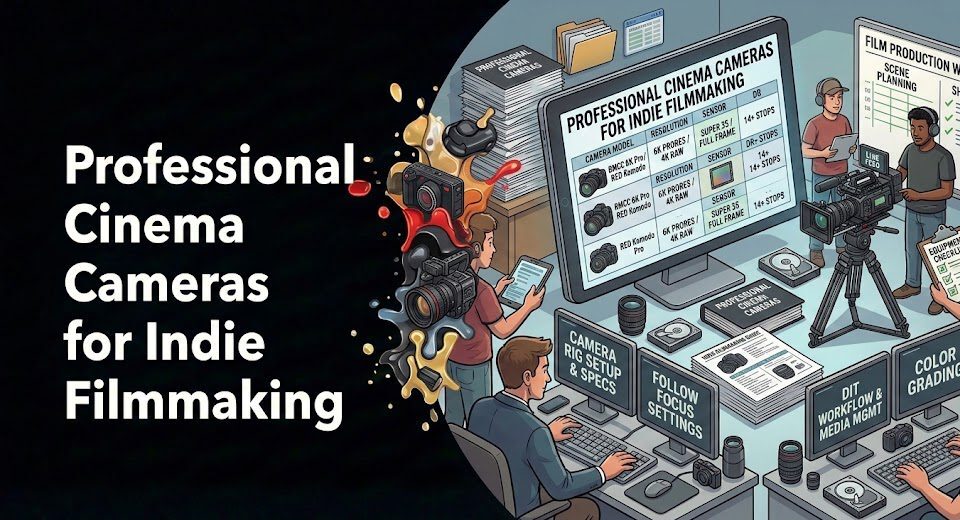
The best cinema cameras for indie filmmaking in 2026 aren’t the ones with the longest spec sheet. They’re the ones that disappear into your workflow—letting your DP focus on the shot rather than the technology—while delivering footage that holds up under the scrutiny of acquisition executives and festival programmers who’ve seen every camera artifact and compression artifact imaginable.
Here’s what’s actually happening in the indie market right now: Phil Hunt, founder and CEO of Head Gear Films—which finances roughly 35–40 films per year—has been direct about the current production reality. The industry has become, in his words, “much, much harder in terms of getting movies off the ground and getting movies sold.” That commercial pressure has a direct bearing on your camera choice. Every dollar in your gear budget is a dollar not in your cast, your locations, or your finishing costs—all of which have a stronger effect on your film’s commercial trajectory than the sensor size of your primary camera.
This guide gives you a clear breakdown of the best professional cinema cameras by budget tier, plus the framing you need to make this decision intelligently—as a producer, not just as a cinematographer.
In This Guide
- How to Think About Camera Choice as a Budget Decision
- Under $3,000: Blackmagic Pocket Cinema Camera 6K G2
- $3,000–$5,000: Sony FX3 and Canon EOS C70
- $5,000–$8,000: Sony FX6, RED Komodo 6K, URSA Mini Pro 12K
- $8,000+: Canon C300 Mark III and the Studio Tier
- The Rental Argument: Why Ownership Isn’t Always Smart
- What Acquisition Executives Actually Care About
- Quick Comparison: Cinema Cameras by Budget Tier
- FAQ: Cinema Cameras for Indie Filmmakers
Ask VIQI: What Equipment Rental Companies Are Active in My Region?
VIQI is Vitrina’s AI assistant—trained on 1.6 million titles, 360,000 companies, and 5 million entertainment professionals. Ask it to find verified camera rental houses and production equipment suppliers matched to your territory and project type.
✓ Included with 200 free credits | ✓ No credit card needed
How to Think About Camera Choice as a Budget Decision
The real question isn’t “what’s the best cinema camera?”—it’s “what’s the best camera for this project, at this budget, shot by this DP, delivering to this platform?” Those qualifiers change the answer entirely. And they’re the questions that experienced independent producers ask before the gear conversation ever starts.
Here’s the practical framework before you commit to any purchase or rental decision:
- What’s your delivery spec? Netflix’s preferred 4K UHD acquisition spec is different from Amazon’s, and both differ from theatrical DCP requirements. Know your end-state first—it determines minimum resolution and codec requirements, which narrows your camera options before aesthetics enter the conversation.
- What’s your DP’s camera familiarity? A Blackmagic BRAW workflow and a Sony XAVC workflow have meaningfully different post-production implications. Your DP’s fluency with the camera system affects your shoot pace and your edit timeline. Don’t buy a camera your DP hasn’t shot on.
- Own vs. rent. Unless you’re producing 3+ projects per year, the ownership ROI calculation rarely favors buying. More on this in the rental section below.
- What does your genre demand? A low-light-heavy horror thriller has different sensor requirements than a sun-drenched road movie. Genre shapes the camera spec more than most producers acknowledge.
With that framework in place—here’s the breakdown by tier.
Under $3,000: Blackmagic Pocket Cinema Camera 6K G2
Nothing in this price range—nothing—matches what the Blackmagic Pocket Cinema Camera 6K G2 delivers for independent narrative production. At approximately $1,995, you’re getting a Super 35 sensor, 13 stops of dynamic range, native support for EF and PL lens mounts, and the Blackmagic RAW (BRAW) codec that gives you genuine color grading latitude in post. The image holds up under scrutiny. Full stop.
But here’s what the spec sheet doesn’t tell you: the BMPCC 6K’s limitations are real and worth understanding before you commit. The battery life is poor—you’ll need V-mount battery solutions or AC power for controlled environments. It runs hot. The ergonomics are designed for a DIT-centric workflow, not run-and-gun handheld production. And the internal ND system is absent, meaning you’re managing exposure through external NDs, which adds complexity for smaller crews.
The BMPCC 6K is ideal for: controlled narrative indie features with a camera department of three or more people, where the DP can focus on the image and a camera assistant handles the operational overhead. It’s a mistake for documentary or run-and-gun production unless your crew has specific experience making it work in those conditions.
For producers on a micro-budget wanting the highest possible image quality with dollars left over for cast and locations, this is the clear recommendation in its tier.

Your AI Assistant, Agent, and Analyst for the Business of Entertainment
VIQI AI helps you plan content acquisitions, raise production financing, and find and connect with the right partners worldwide.
- Find active co-producers and financiers for scripted projects
- Find equity and gap financing companies in North America
- Find top film financiers in Europe
- Find production houses that can co-produce or finance unscripted series
- I am looking for production partners for a YA drama set in Brazil
- I am looking for producers with proven track record in mid-budget features
- I am looking for Turkish distributors with successful international sales
- I am looking for OTT platforms actively acquiring finished series for the LATAM region
- I am seeking localization companies offer subtitling services in multiple Asian languages
- I am seeking partners in animation production for children's content
- I am seeking USA based post-production companies with sound facilities
- I am seeking VFX partners to composite background images and AI generated content
- Show me recent drama projects available for pre-buy
- Show me Japanese Anime Distributors
- Show me true-crime buyers from Asia
- Show me documentary pre-buyers
- List the top commissioners at the BBC
- List the post-production and VFX decision-makers at Netflix
- List the development leaders at Sony Pictures
- List the scripted programming heads at HBO
- Who is backing animation projects in Europe right now
- Who is Netflix’s top production partners for Sports Docs
- Who is Commissioning factual content in the NORDICS
- Who is acquiring unscripted formats for the North American market
$3,000–$5,000: Sony FX3 and Canon EOS C70
This tier is where you start trading raw image capability for operational efficiency—which, on a lean indie shoot, is a trade worth making.
Sony FX3 (~$3,799)
The Sony FX3 is the most operationally versatile cinema camera in the $3K–$5K range. It runs the same full-frame 12.1MP sensor as the Sony A7S III—a sensor that’s become the benchmark for low-light performance, routinely usable at ISO 12,800 and beyond with manageable noise. The form factor is compact enough for gimbal and handheld work. The autofocus system—Sony’s Real-Time Eye Tracking—is the best in class for the price. And the operational reliability on a 15-day run-and-gun indie schedule is simply better than what you get with the BMPCC ecosystem.
The tradeoff? The FX3 records in XAVC codecs with a maximum of S-Log3 rather than a true RAW output, which means your latitude in post is real but not at the same level as BRAW from Blackmagic. For most indie narrative projects delivering to streaming platforms, this is a non-issue. For theatrical deliverables that will go through extensive DI work, it’s worth a conversation with your colorist before you commit.
Canon EOS C70 (~$4,299)
Canon’s EOS C70 brings the Cinema EOS color science—which many colorists consider among the best native looks in the sub-$10K tier—into a compact, RF-mount body. The 4K DCI up to 120fps slow motion option is genuinely useful for action and genre work. The built-in ND filter system (up to 10 stops, electronic) is a significant operational advantage over both the FX3 and the BMPCC. On a lean shoot where your camera operator is also managing a small crew, not stopping to swap external NDs saves real time and real money.
The limitation: the RF mount ecosystem is more expensive than Sony E-mount or EF—which affects your lens rental costs if you’re not already in that ecosystem.
Find Verified Equipment Rental Partners for Your Production
Trusted by Netflix, Warner Bros, and Paramount. Join 140,000+ companies on Vitrina—the platform where indie producers discover verified production equipment and camera rental services filtered by territory and project type.
✓ 200 free credits | ✓ No credit card required | ✓ Full platform access
$5,000–$8,000: Sony FX6, RED Komodo 6K, URSA Mini Pro 12K
This is the tier where cameras start performing at a level that acquisition executives notice—not because of the brand name, but because the image latitude, the color depth, and the deliverable quality genuinely changes the post-production conversation.
Sony FX6 (~$6,498)
The Sony FX6 is the FX3 grown up. Same full-frame Sony sensor lineage, but with a variable ND filter system, a proper cinema form factor with a top handle, and XLR audio inputs that make it a genuine one-body solution for small-crew documentaries and mid-range indie narratives. The 4K 120fps capability and 12-bit RAW output to compatible recorders pushes the deliverable ceiling meaningfully above the FX3. It’s the workhorse camera for productions that need operational efficiency and cinematic image quality without stepping into the RED or Arri ecosystem’s complexity and cost.
RED Komodo 6K (~$6,000 body)
The RED Komodo 6K is a genuinely interesting proposition for independent producers: it’s the entry point into the RED RAW (R3D) ecosystem at a price point that micro-budget productions can actually consider. The Super 35 global shutter sensor eliminates rolling shutter distortion—significant for action content, any handheld work, and productions with fast lateral movement. And because it records in R3D RAW, your colorist has the same grading flexibility they’d expect from larger RED cameras at 3–4x the price.
The catch: the RED ecosystem has real costs beyond the body. You need RED proprietary media (expensive), and the R3D post workflow requires a system that can handle the decode—which isn’t automatic for smaller post houses. Know your post pipeline before you commit to RED.
Blackmagic URSA Mini Pro 12K (~$5,995)
If you’re a BRAW believer from your BMPCC 6K work, the URSA Mini Pro 12K is the logical step up. The 12K Super 35 sensor gives you enormous cropping flexibility for reframing in post—genuinely useful for smaller-crew shoots where you’re running fewer angles. The form factor is a proper cinema camera body with built-in NDs, multiple media slots, and XLR audio. It’s a serious tool. The workflow overhead is higher than Sony, but for experienced Blackmagic users, that’s a known quantity.
$8,000+: Canon C300 Mark III and the Studio Tier
Above $8,000, you’re in proper cinema camera territory. The Canon EOS C300 Mark III (approximately $11,000) is the most acquisition-friendly camera at this price point for independent narrative work—it records Cinema RAW Light in 4K and 2K with the Canon color science that post houses worldwide know and trust. The built-in 5-stop ND system and modular design make it a DP’s tool in the fullest sense: ready for a single-camera narrative, documentary, or commercial workflow without adding accessories to reach functionality.
And then there’s the Arri Alexa Mini—the camera that effectively set the visual standard for independent features with theatrical ambitions over the past decade. It’s approximately $45,000–$65,000 used to buy, which puts it out of reach for most indie budgets as a purchase. But it’s very much within reach as a rental: typically $800–$1,500/day from a reputable rental house, which on a 20-day shoot is a meaningful but justifiable BTL line item if your distribution aspirations warrant it.
Insiders recognize that the Alexa’s advantage isn’t just image quality—it’s the post pipeline shortcut. Colorists know it. Streamers know it. If you’re targeting theatrical distribution or a Sundance-tier acquisition, the Alexa is still the camera that generates the fewest platform-level conversations about technical delivery.
The Rental Argument: Why Ownership Isn’t Always Smart
Here’s the thing that camera manufacturers don’t want you to focus on: for most independent producers, renting a better camera than you can afford to buy is a superior capital allocation strategy.
Do the math. An Arri Alexa Mini LF rental for a 20-day shoot runs approximately $16,000–$25,000—including the camera package but not lenses. Buying a Sony FX3 costs under $4,000. The delta funds other production priorities. But the rented Alexa Mini LF delivers footage that takes you to a fundamentally different conversation with sales agents and distributors.
The rental argument wins when: your production cadence is fewer than two or three shoots per year, your projects vary enough in genre that no single camera optimizes across all of them, and your DP relationship changes project to project (so camera familiarity starts fresh anyway). Ownership wins when: you’re producing consistently at the same budget tier, your DP has a long-term relationship with the tool, and you have the infrastructure to maintain and insure the equipment.
For most independent producers, that calculation points toward renting. As we covered in our guide to equipment rental services for producers, accessing verified rental partners with the right camera inventory for your shoot territory is now significantly more streamlined than it was five years ago—which further weakens the ownership case for all but the most active production companies.
Connect with Production Equipment Partners Worldwide
A LA-based producer connected with Netflix UK, Fifth Season, and Fox Entertainment in 48 hours through Vitrina. Join 140,000+ companies using the platform to surface verified production service providers—including camera rental houses—matched to their territory and production type.
✓ 200 free credits | ✓ No credit card required
What Acquisition Executives Actually Care About
The real question for any independent producer isn’t “is this a cinematic camera?”—it’s “will this footage hold up at the point of sale?” And the honest answer from acquisition executives and sales agents is that the camera matters far less than most filmmakers assume—but it’s not irrelevant either.
As Variety‘s coverage of the Sundance and AFM acquisition markets has consistently reinforced, what buyers and sales agents scrutinize first is story, performance, and genre execution—not the camera. But technical quality functions as a threshold. Cross it and it stops being a factor. Fall below it and it becomes a conversation-ender during acquisition discussions, particularly for platform deliveries that have explicit technical requirements.
What that threshold looks like in practice, according to standard platform delivery specs reviewed by Screen International and the broader trade press:
- Netflix preferred minimum: 4K UHD with no heavy compression artifacts; RAW or high-bitrate log recording preferred for any original content acquisition
- Amazon Prime Video: 4K UHD acquisition; HDR delivery increasingly expected for originals
- Theatrical DCP: 4K or 2K DCI; the colorist and DCP house matter as much as the camera at this stage
- AVOD and FAST channels: More flexible, but 4K masters are increasingly standard even here
Every camera in the $3,000+ tier reviewed above clears these thresholds with a competent colorist. Below $2,000, the BMPCC 6K also clears them—but with more workflow complexity in post. The point is: your camera choice doesn’t need to impress a distributor. It needs to not disqualify you from a conversation with one.
Quick Comparison: Cinema Cameras by Budget Tier
FAQ: Cinema Cameras for Indie Filmmakers
Conclusion: Choose the Camera That Serves the Film
Your camera choice is a production economics decision as much as a creative one. The best cinema camera for indie filmmaking on a budget is the one that delivers broadcast-acceptable image quality, works within your DP’s expertise, fits your operational workflow—and leaves enough capital in the budget for the things that actually drive acquisition conversations: cast, story, and finishing quality.
Don’t let gear become a substitute for production intelligence. The right camera won’t save a weak script or a misaligned commercial strategy. But the wrong camera—or the wrong camera choice process—can quietly undermine every other good decision you’ve made.
Key Takeaways:
- Under $3,000: Blackmagic BMPCC 6K G2 is the clear best value for controlled narrative work—13 stops of DR, BRAW, Super 35 sensor at ~$1,995.
- $3K–$5K: Sony FX3 wins for operational versatility and low-light performance; Canon C70 wins when built-in ND and genre-specific slow-motion are priorities.
- $5K–$8K: Sony FX6 is the most all-around cinema workhorse; RED Komodo 6K for action/global shutter needs; URSA Mini Pro 12K for established BRAW teams.
- Rental beats ownership for most indie producers shooting fewer than 3 projects per year—renting an Arri Alexa for a 20-day shoot unlocks a different acquisition conversation.
- The camera clears a threshold—it doesn’t make the film. Acquisition executives care about story, performance, and genre execution first; technical quality functions as a gating criterion, not a competitive advantage.
Find Verified Production Equipment Partners—Start Free
Join 140,000+ companies on Vitrina, trusted by Netflix, Warner Bros, and Paramount. Discover verified camera rental houses, production service companies, and equipment suppliers filterable by territory, specialty, and production type.
✓ 200 free credits | ✓ No credit card required | ✓ Cancel anytime
Need Production Partners for Your Indie Project? We’ll Find Them.
Vitrina Concierge is your Virtual Agent. We make warm introductions to verified production service companies, equipment partners, and decision-makers actively looking for projects like yours—not a list, but real connections.
Find Film+TV Projects, Partners, and Deals – Fast.
VIQI matches you with the right financiers, producers, streamers, and buyers – globally.
Producers Seeking Financing, Co-Pros, or Pre-Buys?
Vitrina Concierge helps producers reach the right financiers, commissioners, distributors, and co-production partners — with precision outreach, not cold pitching.
Join Industry Briefings Trusted by Leaders

Micro-Dramas & Mobile-First Storytelling
Micro-dramas are building real audiences and revenue. Understand the platforms, buyers, and economics behind the growth.

Navigating Global Content Licensing Trends
How global content licensing is shifting beyond flat fees to flexible, deal-driven models.
Film & TV Production Financing: 2026 Trends
Production financing conditions are changing quickly. Understanding where money is moving and what buyers are backing is key to getting projects approved and funded in 2026.
Unreleased Film+TV Projects: Opportunities & Showcase
A curated view of unreleased Film and TV projects open for financing and collaboration