About Innovation Hub
 Global Content Pulse (Webinars)


 Global Production Financing
(Webinars)
Global Production Financing
(Webinars)  LeaderSpeak Podcast
  Global Entertainment Digest (Newsletter)
  About Vitrina
 About VIQI
 Our Story
 Our Solutions 🔥
 Film+TV Projects Tracker 🚀
 Case Studies
 Our Profile
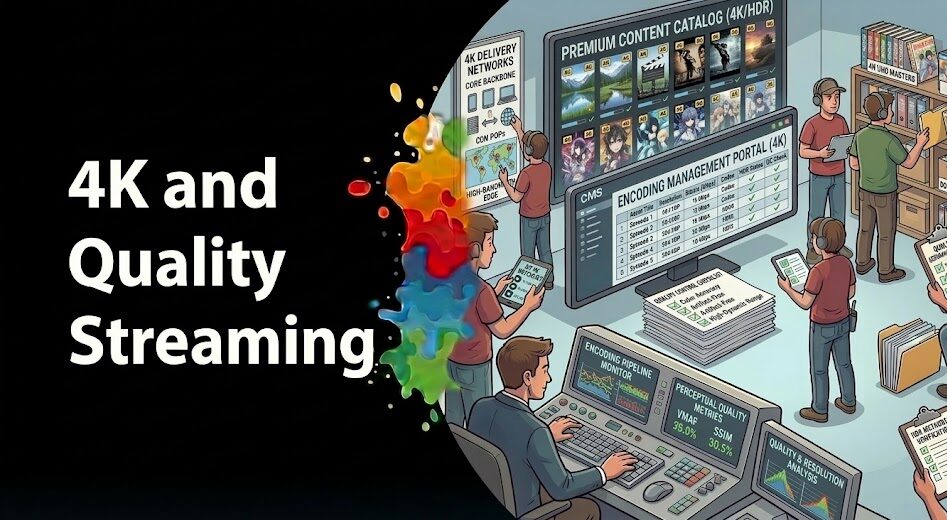
Anime at 4K HDR is a different experience entirely. The fluid sakuga cuts in Demon Slayer, the painterly backgrounds of Violet Evergarden, the kinetic fight choreography of Jujutsu Kaisen—all of it becomes measurably more stunning when your display is getting a true 4K HDR signal rather than an upscaled 1080p stream with a misleading quality badge. But here’s the problem most guides skip over: not all platforms claiming “4K” actually deliver it for anime, and many that do compress so aggressively that the bitrate makes the resolution feel pointless.
This guide cuts through the marketing language. We’re ranking the best anime streaming services for 4K HDR high quality video on five things that actually determine visual quality: native 4K content availability (not upscaled), HDR format support (HDR10, Dolby Vision, HLG), streaming bitrate and compression quality, how large the 4K anime catalog actually is, and whether the quality holds on large-screen devices. Not just which platform says “4K”—but which one actually delivers it.
And there’s one upstream reality that shapes the entire picture: most anime is still produced and mastered at 1080p or below. True native 4K anime is rarer than the platform marketing suggests. Understanding which titles are genuinely 4K versus upscaled 1080p is the single most important thing to know before evaluating any platform’s quality claims.
In This Guide
- The Uncomfortable Truth About 4K Anime in 2026
- Netflix — The 4K HDR Anime Leader With Dolby Vision Support
- Amazon Prime Video — 4K HDR With the Widest Format Support
- Disney+ — 4K for Ghibli and Pokémon, Dolby Vision Included
- Crunchyroll — Improving, But Not a True 4K Platform Yet
- Bitrate and Compression: Why Resolution Labels Lie
- Anime Titles That Are Actually Available in True 4K HDR
- What You Need to Actually Receive 4K HDR Anime
- Frequently Asked Questions
- Key Takeaways
Discover Which Studios Are Producing the Highest-Quality Anime in 2026
The visual quality of what you’re watching starts at the production studio level—not the platform. Vitrina tracks 400,000+ projects and 140,000+ companies across the global anime supply chain, including which studios are mastering in 4K HDR and which platforms are acquiring those titles. Used by acquisition teams at Netflix, Warner Bros, and Paramount.
Get 200 Free Credits — No Card Needed →
No credit card required • Cancel anytime
The Uncomfortable Truth About 4K Anime in 2026
Let’s establish the baseline before comparing platforms, because this is the thing most 4K anime guides deliberately obscure.
The overwhelming majority of anime is produced and composited at 1080p (Full HD)—and many titles, particularly long-running productions and older back-catalog series, were originally produced at 720p or lower. True native 4K production in anime—meaning the source animation files were created and rendered at 3840×2160 pixels—remains the exception rather than the rule. Studios like Kyoto Animation (Violet Evergarden, A Silent Voice), ufotable (Demon Slayer, Fate series), and MAPPA (Jujutsu Kaisen, Chainsaw Man) have invested in 4K production pipelines for their premium productions—but they represent a fraction of total anime output.
When a streaming platform labels an anime series as “4K,” it often means one of three different things—and the experience varies enormously between them:
- Native 4K — The source files were produced at 4K resolution. What you see is what the artists created. Rare but stunning.
- AI-upscaled 4K — The original 1080p (or lower) source was algorithmically upscaled to 4K using machine learning tools. Results vary from impressive to noticeably artificial, particularly on hand-drawn lines and motion sequences.
- Marketing “4K” — The platform streams at 4K resolution but from a 1080p or lower source without proper upscaling. It just looks like soft 1080p on a 4K screen. Essentially meaningless.
HDR (High Dynamic Range) is a separate quality layer from resolution—and often more impactful than the resolution increase itself. HDR expands the range of brightness and color that the image can display, making highlights genuinely luminous and shadow detail visible where standard dynamic range crushes it to black. For anime specifically—with its vivid color palettes, dramatic lighting, and high-contrast action sequences—HDR frequently has a more visible impact than the step from 1080p to 4K. For a deeper look at how premium streaming technology is evolving for high-quality content delivery, Vikram Arumilli from IMAX discussed the infrastructure challenge directly in the Vitrina LeaderSpeak series:

Vikram Arumilli, SVP and General Manager of Streaming and Consumer Technology at IMAX, discusses how the premium viewing experience is being brought to streaming platforms — the technical and delivery challenges that directly shape 4K anime quality.
The fragmentation of 4K anime content across platforms is also shaped by the same rights dynamics that drive every other aspect of anime streaming. Which platform acquires 4K HDR streaming rights—versus standard HD rights—is a separate licensing negotiation. That’s covered in our breakdown of anime streaming acquisition strategy for anyone tracking the supply-side dynamics.

Your AI Assistant, Agent, and Analyst for the Business of Entertainment
VIQI AI helps you plan content acquisitions, raise production financing, and find and connect with the right partners worldwide.
- Find active co-producers and financiers for scripted projects
- Find equity and gap financing companies in North America
- Find top film financiers in Europe
- Find production houses that can co-produce or finance unscripted series
- I am looking for production partners for a YA drama set in Brazil
- I am looking for producers with proven track record in mid-budget features
- I am looking for Turkish distributors with successful international sales
- I am looking for OTT platforms actively acquiring finished series for the LATAM region
- I am seeking localization companies offer subtitling services in multiple Asian languages
- I am seeking partners in animation production for children's content
- I am seeking USA based post-production companies with sound facilities
- I am seeking VFX partners to composite background images and AI generated content
- Show me recent drama projects available for pre-buy
- Show me Japanese Anime Distributors
- Show me true-crime buyers from Asia
- Show me documentary pre-buyers
- List the top commissioners at the BBC
- List the post-production and VFX decision-makers at Netflix
- List the development leaders at Sony Pictures
- List the scripted programming heads at HBO
- Who is backing animation projects in Europe right now
- Who is Netflix’s top production partners for Sports Docs
- Who is Commissioning factual content in the NORDICS
- Who is acquiring unscripted formats for the North American market
Netflix — The 4K HDR Anime Leader With Dolby Vision Support
Netflix is the clear leader for 4K HDR anime in 2026. The reasons are structural, not accidental. Netflix invested more than $2.5 billion in anime content between 2019 and 2023, according to reporting in Variety—and a significant portion of that investment went into co-production arrangements where Netflix specified production quality standards, including 4K HDR mastering requirements. When you finance the production itself, you get to require the deliverable format.
The result: Netflix’s original anime catalog has the deepest library of genuine 4K HDR content in streaming. Cyberpunk: Edgerunners (produced by Trigger), Castlevania: Nocturne, Baki Hanma, Blue Eye Samurai, and multiple Ghibli films in non-North American territories all stream in true 4K with HDR.
Netflix also offers the premium HDR format lineup: HDR10, Dolby Vision, and HLG depending on title and device. Dolby Vision is the gold standard—it carries dynamic metadata that adjusts HDR rendering scene-by-scene rather than applying a static profile to the entire film. The difference on an OLED panel watching a high-contrast anime sequence is visible. Cyberpunk: Edgerunners in Dolby Vision on a calibrated display is among the best anime looks available on any streaming platform.
The Limitation
Netflix’s 4K HDR anime catalog, while deep for what it carries, is a curated library—not a comprehensive one. Most simulcast seasonal anime doesn’t exist on Netflix at all. If your 4K priorities extend beyond Netflix’s originals and high-profile licensed titles, you’ll need additional platforms.
Find Which Studios Are Mastering Anime in 4K HDR Right Now
The 4K anime titles landing on platforms in 2026 were commissioned from specific Japanese studios with premium production specs. Vitrina maps 400,000+ projects and 140,000+ companies across the anime supply chain—including which studios are delivering 4K-mastered content and which platforms are acquiring those premium windows. Netflix UK sourced production intelligence in under 48 hours using Vitrina.
Amazon Prime Video — 4K HDR With the Widest Format Support
Amazon Prime Video matches Netflix’s HDR format breadth—offering HDR10, HDR10+, Dolby Vision, and HLG—and in one meaningful way, it goes further. HDR10+ is Amazon’s dynamic HDR format equivalent to Dolby Vision, developed with Samsung and supported natively on Samsung QLED panels. If your primary display is a Samsung TV (a large percentage of the 4K TV market), Amazon’s HDR10+ content frequently looks superior to the HDR10 streams you’d get from the same title on a competing platform.
Amazon’s 4K HDR anime catalog is selective but genuine. Vinland Saga (Season 2 in select territories), Mashle: Magic and Muscles, and the 2022 and 2023 exclusive anime acquisitions all benefit from Amazon’s 4K pipeline. The platform’s broader production investment in anime—including the Wit Studio co-productions—means it has acquired 4K rights for titles where the production quality supports them.
Amazon’s streaming bitrate for 4K content is also among the highest in the industry—consistently benchmarked at 15–25 Mbps for 4K HDR streams, versus Netflix’s typical 15–20 Mbps. On a calibrated display with sufficient internet bandwidth (25+ Mbps recommended), the compression artifacts that plague lower-bitrate platforms are largely absent on Amazon’s 4K streams. As noted in reporting by Deadline, Amazon’s investment in premium streaming infrastructure has been a deliberate differentiator for its video product since the 2020 Prime Video rebrand.
Disney+ — 4K for Ghibli and Pokémon, Dolby Vision Included
Disney+ earns its place in this comparison for a specific reason: it offers 4K HDR with Dolby Vision across its anime catalog—and in North America, that catalog includes the full Studio Ghibli library. Watching Spirited Away, Princess Mononoke, or Howl’s Moving Castle in 4K HDR Dolby Vision on a proper display is genuinely revelatory if you’ve only ever seen these films in standard definition or 1080p. The hand-painted backgrounds and color grading respond to HDR in a way that makes familiar scenes look new.
Disney+ streams 4K content at up to 20 Mbps—competitive with Netflix, adequate for most display configurations. The platform supports HDR10 and Dolby Vision on compatible devices. Not all Disney+ anime titles are available in 4K—older Toei Animation catalog titles like Dragon Ball series remain at 1080p or lower due to source limitations—but the premium titles are well-served.
The honest caveat: Disney+’s anime library is curated for a more general audience. It’s not the platform for comprehensive seasonal simulcasts or back-catalog exploration. But for the specific titles it has in 4K HDR—particularly the Ghibli catalog—the quality is exceptional and the Dolby Vision implementation is among the best in streaming.
Crunchyroll — Improving, But Not a True 4K Platform Yet
Here’s the honest assessment of Crunchyroll‘s 4K situation: the platform—despite being the largest dedicated anime streaming service in the world with 145 million+ registered users—does not currently offer true 4K streaming for the majority of its library. Most Crunchyroll content tops out at 1080p HD. A limited and slowly growing selection of premium titles are available in 1080p with HDR on specific devices, but widespread native 4K remains a gap in Crunchyroll’s technical delivery.
This is partly a catalog reality—most simulcast seasonal anime is produced and delivered at 1080p—and partly an infrastructure lag following the Funimation merger. Sony has invested in Crunchyroll’s platform technology, and some premium titles do stream at higher quality tiers on Apple TV 4K and PlayStation 5, but the platform is not consistently delivering the 4K HDR streams that Netflix and Amazon provide for their anime catalogs.
Does this mean Crunchyroll looks bad? No. Well-compressed 1080p on a 4K display with a good upscaling engine (most modern 4K TVs have one) looks excellent for anime. But if native 4K HDR is specifically what you’re optimizing for, Crunchyroll is not the platform to anchor your setup around. Use it for catalog depth and simulcasts; use Netflix or Amazon for premium quality on the titles that exist there. Understanding how each platform’s acquisition strategy shapes the quality it can deliver is precisely the kind of intelligence covered in our anime platform strategy guide.
Bitrate and Compression: Why Resolution Labels Lie
Resolution is a spec. Visual quality is a result. The gap between those two is entirely determined by bitrate—how much data is used to encode each second of video—and the compression algorithm applied to squeeze that data into a streamable file size.
A 4K stream at 8 Mbps looks noticeably worse than a 1080p stream at 15 Mbps. The compression artifacts that low-bitrate encoding introduces—visible “blocking” in gradients, motion blur artifacts in fast-moving animation sequences, color banding in sky backgrounds—are particularly damaging to anime aesthetics. The flat color fields and sharp line art that define anime’s visual style are exactly the content types that low-bitrate compression handles worst.
| Platform | Max Resolution | Typical 4K Bitrate | HDR Formats | 4K Anime Catalog |
|---|---|---|---|---|
| Netflix | 4K Ultra HD | 15–20 Mbps | HDR10, Dolby Vision, HLG | Strong — originals focus |
| Amazon | 4K Ultra HD | 15–25 Mbps | HDR10, HDR10+, Dolby Vision, HLG | Selective — exclusive titles |
| Disney+ | 4K Ultra HD | ~20 Mbps | HDR10, Dolby Vision | Ghibli + select titles |
| Crunchyroll | 1080p HD (primarily) | ~8–10 Mbps (1080p) | HDR on select titles, limited | Limited — improving |
| HiDive | 1080p HD | ~8 Mbps (1080p) | No HDR | None currently |
The minimum internet connection speed you need to reliably stream 4K HDR is 25 Mbps for Netflix and Disney+, and 35 Mbps for Amazon’s higher-bitrate 4K streams. Below these thresholds, most platforms will automatically downgrade to 1080p HD—which can happen invisibly without a quality indicator in the player.
Need Intelligence on Premium Anime Content Rights Before They Land?
The 4K HDR anime titles on Netflix, Amazon, and Disney+ are there because of premium rights deals negotiated directly with Japanese studios. Vitrina’s Concierge team helps acquisition professionals trace which studios hold 4K master rights to specific titles—and which platforms are acquiring premium-quality windows before they go public.
No commitment required • Response within 24 hours
Anime Titles That Are Actually Available in True 4K HDR
This list is shorter than platform marketing implies—but every title on it is genuinely worth seeking out on a calibrated 4K display:
On Netflix (4K HDR, Dolby Vision where noted)
- Cyberpunk: Edgerunners — Dolby Vision. Trigger‘s neon-drenched Night City aesthetic is among the most visually stunning anime ever made in HDR. The contrast ratios in night scenes on an OLED are extraordinary.
- Blue Eye Samurai — Dolby Vision. Not traditionally anime but produced as Japanese-inspired animation with an explicitly cinematic approach to color grading.
- Demon Slayer: Mugen Train — HDR10. ufotable‘s theatrical film looks exceptional in HDR; the Flame Breathing sequences in particular benefit enormously from the expanded brightness range.
- Full Studio Ghibli catalog — HDR10 (non-North America territories). Spirited Away, My Neighbor Totoro, and others have been remastered in 4K for this release.
- Baki Hanma — 4K HDR available in select territories.
On Amazon Prime Video (4K HDR, HDR10+ on Samsung)
- Vinland Saga Season 2 — HDR10+. MAPPA‘s production quality combined with Amazon’s high-bitrate 4K delivery makes this one of the best-looking anime available on Prime.
- Mashle: Magic and Muscles — 4K HDR in select regions.
- Made in Abyss: The Golden City of the Scorching Sun — 4K HDR in select territories.
On Disney+ (4K HDR, Dolby Vision)
- Full Studio Ghibli catalog — Dolby Vision (North America). This is the definitive home viewing presentation of these films.
- Pokémon films — Select theatrical releases in 4K HDR.
This landscape is actively shifting. As Japanese studios adopt 4K production pipelines—driven partly by streaming platform requirements and partly by the theatrical market’s shift to 4K DCP—more titles will receive genuine 4K HDR streaming releases annually. The future of anime streaming technology points toward 4K becoming a baseline production spec for premium titles within the next 3–5 years, which will expand this catalog significantly.
What You Actually Need to Receive 4K HDR Anime
Getting 4K HDR anime requires every component in the chain to support it. One weak link eliminates the benefit entirely.
- A 4K HDR display — Required. An OLED or QLED panel from LG, Samsung, Sony, or similar. For Dolby Vision specifically, confirm your TV is Dolby Vision certified—not all 4K HDR panels support it.
- A compatible streaming device — Apple TV 4K, Amazon Fire TV Stick 4K Max, NVIDIA Shield, Chromecast with Google TV 4K, or a 4K-capable smart TV app. Note that Crunchyroll’s 4K support is most consistent on Apple TV 4K and PlayStation 5; its Android and Roku implementations lag behind.
- An HDMI 2.0 or higher cable — HDMI 2.0 supports 4K at 60fps with HDR. Older HDMI 1.4 cables cap at 4K 30fps without HDR. Check your cable if the 4K signal isn’t passing through correctly.
- Internet connection of 25+ Mbps (Netflix/Disney+) or 35+ Mbps (Amazon) — Sustained, not peak. Run a speed test at the device location, not just at your router. Wi-Fi can degrade significantly through walls.
- The right subscription tier — Netflix requires the Standard with ads (no 4K) or Premium plan for 4K. Amazon Prime includes 4K on all plans. Disney+ includes 4K on all paid plans. Crunchyroll’s 4K requires the Mega Fan or Ultimate Fan tier.
Frequently Asked Questions
What is the best anime streaming service for 4K HDR high quality video?
Netflix is the best platform for 4K HDR anime in 2026, combining genuine native 4K titles, Dolby Vision support, and a growing catalog of co-produced originals mastered at premium quality. Amazon Prime Video is a strong second with HDR10+ support (particularly for Samsung displays) and the highest typical 4K bitrate among major platforms. Disney+ is essential if your 4K priorities include Studio Ghibli in North America. Crunchyroll—despite having the largest anime catalog—remains primarily a 1080p platform for most of its library.
Is Crunchyroll available in 4K?
Crunchyroll does not currently offer 4K streaming for the majority of its catalog. Most titles stream at a maximum of 1080p HD. A limited selection of premium titles offer HDR on specific devices (Apple TV 4K, PlayStation 5), but widespread true 4K Ultra HD delivery is not yet a standard Crunchyroll feature. The platform is improving but lags significantly behind Netflix and Amazon for 4K-specific quality.
Is most anime actually produced in 4K?
No—the majority of anime is still produced and mastered at 1080p or below. Studios like Kyoto Animation, ufotable, and MAPPA have adopted 4K production pipelines for premium titles, but they represent a fraction of total anime output. Many titles labeled “4K” on streaming platforms are upscaled from 1080p source files, not natively produced at 3840×2160 pixels. The native 4K anime catalog across all platforms is meaningful but considerably smaller than platform marketing suggests.
What is the difference between HDR10 and Dolby Vision for anime?
HDR10 applies a single, static set of HDR metadata to the entire film or episode. Dolby Vision carries dynamic metadata that adjusts HDR rendering scene-by-scene—or even frame-by-frame—for optimized brightness and color at every moment. For anime specifically, Dolby Vision’s dynamic adjustment is particularly valuable during high-contrast action sequences, where the range between deep shadows and bright highlights changes rapidly. On a Dolby Vision-certified OLED display, the difference compared to HDR10 on the same title is visible, particularly in scenes with dramatic lighting.
What internet speed do I need for 4K HDR anime streaming?
For reliable 4K HDR streaming: 25 Mbps minimum for Netflix and Disney+; 35 Mbps recommended for Amazon Prime Video’s higher-bitrate 4K streams. These are sustained connection speeds measured at the streaming device—not router peak speeds. If your connection fluctuates below these thresholds, platforms will automatically downgrade to 1080p. A wired Ethernet connection from your router to your TV or streaming device significantly improves 4K HDR reliability versus Wi-Fi.
Which Studio Ghibli films are available in 4K HDR?
The complete Studio Ghibli catalog of 21 films has been remastered in 4K HDR. In North America, all 21 films stream in 4K Dolby Vision on Disney+ via the GKids licensing agreement. In most other global territories—UK, Australia, Europe, Asia—the Ghibli catalog streams in 4K HDR on Netflix. This territorial split is a rights deal, not a technical limitation—the 4K remaster exists globally; the platform delivering it depends on your location.
Does the streaming device affect 4K HDR quality for anime?
Yes—significantly. The streaming device determines which HDR formats can be decoded and whether the full bitrate reaches your display. Apple TV 4K (latest generation) and Amazon Fire TV Stick 4K Max offer the most consistent 4K HDR performance across platforms. Smart TV built-in apps vary in quality—Samsung’s native app implementations are generally strong; Vizio and older Hisense TVs can struggle with high-bitrate 4K streams. If your smart TV’s built-in app isn’t delivering reliable 4K, adding a dedicated streaming device is a cost-effective fix that often noticeably improves quality.
Key Takeaways
4K HDR anime is real and it’s stunning—but it’s also rarer, more technically specific, and more platform-dependent than the streaming marketing suggests. The path to genuinely cinematic anime quality in 2026 requires the right platform, the right title, and the right display setup working together.
- Netflix leads for 4K HDR anime — Deepest library of genuine native 4K originals, Dolby Vision support, and the consistent bitrate to back it up. Cyberpunk: Edgerunners in Dolby Vision remains a benchmark for anime visual quality in streaming.
- Amazon Prime has the highest 4K bitrate — 15–25 Mbps for 4K HDR streams, plus HDR10+ for Samsung displays. The best technical delivery spec for viewers with high-end displays and fast connections.
- Disney+ is essential for Ghibli in 4K — All 21 Studio Ghibli films in 4K Dolby Vision in North America. No other platform matches this for the Ghibli catalog in that territory.
- Crunchyroll is 1080p for now — The largest anime catalog in streaming, but not a true 4K platform yet. Excellent for catalog depth and simulcasts; not the right anchor for a quality-first setup.
- HDR matters more than resolution for anime — For most titles and most displays, the step from SDR to HDR is more visually impactful than 1080p to 4K. Prioritize HDR format support when evaluating platforms for your specific display.
Explore the Premium Anime Supply Chain on Vitrina
The 4K HDR titles landing on Netflix, Amazon, and Disney+ are the result of premium rights deals struck with specific Japanese studios months before release. Vitrina tracks 400,000+ projects and 140,000+ companies across the global anime supply chain. Get 200 free credits to start mapping the production and licensing landscape behind premium anime.
No credit card required • Used by Netflix, Warner Bros, Paramount teams
Find Film+TV Projects, Partners, and Deals – Fast.
VIQI matches you with the right financiers, producers, streamers, and buyers – globally.
Join Industry Briefings Trusted by Leaders
Unreleased Film+TV Projects: Opportunities & Showcase
A curated view of unreleased Film and TV projects open for financing and collaboration
The Mid-Budget Comeback: Why Mid-Budget Films Is the Smartest Bet in the Room
Mid-budget films are attracting new capital. See why this segment is becoming one of the strongest bets in Film today.
Franchise Fatigue vs. IP Dependency: What Studios Should Be Betting On Now
s franchise performance softens, where will the next generation of valuable IP come from? Join the briefing.

Unscripted Is Eating the World: The Multi-Billion Reality and Format Boom
Unscripted is the new prestige — inside the $19.8B global format boom reshaping how streaming platforms compete.