IHUB
IHUB
 Private Briefings (Webinars)


 LeaderSpeak Podcast
  Global Entertainment Digest (Newsletter)
  Premium Lists
 Membership Benefits
 About Vitrina
 Our Story
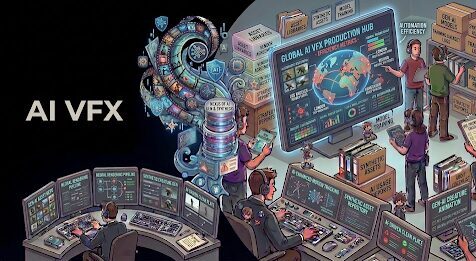
AI VFX is the application of artificial intelligence to visual effects production, automating tasks that once required hundreds of artist-hours, enabling effects that were previously cost-prohibitive, and fundamentally changing the economics of VFX for film and TV. In 2026, AI is embedded across the VFX pipeline: from automated rotoscoping and compositing to generative environment creation, neural de-aging, and AI-powered digital humans.
The Eight Core Applications of AI in VFX Production
AI is not a single tool but a category of technologies applied at different stages of the VFX pipeline. Here are the eight applications with the greatest production impact in 2026:
| Application | What AI Does | Time/Cost Saving | Leading Tools |
|---|---|---|---|
| Automated Rotoscoping | ML models segment subjects from background frame-by-frame with minimal manual correction | 60–80% reduction in roto artist hours | Silhouette AI, Mocha Pro AI, Adobe Firefly |
| AI Compositing | Neural networks handle color matching, edge refinement, and background integration | 40–60% reduction in comp time for standard shots | Foundry Nuke AI plugins, DaVinci Resolve Neural Engine |
| De-aging / Digital Humans | Neural networks reconstruct younger facial geometry and texture from reference footage | Enables effects previously requiring $5M+ budgets at $200–500K range | Metaphysic, Luma AI, proprietary studio tools |
| AI Upscaling | Super-resolution algorithms upgrade archival or lower-resolution footage to 4K/8K | Enables reuse of archive footage without reshooting | Topaz Video AI, NVIDIA DLSS, DaVinci Neural Engine |
| Generative Environment Creation | Text-to-image/video generates background plates, environment concepts, and set extensions | Pre-viz and concept generation 5–10x faster | Runway Gen-3, Stability AI, Adobe Firefly |
| AI Crowd Simulation | AI agents generate realistic crowd behavior with minimal manual animation | Stadium/battle scenes at fraction of traditional CGI crowd cost | Houdini AI agents, Massive, proprietary crowd AI |
| Real-Time Rendering Acceleration | AI denoising reduces the render passes required, and ray tracing acceleration runs via hardware AI | 3–5x render speed improvement with NVIDIA RTX AI denoising | NVIDIA OptiX AI denoiser, AMD HIP RT |
| AI Dubbing & Lip-Sync | AI replaces original language lip movements with target language equivalent | Localization cost reduction 40–60% vs. traditional dubbing | Flawless AI, Papercup, ElevenLabs |
Find AI-Capable VFX Studios for Your Production
Vitrina AI indexes 5,000+ VFX and production service companies globally, searchable by AI capability, specialisation, territory, and past credits.
How VFX Studios Are Integrating AI Into Their Pipelines
The question for VFX studios in 2026 is not whether to use AI but how to integrate it without disrupting existing workflows, managing IP risks, and maintaining creative quality control. The approaches vary significantly by studio tier.
Tier 1 Studios: Proprietary AI Development
Industrial Light & Magic, DNEG, Framestore, Weta FX, and MPC have invested heavily in proprietary AI tooling. Their approach:
- Custom training data: Models trained on their own shot libraries, meaning outputs match their proprietary quality standards and aesthetic
- Pipeline integration: AI tools built directly into Katana, Nuke, Houdini workflows, artists don’t switch applications
- Human-in-the-loop: AI automates the first 80% of a task. Artists handle the last 20% requiring creative judgment
- IP protection: No production assets processed through third-party cloud AI services, critical for pre-release content
ILM’s StageCraft virtual production system integrates AI-driven real-time rendering with LED volume technology. DNEG has deployed proprietary AI de-aging tools on multiple productions, including Marvel projects. Weta FX’s neural simulation tools were developed during the Avatar sequels and are now part of their standard pipeline.
Mid-Tier Studios: Commercial AI Tool Integration
Mid-tier VFX studios (50–300 seats) typically integrate commercial AI tools into specific pipeline stages rather than building proprietary systems:
- Roto and paint: Silhouette AI or Mocha Pro AI replaces manual roto for straightforward subject isolation
- Color and comping: DaVinci Resolve’s Neural Engine for color matching and Magic Mask for quick isolation
- Upscaling: Topaz Video AI for resolution enhancement on archive material or lower-resolution VFX elements
- Concept and pre-viz: Midjourney, Runway, or Adobe Firefly for rapid visual development before production
The economics are compelling: a mid-tier studio that replaces 50% of its roto hours with AI (while maintaining quality) can reduce costs on roto-heavy projects by 25–35%, improving bid competitiveness without reducing headcount on creative tasks.
Boutique Studios: AI as Capability Enabler
Boutique VFX studios (under 50 seats) are using AI to compete for work that would previously have required larger teams. AI-powered roto, compositing, and upscaling tools reduce the headcount required for many commercial and broadcast-tier projects. Some boutique studios are building AI-first workflows specifically designed for the cost-efficiency demands of streaming originals in secondary markets.
AI VFX Vendor Evaluation Checklist
- Identify which VFX categories in your project are AI-automatable (roto, paint, upscaling)
- Request AI tool disclosure from VFX vendors, what proprietary or third-party AI is in their pipeline?
- Clarify IP ownership of AI-generated assets in the SOW
- Verify union compliance: SAG-AFTRA AI provisions for digital humans/de-aging
- Test AI output quality against your broadcast/theatrical spec
- Assess AI-related data security: pre-release assets processed by third-party AI services
AI De-aging and Digital Humans: The Most Commercially Significant Application
AI de-aging has moved from experimental to production-standard between 2022 and 2026. The economic impact is significant: de-aging a lead actor now costs $200,000–$600,000 per film (versus $5M+ using purely CG replacement approaches used on films like “The Irishman” in 2019). This democratizes access to digital human effects for mid-budget productions.
Key developments:
- Metaphysic’s neural de-aging: Used on productions including “Here” (Tom Hanks, Robert Zemeckis). The company’s AI system analyzes reference footage to reconstruct younger facial geometry and skin texture
- SAG-AFTRA AI provisions: The 2023 SAG-AFTRA agreement established consent and compensation requirements for AI likeness use. Productions using AI de-aging must obtain explicit actor consent and pay additional fees. These provisions are now standard in talent deal memos
- Performance capture + AI synthesis: Motion capture with AI-driven facial synthesis creates digital characters that retain performance nuance, used for de-aging, posthumous appearances, and fully digital characters
For productions considering AI digital humans or de-aging, the key procurement consideration is ensuring SAG-AFTRA compliance is built into the VFX contract from day one, not treated as a post-production legal issue.
Generative AI in Pre-Production and Pre-Visualization
Generative AI has had its earliest and largest impact in pre-production. The economics are clear: generating 50 concept images for a production design meeting using Midjourney or Stable Diffusion takes 2–4 hours and costs under $100. The same output from a traditional concept artist team takes 2–3 weeks and costs $15,000–$30,000.
Current use cases in pre-production:
- Concept visualization: Rapid iteration on set design, creature design, costume concepts before committing to physical development
- Storyboard acceleration: AI-generated storyboard panels from shot descriptions, reviewed and refined by human storyboard artists
- Pre-visualization: Rough 3D pre-vis sequences generated from script breakdown, allows directors to test blocking and camera decisions before principal photography
- Location scouting supplements: AI-generated “versions” of real locations showing how they would look with set extensions or in different lighting conditions
The critical distinction: generative AI in pre-production creates references and concepts, it does not produce final deliverables. The IP ownership implications of using third-party generative AI tools for pre-production materials vary by jurisdiction and tool EULA and should be reviewed with production counsel before use.
AI VFX Economics: Impact on Studio Bidding and Project Budgets
AI is reshaping VFX economics in two directions simultaneously:
Downward Pressure on Automatable Work
Shot categories with high AI substitutability are seeing per-shot rate compression:
- Standard roto/paint: AI has compressed market rates by 30–50% since 2022 as AI roto becomes standard
- Motion graphics: AI-assisted motion graphics tools reduce production time significantly, and broadcast rates are under pressure as a result
- Simple compositing: Background replacement, sky replacement, AI handles quality that previously required 4–8 hours of comp time in 30–45 minutes
Premium for Complex Creative Work
AI has not compressed rates for high-complexity VFX work:
- Hero creature work: Photorealistic digital characters with complex simulation (fur, cloth, fluid) remain high-cost regardless of AI augmentation
- Simulation-heavy sequences: Destruction, crowds, water, fire, simulation at theatrical quality still requires significant artist expertise
- Fully digital environments: World-building at blockbuster quality (e.g., Avatar, Dune) requires deep artistic and technical investment that AI accelerates but cannot replace
The net result for productions: total VFX budgets can potentially decrease 10–25% on projects with high automatable VFX shot counts (commercial content, procedural TV), while tentpole theatrical VFX budgets remain stable or increase as AI enables more complex shots at the same price point.
Key Considerations When Procuring AI-Capable VFX Vendors
When sourcing VFX vendors for productions that will involve AI tools, productions should address these five areas in the vendor evaluation and SOW process:
1. IP Ownership of AI-Generated Output
Clarify in the SOW who owns AI-generated VFX elements. If the vendor uses a third-party generative AI service to create background plates or environment assets, the IP ownership may be governed by that service’s terms, not your production’s contract with the vendor. Require vendors to confirm all AI-generated deliverables are fully licensable for your production’s distribution plan.
2. Data Security for Pre-Release Assets
Major streamers (Netflix, Disney+) and studios have strict requirements about pre-release content security. If a VFX vendor is processing pre-release footage through a third-party cloud AI service, this may violate security protocols. Require vendors to disclose all AI tools used and confirm pre-release assets are processed only through on-premise or approved secure cloud environments.
3. Union Compliance for AI Likeness Use
SAG-AFTRA’s AI provisions require consent and compensation for AI use of actor likenesses. Your VFX SOW should require vendor compliance with all applicable guild agreements covering AI use. This applies specifically to de-aging, digital human work, and any AI that processes actor performance data.
4. Quality Disclosure
Require vendors to specify which deliverables are AI-generated vs. manually created and what quality assurance process applies. AI output quality can vary significantly between tools and training data, establish reference quality standards in the SOW rather than assuming AI output is automatically at the required spec.
5. Fallback Capacity for AI Failures
AI tools can produce unexpected output on edge cases, unusual lighting, complex motion, specific face shapes. Confirm that vendors have human artist capacity to manually remediate AI failures without delaying your schedule. AI-first pipelines with no manual fallback capability represent a production risk.
For a broader approach to evaluating and sourcing VFX vendors, see our Film & TV Vendor Sourcing Guide.
VFX Studio Intelligence:
Vitrina AI tracks AI tool adoption, specialisation areas, and production capacity across global VFX studios, helping productions match the right vendor to their AI VFX requirements before the RFP stage.
The Future of AI VFX: What to Watch Through 2027
The pace of AI VFX development is accelerating. Key developments to watch:
- Real-time AI rendering for final pixels: NVIDIA’s continued development of AI-accelerated path tracing is moving toward real-time quality at theatrical standard, potentially compressing render farm costs significantly for studios using compatible workflows
- AI-native pre-visualization: Systems that generate 3D pre-viz directly from script breakdowns (not just concept images) are in development at multiple major studios. Production pipeline implications will be significant when these reach production-standard quality
- Autonomous AI VFX for broadcast-tier content: For sports graphics, lower-budget TV, and commercial content, fully automated AI VFX pipelines, where AI handles brief, camera edit, motion graphics, and delivery with minimal human oversight, are approaching viability
- Guild rules in progress: SAG-AFTRA, IATSE, and WGA are all developing more detailed AI provisions. Productions entering multi-year development now should build flexibility into creative contracts to accommodate AI provision updates
Frequently Asked Questions
What is AI VFX?
AI VFX is the application of artificial intelligence and machine learning to visual effects production in film and TV. It covers automated rotoscoping, AI compositing, neural de-aging, generative environment creation, AI upscaling, crowd simulation, real-time rendering acceleration, and AI dubbing, tools that reduce cost, accelerate timelines, or enable effects previously out of reach for many production budgets.
Which AI tools are VFX studios using in 2026?
Leading VFX studios use a mix of proprietary tools and commercial platforms: Runway Gen-3 for generative video, Adobe Firefly for compositing, Topaz Video AI for upscaling and restoration, Silhouette AI and Mocha Pro for rotoscoping, NVIDIA OptiX AI denoiser for rendering, DaVinci Resolve Neural Engine for color and masking, and Metaphysic or Luma AI for digital human and de-aging work.
Does AI VFX replace traditional VFX artists?
AI VFX augments rather than replaces VFX artists in most 2026 production contexts. AI tools automate high-volume, time-intensive tasks (roto, paint, upscaling) allowing artists to focus on creative and technically complex work. AI is compressing rates and reducing staffing needs for entry-level automatable work, while demand for experienced artists on complex creature, simulation, and digital human work remains strong.
What are the main applications of AI in VFX production?
The eight main applications are: automated rotoscoping (60–80% time savings), AI compositing, neural de-aging and digital humans, AI upscaling, generative environment creation, AI crowd simulation, real-time rendering acceleration, and AI dubbing and lip-sync for localization.
How is AI changing VFX studio economics?
AI is compressing rates on automatable VFX work (roto, paint, simple compositing, motion graphics) by 30–50%, while complex creative work maintains premium pricing. Productions with high automatable shot counts can see total VFX budget reductions of 10–25%. Studios with strong proprietary AI tooling gain bid competitiveness. The net effect is market bifurcation between commodity VFX (AI-automatable) and premium creative VFX.
Source AI-Ready VFX Vendors Globally
Access Vitrina AI’s database of 5,000+ VFX and production service companies, filtered by AI capability, territory, and production history.