About Innovation Hub
 Global Content Pulse (Webinars)


 Global Production Financing
(Webinars)
Global Production Financing
(Webinars)  LeaderSpeak Podcast
  Global Entertainment Digest (Newsletter)
  About Vitrina
 About VIQI
 Our Story
 Our Solutions 🔥
 Film+TV Projects Tracker 🚀
 Case Studies
 Our Profile
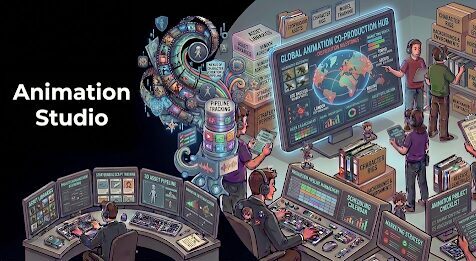
An animation studio creates animated content for film, television, streaming, advertising, and digital platforms — managing some or all of the production pipeline from concept to final delivery. For commissioners, broadcasters, and streamers, finding the right animation studio partner is a high-stakes decision: animation series take 18–36 months to produce, costs range from $200K to $3M per episode, and a studio mismatch (style, capacity, territory) can unravel a co-production financing structure. This guide covers how to evaluate, source, and partner with animation studios for professional productions.
Animation Studio Types: Full-Service vs. Service Production
Understanding the distinction between studio types is essential before approaching the market. The two models operate on fundamentally different commercial terms.
| Full-Service / IP-Owning Studio | Service Animation Studio | |
|---|---|---|
| IP ownership | Retains underlying IP rights, characters, bible | Client owns all IP; studio provides production services only |
| Revenue model | Co-production financing, licensing fees, merchandise, distribution deals | Production fee (cost + margin); sometimes co-production credit for incentive purposes |
| Client relationship | Co-producer or licensor; brings creative development to the table | Service provider executing against client brief and creative direction |
| Typical client | Broadcasters, streamers, distributors seeking co-production partners | Studios, production companies, broadcasters with IP needing production execution |
| Co-production value | Provides national broadcaster relationship, territory rights, tax incentive access | Provides tax incentive territory access and cost-efficient production capacity |
| Risk profile | Higher risk/reward — studio invests creative and financial capital | Lower risk — paid production fee regardless of commercial performance |
Most large animation production markets (France, Ireland, Canada, Japan, South Korea) have a mix of both types. Understanding which model a studio operates on shapes every aspect of the deal — from IP terms to financing structure to creative approval rights.
Find Animation Studios Globally
Vitrina AI indexes 3,000+ animation studios worldwide — searchable by style (2D, 3D CG, anime, stop-motion), territory, production credits, and co-production capability.
Global Animation Production Hubs
Animation production is geographically distributed in ways that reflect both creative traditions and tax incentive structures. Key hubs in 2026:
Japan — Anime Production
Japan produces 200–300 new anime titles per year, primarily through a production committee (seisaku iinkai) financing model where multiple investors co-own rights. Key studios:
- Toei Animation: Dragon Ball, One Piece, Sailor Moon — one of the largest anime producers by output
- Sunrise (Bandai Namco Filmworks): Gundam franchise, Code Geass, Love Live — strong in mecha and multimedia properties
- A-1 Pictures (Aniplex): Sword Art Online, Kaguya-sama, Blue Exorcist — Sony Music subsidiary with strong streaming relationships
- MAPPA: Jujutsu Kaisen, Chainsaw Man, Attack on Titan final arc — known for high-quality action animation
- Kyoto Animation: Violet Evergarden, K-On!, Clannad — premium production values, unusual for employee-owned model
- Ufotable: Demon Slayer: Kimetsu no Yaiba — responsible for the record-breaking theatrical film franchise
For international buyers seeking anime licensing or co-production, entry points include TIFFCOM (Tokyo), the Anime Licensing Forum, and direct outreach through Japanese talent agencies and sales companies. See our Anime Licensing Guide for full deal structure detail.
South Korea — Service Production Hub
South Korea is the world’s largest animation service production market for US and European content, handling an estimated 30–40% of US broadcast animation production. Seoul-based studios including DR Movie, Lotto Animation, Rough Draft Korea, and Sunwoo Entertainment produce for Disney, Cartoon Network, Nickelodeon, and multiple European broadcasters.
Korean studios offer cost efficiency (40–60% lower per-episode costs vs. US in-house production), strong 2D production capabilities, and well-established pipeline management for high-volume series work. The trade-off: timezone differences (UTC+9) require proactive communication management on international productions.
France — Creative IP Development
France has one of Europe’s most active animation IP development ecosystems, supported by the CNC (Centre national du cinéma) funding system and a legally mandated broadcaster investment obligation in animation. Key studios:
- Illumination Mac Guff: The Minions franchise, Sing — Universal Pictures subsidiary, high-end CG feature production
- Xilam Animation: Oggy and the Cockroaches, Zig & Sharko — successful IP library with strong international licensing
- Ankama: Wakfu, Dofus — known for transmedia IP development across games and animation
- TeamTO: Angelo Rules, Mighty Mike — mid-size studio with strong broadcaster relationships in Europe and North America
Cartoon Forum (September, Toulouse) is the key market for accessing French and European animation co-production opportunities. Pitches are made to buyers from 50+ countries; most major European broadcasting relationships in animation are initiated here.
Ireland — Tax Incentive Driven
Ireland’s Section 481 tax relief (32% on qualifying Irish production spend) makes it attractive for co-productions seeking European Union status and favorable financing. Studios including Brown Bag Films (owned by 9 Story Media), Boulder Media (owned by Disney), and Kavaleer Productions have built strong track records producing for Netflix, Disney Junior, and major European broadcasters.
Canada — Federal and Provincial Credits
Canada combines federal CAVCO credits with provincial incentives (BC, Ontario, Quebec) creating effective tax credit rates of 35–45% on qualifying Canadian production spend. WildBrain (formerly DHX Media), Corus/Nelvana, and Guru Studio are major IP-owning studios; multiple service studios in Vancouver and Toronto serve US and international clients.
India — Cost-Efficient 2D Service
India has a large animation service production industry concentrated in Mumbai, Hyderabad, and Pune. Studios including Green Gold Animation, Toonz Media Group, and Prana Studios provide 2D and 3D service production at significant cost advantages. India is particularly active in children’s content service production and broadcast animation for price-sensitive international markets.
Animation Studio Sourcing Checklist
- Define animation style requirements: 2D, 3D CG, anime-style, hybrid, stop-motion
- Set budget range per episode or per minute of finished content
- Identify target territories for co-production financing eligibility
- Review comparable credits: studios whose recent work matches your quality spec
- Assess capacity: is the studio available for your production window?
- Confirm IP terms: who retains underlying rights, music rights, character rights
- Verify tax incentive eligibility: does the studio qualify under target territory incentive programs?
Animation Production Costs: What to Expect by Format
Production costs vary significantly by animation style, production territory, and delivery specification. These ranges reflect 2026 market rates:
| Format | Production Territory | Cost Per 11-min Episode | Notes |
|---|---|---|---|
| Preschool 2D (broadcast) | Ireland / France | €280,000–€420,000 | Section 481 / CNC incentives typically reduce net cost 30–35% |
| Preschool 2D (broadcast) | South Korea (service) | $180,000–$280,000 | Lower cost; no IP contribution; requires co-production for incentive access |
| Premium 2D (streaming) | France / Canada | $450,000–$800,000 | Higher quality spec; adult animation or premium children’s content |
| 3D CG (broadcast tier) | Canada / Ireland | $600,000–$1,200,000 | Significant pipeline investment; incentives reduce net cost |
| Premium 3D CG (streaming) | US / France | $1,500,000–$3,000,000 | Netflix / Disney+ spec; character complexity, render quality, IP budget |
| Anime-style (broadcast) | Japan | ¥20M–¥40M (~$135K–$270K) | Production committee financing; simulcast rights often retained by Japanese investors |
| Stop-motion | UK / US | $1,000,000–$2,500,000 | Extremely capital-intensive; small number of specialist studios globally |
Key variable: Tax incentives can reduce the net production cost by 25–40% for qualifying co-productions. A €420,000 Irish-produced episode with Section 481 access has an effective net cost to an international co-producer of approximately €275,000–€300,000. Understanding territory-specific incentive structures is essential for accurate budget modelling at the development stage.
How to Evaluate an Animation Studio: A Six-Point Framework
Before committing to a studio partnership, commissioners and co-producers should assess six dimensions:
1. Creative Style Match
Animation style is non-transferable in the short term. A studio renowned for anime-influenced action sequences cannot pivot to flat-design preschool content on a single project. Review 3–5 recent productions in the target style, not the studio’s general showreel. Request scene-level breakdowns for comparable technical challenges (character animation complexity, environment rendering, lighting approach).
2. Production Capacity and Availability
Confirm the studio has bandwidth for your production window. Highly in-demand studios are often booked 12–18 months ahead. Ask directly: what is current episode throughput? How many concurrent series are in production? What percentage of capacity would your project represent? A studio at 90% capacity on a competitor project is a schedule risk.
3. Co-Production and Financing Track Record
If the deal requires co-production financing (access to broadcaster commitments, tax credits, or national fund support), assess the studio’s financing track record. Have they successfully closed co-production deals with comparable broadcasters? Do they have established broadcaster relationships in target territories? Can they provide completed deal references?
4. Financial Stability
Animation productions run 18–36 months. A studio financial failure mid-production is catastrophic — assets may be inaccessible, team disperses, and production must restart elsewhere. Review studio financial health indicators: length of operation, production volume trend, public ownership information if available. For service contracts above $2M, consider requiring payment milestone structures that retain meaningful leverage.
5. Technical Pipeline Compatibility
Confirm pipeline compatibility with your delivery requirements. What software does the studio use for rigging, animation, rendering, compositing? Does it match your post-production pipeline or will format conversion create downstream costs? For hybrid productions (animation + VFX integration), assess whether the studio has experience delivering layered outputs compatible with live-action VFX workflows.
6. IP and Rights Structure
Clarify IP terms before detailed development begins. For service productions: confirm work-for-hire terms, music rights ownership, and character design IP. For co-productions: negotiate territory rights splits, sequel rights, merchandise licensing, and reversionary provisions upfront. Rights disagreements in mid-production are among the most expensive and time-consuming disputes in animation.
Animation Studio Intelligence:
Vitrina AI tracks animation studio capabilities, production credits, co-production history, and broadcaster relationships globally — helping commissioners and distributors find the right production partner before the formal pitch stage.
Key Animation Markets and Industry Events
Animation co-production deals are initiated at a concentrated set of industry markets. Understanding where to engage is essential for both studios seeking co-producers and commissioners seeking animation partners.
| Market / Event | Location & Timing | Primary Function | Who Attends |
|---|---|---|---|
| Annecy International Animation Film Festival | Annecy, France — June | World’s largest animation industry gathering; project pitching, co-production meetings | Studios, broadcasters, distributors, financiers globally |
| Cartoon Forum | Toulouse, France — September | European animation co-production market; pitches to broadcaster buyers | European producers, broadcasters, distributors |
| MipJunior | Cannes, France — October | Children’s and animation content licensing and acquisition | Distributors, platform buyers, producers |
| TIFFCOM | Tokyo, Japan — November | Japanese content acquisition including anime; co-production with Japanese studios | Japanese producers, international buyers |
| Kidscreen Summit | Miami, US — February | Children’s media content deals; US broadcaster and streamer programming meetings | US and international producers, broadcasters, streamers |
| Ottawa International Animation Festival | Ottawa, Canada — October | Artistic showcase; industry networking; North American co-production | Studios, directors, broadcasters from North America and Europe |
Animation Studio Deal Structures
Animation deals between studios and commissioners take several forms depending on IP ownership, territory needs, and financing structure.
Service Production Agreement
Commissioner owns IP; studio delivers production services for a fixed fee. Payment milestones typically tied to deliverables: concept approval (15%), animatic delivery (25%), rough animation delivery (30%), final delivery (30%). All IP created vests in the commissioner. Studio takes no financial risk and earns no upside on commercial success.
Co-Production Agreement
Two or more parties share production financing, creative input, and rights — often structured to access multiple territory incentive programs. Typical structure:
- Each co-producer holds rights in their home territory
- World rights split by territory per negotiated schedule
- Each co-producer accesses their territory’s incentives on their share of qualifying spend
- Distribution revenue applied first to recoupment of co-producers’ investments, then to profit split per agreed share
Development and Option Agreement
Commissioner pays a development fee for the studio to develop IP (bible, pilot script, style guide, character designs) to presentation-ready stage. Commissioner holds an option to produce the series for a defined period. If the commissioner doesn’t exercise the option, IP reverts to the studio (unless otherwise negotiated).
For more on how content distribution deals interact with animation production partnerships, see the Film & TV Distribution & Acquisition Guide.
Finding the Right Animation Studio: Where to Start
The search for an animation studio partner typically begins with one of three approaches:
- Market attendance: Annecy and Cartoon Forum allow direct contact with studios actively seeking co-production partners. Most studio executives at these markets are specifically looking for commissioner and co-producer relationships.
- Supply chain intelligence platforms: Vitrina AI indexes 3,000+ animation studios globally, searchable by animation style, production territory, broadcaster relationships, and past production credits — allowing research before first contact.
- Sales agent and distributor introductions: Animation distributors (CAKE, Jetpack Distribution, ZDF Enterprises, Federation Entertainment) have deep studio relationships and can make targeted introductions based on your project requirements.
For complex co-productions requiring multiple territory partners, the sourcing process typically begins 18–24 months before target production start — allowing time for development financing, studio qualification, co-production agreement negotiation, and broadcaster presales before the production budget is committed.
Frequently Asked Questions
What does an animation studio do?
An animation studio creates animated content for film, television, streaming, and digital platforms — managing production from concept and character development through animation, rendering, compositing, and final delivery. Full-service studios develop and co-own IP; service studios provide production services for client-owned content.
How do broadcasters and streamers find animation studios?
Broadcasters and streamers find animation studios through industry markets (Annecy, MipJunior, Cartoon Forum), supply chain intelligence platforms like Vitrina AI, distributor and sales agent introductions, and direct outreach to studios whose work they’ve seen. For co-productions, national film bodies in target territories maintain approved studio lists.
What is the difference between a full-service animation studio and a service studio?
A full-service studio develops, produces, and often co-owns the IP — earning revenue through licensing, co-production deals, and distribution. A service studio provides production services for client-owned IP, paid a production fee with no IP stake or commercial upside. Most international co-productions involve full-service studios with their own development slate; service studios are more common for US broadcast animation produced in Korea or India.
How much does it cost to produce an animated series?
Costs vary by style and territory: preschool 2D animation from Irish or French studios runs €280,000–€420,000 per 11-minute episode (before incentives); premium 3D CG for streaming runs $1.5M–$3M per episode. Tax incentives in qualifying co-production territories (Ireland, Canada, France) typically reduce net cost by 25–40%.
What are the major animation production hubs in 2026?
The major animation hubs are Japan (anime production), South Korea (service production for US/European content), France (creative IP development), Ireland (tax incentive-driven production), Canada (federal/provincial credit stacking), and India (cost-efficient 2D service production). Each hub has distinct strengths in style, cost structure, and incentive access.
Source Animation Studios Worldwide
Access Vitrina AI’s database of 3,000+ animation studios — filtered by style, territory, co-production capability, and production history.