IHUB
IHUB
 Private Briefings (Webinars)


 LeaderSpeak Podcast
  Global Entertainment Digest (Newsletter)
  Premium Lists
 Membership Benefits
 About Vitrina
 Our Story
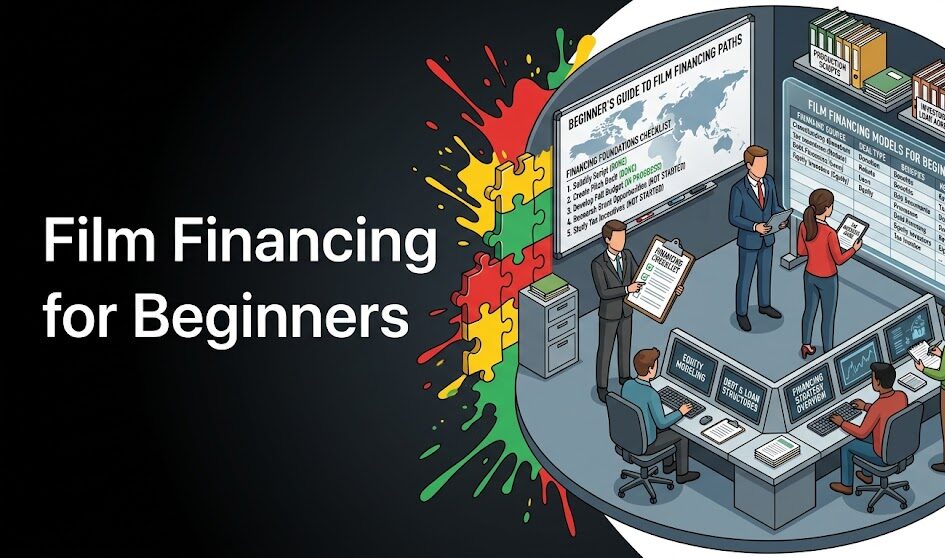
Nobody gives you a film financing roadmap when you’re starting out. You get vague advice about “finding investors” and “applying for grants,” but nobody shows you the order. That’s the part that kills most first films before they start.
Here’s the short version: budget first, soft money second, private investors third, pre-sales last. Most first-time independent filmmakers try to do it backwards—pitching investors before their budget is locked, approaching distributors before they have a package, applying for everything simultaneously without a strategy. This guide gives you the sequence: six concrete steps that move from what’s achievable with zero track record to what becomes possible as your project builds credibility.
Whether you’re working with $50,000 or $500,000, the step-by-step film financing plan below applies. The tools change as your budget scales. The sequence doesn’t.
Table of Contents
- Why Film Financing Feels Impossible for First-Timers (and Why It Isn’t)
- Step 1: Lock Your Budget Before You Approach Anyone
- Step 2: Start with Grants and Soft Money (No Equity Required)
- Step 3: Crowdfunding as Proof of Concept (Not Just Cash)
- Step 4: Approaching Private Investors for the First Time
- Step 5: Pre-Sales and Tax Incentives (Once Your Package Is Ready)
- Step 6: Building Your Team Before the Money Arrives
- The Financing Stack: What a Real First-Film Budget Looks Like
- FAQ
- Conclusion
Which Film Grants Are You Eligible For Right Now?
VIQI is Vitrina’s AI assistant—trained on 1.6 million titles, 300,000+ companies, and 5 million entertainment professionals. Ask it about grant eligibility, producer requirements, or financing timelines for your specific project.
✓ Included with 200 free credits | ✓ No credit card needed
Why Film Financing Feels Impossible for First-Timers (and Why It Isn’t)
Here’s what nobody tells you: the film financing system isn’t designed for first-time filmmakers. It’s designed for people who already have a track record. Gap financing lenders require completion bonds and proven producer credits. Sales agents want commercial packages with recognizable talent. Most equity funds evaluate slates, not individual projects.
But—and this matters—there’s a parallel system that does exist for first-timers. Grants, crowdfunding, micro-investors, and regional film funds don’t require a previous credit. They require a compelling project and a credible pitch. That’s a very different barrier to entry.
Phil Hunt, Founder & CEO of Head Gear Films—a company that has financed over 550 films in 25 years—puts the independent financing challenge plainly: “The whole industry has become much, much harder in terms of getting movies off the ground and getting movies sold.” But he’s also clear about what works: projects that the market actually wants, packaged by teams who’ve done their homework. That’s achievable even without a first credit—if you approach it in the right order.
Phil Hunt (Founder & CEO, Head Gear Films) on why independent film finance is hard right now—and what filmmakers can do about it:
Step 1: Lock Your Budget Before You Approach Anyone
This seems obvious. In practice, most first-time filmmakers skip it.
Your budget isn’t just a number—it’s a signal. Investors read your budget to evaluate whether you’ve done your homework. An over-inflated budget signals inexperience. An unrealistically low one signals you haven’t thought through post-production, insurance, or delivery requirements. Either way, you lose the room before you’ve made your case.
The right process starts with your script breakdown. Every scene, every location, every cast requirement generates costs. Independent films under $1 million typically break down as follows:
- Above-the-line (director, writers, principal cast): 20–30% of budget
- Below-the-line production (crew, equipment, locations): 40–50% of budget
- Post-production (editing, sound, color grading): 20–25% of budget
- Contingency (always include this): 10% of budget
Don’t include costs you haven’t researched. If you don’t know what a drone operator costs in your shooting location, find out before you put a number in the document. Nothing kills investor confidence faster than line items that clearly haven’t been verified. Lock this budget before any conversation with any potential funder—without it, you’re not ready for Step 2.

Your AI Assistant, Agent, and Analyst for the Business of Entertainment
VIQI AI helps you plan content acquisitions, raise production financing, and find and connect with the right partners worldwide.
- List the top commissioners at the BBC
- List the post-production and VFX decision-makers at Netflix
- List the development leaders at Sony Pictures
- List the scripted programming heads at HBO
- Find active co-producers and financiers for scripted projects
- Find equity and gap financing companies in North America
- Find top film financiers in Europe
- Find production houses that can co-produce or finance unscripted series
- Who is backing animation projects in Europe right now
- Who is Netflix’s top production partners for Sports Docs
- Who is Commissioning factual content in the NORDICS
- Who is acquiring unscripted formats for the North American market
- Show me recent drama projects available for pre-buy
- Show me Japanese Anime Distributors
- Show me true-crime buyers from Asia
- Show me documentary pre-buyers
- I am looking for production partners for a YA drama set in Brazil
- I am looking for producers with proven track record in mid-budget features
- I am looking for Turkish distributors with successful international sales
- I am looking for OTT platforms actively acquiring finished series for the LATAM region
- I am seeking localization companies offer subtitling services in multiple Asian languages
- I am seeking partners in animation production for children's content
- I am seeking USA based post-production companies with sound facilities
- I am seeking VFX partners to composite background images and AI generated content
Step 2: Start with Grants and Soft Money (No Equity Required)
Grants don’t take equity. They don’t take a percentage of your film. They give you money—sometimes significant money—because your project fits a cultural, regional, or thematic mandate. First-time filmmakers consistently underestimate how much soft money for independent films is available. Regional film funds, national arts councils, broadcaster development grants collectively represent millions that goes unclaimed every year—because filmmakers don’t find them, don’t apply correctly, or apply too late.
The key sources for first-time filmmakers, in rough order of accessibility:
National and Regional Film Funds
Every major English-speaking country has one. The BFI Film Fund in the UK, Screen Australia, the Canada Media Fund, Sundance Institute grants in the US. These exist specifically to support new voices. Read their eligibility criteria carefully—most require a resident producer or citizen director, which is achievable if you structure your team correctly from the start.
Cultural and Arts Council Grants
Less film-specific, but often less competitive. Regional arts councils and community foundations are accessible to first-timers if your film has a cultural, social, or educational dimension. These grants rarely exceed $25,000–$50,000, but combined with other sources, they meaningfully reduce your equity requirement.
Broadcaster Development Funds
Channel 4, ARTE, NHK, SBS—many broadcasters maintain development funds for projects aligned with their programming needs. Harder to access as an unknown, but not impossible if your pitch is compelling and your project fits their mandate. Worth researching if you’re already building toward broadcast distribution.
Film Festival Labs and Development Programs
Sundance Collab, IFP (now Gotham Film & Media Institute), IFFR Rotterdam, Berlinale Talents. These don’t just offer development funding—they offer industry relationships. Getting into one of these programs is itself a credibility signal that helps you at every subsequent step. Application timing matters: build a calendar. Missing a deadline means waiting six to twelve months to reapply.
For a broader breakdown of film production funding sources across regions, the options are more extensive than most first-time filmmakers realize.
Find the Right Funders for Your Project
Trusted by Netflix, Warner Bros, and Paramount. Join 140,000+ companies tracking the global entertainment supply chain—including film funds, co-production partners, and private investors actively seeking projects like yours.
✓ 200 free credits | ✓ No credit card required | ✓ Full platform access
Step 3: Crowdfunding as Proof of Concept (Not Just Cash)
Crowdfunding for independent film is widely misunderstood. Most first-time filmmakers approach it purely as a funding mechanism—”if we raise $30,000 on Kickstarter, we can make the film.” That’s the wrong frame.
The more powerful use of crowdfunding is proof of concept. A successful campaign demonstrates to future private investors that real people in the real world care about your project enough to pay for it before it exists. That’s a genuinely meaningful signal when you’re sitting across from an angel investor six months later.
What makes crowdfunding campaigns work:
- Your existing community, not strangers. Most successful campaigns are funded by people who already know and trust the creator. Your first 48 hours are disproportionately important—reach your warmest contacts before the campaign goes live. A campaign hitting 30% of target in 48 hours gets organic traction; one that starts slowly rarely recovers.
- Transparency builds trust. Break down the budget publicly. Show people exactly what the money does. “This covers three days of principal photography and the lead actor’s travel” lands better than “help us make this film.”
- Tiered rewards that mean something. Associate producer credits for larger backers, set visits, private Q&As. First-time filmmakers undervalue these—some angels genuinely care about credits.
Platforms worth considering: Kickstarter for general projects, Seed&Spark specifically for independent film (with a more engaged audience), and Patreon if you’re building a longer-term creative career rather than funding a single project. The practical cap is real: crowdfunding for film rarely exceeds $50,000–$100,000 for first-time filmmakers without an existing audience. Plan accordingly—it’s a proof point and gap-filler, not your primary funding source.
Step 4: Approaching Private Investors for the First Time
Private investors—angels and micro-equity investors—are the most common path for first films in the $100,000–$500,000 range. They’re also the most frequently misapproached.
Here’s what most first-time filmmakers get wrong: they pitch the film before they build the relationship. Film investment is relationship-driven. No experienced private investor writes a check to someone they’ve just met. The pitch comes after the relationship—sometimes weeks or months later.
What to bring to those relationship-building conversations:
Your Business Plan, Not Just Your Screenplay
A proper film business plan includes: a two-page executive summary, project overview and synopsis, target audience analysis, comparable films with performance data, your marketing and distribution strategy, the full budget and financing plan, projected returns across three scenarios (conservative, mid, high), team credentials, and legal structure. Without this, you’re asking someone to invest in a dream. With it, you’re asking them to invest in a business.
Realistic Return Expectations
Independent film is high-risk investment—don’t hide that. Experienced angels know the failure rate. What they want is evidence you understand it too, and that you’ve structured the deal with appropriate risk mitigation. A completion bond commitment letter shows seriousness. A clear waterfall structure—outlining exactly how revenue flows to investors before profit participation—shows you understand recoupment. These details matter to anyone who’s done a film deal before.
The Right Investor Profile
Not all money is the right money. Film investors who have never invested in film before often want more creative control than you’re comfortable giving. Andrea Scarso, Managing Partner at IPR VC—a fund that has co-financed over 15 films with A24 alone—notes: “The challenge in the industry right now is not on deal flow, it’s on the quality of investing, it’s on how you structure the investment.” That applies to your first private investor conversation. Structure the deal well before you ask for the capital.
Look for: film industry professionals with capital, people in adjacent creative industries (music, publishing, advertising), and high-net-worth individuals with a demonstrated passion for film. These investors understand the asset class.
Step 5: Pre-Sales and Tax Incentives (Once Your Package Is Ready)
Pre-sales and tax incentives aren’t where first-film financing starts. They’re where it finishes.
Pre-sales require a sales agent. Sales agents require a marketable package—recognized director, name cast, commercial genre. Most first-time filmmakers don’t have this yet. That’s fine. This step becomes available as your project builds credibility through Steps 2–4. But tax incentives? Different story. Most production incentive programs qualify any production regardless of the producer’s track record, as long as you meet the spend requirements.
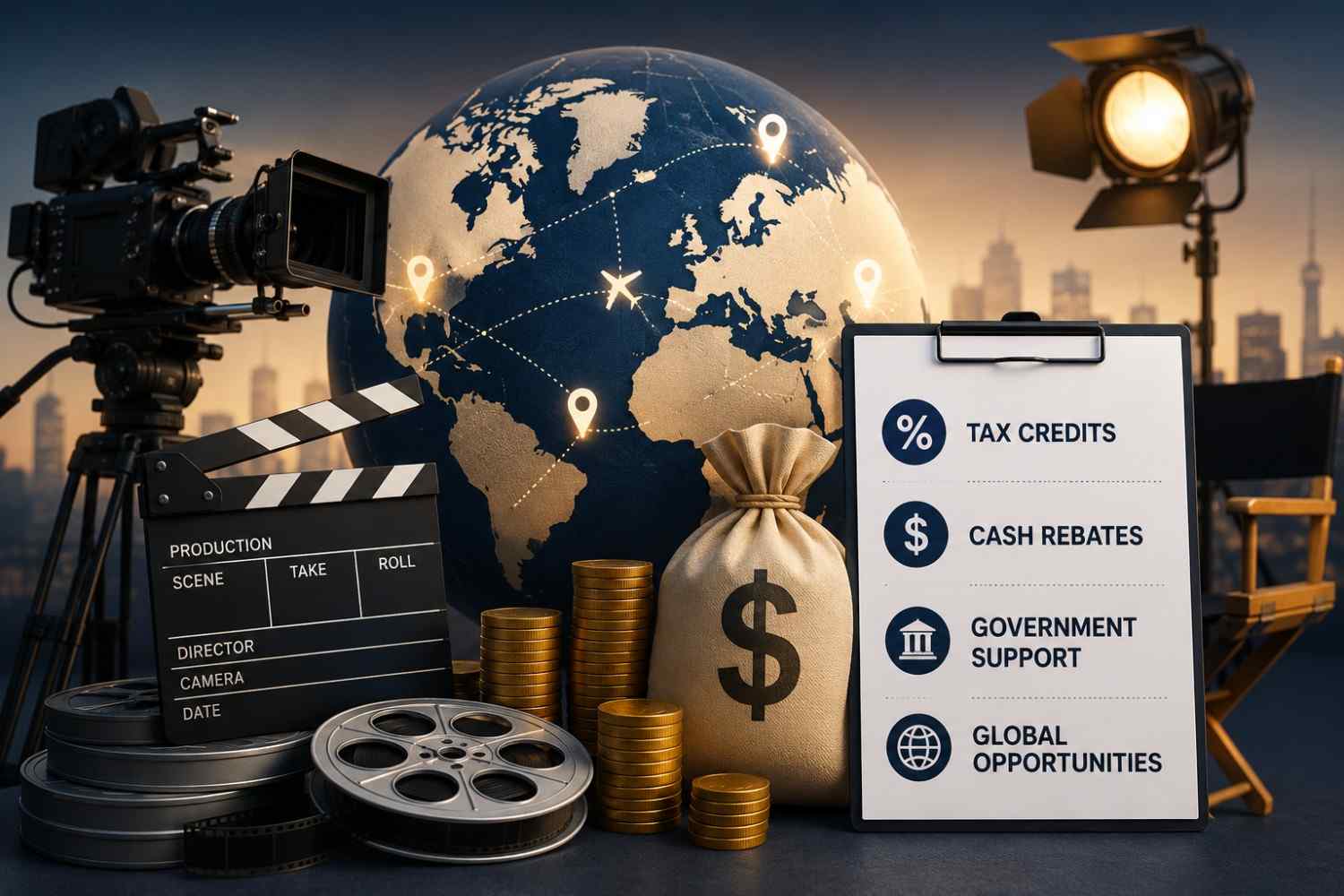
The global film tax incentive landscape for independent productions, in brief:
- Georgia (US): 30% transferable tax credit, no annual cap—one reason it’s become a dominant production hub with over $4.2 billion in annual production spend.
- UK: 25% Audio-Visual Expenditure Credit on qualifying UK spend. Cultural test required but achievable for most projects with UK elements.
- Australia: 30% Location Offset for international productions; 40% Producer Offset for Australian projects.
- Canada: Federal 25% refundable tax credit, with provincial add-ons that can push the effective rate significantly higher.
- Saudi Arabia / UAE: 40–50% cash rebates—among the most aggressive in the world—as part of regional production expansion initiatives.
The critical caveat: incentive payments are backend money. You receive them after production and audit, typically 6–18 months after wrap. They don’t fund your production directly—but they can be used as collateral for rebate loans from entertainment lenders, which do provide bridge financing during production. Work with a production accountant who specializes in incentives before you commit to a shooting location. The headline rate is one factor; qualifying spend requirements and local spend mandates are the others. For a deeper look at film tax credits and incentives by territory, the differences in eligibility are significant.
Step 6: Building Your Team Before the Money Arrives
Most first-time filmmakers leave team-building until after financing is secured. That’s backwards—your team is part of your financing package.
Private investors and grant panels evaluate your project largely through execution risk. Who is actually going to make this film? Do they have the capability? A strong producer with a track record dramatically reduces perceived risk, even if you as the director are an unknown. Get these people attached early—often on the promise of their full rate once financing closes. Their names on the package change the conversation.
Key hires to prioritize before the money arrives:
- An experienced line producer. Their attachment signals competence to investors—and they often catch budget errors before those errors cause problems downstream.
- A production lawyer. Entertainment attorneys are non-negotiable. Chain of title, rights agreements, investor documents, co-production frameworks—getting these wrong is expensive. Get legal counsel involved before you sign anything.
- A sales agent (when your package is ready). Sales agents are sometimes willing to have early conversations about a project’s market potential before formally signing on. That conversation is valuable intelligence—it tells you what the market actually thinks of your package before you’ve raised a dollar.
If you’re building out your understanding of gap financing for later-stage projects, team credentials will matter—lenders evaluate the producer as much as the package.
The Financing Stack: What a Real First-Film Budget Looks Like
Let’s make this concrete. Here’s how a realistic $500,000 first independent film might actually be financed—not in theory, but in practice:
This isn’t a template—it’s a demonstration. Notice what’s absent: gap financing, pre-sales, and institutional debt. At $500,000, those tools aren’t in the picture. What funds a first film is grants, small equity, incentives, and deferred payments. That’s a capital stack you can close without industry connections—if you work the steps in order.
Deferred payments deserve special mention. Experienced crew members sometimes work on first films for reduced or deferred fees if they believe in the project—not out of charity, but as calculated risk. They get a credit, they get the experience, and they get paid from revenues if the film finds distribution. Structure these arrangements through a production lawyer. Don’t rely on a handshake. A comprehensive look at how to finance a film in 2025 shows how deferred arrangements have become a standard part of micro-budget capital stacks.
Need Direct Introductions to Film Funders? We’ll Make Them.
Vitrina Concierge doesn’t give you a list—we make warm introductions to decision-makers actively seeking projects like yours.
- Korean animation studio → Netflix Adult Animation (week one)
- LA producer → Netflix UK, Fifth Season, Fox Entertainment (48 hours)
- Middle Eastern studio → Legendary Pictures (direct access)
Frequently Asked Questions
Do first-time filmmakers qualify for gap financing?
Almost certainly not—at least not without a significant track record. Gap financing is a debt facility secured against unsold distribution territories, and lenders require a proven producer, reputable sales agent, and completion bond. First-time producers rarely have the relationships needed to access this instrument. The good news is that gap financing isn’t needed at the first-film level. Grants, small equity, and tax incentives are more accessible and more appropriate starting points.
How much does it cost to apply for film grants?
Most film grants are free to apply for. The investment is time, not money—application packages often require a treatment, budget, synopsis, director’s statement, team bios, and sometimes a short work sample. Some festival-adjacent lab programs charge a small application fee ($25–$75), but most national and regional film fund applications are free. The real cost is the time required to do each application properly, which is why building a grant calendar and reusing core materials across applications matters.
What’s the minimum budget to attract a private film investor?
There’s no hard minimum—the question is whether the deal is structured attractively enough to justify the risk. Angel investors typically write checks of $50,000–$500,000 for film projects. For amounts below $50,000, personal networks, crowdfunding, and small grants are generally more appropriate. Above $100,000, you’re in territory where a proper business plan, waterfall structure, and realistic return projections are non-negotiable. The budget itself matters less than whether the investment thesis is credible.
Can I stack multiple funding sources for my first film?
Yes—and you almost certainly have to. Most first independent films are funded through a combination of 4–6 different sources: grants, equity, crowdfunding, tax incentive bridges, personal contributions, and deferred payments. Stacking is normal. The important thing is that each source is legally compatible with the others—which is why a production lawyer should review your financing structure before you finalize any agreements.
How long does film grant funding typically take?
Longer than most first-timers expect. National film fund applications typically have review periods of 3–6 months from application deadline to decision notification, followed by contract negotiation and payment processing. Total timeline from application submission to funds in hand is often 6–12 months. Plan your production timeline accordingly—don’t assume grant funding will be available in time for a shoot you’re planning in the next few months.
What’s a realistic crowdfunding goal for a first independent film?
For most first-time filmmakers, $15,000–$50,000 is a realistic and achievable crowdfunding goal. Higher targets are possible but require an existing audience with real engagement. Setting a target that’s too high and failing publicly is worse than setting a modest goal and exceeding it—a successful campaign that exceeds its target creates momentum you can leverage in investor conversations. Set a goal you’re confident you can hit, not a goal that reflects your full budget aspiration.
Do I need an entertainment lawyer before approaching investors?
Yes—before accepting any money, not just before approaching investors. In most jurisdictions, equity offerings are regulated as securities. An entertainment attorney ensures your investor documents comply with applicable securities laws, protects chain of title, and structures the deal to avoid disputes later. The cost ($5,000–$15,000 for basic investor document preparation) is far less than the cost of getting it wrong. Most production lawyers will do an initial consultation to scope the work.
How do I find a sales agent as a first-time filmmaker?
The honest answer: it’s hard without a project that’s already generating interest. Sales agents typically sign on when they see a commercially viable package—recognizable talent or director, strong genre, completed or near-completed film. Your best early path to a sales agent is through festival lab programs (many have industry connections baked in), through your entertainment lawyer’s network, or through attending markets (AFM, Cannes Marché, EFM). Research agents who represent films similar to yours in budget range and genre, and approach them with a polished package, not a cold pitch.
Conclusion: The Sequence Is the Strategy
The film financing path for first-time filmmakers is genuinely harder than it looks from the outside. But it follows a pattern. The filmmakers who close their first deal aren’t usually the most talented. They’re the ones who understood the sequence and executed it methodically—budget first, soft money before equity, relationships before pitches, team before money.
Key Takeaways:
- Budget first, always: No investor conversation should happen before your budget is locked and every line item is defensible.
- Soft money before equity: Grants and regional funds give you capital without ownership dilution—pursue them before you approach private investors.
- Crowdfunding proves demand: A successful campaign demonstrates real-world interest to future investors—use it as proof of concept, not just a fundraising tool.
- Relationship precedes pitch: Private investors don’t write checks to strangers—build the relationship first, pitch the project second.
- Tax incentives are backend but bankable: Plan for the 6–18 month lag between production and payment; rebate loans bridge the gap in production cash flow.
- Team as validation: Experienced team members reduce perceived execution risk for every funder you approach.
The first deal is the hardest. But every producer who works at the level of Head Gear Films, IPR VC, or Peachtree Media started with exactly one film. Work the steps. Don’t skip the sequence. The capital is there for projects that earn it.
Track 140,000+ Entertainment Companies and Funders in One Place
Trusted by Netflix, Warner Bros, Paramount, and Google TV. Access 1.6 million+ tracked projects, 3 million verified executives, and VIQI—Vitrina’s AI assistant trained on the global entertainment supply chain.
✓ 200 free credits | ✓ No credit card required | ✓ Cancel anytime
Need direct introductions to film funders? Explore Concierge Service →