Film Production Funding Sources: A Complete Guide for Producers (2026)
By Vitrina Research Team | Published: July 13, 2026 | Updated: July 14, 2026 | 14 min read
The global film and TV production market reached $298.47 billion in 2025 (Mordor Intelligence). But for most independent producers, accessing those film production funding sources requires assembling capital from multiple streams simultaneously – government incentives, presales, co-production partners, equity investors, and streaming deals – each with its own timeline, requirements, and trade-offs.
The market is projected to reach $409.69 billion by 2031 at a 5.54% CAGR (Mordor Intelligence). That growth is real. But the capital doesn’t flow to projects automatically. Producers who consistently finance independent films share one defining skill: they understand how each funding source works, when to apply it, and how to combine sources into a coherent financing stack without losing creative control.
This guide covers every major film production funding source available in 2026 – from government tax incentives and Eurimages co-production funds to streaming platform deals and private equity. For each source, we explain what it pays, what it requires, and where it fits in a real financing structure. You can read the broader context in our film financing guide for independent producers.
Key Takeaways
→ Film production funding almost always requires 3-6 sources stacked together – no single source covers a full budget.
→ Netflix is guiding $20B in content spend for 2026 (Variety) – streaming deals now anchor mid-budget independent financing.
→ Government tax incentives – the UK’s 34% AVEC, Canada’s 25% federal credit, Australia’s 40% Producer Offset – can cover 25-40% of qualifying costs.
→ France’s CNC reported that 47.2% of approved films in 2025 were co-productions, with €294.3M in foreign contributions – co-financing is mainstream, not exceptional.
Quick Answer
The main film production funding sources are government tax incentives (25-40% of qualifying costs), streaming platform deals, presales and distribution advances, international co-production funds, and private equity. Most independent films stack 3-6 sources simultaneously. Eurimages distributed €27.6M across 91 projects in 2025 (Council of Europe). Government incentives are the most predictable anchor – close them first, bridge with a production loan, then close presales and equity in parallel.
The Film Funding Landscape in 2026: What’s Changed
The film and TV production market hit $298.47 billion in 2025 (Mordor Intelligence), yet independent producers report financing is harder to close than it was five years ago. The reasons are structural: streaming platforms have pulled back on volume deals, traditional presale markets are more selective, and interest rates have raised the cost of production loans. Assembling a financing stack now demands more precision, not less.
Three shifts define 2026’s funding environment. First, government incentives have become the most reliable anchor – every major production territory has either expanded its rebate or launched a new fund since 2023. Second, streaming platforms now behave more like traditional broadcasters, offering structured licensing deals rather than open-ended output commitments. Third, co-production is no longer a niche strategy. It is how most independent films over $5M get made. Our market intelligence guide for the media industry covers how data tools help producers track these structural shifts.
The M&E deal market reflects this scale. Total M&E deal value reached approximately $250 billion in 2025 (KPMG/Hollywood Reporter), covering acquisitions, licensing, and co-production agreements. Understanding where your project fits within that ecosystem – and which partners can help unlock each funding source – is the core challenge this guide addresses.
Most independent producers who successfully close financing on films over $3M use a minimum of four funding sources. Projects relying on two or fewer sources carry significantly higher closure risk, based on financing patterns observed across VIQI’s tracked production company dataset.
Citation Capsule
The global film and TV production market reached $298.47 billion in 2025 and is projected to grow to $409.69 billion by 2031 at a 5.54% CAGR, according to Mordor Intelligence. Total M&E deal value across acquisitions, licensing, and co-production agreements reached approximately $250 billion in 2025 (KPMG/Hollywood Reporter).
Government Tax Incentives and Film Funds: Where the Money Is
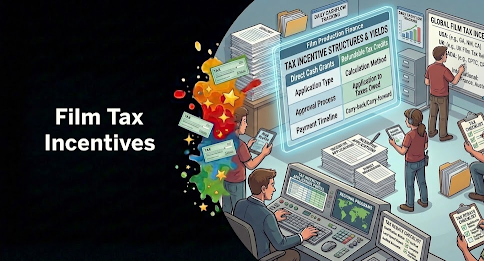
Government incentives remain the most accessible and predictable film production funding source. The UK’s Audio-Visual Expenditure Credit (AVEC) offers 34% on the first £1 million of qualifying spend and 25% above that threshold – a rate in effect since April 2024 (BFI). Australia’s Producer Offset pays 40% for feature films and 20% for television, with Australian drama spend hitting AU$2.7 billion in 2024/25 (Screen Australia). Canada’s federal tax credit covers 25% of qualifying Canadian labour costs (CAVCO).
These are not grants. They are tax credits or rebates on qualifying production expenditure, which means producers must spend money in-territory before receiving the benefit. Most productions bridge their incentive with a production loan from a specialist lender, using the confirmed credit as collateral. The loan costs 6-9% annualized in most major territories in 2026, which still leaves significant net benefit on a 34% or 40% incentive.
How to Qualify for Major Territory Incentives
Every incentive has a cultural test or minimum spend threshold. The UK’s BFI Cultural Test requires a minimum of 16 points across a 35-point scale covering cultural content, creative talent, and hub criteria. Australia requires a minimum AU$500,000 in qualifying Australian production expenditure. Canada requires the production to be a Certified Canadian Production with majority Canadian ownership and creative key roles filled by Canadians.
Beyond the big three, producers increasingly look at smaller territory incentives as gap-fillers. Malta offers a 40% cash rebate on eligible expenditure. Belgium’s Tax Shelter provides a significant deductibility benefit for Belgian investors. Ireland’s Section 481 credit runs at 32% of qualifying spend. Each of these can be stacked with a co-production treaty to unlock funds from multiple territories simultaneously. Understanding licensing challenges in the entertainment industry is essential when structuring multi-territory deals.
Soft Money vs. Hard Money Incentives
Producers distinguish between “soft money” and “hard money” incentives. Soft money includes grants, development funds, and equity from national film agencies that carry no repayment obligation – the UK’s BFI Film Fund, France’s CNC production support, and Germany’s FFA are examples. Hard money is the tax credit or rebate itself, which flows as real cash after production. Smart stacks use soft money for development and hard money to anchor production financing.
Citation Capsule
The UK’s Audio-Visual Expenditure Credit (AVEC) pays 34% on the first £1 million of qualifying production spend and 25% above that threshold, in effect since April 2024 (BFI). Australia’s Producer Offset pays 40% for feature films, with AU$2.7 billion in qualifying Australian drama spend recorded in 2024/25 (Screen Australia). Canada’s federal tax credit covers 25% of qualifying Canadian labour costs (CAVCO).
Streaming Platform Deals: The New Anchor Financing Source
Netflix spent $18 billion on content in 2025 and is guiding toward $20 billion for 2026 (Variety). That scale makes streaming platforms the single largest source of production financing available to independent producers – but accessing it requires understanding how platform deals actually work. Most are licensing agreements, not equity investments. The platform pays a license fee for a defined set of rights in specific territories, and that fee anchors a financing stack. The rise of streaming platforms and shifting viewer preferences has made these deals more structured and selective than they were in 2020-2022.
Platform deals come in several forms. A global rights deal – where the platform acquires worldwide streaming rights – pays the highest fees but eliminates the producer’s ability to sell territorial rights elsewhere. A territory-specific deal leaves the rest of the world available for presales. A co-production deal, where the platform co-finances and shares creative control, often provides the highest total budget contribution but comes with significant editorial involvement.
How Producers Access Platform Deals
Independent producers rarely pitch platforms directly without a sales agent or established relationship. The most common path is: attach a sales agent with platform relationships, develop the project to package stage (director, lead cast attached), then approach platforms for a pre-buy or co-development agreement. Platform acquisitions teams at Cannes, Berlin, Sundance, and Toronto’s market are the primary deal-making venues.
Understanding how content licensing shapes deal terms helps producers negotiate better agreements. Platforms pay different multiples for different right configurations, and knowing which rights to retain – and which to sell first – affects total financing significantly. A well-structured content acquisition strategy from the platform’s perspective tells you exactly what they prioritize in a pitch.
What Platforms Pay and What They Expect
Platform license fees for independent films typically range from 1x to 2.5x the production budget for global rights at the top-tier platforms – but only for projects that meet their audience metrics and quality thresholds. For territory-specific deals, fees are calibrated by market size. US rights from a major platform can cover 30-50% of a mid-budget independent film’s budget on their own.
Presales and Distribution Advances: Financing Through Forward Sales
A presale is a distribution agreement signed before a film is completed, where a distributor pays an advance against future revenue in exchange for territorial rights. Presales have been a cornerstone of independent film financing for four decades. They remain viable in 2026, though the market has become more selective: distributors want proven talent attachments, clear genre positioning, and realistic budgets before committing. The MPA estimates that international sales remain the second-largest revenue stream for independent productions after streaming, underscoring why presale markets still matter.
The mechanics work like this. A sales agent represents the project and approaches distributors territory by territory. Each signed presale agreement generates a contract that can be discounted at a bank to release cash during production. The bank lends against the face value of the contracts (typically at 80-90%), and the producer repays the loan when the film delivers to each distributor. The discount cost – the bank’s fee – runs at 8-12% annualized in current market conditions.
Which Territories Presell Best
The largest presale values come from Germany, France, the UK, Japan, and South Korea for international productions. The US market rarely presells through traditional presale structures – instead, US rights are more commonly licensed to a platform or distributed through a US domestic deal. Genre matters significantly: action, horror, and thriller genres command higher per-territory advances than drama or documentary.
Working with the right sales agent is the single biggest factor in presale success. Sales agents who attend all major markets – Cannes Marche, AFM, Berlin’s EFM, Hong Kong FILMART – and maintain active distributor relationships can generate presale packages that cover 40-60% of a mid-budget film’s cost. Producers without an existing agent relationship should prioritize finding one before approaching distributors directly.
Citation Capsule
Netflix spent $18 billion on content in 2025 and is guiding toward $20 billion for 2026 (Variety). Platform licensing fees for independent films with global rights typically range from 1x to 2.5x production budget at top-tier streamers, making streaming deals the largest single financing source available to independent producers in 2026. US platform territory rights alone can cover 30-50% of a mid-budget production.
FIND PRESALE AND PLATFORM PARTNERS
Identify Sales Agents and Distributors in Every Territory
VIQI gives producers a searchable database of 300,000+ M&E companies – including sales agents, distributors, and platform acquisitions contacts – in every major market.
France’s CNC reported that 47.2% of approved films in 2025 were co-productions, with €294.3M in foreign contributions. UK co-production spend reached £152 million in 2025 (BFI). These numbers confirm that international co-productions are not a niche strategy – they are how the majority of commercially ambitious independent films are financed.
A formal co-production treaty allows producers from two or more countries to combine their national incentives on a single production. A UK-France co-production, for example, can access the UK’s AVEC and France’s CNC support simultaneously, provided the project meets each country’s cultural test and the creative and financial split between partners is correctly structured. The result is a significantly larger incentive pool than either country could provide alone.
Eurimages and European Co-Production Funds
Eurimages, the Council of Europe’s co-production fund, distributed €27.6 million across 91 projects in 2025 (Council of Europe). Individual project grants range from €200,000 to €1.2 million, with priority given to projects involving three or more European co-producers. Eurimages applications are submitted by the majority co-producer and require a full co-production agreement, financing plan, and distributor commitments at the time of application.
Other significant European co-production funds include MEDIA (the EU’s primary film support programme), the Nordic Film and TV Fund, the Franco-German film fund DFFF/FFF Bavaria combination, and the Ibermedia fund for Spanish-language co-productions. Each has distinct eligibility criteria, application windows, and decision timelines – typically 3-6 months from submission to decision.
Finding the Right Co-Production Partner
The hardest part of co-production financing is not the paperwork – it’s finding a co-producer in the right territory who has the capacity, credits, and local relationships to qualify the project for that country’s funds. Co-producers need to be registered production companies in good standing with their national film agency, with a track record of completed productions and, ideally, existing relationships with local distributors and broadcasters.
The entertainment market intelligence you need to identify the right partners – verified company profiles, past production credits, financial standing, and territory relationships – is exactly what producers most often lack. VIQI’s database addresses this gap directly. Producers who approach co-production partner search with structured data close deals faster than those relying solely on festival introductions.
FIND CO-FINANCING PARTNERS
Map Production Partners Across Every Incentive Territory
VIQI gives producers a searchable database of 300,000+ M&E companies – including co-producers, production service companies, and sales agents – in every major incentive territory.
Private equity now represents a significant share of independent film financing, particularly for mid-budget productions in the $5-30 million range. The total M&E deal value of approximately $250 billion in 2025 (KPMG/Hollywood Reporter) includes substantial PE activity – funds dedicated to entertainment, family office investments, and structured tax-efficient vehicles that attract high-net-worth individual investors. Each structure carries different risk and return expectations.
Individual investors – sometimes called “angel investors” in the film context – typically come through producer relationships, entertainment lawyers, or via structured investment vehicles like UK EIS (Enterprise Investment Scheme) or SEIS (Seed Enterprise Investment Scheme). EIS allows UK investors to claim 30% income tax relief on investments up to £1 million per year in qualifying productions. SEIS gives 50% relief on investments up to £200,000. These schemes make UK film investment attractive to individual investors even after accounting for the speculative nature of returns.
Structured Equity Vehicles for Film
Many producers raise equity through a Special Purpose Vehicle (SPV) – a limited company created specifically for a single production. Investors buy shares in the SPV, which owns the production and its revenues. The SPV structure limits investor liability, provides a clean ownership record for the film’s chain of title, and simplifies revenue distribution. SPVs are standard in UK, US, and Australian productions at the mid-budget level.
The risk profile of film equity investment is genuinely high. Most productions do not recoup their budgets through theatrical revenue alone. Investors in successful financing structures understand that returns depend on the combination of all revenue streams – theatrical, streaming, TV, VOD, and ancillary – often over a 5-7 year window. Producers who present this clearly, with conservative recoupment projections, attract better quality investors than those who promise theatrical hits.
Producers who close equity rounds most efficiently share detailed comparables – similar films, their budgets, their revenue breakdown, and their recoupment timeline – rather than abstract projections. Investors who understand the asset class make better partners throughout production.
How to Combine Multiple Funding Sources: The Financing Stack Approach
A financing stack is the combination of all funding sources assembled to cover a film’s total budget. It’s rarely assembled in sequence – producers often develop relationships with multiple funding sources simultaneously, working backward from a target budget to identify how much each source can realistically contribute. The skill is in sequencing the commitments correctly so each source’s requirements are met by the time you need their money. For a deeper dive into deal structures, our film financing guide covers capital structures in detail.
A typical stack for a $10 million independent English-language film with a European co-producer might look like this: 30% from the UK AVEC (bridged by a production loan), 20% from a European co-production fund (Eurimages plus the co-producer’s national credit), 25% from a streaming platform territory deal, 15% from presales in key international territories, and 10% from UK EIS equity. That adds to 100% – but each percentage requires a different process, different partners, and a different timeline.
Sequencing the Stack: What to Close First
Most experienced producers close the incentive element first. Government incentives are based on where you spend money, not on project quality – they’re the most predictable component. Once the incentive is confirmed (via a letter of eligibility from the relevant agency), it becomes collateral for the production loan, which releases cash for production to begin. The other elements – presales, platform deals, equity – are closed in parallel, with their funds drawn down as needed.
The production loan is the glue that holds the stack together. It bridges the incentive credit, allows production to begin before all equity is committed, and can be increased as additional presales are signed. Specialist entertainment lenders – Coutts, Credit Industriel et Commercial, City National Bank – understand production timelines and are accustomed to lending against contracts that have future delivery conditions attached.
Common Mistakes in Financing Stack Assembly
The most common mistake is treating funding sources as sequential rather than parallel. Producers who wait to close a streaming deal before approaching co-producers, or who delay presale conversations until after equity is secured, add months to their financing timeline unnecessarily. Each funding source takes 3-9 months to close. Running them in parallel is not optional – it’s required if you want to greenlight within a realistic timeframe.
Producers who treat their financing stack as a product – with a clear pitch deck tailored to each type of funder – close deals faster than those who use a one-size-fits-all approach. Equity investors need P&L projections. Co-production fund applications need cultural test documentation. Platform deals need creative packages. Each funder’s language is different, and conflating them in a single pitch document is one of the most common and correctable errors in independent film financing.
Citation Capsule
France’s CNC reported that 47.2% of approved films in 2025 were formal co-productions, with €294.3M in foreign contributions. UK co-production spend reached £152 million in 2025 (BFI). A typical $10M independent film financing stack draws on 4-5 sources: government incentive, production loan, co-production fund, streaming territory deal, and EIS equity.
How VIQI Helps Producers Find Financing Partners
Every major film production funding source requires the right partner in the right territory. Eurimages requires a qualified co-producer in at least two additional European countries. UK AVEC requires a UK-based production company. Australian Producer Offset requires Australian production expenditure – which means finding and qualifying local production service companies. The bottleneck is rarely knowing which funds exist. It’s identifying the right partner to unlock each one.
VIQI (Vitrina Intelligence) is a searchable database of 300,000+ M&E companies across 100+ countries, covering production companies, co-producers, production service companies, sales agents, distributors, and broadcasters. Producers use VIQI to identify and vet potential co-production partners by territory, service type, and past credits – before approaching them for a financing conversation.
For producers building a financing stack, VIQI shortens the research phase significantly. Instead of relying on festival introductions or word-of-mouth to find a co-producer in Belgium or a production service company in Australia, you can search verified company profiles directly, filter by territory and service category, and identify which companies have completed co-productions in your target incentive territory. The broader picture of how intelligence platforms support deal-making is covered in our entertainment market intelligence guide.
FILM FINANCING INTELLIGENCE
Find the Partners Who Can Unlock Your Financing Stack
From UK AVEC to French CNC to Eurimages – every funding source requires the right local partner. VIQI helps you find and verify them before you apply.
Film production funding in 2026 is multi-source by necessity. Government incentives, streaming deals, presales, co-production funds, and private equity are not alternatives – they’re components of the same financing stack. The UK’s 34% AVEC, Australia’s 40% Producer Offset, Eurimages’ €27.6M annual distribution, and Netflix’s $20B content budget all represent real money available to producers who approach each source correctly and build the right partner relationships to access it.
The producers who close financing consistently share several traits. They run their funding conversations in parallel, not in sequence. They build dedicated pitches for each type of funder. They find co-production partners through verifiable data – not only through festival networking. And they treat their incentive as collateral from day one, bridging it with a production loan so production can begin before all equity is committed.
The $298.47 billion production market (Mordor Intelligence) is growing. But the capital that flows from it reaches producers who have built a systematic approach to financing. Start with the incentive you can confirm, map the co-producers who can unlock adjacent funds, and build your stack from the most predictable element outward. The full deal-making context is in our film financing guide for independent producers.
About the Author
Vitrina Research Team
The Vitrina Research Team produces intelligence-led analysis on media and entertainment industry structure, deal activity, and market trends. Our research draws on VIQI’s proprietary dataset of 300,000+ M&E companies worldwide, cross-referenced with public filings, film agency reports, and market data from BFI, CNC, Screen Australia, CAVCO, and the Council of Europe.
Frequently Asked Questions
1
What is the most reliable film production funding source for independent producers?
Government tax incentives are the most reliable anchor for independent film financing because they are based on qualifying expenditure rather than project quality. The UK’s AVEC (34% on first £1M), Australia’s Producer Offset (40% for film), and Canada’s federal credit (25% of qualifying labour) represent confirmed, calculable returns that can be bridged by a production loan from day one of production. See the film financing guide for detail on each territory’s qualifying criteria.
2
How many funding sources does a typical independent film use?
Most independent films over $3 million assemble 3-6 funding sources simultaneously. A typical stack combines a government tax incentive, a production loan bridging that incentive, a streaming platform territory deal or presale, international co-production funds (such as Eurimages), and equity from investors. No single source covers a full budget at the independent level. France’s CNC data shows that 47.2% of approved films in 2025 were formal co-productions.
3
What does Eurimages fund and how much does it pay?
Eurimages is the Council of Europe’s co-production fund, distributing €27.6 million across 91 projects in 2025 (Council of Europe). Individual project grants range from €200,000 to €1.2 million, with priority given to projects involving producers from at least three European countries. Applications are submitted by the majority producer and require a full co-production agreement, a complete financing plan, and confirmed distributor relationships in at least two territories. More on structuring these partnerships is in our guide to international co-productions.
4
How do streaming platform deals work as a film funding source?
Streaming platforms pay license fees for defined territorial rights – global, regional, or single-country. These fees can be used to anchor a production’s financing stack. Netflix is guiding $20 billion in content spend for 2026 (Variety). For qualifying independent films, US platform rights alone can cover 30-50% of a mid-budget production. Most platform deals require a sales agent intermediary, a packaged project (director and lead cast attached), and pitch readiness for major market presentations.
5
What is a film financing stack and how is it assembled?
A financing stack is the combination of all funding sources assembled to cover a film’s total budget. Most producers close the government incentive element first – because it’s the most predictable – use it as collateral for a production loan, then close presales, platform deals, and equity in parallel. Running all financing conversations simultaneously is essential since each source takes 3-9 months to close. Waiting for one to finish before starting the next can add a year or more to the financing timeline.


 IHUB
IHUB
 Private Briefings (Webinars)


 LeaderSpeak Podcast
  Global Entertainment Digest (Newsletter)
  Premium Lists
 Membership Benefits
 About Vitrina
 Our Story