About Innovation Hub
 Global Content Pulse (Webinars)


 Global Production Financing
(Webinars)
Global Production Financing
(Webinars)  LeaderSpeak Podcast
  Global Entertainment Digest (Newsletter)
  About Vitrina
 About VIQI
 Our Story
 Our Solutions 🔥
 Film+TV Projects Tracker 🚀
 Case Studies
 Our Profile
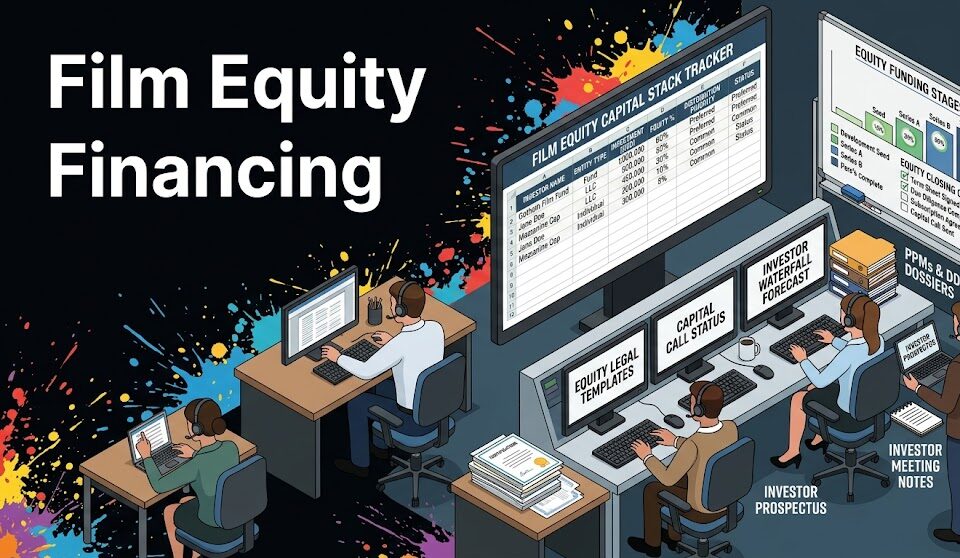
Film equity financing means selling a percentage of your project’s future profits in exchange for production capital. Investors take the riskiest position in the capital stack—sitting behind distribution fees, sales agent commissions, senior debt, gap financing, and tax credit recoupment before they see a single dollar back. That’s not a scare tactic. It’s the reality every producer needs to communicate clearly before pitching anyone.
But here’s what makes equity attractive to serious investors: the upside is uncapped. When a film hits—really hits—equity holders participate in backend revenue that debt lenders never touch. The math only works if everyone goes in with honest expectations about timelines, risk position, and what “profit” actually means under an entertainment accounting structure.
Based on Vitrina’s analysis of 62 expert interviews across the entertainment supply chain—including institutional fund managers, production lenders, and independent producers—this guide breaks down exactly how equity financing for film deals are structured, what investors can realistically expect to receive, and what makes an equity offer compelling enough to close.
Table of Contents
- What Film Equity Financing Actually Is
- The Four Types of Film Equity Investors
- The Vitrina Capital Stack Hierarchy™
- What Returns Do Film Equity Investors Actually Receive?
- How Profit Participation Is Structured
- What Makes an Equity Offer Attractive Enough to Close?
- Single-Project Equity vs Slate Financing
- FAQ
- Conclusion
Not Sure How Equity Fits Your Financing Plan?
VIQI is Vitrina’s AI assistant—trained on 1.6 million titles, 360,000 companies, and 5 million entertainment professionals. Ask it anything about equity structures, capital stacks, or investor expectations.
✓ Included with 200 free credits | ✓ No credit card needed
What Film Equity Financing Actually Is
Film equity financing is a capital structure in which investors provide production funds in exchange for an ownership percentage and a share of future revenue. Unlike debt financing, equity carries no mandatory repayment schedule—but investors only recoup after every other financial obligation in the distribution waterfall is satisfied first. It’s the highest-risk, highest-potential-return position in any film’s capital structure.
Think of it this way. A $10 million independent film might be financed with 40% equity ($4M), 45% through pre-sales and gap financing ($4.5M), and 15% from tax incentives ($1.5M). The debt gets paid first. Then the equity. That waterfall is non-negotiable—it’s written into every distribution agreement from day one, and changing it post-production is practically impossible.
This structure exists for a reason. Lenders who take first position accept lower returns because their risk is lower. Equity investors absorb the downside risk in exchange for uncapped upside. It’s the same logic that governs every asset class—film is just less liquid and harder to model. Understanding the difference between equity and debt financing in film is the starting point for structuring any deal responsibly.
The Four Types of Film Equity Investors (and What They Each Need to See)
Not all equity capital is the same. And not all investors want the same things. Understanding who you’re actually talking to determines how you pitch, what documentation you prepare, and what recoupment terms you can realistically negotiate.
Angel Investors. High-net-worth individuals who typically write checks from $50K to $500K. They’re often driven by passion for the project—and they frequently want executive producer credits alongside their financial return. The upside of angel capital? Speed and flexibility. Angels move faster than institutions. But they’re often unsophisticated about recoupment timelines. Managing expectations about the 3-5 year return cycle is essential before you cash their check.
Film Investment Funds. Institutional pools of capital with professional managers. These are $500K-$5M+ per project investors who apply the same due diligence you’d expect from any alternative asset fund. IPR VC—founded in Helsinki in 2014 and now 12 years in operation—is a clear example of this model. They take equity positions in projects (not production companies), build portfolios across multiple titles, and look for strategic partnerships rather than one-off transactions. According to Andrea Scarso, Managing Partner at IPR VC, “the challenge in the industry right now is not on deal flow, it’s on the quality of investing and how you structure the investment.”
Family Offices. Wealth management entities with long investment horizons. They may fund entire slates or single projects—and they expect professional-grade reporting, not just box office updates. If you’re approaching a family office, you need offering memoranda, financial projections modeled conservatively across multiple scenarios, and a clear exit strategy. Don’t walk into these meetings with a sizzle reel and a handshake. They want the full business case.
Private Equity Firms. Commitments at $10M+. These investors look at company equity or major slate financing structures—not individual films. If you’re operating at this level, you’re already in conversations with legal teams, co-financing advisors, and institutional intermediaries. PE capital changes the conversation entirely.

Your AI Assistant, Agent, and Analyst for the Business of Entertainment
VIQI AI helps you plan content acquisitions, raise production financing, and find and connect with the right partners worldwide.
- Find active co-producers and financiers for scripted projects
- Find equity and gap financing companies in North America
- Find top film financiers in Europe
- Find production houses that can co-produce or finance unscripted series
- I am looking for production partners for a YA drama set in Brazil
- I am looking for producers with proven track record in mid-budget features
- I am looking for Turkish distributors with successful international sales
- I am looking for OTT platforms actively acquiring finished series for the LATAM region
- I am seeking localization companies offer subtitling services in multiple Asian languages
- I am seeking partners in animation production for children's content
- I am seeking USA based post-production companies with sound facilities
- I am seeking VFX partners to composite background images and AI generated content
- Show me recent drama projects available for pre-buy
- Show me Japanese Anime Distributors
- Show me true-crime buyers from Asia
- Show me documentary pre-buyers
- List the top commissioners at the BBC
- List the post-production and VFX decision-makers at Netflix
- List the development leaders at Sony Pictures
- List the scripted programming heads at HBO
- Who is backing animation projects in Europe right now
- Who is Netflix’s top production partners for Sports Docs
- Who is Commissioning factual content in the NORDICS
- Who is acquiring unscripted formats for the North American market
The Vitrina Capital Stack Hierarchy™
This is where most equity conversations go sideways. Investors don’t always understand—or aren’t clearly told—exactly how far down the repayment queue they sit. Be transparent about this upfront. Every time. The full film finance waterfall structure follows this sequence:
The Vitrina Capital Stack Hierarchy™
- Distribution Fees (20–35% of gross) — Off the top. Always. Before anyone else sees revenue.
- P&A Costs — Marketing and print recoupment in theatrical deals.
- Senior Production Loan + Interest — Bank financing. Lowest risk, lowest return, first out.
- Gap Financing Loan + Interest — Mezzanine debt position, fully repaid before equity.
- Tax Credit / Soft Money Recoupment — Government incentives recouped at this stage.
- EQUITY RECOUPMENT ← You are here — Investors recover principal + target premium (120–125%).
- Deferred Fees — Producer, director, talent backend.
- Net Profit Participation — True backend. May arrive years post-delivery.
The takeaway isn’t discouraging—it’s clarifying. Gap financing carries fixed interest (typically 8-15% annually) with mandatory repayment. Equity carries no mandatory repayment at all—investors only recoup when revenue flows. That asymmetry is exactly why equity investors in genuinely successful films can dramatically outperform debt holders. The structural downside is real; so is the upside.
According to Variety, the growing sophistication of independent film investors means more deals now include detailed waterfall modeling at the term sheet stage—not just at closing. Investors are asking harder questions earlier. That’s a good thing for producers who know their numbers.
What Returns Do Film Equity Investors Actually Receive?
Here’s the honest answer: it depends entirely on the film’s commercial performance, and most independent films don’t return equity investment within the first two years. The industry-standard target return is 120–125% of invested principal—meaning a $1M investment targets a $1.2M–$1.25M return. But that’s a target, not a guarantee, and the timeline is almost always longer than expected.
The Timeline Reality. Andrea Scarso at IPR VC described their typical investment lifecycle: they invest a few months before principal photography begins, then track through production, post-production, and delivery. First revenues start flowing roughly 12–24 months after investment. Full recoupment often extends to 3–5 years—particularly for films following traditional theatrical and pay-TV windows. Streaming deals accelerate this significantly. A Netflix or Amazon acquisition delivers a lump sum rather than trickled theatrical revenue—but the upfront acquisition price is typically lower than what a strong theatrical run generates over time.
The Revenue Sources That Matter. Equity investors participate in revenue at every stage once their position in the waterfall is reached: theatrical revenue (after distributor fees), home entertainment, transactional VOD, streaming licensing, international sales, ancillary rights. The long tail of revenue is real—and it’s part of why sophisticated investors think in portfolio terms rather than single-project terms. Understanding how recoupment actually works through these windows is non-negotiable before committing capital.
The Portfolio Reality. IPR VC’s partnerships—with A24, XYZ Films, MK2, and Red Bull Studios—reflect the portfolio thinking that makes equity investment sustainable. “It’s binary,” Scarso noted. “You need hits to cover misses.” That’s not unique to film. It’s standard alternative asset management applied to creative IP. And it’s why any serious conversation about film equity financing returns has to account for the full distribution of outcomes—not just the upside scenario.
Find Equity Investors Actively Deploying Capital
Trusted by Netflix, Warner Bros, and Paramount. Vitrina’s database includes verified equity investors, film funds, and private finance partners filtered by investment size, project type, and recent deal history.
✓ 200 free credits | ✓ No credit card required | ✓ Full platform access
How Profit Participation Is Structured
Profit participation is where equity terms get complicated—and where producers and investors most frequently disagree after the fact. Get the definitions nailed down contractually before you close. Not after.
Net Profits vs Defined Gross. Net profits are calculated after every cost in the waterfall is deducted. Studios use what’s colloquially called “Hollywood accounting”—a structure that can minimize or eliminate net profits on commercially successful films through legitimate but aggressive cost allocations. Experienced equity investors push hard for defined gross or adjusted gross structures instead. Defined gross: a negotiated percentage after distribution fees but before cost recoupment. More favorable and more common in professional independent film equity deals. Net profits: frequently reach zero even for films that perform well at the box office. Never accept “net profits” without a precise contractual definition of every line item that comes before it.
Ownership Percentage and Priority. Equity investors typically own a proportional share based on their financial contribution. If you invest $2M in a $10M film, you own 20% of the equity position. But here’s what many first-time equity investors miss: ownership percentage is not the same as recoupment priority. Within a single project’s equity structure, some deals include senior equity and junior equity tiers. Senior equity recoups before junior equity. If you’re raising from multiple investors, you need explicit agreement on where each party sits—and that agreement needs to be documented before a dollar changes hands.
Liquidation Preferences. Most institutional equity deals include a liquidation preference—typically 120-125% of invested capital—that the investor receives before any other equity distribution. This protects downside without capping upside. An investor who puts in $1M might have a $1.2M liquidation preference, meaning they receive $1.2M before any profit-sharing kicks in. Above that threshold, they participate in whatever backend formula was negotiated. It’s a structure borrowed directly from venture capital—and it works.
What Makes an Equity Offer Attractive Enough to Close?
You can have the best project in the world and still fail to close equity capital. What investors actually need to say yes isn’t always what producers expect. And it’s almost never about the script.
A package that can be valued. Investors need to quantify risk. That requires confirmed cast attachments with deal memos (not just conversations), a director with a verifiable commercial track record, and a sales estimate from a reputable international sales agent. Without these, there’s no basis for valuation—and no basis for investment. The three core pillars of film financing—package, pre-sales, and production incentives—all contribute to making the equity position more defensible.
Conservative projections, not optimistic ones. Experienced investors ignore optimistic projections. They model conservative scenarios first and stress-test from there. If your pitch deck shows only the upside, you’ll lose credibility immediately. Show low, mid, and high return scenarios. Acknowledge the downside explicitly. Be transparent about where equity sits in the waterfall. Investors who know what they’re buying are far easier to manage through a difficult distribution cycle than investors who feel misled.
Co-investment structure. Sophisticated equity investors rarely want to be the only capital in the deal. Phil Hunt, CEO of Head Gear Films—a UK production lender that finances 35–40 films per year, more than most studios—has been explicit about this: investors want to see other capital alongside equity. Pre-sales, gap financing, or confirmed tax incentives reduce the total equity burden and independently validate market demand for the project. Your equity offer is stronger when it’s part of a complete capital stack, not a standalone ask.
Completion bond commitment. No serious film equity investor commits without a completion guarantee from a reputable bond company. It’s non-negotiable. A completion bond signals that the film will actually be delivered—protecting against the single biggest risk in equity investing: an unfinished project that cannot be distributed, sold, or recouped against. Get this in place early. It’s not an afterthought; it’s table stakes.
A credible exit path. What’s the distribution strategy? Festival circuit to acquisition? SVOD deal pre-negotiated? Theatrical day-and-date with a named distributor? The clearer your path from production to revenue, the more credible your equity offer becomes. Investors don’t just need to believe in the film—they need to believe in the path to return.
Single-Project Equity vs Slate Financing: What Investors Prefer
These are two fundamentally different investment structures—and they attract very different types of equity capital. Understanding the distinction helps you target the right investors for your situation. As covered in more depth in our guide to single-purpose vs slate equity, the implications for both producers and investors are significant.
IPR VC’s model reflects the institutional preference clearly. Their partnerships with A24, XYZ Films, MK2, and Red Bull Studios aren’t one-time project deals. They’re strategic relationships across multiple titles, built on shared understanding of risk profiles and return expectations over time. “We don’t just want to co-invest once,” Scarso explained. “We want to be a strategic partner across a slate.” That’s the conversation institutional equity investors are looking to have—not project-by-project cherry-picking.
For producers approaching institutional equity for the first time, the implication is this: come with a slate strategy, not just a single title. Even if you only have one project ready to finance, frame your vision around the body of work you’re building. It changes the nature of the conversation entirely.
Phil Hunt, CEO of Head Gear Films, breaks down exactly why film finance has become more challenging—and what investors now need to see before committing equity capital:
Phil Hunt (Founder & CEO, Head Gear Films) on the current state of film financing and what actually gets equity deals done:

How Vitrina Helps with Film Equity Financing
Finding the right equity partners isn’t just about term sheets and return expectations. It’s about identifying investors whose risk appetite, timeline expectations, portfolio strategy, and creative philosophy actually align with your project—before you spend six months in conversations that go nowhere.
That requires intelligence. Vitrina’s platform gives you verified access to 140,000+ entertainment supply chain companies—including equity investors, film funds, private finance partners, and institutional capital providers—filtered by investment size, project type, geographic focus, and recent deal activity. As noted by Screen International, the challenge for independent producers isn’t a shortage of equity capital—it’s identifying which investors are actively deploying in their specific category. That’s exactly the intelligence gap Vitrina closes.
Ready to Connect with Active Equity Investors?
Vitrina Concierge doesn’t give you a list—it makes warm introductions directly to decision-makers actively reviewing projects in your category.
- Korean animation studio → Netflix Adult Animation (week one)
- LA producer → Netflix UK, Fifth Season, Fox Entertainment (48 hours)
- Middle Eastern studio → Legendary Pictures (direct access)
Frequently Asked Questions
What is film equity financing and how does it work?
Film equity financing is a funding structure where investors provide production capital in exchange for an ownership percentage and a share of future revenue. Unlike debt, it carries no mandatory repayment schedule—but equity investors sit behind all debt obligations in the recoupment waterfall. They recoup last, with the highest potential return if the film performs.
What return do equity investors typically receive on film investments?
The industry-standard target is 120–125% of invested principal—a 20–25% premium above the original investment. But this is a target, not a guarantee. Many films don’t return equity in full. Full recoupment across theatrical, streaming, and ancillary windows typically takes 3–5 years. Streaming acquisition deals can accelerate this significantly with upfront lump-sum payments.
How does film equity financing differ from gap financing?
Gap financing is debt—it charges interest (8–15% annually) and requires repayment regardless of the film’s performance. Equity financing is ownership—it costs nothing until revenue flows, but investors sit behind gap lenders in the recoupment waterfall. Gap lenders have lower risk and lower returns. Equity investors have higher risk and higher potential upside. Most independent films use both in combination.
What is the difference between net profits and defined gross in equity deals?
Net profits are calculated after every cost in the waterfall—distribution fees, P&A, debt repayment, overhead allocations—which can result in zero even for commercially successful films. Defined gross is negotiated as a percentage after distribution fees but before cost recoupment, making it significantly more favorable for investors. Always push for defined gross or adjusted gross participation, and define every line item contractually before closing.
Do film equity investors need a completion bond?
Yes—any serious institutional equity investor will require one. A completion bond from a reputable guarantor ensures the film will be finished on budget and delivered on time, protecting against the single biggest equity risk: an unfinished project with no distribution and no recoupment path. Don’t approach institutional equity without a completion bond commitment already in place or in advanced discussion.
What percentage of the film budget should equity cover?
Equity typically covers 10–50% of total production budget, with the balance coming from pre-sales, gap financing, and tax incentives. There’s no fixed rule—but the smaller the equity percentage, the more manageable each investor’s risk exposure. Equity-heavy structures (above 60%) are harder to close with professional investors because it signals underdeveloped pre-sales and limited market validation.
Can I raise film equity financing without cast attached?
It’s very difficult for institutional equity. Angels may move on passion and concept, but fund managers and family offices need a package they can value—which requires cast attachments (even letters of intent), a director with commercial credits, and sales agent estimates. Without these elements, there’s no quantitative basis for investment. Genres with strong market demand (action, thriller, horror) offer slightly more flexibility, but cast is almost always a requirement at meaningful investment levels.
What’s the difference between single-project equity and slate equity financing?
Single-project equity concentrates investment in one film—higher risk, clearer timeline, suitable for angels and first-time institutional relationships. Slate financing spreads investment across multiple projects over a fund lifecycle—lower per-project risk, preferred by family offices and PE funds, requires a multi-year relationship and proven track record. Institutional investors like IPR VC almost universally prefer slate relationships over single-project commitments.
Conclusion: Know the Structure Before You Pitch It
Film equity financing works—but only when both sides understand the structure clearly. Investors who know they’re taking the last position in a long waterfall, with a 3-5 year timeline and returns that depend on distribution performance, are far better partners than investors who discover that reality mid-deal. Transparency isn’t a weakness. It’s what closes institutional capital.
Key Takeaways:
- Equity sits last in the waterfall: Behind distribution fees, P&A, senior debt, gap financing, and tax credit recoupment. Investors know this—make sure they do before the term sheet.
- Target returns are 120–125% of principal: With realistic timelines of 3–5 years for full recoupment. Streaming acquisitions can accelerate this significantly.
- Defined gross outperforms net profits: Always negotiate a defined gross participation structure. Net profits frequently reach zero even on successful films.
- A complete package closes deals: Cast attachments, a director with commercial credits, sales agent estimates, and a completion bond are not negotiable with institutional investors.
- Institutional investors prefer slates: If you’re approaching film funds or family offices with a single project, frame a long-term relationship. It changes the nature of every conversation.
The producers who close equity capital fastest are those who’ve already done the work—clean chain of title, a package investors can value, and a distribution strategy that maps credibly from delivery to returns. Do that work before you pitch. The capital is there for projects that have earned it.
Find the Right Equity Partners for Your Project
Trusted by Netflix, Warner Bros, Paramount, and Google TV. Vitrina’s database includes verified equity investors, film funds, and finance partners—filtered by investment size, project type, and recent deal activity.
✓ 200 free credits | ✓ No credit card required | ✓ Cancel anytime
Need direct introductions to active equity investors? Explore Concierge Service →
Find Film+TV Projects, Partners, and Deals – Fast.
VIQI matches you with the right financiers, producers, streamers, and buyers – globally.
Producers Seeking Financing & Partnerships?
Book Your Free Concierge Outreach Consultation
(To know more about Vitrina Concierge Outreach Solutions click here)
Join Industry Briefings Trusted by Leaders
The Mid-Budget Comeback: Why Mid-Budget Films Is the Smartest Bet in the Room
Mid-budget films are attracting new capital. See why this segment is becoming one of the strongest bets in Film today.
Franchise Fatigue vs. IP Dependency: What Studios Should Be Betting On Now
s franchise performance softens, where will the next generation of valuable IP come from? Join the briefing.
Unscripted Is Eating the World: The Multi-Billion Reality and Format Boom
Unscripted is the new prestige — inside the $19.8B global format boom reshaping how streaming platforms compete.
How Co-Productions and Regional IP Are Reshaping Global Drama
As global drama evolves, which stories travel, which stay local, and how are they getting financed?