IHUB
IHUB
 Private Briefings (Webinars)


 LeaderSpeak Podcast
  Global Entertainment Digest (Newsletter)
  About Vitrina
 About VIQI
 Our Story
 Our Solutions 🔥
 Film+TV Projects Tracker 🚀
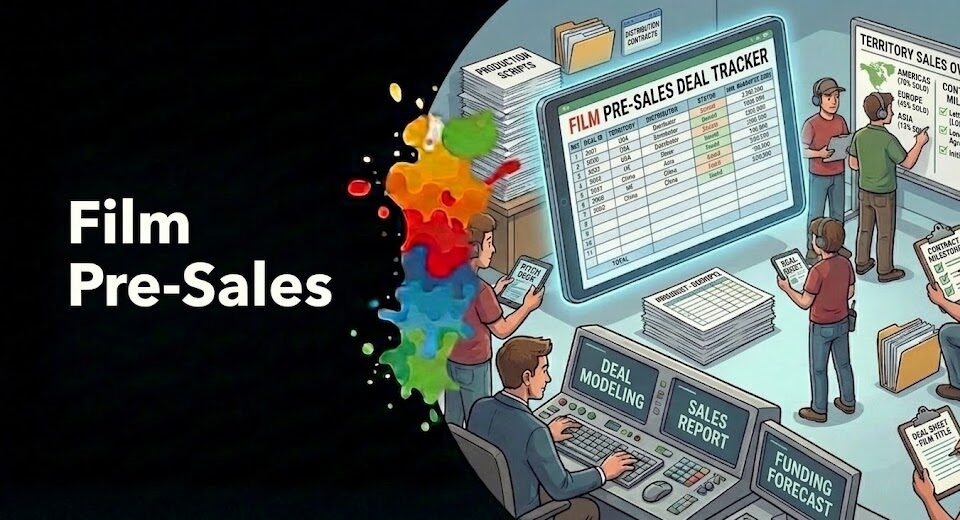
Film pre-sales are distribution agreements signed before a film is produced—commitments from distributors in specific territories to pay a minimum guarantee (MG) for the right to release the finished film in their market. Those contracts become collateral.
A bank or gap lender advances against their face value, and that advance becomes production capital. Done right, a producer can greenlight a film without having made a single frame of it—because committed distributors have already validated the project’s commercial worth.
But “done right” is the operative phrase. Pre-sales don’t happen by sending a script to a list of distributors. They require a reputable sales agent, a credible package, and access to the film markets where serious buyers actually operate. Most independent producers understand conceptually that pre-sales exist—far fewer understand the mechanics that make them work as a financing instrument. This guide covers exactly that: how the deal is structured, who’s involved, what a minimum guarantee looks like in practice, and how to build a pre-sale strategy that genuinely anchors your capital stack.
Table of Contents
- What Is a Film Pre-Sale and How Does It Become Production Financing?
- The Sales Agent: Why You Can’t Do This Without One
- What Minimum Guarantees Actually Look Like in Practice
- Where Pre-Sale Deals Happen: Markets and Festivals That Matter
- The Vitrina Pre-Sale Readiness Framework™
- How Banks Lend Against Pre-Sale Contracts
- Risks and Limitations Producers Need to Understand
- Frequently Asked Questions
- Conclusion
Find Verified Sales Agents and Distribution Partners on Vitrina
Trusted by Netflix, Warner Bros, and Paramount. Vitrina maps 140,000+ verified companies in the global entertainment supply chain—including sales agents, territorial distributors, and financing partners active in your genre and budget range.
✓ 200 free credits | ✓ No credit card required | ✓ Full platform access
What Is a Film Pre-Sale and How Does It Become Production Financing?
A pre-sale is a license agreement between a producer and a distributor—signed before production begins—granting the distributor the right to release the completed film in a specific territory for a defined period (typically 15–20 years). In exchange, the distributor commits to pay a minimum guarantee (MG): a fixed amount due upon delivery of the finished film meeting agreed technical and creative specifications.
That commitment—the signed contract and the MG obligation it creates—is what transforms a pre-sale from a distribution deal into a financing instrument. A bank or gap lender looks at a signed pre-sale contract from a creditworthy distributor the same way it looks at a receivable. It’s a legal obligation to pay a specific sum on a specific trigger (delivery). So the bank advances against that receivable—typically 70–90% of the MG face value—and the producer receives production capital now, with the MG payment arriving upon delivery to repay the advance.
Here’s the sequence in practice:
- Producer packages the project — script, director, cast attachments, budget. The package determines what territories will commit and at what MG levels.
- Sales agent takes the project to market — presenting at Cannes, AFM, EFM, or directly to known distributors. Territory-by-territory MG offers are negotiated and signed.
- Signed pre-sale contracts are delivered to the bank — along with a notice of assignment giving the bank a secured interest in the MG payments.
- Bank advances production capital — typically 70–90% of the aggregate MG values from the pre-sale contracts it accepts as collateral.
- Film is produced and delivered — once technical delivery is confirmed, distributors release their MG payments directly to the bank.
- Advance is repaid, and any residual MG flows to the producer — after the bank is repaid, the remaining 10–30% of the MGs (the portion not advanced) typically goes to the sales agent’s commission and then to the producer.
The key insight: the distributor’s commitment to pay is what generates production capital—not the payment itself. The payment arrives post-delivery. The advance against that commitment is what funds production. This is sometimes called pre-sale financing or gap-adjacent financing, and it’s distinct from the film simply having pre-sales—the bankability of those specific contracts by the specific bank is what matters.
The Sales Agent: Why You Can’t Do This Without One
Pre-sales don’t happen without a sales agent. Full stop. A producer approaching a German distributor cold with a pre-sale offer has almost no chance of getting a deal signed—not because the distributor wouldn’t be interested in the film, but because they have no mechanism to trust the producer’s ability to deliver and no established commercial relationship to work from.
A reputable sales agent brings three things that producers can’t self-supply:
Distributor relationships. Sales agents have ongoing commercial relationships with buyers in every major territory. They know which buyers are actively seeking which genres, which buyers are over-committed, which buyers have acquisition budgets available in the current market cycle, and what MG levels are realistic for a given package. That intelligence—and those relationships—are the core of what you’re paying for when you engage a sales agent.
Sales estimates that banks accept. When a producer seeks production financing against pre-sales, the bank requires a market assessment of what unsold territories are worth—called sales estimates. These must come from a recognised sales agent with a credible track record. A producer’s own projections don’t count. The sales agent’s estimates are what give gap lenders confidence to advance against partially-sold slates, and what give banks context to evaluate the full collateral pool.
Bankable deal structure. Not all pre-sale contracts are equal in the eyes of a bank. Sales agents who work regularly with entertainment banks know exactly how contracts need to be structured—which representations and warranties are required, how delivery conditions need to be defined, which distributors in which territories a specific bank will or won’t advance against. A sales agent unfamiliar with these requirements can inadvertently structure deals that generate MG commitments the bank won’t lend against—rendering the pre-sale commercially real but financially useless as a production financing instrument.
How Sales Agents Are Compensated
Sales agents earn a commission of 10–25% of MG revenue—typically 15% for established agents on commercial projects, higher for emerging markets or niche genres. They also recoup marketing and delivery expenses (market fees, screener production, promotional materials) from the first revenues, ahead of any payment to the producer. These expenses—typically $50,000–$150,000 depending on the agent and the market footprint—should be negotiated upfront and capped.
The producer typically signs a sales representation agreement granting the agent exclusive rights to sell specific territories for a defined term (usually 5–10 years from delivery, with options to extend). The territories and term are negotiable. Producers should retain US/North American rights unless the agent has a compelling US distribution strategy—domestic rights are typically the most valuable and the hardest to recover once sold at pre-sale discounts.
For guidance on identifying and approaching reputable sales agents for your project, see our overview of how to find the right sales agent for your film.

Your AI Assistant, Agent, and Analyst for the Business of Entertainment
VIQI AI helps you plan content acquisitions, raise production financing, and find and connect with the right partners worldwide.
- Find active co-producers and financiers for scripted projects
- Find equity and gap financing companies in North America
- Find top film financiers in Europe
- Find production houses that can co-produce or finance unscripted series
- I am looking for production partners for a YA drama set in Brazil
- I am looking for producers with proven track record in mid-budget features
- I am looking for Turkish distributors with successful international sales
- I am looking for OTT platforms actively acquiring finished series for the LATAM region
- I am seeking localization companies offer subtitling services in multiple Asian languages
- I am seeking partners in animation production for children's content
- I am seeking USA based post-production companies with sound facilities
- I am seeking VFX partners to composite background images and AI generated content
- Show me recent drama projects available for pre-buy
- Show me Japanese Anime Distributors
- Show me true-crime buyers from Asia
- Show me documentary pre-buyers
- List the top commissioners at the BBC
- List the post-production and VFX decision-makers at Netflix
- List the development leaders at Sony Pictures
- List the scripted programming heads at HBO
- Who is backing animation projects in Europe right now
- Who is Netflix’s top production partners for Sports Docs
- Who is Commissioning factual content in the NORDICS
- Who is acquiring unscripted formats for the North American market
What Minimum Guarantees Actually Look Like in Practice
MG levels vary enormously by territory, genre, budget level, and package strength. Understanding what’s realistic for your project prevents two of the most common pre-sale mistakes: overestimating MGs when building a financing plan, and undervaluing territory rights when negotiating with distributors who are offering below-market.
Some context that actually matters:
Major territories command the largest MGs. Germany, France, UK, Japan, South Korea, and Australia are the anchor territories that move financing. A well-packaged genre thriller with recognisable cast might generate MGs of $200,000–$500,000 from Germany alone. The same project might generate $50,000–$150,000 from Spain and $30,000–$80,000 from Scandinavia combined. Territory values are not equal—and the difference between closing a German deal versus not can mean the difference between a bankable financing plan and an unbankable one.
Genre determines international pre-sale viability more than subject matter. Action, thriller, and horror consistently generate the strongest pre-sales in foreign markets. Phil Hunt of Head Gear Films—which finances 35–40 films per year—is direct: drama without stars is “not really working” in the independent pre-sale market. Comedy is notoriously difficult to pre-sell internationally because humour doesn’t travel the same way genre does. Documentary pre-sales are possible but rare outside of broadcaster-specific deals (ARTE, ZDF, Canal+).
Cast determines MG levels more than any other variable. A-list international cast (names that open films in Germany or Japan independently) generates premium MGs at pre-sales stage. B-list cast with genre appeal generates moderate MGs. Unknown cast generates minimal to no bankable pre-sale interest regardless of script quality. This is not an artistic judgment—it’s how distributors manage acquisition risk when buying an unproduced film without a finished cut to evaluate.
Pre-sale discounts are real. A territory that would pay $300,000 for your finished film at a festival might pay $180,000 as a pre-sale MG. That’s a 40% discount in exchange for early commitment. Whether that discount is worth taking depends on your financing needs. If the $180,000 closes your capital stack and lets you make the film, the discount was worth it. If you’re only 20% short of your budget and don’t need the pre-sale to greenlight, holding that territory for post-completion sale at a premium is the better strategic choice.
Where Pre-Sale Deals Happen: Markets and Festivals That Matter
Pre-sales don’t happen by email alone. They happen in the concentrated deal-making environments of film markets—intensive industry gatherings where buyers and sellers converge for a few days to transact efficiently. Understanding which markets matter for which type of project determines where your sales agent will focus energy and where you need to be present.
Cannes Marché du Film (May)
The single most important film market in the world for pre-sales. Cannes Marché runs alongside the festival and attracts buyers from every significant territory globally. The combination of the festival’s prestige—which validates the projects being presented in parallel—and the concentrated buyer attendance makes it the optimal time to present pre-sale packages to multiple territories simultaneously. A project presented at Cannes Marché by a credible sales agent will typically reach 30–50 potential buyers in 72 hours. The same reach would take months of individual outreach.
American Film Market (AFM) — November
AFM in Santa Monica is the primary US-hosted sales market and the most important event for genre content specifically. Horror, action, thriller, and genre hybrid projects find their most active buyer pool here. AFM is where Joshua Harris of Peachtree Media Partners—a film finance lender whose deals have included projects with Henry Cavill and Jake Gyllenhaal—reports seeing the strongest signal of market recovery and theatrical demand in recent cycles. For genre projects seeking both pre-sales and gap financing, AFM is the most efficient market to target.
European Film Market (EFM) — February
EFM in Berlin runs alongside the Berlinale festival and is the primary European market for arthouse, documentary, and European co-production projects. It’s smaller than Cannes Marché in total deal volume but highly concentrated in European broadcaster and arthouse distributor attendance. If your project is seeking German, French, Scandinavian, or Eastern European pre-sales, EFM is often the most efficient market to target—the buyers are there specifically, and the competition from Hollywood tentpole titles is lower than at Cannes.
TIFF and Sundance — Acquisition Markets
Toronto International Film Festival and Sundance operate differently from the sales markets above—they’re primarily acquisition markets for completed films rather than pre-sale markets. But they matter for pre-sales indirectly: a filmmaker with a Sundance or TIFF track record generates significantly higher buyer interest in their pre-sale packages at the sales markets. A sales agent presenting your third film to a German distributor who remembers your second film premiering at TIFF is a fundamentally different conversation than presenting your debut with no festival history.
Ask VIQI: Which Distributors Are Actively Pre-Buying in My Genre Right Now?
VIQI is Vitrina’s AI research assistant—trained on 1.6 million titles, 360,000 companies, and 5 million entertainment professionals. Ask it about active pre-sale buyers by territory, sales agents with track records in your genre, and how to build a pre-sale strategy for your specific project.
✓ Included with 200 free credits | ✓ No credit card needed
The Vitrina Pre-Sale Readiness Framework™
Not every project is ready for a pre-sale strategy. Approaching the market too early—without a package that distributors can evaluate and price—wastes your sales agent’s relationship capital and produces soft interest rather than signed contracts. The Vitrina Pre-Sale Readiness Framework™ gives you a clear-eyed assessment of whether your project is ready to take to market, and what’s missing if it isn’t.
The Vitrina Pre-Sale Readiness Framework™
Framework rule: All five elements must show Ready Signals before you take a project to market. A project that scores 4/5 isn’t “almost ready” — it’s not ready. Buyers who see a pre-sale package without confirmed cast or a signed sales agent give soft feedback that feels like interest but produces no signed contracts. Fix the gaps first, then approach the market.
How Banks Lend Against Pre-Sale Contracts
Understanding the banking side of pre-sales transforms a producer’s negotiating position. Most producers think about pre-sales purely as distribution deals—which they are. But the financing function means they’re simultaneously being structured for a bank’s underwriting criteria, and those criteria determine how much production capital the contracts actually unlock.
Banks rate distributors. Not all pre-sale contracts are equal as collateral. An entertainment bank lending against pre-sales rates the financial strength of each distributor in each territory. A-rated distributors in major territories—Germany’s Constantin Film, France’s Pathé, Japan’s Toho—generate higher advance rates (closer to 90% of MG) because their payment obligations are considered highly reliable. Unknown distributors in smaller markets may not be accepted as collateral at all, or accepted at advance rates below 50%. Your sales agent’s ability to close deals with creditworthy buyers is the single most important variable in determining how much production capital your pre-sale strategy generates.
Notice of assignment is the key legal instrument. When a bank lends against a pre-sale, the distributor is served with a notice of assignment—a formal legal document notifying them that the MG payment obligation has been assigned to the bank as security for the production loan. Upon delivery of the finished film, the distributor pays the bank directly rather than the producer. Distributors in major markets are familiar with this structure; it’s standard in international co-production financing. But it must be properly documented and served to be enforceable, which is why entertainment-specialised legal counsel is non-negotiable.
Delivery requirements are precise—and consequential. The MG trigger is delivery of a film meeting the technical and creative specifications defined in the pre-sale contract. Those specifications—format, runtime, censorship certificates, dubbed or subtitled versions, marketing materials—are negotiated at signing and are legally binding. A film that delivers at 88 minutes against a contract specifying 90-minute minimum technically triggers a delivery dispute. This is not hypothetical: delivery disputes between producers and distributors are a significant source of MG delays and payment complications in the independent film space. Producers should understand exactly what they’re committing to deliver before signing.
According to Screen International, the entertainment banks still actively lending against pre-sale packages in 2025–2026 are applying significantly more conservative advance rates and requiring stronger distributor credentials than in pre-2020 cycles. The practical implication: producers need to over-build their pre-sale base relative to their financing needs, because bank advance rates on the available contracts will be lower than historical norms.
For a complete overview of how pre-sales fit within the full capital stack alongside gap financing, equity, and tax incentives, see our guide to mastering pre-sales and avails for financial success and our overview of the complete film capital stack.
Risks and Limitations Producers Need to Understand
Pre-sales are a powerful financing tool with real structural limitations. Knowing them doesn’t mean avoiding the strategy—it means designing your financing plan to account for them honestly.
Pre-sales constrain your upside. When you pre-sell Germany for $250,000, you’ve given away the upside in that territory. If your film performs exceptionally well—winning awards, generating theatrical buzz—the German distributor benefits from that performance through above-MG theatrical revenue, not you. Your $250,000 is fixed regardless of the film’s ultimate success. The pre-sale discount you accepted in exchange for financing certainty has a real cost if the film becomes a breakout.
Streaming has complicated the traditional pre-sale market. The rise of global streaming platforms acquiring worldwide rights has reduced the pool of territory-by-territory pre-sale buyers at the mid-budget level. A platform that acquires worldwide rights eliminates 15–20 individual territory deals—and typically pays a lower aggregate MG than those deals would have generated in total (though with faster payment and lower execution complexity). Phil Hunt of Head Gear Films noted that the pre-sale market has become “much harder” at the independent level post-COVID, with fewer buyers taking risks on unproduced films without strong genre alignment or star cast.
Pre-sales require a completion bond. A bank will not advance against pre-sale contracts without a completion bond—an insurance policy guaranteeing that the film will be delivered on time and on budget. Completion bonds cost approximately 3–6% of the production budget and come with oversight requirements that some producers find restrictive. But they’re non-negotiable for pre-sale financing. Budget for the bond from the outset rather than treating it as an optional add-on.
Currency fluctuation is a real risk on international MGs. MGs in foreign territories are typically denominated in local currency or euros. Between signing and delivery—12–24 months in most cases—exchange rate shifts can meaningfully alter the US dollar value of your pre-sale proceeds. Larger production companies hedge this exposure. Independent producers often don’t, which can create a capital stack that’s theoretically complete but in practice short when the exchange rate moves adversely. Discuss currency risk with your entertainment attorney and accountant before finalising your financing plan.
Build Your Pre-Sale Strategy With Direct Access to Buyers and Sales Agents
Vitrina Concierge identifies verified sales agents and territorial distributors matched to your project’s genre, budget, and production stage—then makes warm introductions directly to active decision-makers. No cold outreach. Real connections with buyers who can write the contracts your bank will advance against.
- Genre thriller producer → matched to three sales agents with active German and Japanese buyer relationships
- Documentary filmmaker with ITVS backing → connected to European broadcaster pre-buy buyers within 48 hours
- Debut feature with festival-ready package → introduced to sales agent specialising in emerging filmmaker slates
Frequently Asked Questions
How do film pre-sales work to finance production before filming begins?
Film pre-sales are distribution agreements signed before production—distributors commit to pay a minimum guarantee (MG) upon delivery of the completed film. Those signed contracts become collateral for a bank or gap lender, which advances 70–90% of the MG face value as production capital. The advance is repaid from the MG payments distributors make upon delivery. The producer receives financing now against a payment obligation that triggers later, enabling production to begin before the film exists.
Do I need a sales agent to get pre-sales for my film?
Yes. A reputable sales agent is essential for pre-sales that function as financing instruments. Sales agents provide distributor relationships you cannot access independently, produce the sales estimates that banks require to evaluate collateral, and structure contracts in the specific way that entertainment banks accept for advancement. A producer approaching foreign distributors directly may generate informal interest but almost never produces bankable pre-sale contracts. The sales agent’s fee (typically 10–25% commission plus recoupable expenses) is a cost of doing the deal, not an option.
What genres get the best pre-sales for independent films?
Action, thriller, and horror generate the strongest international pre-sales consistently. These genres travel well—buyers in Germany, Japan, and Australia understand the commercial proposition without needing cultural context. Drama without recognisable cast is very difficult to pre-sell internationally. Comedy is the hardest genre to pre-sell because humour localises poorly. Documentary pre-sales exist primarily as broadcaster co-production deals (ARTE, ZDF, Canal+) rather than traditional territory-by-territory distribution agreements.
What is a minimum guarantee in film pre-sales?
A minimum guarantee (MG) is the fixed payment a distributor commits to pay for a pre-sale territory upon delivery of the completed film. It’s a floor guarantee—the distributor pays the MG regardless of how the film performs in their market, and earns back their MG from theatrical, streaming, and home entertainment revenues before any additional amounts flow to the sales agent or producer. MG levels vary enormously by territory, genre, and cast—from $20,000–$50,000 for smaller European territories to $200,000–$500,000+ for Germany or Japan on a well-packaged genre project.
How much of my budget can pre-sales realistically cover?
For a well-packaged commercial genre film with bankable cast, pre-sales from major territories (Germany, UK, France, Japan, Australia) might cover 40–70% of a $5–10M production budget. Smaller or less commercial projects might generate 15–30%. Pre-sales alone rarely cover 100% of a production budget—they’re typically combined with equity investment, tax incentives, and gap financing to complete the capital stack. The pre-sale layer’s value is both its direct contribution and its de-risking effect on the remaining financing sources.
Which film markets are best for securing pre-sales?
Cannes Marché du Film (May) is the most important market globally for pre-sales across all genres and territories. AFM in Santa Monica (November) is the primary market for genre content and US-adjacent financing. EFM in Berlin (February) is the most efficient market for European territory buyers and arthouse or documentary projects. MIPCOM in Cannes (October) focuses on television and series rather than theatrical features. For most independent films, Cannes Marché and AFM are the two essential markets—EFM adds value for projects with European distributor targets or festival history.
Do streaming platforms count as pre-sales for financing purposes?
Sometimes. A streaming platform pre-acquiring rights to a specific territory or set of territories before production creates an MG-equivalent obligation that banks will consider as collateral, subject to the usual distributor credit assessment. A worldwide acquisition by a major streaming platform (Netflix, Amazon) is typically structured differently—often as a licensing deal with milestone payments rather than a traditional MG structure—but can still be bankable depending on deal structure and timing. The key question is always whether the payment obligation is clearly defined, contractually binding, and the counterparty creditworthy.
What’s the difference between a pre-sale and a distribution agreement for a completed film?
A pre-sale is a distribution agreement signed before the film is produced. A distribution agreement for a completed film is signed after the film exists—usually at a festival or market following a screening. The key practical difference is price: distributors pay a significant pre-sale discount (often 30–50%) in exchange for early commitment when they’re buying an unproduced film on the strength of the package alone. Completing the film and acquiring festival exposure before selling typically generates higher aggregate revenue from distribution—but only if you can finance production without needing the pre-sale capital.
Conclusion: Pre-Sales Are a Financing Instrument, Not Just a Distribution Strategy
Understanding how film pre-sales work changes how you approach independent film financing at a fundamental level. Pre-sales aren’t just early distribution deals—they’re a mechanism for converting future payment obligations into present production capital. A signed pre-sale from a creditworthy German distributor is worth 70–90% of its face value in production financing before you’ve shot a single frame. That’s not a distribution conversation. That’s a financing conversation that happens to involve a distributor.
Key Takeaways:
- Pre-sales convert distributor commitments into production capital. Signed MG contracts from creditworthy distributors become collateral for bank advances of 70–90% of face value—the mechanism that turns a distribution deal into a financing instrument.
- You cannot do this without a reputable sales agent. They provide the distributor relationships, sales estimates, and contract structure that make pre-sales bankable. Their commission is a cost of the deal, not an optional expense.
- Genre, cast, and package determine MG levels more than subject matter. Action, thriller, and horror travel internationally. Bankable cast drives MG premiums. A compelling script without commercial packaging generates interest but not signed contracts.
- Cannes Marché and AFM are the essential markets. These are where serious pre-sale buyers operate in concentrated windows. Your sales agent’s market presence—and your project’s readiness when they attend—determines what you close.
- Pre-sales work best combined with other financing layers. They typically cover 40–70% of a well-packaged commercial film’s budget. Stack them with equity, tax incentives, and gap financing to complete the capital stack—and use your pre-sale success as validation that unlocks those additional layers.
The independent films that get made—consistently, across budget ranges, across market cycles—are the ones where producers understand financing mechanics as fluently as they understand creative development. Pre-sales are one of the most powerful of those mechanics. Use them strategically, and they become the anchor that makes everything else possible.
Find the Sales Agents and Buyers Who Can Make Your Pre-Sale Strategy Real
Trusted by Netflix, Warner Bros, Paramount, and Google TV. Search 140,000+ verified companies to find sales agents, territorial distributors, and financing partners active in your genre right now. Track 159,223 projects. Connect with 3 million entertainment professionals.
✓ 200 free credits | ✓ No credit card required | ✓ Cancel anytime
Need direct introductions to sales agents and pre-sale buyers? Explore Concierge Service →