About Innovation Hub
 Global Content Pulse (Webinars)


 Global Production Financing
(Webinars)
Global Production Financing
(Webinars)  LeaderSpeak Podcast
  Global Entertainment Digest (Newsletter)
  About Vitrina
 About VIQI
 Our Story
 Our Solutions 🔥
 Film+TV Projects Tracker 🚀
 Case Studies
 Our Profile
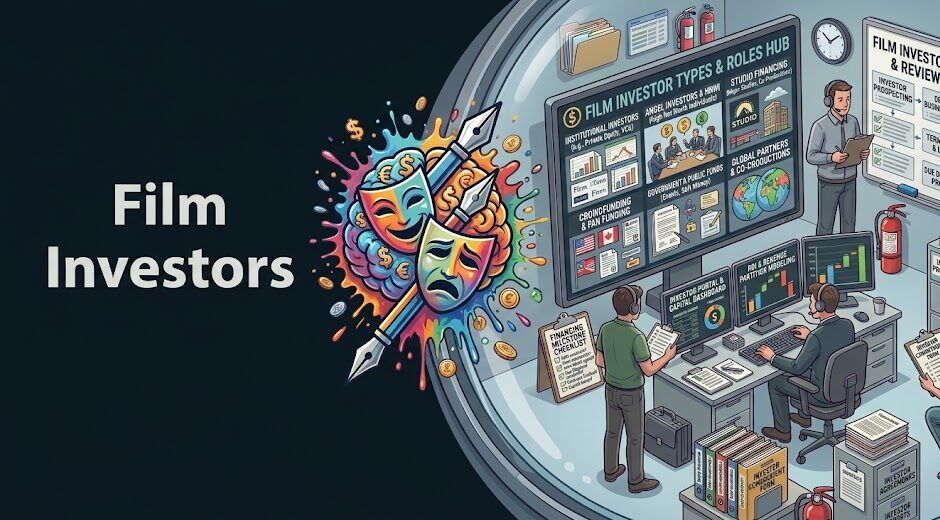
Private investors for independent film are not hiding—they’re accessible, they’re actively looking for deals, and they make commitments when two things align: they trust the team, and the financial structure makes sense to them.
The problem isn’t that film investors don’t exist. It’s that most producers approach them wrong—leading with passion when investors need proof, leading with the story when investors need the business case, and leading with a pitch when investors need a relationship.
The good news? This is learnable. Film investors—whether they’re high-net-worth angels, family offices, or specialist equity funds—respond to the same signals that any sophisticated investor responds to: a credible team, a realistic financial model, a clear path to market, and a structure that protects their downside. Give them those four things in the right order, and you don’t need to “sell” anyone. The deal closes itself.
This guide covers where serious film investors actually look for projects, what structures attract them, what red flags make them walk away fast, and how to present your film as a fundable business opportunity—not a passion project looking for a patron.
Table of Contents
- Who Actually Invests in Independent Films (and Who Doesn’t)
- Where to Find Private Film Investors in Practice
- What Private Film Investors Actually Evaluate
- The Vitrina Investor Fit Matrix™
- Financial Structures That Attract Serious Capital
- Red Flags That Make Investors Walk Away Immediately
- How to Structure the Conversation That Closes Deals
- Frequently Asked Questions
- Conclusion
Find Verified Film Investors and Financing Partners on Vitrina
Trusted by Netflix, Warner Bros, and Paramount. Search 140,000+ verified companies—including equity funds, private lenders, and co-production partners active in your budget range and territory right now.
✓ 200 free credits | ✓ No credit card required | ✓ Full platform access
Who Actually Invests in Independent Films (and Who Doesn’t)
Before you spend months chasing the wrong people, it helps to understand the real landscape of private film investors. Not all money is the same, and not all capital sources work at every budget level.
Angel investors are high-net-worth individuals investing personal capital, typically $50K–$500K per project. They’re often motivated by a combination of financial return and proximity to the filmmaking world—set visits, producer credits, premiere invitations. They tend to have less formal due diligence processes than institutional investors, which makes them accessible earlier in a project’s development. But they also have less capital to deploy, meaning you often need several angels to close a meaningful equity tranche.
Family offices manage wealth for ultra-high-net-worth families—and increasingly allocate a portion of their alternative investment portfolio to entertainment. They’re patient capital with longer investment horizons than traditional PE, which aligns well with film’s 18–36 month return cycle. Family offices that have done entertainment deals before are significantly easier to close than first-time entertainment investors who don’t understand the asset class.
Specialist film equity funds like IPR VC—a Helsinki-based fund that has co-financed over 15 films with A24, MK2, XYZ Films, and Red Bull Studios—represent the most sophisticated capital in this landscape. They apply portfolio management discipline, require professional documentation, and focus heavily on team relationships and slate approach rather than individual project bets. But they also move faster than angels once they’re convinced, and they bring strategic value beyond the cheque.
Private equity firms have entered entertainment financing at meaningful scale, often through JV structures with production companies or through vertical production finance entities—think Domain Capital (whose logo appears on studio-scale releases like Wonka) or Peachtree Media Partners (a JV between a seasoned entertainment banker and a major Southeast US PE firm). These structures lend rather than invest equity, taking collateral positions against IP, pre-sales, and tax incentives—which matters for how you approach them.
Who doesn’t invest? Casual high-net-worth individuals who have “always wanted to make a movie” but no financial sophistication. Friends and family who can’t afford to lose the money. Corporate sponsors who want brand integration, not equity returns. Knowing who you’re not looking for saves as much time as knowing who you are.
Where to Find Private Film Investors in Practice
The question “where do I find private investors for my film?” has a honest answer: mostly through warm introductions and market relationships, not cold outreach. But that doesn’t mean you’re stuck if you don’t already know the right people—it means you need to build into networks where those introductions happen naturally.
Film Markets and Co-Production Events
Cannes Marché, AFM (American Film Market), EFM (European Film Market), and MIPCOM are where serious capital meets serious projects. But the investors aren’t sitting in market booths—they’re in side meetings, at dinners, and at curated networking events attached to the market. Getting into those rooms requires either existing relationships or strategic introductions from sales agents, attorneys, or producers who are already in the ecosystem.
The Big Picture Summit—a Vitrina-facilitated event that generated a record number of producer-financier meetings—is the kind of curated format that compresses what would otherwise take 12 months of market attendance into focused introductions between qualified parties. For independent producers without deep market relationships, these structured matchmaking opportunities are often the most efficient entry point.
Entertainment Attorneys and Production Accountants
This is genuinely one of the most underused sourcing channels for independent film investors. Entertainment lawyers who structure financing deals know exactly which angels, family offices, and funds are actively deploying capital in your budget range. They can’t facilitate introductions without client consent, but if they trust your project and your professionalism, a warm introduction from your attorney carries enormous credibility with an investor they already know.
Sales Agents With Financing Relationships
Reputable sales agents—particularly those who specialise in commercial genres with proven pre-sale track records—maintain relationships with the equity investors who typically co-finance their slates. When a sales agent takes on your project, they’re implicitly introducing you to their financing network. This is one of the strongest arguments for prioritising sales agent attachment early, even before you’ve approached a single investor directly.
Vitrina’s Platform and Concierge Service
Vitrina maps 140,000+ companies in the global entertainment supply chain, including specialist equity funds, lenders, and financing partners active by budget range, territory, and content type. For independent producers, this solves the fragmentation problem—you’re not limited to the 5–10 investors you personally know or can get introduced to. You can identify verified active investors, understand their portfolio and criteria, and approach with targeted precision rather than spray-and-pray networking.
For more on how to approach the financing landscape strategically, see our overview of financing opportunities in entertainment and tools for success.

Your AI Assistant, Agent, and Analyst for the Business of Entertainment
VIQI AI helps you plan content acquisitions, raise production financing, and find and connect with the right partners worldwide.
- Find active co-producers and financiers for scripted projects
- Find equity and gap financing companies in North America
- Find top film financiers in Europe
- Find production houses that can co-produce or finance unscripted series
- I am looking for production partners for a YA drama set in Brazil
- I am looking for producers with proven track record in mid-budget features
- I am looking for Turkish distributors with successful international sales
- I am looking for OTT platforms actively acquiring finished series for the LATAM region
- I am seeking localization companies offer subtitling services in multiple Asian languages
- I am seeking partners in animation production for children's content
- I am seeking USA based post-production companies with sound facilities
- I am seeking VFX partners to composite background images and AI generated content
- Show me recent drama projects available for pre-buy
- Show me Japanese Anime Distributors
- Show me true-crime buyers from Asia
- Show me documentary pre-buyers
- List the top commissioners at the BBC
- List the post-production and VFX decision-makers at Netflix
- List the development leaders at Sony Pictures
- List the scripted programming heads at HBO
- Who is backing animation projects in Europe right now
- Who is Netflix’s top production partners for Sports Docs
- Who is Commissioning factual content in the NORDICS
- Who is acquiring unscripted formats for the North American market
What Private Film Investors Actually Evaluate
Here’s what most producers get wrong: they assume investors are evaluating the film. They’re not—at least not primarily. Investors are evaluating the investment. The film is the vehicle. The investment is what they care about.
Andrea Scarso, Managing Partner at IPR VC, is direct on this point: “The challenge in the industry right now is not on deal flow—it’s on the quality of investing, and how you structure the investment.” IPR VC’s approach, which has generated successful outcomes across films with A24, Red Bull Studios, and XYZ Films, focuses on building strategic partnerships with companies over multiple projects rather than betting on individual films. That’s a sophisticated investor’s instinct—they want to back teams and relationships, not single lottery tickets.
What private film investors are actually evaluating:
- Team credibility — Have the producers delivered before? Do they have relationships with sales agents, distributors, and completion guarantors who can validate the project? First-time producers face a credibility deficit that packaging and strong attachments must overcome.
- Downside protection — How much of the budget is de-risked through pre-sales, tax incentives, and other non-equity sources? An investor putting in $1M against a $5M budget fully pre-sold to 60% has a very different risk exposure than the same investment in a project with no other financing confirmed.
- Recoupment clarity — Where does this film go after production? Who distributes it, in which territories, on what platforms, and on what timeline? Vague distribution plans are a red flag. Specific market strategies with named distribution partners—even at the letter-of-intent stage—signal professional thinking.
- Return structure fairness — Is the waterfall reasonable? Does the investor have meaningful priority recoupment before profits are split with the producer? Are the distribution fees contained enough that there’s actually money left after they’re taken?
- Portfolio fit — Sophisticated investors think in portfolios. A genre thriller fits differently than an art-house drama in a diversified entertainment portfolio. Understanding how your project fits an investor’s broader strategy—rather than just pitching the project in isolation—demonstrates the commercial intelligence investors want to see.
As we covered in our guide to unlocking ROI in film content financing, the producers who consistently attract private capital understand that they’re selling a financial instrument, not a creative vision.
Ask VIQI: Which Equity Funds Are Active in My Budget Range Right Now?
VIQI is Vitrina’s AI research assistant—trained on 1.6 million titles, 360,000 companies, and 5 million entertainment professionals. Ask it to identify active investors and funds matched to your genre, budget, and territory.
✓ Included with 200 free credits | ✓ No credit card needed
The Vitrina Investor Fit Matrix™
Not every investor is right for every project. Approaching a sophisticated institutional fund with a micro-budget passion project wastes their time and damages your relationship with them for future projects. Approaching a first-time angel with a $20M feature requiring complex multi-party financing structures sets both of you up for failure. The Vitrina Investor Fit Matrix™ maps investor type to project profile so you target the right capital for your specific situation.
The Vitrina Investor Fit Matrix™
Rule of thumb: Match investor sophistication to your project’s financing complexity. A first-time producer with a $1.5M horror film should not be pitching specialist film funds. A producer with three delivered features and a sales agent attached should not be asking angels for $5M. Right investor, right stage.
Financial Structures That Attract Serious Capital
The structure of your investor offer matters as much as the project. Equity investors are giving you money in exchange for a claim on future revenues—how that claim is structured, at what priority, with what protections, and with what transparency requirements determines whether sophisticated investors say yes or walk politely.
Liquidation preference is the single most important structural element for serious equity investors. This is a guaranteed return threshold—typically 120–125% of invested capital—that investors recoup before profit participation kicks in. It’s not a red flag for producers to accept; it’s a standard protection that allows investors to model their downside exposure. Resisting a reasonable liquidation preference signals that you don’t understand how professional equity works.
Defined audit rights and reporting matter enormously to institutional investors and experienced angels. Quarterly financial reporting, completion bond status updates, and post-completion distribution statements signal that you run a professional operation. Investors who have been burned by opaque producers—and many have—specifically look for these structural commitments before committing capital.
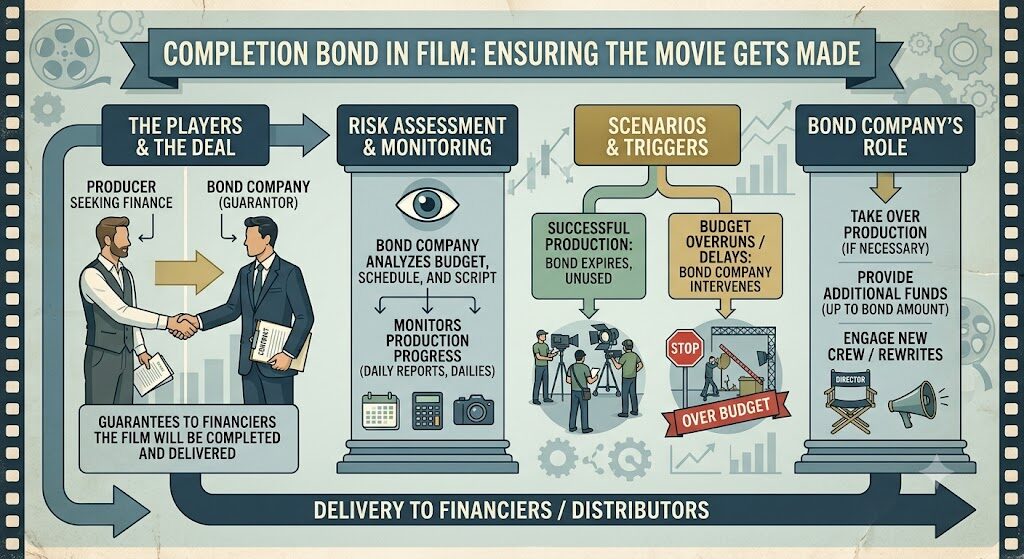
Completion bonds are non-negotiable for investors above the angel level. Joshua Harris of Peachtree Media Partners—a film finance lender whose deals have included an $80M Guy Ritchie project starring Henry Cavill and Jake Gyllenhaal—is explicit: “We only lend when there is a completion guarantee on a project. That’s the biggest single risk in moviemaking—that the film never gets finished.” For equity investors, the same logic applies. A completion bond converts the completion risk from an open question to an insured certainty, which dramatically improves the investability of the project.
Co-investment structures—where the producer also has skin in the game through a meaningful equity contribution or deferred fee subordination—signal alignment. Investors are more comfortable when producers are financially exposed to the outcome alongside them. A producer taking 100% of their fee upfront while the investor carries all the risk is a structural red flag even when the project is genuinely strong.
For a complete overview of how equity structures work within the broader financing framework, see our guide to decoding the film capital stack and our analysis of equity versus debt financing for film.
Red Flags That Make Investors Walk Away Immediately
Experienced film investors have seen every version of the pitch. And they’ve learned to read the warning signals that indicate a producer isn’t ready to manage their capital—or worse, isn’t operating in good faith. These red flags don’t have to be intentional to be damaging. Inexperience produces most of the same signals as misrepresentation.
Speculative cast attachments. “We’re in conversations with [major star]” is not a cast attachment. It’s a conversation. Investors who have been burned on projects where confirmed cast “fell off” are now hyper-vigilant about the difference between interest and commitment. Only present cast as attached when you have a deal memo or signed LOI. Present anything softer as “in discussions” and be prepared for that to reduce your valuation.
Unrealistic financial projections. A business plan showing a $3M film earning $50M in net profits is not ambitious—it’s uninformed. Investors who understand how distribution economics actually work (fees, P&A recoupment, territory splits, waterfall priority) will immediately discount your credibility when projections don’t reflect market reality. Conservative, sourced, territory-by-territory projections with clear assumptions signal financial sophistication. Hockey-stick projections signal wishful thinking.
No distribution strategy. “We’ll figure out distribution after we make it” is the single most common deal-killer after the pitch stage. Investors want to understand how they get their money back. That requires a specific, credible distribution strategy—named distributors you’re in conversations with, a realistic festival strategy for art-house projects, or confirmed streaming platform interest for genre content. “Good films find distributors” is not a strategy.
Rushing to close. Pressuring investors with artificial urgency—”We need to move in the next two weeks or we lose the window”—is a tactic that sophisticated investors recognise and resent. Good deals are available for reasonable closing windows. Artificial urgency signals either inexperience or a project that can’t sustain scrutiny. Give investors the time to do appropriate due diligence, and they’ll trust you more, not less.
Asking for more than you need right now. Raising your full production budget at the seed stage—before you have a sales agent, before you have pre-sales, before you have your financing structure confirmed—asks investors to take risks that other financing tools are designed to absorb. Sophisticated investors know their appropriate place in the capital stack. Asking them to fill the whole stack signals that you don’t.
According to The Hollywood Reporter, the most common failure point in independent film financing isn’t project quality—it’s the professionalism of the financing approach. Projects that are structured correctly and presented by credible teams close even in difficult market conditions.
How to Structure the Conversation That Closes Deals
The best pitches don’t feel like pitches. They feel like conversations between professionals who both understand the business—where the producer is sharing intelligence and the investor is evaluating fit. That dynamic requires you to lead with financial literacy and market knowledge, not enthusiasm.
Here’s a conversation sequence that works with sophisticated film investors:
Open with the market context, not the story. “We’re producing a contained thriller in the $3–4M budget range. It’s a genre that consistently pre-sells well in Germany, UK, and Australia, and we’ve got a sales agent attached who’s done three deals in this space in the last 18 months.” That’s an investor’s framing—it tells them the market, the budget, the territory appeal, and the validation through sales agent attachment. Save the story for after they’ve said yes to the business framework.
Present the capital stack, not just the equity ask. Show them where their money fits relative to everything else. “We’re targeting a $3.5M budget. We have $1.2M in pre-sales committed, a UK tax credit that covers approximately $700K, and we’re seeking $800K in equity—leaving a $800K gap that we’re bridging through gap financing against remaining territories.” That structure tells the investor their exposure, the priority of their position relative to other capital, and the path to recoupment. It’s the conversation that serious investors want to have.
Address the downside scenario proactively. Don’t wait for investors to ask what happens if the film doesn’t perform. Tell them first. “If distribution underperforms, your liquidation preference means you recoup 120% before any backend splits. The completion bond ensures the film is delivered even if production hits problems. The worst case is a 12–18 month delay before we see meaningful distribution revenues—not a scenario where you lose everything.” Investors who have thought through downside scenarios with you are far more likely to commit than those you’ve left to imagine them independently.
Follow up with the offer document, not the pitch deck. After an encouraging first conversation, experienced investors expect to receive formal offering materials—an investment memorandum, the proposed operating agreement structure, financial projections with sourced assumptions, and legal documentation prepared by an entertainment attorney. Sending a prettier version of your pitch deck instead signals that you’re not operating at the level they expect.
For further reading on how to structure the investor conversation and what documentation serious investors expect, see our guide to pitch decks that attract film financiers and our overview of private investor pitches for film capital.
Want Direct Introductions to Active Film Investors? Vitrina Concierge Does the Work.
Vitrina Concierge identifies verified financiers matched to your project’s genre, budget, territory, and stage—then makes warm introductions directly to active decision-makers. No cold outreach. No cold lists. Real connections.
- UK producer → matched to five equity funds active in $2–8M commercial features (48 hours)
- First feature, LA-based → direct access to angel network with genre film track record
- Established producer → introduced to specialist fund seeking slate partnership in MENA region
Frequently Asked Questions
How do I find private investors for an independent film project?
Private investors for independent film are found primarily through warm introductions—from entertainment attorneys, production accountants, sales agents, and fellow producers who already have relationships with active investors. Film markets like Cannes, AFM, and EFM host curated investor networking alongside the main market. Specialist platforms like Vitrina map verified financing companies by budget range and territory. Cold outreach rarely works; warm introductions through credible intermediaries are the standard path to a serious investor conversation.
How much equity should I give up to private film investors?
Equity percentage depends on how much of your budget equity covers versus other financing sources. On a well-structured independent film, equity typically represents 20–40% of the total budget—meaning investors receive 20–40% of the project’s profit participation in proportion to their contribution. Avoid giving up majority equity on your first project if possible; the waterfall economics of film mean that with significant distribution fees and P&A recoupment ahead of equity in the recoupment order, your ownership stake needs to be protected to have any economic meaning post-distribution.
What documents do private film investors typically require?
Serious investors above the angel level expect a formal offering memorandum (OM) describing the investment opportunity, risk factors, and use of proceeds; a proposed operating agreement outlining equity percentage, recoupment waterfall, and governance rights; financial projections with conservative, sourced assumptions by territory; chain of title documentation; the production budget and schedule; and evidence of current attachments (cast, director, sales agent). These should be prepared by an entertainment attorney experienced in film finance, not assembled from templates.
Is it possible to find film investors without a track record?
Yes, but it requires compensating for the track record gap through other credibility signals. A strong sales agent attachment—from a reputable firm with active market relationships—validates your project’s commercial merit even without producer history. Meaningful cast attachments (letters of intent from recognizable names, not verbal interest) provide another signal. A co-producer with established credentials attached to the project is among the most effective ways to bridge the credibility gap for first-time producers seeking professional investment. Angel investors from personal networks are the most accessible starting point.
What return do private film investors expect?
Private equity investors in independent film typically expect a 120–125% liquidation preference (principal plus 20–25% premium) before backend profit sharing begins. Beyond the preference, backend returns vary enormously based on film performance—from zero (majority of films) to significant multiples on commercially successful projects. Specialist film funds like IPR VC structure for portfolio returns across a slate rather than individual film bets, targeting overall fund returns in the 15–25% IRR range from a diversified portfolio. Angels typically accept lower systematic return expectations in exchange for proximity and the occasional significant upside.
Should I approach investors before or after attaching a sales agent?
After. A reputable sales agent attachment changes every investor conversation. It provides independent territory valuations that validate your financial projections, signals that a credible market professional believes in the project’s commercial merit, and unlocks access to pre-sales as collateral—which reduces the investor’s risk exposure. Most professional investors will ask “who is your sales agent?” early in the first conversation. If your answer is “we don’t have one yet,” their interest and the terms available to you both deteriorate significantly.
Can I use crowdfunding as film investment?
Crowdfunding platforms like Kickstarter and Indiegogo function as pre-sales or rewards-based funding, not equity investment—backers receive perks and recognition rather than financial returns. Equity crowdfunding through regulated platforms (StartEngine, Republic) is different—it allows retail investors to take actual equity positions, but is limited to US projects under SEC Regulation Crowdfunding rules and typically caps at $5M raised per 12-month period. For films under $500K, hybrid crowdfunding strategies can meaningfully supplement production budgets. Above that level, the administrative overhead of equity crowdfunding rarely justifies the capital raised.
How do film investment funds differ from individual private investors?
Film investment funds like IPR VC operate with professional fund management structures, formal LP (limited partner) investor relationships, and defined investment criteria applied systematically across a portfolio. They move faster than individuals once committed, bring strategic value through distribution relationships and market expertise, and typically prefer to invest across multiple projects with a single production company rather than making one-off deals. Individual private investors are less systematic but more flexible—they can move on gut feel for a project or relationship rather than requiring it to meet a fund mandate. The tradeoff: funds bring more capital and strategic value; individuals offer more flexibility and potentially more accessible entry points.
Conclusion: Private Film Investment Is a Relationship Business Built on Financial Literacy
Finding private investors for independent film isn’t primarily about finding people with money—it’s about becoming the kind of producer that people with money trust to deploy it. That trust is built through financial sophistication, professional structure, realistic projections, and the relationships that come from operating credibly in the market over time.
Key Takeaways:
- Match investor type to project stage. Angels for micro-budgets and early-stage projects. Family offices and specialist funds for structured commercial projects with sales agent and pre-sales confirmation. Never approach capital that’s too sophisticated for your current stage.
- Warm introductions beat cold outreach every time. Entertainment attorneys, sales agents, production accountants, and curated market events are the most reliable paths to active investor conversations.
- Lead with financial structure, not story. Investors evaluate the investment, not just the film. Present your capital stack, your recoupment model, and your downside scenario before you screen the trailer.
- Avoid the red flags that signal inexperience. Speculative cast, unrealistic projections, no distribution strategy, artificial urgency—any of these immediately reframe you as a risk rather than an opportunity.
- Structure properly from the start. Liquidation preferences, audit rights, completion bonds, and formal offering documents are not obstacles—they’re the signals that attract serious capital and convert conversations into commitments.
The producers who consistently close private film investment deals aren’t luckier than everyone else—they’ve done the work to understand how investment actually functions, and they’ve built the relationships and credentials that make investors want to say yes. Both of those things are achievable, and Vitrina exists to accelerate both.
Find the Right Film Investors for Your Project—Before Your Timeline Closes
Trusted by Netflix, Warner Bros, Paramount, and Google TV. Access 140,000+ verified companies including equity funds, film finance lenders, and co-production partners. Track 400,000+ active productions. Connect with 3 million entertainment professionals.
✓ 200 free credits | ✓ No credit card required | ✓ Cancel anytime
Need direct introductions to active film investors? Explore Concierge Service →
Find Film+TV Projects, Partners, and Deals – Fast.
VIQI matches you with the right financiers, producers, streamers, and buyers – globally.
Producers Seeking Financing & Partnerships?
Book Your Free Concierge Outreach Consultation
(To know more about Vitrina Concierge Outreach Solutions click here)
Join Industry Briefings Trusted by Leaders
The Mid-Budget Comeback: Why Mid-Budget Films Is the Smartest Bet in the Room
Mid-budget films are attracting new capital. See why this segment is becoming one of the strongest bets in Film today.
Franchise Fatigue vs. IP Dependency: What Studios Should Be Betting On Now
s franchise performance softens, where will the next generation of valuable IP come from? Join the briefing.

Unscripted Is Eating the World: The Multi-Billion Reality and Format Boom
Unscripted is the new prestige — inside the $19.8B global format boom reshaping how streaming platforms compete.
How Co-Productions and Regional IP Are Reshaping Global Drama
As global drama evolves, which stories travel, which stay local, and how are they getting financed?