IHUB
IHUB
 Private Briefings (Webinars)


 LeaderSpeak Podcast
  Global Entertainment Digest (Newsletter)
  About Vitrina
 About VIQI
 Our Story
 Our Solutions 🔥
 Film+TV Projects Tracker 🚀
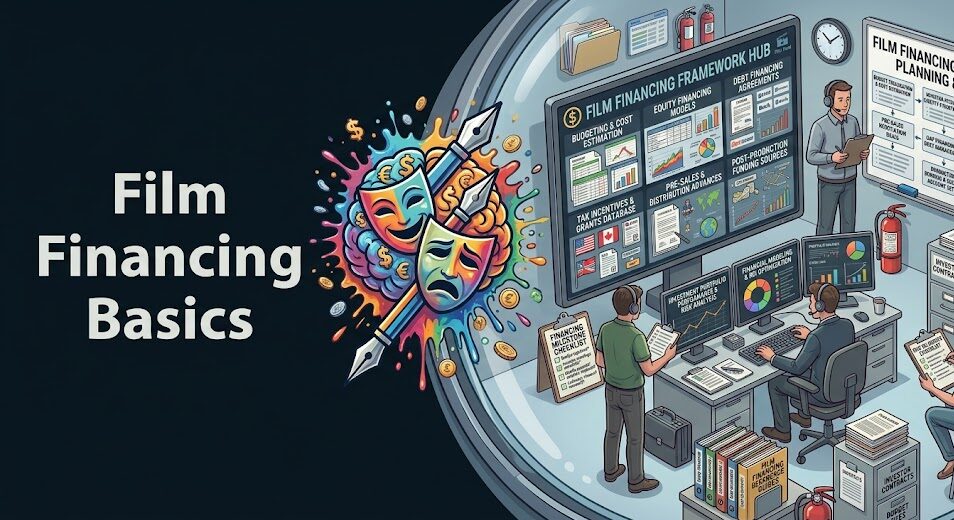
Film financing for independent filmmakers works through a capital stack—multiple funding sources layered together to cover your total production budget. No single source typically covers 100%. Instead, you combine equity investment, pre-sales, tax incentives, and sometimes gap financing until the numbers close.
The mix you use depends on your project’s commercial profile, your territory, and how much leverage your package—cast, director, script—gives you in the market.
That’s the structural answer. But knowing how film financing works in practice—the sequence, the relationships, the timing, and the points where deals collapse—requires understanding each layer of that stack and how they interact. Get this right, and you greenlight faster, retain more ownership, and protect your margins. Miss it, and you spend years in development hell or greenlight a project that loses money before cameras roll.
This guide covers everything: equity, pre-sales, gap financing, tax incentives, co-production structures, and the recoupment waterfall that determines who gets paid first. Whether you’re producing your first feature or scaling to a slate, these are the fundamentals that don’t change.
Table of Contents
- The Capital Stack: How Independent Films Are Actually Funded
- Equity Financing: What Investors Actually Want
- Pre-Sales and Minimum Guarantees: Turning Territory Rights Into Cash
- Tax Incentives and Soft Money: The Layer Most Producers Underuse
- Gap Financing: Bridging the Last 10–30% of Your Budget
- Co-Production Structures: Splitting Risk Across Borders
- The Vitrina Film Finance Readiness Ladder™
- The Recoupment Waterfall: Who Gets Paid and In What Order
- Frequently Asked Questions
- Conclusion
Ask VIQI: How Should I Structure Financing for My Specific Project?
VIQI is Vitrina’s AI research assistant—trained on 1.6 million titles, 360,000 companies, and 5 million entertainment professionals. Ask it to analyse your project’s financing profile and suggest the right capital stack mix based on your genre, budget, and territory.
✓ Included with 200 free credits | ✓ No credit card needed
The Capital Stack: How Independent Films Are Actually Funded
Film financing works through layers—not a single source, but a structured combination of money from different places, each with different risk profiles, repayment expectations, and leverage over your project. That combination is called your capital stack, and understanding it is the foundation of everything else.
Here’s what a typical independent feature capital stack looks like in practice:
- Equity investment — 20–40% of budget, from individuals or funds taking ownership stakes
- Pre-sales — 30–50% of budget, from distributors paying upfront for territorial rights
- Tax incentives and rebates — 15–30% of budget, from government programs in your filming jurisdiction
- Gap financing — 10–30% of budget, from specialist lenders advancing against unsold territories
- Soft money — 5–15% of budget, from film funds, cultural grants, broadcaster contributions
Not every project uses every layer. A $2M genre film with a known director and recognizable cast might close on equity plus a UK tax credit alone. A $15M international co-production might need all five layers working together. The commercial profile of your project—its genre, cast attachments, territory appeal, and distribution strategy—determines which layers are accessible and in what proportions.
The sequence matters as much as the components. Pre-sales need a package to sell. Tax incentives need production to occur. Gap financing needs pre-sales as collateral. Equity typically moves last—once the other layers reduce the investor’s risk exposure to an acceptable level. Miss the sequence and you’ll spend months chasing commitments that can’t close in the wrong order.
As we covered in our comprehensive film finance guide, the capital stack is the master framework every producer needs to understand before approaching any single financing source.
Equity Financing: What Investors Actually Want
Equity financing means someone gives you money in exchange for an ownership stake in your film—a percentage of profits, after all the debt and senior claims are paid. It’s the highest-risk position in the capital stack, which means equity investors expect the highest potential return. They also typically have the least control over day-to-day production decisions, though they often negotiate approval rights over the budget, distribution deals, and major cast changes.
Who provides equity to independent films? The sources vary considerably by budget level. Angel investors—high-net-worth individuals with a passion for film and the financial sophistication to accept the risk—fund a large percentage of micro-budget and low-budget features. Family offices, private equity firms, and specialist film funds like IPR VC dominate mid-budget productions. For budgets above $5M, institutional capital with professional track record requirements becomes the norm.
What do equity investors actually want? Andrea Scarso, Managing Partner at IPR VC—a Helsinki-based fund that has co-financed over 15 A24 films and works with partners including MK2 and XYZ Films—is direct about this: the challenge isn’t deal flow, it’s the quality of the investment structure. Investors want to understand your recoupment timeline, the downside protection your other financing layers provide, and whether the project has built-in distribution intelligence—meaning you understand your audience, not just your story.
Three things equity investors evaluate on every deal:
- Team track record — Have the producers done this before? Have they delivered and sold? First-time producer projects face a much higher bar.
- Package quality — What cast and director are attached? Are they confirmed or speculative? Unconfirmed “interest” is not a package.
- Recoupment path clarity — Where does the film go after production? Who distributes it, in which territories, through what platforms, on what timeline?
The equity you give up also determines your economic relationship with the film for its entire commercial life. Waterfall structures—the order in which revenue is distributed to stakeholders—heavily influence whether producers see any return. We’ll cover that in detail in the recoupment section below.
Equity at Different Budget Levels
Under $500K, equity often comes from producer-adjacent relationships: family, friends, community investors, or through crowdfunding as a hybrid model. These investors accept lower return expectations in exchange for proximity to the filmmaking process—credits, set visits, screening invitations.
$500K–$5M is the “emerging producer” band, where deals most commonly collapse. Budget is too high for personal networks but too low for institutional investors who need professional packaging. This is where your relationship with a sales agent becomes critical—their market estimates legitimise the project for investors who don’t know how to value territory rights independently.
Above $5M, professional equity expects professional documentation: offering memoranda, operating agreements, audit rights, quarterly reporting. Entertainment attorneys with fund experience aren’t optional at this level.

Your AI Assistant, Agent, and Analyst for the Business of Entertainment
VIQI AI helps you plan content acquisitions, raise production financing, and find and connect with the right partners worldwide.
- Find active co-producers and financiers for scripted projects
- Find equity and gap financing companies in North America
- Find top film financiers in Europe
- Find production houses that can co-produce or finance unscripted series
- I am looking for production partners for a YA drama set in Brazil
- I am looking for producers with proven track record in mid-budget features
- I am looking for Turkish distributors with successful international sales
- I am looking for OTT platforms actively acquiring finished series for the LATAM region
- I am seeking localization companies offer subtitling services in multiple Asian languages
- I am seeking partners in animation production for children's content
- I am seeking USA based post-production companies with sound facilities
- I am seeking VFX partners to composite background images and AI generated content
- Show me recent drama projects available for pre-buy
- Show me Japanese Anime Distributors
- Show me true-crime buyers from Asia
- Show me documentary pre-buyers
- List the top commissioners at the BBC
- List the post-production and VFX decision-makers at Netflix
- List the development leaders at Sony Pictures
- List the scripted programming heads at HBO
- Who is backing animation projects in Europe right now
- Who is Netflix’s top production partners for Sports Docs
- Who is Commissioning factual content in the NORDICS
- Who is acquiring unscripted formats for the North American market
Pre-Sales and Minimum Guarantees: Turning Territory Rights Into Cash
Pre-sales are among the most powerful tools in independent film financing—and among the most misunderstood. A pre-sale is a licensing agreement where a distributor pays a Minimum Guarantee (MG) for the right to distribute your completed film in a specific territory for a defined period, typically 15–20 years. That MG contract can then be used as collateral for a production bank loan—converting a future distribution commitment into current production cash.
The mechanics: your sales agent takes your packaged project—script, director, cast attachments—to film markets like Cannes, AFM (American Film Market), or EFM (European Film Market). Territorial distributors evaluate the package and offer MGs based on their market estimates. Major territories (Germany, France, Japan, UK, Australia) drive most of the value. A-list cast dramatically increases territory values; unknown cast in commercial genres can still attract pre-sales from buyers who trust the genre formula.
Banks don’t lend the full face value of MG contracts. They discount based on distributor creditworthiness—a contract with a major German distributor like Constantin might be lent against at 85–90 cents on the dollar; a smaller, less-established buyer might only qualify for 70%. The aggregate of bankable pre-sales contracts, discounted to their lending value, becomes your pre-sales financing line.
“Pre-sales have become much harder. There was a time when you could walk around Cannes with an idea and a star attached and close deals. Now the film basically needs to be made before buyers will commit at meaningful MG levels. The market got burned too many times on packages that never delivered.
— Phil Hunt, Founder & CEO, Head Gear Films (550+ films financed)
Hunt’s observation from the Vitrina LeaderSpeak interview reflects a real market shift. Pre-sales still work—they’re critical to most independent film financing—but they require stronger packaging than they did five years ago. Genre projects with recognizable cast in thriller, action, and horror categories still attract meaningful pre-sale interest. Drama with unknown talent is significantly harder.
One strategic point worth understanding: pre-selling every territory upfront maximises your production financing but eliminates your backend upside on those markets. Smart producers hold back key territories—especially domestic (US) rights and major anchor markets—to sell post-completion when the completed film commands a premium. This requires bridging the funding gap through other means, which is where gap financing enters the picture.
For a detailed breakdown of the pre-sales process including territory valuation and market strategy, see our guide to mastering pre-sales and avails in entertainment.
Find Financiers, Sales Agents, and Co-Production Partners on Vitrina
Trusted by Netflix, Warner Bros, and Paramount. Search 140,000+ verified companies in the global entertainment supply chain—including specialist film financiers, pre-sale buyers, and co-production funds active in your territory.
✓ 200 free credits | ✓ No credit card required | ✓ Full platform access
Tax Incentives and Soft Money: The Layer Most Producers Underuse
Tax incentives are government-backed financial returns on qualifying production expenditure—cash rebates, refundable tax credits, or transferable credits that reduce your effective budget. They’re among the most powerful tools in the independent filmmaker’s financing arsenal because they’re non-dilutive (you don’t give up ownership) and relatively predictable once you understand the qualifying criteria.
The global incentive landscape is competitive and actively expanding. Saudi Arabia’s Vision 2030 program offers a 40% cash rebate on qualifying spend. Abu Dhabi goes as high as 50%. The UK’s Audio-Visual Expenditure Credit runs at 25% base, with a VFX-specific uplift reaching 29.25% as of 2025. Georgia (USA) offers 30% with no annual cap. Czech Republic recently increased its rebate to 25% standard and 35% for animation. Japan’s incentive program reaches up to 50% with a ¥1B cap per project.
A few things producers consistently get wrong about tax incentives:
Headline rate ≠ effective rate. The percentage applies only to qualifying spend, which excludes non-resident above-the-line costs in many programs, marketing expenses, and sometimes post-production if it occurs outside the territory. Get a production accountant with incentive experience to run your actual effective rate before choosing your location.
Tax incentives are backend money. Most rebates and refundable credits are paid after production wraps, following an audit—typically 6–18 months after principal photography. You cannot spend this money during production unless you monetize it through a rebate loan. Banks and specialist lenders will advance 80–90% of an approved incentive against the pending payment, at interest—which adds cost but solves the cash flow problem.
Stacking is possible. Multiple incentives from different jurisdictions can be combined: a Georgia state credit with Savannah’s local rebate, or a UK tax credit with a Northern Ireland Screen fund grant. Co-productions structured under bilateral treaties can access two national incentive programs simultaneously, which is one of the primary financial motivations for international co-production beyond creative and distribution reasons.
According to Screen International, the competition among jurisdictions to attract international productions has intensified significantly, with multiple markets increasing their incentive rates or expanding qualifying criteria in 2024–2025. For producers, this is genuinely good news—the soft money available per dollar of production spend has never been higher.
For a territory-by-territory breakdown of current incentive rates and qualifying criteria, see our global guide to film and TV tax credits and incentives.
Gap Financing: Bridging the Last 10–30% of Your Budget
Gap financing is a debt facility that covers the funding gap between your secured financing (pre-sales, equity, tax incentives) and your total production budget. It typically covers 10–30% of the budget and is secured against the value of your unsold distribution territories—the rights you’ve deliberately held back to sell post-completion.
Here’s the mechanical reality: lenders advance against projected territory values, not actuals. Your sales agent provides estimates for unsold markets—Japan, Germany, Australia, Scandinavia—and the gap lender advances a percentage of that estimated value, discounted for risk. Lenders typically only count major territories and apply conservative haircuts (lending 50–70% of the agent’s estimates) because they’re taking on performance risk rather than contractual certainty.
The cost is real and should be fully modeled before you pursue this route. Gap financing typically costs 8–15% annually in interest, plus origination fees of 1–2% of the loan and legal costs typically running $15–25K. For an 18-month loan period, you’re looking at an all-in effective cost of 15–22% of the loan principal. On a $1.5M gap facility, that’s $225K–$330K in financing costs that don’t appear on your production budget but absolutely affect your project’s economics.
When Does Gap Financing Make Sense?
Gap financing makes sense when you have strong pre-sales (60%+ of budget secured), a reputable sales agent with lender relationships, a completion bond in place, and meaningful commercial cast attached. It lets you hold back key territories—particularly domestic US rights—rather than pre-selling them at production-stage discounts, betting that a completed film will command better terms.
It doesn’t make sense when your gap is larger than 30% of budget (signals insufficient market confidence in your package), when you don’t have a completion bond (most gap lenders require one), or when your genre has weak international territory appeal (comedy, for instance, tends to have low foreign pre-sale value and poor gap collateral).
Joshua Harris, President and Managing Partner of Peachtree Media Partners—a US-based film finance lender that has deployed capital across dozens of independent productions—explains his firm’s approach: “We advance against territory value before a distribution agreement is executed. That’s what makes us different from commercial banks. It enables producers to hold back rights and maintain upside.”
For a complete breakdown of gap financing mechanics, costs, and lender requirements, see our dedicated guide to gap financing in film production.
Co-Production Structures: Splitting Risk Across Borders
Co-production is a formal partnership between producers from different countries to jointly develop and produce a project, accessing the financial benefits—tax incentives, national film fund support, quota advantages—of multiple jurisdictions simultaneously. Done under an official bilateral or multilateral treaty, it grants the project national status in each co-producing country.
The financial logic is straightforward: stack two countries’ incentive regimes and you dramatically increase your effective soft money. A UK-Australia co-production, for example, can access the UK’s 25% AVEC alongside Australia’s 30% Location Offset—with the qualifying spend in each jurisdiction counting against that country’s program. Combined correctly, you might cover 50–55% of your total budget through incentives alone before equity or pre-sales enter the picture.
The requirements are significant. Financial contributions must be proportional to creative contributions—you can’t bring in a co-producer to harvest a tax credit without giving them meaningful creative involvement. Minimum financial thresholds apply (typically 10–20% of budget from each co-producer). The project must meet cultural test requirements in each country. And the administrative load of managing multiple national approval processes, different production regulations, and international crew requirements adds real overhead.
What Co-Production Is Not
Co-production is often confused with a Production Services Agreement (PSA)—where you hire a local production services company to facilitate your foreign shoot. A PSA gives you local crew access and potentially a local incentive, but it doesn’t give you a co-producer’s national status or multi-territory incentive access. It’s cheaper and simpler to structure, but the financial upside is lower.
Canada has the world’s most extensive bilateral co-production treaty network—over 60 countries—which is why it features prominently in international independent film financing structures. France has 61 bilateral treaties. The UK maintains treaties with more than a dozen countries. US producers, notably, operate without formal co-production treaties, which is why American productions often structure through a Canadian or European co-producer to access these frameworks.
For a detailed guide to co-production treaty structures and their financing implications, see our analysis of how co-productions work in global film and TV.
The Vitrina Film Finance Readiness Ladder™
Most independent film financing fails not because the market doesn’t want the project, but because the producer approaches each financing layer in the wrong sequence—or before the prerequisite conditions for that layer are in place. The Vitrina Film Finance Readiness Ladder™ maps the conditions required at each stage before you move to the next.
The Vitrina Film Finance Readiness Ladder™
Key principle: You cannot greenlight until you’re at Rung 5. Approaching gap lenders at Rung 1, or equity investors before you have a sales agent at Rung 2, wastes relationships and signals inexperience. Work the ladder in sequence.
The Recoupment Waterfall: Who Gets Paid and In What Order
The recoupment waterfall is the contractual order in which film revenues are distributed to everyone who has a claim on the project. Understanding it is essential—not just for investors, but for producers who need to model what they’ll actually earn from a film that performs commercially. Here’s the standard hierarchy:
- Distribution and sales agent fees — typically 20–35% of gross revenues off the top, before anyone else sees anything
- P&A (prints and advertising) recoupment — the distributor recoups their marketing spend, often substantial for theatrical releases
- Senior production loan repayment — the bank gets repaid with interest before junior claims
- Gap financing repayment — gap lender recoups principal plus accrued interest
- Tax credit recoupment — if rebate loans were taken, the lender is repaid when the government incentive pays out
- Equity investor recoupment — investors recoup their principal, typically at a 120–125% threshold (principal plus premium) before profit participation begins
- Deferred fees — cast, crew, and producers who accepted deferrals are paid from what remains
- Net profit participation — everyone else with a backend deal, after everything above is satisfied
Why does this matter to independent filmmakers? Because it determines what you earn from your own film. If your total financing cost (distribution fees + P&A + debt interest + equity premium) represents 75% of projected revenues, a film needs to gross 4x its production budget before a producer sees any profit participation. That’s a high bar that most films don’t clear.
This is why experienced producers focus intensely on minimising each layer’s cost: negotiating distribution fees down from 30% to 20%, securing lower-rate gap financing, using soft money to reduce equity dilution, and ensuring deferred fee pools are realistic rather than aspirational. Each percentage point you reclaim from any waterfall layer directly improves your economics.
For a full breakdown of how to model your recoupment position, see our guide to recoupment schedules in film finance.
Need Financiers Matched to Your Specific Project? We’ll Find Them.
Vitrina Concierge identifies verified financiers, co-production partners, and sales agents matched to your project’s genre, budget, territory, and stage—with warm introductions to active decision-makers.
- UK producer → matched to MENA co-production fund in 48 hours
- LA-based indie → direct access to five equity funds active in $2–8M features
- First feature → connected to sales agents who work with emerging producers
Frequently Asked Questions
How does film financing work for independent filmmakers?
Film financing for independent filmmakers works through a capital stack—multiple funding sources layered together to cover the full production budget. Typical components include equity investment (20–40%), pre-sales from territorial distributors (30–50%), tax incentives and rebates (15–30%), and sometimes gap financing (10–30%) against unsold territory rights. No single source usually covers the entire budget. The mix depends on your project’s commercial profile, genre, cast attachments, and target distribution territories.
What is the minimum budget required to attract film financing?
There’s no hard minimum, but the practical reality differs by financing type. Angel equity can fund films under $500K. Pre-sales require bankable cast and typically become meaningful above $1M. Gap financing lenders like Peachtree Media Partners require completion bonds, which become economically viable around $5M. Institutional equity funds generally focus on $2M+ projects. Under $1M, you’re typically working with equity from personal networks, crowdfunding, and local government grants or broadcaster development funds.
Do I need a sales agent to finance an independent film?
For most independent features above $1M, yes—practically speaking. Sales agents provide territory estimates that legitimize your project for investors who can’t independently value distribution rights. They have market relationships that make pre-sales possible. And gap lenders specifically require reputable sales agent involvement as a condition for lending. Without a sales agent, you can still finance through equity alone, but your pool of equity investors is limited to those who trust your own commercial judgment rather than validated market estimates.
What is a completion bond and why do I need one?
A completion bond is an insurance product from a third-party bonding company that guarantees your film will be completed on time and within budget. If production collapses or runs over budget beyond a defined threshold, the bonding company steps in to either fund the overage or pay back investors and lenders. Gap financing lenders and most institutional equity investors require a completion bond as a condition of their commitment—it’s the primary risk mitigation tool for financial parties who aren’t on set to manage production. Completion bonds typically cost 3–6% of the production budget.
How do tax incentives work for independent film financing?
Film tax incentives are government programs that return a percentage of qualifying production spend as a cash rebate, refundable tax credit, or transferable credit. Rates range from 20% (UK base) to 50% (Abu Dhabi, Japan) on qualifying expenditure. They’re paid after production, following an audit—typically 6–18 months after principal photography wraps. You can monetize an approved incentive through a rebate loan (80–90% advance at interest) to access the funds during production. Tax incentives don’t dilute your ownership and are among the most cost-effective financing layers available.
What is the recoupment waterfall and how does it affect what I earn?
The recoupment waterfall is the contractual order in which film revenues are paid out. Distribution fees and P&A costs come off the top. Senior debt (bank production loans) is repaid next. Gap financing follows. Then equity investors recoup at their preferred rate (typically 120–125% of investment). Deferred fees come after that. Net profit participation—what producers and backend participants earn—is calculated from whatever remains. On films where total financing costs represent 70–80% of projected revenue, the producer’s net position can be minimal even on commercially successful projects. Understanding this order before you structure your deal is essential.
How long does it take to finance an independent film?
Honest answer: 12–36 months from clean package to fully closed financing on most independent features above $2M. The timeline depends heavily on the strength of your package, your relationships with sales agents and investors, and market conditions. Films with strong genre profiles, known directors, and A-list attachments can move faster—sometimes 6–9 months in favorable markets. First features without established producer track records or strong cast often take longer. Development financing—the funding to develop the project to packagable stage—is a separate, earlier step that most producers fund themselves or through small development grants.
What genres are easiest to finance independently?
Horror, thriller, and action consistently attract the strongest pre-sale interest and the most accessible equity because their commercial profiles are legible to buyers in advance. Horror in particular has proven bankable at low-to-mid budgets without A-list cast—the genre sells. Drama is significantly harder to pre-sell without major cast or festival pedigree. Comedy has weak foreign territory value. Documentary attracts grant and broadcaster funding but limited equity. Phil Hunt of Head Gear Films—who finances 35–40 films annually—describes the current market as requiring projects to be “completely exceptional” because there’s no room for anything else at current distribution values.
Conclusion: Film Financing Is a Skill, Not a Mystery
Film financing for independent filmmakers works through a capital stack assembled in sequence, each layer building on the credibility and collateral the previous one established. It’s complex—but it’s learnable, and it’s repeatable once you understand the logic behind each component.
Key Takeaways:
- The capital stack is your master framework. Equity, pre-sales, tax incentives, gap financing, and soft money work together—no single source covers a full independent budget at any meaningful scale.
- Sequence matters as much as the components. Package before sales agent, sales agent before pre-sales, pre-sales before gap—skip steps and you waste relationships and delay your greenlight.
- Tax incentives are the most underused layer. Non-dilutive, predictable, and increasingly generous globally—producers who don’t model incentive stacking are leaving significant money on the table.
- The recoupment waterfall determines your actual economics. Know who gets paid before you and in what order before you sign any financing document.
- Genre matters. Horror, thriller, and action have the most accessible independent financing paths. Drama and comedy face structural headwinds in the current pre-sale market that better packaging alone won’t fix.
The producers who greenlight consistently aren’t luckier than everyone else—they’ve built the relationships, understand the mechanics, and know which layers to pursue in what order for their specific project profile. That’s learnable. And Vitrina exists to give you the intelligence and connections that used to require years of market experience to develop.
Find Your Film’s Financing Partners Before Your Competition Does
Trusted by Netflix, Warner Bros, Paramount, and Google TV. Access 140,000+ verified companies—including equity funds, sales agents, gap lenders, and co-production partners active right now. Track 159,223 projects. Connect with 3 million entertainment professionals.
✓ 200 free credits | ✓ No credit card required | ✓ Cancel anytime
Need direct introductions to active film financiers? Explore Concierge Service →