About Innovation Hub
 Global Content Pulse (Webinars)


 Global Production Financing
(Webinars)
Global Production Financing
(Webinars)  LeaderSpeak Podcast
  Global Entertainment Digest (Newsletter)
  About Vitrina
 About VIQI
 Our Story
 Our Solutions 🔥
 Film+TV Projects Tracker 🚀
 Case Studies
 Our Profile
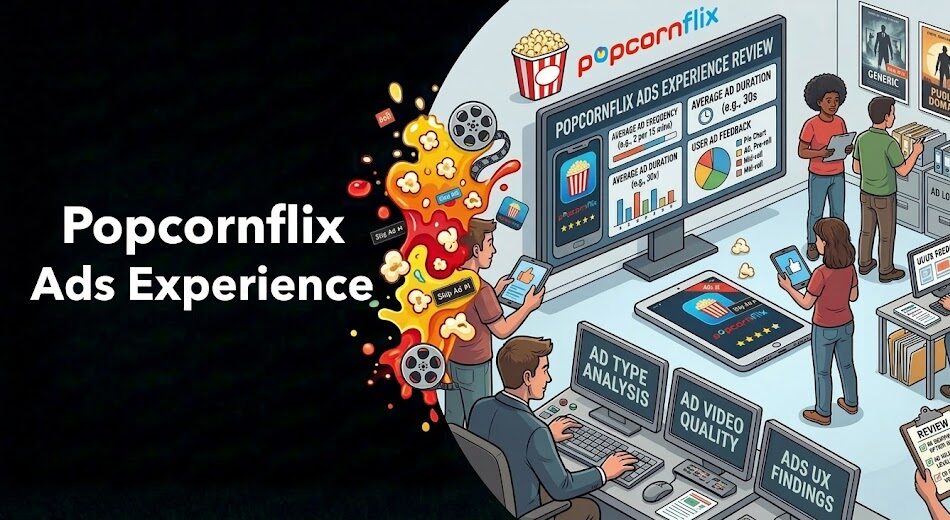
Before you commit a Friday night to any free streaming platform, you deserve actual numbers. Not vague impressions. Not “there are a few ads.” Real, timed, counted data on how many ads Popcornflix shows, how long those breaks last, what the dead-time loading lag looks like, and—critically—how that stacks up against Tubi, Pluto TV, and Peacock Free.
The ad load comparison across free streaming platforms is genuinely one of the most consequential decisions you’re making when you choose where to watch. A platform that delivers 4 minutes of ads per hour feels completely different from one delivering 12 minutes per hour. That’s the difference between a night that feels like watching a film with a few coffee-break interruptions and a night that feels like basic cable in 2003.
This article gives you the straight numbers—and explains the business logic behind why each platform lands where it does. Because understanding why Pluto TV has more ads than Tubi, and why Popcornflix sits somewhere in the middle, tells you something real about each platform’s future. And that matters if you’re picking a primary free streaming service for the long term.
⚡ Ad Load Quick Reference (Per Hour of Content)
- Tubi: 4–6 minutes — lightest among major free platforms
- Peacock Free: ~5 minutes — comparable to Tubi
- Popcornflix: ~8–10 minutes — mid-range, plus loading lag
- Roku Channel: ~8 minutes — similar to Popcornflix
- Pluto TV (on-demand): 10–12 minutes — highest among major AVOD
- Pluto TV (live channels): Up to 12–15 minutes — closest to cable
- Linear TV: ~12 minutes — the benchmark everything competes against
Table of Contents
- How Many Ads Popcornflix Actually Shows
- The Loading Lag Problem Nobody Talks About
- Tubi Ad Load: Why It’s the Lightest Among Free Platforms
- Pluto TV Ad Load: The Heaviest Free Streaming Experience
- Peacock Free Ad Load: The Paid Platform Comparison Point
- Full Side-by-Side Ad Load Comparison Table
- Why Ad Loads Differ: The Business Logic Behind the Numbers
- TV Episodes vs Movies: Ad Load Is Not Equal
- Verdict: Which Platform Has the Most Tolerable Ads?
- Frequently Asked Questions
- Conclusion
Ask VIQI: Which AVOD Platforms Are Winning the Ad-Load War Right Now?
VIQI is Vitrina’s AI assistant—trained on 1.6 million titles, 360,000 companies, and 5 million entertainment professionals. Ask VIQI which free streaming platforms have the best viewer retention rates, how ad load affects content licensing economics, and where the AVOD market is heading.
✓ Included with 200 free credits | ✓ No credit card needed
How Many Ads Popcornflix Actually Shows
Let’s start with the actual count. A standard two-hour film on Popcornflix involves approximately 10 commercial breaks. Structure: one pre-roll ad before the content begins, followed by regular mid-roll interruptions placed roughly every 12–15 minutes throughout the film.
Each break runs 30–90 seconds. Do the math: 10 breaks averaging 60 seconds each equals roughly 10 minutes of ad time in a two-hour film—or about 5 minutes per hour of content. That puts Popcornflix in the mid-range of the free streaming market when measured purely on ad minutes.
But raw minutes don’t capture the full experience. There’s a specific Popcornflix friction point that changes the feel of the ad experience substantially: the platform’s ad-break loading lag. When a break triggers, playback doesn’t immediately switch to an ad. There’s a buffer period of approximately 10–15 seconds before the ad loads and plays. This loading dead-time is invisible in the “minutes of ads” metric but is very visible when you’re actually watching.
Across 10 breaks, that’s an additional 1.5–2.5 minutes of spinning loader that isn’t content, isn’t advertising, and isn’t recoverable. Total interruption time—ads plus loading lag—in a two-hour Popcornflix film is closer to 11.5–12.5 minutes. That’s what you’re actually sitting through.
The Loading Lag Problem: Why It Matters More Than the Minute Count
Loading lag is the silent tax on Popcornflix’s viewing experience—and it’s the reason the platform’s ad experience feels worse than its minute-per-hour count suggests. Here’s the psychology: your brain reacts differently to “I’m watching an ad” versus “I’m staring at a buffering screen.” The first is passive. The second creates active frustration.
Tubi’s ad breaks snap in almost instantly—the ad starts within 1–2 seconds of content pausing. Pluto TV’s live channels have similar instantaneous switching. Popcornflix’s post-relaunch infrastructure hasn’t achieved that yet. The lag was most pronounced on Roku devices post-March 2025 relaunch, less severe on the mobile web browser version.
This is a solvable technical problem, not a permanent feature. Screen Media Ventures is rebuilding the platform’s ad delivery infrastructure—the lag will likely improve as the platform matures past its first year. But as of early 2026, it’s real and measurable. And it’s the single biggest differentiator between Popcornflix’s actual viewing experience and what the “5 minutes per hour” number suggests.
For a detailed breakdown of the mobile and device experience including ad lag specifics by device, our Popcornflix app review covers this in granular detail.

Your AI Assistant, Agent, and Analyst for the Business of Entertainment
VIQI AI helps you plan content acquisitions, raise production financing, and find and connect with the right partners worldwide.
- Find active co-producers and financiers for scripted projects
- Find equity and gap financing companies in North America
- Find top film financiers in Europe
- Find production houses that can co-produce or finance unscripted series
- I am looking for production partners for a YA drama set in Brazil
- I am looking for producers with proven track record in mid-budget features
- I am looking for Turkish distributors with successful international sales
- I am looking for OTT platforms actively acquiring finished series for the LATAM region
- I am seeking localization companies offer subtitling services in multiple Asian languages
- I am seeking partners in animation production for children's content
- I am seeking USA based post-production companies with sound facilities
- I am seeking VFX partners to composite background images and AI generated content
- Show me recent drama projects available for pre-buy
- Show me Japanese Anime Distributors
- Show me true-crime buyers from Asia
- Show me documentary pre-buyers
- List the top commissioners at the BBC
- List the post-production and VFX decision-makers at Netflix
- List the development leaders at Sony Pictures
- List the scripted programming heads at HBO
- Who is backing animation projects in Europe right now
- Who is Netflix’s top production partners for Sports Docs
- Who is Commissioning factual content in the NORDICS
- Who is acquiring unscripted formats for the North American market
Tubi Ad Load: Why It’s the Lightest Among Major Free Platforms
Tubi has the best ad experience of any major free streaming platform. Full stop. Across independent tests of Tubi’s ad load, reviewers saw around four to six minutes of ads per hour of content—and the experience was rated as genuinely tolerable even by viewers who aren’t used to ad-supported streaming. Ad breaks run approximately 90 seconds each, they snap in quickly with minimal loading lag, and the targeting is sophisticated enough that you’re seeing ads relevant to your profile rather than generic inventory filler.
Why does Tubi have a lighter ad load than Popcornflix? The answer is CPM economics. Fox Corporation’s investment in ad targeting infrastructure allows Tubi to charge advertisers significantly more per impression—reportedly $15–20 CPM versus the lower rates a less-targeted platform commands. When you’re generating more revenue per ad, you can serve fewer ads and still fund the platform. Tubi’s lighter load is essentially financed by its more valuable ad inventory.
Tubi also introduced pause ads—non-intrusive display ads that appear when you pause the content, not during playback. These generate revenue without adding to the commercial break count. It’s a smart monetization strategy that keeps the mid-roll count low while still maximising advertiser touchpoints.
Pluto TV Ad Load: The Heaviest Free Streaming Experience
Pluto TV has the heaviest ad load of any major free streaming platform—and the gap between its on-demand and live channel experience is significant enough to treat them separately.
Pluto TV on-demand: Pluto TV comes with more than 10 ad breaks during a single movie, which can add up to as much as 30 minutes of commercials. That’s an extraordinary number—30 minutes of ads in a feature film would mean roughly a quarter of your total viewing time is commercials. On TV shows, viewers might be asked to sit through as many as 15 minutes of ads per hourlong episode—making Pluto TV on-demand the clear outlier among free streaming services.
Pluto TV live channels: The live channel experience is structured more like traditional cable—ads appear at natural programming breaks, everyone watching the same channel sees the same ad at the same time, and you can’t pause or skip. Pluto TV’s live channels have ad loads of approximately 12 minutes per hour—in line with broadcast television and significantly higher than any on-demand AVOD service.
Why does Pluto TV carry more ads? The model is different. Pluto TV feels more like a traditional television experience—live, scheduled channels with ad breaks that feel heavier and less predictable than Tubi’s. Paramount Global (which owns Pluto TV) has positioned it as a cable-TV replacement, and that means cable-TV advertising density. The trade-off is explicit: you get live sports, news, and hundreds of curated channels, but you pay for it in commercial time.
Carol Hanley (CEO, Whip Media) breaks down how AVOD and FAST platforms balance ad load against viewer retention—and the analytics signals that tell platforms when their ad density is hurting their business:
Track Which AVOD Platforms Are Winning on Viewer Retention—and Why
Trusted by Netflix, Warner Bros, and Paramount. Join 140,000+ companies tracking streaming platform strategies, advertising economics, and the content acquisition decisions that drive AVOD growth worldwide.
✓ 200 free credits | ✓ No credit card required | ✓ Full platform access
Peacock Free Ad Load: The Paid Platform Comparison Point
Peacock is interesting to include in this comparison because it straddles the line between free and paid—its free tier is ad-supported, and it competes directly with AVOD platforms for viewers who don’t want to pay. Peacock holds the line at approximately five minutes of ads per hour—comparable to Tubi and well below Popcornflix or Pluto TV.
Peacock Free’s lighter-than-average ad load for a “free” platform is partly explained by the same CPM premium logic that works for Tubi: NBC/Universal content adjacency commands higher advertising rates, so fewer ads generate equivalent revenue. Sports adjacency (Premier League, NFL, Olympics) is particularly valuable inventory. Peacock can afford to keep the load lighter because the ads it does show are worth more.
The trade-off for Peacock Free is content restriction—certain titles and live sports are locked behind the paid tier. So you get a light ad load, but on a more limited content selection. Popcornflix gives you everything in the catalog for free without content walls, but you get more ads and the loading lag tax on top.
Full Side-by-Side Ad Load Comparison Table
Why Ad Loads Differ: The Business Logic Behind the Numbers
Ad load isn’t random. Every platform lands where it does for calculable business reasons—and understanding those reasons helps you predict where each platform is heading.
CPM × Ad Minutes = Revenue. A platform generating $18 CPM (Tubi’s territory) needs fewer ad minutes to hit the same revenue target as a platform at $12 CPM (Pluto TV’s territory). Tubi’s higher CPM—built on Fox’s targeting infrastructure, named talent originals, and premium advertiser relationships—allows it to serve lighter ad loads without sacrificing revenue per viewer. FAST platforms like Tubi and Pluto TV offer the lowest CPMs in streaming at $15–20, providing free content to viewers in exchange for higher ad loads. But even within the FAST tier, Tubi commands a premium over Pluto TV—which is why Tubi can afford fewer ads.
Popcornflix sits at a structural disadvantage here post-relaunch. Screen Media Ventures is rebuilding the platform’s advertiser relationships from scratch after the bankruptcy disruption. Until those relationships mature and CPMs normalise, the platform generates less revenue per ad impression—which means it needs either more ad minutes or lower content investment. Right now, it’s absorbing some of that gap with a slightly heavier-than-Tubi load combined with a lower-budget catalog rebuild strategy.
According to analysis from nScreenMedia, the lowest viable ad load for free AVOD platforms is 8–10 minutes per hour—below that, platforms can’t generate enough revenue to fund the content licensing costs that keep viewers engaged. Tubi’s ability to operate at 4–6 minutes is a direct result of charging premium CPMs. For Popcornflix, operating at its current level is rational given its revenue position.
As reported by The Hollywood Reporter, streaming ad loads are converging toward a new equilibrium—the forecast is that Tubi will settle around 5 minutes per hour, while Pluto TV maintains approximately 12 minutes, cementing their positions at opposite ends of the free streaming ad spectrum. Popcornflix’s trajectory depends on whether Screen Media can drive its CPMs upward through better targeting infrastructure and advertiser relationships.
TV Episodes vs Movies: Ad Load Is Not Equal Across Content Types
Here’s a nuance most ad load comparisons skip—and it’s practically important. The per-hour ad count is not uniform across content types. Movies get more ad breaks than TV episodes on most platforms, because the episode format has natural act breaks that limit where pre-determined ad slots can be inserted without disrupting narrative flow.
On Popcornflix: a 45-minute TV episode typically has 2–3 ad breaks. Scale that up: 2.5 breaks × 60 seconds = roughly 2.5 minutes of ads in 45 minutes of content—or about 3.3 minutes per hour. That’s actually lighter than Tubi’s feature-film ad load, and considerably lighter than Popcornflix’s own film experience. TV binge-watching on Popcornflix is a meaningfully better ad experience than movie-watching.
This pattern holds across platforms. Hulu titles feature up to eight minutes of ads per hourlong episode of TV, with ad breaks as long as two minutes each—but Hulu’s movie ad load can be even heavier per hour. Pluto TV’s TV show ad load reaches as many as 15 minutes per hourlong episode—but that’s for its bloated on-demand catalog, not the live channel experience.
The practical recommendation: if you’re evaluating Popcornflix as a daily streaming choice, consider building your watchlist around TV series rather than films. The ad experience improves substantially, and the binge format is better suited to the AVOD model across every platform. Our guide to the best TV shows to binge on Popcornflix covers exactly what’s worth watching on that basis.
Verdict: Which Platform Has the Most Tolerable Ad Experience?
Tubi wins, clearly. Four to six minutes per hour, fast-loading breaks, sophisticated targeting, and pause ads that don’t interrupt playback—it’s the best ad experience available on any free streaming platform. If minimising your ad time is the primary criterion for platform choice, Tubi is the answer.
Popcornflix is mid-range—8–10 minutes per hour is tolerable but clearly heavier than Tubi or Peacock. The loading lag adds friction that the raw minute count doesn’t capture. But the zero-signup, no-account model is a genuine differentiator that Tubi doesn’t offer. If you find yourself frequently switching between platforms or watching occasionally rather than daily, Popcornflix’s frictionless access may be worth the extra ad minutes.
Pluto TV is for channel surfers, not binge-watchers. Its on-demand ad load is brutal—potentially 30 minutes of commercials in a two-hour film. But if you want the live TV channel experience with news, sports, and scheduled programming, Pluto TV’s live channels are a different product category that the ad load comparison doesn’t fairly capture. You’re watching it like cable, not like on-demand streaming.
The practical verdict for most viewers: run both Tubi and Popcornflix. Use Tubi as your primary platform for the lighter ad experience and larger catalog. Use Popcornflix for its indie and international content depth, and for the moments when you want zero-friction no-signup access. Both are free. Neither costs you anything except your attention. For the full picture on how these platforms compare across all dimensions—not just ads—our Popcornflix vs Tubi comparison covers it comprehensively.
Get Your Content onto AVOD Platforms—We’ll Connect You to the Buyers.
Vitrina Concierge is your Virtual Agent. We make warm introductions directly to acquisition executives at Popcornflix, Tubi, Pluto TV, and 400+ AVOD platforms actively seeking content like yours right now.
- LA producer → Netflix UK, Fifth Season, Fox Entertainment (48 hours)
- Korean animation studio → Netflix Adult Animation (week one)
- Middle Eastern studio → Legendary Pictures (direct access)
Frequently Asked Questions
How many ads does Popcornflix show per hour?
Popcornflix delivers approximately 8–10 minutes of ad time per hour of content—roughly 10 commercial breaks across a two-hour film, each running 30–90 seconds. An additional 10–15 second loading lag before each break adds roughly 1.5–2.5 minutes of buffering time on top. Total effective interruption time in a two-hour film runs around 11.5–12.5 minutes when loading lag is included.
Does Popcornflix have fewer ads than Tubi?
No—Tubi has fewer ads. Tubi delivers 4–6 minutes of ads per hour, while Popcornflix delivers approximately 8–10 minutes per hour. Tubi’s lighter ad load is financed by higher CPM advertising rates enabled by Fox Corporation’s sophisticated targeting infrastructure. Tubi is the best ad experience among major free streaming platforms.
Does Popcornflix have more or fewer ads than Pluto TV?
Popcornflix has fewer ads than Pluto TV’s on-demand section. Pluto TV on-demand can run 10–12 minutes of ads per hour, with some feature films reaching up to 30 minutes of total commercial time. Pluto TV’s live channels run 12–15 minutes of ads per hour—closest to traditional cable TV. Popcornflix’s 8–10 minutes per hour makes it significantly lighter than Pluto TV on-demand.
Can you skip ads on Popcornflix?
No—ads on Popcornflix are non-skippable. Once a break begins, you watch it through to completion before content resumes. There’s no “skip in 5 seconds” option, no fast-forward, and no paid tier that removes ads. This is standard across all free AVOD platforms—Tubi, Pluto TV, and Popcornflix all enforce non-skippable commercial breaks.
How do Popcornflix ads compare to Peacock?
Peacock Free runs approximately 5 minutes of ads per hour—lighter than Popcornflix’s 8–10 minutes. But Peacock Free restricts some content behind its paid tier, while Popcornflix gives you access to its entire catalog for free with no content walls. You’re trading a heavier ad load on Popcornflix for unrestricted access to everything in the library.
Why does Popcornflix have more ads than Tubi?
Ad load is determined by CPM rates—the revenue generated per thousand ad impressions. Tubi charges premium CPMs ($15–20) backed by Fox Corporation’s targeting infrastructure and named-talent originals, allowing fewer ads to generate equivalent revenue. Popcornflix, post-relaunch, is rebuilding its advertiser relationships from scratch after the 2024 bankruptcy, commanding lower CPMs and therefore needing more ad minutes to fund the same content investment.
Are there fewer ads watching TV shows than movies on Popcornflix?
Yes—significantly fewer. A 45-minute TV episode on Popcornflix typically has only 2–3 ad breaks, translating to roughly 2–3 minutes of ad time per episode or about 3–4 minutes per hour. That’s lighter than Tubi’s film experience. If you’re evaluating Popcornflix’s ad experience, building your watchlist around TV series rather than feature films substantially improves the viewing experience.
Which free streaming service has the most tolerable ad experience overall?
Tubi—by a clear margin. At 4–6 minutes per hour with fast-loading breaks and sophisticated ad targeting, it’s the best free streaming ad experience available. Peacock Free is close at approximately 5 minutes per hour, but restricts some content. Popcornflix at 8–10 minutes per hour is mid-range and tolerable. Pluto TV on-demand at 10–15 minutes per hour is the heaviest experience among major free platforms.
Conclusion: Popcornflix Is Mid-Range—and That’s an Honest Assessment
Popcornflix’s ad load isn’t the worst in free streaming—that’s Pluto TV by a distance. But it’s not the best either—Tubi wins that comparison clearly. At 8–10 minutes per hour with a 10–15 second loading lag, Popcornflix sits in the tolerable middle of the AVOD market. The zero-signup model and catalog depth make it worth the trade-off for certain viewers. But if ad minimisation is your priority, Tubi is the platform you want.
Key Takeaways:
- Popcornflix: ~8–10 Min/Hour, ~10 Breaks Per Film: Plus 10–15 second loading lag per break adds 1.5–2.5 minutes of dead time. Total effective interruption in a 2-hour film: ~11.5–12.5 minutes.
- Tubi Wins the Ad Load War: 4–6 Min/Hour: Fox’s targeting infrastructure enables premium CPMs that fund a lighter ad load. Best free streaming ad experience available.
- Pluto TV Is the Heaviest: Up to 30 Min Per Film: On-demand ad load can reach 10–15 minutes per hour. Live channels run 12–15 minutes per hour—cable-era density.
- TV Episodes Are Lighter Than Films on Every Platform: 2–3 breaks per 45-minute episode on Popcornflix = roughly 3–4 minutes per hour. Build your watchlist around TV series for the best free streaming ad experience.
- CPM Economics Drive Ad Load—and Popcornflix’s Will Improve: As Screen Media rebuilds advertiser relationships post-bankruptcy, CPMs will rise and ad minutes can decrease. The current load reflects a platform rebuilding, not a permanent ceiling.
The free streaming ad experience across all platforms is improving as CPMs rise and targeting gets more sophisticated. The trajectory of the market—documented by forecasters and industry analysts alike—points toward lighter loads as more premium inventory gets unlocked. Popcornflix’s current ad experience is a 2026 snapshot, not a permanent feature. But right now, if you’re choosing based purely on how much time you’ll spend watching commercials, the ranking is clear: Tubi first, Peacock second, Popcornflix third, Pluto TV last.
Track Every AVOD Platform’s Advertising Strategy—Before the Deals Close
Trusted by Netflix, Warner Bros, Paramount, and Google TV. Track 400,000+ projects. Access 3 million verified executives. Understand the advertising economics that drive content investment decisions at every major free streaming platform.
✓ 200 free credits | ✓ No credit card required | ✓ Cancel anytime
Find Film+TV Projects, Partners, and Deals – Fast.
VIQI matches you with the right financiers, producers, streamers, and buyers – globally.
Join Industry Briefings Trusted by Leaders
Unreleased Film+TV Projects: Opportunities & Showcase
A curated view of unreleased Film and TV projects open for financing and collaboration
The Mid-Budget Comeback: Why Mid-Budget Films Is the Smartest Bet in the Room
Mid-budget films are attracting new capital. See why this segment is becoming one of the strongest bets in Film today.
Franchise Fatigue vs. IP Dependency: What Studios Should Be Betting On Now
s franchise performance softens, where will the next generation of valuable IP come from? Join the briefing.
Unscripted Is Eating the World: The Multi-Billion Reality and Format Boom
Unscripted is the new prestige — inside the $19.8B global format boom reshaping how streaming platforms compete.