IHUB
IHUB
 Private Briefings (Webinars)


 LeaderSpeak Podcast
  Global Entertainment Digest (Newsletter)
  Premium Lists
 Membership Benefits
 About Vitrina
 Our Story
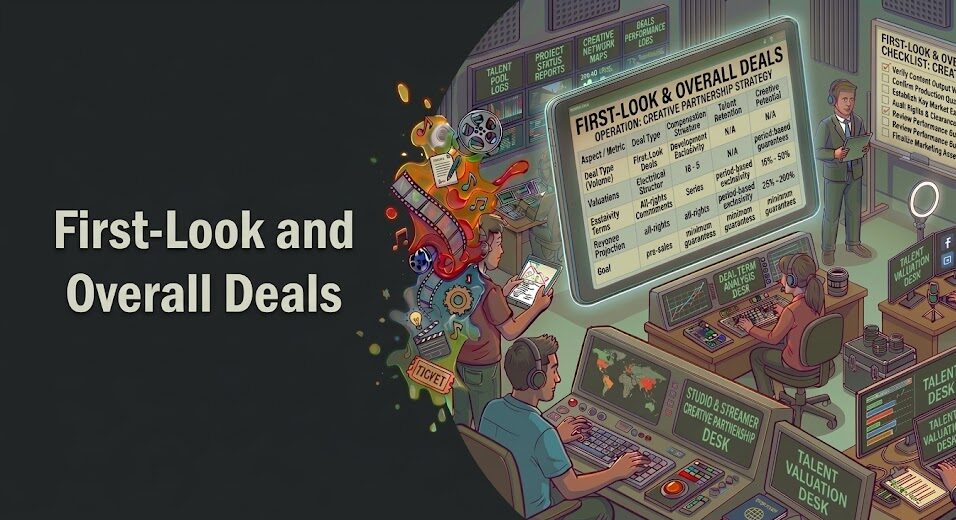
First-look and overall deals are the agreements that don’t make the trades until after they close—and by then, the competitive intelligence they contain is already 6 weeks stale. If you’re trying to understand why a particular showrunner’s projects keep landing at the same studio, or how a streamer is quietly building a dominant position in a specific genre, the answer is almost always sitting inside one of these talent pacts.
This guide covers how first-look and overall deals actually work in 2026, what the financial architecture looks like, which studios and platforms are actively signing them, and how these agreements shape—or constrain—a studio’s content pipeline for years at a time. No fluff. Just mechanics.
Here’s the thing: the streaming era didn’t kill talent pacts. It mutated them. Netflix, Amazon, and Apple created a feeding frenzy for A-list writers, directors, and producers from 2018 to 2022 that pushed overall deal costs to levels traditional studios couldn’t match. That boom is over—but the underlying logic of locking in creative relationships hasn’t changed. What’s changed is who’s signing, what they’re paying, and what they expect in return.
Table of Contents
What’s Inside This Guide
- First-Look vs. Overall Deals: The Actual Difference
- Right of First Refusal, Blind Script, and Output Deals
- The Financial Anatomy of a Talent Pact
- Who Signs What: Talent Categories and Deal Types
- Which Studios and Platforms Are Actively Signing in 2026
- How Talent Pacts Shape a Studio’s Content Pipeline
- Deal Terms That Changed After the Streamer Pullback
- How to Negotiate Your First-Look or Overall Deal Position
- Red Flags That Poison a Talent Pact Before It Starts
- Frequently Asked Questions
- The Bottom Line
Track Active First-Look and Overall Deal Signings—Before They Hit the Trades
Vitrina monitors talent pact activity across 300,000+ companies and 1.6 million+ projects globally. Netflix, Warner Bros., Amazon, Apple—see which studios are building their pipeline right now.
Used by commissioning executives at Google TV, OSN, and independent financiers tracking deal flow in real time.
Ask VIQI About Active Talent Deals →
No credit card required. 200 free credits to start.
First-Look vs. Overall Deals: The Actual Difference
A first-look deal gives a studio or platform the right to evaluate a creative’s next project before anyone else sees it. If the studio passes, the talent takes it elsewhere. There’s no exclusivity on where the talent spends their time—just a contractual obligation to show the studio every new idea first. The studio gets priority access to the creative’s pipeline. The talent gets an overhead payment—typically covering office space, staff, and development costs—plus any development fees on projects the studio picks up.
An overall deal is heavier. The talent is effectively exclusive to the studio for the term of the agreement—usually 2 to 3 years. They can’t develop projects with other studios while the overall deal is active. In exchange, they receive a much larger overhead commitment, guaranteed development funds, and often a bonus structure tied to projects that go into production. Overall deals are reserved for proven showrunners, bankable directors, and production companies with demonstrated hit track records.
The financial gap between these two structures is significant. A first-look deal for a mid-tier TV writer might carry an overhead commitment of $500K–$1.5M over 2 years. An overall deal for a showrunner with a proven Netflix hit? That number routinely sits at $5M–$20M over the same period—sometimes higher for A-list talent at peak demand.
But don’t let the dollar figures distract from the strategic logic. Both deal types are fundamentally about one thing: controlling who gets to develop what projects, and where those projects end up. The studio that signs Ryan Murphy or Shonda Rhimes to an overall deal doesn’t just get their next show—it gets a content factory with a proven audience relationship, a development machine, and a pipeline of IP it can greenlight or pass on over multiple years. That’s worth the overhead.
Right of First Refusal, Blind Script Deals, and Output Deals: Where They Fit
Right of First Refusal (ROFR) vs. First-Look
A first-look deal requires the talent to show the studio a project first; if the studio passes, the talent is free to take it anywhere. A right of first refusal is a stronger, more talent-unfriendly version: the studio doesn’t just get to see the project first, it gets the right to match any competing offer the talent subsequently receives before the talent can accept it. That matching right chills the market—a competing buyer who knows the original studio can simply match their bid has less incentive to bid aggressively in the first place. Studios with real leverage push ROFR language into deals marketed informally as “first-look.” Read the actual clause, not the deal’s nickname.
Blind Script Deals
A blind script deal sits between a first-look and an overall deal on the commitment spectrum. The studio commits to paying for a defined number of scripts—typically one to three—without a specified project attached at the time of signing. Neither side knows what the material will be when the money changes hands; the studio is buying the writer’s output in advance, sight unseen. It’s a structure writers use more often than producers, to lock in guaranteed income while retaining story control—a useful middle option for talent who’ve outgrown a pure pitch-by-pitch relationship but aren’t yet at overall-deal scale.
Output Deals, and Development vs. Production First-Looks
An exclusive output deal is broader than a standard first-look: the talent or production company commits its content exclusively to one buyer, rather than retaining the right to shop a passed project elsewhere. Output deals function much like overall deals in practice, but the term is used more often at the production-company level—particularly for companies whose business model is supplying a steady slate to a single network or platform rather than developing individual auteur-driven projects.
Within the first-look category itself, deals also split by stage. A development first-look covers early-stage material—concepts, treatments, scripts still being shaped—and is the more common structure for emerging producers and writers. A production first-look attaches to projects that are already completed or substantially developed, a different risk profile for the studio: less speculative development cost, but a narrower window to shape the creative direction.
On turnaround mechanics specifically: when a studio passes on a project it helped develop and that project later gets made elsewhere, reimbursement of the studio’s sunk development costs is common. Depending on how much development work was actually done—script fees, option payments, allocated overhead—that reimbursement can run anywhere from $50,000 to $500,000 or more, which is a real deterrent to competing buyers even after a clean pass.
For a sense of scale at the far end of the spectrum: the overall deal Netflix signed with Ryan Murphy was widely reported at roughly $300 million, and Greg Berlanti’s long-running overall deal at Warner Bros. TV is one of the industry’s longest-standing examples of the structure. Both sit well outside first-look territory—but they illustrate why talent with a first-look deal and a strong hit rate has real incentive to push for an upgrade.
The Financial Anatomy of a Talent Pact
Let’s get specific—because “overhead deal” is a vague term that obscures how the money actually moves.
A standard talent pact has three financial components:
The overhead payment. This covers the talent’s production company costs: office space, assistant salaries, development executives, and other operating expenses. For first-look deals, the studio typically pays $300K–$1M per year. For overall deals with A-list talent, overhead can run $3M–$7M annually. Studios treat this as a development investment—they’re buying the exclusive right to see (and potentially acquire) everything that comes out of that production company.
Development fees. When the studio picks up a project from the talent’s pipeline, it pays a development fee—typically $50K–$250K per project for a script commission or pilot. These fees are recoupable against the talent’s eventual production fee if the project goes forward. If the project dies in development (which most do), the talent keeps the development fee and the studio absorbs the loss.
Backend and production bonuses. For overall deals specifically, studios structure bonuses around production milestones. Get a pilot greenlit? Trigger a $250K bonus. Go to series? Another trigger. This aligns the talent’s financial incentives with the studio’s production goals—and it’s what separates a true overall deal from an inflated first-look arrangement.
Here’s what most producers miss when they evaluate these deals: the overhead payment is not free money. It’s an advance against future fees on projects that go forward. When a project gets picked up, the development fees and production payments are typically structured to recoup the overhead first. The talent who signs a $4M overall deal and only gets one project greenlit over 2 years has effectively subsidized the studio’s development slate.
Smart talent reps negotiate hard on the recoupment structure—and on what happens to unrecouped overhead if the studio doesn’t pick up projects. Phil Hunt, founder and CEO of Head Gear Films, has built an entire business model around the insight that most producers lack the business affairs expertise to navigate these structures. As he noted in the Vitrina LeaderSpeak podcast, the whole industry has become “much harder in terms of getting movies off the ground”—and the talent that survives is the talent with professional support on the financial and legal side of their deals.
Phil Hunt (Founder & CEO, Head Gear Films) on packaging, producer relationships, and why most talent needs professional business affairs support to survive today’s deals. Via Vitrina LeaderSpeak.
Who Signs What: Talent Categories and Deal Types
Not every creative gets the same deal structure. The type of pact a studio offers depends entirely on the talent’s track record, the content type, and the platform’s strategic priorities.
Showrunners and TV Writers
This is the category where overall deals are most common and most valuable. A showrunner who has delivered 3+ seasons of a hit series—and who has demonstrated the ability to run a writers’ room, manage production, and maintain quality at scale—commands an overall deal, not a first-look. Studios know that true showrunner capability is rare. There are maybe 200 working showrunners in the US who can consistently deliver a network-quality drama. All of them get calls from multiple platforms simultaneously.
The 2023 WGA strike changed this market in ways that are still working through the system. The resulting Minimum Basic Agreement reset deal terms for more than 11,500 working writers, and its minimum-compensation and turnaround provisions are now the benchmark entertainment attorneys cite in first-look and overall deal negotiations industry-wide. Minimum compensation floors went up, residual structures shifted, and the “mini-room” model—where streamers kept small writers’ rooms on retainer without committing to production—became contractually harder to sustain. Overall deals for showrunners now need to guarantee a minimum number of weeks of work per year to comply with new guild standards. Studios that pushed back on this found their talent relationships deteriorating fast.
Directors and Filmmaker Deals
Director deals are typically first-look rather than overall—because directors work one project at a time and the exclusivity logic of an overall deal doesn’t apply as cleanly. A director can only shoot one film at once. What the studio wants is the right to be in the conversation on every new project, which a first-look arrangement delivers cleanly.
The exceptions are directors who’ve crossed into producing and who have active development slates running parallel to their directing careers. J.J. Abrams at Bad Robot, Jordan Peele at Monkeypaw Productions—these are directors who’ve built genuine production companies, and their pacts function as hybrid overall deals covering both their personal directing work and their company’s development activity.
Producers and Production Companies
This is where the Fragmentation Paradox hits hardest. Producers with strong track records in one genre or format are now fielding offers from 6–8 different buyers simultaneously—because the content supply chain has fragmented to the point where every platform, every streaming service, and every studio needs more relationships than it can organically maintain.
The structure for production companies is usually a first-look deal with a larger overhead commitment than the individual creator deals—because you’re funding an entire development infrastructure, not just one person’s creative output. A mid-tier production company with 2–3 shows in development might negotiate a first-look deal at $1.5M–$3M overhead per year, covering a development team of 3–5 people.
Actors with Development Arms
The fastest-growing category. Actors who’ve built production companies—Reese Witherspoon’s Hello Sunshine, Mindy Kaling’s Kaling International, Ryan Reynolds’ Maximum Effort—are signing first-look arrangements that give them access to studio infrastructure while retaining the IP development control they’d lose in a full overall deal.
These deals are explicitly about IP acquisition as much as talent. The studio isn’t just buying access to the actor’s next starring vehicle—it’s buying the rights pipeline from that actor’s production company, which typically includes book adaptations, podcast rights, and format optioning activity. The overhead covers that development activity, and the studio gets first access to everything that comes out of it.
Discover Which Production Companies Have Active Studio Pacts—Right Now
Vitrina’s Smart Pairing engine maps talent pact activity across 1.6 million+ tracked projects, showing you which studios are actively building their pipeline—and which production companies are available for new deals.
Netflix UK connected with target producers through Vitrina intelligence within 48 hours. Join 300,000+ companies using the same platform.
No credit card required. Cancel anytime.
Which Studios and Platforms Are Actively Signing in 2026
The talent pact market in 2026 looks nothing like 2021. Here’s the current state, by buyer.
Netflix
Netflix’s talent pact activity has rationalized dramatically from the 2020–2022 peak. During that period, the platform was signing overall deals at rates that shocked traditional studios—$30M+ commitments for top showrunners weren’t unusual. The correction came in 2023 when subscriber growth slowed and content budget pressure hit. A significant number of overall deals weren’t renewed.
But Netflix hasn’t stopped signing talent. It’s gotten more selective. The platform now prioritizes overall deals with talent who’ve demonstrated global audience appeal—not just domestic prestige. A showrunner whose series performed in the top 10 in Latin America, Southeast Asia, or MENA gets a renewal conversation. One whose show performed brilliantly with US critics but didn’t drive global engagement? That renewal is harder. Netflix’s content spend is increasingly justified by subscriber impact metrics, and deal renewals follow the same logic.
Amazon MGM Studios
Post-MGM acquisition, Amazon has been actively building its traditional studio talent infrastructure—which means first-look deals with production companies that have theatrical as well as streaming output. Amazon’s deal activity looks more like a legacy studio than a pure streamer, with overhead arrangements covering both feature film and TV development. The MGM library and the theatrical ambitions that came with it changed Amazon’s talent strategy: they need deals that feed both Prime Video and the theatrical pipeline MGM requires to maintain its distribution relationships.
Apple TV+
Apple operates the most selective talent market of any major platform. It’s signed a small number of very large overall deals—Ridley Scott’s Scott Free Productions, Skydance’s David Ellison relationships, and select A-list talent where the prestige positioning justifies the overhead cost. Apple doesn’t need volume. It needs 8–12 prestige titles per year that justify its Apple One bundle positioning and drive device attachment. The overall deal economics at Apple reflect that: fewer deals, higher per-deal commitment, very high quality thresholds for what actually gets greenlit.
Traditional Studios: Warner Bros., Disney, Universal
All three have recalibrated their talent deal activity post-strike and post the streaming correction. Warner Bros. Discovery, carrying its substantial debt load from the Discovery merger, has been one of the more aggressive traditional studios in renegotiating overall deal terms downward on renewals. The calculus is simple: if the platform is watching EBITDA, the overhead commitments on deals that haven’t produced hits are the first cost center under pressure.
Disney’s talent pact strategy is inextricably linked to its streaming architecture—Marvel and Star Wars talent relationships are managed as quasi-overall deals even when they’re not formally structured that way, because the franchise IP requires continuity of creative relationships across years of interconnected content. Universal has been quietly building first-look relationships with mid-tier production companies that weren’t on streamers’ radar during the 2020–2022 frenzy—a smart counter-positioning move that gives Universal access to deals at rational overhead costs.
How Talent Pacts Shape a Studio’s Content Pipeline
This is the question that most coverage of talent deals misses. The business press focuses on the money. The strategic reality is about pipeline architecture.
A studio with 20 active first-look deals and 8 overall deals has, in effect, pre-loaded its development slate for the next 2–3 years. Every project in development at those production companies is a potential greenlight for that studio. The studio’s programming team knows—before anything hits the trades—what’s being written, what’s getting packaged with talent, and what might be ready to go into production in 12–18 months.
That’s a profound competitive intelligence advantage. And it’s the reason platforms like Netflix were willing to pay above-market rates for overall deals during their growth phase—they were buying foresight into the content market, not just access to talent.
But here’s what it also does on the downside: every active overall deal is a first-right-of-refusal obligation. If a talent brings a project the studio doesn’t want to make, they have to formally pass before the talent can take it elsewhere. That creates administrative drag, slows the talent’s project development, and sometimes creates relationship friction when the studio keeps passing on projects the talent is passionate about. It’s why the overall deal market has shifted toward first-look structures at many platforms—less obligation, less administrative burden, still get priority access.
You can see how co-commissioning structures are changing this dynamic in real time—studios are increasingly sharing development costs and pipeline access across talent pacts rather than holding exclusive positions that burden their P&L.

Your AI Assistant, Agent, and Analyst for the Business of Entertainment
VIQI AI helps you plan content acquisitions, raise production financing, and find and connect with the right partners worldwide.
- List the top commissioners at the BBC
- List the post-production and VFX decision-makers at Netflix
- List the development leaders at Sony Pictures
- List the scripted programming heads at HBO
- Find active co-producers and financiers for scripted projects
- Find equity and gap financing companies in North America
- Find top film financiers in Europe
- Find production houses that can co-produce or finance unscripted series
- Who is backing animation projects in Europe right now
- Who is Netflix’s top production partners for Sports Docs
- Who is Commissioning factual content in the NORDICS
- Who is acquiring unscripted formats for the North American market
- Show me recent drama projects available for pre-buy
- Show me Japanese Anime Distributors
- Show me true-crime buyers from Asia
- Show me documentary pre-buyers
- I am looking for production partners for a YA drama set in Brazil
- I am looking for producers with proven track record in mid-budget features
- I am looking for Turkish distributors with successful international sales
- I am looking for OTT platforms actively acquiring finished series for the LATAM region
- I am seeking localization companies offer subtitling services in multiple Asian languages
- I am seeking partners in animation production for children's content
- I am seeking USA based post-production companies with sound facilities
- I am seeking VFX partners to composite background images and AI generated content
Deal Terms That Changed After the Streamer Pullback
Five specific deal mechanics shifted materially between 2022 and 2026:
Overhead caps came down. Overall deal overhead commitments that peaked at $7M–$10M per year for A-list showrunners have pulled back to $3M–$6M for most talent tiers. The exceptions are genuine franchise builders—the Ryan Murphys of the world whose shows reliably drive subscriber acquisition—but even those deals are being scrutinized more carefully against subscriber impact data before renewal.
Development fund guarantees shrank. Pre-2022, studios competed by offering development funds—money ringfenced for the talent to option books, acquire IP, and develop scripts—on top of the overhead. Those funds have largely been folded back into the general overhead commitment, which means the talent’s development activity now competes with the studio’s own IP acquisition team for the same budget dollars.
Greenlight guarantees disappeared. During the peak streaming war period, some overall deals included guaranteed series commitments—the talent gets a pilot order guaranteed into the deal regardless of the script’s performance. That’s gone. Every project now goes through the studio’s normal greenlight process, and the overall deal buys you priority consideration, not guaranteed pickup.
IP ownership terms tightened. Streamers in particular have pushed harder for IP retention—meaning the studio/platform owns the underlying intellectual property in perpetuity rather than reverting to the talent after a defined period. Talent representatives have pushed back hard on this post-strike, and the current norm at most studios is a 5–7 year window before reversion rights kick in on projects that don’t go into production.
Global performance clauses appeared. New to the 2024–2026 deal cycle: overall deal renewals at streaming platforms now include global performance benchmarks. If your show didn’t hit defined viewership thresholds in specific international territories, the renewal terms deteriorate. This is a direct product of Netflix, Amazon, and Apple managing their content ROI against subscriber impact data rather than prestige metrics.
You can read more about how overall deal structures have evolved and what the current market terms look like for different talent tiers.
De-Risk Your Next Talent Deal with Live Market Intelligence
Vitrina Concierge gives you current overhead benchmarks by talent tier, active first-look deal activity by studio, and which platforms have open pipeline capacity—6 weeks before any of it hits Deadline.
Trusted by senior acquisition executives and production company heads at companies tracking 159,223 projects globally.
How to Negotiate Your First-Look or Overall Deal Position
Whether you’re a production company entering your first studio deal or a showrunner renegotiating a renewal, the same principles apply. Here’s what actually moves the needle.
Know your leverage window. Talent deals get negotiated from strength or from desperation—there’s not much middle ground. Your leverage is highest immediately after a hit lands: the 6–8 week window after a show premieres strongly, before the platform’s subscriber data has had time to settle into “what does this actually mean for renewals.” If you’re entering deal conversations outside that window, your negotiating position is weaker. Go in early.
Separate the overhead from the IP terms. Most talent negotiation energy goes into the overhead number—which is the most visible part of the deal. But IP reversion rights, sequel participation, and format rights are where the real long-term value sits. A $5M overall deal where you retain reversion rights after 5 years is worth more than a $6M deal where the studio holds IP in perpetuity. Know which you’re negotiating for.
Negotiate the pass process. How quickly does the studio have to pass on a project you bring them before you can take it elsewhere? Standard first-look terms give the studio 30–45 days to respond. For overall deals, it’s often 60–90 days. Every day you’re waiting on a pass is a day your project isn’t being pitched elsewhere. Shorter response windows are a real negotiating win that doesn’t show up in the headline deal value.
Get explicit on what “first look” actually means. Does it cover only your production company’s projects, or does it extend to your personal creative work as well? Does it apply to podcasts and books you’re developing alongside the screen pipeline? These boundaries matter—especially as talent increasingly operates across formats that blur the traditional film/TV/digital lines.
The talent who navigates this best in 2026 is the talent who has professional business affairs support—the kind Phil Hunt describes Head Gear providing for independent producers: a background machine handling the legal, financial, and packaging mechanics so the creative talent can focus on the work. Tracking comparable deal activity globally is a critical part of that support—you can’t negotiate benchmarks you don’t know.
Red Flags That Poison a Talent Pact Before It Starts
A few deal-killers worth putting on record:
Vague IP ownership language. “The studio will have rights to projects developed under this agreement” sounds straightforward. It’s not. “Projects developed” can be interpreted to include ideas you had before the deal started, projects you’re developing personally, and work you do with co-writers who aren’t on the studio’s payroll. Get specific definitions—and get a lawyer who works entertainment deals to review the ownership provisions before you sign anything.
Overhead structures that recoup too aggressively. If the deal requires you to recoup 100% of the overhead before any production fee flows to you, you’re in an arrangement that can result in years of work producing zero net income. Negotiate for partial overhead recoupment—50–60% is a more common market standard—or for clear limits on the recoupment period.
No “turnaround” rights. What happens to projects you develop under the deal that the studio passes on? Standard turnaround provisions let you take those projects to other buyers after a defined period, sometimes paying back development costs. Deals without clear turnaround rights can trap projects in development limbo for years—the studio won’t make them, but you can’t take them elsewhere either.
Renewal terms that favor the studio unilaterally. Some overall deal structures give the studio an option to renew at the same terms, regardless of what’s happened to the talent’s market position in the interim. If you’ve just delivered a hit, that renewal option is a below-market obligation. Make sure renewal terms either reprice to market or include renegotiation triggers tied to production outcomes.
Evaluation windows that drift past 60 days with no automatic reversion. A clean first-look structure gives the studio a defined window—commonly 30 days, sometimes up to 60—to respond before the project automatically reverts to the talent. Deals that stretch past 60 days without an automatic reversion mechanism, or that let the studio’s silence substitute for a formal pass, put projects in indefinite limbo instead of a defined decision point.
Exclusivity language that reaches backward into pre-existing work. A first-look deal is supposed to cover new projects developed during the deal term—not material the talent was already developing independently before signing. Vague “projects developed under this agreement” language can be read to sweep in pre-existing pitches and partnerships. The fix is the same one that applies to IP ownership: name the carved-out projects explicitly in an attached exhibit rather than relying on a general exclusion clause.
You can see the full breakdown of how first-look deals are structured above and what the standard provisions cover—including the ones talent agents routinely push back on.
Frequently Asked Questions About First-Look and Overall Deals
What is a first-look deal in the entertainment industry?
A first-look deal gives a studio or streaming platform the contractual right to evaluate a creative’s next project before anyone else. The talent must present every new idea to the studio first. If the studio passes—typically within 30–60 days—the talent is free to take the project elsewhere. In exchange, the studio pays an overhead commitment covering the talent’s production company costs. First-look deals don’t require exclusivity of the talent’s time, only priority access to their projects.
How is an overall deal different from a first-look deal?
An overall deal is exclusive: the talent agrees to develop projects only with that studio for the term of the agreement, typically 2–3 years. The studio pays a larger overhead commitment—often $3M–$10M+ annually for top talent—plus guaranteed development funds and production bonuses. Overall deals are reserved for proven showrunners, A-list directors, and production companies with strong hit track records. First-look deals allow the talent to work elsewhere; overall deals don’t.
How much do first-look and overall deals pay in 2026?
First-look deal overhead ranges from $300K–$3M per year depending on the talent’s track record and the size of their production company. Overall deals for proven showrunners run $3M–$8M annually after the 2022–2023 correction from peak streaming-era rates ($10M–$30M+). Development fees of $50K–$250K per project add on top when the studio picks something up. Backend bonuses for overall deals trigger at pilot order, series greenlight, and other production milestones.
Who has first-look and overall deals at Netflix in 2026?
Netflix no longer discloses its full talent deal roster publicly, and trade press coverage typically lags actual signings by 6–8 weeks. The platform has significantly rationalized its overall deal commitments from the 2020–2022 peak, focusing renewals on talent with demonstrated global audience impact rather than domestic prestige. Vitrina’s deal intelligence layer tracks first-look and overall deal activity across major platforms in near-real time—which is how producers and financiers stay current on the market ahead of public announcements.
What is IP reversion in a talent deal?
IP reversion is the contractual provision that returns ownership of a developed project to the talent if the studio doesn’t put it into production within a defined period—typically 5–7 years. Without reversion rights, a studio can hold a project in perpetual development without making it, preventing the talent from taking it elsewhere. Post-WGA strike, talent representation has pushed hard for reversion provisions on all development projects, and most current deals include them in some form.
What happened to talent deal values after the streaming pullback?
Overall deal overhead commitments dropped 30–50% from peak 2021 levels as Netflix, Amazon, and Apple all reduced content budgets in response to slowing subscriber growth. Many deals weren’t renewed when they expired in 2023–2024. The talent market has stabilized at lower rates, with studios now requiring demonstrated global audience performance rather than prestige credentials as the primary renewal trigger. First-look deal values held up better than overall deals because the exclusivity cost to the talent is lower.
Can a first-look deal turn into an overall deal?
Yes—and this is one of the more common deal evolution patterns. A production company signs a first-look arrangement; delivers one or two projects the studio greenlights; and the studio offers an overall deal on renewal to lock in the exclusivity. The progression depends entirely on the production company’s hit rate and the studio’s confidence in the creative relationship. Studios don’t typically offer overall deals to talent they haven’t worked with—the first-look period functions as a trial run.
How do talent pacts affect a studio’s content pipeline strategy?
Studios with 15–25 active talent pacts have 2–3 years of development pipeline visibility before anything is publicly announced. Every project in development at those production companies is a potential greenlight—which gives the studio’s programming team a significant competitive advantage in content planning. The downside is the administrative obligation: studios must formally pass on every project within defined timeframes or they hold the project up. This is why many studios now prefer first-look arrangements over overall deals—less obligation, similar pipeline visibility.
What’s the difference between a first-look deal and a right of first refusal (ROFR)?
A first-look deal requires the talent to show a project to the studio first; if the studio passes, the talent can take it anywhere. A right of first refusal is stronger: it lets the studio match any competing offer the talent later receives before the talent can accept it, which discourages other buyers from bidding aggressively in the first place. ROFR language sometimes gets bundled into deals marketed as standard first-looks—talent and their reps should confirm which mechanism is actually in the contract before treating the two as interchangeable.
What is a blind script deal, and how is it different from a first-look deal?
A blind script deal is a studio’s commitment to pay a writer for one to three scripts without a specific project attached at signing—the studio is buying future output sight unseen. A first-look deal, by contrast, covers whatever projects the talent happens to develop during the term and only grants the studio priority review, not a guaranteed script commission. Blind script deals sit between first-look and overall deals on the commitment spectrum and are more common for writers than producers.
The Bottom Line
First-look and overall deals in 2026 are leaner, more performance-driven, and far more carefully structured than the pacts signed during the streaming war peak. Studios aren’t less interested in locking in creative relationships—they’re just more disciplined about what they pay for exclusivity and what they expect in return.
A few things worth keeping close at hand:
- First-look deals offer priority access without exclusivity—overall deals require the talent’s full commitment for the term
- Overhead payments are not free money—they typically recoup against future fees on projects that go forward
- IP reversion rights, turnaround provisions, and pass-window length are where the real long-term value sits—not the headline overhead number
- Overall deal renewals at streaming platforms now hinge on global subscriber impact data, not domestic prestige credentials
- The 6–8 week window after a hit lands is your maximum leverage point for deal renegotiation
- Studios with 20+ active talent pacts have 2–3 years of development pipeline visibility before any of it hits the trades—which is why deal intelligence matters more than ever
Accelerate Your Talent Deal Intelligence
Vitrina tracks 1.6 million+ active projects and 300,000+ companies—including first-look and overall deal activity at Netflix, Warner Bros., Amazon, Apple, and every major independent studio.
See who’s building their pipeline. See who has capacity. Get there 6 weeks before it hits the trades.
No credit card required. Cancel anytime.