About Innovation Hub
 Global Content Pulse (Webinars)


 Global Production Financing
(Webinars)
Global Production Financing
(Webinars)  LeaderSpeak Podcast
  Global Entertainment Digest (Newsletter)
  About Vitrina
 About VIQI
 Our Story
 Our Solutions 🔥
 Film+TV Projects Tracker 🚀
 Case Studies
 Our Profile
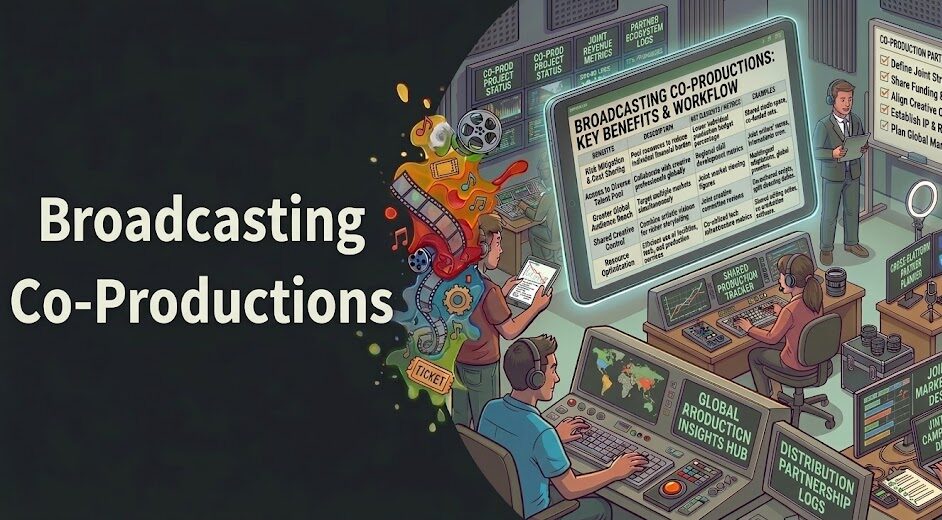
Public broadcasting co-productions are no longer a nice-to-have for the BBC, ITV, and ARD. They’re a structural necessity. Declining domestic licence fee revenue, shrinking commissioning budgets, and the escalating cost of prestige drama have pushed Europe’s most storied public broadcasters toward international deal structures that would have seemed foreign—pun intended—just a decade ago.
Today, a BBC drama that looks like a solo commission often has a German, Canadian, or Australian co-producer embedded in its capital stack before a single frame is shot.
But how exactly do these deals get structured? What’s the financial logic, which treaty frameworks govern the mechanics, and—critically—what does this mean for independent producers trying to navigate the co-production opportunity from outside the broadcasters’ existing relationship networks? That’s what this guide breaks down. No glossing over the complexity. No pretending the process is straightforward when it isn’t.
Let’s start with the underlying economics driving all of it—then work through how BBC, ITV, and ARD each approach co-production differently, what the treaty architecture looks like, and where the real opportunities are for producers who understand how to pitch into this system in 2026.
In This Guide
- Why Public Broadcasters Can’t Afford to Go It Alone Anymore
- How the BBC Structures International Co-Production Deals
- ITV Studios: The Commercial Logic Behind International Partnerships
- ARD’s Co-Production Approach: European by Design
- The Treaty Architecture: UK, Germany, and the European Convention
- Incentive Stacking: How Co-Productions Access Multiple Tax Benefits
- Building the Capital Stack: What Goes Where
- How to Pitch Into BBC, ITV, and ARD Co-Production Slates
- Frequently Asked Questions
Ask VIQI: Which European Broadcasters Have Active Co-Production Mandates in My Genre?
VIQI is Vitrina’s AI assistant—trained on 1.6 million titles, 360,000 companies, and 5 million entertainment professionals. Get real-time intelligence on BBC, ITV, ARD, and 140+ other active broadcasters before your next pitch.
✓ 200 free credits | ✓ No credit card needed
Why Public Broadcasters Can’t Afford to Go It Alone Anymore
The economics are blunt. The BBC’s total income has been under sustained pressure since the licence fee was frozen at £169.50 in 2022 and then increased by just 6.7% in 2024—well below the inflation that hit production costs over the same period. ITV’s advertising revenue is structurally linked to linear viewing, which—as we examined in our analysis of the rise of co-commissioning partnerships—has declined sharply among audiences under 50. ARD operates across nine regional public broadcasters in Germany with a combined budget exceeding €6 billion, but internal cost pressures and political scrutiny of public broadcasting expenditure have tightened commissioning margins for years.
Meanwhile, the budgets required to produce content that looks competitive on the international market have moved in the opposite direction. A prestige six-part drama that could be budgeted at £1.5M per episode in 2018 now needs closer to £4–6M to match the production values audiences associate with streaming originals from Netflix, Apple TV+, and HBO. No single public broadcaster can routinely justify that spend from its domestic commissioning budget alone.
Co-production is the structural answer—not as a creative preference, but as a financial necessity that also creates genuine value. When the BBC brings in a Canadian or Australian partner, it isn’t just sharing cost. It’s sharing risk, accessing tax incentive regimes in other jurisdictions, gaining built-in international distribution in partner markets, and—in the best cases—producing content that resonates globally from the ground up rather than being retrofitted for international sale after the fact.
Phil Hunt, Founder and CEO of Head Gear Films—which has financed 550+ productions and operates at 35–40 films per year from its UK base—frames this clearly: everything built in London has to be built for international from the start. The UK market alone doesn’t justify the investment. That applies with even more force to public broadcaster co-productions, where the domestic audience mandate coexists with an economic imperative to find international financing partners from development stage onward.
As Andrea Scarso, Managing Partner at IPR.VC—which connects institutional capital with European content production—observes, looking at co-production opportunities in territories where you can stack local incentives, tax credits, and local pre-sales has become critically more important. It’s something producers now need to think about from the very beginning of packaging, not as an afterthought once domestic funding falls short.
Phil Hunt (Founder & CEO, Head Gear Films) discusses the structural challenge facing UK-based producers building internationally viable projects in this Vitrina LeaderSpeak episode:

How the BBC Structures International Co-Production Deals
The BBC approaches international co-production through two distinct channels that are worth keeping clearly separate, because they function very differently and serve different strategic purposes.
BBC Studios—the commercial production and distribution arm—is the entity that operates most actively in the international co-production market. BBC Studios holds the rights to the BBC’s commercial catalogue, produces original content, and licenses or co-develops projects with international partners. When you see a BBC drama appearing on PBS in the US, ABC in Australia, or a major European public broadcaster, the commercial deal architecture almost certainly runs through BBC Studios.
The BBC itself—the public service broadcaster—commissions content through its editorial departments. In co-production contexts, this typically means a BBC commissioner greenlights a project as a BBC commission, while BBC Studios simultaneously structures the international co-production to bring in co-financing partners. The distinction matters: the BBC’s editorial mandate governs the creative direction, while BBC Studios manages the commercial co-production architecture. Producers approaching the BBC for a co-production deal need to understand which half of this relationship they’re actually pitching into.
In practice, the BBC’s preferred co-production models in 2026 break into three main structures. First, the broadcaster pre-buy — a partner broadcaster (say, PBS Masterpiece or Foxtel in Australia) commits to a minimum guarantee for its territory before or during production, which feeds directly into the financing plan as collateral for production loans. Second, equity co-production — a production company in a partner country contributes cash equity in exchange for ownership stake and distribution rights in their territory. Third, soft money integration — the BBC or its independent production partner structures the project to access tax credits or grants in the partner territory, often requiring a proportion of the production spend to be incurred in that jurisdiction.
The UK’s treaty framework administered by the BFI Certification Unit covers bilateral agreements with Australia, Brazil, Canada, China, France, India, Israel, Morocco, New Zealand, and South Africa, among others. An official treaty co-production automatically passes the UK Cultural Test—which otherwise requires scoring 18 out of 35 points across cast, locations, subject matter, and crew—and grants national film status in each co-producing country simultaneously. That’s a meaningful efficiency: you unlock UK AVEC at 25% (29.25% for qualifying VFX spend) plus whatever incentive applies in the partner territory, without needing to pass two separate cultural tests independently.
Track BBC, ITV and ARD Development Slates in Real Time
Trusted by Netflix, Warner Bros, and Paramount. Join 140,000+ companies using Vitrina to monitor greenlit projects, active co-production mandates, and broadcaster development pipelines across 195 countries.
✓ 200 free credits | ✓ No credit card required | ✓ Full platform access
ITV Studios: The Commercial Logic Behind International Partnerships
ITV operates a different co-production model to the BBC—and the difference is important. Where the BBC is primarily a public service broadcaster with a commercial arm, ITV is primarily a commercial broadcaster with a production and distribution operation that’s grown substantially through acquisitions. ITV Studios is now one of the largest independent production companies in the world by revenue, with operations across the UK, Netherlands, Germany, the US, France, and Australia.
That geographic footprint changes the co-production logic entirely. ITV Studios doesn’t need a treaty partner to access production infrastructure in multiple European markets—it owns production companies in those markets directly. A format developed in the Netherlands by Talpa Network (acquired by ITV) can be adapted and co-produced across ITV’s European footprint without requiring a formal treaty structure. Similarly, Potato and Mammoth Screen in the UK can develop projects that ITV Studios then packages with international partners before approaching ITV the broadcaster for a commission.
But ITV’s co-production strategy for scripted drama—particularly the prestige end—increasingly mirrors the BBC’s pre-buy model. A project like a high-budget crime series or period drama will typically have an ITV broadcaster commission as its anchor, with ITV Studios then packaging additional financing from a US cable network pre-buy, an Australian broadcaster commitment, and potentially a streaming platform acquiring specific windows or territories. The Minimum Guarantee structure is central: each territorial partner commits an MG against delivery, which—as outlined in standard presales mechanics—allows production banks to lend 70–90% of contracted MG value against the paper, providing the production capital before a frame is shot.
ITV’s relationship with Disney+ in the UK is worth noting as a benchmark. The partnership, which brought Disney streaming investment into ITV’s ITVX content strategy, demonstrates a broadcaster-streamer co-production model where the public (in ITV’s case, commercial) broadcaster provides domestic reach and editorial identity, while the streaming partner provides incremental financing and global distribution capability. As reported by Vitrina, this kind of hybrid broadcaster-streamer co-commissioning is now embedded strategy rather than opportunistic deal-making at ITV.
The strategic implication for producers: ITV Studios is simultaneously the broadcaster, the independent production company, and the international distributor on many of its projects. That’s a different animal to pitch than the BBC’s more separated structure. You’re often competing with ITV Studios’ own production labels for the commission—which means a third-party independent producer needs to bring something ITV Studios can’t develop internally to win the slot.

Your AI Assistant, Agent, and Analyst for the Business of Entertainment
VIQI AI helps you plan content acquisitions, raise production financing, and find and connect with the right partners worldwide.
- Find active co-producers and financiers for scripted projects
- Find equity and gap financing companies in North America
- Find top film financiers in Europe
- Find production houses that can co-produce or finance unscripted series
- I am looking for production partners for a YA drama set in Brazil
- I am looking for producers with proven track record in mid-budget features
- I am looking for Turkish distributors with successful international sales
- I am looking for OTT platforms actively acquiring finished series for the LATAM region
- I am seeking localization companies offer subtitling services in multiple Asian languages
- I am seeking partners in animation production for children's content
- I am seeking USA based post-production companies with sound facilities
- I am seeking VFX partners to composite background images and AI generated content
- Show me recent drama projects available for pre-buy
- Show me Japanese Anime Distributors
- Show me true-crime buyers from Asia
- Show me documentary pre-buyers
- List the top commissioners at the BBC
- List the post-production and VFX decision-makers at Netflix
- List the development leaders at Sony Pictures
- List the scripted programming heads at HBO
- Who is backing animation projects in Europe right now
- Who is Netflix’s top production partners for Sports Docs
- Who is Commissioning factual content in the NORDICS
- Who is acquiring unscripted formats for the North American market
ARD’s Co-Production Approach: European by Design
ARD—the consortium of nine regional public broadcasters that together form Germany’s first public TV network—approaches co-production with a fundamentally European orientation. This is partly cultural, partly structural, and partly a function of Germany’s position at the heart of the European Convention on Co-production, which covers 43 European countries under a multilateral framework revised in 2018 to make cross-border collaboration more accessible.
Germany’s film and TV funding infrastructure is unusual in its complexity. The DFFF (Deutscher Filmförderfonds) and GMPF (German Motion Picture Fund) together offer a rebate rate of 30% on qualifying German production expenditure—a rate increased from 25% in 2024, signalling a deliberate policy choice to keep Germany competitive as a production destination. The FFA (Filmförderungsanstalt) administers federal-level support, while regional Filmförderanstalten in Bavaria, Nordrhein-Westfalen, Berlin-Brandenburg, and Hamburg provide additional layers of co-financing that stack with the federal incentive.
ARD co-productions typically engage this funding architecture in two ways. The first is through Degeto Film—ARD’s central acquisition and co-production subsidiary, which acquires rights and co-finances projects for transmission across the ARD network. Degeto functions similarly to BBC Studios in some respects, acting as the commercial interface between the broadcaster and the independent production market. The second route is direct commissioning from the regional broadcasters themselves—particularly BR (Bavarian Broadcasting), WDR (Westdeutscher Rundfunk), and NDR (Norddeutscher Rundfunk)—each of which has its own commissioning budget and co-production mandates.
For international co-production, ARD’s strongest recurring partnerships are with France’s public broadcasters through the Franco-German cultural axis established by the Arte channel—jointly operated by ARD/ZDF and France Télévisions. Arte’s co-production model is a genuine template: it actively structures multilateral European co-productions, brings in the Eurimages multilateral fund (covering 43 European countries), and consistently develops content designed for cultural export rather than domestic-only consumption.
Beyond France, ARD’s co-production activity extends into Scandinavia, the Netherlands, and increasingly into UK partnerships—despite post-Brexit complications around the European Convention. But here’s the thing: the European Convention on Co-production doesn’t require EU membership. The UK remains a signatory to the revised 2018 framework, which means UK-Germany official co-productions can still access the bilateral minimum (10% stake) structure under the Convention, granting both UK AVEC and German DFFF/GMPF rebates on the same project. That bilateral stack—25% UK plus 30% Germany on their respective spend portions—creates a combined incentive that can cover 50–60% of a project’s total budget in pure incentive value before a single equity investor is approached.
The Treaty Architecture: UK, Germany, and the European Convention
Getting the treaty architecture right isn’t optional—it’s the mechanism that unlocks the incentive value, the national film status, and the automatic cultural test passes that make co-production financially viable. So let’s be precise about how it works. For a deeper introduction to the treaty landscape, our ultimate guide to international film and TV co-productions covers the global framework in full.
Official treaty co-productions are bilateral or multilateral arrangements made under a formal intergovernmental agreement. They grant the project national film status in each co-producing country—which is what triggers access to local incentives and funding. In a UK-Germany bilateral co-production, the project qualifies as a British film (for UK AVEC purposes) and a German film (for DFFF/GMPF purposes) simultaneously. But to get there, you have to meet strict requirements on each party’s financial contribution, creative and technical staffing, and—in some cases—shooting location.
The eligibility requirements under bilateral treaties generally mandate a minimum financial contribution of 10–20% from each co-producer, with a bilateral maximum of 80–90% for the majority partner. Creative and technical contributions—directors, cast, crew, post-production services—must be proportional to the financial stake. Third-country shooting is typically capped at 20–30% of total production days. And crucially, you need to apply to competent authorities—the BFI Certification Unit in the UK, FFA in Germany—at least four weeks before principal photography begins. Missing that window is not a small problem; it can invalidate the entire treaty structure.
Under the European Convention (which the UK remains party to), multilateral co-productions involving three or more countries have more flexibility: minimum contribution drops to 5–10%, maximum rises to 70–80%, and the framework explicitly opens to non-European countries, which has become relevant as UK-based productions increasingly seek to involve Australian, Canadian, or MENA partners in the same deal structure.
Unofficial co-productions—using Production Service Agreements (PSAs) rather than formal treaty structures—trade treaty benefits for flexibility. A US producer, for example, can’t access the official treaty framework at all (the US has no co-production treaties), so PSAs are the standard approach for US-UK or US-Germany projects. The tradeoff: you’re limited to the incentive structure of whichever single country’s spend qualifies, without gaining national status in the partner country. For BBC co-productions with US partners specifically, this means structuring the UK spend to maximise AVEC eligibility while treating the US element as an MG pre-buy rather than a co-production contribution.
All of this is navigable—but it requires early-stage planning, not retrofit. As we cover in our guide to cross-border European film funding opportunities, the biggest structural mistakes in co-production financing come from trying to engineer treaty compliance into a project that was developed without it in mind.
Incentive Stacking: How Co-Productions Access Multiple Tax Benefits
This is where the financial engineering of a well-structured public broadcaster co-production actually becomes compelling—and why the top independent producers in this space treat the incentive stack as a foundational component of the financing plan, not a bonus discovered late in the process.
Here’s a concrete illustration of what stacking looks like in a UK-Germany-Canada three-party multilateral co-production under the European Convention and the UK-Canada bilateral treaty:
Illustrative Incentive Stack: UK–Germany–Canada (€12M Budget)
| Territory | Incentive | Rate | Spend Share | Value |
|---|---|---|---|---|
| UK | AVEC (Audio-Visual Expenditure Credit) | 25% | 40% of budget | ~€1.2M |
| Germany | DFFF/GMPF | 30% | 30% of budget | ~€1.08M |
| Canada (Federal) | CPTC | 25% | 30% of budget | ~€0.9M |
| Combined Incentive Value | ~€3.18M (26.5% of budget) | |||
Note: Indicative illustration only. Actual values depend on qualifying spend, provincial Canadian credits, and programme-specific rules. Figures are not financial advice.
And that’s before any broadcaster pre-buys, Eurimages funding (available to qualifying European multilateral co-productions), or provincial-level Canadian credits (British Columbia offers up to 33% on resident labour, Ontario up to 40% for certain project types). In practice, well-structured public broadcaster co-productions regularly achieve 50–65% of their budgets from incentives and pre-buys combined—leaving a relatively modest equity requirement to close the capital stack. The Recoupment Acceleration benefit is real: when soft money covers the majority of the budget, investor equity is smaller, recouped faster, and commands better terms.
For BBC and ARD specifically, the broadcaster pre-buy isn’t counted as an “incentive” in the technical sense—but it functions like one from a financing perspective. A BBC commissioning fee of £2M per episode (against a £5M per episode budget) immediately covers 40% of production costs, provides bankable security for production lenders, and signals to other partners that the project has credible editorial anchor. That’s the Minimum Guarantee dynamic from presales mechanics applied to broadcaster commissioning: the broadcaster MG is collateralised by production banks at 70–90% of face value. Explore our full breakdown of production financing and commissioning in the UK and EU for how this fits into the wider capital stack picture.
Building the Capital Stack: What Goes Where
A fully assembled public broadcaster co-production capital stack in 2026 typically looks something like this—working from most senior to most subordinated:
Senior position: Tax credits and incentives. These sit effectively at the top of the recoupment waterfall because they’re not repaid to an equity investor—they’re government-issued cash. Banks lend against confirmed incentive claims at 80–90% of their face value, giving producers immediate access to this capital during production rather than waiting for the rebate cycle. For a production accessing UK AVEC and German DFFF, this can represent £1–3M in bankable liquidity before a single equity investor is approached.
Broadcaster pre-buys and MGs. These sit just below tax credits in the security hierarchy. A confirmed BBC commissioning agreement or ARD Degeto pre-buy is bankable—production lenders will advance against it once the broadcaster contract is in place. The 10% on-signature / 90% on-delivery structure is standard, meaning the bulk of the MG value is delivered at completion rather than at the start of production, necessitating bridge financing during the production period.
Co-production equity. Each co-producing partner’s equity contribution—proportional to their financial stake, which must align with their creative and technical contribution under treaty requirements—sits in the middle of the stack. For a bilateral 60/40 split between a UK lead producer and a German co-producer, the UK party bears 60% of equity costs and the German party 40%, each accessing their respective territory’s incentives against their proportional spend.
Gap financing. If the combined weight of incentives, broadcaster MGs, and equity still leaves a funding gap—typically 10–25% of total budget—a gap lender can fill it against residual territory value or unsold distribution windows. This is the Insider Advantage in the production finance context: knowing which lenders actively write gap facilities for European public broadcaster co-productions, at what leverage ratios, and with what time horizons. That intelligence used to require years of relationship-building. Vitrina maps it in real time across 400,000+ active projects.
The Fragmentation Paradox™ hits hardest at the partner-finding stage of this capital stack. There are 600,000+ companies operating in the global film and TV ecosystem. The independent producer who needs a German co-production partner with the right credits, available capacity, and compatibility with ARD’s commissioning relationship doesn’t have months to spend manually working through referral networks. And the six-month deal cycle that results from information opacity—where producers spend weeks just verifying who the right contacts even are—regularly causes projects to miss financing windows entirely.
Need to Find the Right Co-Production Partner for a BBC, ITV, or ARD Project?
Vitrina Concierge matches you with verified co-producers, broadcaster contacts, and financing partners—filtered by genre, treaty eligibility, and available production capacity in your target territory.
- UK producer → German ARD-aligned co-producer, confirmed BBC contact in 48 hours
- APAC studio → ITV Studios treaty-eligible UK partner in 1 week
- No commitment | No credit card | Tailored to your brief
How to Pitch Into BBC, ITV, and ARD Co-Production Slates
Here’s the part where many guides get vague. Let me be specific instead about what actually moves co-production pitches forward at each of the three broadcasters.
For BBC co-productions, the pitch that lands is one that arrives pre-packaged with a credible international financial structure—not one asking the BBC to figure out co-production logistics after the fact. BBC commissioners are assessing projects against editorial fit first, but their development executives also evaluate whether a project’s international appeal is genuine and whether a co-production structure can be assembled without compromising the BBC’s editorial control. Turn up with an identified Canadian or Australian broadcaster partner already expressing interest, a treaty-compatible project structure, and a clear incentive model—and you’re having a different conversation than the producer who arrives with just a script and a cast wish list.
For ITV Studios, the dynamic is different. You’re pitching into a production company that has its own labels competing for ITV commission slots. Your strongest position is as an external indie bringing IP that ITV Studios doesn’t have—an adapted book, a format with proven international performance in another territory, or a package with talent attached that ITV Studios hasn’t been able to sign. The co-production element should be pre-structured: bring a US cable network or streaming partner already at the table, and the pitch becomes about execution rather than financing assembly.
For ARD and Degeto, the European Convention framework is your primary tool. ARD has a strong cultural mandate toward European content, which means a German language version isn’t always required for a co-production to qualify. What is required is genuine German creative and technical contribution proportional to the financial stake—a German director, significant German cast, or post-production spend in Germany. Degeto is particularly active in crime drama, literary adaptations, and prestige historical series—genres where UK-Germany bilateral co-productions have a genuine track record. The FFA application process requires a minimum of four weeks lead time before principal photography, so the administrative timeline needs to be built into your development schedule from the start.
And across all three? The intelligence deficit is the most common reason pitches arrive too late or to the wrong people. Broadcasters’ commissioning priorities shift quickly—faster than the trades report them. A development executive who championed Nordic crime drama last year may have pivoted to contemporary thriller this year. An ARD regional broadcaster may have just greenlighted its full slate for 2026–27 and have no open co-production window for 12 months. Arriving with last year’s intelligence into this year’s conversation is a structural problem that no amount of relationship warmth fully compensates for.
Vitrina tracks 400,000+ active projects and 140,000+ companies across the global supply chain in real time—including broadcaster development pipelines, commissioning priorities, and executive movements at BBC, ITV, and ARD before they surface in the trades. That’s the Insider Advantage in practical form: arriving at a co-production conversation with better intelligence than the room expects you to have. You can also explore the UK Global Screen Fund as an additional route for international co-productions connecting UK and overseas partners.
Frequently Asked Questions: Public Broadcasting Co-Productions
What is a public broadcasting co-production and how does it differ from a standard commission?
A public broadcasting co-production is a production financed jointly by two or more broadcasters or production companies from different countries, typically structured under a bilateral or multilateral co-production treaty. Unlike a standard commission—where one broadcaster funds the production and retains primary rights—a co-production distributes both the financial risk and the rights across all co-producing parties, each receiving distribution rights in their respective territories. For broadcasters like BBC, ITV, and ARD, co-production is increasingly the default model for prestige drama, as it allows access to multiple incentive regimes and distributes budget requirements that no single broadcaster can justify from its domestic commissioning budget alone.
How does the BBC structure international co-production deals?
BBC co-production deals are typically structured through two channels: BBC Studios (the commercial arm) manages the international co-production architecture, including partner broadcaster pre-buys, equity contributions, and incentive access. The BBC itself (the public service broadcaster) provides the commissioning mandate and editorial direction. The three main structural models are: broadcaster pre-buys where international partners commit Minimum Guarantees against their territorial rights; equity co-production where partners contribute cash in exchange for ownership and distribution rights; and soft money integration where production spend is structured to qualify for tax credits in the partner’s territory under the UK’s bilateral treaty network, administered by the BFI Certification Unit.
What tax incentives are available for UK-Germany co-productions?
UK-Germany official co-productions structured under the European Convention on Co-production can simultaneously access the UK Audio-Visual Expenditure Credit (AVEC) at 25% (29.25% for qualifying VFX spend) on UK-incurred costs, and the German DFFF/GMPF rebate at 30% on German-incurred costs. Both countries automatically grant national film status to the qualifying co-production, meaning both rebate programmes apply to their respective spend portions without requiring separate cultural test applications. Additional German funding from regional Filmförderanstalten can stack on top of the federal DFFF/GMPF. Combined, this incentive architecture can cover 25–30% of the overall project budget from government sources alone.
What are the treaty requirements for an official UK or German co-production?
Under bilateral co-production treaties, each co-producing party must contribute a minimum of 10–20% of total production financing, with a maximum of 80–90% for the majority partner. Financial contribution must be proportional to creative and technical contribution, including personnel (directors, cast, crew) and post-production services from each country. Third-country shooting is typically capped at 20–30% of production days. Applications must be submitted to competent authorities—BFI Certification Unit in the UK, FFA in Germany—at least four weeks before principal photography. Projects that pass treaty requirements automatically satisfy the UK Cultural Test and German national film eligibility without further assessment.
How does ARD’s Degeto Film function in international co-productions?
Degeto Film is ARD’s central acquisition and co-production subsidiary, acting as the commercial interface between the ARD network and the independent production market. In international co-productions, Degeto provides both commissioning mandate (providing German broadcaster anchor equivalent to a BBC or ITV commission) and co-financing in exchange for German-language distribution rights. ARD’s strongest recurring international co-production axis runs through Arte, the Franco-German cultural channel jointly operated by ARD/ZDF and France Télévisions, which actively structures multilateral European co-productions and accesses Eurimages multilateral funding across 43 European Convention signatory countries.
What is the difference between an official co-production and a Production Service Agreement?
An official treaty co-production grants national film status in each co-producing country, enabling access to both countries’ incentive regimes and funding streams. It requires formal approval from competent authorities and must meet strict requirements on financial contribution, creative staffing, and spending patterns. A Production Service Agreement (PSA) is an unofficial co-production without formal treaty structure—it offers more flexibility (no minimum or maximum contribution percentages, no cultural test requirements) but limits the project to one country’s incentives and does not grant national status in the service provider’s country. US producers almost always use PSAs as the US has no co-production treaties; for UK-Canada, UK-Australia, or UK-Germany partnerships, the official treaty route is usually preferable when eligibility can be met.
How do you build the capital stack for a BBC or ARD co-production?
A typical capital stack for a BBC or ARD co-production in 2026 layers from most to least senior: government tax credits and incentives (bankable at 80–90% of face value against confirmed claims); broadcaster Minimum Guarantee pre-buys (bankable once commissioning contracts are in place); co-producer equity contributions proportional to each party’s treaty stake; and gap financing against residual territory value or unsold distribution windows, if needed. Well-structured European public broadcaster co-productions routinely achieve 50–65% of total budget from incentives and pre-buys combined, leaving a relatively small equity requirement that compresses the recoupment timeline and improves IRR for any equity investors participating.
What genres do BBC, ITV, and ARD co-produce most actively?
BBC co-productions skew toward prestige drama (crime, literary adaptation, historical), documentary, and natural history (through BBC Studios’ globally distributed nature content). ITV Studios’ international co-production activity is heaviest in scripted drama formats, unscripted reality, and commercial crime or thriller series. ARD and Degeto are most active in crime drama, literary series adaptations, and prestige historical drama—particularly through the Arte channel axis for projects with strong European cultural scope. All three broadcasters increasingly consider multi-platform window strategies, with FAST and streaming rights negotiated as part of co-production agreements rather than as secondary afterthoughts.
The Bottom Line: Co-Production Is the Default, Not the Exception
The era of a single public broadcaster fully funding a prestige production from its own commissioning budget is, structurally, over. For BBC, ITV, and ARD, international co-production has moved from an occasional strategic choice to the baseline operating model for anything competing at premium budget levels. The treaty architecture exists, the incentive stacks are real, and the deal structures are increasingly standardised. What’s still scarce is the intelligence to navigate them efficiently—to find the right partner in the right territory, with the right capacity and the right broadcaster relationships, before your financing window closes.
That’s the Fragmentation Paradox™ applied to international co-production: 600,000+ companies in the global supply chain, and producers are typically working with a relationship network covering a fraction of a percent of the available options. The producers and production companies who consistently close European public broadcaster co-production deals aren’t just better at pitching—they have better intelligence about who to pitch, when their windows are open, and what structure each broadcaster can actually support in their current slate cycle.
Key Takeaways
- Co-production is a financial necessity for BBC, ITV, and ARD: Budget compression and declining domestic revenue streams have made multi-party international deal structures the baseline for prestige production, not a nice-to-have.
- BBC Studios and the BBC editorial function operate separately: Producers need to understand which channel they’re approaching—the commercial co-production architecture (BBC Studios) or the commissioning mandate (BBC editorial)—and pitch accordingly.
- UK AVEC + German DFFF/GMPF = up to 55% of budget from incentives: UK-Germany bilateral co-productions under the European Convention can stack 25% UK and 30% German rebates on their respective spend portions, creating genuine budget efficiency before equity financing begins.
- Treaty applications need a four-week runway minimum: BFI (UK) and FFA (Germany) both require treaty co-production applications before principal photography begins. Retrofitting treaty compliance is not possible—plan from development.
- The intelligence gap is the primary reason deals miss: Broadcaster commissioning priorities shift faster than the trades report. Real-time intelligence on BBC, ITV, and ARD development pipelines is the Insider Advantage that separates producers who close from those who show up late.
Find Your Next BBC, ITV, or ARD Co-Production Partner Before the Window Closes
Trusted by Netflix, Warner Bros, and Paramount. Join 140,000+ companies using Vitrina to track broadcaster commissioning pipelines, active co-production mandates, and partner company capacity in real time.
✓ 200 free credits | ✓ No credit card required | ✓ Full platform access from day one
Find Film+TV Projects, Partners, and Deals – Fast.
VIQI matches you with the right financiers, producers, streamers, and buyers – globally.
Join Industry Briefings Trusted by Leaders
Film & TV Production Financing: 2026 Trends
Production financing conditions are changing quickly. Understanding where money is moving and what buyers are backing is key to getting projects approved and funded in 2026.
Unreleased Film+TV Projects: Opportunities & Showcase
A curated view of unreleased Film and TV projects open for financing and collaboration
The Mid-Budget Comeback: Why Mid-Budget Films Is the Smartest Bet in the Room
Mid-budget films are attracting new capital. See why this segment is becoming one of the strongest bets in Film today.
Franchise Fatigue vs. IP Dependency: What Studios Should Be Betting On Now
s franchise performance softens, where will the next generation of valuable IP come from? Join the briefing.