IHUB
IHUB
 Private Briefings (Webinars)


 LeaderSpeak Podcast
  Global Entertainment Digest (Newsletter)
  Premium Lists
 Membership Benefits
 About Vitrina
 Our Story
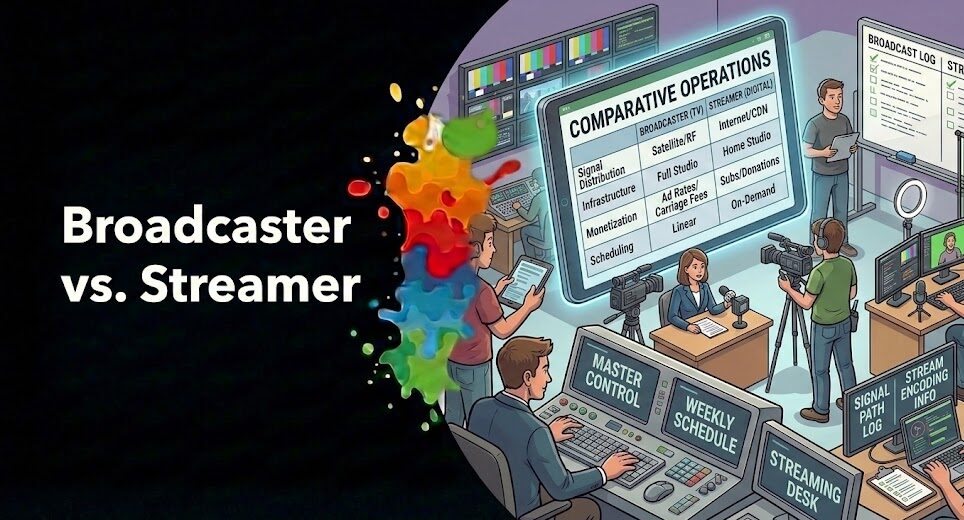
Ask any independent producer which has changed more in the last four years—broadcaster vs. streamer commissioning—and you’ll get the same answer: both. But the direction of change is completely different, and the gap between them has never been wider.
Broadcasters are licensing less, co-commissioning more, and fighting audience erosion by leaning into event television and local-language drama. Streamers are cutting volume, raising quality thresholds, tightening IP ownership demands, and deploying data science at the greenlight stage that broadcasters simply can’t match.
What nobody tells you—until it’s in the contract—is that the structural difference between a broadcaster commission and a streamer commission isn’t just about which platform your show airs on. It’s about who owns the intellectual property when it’s done. It’s about your back-end economics, your remake rights, your format value, and your ability to sell the same show to a second territory. The commissioning conversation in 2026 is ultimately a capital structure conversation. And producers who treat it as anything less are negotiating blind.
In This Article
- What Broadcaster Commissioning Actually Means in 2026
- What Streamer Commissioning Actually Means in 2026
- The IP Rights Chasm — and Why It Defines Your Back-End ROI
- Development Timelines: Where Broadcasters and Streamers Diverge
- Budget Structures and Finance Plans: Who Contributes What
- Co-Commissioning: The Strategy That Lets You Play Both Sides
- How to Pitch Each Commissioner Type Differently
- The “Big Crunch” Reality: What It Means for Your Commissioning Prospects
- FAQ: Broadcaster vs. Streamer Commissioning
- Conclusion & Key Takeaways
Know Which Commissioners Are Actively Buying — Before You Pitch
VIQI maps active commissioning intent across 300,000+ verified companies — broadcasters, streamers, and premium pay-TV platforms — so you approach the right commissioner with the right project at exactly the right moment. Trusted by Netflix, Warner Bros., and Paramount.
Ask VIQI About Commissioner Activity
200 free credits · No credit card required
What Broadcaster Commissioning Actually Means in 2026
The broadcaster commissioning model hasn’t died — but it’s been restructured in ways that catch producers off guard if they’re still thinking in 2019 terms. The fundamentals remain: a broadcaster commissions a series by paying a licence fee in exchange for a defined broadcast window, typically within their territory of operation. You retain the IP. You keep the format rights. You own the international sales potential. And you can layer co-production finance, tax incentives, and broadcaster presales from other territories on top to close the budget gap.
But here’s what’s changed. The licence fee as a proportion of total budget has contracted. What used to cover 70-80% of a UK scripted drama budget through a major PSB commission now more commonly lands at 50-65% — sometimes lower for first-time producer relationships. That gap has to be filled from somewhere: co-production treaties, tax credits, presales in secondary markets, equity financing. The UK’s Audio-Visual Expenditure Credit at 25% of qualifying spend (rising to 29.25% for VFX-intensive production) helps, but it doesn’t paper over a licence fee shortfall on its own.
The other thing that’s shifted is the commercial appetite by genre. Broadcasters in 2026 are commissioning towards event programming — returning series with loyal audiences, premium true crime, prestige drama with awards potential, and high-concept unscripted with clear international format value. Midrange drama, conventional sitcom, and general entertainment formats are harder to greenlight through broadcast routes than they were three years ago. The commissioning window is narrower, and the competition for it is sharper. As our complete guide to commissioned content in film and TV details, understanding what each commissioner type is actually buying is half the battle before you put a pitch together.
One broadcaster move worth watching: Channel 4 distributing digital originals through Spotify to target younger audiences. That’s not a small strategic pivot — it’s a signal that broadcaster commissioning pipelines are starting to include platform-native distribution as part of the content brief, not an afterthought. Producers pitching to broadcasters in 2026 who aren’t thinking about multi-platform delivery from the development stage are going to find themselves renegotiating terms they didn’t anticipate.

Your AI Assistant, Agent, and Analyst for the Business of Entertainment
VIQI AI helps you plan content acquisitions, raise production financing, and find and connect with the right partners worldwide.
- List the top commissioners at the BBC
- List the post-production and VFX decision-makers at Netflix
- List the development leaders at Sony Pictures
- List the scripted programming heads at HBO
- Find active co-producers and financiers for scripted projects
- Find equity and gap financing companies in North America
- Find top film financiers in Europe
- Find production houses that can co-produce or finance unscripted series
- Who is backing animation projects in Europe right now
- Who is Netflix’s top production partners for Sports Docs
- Who is Commissioning factual content in the NORDICS
- Who is acquiring unscripted formats for the North American market
- Show me recent drama projects available for pre-buy
- Show me Japanese Anime Distributors
- Show me true-crime buyers from Asia
- Show me documentary pre-buyers
- I am looking for production partners for a YA drama set in Brazil
- I am looking for producers with proven track record in mid-budget features
- I am looking for Turkish distributors with successful international sales
- I am looking for OTT platforms actively acquiring finished series for the LATAM region
- I am seeking localization companies offer subtitling services in multiple Asian languages
- I am seeking partners in animation production for children's content
- I am seeking USA based post-production companies with sound facilities
- I am seeking VFX partners to composite background images and AI generated content
What Streamer Commissioning Actually Means in 2026
Streamer commissioning in 2026 looks very different from the peak-TV spending era of 2020-2022. Insiders recognise that the post-COVID production bubble has well and truly deflated — and what’s replaced it is a more disciplined, data-intensive commissioning model that favours higher-concept, higher-budget content at lower volume. Netflix, Amazon Prime Video, and Apple TV+ are all greenlighting fewer originals than two years ago. But the projects they are commissioning carry bigger per-episode budgets and much more aggressive IP terms.
The real dynamic in streamer commissioning — and what many producers still don’t fully internalise — is that most major streamers operate on a cost-plus or buy-out model, not a licence-fee model. When Netflix commissions your series, they’re typically paying the full production cost plus a producer margin (commonly 10-20% on cost), in exchange for all rights: worldwide, all media, in perpetuity. You don’t retain international sales. There’s no back-end if the show becomes a global hit. What you get is certainty — your budget is funded, your margin is paid, and you’re done with that IP.
That’s not necessarily a bad deal. But it requires a completely different financial model from your production company than a broadcaster commission does. With a broadcaster, your production company’s long-term value is built through IP accumulation — format rights, remake rights, international distribution income, merchandise licensing. With a streamer buy-out, you’re running a service business: high-quality production execution, reliable delivery, and repeatable relationships that generate the next commission. Both are viable businesses. But they’re not the same business, and producers who confuse them often end up structuring deals that work against their own long-term P&L.
There are exceptions. Apple TV+ has been notably more flexible on IP retention than Netflix in certain deal structures — particularly for marquee talent with leverage. Amazon co-productions through the MGM Studios arm often involve shared rights rather than full buy-outs when a significant co-production partner is in the capital stack. But these are negotiated exceptions, not the default. According to Deadline, the baseline streamer commissioning term in 2026 still overwhelmingly favours all-rights acquisition — and producers who go in without leverage rarely get carve-outs.
Track Live Commissioning Activity Across 159,223 Active Projects
Vitrina maps which commissioners are actively developing in your genre, territory, and budget range — so you know who’s buying before they’ve announced it. Join Netflix, Warner Bros., and Paramount on the platform.
No credit card required · Cancel anytime
The IP Rights Chasm — and Why It Defines Your Back-End ROI
The single most consequential variable in broadcaster vs. streamer commissioning isn’t the upfront fee. It’s IP ownership. And the industry still doesn’t talk about it directly enough.
Under a broadcaster licence model, you—the production company—retain underlying IP. That means format rights (sell a local-language version of your UK show to Korean broadcasters), remake rights (someone wants to make a big-budget US remake of your six-part drama — you participate), sequel rights, merchandise rights, and continued international distribution income after the original broadcast window closes. An IP-rich production company has catalogue value. A bank will lend against it. A private equity buyer will pay a multiple of it. It compounds over time.
Under a streamer buy-out, you have none of that. Your show might become the most-watched series on Netflix globally in 2027. You don’t share in that upside — you got your cost-plus margin when the deal closed. The streamer owns the IP, the format, the remake potential, and every future monetisation path. The WBD/Netflix $72B multi-year licensing deal is the clearest institutional illustration of this principle at scale — content ownership is the leverage. Weaponized Distribution™ only works when you still own what you’re licensing. Producers who’ve surrendered IP at the commissioning stage have nothing to license back to anyone.
The practical implication for your production company’s strategy: if you’re building a business for long-term catalogue value, broadcaster commissions—even with lower upfront certainty—are structurally better vehicles than streamer buy-outs. If you’re building a high-volume production services business with predictable margins and no appetite for IP risk, streamer commissions are a more reliable cash flow model. The mistake is treating both as equivalent when they’re pointing your company in fundamentally different directions.
Phil Hunt, Founder and CEO of Head Gear Films, has financed over 550 films across a quarter-century and currently operates at 35-40 productions per year — more than most studios. In this episode, he discusses directly why IP ownership, capital structure, and the current “big crunch” are reshaping what gets off the ground in 2026:
Development Timelines: Where Broadcasters and Streamers Diverge
Behind closed doors, the timeline difference between broadcaster and streamer commissioning processes is one of the most persistent frustrations for producers working with both. And it’s gotten more pronounced, not less.
A traditional broadcaster development process for a scripted series typically moves through multiple stages: development agreement (paid, £5,000-£25,000 for scripted), script commission, script delivery, editorial notes, possible redevelopment, greenlight decision. The full arc from first pitch to greenlight can run 12-24 months for a major PSB commission. That’s the timeline you’re working with. And during that period, your budget escalates, your talent holds expire, and your co-production financing partners need to see a committed greenlight before they’ll lock in their contribution. The cascade effect of broadcaster development timelines on indie production company cash flow is real and underacknowledged.
Streamer commissioning timelines, by contrast, can move startlingly quickly when a project clicks — particularly for non-scripted content that matches an active data signal. Amazon Prime Video and Netflix have both moved from first meeting to series greenlight in under 8 weeks on high-concept unscripted in genres their algorithms flagged as under-represented in their catalogues. The greenlight process is still opaque to most indie producers — you’re essentially arguing against a data-driven brief you don’t have access to — but the sheer speed when it works is a structural advantage for production companies that can move quickly on packaging and finance plans.
Scripted streamers timelines are another story. A Netflix originals scripted development process — with the full creative executive review, pilot script, multiple drafts, talent packaging requirements — can still run 18-36 months from first submission to series order. Don’t let the platform’s perceived speed create false expectations about scripted. The data-driven greenlight applies much more cleanly to unscripted content where audience signals are clearer.
Budget Structures and Finance Plans: Who Contributes What
The capital stack for a broadcaster-commissioned series looks materially different from a streamer-commissioned one. Understanding that difference before you put a finance plan together saves you from building a model that collapses on contact with reality.
A broadcaster-commissioned capital stack for a premium UK scripted drama might look something like this: broadcaster licence fee covering 50-65% of budget, UK AVEC tax credit contributing 20-25% of qualifying spend, a co-production partner (European broadcaster or Canadian co-production under treaty) covering 20-30%, and a presale in a secondary territory—say, a Scandinavian streamer or a MENA premium platform like OSN—contributing 10-20%. Gap financing covers any residual shortfall. The finance plan requires you to coordinate four or five different parties, each with their own contractual requirements, cultural expectations, and timeline constraints. That’s the work. But you own the IP at the end of it.
Rolla Karam, Senior Vice President of Content Acquisition at OSN—which serves 23 countries across MENA and North Africa under exclusive partnerships with Warner Bros. Discovery and HBO—describes the platform’s appetite for premium Western scripted content as a consistent priority: “We tend to go after the companies that produce premium scripted series, be it in London or Canada or the US.” Presales into platforms like OSN are a legitimate component of broadcaster-commissioned finance plans—and they’re one of the cleaner ways to fill a licence fee gap without surrendering IP.
A streamer-commissioned capital stack is structurally simpler. The streamer funds the budget directly—cost plus margin, all rights, closed deal. There’s no finance plan to coordinate. No presales to arrange. No tax credit filing timeline to manage (the streamer typically handles incentive applications in production territories themselves). But the simplicity comes at the cost of IP, back-end, and format value. For our detailed breakdown of how to structure TV series financing across both routes, see our guide to TV show financing in 2026.
Co-Commissioning: The Strategy That Lets You Play Both Sides
The most interesting commissioning deals happening in 2026 aren’t purely broadcaster or purely streamer — they’re co-commissions that combine a broadcaster’s licence fee, a streamer’s global reach, and a production company’s retained IP interests into a single deal structure. These deals are harder to close, but the economics are genuinely superior when you can make them work.
The co-commission logic is straightforward. A national broadcaster commits a licence fee for exclusive domestic broadcast rights and a defined window. A streamer commits a second licence fee for a specific international streaming window — say, day-and-date globally outside the broadcaster’s territory. The production company retains underlying IP, format rights, and certain downstream rights categories that neither commissioner requires. The total licence fees from both parties fund a larger portion of the budget than either could justify independently, reducing the equity gap and improving producer ROI. It’s the Weaponized Distribution™ principle applied at the production stage: two commissioners, each getting what they actually need, with the producer retaining what neither party demands.
But co-commissions require careful rights management. The territorial definitions need to be airtight. The exclusivity windows need to be sequenced so neither commissioner can claim the other is encroaching. Holdback periods on streaming need to respect whatever broadcast exclusivity the PSB has negotiated. And the production company’s retained IP categories need to be explicitly carved out — not assumed. As we examine in our analysis of the rise of co-commissioning between streamers and studios, the deal structures that are emerging in 2026 are significantly more sophisticated than anything seen in the 2018-2022 era.
Find Your Co-Commission Partner Before Anyone Else Approaches Them
Vitrina’s Concierge team identifies active co-commissioning targets — broadcasters, streamers, and premium pay-TV platforms with open mandates in your genre and territory — and connects you before the window closes. Producers have found verified commissioning contacts in 48 hours, not 6 months.
200 free credits to start · No commitment required
How to Pitch Each Commissioner Type Differently
What’s actually happening in commissioning meetings — and what the trades don’t report — is that the vocabulary, the materials, and the strategic framing that resonate with a broadcaster commissioning editor are almost entirely different from what lands with a streamer’s development executive. Pitching the same deck to both is a reliable way to fail at both.
Pitching Broadcasters
Broadcaster commissioning editors respond to audience proposition, scheduling logic, and tone-of-voice fit with their channel identity. You need to demonstrate where the show sits in their schedule, why their specific audience will show up for it, and why it couldn’t work on any other channel. The “only on [Channel X]” argument—what makes this show specifically right for BBC One versus ITV versus Channel 4—is the pitch’s core. Broadcasters are also more responsive to talent packages that carry marquee recognition among their audience demographic. A writer with a BAFTA and a proven primetime track record opens rooms that an equivalent streaming credit doesn’t, because broadcaster commissioners are thinking about appointment viewing and brand identity in ways streamers simply aren’t.
Pitching Streamers
Streamer development executives are responding to a different set of signals. Global audience appeal matters more than domestic scheduling fit. The show needs to work in 15 territories, not just one. Genre clarity is essential — streamers’ algorithmic recommendation systems require clean genre categorisation, and content that defies easy categorisation performs worse in their discovery layers regardless of creative quality. Your pitch materials need to demonstrate an understanding of comparable titles on the platform and why yours fits that space without cannibalising it. And increasingly, streamers want pre-packaged talent: attached director, lead cast, and if possible a showrunner or lead writer with a verifiable track record of delivering high-engagement content on a tight schedule.
According to Variety, the volume reduction in streamer original commissioning across 2025-2026 has made the talent packaging requirement even more critical — with fewer greenlight slots available, content that arrives with packaging already in place is materially more likely to advance past first-look stage than concepts requiring streamer involvement in creative assembly from scratch.
The “Big Crunch” Reality: What It Means for Your Commissioning Prospects
Phil Hunt, Founder and CEO of Head Gear Films—the most highly credited production company in the UK since records began in 1906, with 550+ films financed at 35-40 per year—has been direct about current market conditions: “The whole industry has become much, much harder in terms of getting movies off the ground and getting movies sold.” That assessment applies with equal force to scripted TV commissioning in 2026.
The post-COVID “revenge production” boom of 2021-2022 generated a capital abundance that temporarily made commissioning easier — streamers were spending aggressively, broadcasters were competing more actively for premium content, and development finance was relatively accessible. That window has closed. Both broadcasters and streamers are operating with tighter commissioning budgets, more conservative greenlight criteria, and longer decision timelines as senior executives face more internal scrutiny on each commission. The practical result for producers: more competition for fewer slots, higher quality thresholds at every stage, and a premium on relationships and track records that weren’t strictly required during peak spending.
The Fragmentation Paradox™ — the reality that 600,000+ companies operate across the global content supply chain in deeply siloed, opaque ways — is hitting producers navigating this landscape especially hard. In a tight market, the difference between a producer who knows which commissioners are actively developing in their genre right now and one who’s working from a contact list assembled at a market two years ago isn’t a marginal advantage. It’s the difference between pitching into open mandates and pitching into completed slates. The 3-6 month deal cycle extension that information asymmetry causes in a buoyant market becomes a fatal lag in a constrained one.
Strategic players understand that the “big crunch” is also creating category opportunities. Broadcasters that need content at lower budget points are increasingly open to co-production structures that would have felt administratively burdensome during flush years. And the same streamers cutting volume on scripted are simultaneously expanding their acquisition appetite for finished content — particularly in territories where they lack relationships with local producers. For producers with access to real-time commissioning intelligence, the “crunch” is a compression event that’s separating those with Insider Advantage from those without it.
FAQ: Broadcaster vs. Streamer Commissioning in 2026
What is the main difference between broadcaster and streamer commissioning?
The central difference is IP ownership and rights structure. A broadcaster commission issues a licence fee for a defined broadcast window in their territory — the production company retains underlying IP, format rights, remake rights, and international sales potential. A streamer commission (particularly from Netflix, Amazon, and Apple TV+) typically operates on a cost-plus buy-out: the streamer funds the full budget plus a producer margin, in exchange for all rights worldwide in perpetuity. Broadcasters offer less upfront certainty but more long-term IP value. Streamers offer higher upfront certainty with no back-end participation.
How much does a broadcaster typically contribute to a TV series budget?
UK broadcaster licence fees in 2026 typically cover 50-65% of a premium scripted drama budget — down from the 70-80% that was more common in 2018-2020. The gap is filled through a combination of co-production finance, tax credits (the UK Audio-Visual Expenditure Credit at 25% of qualifying spend), territorial presales to platforms in secondary markets, and equity or gap financing. Indie producers working in the broadcaster model need to build full finance plans across multiple parties to close the budget, which requires more administrative complexity but leaves the producer owning the IP at the end.
Do streamers ever allow producers to retain IP rights?
Occasionally — but as a negotiated exception, not the default. Apple TV+ has been more flexible on IP retention than Netflix in certain marquee talent deals. Amazon co-productions through the MGM Studios structure sometimes involve shared rights when a significant co-production partner holds a meaningful equity position. But the baseline streamer commissioning term in 2026 remains all-rights acquisition worldwide in perpetuity. Producers need substantial leverage — attached A-list talent, a highly competitive bidding situation, or a co-production partner who holds leverage independently — to negotiate meaningful IP carve-outs from major streaming platforms.
What is co-commissioning and how does it benefit producers?
Co-commissioning is a deal structure in which two or more commissioners — typically a national broadcaster and a streaming platform — each contribute a licence fee for different rights windows and territories in the same production. The broadcaster takes exclusive domestic broadcast rights; the streamer takes specific international streaming rights. The production company retains underlying IP and certain downstream rights that neither commissioner requires. Co-commissioning combines a broadcaster’s licence fee with a streamer’s global reach to fund a larger budget share than either could justify independently — while preserving producer IP ownership. It requires careful territorial carve-outs and sequenced exclusivity windows to work legally.
How long does broadcaster commissioning take compared to streamer commissioning?
Broadcaster commissioning timelines for premium scripted content typically run 12-24 months from first pitch to greenlight, moving through development agreement, script commission, editorial notes, possible redevelopment, and final greenlight decision. Streamer commissioning for unscripted content can move dramatically faster — some greenlight decisions at Netflix and Amazon Prime Video have occurred in under 8 weeks on high-concept unscripted content matching active data briefs. Streamer scripted timelines are comparable to broadcasters or longer, often running 18-36 months for full series development. Development speed is genre-dependent, not simply platform-dependent.
What is the “big crunch” and how does it affect commissioning in 2026?
The “big crunch” refers to the contraction in production financing and commissioning that followed the post-COVID spending boom of 2021-2022. As Phil Hunt (Head Gear Films) observed directly, the industry has become “much, much harder in terms of getting movies off the ground and getting movies sold.” Both broadcasters and streamers are operating with tighter commissioning budgets and more conservative greenlight criteria in 2026. The practical effect is more competition for fewer slots, higher quality and packaging thresholds at every pitch stage, and a significant premium on producers who can demonstrate real-time intelligence about active commissioning mandates rather than approaching already-completed slates.
What should producers include in a broadcaster pitch vs. a streamer pitch?
Broadcaster pitches should foreground audience proposition, scheduling logic, and channel identity fit — specifically why this show belongs on this channel rather than any other. Marquee talent with domestic recognition and a proven primetime track record carries significant weight. Streamer pitches should foreground global audience appeal, genre clarity for algorithmic discovery, and comparable titles already performing on the platform. Pre-packaged talent (attached director, lead cast, confirmed showrunner) is materially more important for streamers in 2026 as greenlight competition increases. The same pitch deck does not work for both commissioner types.
How does Vitrina help producers navigate broadcaster and streamer commissioning?
Vitrina tracks 1.6 million+ active projects and 300,000+ verified companies across the global entertainment supply chain — including active commissioning signals from broadcasters, streamers, and premium pay-TV platforms by genre, territory, and budget tier. Producers use Vitrina’s VIQI intelligence layer to identify which commissioners have open mandates in their content category right now, before they’ve announced publicly. Vitrina’s Smart Pairing™ system matches production projects to active buyers based on real-time signals rather than outdated contact lists. Users have connected with verified commissioning contacts in 48 hours, compared to the 3-6 month standard for relationship-dependent outreach.
Conclusion: Commissioning in 2026 Is a Strategic Decision, Not Just a Sales Problem
The broadcaster vs. streamer commissioning question isn’t really a question about which platform is better for your show. It’s a question about what kind of production company you’re building, what your IP strategy is, and what your long-term P&L needs to look like. Broadcaster commissions build catalogue. Streamer commissions build cash flow. Both are legitimate business models — but they require different production company structures, different finance plan capabilities, and different pitch skill sets. And in 2026’s tighter commissioning environment, the producers who treat this as a strategic decision from the outset are the ones closing deals while others are still refining decks for commissioners who’ve already filled their slate.
Key Takeaways
- IP ownership is the commissioning variable that matters most long-term — broadcaster licences preserve it, streamer buy-outs extinguish it, and the difference compounds materially over a 10-year production company trajectory
- Broadcaster licence fees now cover 50-65% of premium scripted budgets — not 70-80% — meaning co-production treaties, tax credits, and territorial presales are structural necessities, not optional upside
- Streamer commissioning timelines for scripted remain 18-36 months — the “streamer speed” advantage applies primarily to unscripted content with clean genre signals and data-validated audience demand
- Co-commissioning structures combine broadcaster IP retention with streamer global reach — but require precisely negotiated territorial definitions, exclusivity windows, and carved-out rights categories to hold legally
- The “big crunch” rewards real-time commissioning intelligence — producers who know which commissioners have active open mandates right now are pitching into opportunity; those working from stale contacts are pitching into closed slates
Find Active Commissioning Mandates Before the Slot Fills
Vitrina tracks live commissioning activity across 140,000+ verified broadcasters, streamers, and pay-TV platforms — so you know who’s actively buying in your genre before anyone else knows they’re in the market. Join Netflix, Warner Bros., and Paramount on the platform.
No credit card required · Trusted by the world’s largest content companies
Need a Dedicated Commissioning Intelligence Partner?
Vitrina’s Concierge team identifies verified commissioning contacts with active open mandates in your content category — matched to your genre, territory, and budget range from real-time platform activity.