IHUB
 Private Briefings (Webinars)


 LeaderSpeak Podcast
 Global Entertainment Digest (Newsletter)
 Premium Lists
 Premium Reports
 Membership Benefits
 About Vitrina
 Our Story

How TV Show Financing Works: A Guide to Funding Your Series in 2026

Author: vitrina
Published: October 16, 2025
A content writer focused on the global entertainment ecosystem, turning complex industry information into meaningful, strategic perspectives.

Introduction
In the high-stakes world of premium television, a compelling script and A-list talent are only half the battle. The most significant hurdle in the entire production process is often the intricate and multifaceted challenge of TV show financing.
With budgets for high-end series regularly soaring into the tens or even hundreds of millions of dollars, securing the necessary capital is a complex art of financial engineering, strategic partnerships, and global deal-making. Gone are the days of a single network simply writing a check.
Today’s funding landscape is a sophisticated mosaic of international co-productions, government incentives, private equity, and pre-sale agreements. According to the European Audiovisual Observatory, total investment in European TV content alone exceeded €21 billion in 2023, up from €18 billion in 2020 — a clear signal of how much capital, and how many competing funding sources, now flow through this market. For producers and executives, understanding how to navigate this landscape is the most critical skill required to bring a vision to the screen.
This guide provides an executive-level overview of the primary funding models that power the modern television industry, how TV financing differs from film financing, and how to sequence conversations with financiers so a project actually closes.
Table of content
- The New Era of TV Show Financing
- How TV Financing Differs From Film Financing
- Funding Model 1: Studio and Network Financing
- Funding Model 2: International Co-Productions
- Funding Model 3: Pre-Sales and Distribution Guarantees
- Funding Model 4: Tax Incentives and Production Rebates
- Funding Model 5: Equity and Gap Financing
- Development Funding vs. Production Funding
- TV Financing Sources at a Glance
- Building a Financial Strategy for Your TV Show
- How to Approach TV Financiers
- Conclusion: Financing as a Strategic Advantage
- Frequently Asked Questions
Key Takeaways
| Core Challenge | The fragmented and global nature of TV show financing makes it difficult to identify, vet, and connect with suitable funding and co-production partners. |
| Strategic Solution | Employ a centralized data platform to map the global financing landscape, qualify partners based on their deal history, and streamline outreach. |
| Vitrina’s Role | Vitrina provides a comprehensive, searchable database of over 2,200 financing and co-production companies, enabling producers to find and qualify partners efficiently. |
The New Era of TV Show Financing
The explosion of global streaming platforms has fundamentally altered the economics of television production. While demand for content is at an all-time high, the sheer cost of producing premium, cinematic-quality series has forced a shift away from singular funding sources.
A high-end drama can cost anywhere from $5 million to over $25 million per episode. According to a report from Forbes, the independent film and television financing market is experiencing a resurgence, driven by a diverse array of investors looking to capitalize on the content boom.
This new environment requires producers to act as sophisticated financial strategists, piecing together funding from multiple sources across different territories. A 2024 Producers Guild of America survey found that 73% of independent TV producers now use four or more funding sources per series, compared to just 44% for independent film projects — a clear sign that TV financing has become structurally more complex than film financing.
A single project might involve a US studio, a German broadcaster, a Canadian production partner to access tax credits, and a UK-based distributor providing a minimum guarantee.
Each partner brings not only capital but also specific requirements, rights, and territories. Successfully managing this complex web of relationships is a critical component of the overall TV series lifecycle and is essential for getting a project off the ground.
How TV Financing Differs From Film Financing
TV project financing operates on a fundamentally different economic model than film. Where a feature film typically secures its funding up front and recoups through theatrical and ancillary windows, television is structured around episodic licensing, with rights split across multiple windows and territories.
Film financing usually hinges on a single large equity investor or a studio green-light. TV financing, by contrast, starts with a broadcaster or streamer commissioning order that only covers part of the cost. The producer must then build a financing stack around that anchor commitment, combining territorial pre-sales, tax credits, co-production funding, and sometimes gap loans to reach the full budget.
There is also a timeline difference that trips up producers moving from film into TV for the first time. Television projects often run on rolling seasons, which means the financing model for season two must be substantially in place before season one has even finished airing. That compresses deal timelines significantly, and it is one more reason producers who understand the funding models below — before they start pitching — close financing faster than those who learn on the fly.
Funding Model 1: Studio and Network Financing
The most traditional model of TV show financing involves a major studio (like Disney or Warner Bros. Discovery) or a network/streamer (like HBO or Netflix) funding a project in its entirety.
In this scenario, the studio or network bears 100% of the production cost in exchange for owning the majority—if not all—of the intellectual property (IP) and global distribution rights.
This model offers the significant advantage of simplicity and stability. Producers can focus on the creative aspects of the show without the distraction of constantly raising capital. However, it is also the most competitive route.
Studios and streamers greenlight a very small percentage of the projects pitched to them, and they typically favor established creators with proven track records or projects based on highly valuable, pre-existing IP. For independent producers, securing a full-funding deal from a major player is increasingly rare.
In practice, most “studio financing” today splits into two distinct deal types. A broadcaster commission is a licensing agreement where a network or public broadcaster funds production in exchange for broadcast rights in their own territory only — typically covering 50-80% of the budget, with UK and European broadcasters most often landing in the 50-70% range depending on genre. A streaming platform deal with a service like Netflix, Amazon Prime Video, or Apple TV+ is usually closer to full-cost, often 80-100% of budget, but the trade-off is that the streamer typically retains global rights in perpetuity. Global streaming platforms invested an estimated $45 billion in original content in 2024, making them the single largest source of TV production capital worldwide, according to Variety.
That gap between a broadcaster’s licence fee and the real cost of production has a name worth understanding on its own.
Understanding Deficit Financing
Deficit financing describes the gap between what a broadcaster pays for the right to air a show and the actual cost of making it. If a broadcaster licenses a drama series for £800,000 per episode while production costs £1.2 million per episode, the £400,000 per-episode shortfall is the deficit. Historically, a studio or production company would absorb this deficit in exchange for owning the underlying IP and recouping through international sales and format licensing — a structure the Alliance of Motion Picture and Television Producers has described as the long-standing economic engine of US network television.
The deficit model remains common in the UK and across Europe, but it is increasingly being displaced by the full-cost streaming deals described above, where the platform simply acquires all rights upfront. Producers weighing a broadcaster commission against a streaming deal are really deciding whether the long-term IP ownership upside of deficit financing is worth the extra financing complexity and risk of assembling the rest of the stack themselves.
Funding Model 2: International Co-Productions in TV Show Financing
International co-productions have become one of the most dominant models for financing independent television. This strategy involves partnering with production companies in two or more different countries to pool financial resources.
The benefits of this model are substantial. Firstly, it allows producers to access multiple pools of capital simultaneously. A UK producer, for example, could partner with a French company to access both UK tax credits and French broadcast funding. Secondly, it guarantees distribution in the partner countries, securing an audience from the outset.
According to a report from the British Film Institute, co-productions are a key driver of production spend, demonstrating their economic importance.
However, co-productions introduce significant complexity. They require navigating different legal frameworks, production cultures, and financing treaties between nations. Most of these treaties are formal, bilateral agreements: the UK alone has co-production treaties with more than 40 countries, Canada maintains an extensive treaty network widely used for drama and children’s content, and agencies like Screen Australia administer their own country’s agreements and publish detailed guidance on qualifying criteria.
Finding the right partner—one who shares the creative vision and has a solid financial reputation—is paramount. A genuine co-production, rather than a service deal dressed up as one, requires meaningful creative and financial contribution from both sides; in return it unlocks national content status in both territories, which is what makes a project eligible for broadcaster quotas and public fund support in each country. This is where a global database of production and financing companies becomes an indispensable tool for discovery and due diligence.
Funding Model 3: Pre-Sales and Distribution Guarantees
Pre-sales are a cornerstone of independent TV show financing. This model involves licensing the distribution rights for a series to broadcasters or distributors in various territories before production has even begun. In exchange for an upfront fee, the distributor receives the exclusive right to sell the show in their specific region.
These fees, known as minimum guarantees (MGs), are paid to the producer and can be used to cash-flow the production budget. By securing pre-sales in several key territories, a producer can cover a significant portion of their costs before filming starts. This model heavily de-risks the project for other investors and lenders.
The key challenge is accurately estimating the value of a show in different markets and having strong relationships with international buyers. Key markets for TV pre-sales include Germany, France, Australia, Scandinavia, and the major Asian broadcasters, each with distinct content preferences and deal structures. A primetime licence from a major German public broadcaster is highly bankable; a shorter licence from a smaller regional player may not meet a lender’s threshold on its own. For more information on this process, see our deep-dive on distribution and licensing.
The Role of Distributors and Sales Agents
Distributors and sales agents are frequently underestimated as financing partners in their own right. A strong international distribution partner can contribute directly to the financing stack by providing a minimum guarantee advance, brokering territorial pre-sales, and lending credibility to the package when approaching broadcasters. The European Audiovisual Observatory’s 2024 report estimates that international sales now account for an average of 18% of total TV series financing in Europe.
A distributor’s MG commitment is particularly valuable for closing the final stretch of a budget. If a production is roughly 85% financed through a broadcaster commission, pre-sales, and tax credits, a distributor’s advance can close that remaining gap without requiring additional equity or complex lending structures — with the distributor recouping their advance from the first sales revenues in their assigned territories. Attaching a reputable distributor early also signals market confidence to every other financier in the stack, which is why producers should open distribution conversations alongside broadcaster pitches rather than after a commission is already secured.
Funding Model 4: Tax Incentives and Production Rebates
Governments around the world offer lucrative tax incentives to attract film and television productions to their jurisdictions. These incentives can take the form of a tax credit, rebate, or grant, and can often cover 20-40% of a project’s qualifying local expenditures.
For producers, these incentives represent “soft money” that can significantly reduce the amount of private capital they need to raise. The specific numbers vary by territory: the UK’s High-End TV (HETV) tax credit offers 25% relief on qualifying UK production expenditure for series with per-episode budgets exceeding £1 million; Canada’s combined federal (CAVCO) and provincial programs can reach 25-40% of eligible costs depending on province; France’s international co-production tax rebate (TRIP) can return up to 30% on French expenditure; Germany’s DFFF provides grants of up to 25% for qualifying international productions; Australia’s Producer Offset gives a 20% rebate for series with budgets above AUD $500,000 per hour, with Screen Australia’s PDV offset adding another 30% for qualifying post-production work; and Ireland’s Section 481 tax credit offers 32% on qualifying Irish expenditure, making it especially attractive for English-language drama production in Europe. Many of these credits are bankable, meaning a lender will advance cash against them before they are formally claimed.
Locations like Canada, the UK, Australia, Ireland, and many US states (like Georgia and New York) have become major production hubs largely because of their generous and reliable tax credit programs.
Structuring a production to maximize these benefits is now a standard part of the TV show financing process. It often involves setting up a local production entity and ensuring a certain percentage of the budget is spent on local cast, crew, and services.
Funding Model 5: Equity and Gap Financing
After maximizing funds from co-producers, pre-sales, and tax credits, there is often still a budget shortfall. This remaining amount is typically covered by private equity.
Equity investors provide direct cash in exchange for an ownership stake in the project and a share of the profits. These investors can range from high-net-worth individuals to specialized media investment funds.
Gap financing is a specific type of loan taken out against a project’s unsold distribution rights. A gap lender advances cash against a sales agent’s projections for the territories that have not yet been pre-sold, typically requiring that at least 80% of the budget already be financed through confirmed deals before they will engage, and taking a senior position in the recoupment waterfall.
Both equity and gap financing are considered “hard money” and are among the most expensive forms of capital, as these investors take on the highest level of risk. Gap loans in particular carry higher interest rates than senior debt because they are secured against projected rather than contracted revenue — but they remain a useful, standard tool for closing the final 5-15% of a budget once everything else is in place.
Development Funding vs. Production Funding
Before any of the five models above can be assembled into a full budget, a project needs to exist in a financeable form. That earlier stage runs on an entirely different type of money than the production itself, and confusing the two is a common, costly mistake for emerging producers.
Development funding covers the cost of creating the materials needed to attract a commission in the first place: the show bible, pilot script, pilot treatment, budget, and schedule. Production funding, by contrast, covers the actual cost of making the series once a commission or financing stack is in place. The two stages have different sources, different risk profiles, and different deal structures.
Where Development Funding Comes From
Development funding typically comes from broadcaster development deals, public screen agencies, and the producer’s own cash. Broadcaster development deals provide relatively small amounts — often £5,000 to £50,000 in the UK — to develop a specific concept, usually with an option on the eventual series commission attached. Public funds such as the BFI, Screen Ireland, and Creative Europe MEDIA all offer development grants for qualifying projects.
Moving From Development Into Production Finance
Moving from development into production finance requires a step change in documentation and financial sophistication. Lenders and co-producers expect a fully locked script or series bible, a chain-of-title opinion confirming IP ownership, a detailed budget with supporting schedules, and evidence of broadcaster interest at minimum. This negotiation is a distinct process from development and often calls for specialist legal and financial advisors who understand TV deal structures specifically.
TV Financing Sources at a Glance
The table below maps the financing sources covered above against typical budget contribution, what each source requires from producers, and the territorial scope of the deal. Figures are indicative and vary significantly by genre, territory, and project profile.
| Financing Source | Typical % of Budget | What They Need | Territories |
|---|---|---|---|
| Broadcaster Commission | 50-80% | Show bible, pilot script, budget, talent attachments | Single territory (domestic broadcast rights) |
| Streaming Platform Deal | 80-100% | Pitch deck, IP clarity, talent package, pilot treatment | Global (streamer retains all rights) |
| International Co-Producer | 20-50% | Treaty qualification, creative involvement, broadcaster in co-pro territory | Co-producer’s territory (bilateral rights split) |
| Tax Credit / Incentive | 15-35% | Local spend threshold, qualifying production criteria | Jurisdiction-specific (UK, Canada, Australia, France, Germany, Ireland) |
| Distributor MG / Pre-Sale | 5-25% | Market-ready package, anchor broadcaster attached | International (distributor’s sales territory) |
| Public Fund / Screen Agency | 5-30% | National content criteria, cultural test, broadcaster attached | Domestic (fund’s national jurisdiction) |
| Gap Loan | 5-15% | 80%+ of budget already financed, strong sales projections | Unsold territories (lender takes security over rights) |
Building a Financial Strategy for Your TV Show
There is no one-size-fits-all solution for TV show financing. The optimal strategy depends on the project’s genre, budget, and international appeal. For most independent productions, the final financing plan is a carefully constructed combination of all the models described above, mapped against the sources-at-a-glance table.
The process is a strategic puzzle: securing a pre-sale in one territory might unlock a co-production deal in another, which in turn makes the project attractive to equity investors.
Successfully assembling this puzzle requires deep market knowledge, an extensive network of contacts, and the ability to vet partners effectively. Without a centralized way to track who is financing what and to identify potential partners based on their history of deals, producers are at a significant disadvantage.
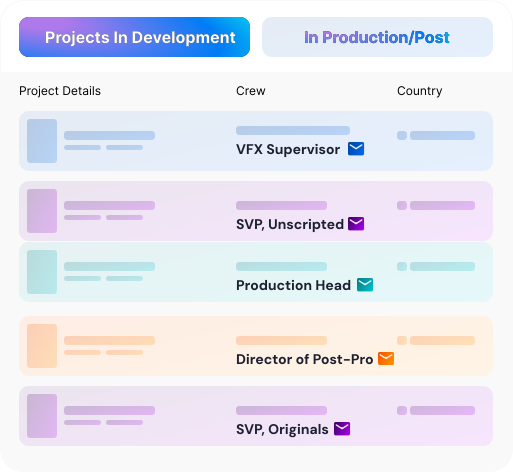
This is the core problem Vitrina solves: providing a transparent, data-driven view of the global financing landscape. By leveraging our platform, producers can map out potential partners, from projects currently in development to active financing companies, streamlining the most challenging phase of bringing a series to life.
How to Approach TV Financiers
Approaching financiers without the right materials is one of the most common reasons promising projects stall. A 2024 Producers Guild of America survey found that 61% of TV development executives rejected pitches at first contact because of incomplete financial documentation, not creative weakness. The creative idea matters, but the packaging matters just as much.
Build a Bulletproof Pitch Package First
Every TV financing conversation should be backed by a minimum package:
- The Pitch Bible: The soul of the show. It details the world, characters, season-long arcs, and episode summaries, and proves the concept has been thought through beyond the pilot.
- The Pitch Deck: A condensed, visual version of the bible — a 10-15 slide presentation with key plot points, character intros, and, crucially, the budget top sheet and financing plan.
- The Sizzle Reel: A 2-3 minute piece that sells the tone, style, and energy of the show, whether a concept reel, animated storyboard, or select scenes.
- Chain-of-Title and Budget: A chain-of-title opinion confirming IP ownership, plus a series budget broken down by department and a financing plan showing how it closes.
This package has to signal “safe bet” the moment a financier opens it. It shows respect for their time and their money — and without it, a project rarely gets a second look.
Sequence the Conversations in the Right Order
The order in which a producer approaches financiers matters as much as the materials themselves. Start with the anchor broadcaster or streaming platform — their commission or green-light signals project viability to every other financier in the stack. Once that interest is secured, approach co-producers in complementary territories, then pursue tax credit eligibility assessments and public fund applications. Distributor and gap financing conversations come last, once the stack is nearly complete. Trying to close gap financing before an anchor commission is in place is almost always unsuccessful.
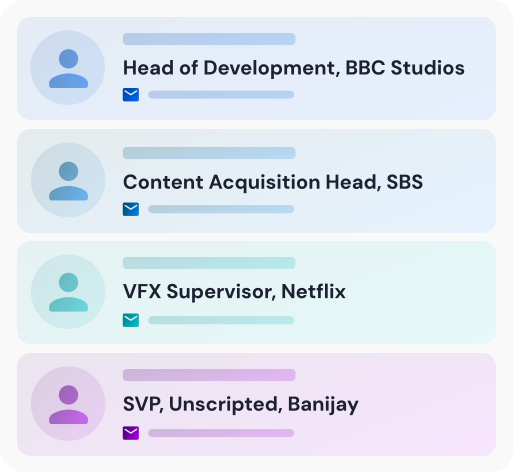
Putting all of these pieces together requires a significant amount of research, networking, and outreach — finding the right sales agents, identifying potential co-producers in Germany, or discovering distributors in South Korea can take months using traditional methods. A centralized global marketplace that surfaces vetted partners, their deal histories, and their current commissioning priorities turns that months-long search into a targeted shortlist, which is precisely the gap Vitrina’s platform is built to close.
Conclusion: Financing as a Strategic Advantage
TV show financing has evolved from a straightforward transaction into a complex, global strategy.
Mastering the interplay between international co-productions, government incentives, pre-sales, deficit structures, and private equity is no longer optional—it is the defining characteristic of a successful modern producer.
In an industry where capital is the ultimate greenlight, the ability to efficiently identify, vet, and secure the right financial partners — and to sequence those conversations correctly — provides a decisive competitive advantage, turning a great idea into a tangible, and profitable, global series.[/vc_column_text][/vc_column_inner]
Frequently Asked Questions
Most independently produced TV shows today are funded through a hybrid model. This typically involves a combination of international co-production partners, pre-sales to distributors in key territories, government tax incentives or rebates, and private equity investment to cover any remaining budget gaps.
A co-production is a partnership between two or more production companies from different countries who collaborate to fund, produce, and distribute a TV show. This model allows producers to pool financial resources, share risks, and access tax credits and broadcast deals in each partner’s home territory.
“Soft money” refers to funds that do not have to be repaid from a project’s profits. This primarily includes government-backed incentives like tax credits, rebates, and grants, which are designed to attract productions to a specific state or country.
Producers find investors through a variety of channels. This includes leveraging industry relationships, attending film and TV markets (like Cannes or AFM) to meet with sales agents and financiers, and using professional networking and data platforms to identify and connect with specialized media investment funds and private equity groups.
Deficit financing is the gap between what a broadcaster pays to license a show and the actual cost of producing it. Historically, a studio or production company absorbs this deficit in exchange for owning the underlying IP and recouping through international sales and format licensing — long the economic engine of traditional network television, though it is increasingly being replaced by full-cost streaming deals.
Gap financing is a short-term loan secured against the projected value of unsold rights in territories where no pre-sale has been completed. A gap lender advances cash against a sales agent’s projections for those territories, typically requiring at least 80% of the budget to already be financed through confirmed deals. Gap loans carry higher interest rates than senior debt because they are secured against projected rather than contracted revenue, and are usually used to close the final 5-15% of a budget.
Technically yes, but in practice it is rare. Netflix, Amazon Prime Video, and Apple TV+ all have internal development teams, but unsolicited submissions are seldom reviewed without a prior relationship or a referral from a recognized talent representative or production company. Most successful streaming deals for independent producers come through an established production partner, a literary agent representing the underlying IP, or a broadcaster attachment that signals market credibility.
The UK’s HETV credit is among the most competitive globally at 25% on qualifying spend. Canada’s combined federal and provincial programs can reach 25-40% depending on province. France’s TRIP rebate offers up to 30% for qualifying international productions, and Ireland’s Section 481 credit offers 32% on qualifying Irish expenditure, making it particularly attractive for English-language drama. Australia’s Producer Offset gives 20% on series above AUD $500,000 per episode hour, with an additional 30% PDV offset for post-production work.
While not strictly necessary, a reputable agent or entertainment lawyer provides immense value. They have established relationships with network executives, financiers, and buyers, and can get a pitch package read by the right people, while also providing crucial credibility during negotiations.