IHUB
IHUB
 Private Briefings (Webinars)


 LeaderSpeak Podcast
  Global Entertainment Digest (Newsletter)
  Premium Lists
 Membership Benefits
 About Vitrina
 Our Story
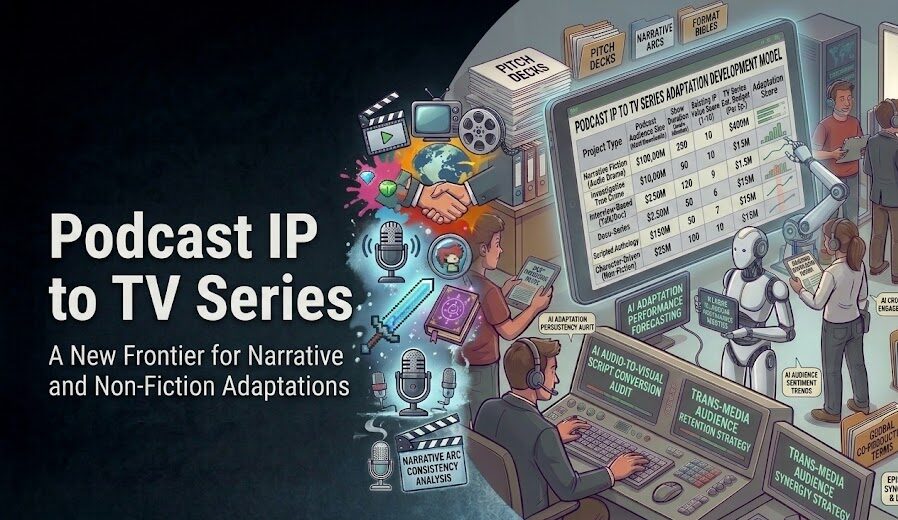
Here’s what most development executives still get wrong when they approach a podcast creator for adaptation rights: they treat the deal like a book option. Send an offer, negotiate a fee, get the IP, move on. But podcast IP adaptation rights don’t work that way—and in 2026, creators who’ve built audiences of a million-plus listeners per episode have exactly zero incentive to let that mistake slide.
The podcast-to-screen pipeline has matured from a niche curiosity into one of the fastest-growing adaptation categories in the industry. Netflix’s video podcast licensing deal with Spotify, announced in late 2025, signaled something structural: the platforms aren’t just buying podcast stories anymore—they’re buying podcast audiences. And that fundamentally changes what you’re negotiating for, who has leverage, and what a fair deal structure actually looks like in 2026.
This is the breakdown of how podcast IP adaptation rights deals actually get structured—from option mechanics to the life rights complications that sink true crime adaptations at the last minute. If you’re acquiring, pitching, or packaging a podcast for screen, you need to understand the specific ways audio IP differs from every other adaptation category.
In This Article
- Why Podcast IP Has Become a Primary Acquisition Category
- What You’re Actually Buying: The Multi-Rights Problem
- Option Structures in 2026: What Creators Actually Want
- The True Crime Complication: Life Rights and Chain of Title
- Platform Convergence and What It Means for Your Deal
- How to Package a Podcast Adaptation for Commissioners
- Finding the Right Production Partners
- Frequently Asked Questions
Track Podcast Adaptation Deals Before They Hit the Trades
Ask VIQI which podcast properties are in active adaptation development right now—and which production companies have the verified track record to bring audio IP to premium television.
300,000+ companies tracked globally. Netflix, Warner Bros, Paramount and major podcast studios active on the platform.
Why Podcast IP Has Become a Primary Acquisition Category
The global podcast market surpassed 4 million active shows and more than 500 million listeners by 2025. But raw audience scale isn’t why acquisition executives are treating podcast IP as a priority—it’s the audience quality that’s driving the deals.
A premium narrative podcast with a loyal audience of even 300,000 weekly listeners represents something genuinely rare: a fanbase that’s already invested 6-10 hours in the world, the characters, and the storytelling voice. That depth of engagement—achieved before a single development dollar is spent—is the same pre-built emotional investment that drives book adaptations and game IP acquisitions. But podcasts can generate it faster, at a fraction of the cost, and with real-time audience data that no publisher or game developer can match.
And then there’s the genre alignment. True crime podcasts—still the dominant format in terms of mainstream crossover appeal—translate almost directly into prestige limited series. Narrative fiction podcasts like scripted audio dramas have already done much of the writers’ room work: the story structure exists, the character voices are defined, the world-building is documented. For a development executive trying to de-risk a greenlight, that’s not just convenient—it’s a meaningful reduction in development timeline and creative uncertainty.
Our deeper breakdown of how podcast-to-screen deals are reshaping TV and film covers the full genre spectrum—but the deal mechanics are where this gets complicated.
What You’re Actually Buying: The Multi-Rights Problem
This is where most podcast adaptation deals get complicated—and where deals collapse weeks from closing. A podcast is not a single IP. It’s a layered bundle of rights with multiple owners who may not even know they’re owners until your legal team starts asking questions.
Consider what a typical narrative podcast actually contains. There’s the underlying story concept—owned by the creator or writing team. Then there are the script and dialogue rights—which may be held separately if the podcast used multiple writers under work-for-hire agreements. The character rights, the title rights, the theme music (almost always a third-party license), and any archive audio or documentary clips used in the series. In true crime podcasts, add the life rights of real subjects—which we’ll come to. And if the podcast was produced by a network like Wondery, iHeart, or Spotify Studios, the network itself may hold a stake in the IP that predates your conversation with the creator.
That last point is the most frequent deal-killer. Podcast creators who launched with a major network often signed agreements they didn’t fully parse at the time—agreements that gave the network first-look rights, co-ownership of derivative works, or direct approval rights over adaptation deals. Discovering that structure after you’ve invested 4 months in development conversations is expensive. Discovering it during chain-of-title review on the eve of greenlight is catastrophic.
Do the chain-of-title work before the option, not after. That means requesting copies of all creator agreements with networks, distributors, and production partners before you make an offer. It costs a few days of legal time up front. It saves you 6 months of remediation later. Our guide on how adaptation deals work across media formats covers the rights bundle framework in detail.

Your AI Assistant, Agent, and Analyst for the Business of Entertainment
VIQI AI helps you plan content acquisitions, raise production financing, and find and connect with the right partners worldwide.
- List the top commissioners at the BBC
- List the post-production and VFX decision-makers at Netflix
- List the development leaders at Sony Pictures
- List the scripted programming heads at HBO
- Find active co-producers and financiers for scripted projects
- Find equity and gap financing companies in North America
- Find top film financiers in Europe
- Find production houses that can co-produce or finance unscripted series
- Who is backing animation projects in Europe right now
- Who is Netflix’s top production partners for Sports Docs
- Who is Commissioning factual content in the NORDICS
- Who is acquiring unscripted formats for the North American market
- Show me recent drama projects available for pre-buy
- Show me Japanese Anime Distributors
- Show me true-crime buyers from Asia
- Show me documentary pre-buyers
- I am looking for production partners for a YA drama set in Brazil
- I am looking for producers with proven track record in mid-budget features
- I am looking for Turkish distributors with successful international sales
- I am looking for OTT platforms actively acquiring finished series for the LATAM region
- I am seeking localization companies offer subtitling services in multiple Asian languages
- I am seeking partners in animation production for children's content
- I am seeking USA based post-production companies with sound facilities
- I am seeking VFX partners to composite background images and AI generated content
The standard podcast option structure has evolved significantly from the early days of the podcast-to-screen market, when creators—unfamiliar with Hollywood’s option mechanics—sometimes signed away significant rights for token fees. That’s changed. And if you’re still structuring offers the way you would have in 2021, you’ll lose deals to competitors who understand what sophisticated podcast creators now expect.
Here’s what the market looks like in 2026. Option fees for mid-tier podcast IP—shows with audiences between 100,000 and 500,000 weekly listeners—typically range from $25,000 to $100,000 for an 18-month exclusive development window. For top-tier podcast IP—the shows with millions of listeners and proven crossover cultural relevance—option fees have escalated sharply, with some deals reported in the $150,000–$400,000 range. The purchase price at exercise is generally structured at 3–5% of the series budget for the first season, with separate negotiations for subsequent seasons.
But here’s the thing—the money isn’t always the friction point. What sophisticated podcast creators are increasingly pushing for in 2026 are three non-financial provisions that shape the creative relationship for the life of the adaptation. First: executive producer credit and a defined creative consultation right. Not script approval—most creators understand that’s operationally unworkable—but a formal right to review key creative decisions on character, tone, and narrative direction before they’re locked. Second: audio continuation rights. Creators want contractual protection that the TV adaptation doesn’t impair their ability to continue producing the original podcast. That sounds obvious, but without an explicit provision it can become a source of conflict if the screen version diverges from the audio canon. Third: sequel and spinoff participation—increasingly standard after creators watched their IP generate franchise value they had no contractual right to share in.
Understanding what optioning a property really means for all parties involved is foundational before you approach any podcast creator with an offer.
Matthew Helderman, co-founder and CEO of BondIt Media Capital, talks about the financing environment creators are navigating in 2026—and why reliable capital structures matter more than ever for content creators trying to get projects from development to screen:
Matthew Helderman, Co-founder & CEO, BondIt Media Capital — “Media Finance: Navigating a Post-Streamer World” (Vitrina LeaderSpeak)
Map the Full Podcast Adaptation Pipeline in Real Time
Vitrina tracks which podcast properties are in active development, which production companies have proven audio-to-screen track records, and which platforms are actively acquiring in this category right now.
200 free credits to start — no credit card required. Join 300,000+ companies using Vitrina to source and track IP deals.
The True Crime Complication: Life Rights and Chain of Title
True crime is the most commercially attractive podcast category for adaptation—and the most legally treacherous. Don’t let those two facts coexist without a very clear-eyed strategy.
Here’s the core problem. A documentary-style true crime podcast tells a real story about real people. The podcast creator—who is typically a journalist or independent producer, not an entertainment lawyer—has conducted interviews, obtained documents, and built a narrative around individuals who are still alive and who have opinions about how their story is told. That journalistic activity is protected. A scripted TV adaptation of that same story is not protected in the same way. The moment you dramatize real events, you need life rights agreements from the principal subjects—or you need to structure the adaptation in a way that eliminates that exposure.
This is what makes true crime podcast acquisitions more complex than they appear. You’re not just optioning the podcast. You’re inheriting the podcast creator’s relationship—and sometimes their ongoing conflict—with the real people at the center of the story. A creator who built a compelling investigative series by antagonizing a subject may have permanently burned the life rights relationship you need to make the adaptation legally defensible.
The practical framework in 2026 has three elements. First: conduct a subjects mapping exercise during option diligence—identify every real person who appears substantively in the podcast and assess whether life rights are required, obtainable, and at what cost. Second: engage the creator as a life rights intermediary where they have existing relationships; their credibility with subjects is often your fastest path to agreements. Third: budget for life rights acquisition as a separate cost item, not as part of the IP option fee—because they’re functionally different transactions, often with different legal and financial terms.
Our breakdown of how IP rights drive film and TV deals covers the life rights framework in the broader context of documentary and narrative non-fiction adaptation structures.
Platform Convergence and What It Means for Your Deal
The Netflix/Spotify video podcast partnership isn’t just a distribution deal—it’s a structural signal about where the podcast IP market is heading. When a streaming platform formalizes its relationship with the world’s dominant podcast platform, it creates a pipeline that bypasses traditional acquisition channels entirely. And that has direct implications for how you structure podcast adaptation rights in 2026.
Spotify Studios and Wondery—now owned by Amazon’s Audible—have accumulated significant IP portfolios through exclusive podcast production deals. That means some of the most commercially attractive podcast properties are already inside platform structures that have their own adaptation incentives and first-look rights. When you approach a creator whose podcast is distributed exclusively through Spotify, you’re not approaching a free agent—you’re approaching someone whose primary platform may have a contractual stake in any screen adaptation.
But platform convergence also creates opportunity. The Fragmentation Paradox™ applies here: the opacity of who actually controls what rights inside podcast network structures means most acquisition executives are working from an incomplete picture. A show that appears to be independently produced may have a network participation right buried in its distribution agreement. Conversely, a show that appears to be locked inside a platform deal may have specific carve-outs for screen adaptation that the creator isn’t even aware of.
The practical implication? Platform mapping belongs in your Phase 1 diligence, not as an afterthought once you’re deep in negotiation. Identify which network or platform the podcast operates under, request the creator’s distribution agreement, and understand the scope of any platform IP provisions before you build your acquisition thesis. This alone will eliminate the most common source of late-stage deal failure in the podcast adaptation market. You can read more about how podcast IP globalization is reshaping comedy content rights as one example of how these platform dynamics play out by genre.
Connect with Podcast Adaptation Specialists in 48 Hours
Vitrina’s Concierge team connects acquisition executives with verified production companies experienced in podcast-to-screen adaptations, rights lawyers who specialize in audio IP, and platform contacts across Netflix, Paramount, and HBO.
No commitment required. Used by Netflix, Warner Bros, and Paramount sourcing teams.
How to Package a Podcast Adaptation for Commissioners
Optioning a podcast is the easy part. Getting a commissioner to greenlight it—especially in the tighter financing environment that Phil Hunt of Head Gear Films describes as the industry’s “big crunch”—requires a package that answers the commercial question before the creative one.
Commissioners evaluating a podcast adaptation are asking a specific question that they won’t always ask out loud: does the podcast’s audience actually translate to a screen audience? These aren’t necessarily the same people, and they definitely aren’t the same behavior. A true crime podcast listener who downloads episodes while commuting has a very different relationship with the content than a Netflix subscriber who commits to a 6-episode limited series on a Friday night. Your packaging pitch needs to demonstrate—not assume—that the transition works.
The strongest podcast adaptation packages in 2026 include four elements beyond the IP option itself. A showrunner attachment with a documented track record in the relevant genre (not just a famous name—actual delivery experience on premium TV). A platform-specific pitch that maps the podcast’s existing audience demographics to the target platform’s subscriber acquisition priorities—because what Netflix needs from a limited series in 2026 is functionally different from what Apple TV+ or Peacock needs. A format analysis that makes a specific case for why this story works better as a 6-episode limited series versus an 8-episode anthology versus a procedural with open-ended series potential. And a production cost estimate that reflects the actual complexity of adapting the specific podcast—because some true crime formats adapt cheaply (essentially scripted docuseries) while others require full dramatic production budgets.
Understanding how series orders work from pilot to full season commitment helps you frame the commissioner conversation correctly—particularly the question of whether to pitch for a pilot order or position directly for a straight-to-series greenlight.
Finding Production Partners with Verified Audio-to-Screen Experience
The Fragmentation Paradox™ hits podcast adaptation hard in a specific way: the supply chain for audio-to-screen development is genuinely fragmented between audio production expertise and television production capability. Very few companies have both. And with 600,000+ active production and service companies globally, identifying the narrow slice that genuinely bridges that gap—without months of festival networking and referral chains—is exactly the kind of intelligence problem that kills good projects before they start.
What you’re looking for in a podcast adaptation production partner isn’t just general TV development experience. It’s specific: production companies who have either previously adapted audio IP or who have demonstrable experience in the documentary/narrative non-fiction formats that translate most directly from long-form podcast storytelling. You want to see hero projects—specific series they’ve delivered at the budget range you’re working in, with verified credits and available references.
Vitrina’s platform maps 140,000+ verified production and service companies by capability, hero project history, and current availability—so you’re not choosing a podcast adaptation partner from the small slice of the market your existing network has surfaced. The goal is to compress what would otherwise be a 3–6 month partner identification process into days of verified intelligence, and surface the production companies best-matched to your specific podcast’s genre, tone, and budget requirements before you’ve committed to a development path that locks in the wrong partner.
Frequently Asked Questions
How much does it cost to option a podcast for TV adaptation in 2026?
Option fees vary significantly by audience scale and commercial profile. Mid-tier podcast IP—shows with 100,000 to 500,000 weekly listeners—typically options for $25,000 to $100,000 for an 18-month exclusive development window. Top-tier podcast IP with millions of listeners and established cultural crossover can command $150,000 to $400,000 or more. The purchase price at exercise is generally structured at 3–5% of the first-season series budget, with separate terms for subsequent seasons and spinoffs.
What rights are included in a podcast IP adaptation deal?
A podcast is a layered bundle of rights that can include the underlying story concept, script and dialogue rights, character rights, title rights, theme music licenses, and any archive audio or documentary material used in the series. If the podcast was produced with or distributed by a major network—Wondery, iHeart, Spotify Studios—that network may hold a stake in the IP or first-look rights over adaptation deals. Chain-of-title diligence before the option is essential to understand the complete rights picture before you make an offer.
Do true crime podcasts require life rights agreements for TV adaptation?
Yes, in most cases. A documentary-style podcast tells real stories about real people and is protected as journalism. A scripted TV adaptation of the same story requires life rights agreements from principal subjects who are still alive. You need to conduct a subjects mapping exercise during option diligence—identify every real person who appears substantively in the podcast, assess whether life rights are required, and determine whether those agreements are obtainable. Budget for life rights acquisition as a separate cost item distinct from the IP option fee, as they are functionally different transactions with different legal and financial terms.
What does the Netflix/Spotify podcast deal mean for podcast IP acquisition?
The Netflix/Spotify video podcast licensing partnership signals structural convergence between the podcast and streaming ecosystems. It also highlights that many commercially attractive podcast properties are already inside platform IP structures—Spotify Studios and Wondery/Audible have accumulated significant podcast IP through exclusive production deals. When approaching podcast creators whose shows are distributed exclusively through major platforms, acquirers need to map what rights the platform holds before assuming the creator is a free agent. Platform participation rights buried in distribution agreements are the most common source of late-stage deal failure in podcast adaptation.
What creative rights do podcast creators typically negotiate in adaptation deals?
In 2026, sophisticated podcast creators routinely push for three provisions beyond the option fee: executive producer credit with a defined creative consultation right on character, tone, and narrative direction; audio continuation rights—explicit contractual protection that the TV adaptation does not impair their ability to continue the original podcast; and sequel and spinoff participation rights in any follow-on screen content based on the IP. These provisions don’t necessarily require financial compensation but have become standard deal points that losing them can damage the creator relationship and, ultimately, the adaptation’s commercial performance.
How do I find production companies experienced in podcast-to-screen adaptations?
Vitrina’s platform maps production companies by verified capability and hero project history, including companies with specific track records in audio-to-screen development and narrative non-fiction formats. For acquisition executives sourcing a podcast adaptation partner, Vitrina surfaces qualified companies filtered by genre experience, budget range, and current availability—without requiring festival-circuit relationships or insider referrals. The platform compresses what is typically a 3–6 month partner identification process into days of verified intelligence.
Key Takeaways: The 2026 Podcast IP Adaptation Playbook
The podcast-to-screen market is maturing fast—and the deal structures are hardening around the specific complications that early adopters learned the hard way. Understand the multi-rights problem before you make an offer. Map life rights exposure in true crime deals before you’re deep in development. And don’t let the Fragmentation Paradox™ constrain your production partner search to the small slice of the market your existing network happens to know.
- A podcast is a bundle of layered rights with multiple potential owners— always conduct chain-of-title diligence before optioning, including a review of any network or platform distribution agreements that may carry IP participation rights.
- Option fees have escalated for premium podcast IP— structure your offer at 3–5% of the first-season series budget as a purchase price, and include executive producer credit, audio continuation rights, and sequel participation as non-financial provisions rather than fighting them.
- True crime adaptations require a life rights strategy, not just an IP option— treat subjects mapping as a Phase 1 diligence step and budget life rights acquisition separately from the podcast option fee.
- Platform convergence is creating hidden IP lock-ups— map platform participation rights before building your acquisition thesis, especially for shows distributed through Spotify, Wondery, or iHeart.
- The strongest packages combine clean IP with a proven showrunner, a platform-specific pitch, and a realistic production cost estimate— not just a good story and an excited creator.
Track Podcast IP Deals and Find Verified Production Partners
Join 300,000+ companies using Vitrina to map podcast adaptation pipelines, verify production partner capability, and surface audio IP opportunities before they’re announced.