IHUB
IHUB
 Private Briefings (Webinars)


 LeaderSpeak Podcast
  Global Entertainment Digest (Newsletter)
  Premium Lists
 Membership Benefits
 About Vitrina
 Our Story
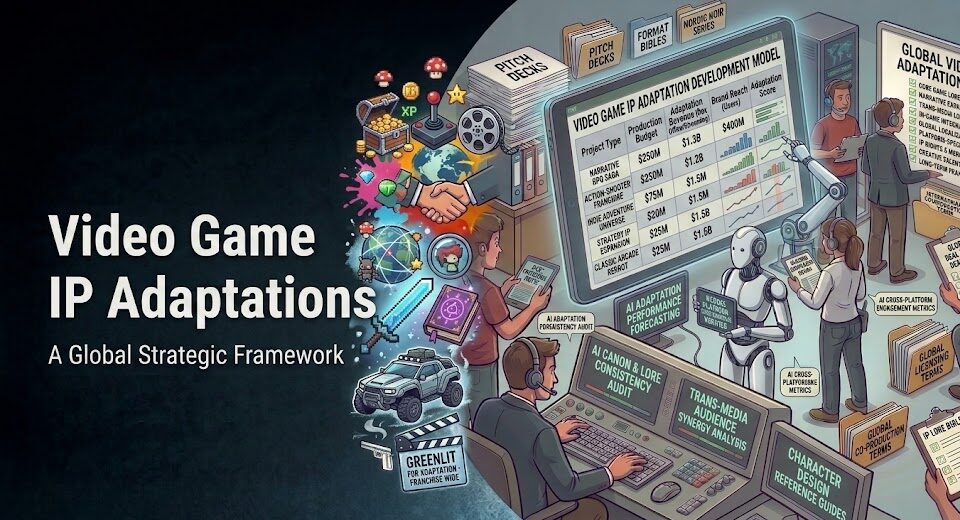
Here’s a deal structure question that would have sounded absurd in 2015: what do you give a gaming publisher that already has hundreds of millions of players, a decade of franchise equity, and no particular need for your distribution relationships? Because that’s exactly the negotiating position studios face in 2026. PlayStation Productions, Xbox Game Studios, and third-party publishers like Bandai Namco—in which Sony acquired a stake in 2024—aren’t passive IP licensors anymore. They’re counterparties with leverage, creative opinions, and an increasingly clear-eyed view of what their franchises are worth before a single script page is written.
The video game IP adaptation market has matured from a Hollywood curiosity into a primary content acquisition category—and the deal structures have evolved accordingly. Options, creative control provisions, sequel rights, merchandise revenue splits, Authorized AI™ chain-of-title requirements, and the question of who controls the franchise after a successful adaptation: all of it is negotiated differently now than it was three years ago.
This is the breakdown of how those deals actually get structured, what studios are paying for the right to adapt game IP, and where the Fragmentation Paradox™ creates the execution risk that derails even well-financed adaptations.
In This Article
- Why Game IP Dominates the 2026 Acquisition Landscape
- Option vs. Full Acquisition: How the Deal Type Shapes Everything
- Creative Control Provisions: The Non-Negotiable Clauses
- The Capital Stack for High-Budget Game Adaptations
- Authorized AI™ and the New Chain-of-Title Requirements
- Streaming vs. Theatrical: How Platform Choice Rewrites the Rights Deal
- Finding Production Partners Capable of Executing Game IP
- Frequently Asked Questions
- Key Takeaways
Track Video Game IP Adaptation Deals Before They’re Announced
Ask VIQI which gaming publishers are actively pursuing film and TV licensing deals right now—and which studios have the verified VFX infrastructure to execute at the scale game adaptations demand.
300,000+ companies mapped globally. Netflix, Warner Bros, Paramount and major gaming studios active on the platform.
Why Game IP Dominates the 2026 Content Acquisition Landscape
The global video game market now generates over $200 billion annually—more than film and music combined. But the financial scale alone doesn’t explain why acquisitions executives at every major streamer and studio have elevated game IP to a top-tier content acquisition category. The real answer is structural.
Game franchises like The Last of Us, Fallout, and Arcane don’t arrive at adaptation without an audience—they arrive with tens of millions of pre-existing fans who already understand the world, care about the characters, and have strong opinions about how the story should unfold. That pre-built audience awareness is worth real money in a streaming environment where subscriber acquisition costs have compelled platforms to de-risk content investments everywhere they can.
But it’s not just fan-base depth. Game IP typically offers something book adaptations and format remakes can’t match: a fully-realized visual and narrative universe. The concept art is done. The world-building is established across dozens of hours of gameplay. The mythology is documented. For production teams, that means a head start on every pre-production conversation—from VFX blocking to production design to casting brief. That translates directly into shorter development timelines and, in theory, reduced creative risk.
The capital reality? Studios aren’t paying option fees for generic IP. They’re paying for franchise infrastructure—and gaming publishers know it. Our full guide to game adaptations in Hollywood tracks how the deal dynamics have shifted as publishers have become more sophisticated counterparties. The era of cheap option fees on triple-A game IP is over.

Your AI Assistant, Agent, and Analyst for the Business of Entertainment
VIQI AI helps you plan content acquisitions, raise production financing, and find and connect with the right partners worldwide.
- List the top commissioners at the BBC
- List the post-production and VFX decision-makers at Netflix
- List the development leaders at Sony Pictures
- List the scripted programming heads at HBO
- Find active co-producers and financiers for scripted projects
- Find equity and gap financing companies in North America
- Find top film financiers in Europe
- Find production houses that can co-produce or finance unscripted series
- Who is backing animation projects in Europe right now
- Who is Netflix’s top production partners for Sports Docs
- Who is Commissioning factual content in the NORDICS
- Who is acquiring unscripted formats for the North American market
- Show me recent drama projects available for pre-buy
- Show me Japanese Anime Distributors
- Show me true-crime buyers from Asia
- Show me documentary pre-buyers
- I am looking for production partners for a YA drama set in Brazil
- I am looking for producers with proven track record in mid-budget features
- I am looking for Turkish distributors with successful international sales
- I am looking for OTT platforms actively acquiring finished series for the LATAM region
- I am seeking localization companies offer subtitling services in multiple Asian languages
- I am seeking partners in animation production for children's content
- I am seeking USA based post-production companies with sound facilities
- I am seeking VFX partners to composite background images and AI generated content
Option vs. Full Acquisition: How the Deal Type Shapes Everything
Most video game IP adaptation deals start with an option—not a full rights purchase. And that distinction matters far more than it sounds. An option gives a studio the exclusive right to develop and ultimately purchase the adaptation rights within a defined window (typically 12-24 months, often renewable for an additional term). Option fees for major game franchises have escalated significantly: where a mid-tier game IP might have optioned for $50,000-$150,000 five years ago, the same deal today routinely starts at $250,000-$500,000, with triple-A franchise options often commanding seven figures against a purchase price.
The purchase price—paid when the studio formally exercises the option and greenlights the adaptation—is where deal structures get complex. Gaming publishers typically negotiate for a percentage of the total production budget, not a flat fee. For a $100M theatrical adaptation, a 2-3% rights fee translates to $2-3M—before any backend participation is factored in. The backend provisions on successful game adaptations are now routinely contested: publishers want a percentage of adjusted gross receipts from the film itself, a merchandising royalty, and increasingly, revenue participation in downstream streaming windows.
Then there’s the sequel rights question. Gaming publishers have learned from watching Hollywood sequelize their IP—and then watching sequels underperform or take the franchise in directions that damaged game sales. Modern deal structures for major game IP routinely include sequel and spinoff reversion clauses: if the studio doesn’t greenlight a sequel within 5-7 years of the original film’s release, sequel rights revert to the publisher. That’s a materially different risk profile than the perpetual rights structures Hollywood operated under for decades.
For producers and acquisition executives structuring these deals, our breakdown of how IP rights drive film and TV deals covers the full mechanics of rights packages, exercise windows, and reversion triggers.
Creative Control Provisions: The Non-Negotiable Clauses
What’s actually happening behind closed doors in game IP negotiations—and what doesn’t make it into the trades—is the fight over creative control. This is where deals collapse, and where the most commercially successful adaptations have gotten it right.
PlayStation Productions built its entire model around a single insight: the studios that adapt game IP without meaningful creative involvement from the publisher consistently produce projects that alienate the fanbase and underperform. The original Uncharted film—which spent years in development hell partly due to creative control disputes before finally being produced with PlayStation Productions formally co-producing—demonstrated both the cost of that dysfunction and what’s possible when the rights holder is genuinely in the room.
In 2026, the standard creative control provision in major game IP deals includes: script approval rights for the publisher on key story elements (not line-by-line rewrites—publishers generally don’t want that burden—but approval on major character arcs, narrative tone, and world-building fidelity), casting consultation (a weaker right than approval, but one publishers use to block obviously misaligned choices), and lore consistency review tied specifically to game-universe continuity. Some deals include a designated “franchise steward” role—a named publisher executive with a formal seat at the creative table through development and production.
The equity question follows. Publishers with meaningful creative involvement increasingly want to be structured as genuine co-producers—not just IP licensors—which has capital stack implications. Co-producer status means equity participation, which means a position in the recoupment waterfall. As our analysis of how gaming companies are financing film adaptations covers, the lines between licensor and co-financier are genuinely blurring for major publishers.
Kirsty Bell, founder and CEO of Goldfinch, captures the strategic logic of IP-driven financing—connecting diverse revenue streams, brand integration, and franchise equity—in a framework directly applicable to game adaptation structures:
Kirsty Bell, Founder & CEO, Goldfinch — “Goldfinch’s Strategy for Financial Sustainability in Independent Filmmaking” (Vitrina LeaderSpeak)
Map the Full Game IP Adaptation Pipeline Right Now
Vitrina’s platform tracks which game franchises are in active adaptation development, which studios have first-look deals with major publishers, and which production companies have the VFX infrastructure for triple-A franchise execution.
200 free credits to start — no credit card required. Join 140,000+ companies tracking IP deals in real time.
The Capital Stack for High-Budget Game Adaptations
Video game adaptations have a structural cost problem that shapes every financing conversation: the source material almost always implies a visual scale that drives budgets into ranges where traditional independent film financing structures start to strain. The Last of Us series reportedly cost HBO approximately $10-15M per episode. Fallout on Prime Video operated at comparable scale. These aren’t budgets you close with presales and gap financing—they require committed platform capital or studio resources from day one.
But not all game adaptations operate at streaming-mega-budget scale. The capital stack question splits differently depending on the project tier:
Tier 1: Platform Flagship Adaptations ($80M–$200M+ total budget)
At this level—think major franchise IP from publishers like PlayStation, Xbox, or Bandai Namco—the capital structure is typically a single-platform commitment. Netflix, Prime Video, or HBO commissions the project as a full-cost greenlight, controlling worldwide rights from the outset. The rights fee to the publisher is baked into the total budget. There’s no traditional presales or gap financing structure—the platform absorbs all production risk in exchange for all distribution upside. The publisher’s recoupment comes from the rights fee, backend participation on licensing revenue, and merchandise royalties.
Tier 2: Mid-Range Theatrical or Premium TV ($25M–$80M budget)
This is where more interesting capital structures emerge—and where equity financing partners become genuinely relevant. Andrea Scarso, Managing Partner at IPR VC—a Helsinki-founded equity fund with a 12-year track record backing film and TV projects through partners including A24, XYZ Films, and MK2—describes the equity thesis directly: “When you hit a successful IP, the upside can be greater than the overall risk you’re taking on a portfolio.” His point is specific to equity positioning in IP-driven content: the long tail of revenues from a successful game franchise adaptation—through theatrical, home entertainment, streaming windows, and merchandise licensing—can compound over years in ways that fixed-return debt structures can’t capture.
At this budget tier, a game adaptation’s capital stack might look like: 30-35% streaming platform pre-buy (one key territory or a regional deal), 20-25% equity from a content fund like IPR VC or a gaming publisher co-investing in their own IP, 15-20% tax incentives from a production jurisdiction, and 20-25% territorial presales leveraged against the publisher’s brand value in key international markets. Gap financing closes the remaining 10-15%.
The relationship between distribution strategy and capital stack architecture is especially acute for game adaptations—the question of whether to sell to a platform or go theatrical first changes the entire financing structure, not just the distribution plan.
The Emergence of Transmedia Storytelling
One of the primary reasons why gaming adaptations have become successful is the emergence of transmedia storytelling. Entertainment businesses do not consider games, movies, TV shows, comic books, and streaming products as individual entertainment ecosystems anymore.
Instead, franchises begin developing into entertainment universes.
The elements making video games an ideal format for transmedia storytelling include:
- cinematic story-telling
- world building
- episodic storytelling
- emotional character arcs
- lore ecosystems
These make them ideal candidates for adapting into premium TV and streaming shows.
Biggest Video Game Adaptations Leading the Industry in 2026
The Last of Us and Prestige Television Adaptations
The adaptation of The Last of Us for HBO showed how video game narrative was capable of becoming equal to television narrative. The Last of Us was a game capable of telling a compelling story while having a good graphical design.
The following lessons were learned from The Last of Us regarding streaming platforms:
- gaming IPs can be used for premium drama positioning
- successful adaptations extend the life cycle of the franchise
- emotional storytelling broadens the audience demographics
- fan base drives engagement in the long term
Fallout and the Expansion of Post-Apocalyptic Universes
Fallout adaptation on Prime Video is an example of how a large game franchise with rich lore can easily transition into episodic and streamable entertainment. Fallout’s retro-futuristic look and post-apocalyptic setting transferred to the screen perfectly.
This adaptation also demonstrated how streaming services can leverage the game’s IP to generate:
- binge-watching
- franchise community building
- social media conversations
- content ecosystem
Post-apocalyptic gaming franchises still fare well because they blend action, survival, and spectacle together.
God of War and Mythology-Driven Streaming Content
The God of War adaptation by Amazon is yet another milestone in the development of gaming IPs. This series has a lot to boast of when it comes to spectacular stories and father-son story arcs.
What makes God of War special is its:
- brand recognition around the world
- emotional storytelling
- cinematic spectacle
- mythology-driven world-building
Gaming franchises with cinematic stories are emerging as an alternative to comic book franchises.
Arcane and the Increasing Popularity of Animated Gaming Franchises
The Netflix series that adapts the League of Legends franchise, Arcane, is an example of the increasing popularity of animations based on gaming franchises. The series gained recognition for its storytelling, plot, and production qualities.
The benefits of animation include:
- lower production complexity than live-action content
- visual consistency
- global scalability
- reaching younger audiences
As anime-based storylines continue gaining global popularity, gaming adaptations in the form of animation will soon emerge as one of the key content categories for streaming platforms.
Minecraft and Cross-Generational Franchise Value
The coming Minecraft movie adaptation underscores the vast commercial appeal of family-friendly gaming IP. While mature gaming franchises target niche demographics, Minecraft transcends generations and is enjoyed internationally.
For media companies, multi-generational gaming franchises present:
- multi-generational appeal
- productization options
- education-based ecosystem growth
- sustainability of franchises
Gaming adaptations are now being considered not just in terms of individual projects, but as long-term intellectual property ecosystems.
Authorized AI™ and the New Chain-of-Title Requirements for Game IP
Here’s what’s actually changed in 2026 for game IP acquisitions that wasn’t on anyone’s term sheet in 2022: Authorized AI™ chain-of-title requirements have become a real negotiating point—and gaming publishers are more exposed here than any other IP category.
The issue isn’t hypothetical. Major gaming publishers have been using AI tools in game development—for asset generation, NPC dialogue, environmental art, and increasingly for narrative scripting assistance—and not all of those tools operated on explicitly licensed training data. When those games become the source material for film and TV adaptations, studios and completion bond providers now want documented confirmation that no AI-generated elements embedded in the game’s creative assets carry unresolved IP liability.
Disney’s $1 billion licensing deal with OpenAI—structured to authorize Disney IP for AI training under explicit licensed terms—established the model that premium IP holders are now expected to follow. For a gaming publisher negotiating an adaptation deal with a major studio, “Authorized AI™” compliance has become a diligence item: studios want written confirmation that the game’s creative assets were developed under authorized AI frameworks with verifiable chain-of-title on all source material used in training.
The business consequence is real. Completion bond providers—which are mandatory for virtually every independently financed film—now include AI IP liability as a standard underwriting question. A game adaptation that can’t produce clean AI compliance documentation faces higher bond costs or, in the worst case, an uninsurable production. That’s not a creative problem. It’s a financing problem that kills deals before greenlight.
For acquisition executives, this means building AI compliance review into the option negotiation phase—not just the production planning phase. The question isn’t just “what rights are we buying?” It’s “what’s the AI provenance of the creative assets we’re licensing?” Our analysis of character IP rights in the 2026 gaming and AI era covers these emerging frameworks in detail.
Structure Your Game IP Adaptation Deal with Expert Support
Vitrina’s Concierge team connects acquisition executives with verified production partners, VFX studios with proven franchise-scale capability, and equity financing contacts with game IP experience—introductions made in under 48 hours.
No commitment required to explore. Used by Netflix, Warner Bros, and Paramount sourcing teams.
Streaming vs. Theatrical: How Platform Choice Rewrites the Rights Deal
The theatrical vs. streaming decision isn’t just a distribution choice—it structurally rewrites every element of the rights agreement, and gaming publishers are now sophisticated enough to push for the option that maximizes their position.
Streaming platforms—Netflix, Amazon Prime Video, Apple TV+—typically want worldwide rights in perpetuity. That’s the cleanest deal structure for them and the most restrictive for the publisher. In exchange, they offer a known, committed fee: the rights cost is baked into a total budget that the platform funds in full. No presales. No waterfall. A single payment event. For a publisher prioritizing certainty over upside, that’s a rational trade.
But certainty isn’t always what sophisticated publishers want. The theatrical route—where a studio distributes globally through theatrical windows before the adaptation moves to streaming—allows for territory-by-territory licensing, which means the publisher can structure backend participation in theatrical revenues, home entertainment windows, and licensing deals across platforms. That complexity adds administration, but it also adds potential upside. It’s the model that makes sense for publishers who believe their IP will outperform the flat fee a streamer offers upfront.
The middle path—and where the most interesting deal structures are emerging in 2026—is the theatrical-then-streaming hybrid. A studio acquires theatrical rights for a defined window (typically 45-90 days post-release), with a pre-negotiated streaming deal triggered automatically after the theatrical window closes. The publisher participates in both revenue streams with different royalty rates. As Deadline and Variety have tracked, this structure has become standard for franchise adaptations where the studio believes theatrical P&A spend will drive streaming subscriber acquisition downstream. The publisher benefits from the marketing halo without carrying P&A risk.
The Netflix gaming strategy offers a case study in how the streaming-first model is evolving—and where the platform is adjusting its rights acquisition approach to accommodate publisher demands for more nuanced deal structures.
Finding Production Partners Capable of Executing Game IP at Scale
The real problem, once the rights deal is closed, is execution. And the Fragmentation Paradox™ hits game IP adaptations particularly hard.
Game adaptations require production partners with highly specific capability combinations that are genuinely rare in the supply chain: world-building fidelity at theatrical VFX standards, experience with IP-protective creative workflows, and the capacity to coordinate with a publisher’s internal asset teams without those interactions becoming a production bottleneck. That’s not a profile you find through a quick search of known contacts. It requires verified supply chain intelligence—and the opacity of the 600,000+ active production and post-production suppliers globally means most acquisition executives are working from a dramatically incomplete picture of what’s actually available.
The practical consequence: studios adapt game IP with production partners they already know, rather than production partners optimally suited to the specific franchise. That’s the Fragmentation Paradox™ at work—relationship-dependent access limiting the option set to a fraction of qualified alternatives, with no systematic way to verify whether better partners exist.
Josh Harris, President of Peachtree Media Partners—a private media lender with 26 years in financial services—frames the market context directly: “We are living in the content creation heyday. These devices are never going away. How we demand content is not going to regress.” He’s describing the demand-supply equation that drives game IP acquisition volume. But the supply constraint isn’t rights availability—it’s production partner quality. And that’s exactly what real-time intelligence resolves.
Vitrina’s platform maps verified VFX studios, production companies, and post-production partners by demonstrated franchise-scale capability—not just self-reported credentials. Acquisition executives can identify which production companies have hero projects with comparable visual complexity to their target game franchise, verify current capacity, and surface qualified options their existing network hasn’t surfaced. The goal is to compress the partner identification timeline from 3-6 months of festival networking to days of verified intelligence—and to make sure the right VFX partner for a demanding game adaptation isn’t invisible just because you haven’t crossed paths at AFM.
For acquisition teams looking to build verified production partner shortlists before a game IP greenlight, our complete guide to buying film and TV rights in 2026 covers the full due diligence framework from rights structure through production partner qualification.
Frequently Asked Questions
How much does it cost to option video game IP for film or TV adaptation in 2026?
Option fees for major game franchise IP typically start at $250,000–$500,000 for a 12-24 month exclusive window, with triple-A franchise options often commanding seven figures. The purchase price on exercise—paid at greenlight—is usually structured as a percentage of total production budget (2–4%), plus backend participation in theatrical and streaming revenues, merchandise royalties, and in some deals, sequel participation rights. Smaller or mid-tier game IP can still option for considerably less, but the era of low-cost options on proven franchise IP is effectively over.
What creative control do gaming publishers typically retain in video game IP adaptation deals?
Standard creative control provisions in major game IP deals now include script approval rights on key story elements (character arcs, world-building fidelity, narrative tone), casting consultation, and lore consistency review tied to game-universe continuity. Some deals include a named publisher executive in a formal “franchise steward” co-producer role through development and production. Publishers increasingly seek equity co-producer status—not just IP licensor status—which gives them a position in the recoupment waterfall in addition to their rights fee.
What is Authorized AI™ and why does it matter for game IP adaptation deals?
Authorized AI™ refers to the use of AI tools with explicitly licensed training data—as opposed to AI systems trained on scraped or unauthorized source material. For game adaptations, the issue is that gaming publishers have increasingly used AI tools in development (for asset generation, NPC dialogue, narrative scripting), and not all those tools operated on clearly licensed data. Studios and completion bond providers now require documented AI compliance confirmation as part of rights acquisition due diligence. Projects that can’t produce clean AI chain-of-title documentation face higher completion bond costs or insurability problems that can block financing.
Should a video game IP adaptation go to streaming or theatrical distribution?
It depends on the publisher’s priorities and the franchise’s commercial profile. Streaming platforms offer certainty—a full-cost commitment with worldwide rights and a known payment—but publishers give up territory-by-territory upside. Theatrical distribution allows for multi-window revenue participation but requires the studio to carry P&A risk. The emerging standard for major game franchise adaptations is a theatrical-then-streaming hybrid: a defined theatrical window (45-90 days) followed by a pre-negotiated streaming deal. Publishers participate in both revenue streams with separate royalty structures, and the theatrical marketing spend creates a subscriber acquisition halo for the streaming window.
How do equity investors approach video game IP adaptation financing?
For equity investors like IPR VC—which has backed film and TV projects through partners including A24, XYZ Films, and MK2—game IP adaptations are attractive specifically because successful IP generates long-tail revenues across theatrical, home entertainment, streaming, and merchandise windows that compound over years. The equity thesis is that the upside from a breakout game adaptation exceeds the portfolio risk, particularly when the investment is structured as a project-level equity position (not a company-level stake) with a diversified slate approach. Equity investors typically enter at the development financing stage—before greenlight—to capture the maximum upside position in the recoupment waterfall.
What are sequel reversion clauses in video game IP adaptation deals?
Sequel reversion clauses contractually require a studio to greenlight a sequel within a defined window—typically 5-7 years of the original release—or lose sequel rights back to the publisher. Gaming publishers introduced these provisions after watching studios acquire perpetual sequel rights and then either sequelize in ways that damaged the franchise or hold the rights indefinitely without producing follow-up content. Reversion clauses protect the publisher’s long-term franchise value and create a meaningful incentive for studios to actually develop sequels rather than park the rights.
How do I find production partners with verified game adaptation experience?
Vitrina’s intelligence platform maps production companies and VFX studios by verified hero projects and demonstrated capability at franchise-scale complexity. For acquisition executives sourcing production partners for a specific game IP, Vitrina identifies qualified companies filtered by visual effects capacity, budget range experience, and current availability—without requiring festival-circuit relationships or insider contacts. The platform also tracks which studios have existing first-look or output deals with major gaming publishers, giving acquisition teams visibility into the competitive landscape before approaching potential partners.
Key Takeaways: The 2026 Game IP Acquisition Playbook
The dynamics of video game IP adaptation deals have structurally changed—and studios that approach game publishers with the playbook from five years ago are going to find themselves outmaneuvered. Publishers understand their leverage. The deal structures reflect it. But the opportunity is real: game IP delivers pre-built audience scale, franchise infrastructure, and visual universe documentation that compresses development timelines and de-risks content investment. You just have to structure the deal right—and build the execution capability to match.
And with Vitrina’s real-time intelligence giving you verified visibility into 300,000+ companies across the global production supply chain—including which production partners can actually execute at the scale your game franchise demands—you don’t have to navigate the Fragmentation Paradox™ on instinct and rolodex alone.
- Option fees have escalated significantly: Major game IP options now start at $250,000-$500,000, with triple-A franchise options commanding seven figures. Model in the purchase price as a percentage of production budget (2-4%), not a flat fee.
- Creative control is non-negotiable for successful adaptations: Build publisher script approval, casting consultation, and a formal franchise steward role into deal structure from the outset—not as a concession, but as the architecture that makes the adaptation commercially viable.
- Authorized AI™ compliance is now a financing requirement: Get AI chain-of-title documentation from publishers at the option stage. Don’t wait for completion bond underwriting to surface this as a problem.
- The theatrical-then-streaming hybrid is the emerging standard: A defined theatrical window followed by a pre-negotiated streaming deal lets publishers participate in both revenue streams with separate royalty structures—and creates marketing leverage for both windows.
- Production partner verification is the execution risk: The Fragmentation Paradox™ means most acquisition executives are choosing partners from a dramatically incomplete supply chain view. Verified intelligence—not relationship networks—surfaces the partners best matched to your franchise’s specific requirements.
Track Video Game IP Adaptation Deals in Real Time
Join 300,000+ companies using Vitrina to map IP acquisition pipelines, verify production partner capability, and surface game adaptation opportunities before they’re announced in the trades.