IHUB
IHUB
 Private Briefings (Webinars)


 LeaderSpeak Podcast
  Global Entertainment Digest (Newsletter)
  Premium Lists
 Membership Benefits
 About Vitrina
 Our Story
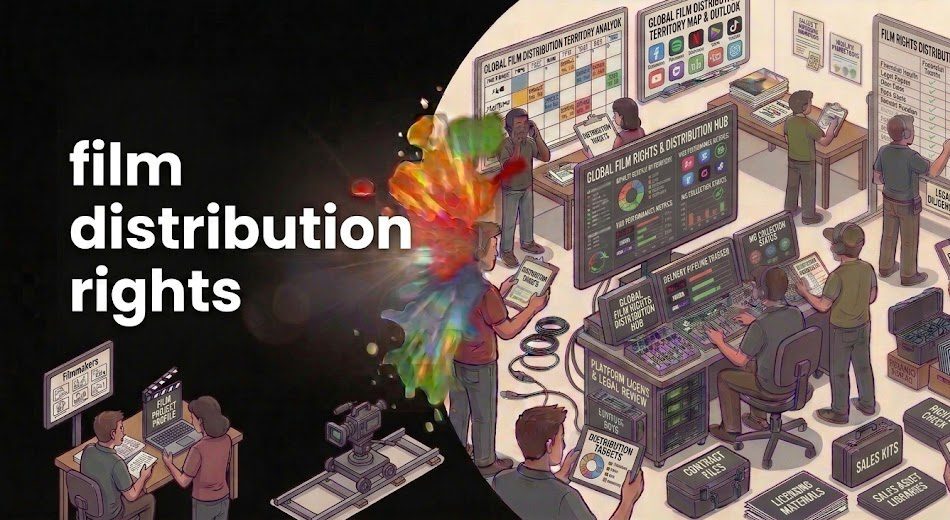
The legal documents required for film distribution rights don’t get simplified by experience—they get respected. Every deal that’s fallen apart during due diligence, every MG that’s gone unpaid, every rights reversion that arrives two years late traces back to gaps in this paperwork. And the gaps aren’t always obvious.
A distributor can sign an acquisition agreement in good faith and still find themselves unable to close lender financing because the chain of title has a broken link from a music rights clearance four years back.
This checklist covers the standard legal documentation stack for acquiring film distribution rights—what each document does, what it protects, and where deals typically break down when it’s missing or incomplete. Whether you’re a distributor acquiring territorial rights, a sales agent structuring a presale package, or a producer preparing for market, you need every layer of this stack in order before money moves.
Table of Contents
- Why the Legal Stack Determines Whether Your Deal Closes
- Chain of Title — The Foundation Document
- Distribution License Agreement — The Core Deal Document
- Notice of Assignment — The Lender’s Clock
- Sales Agency Agreement — Governing the Intermediary
- E&O Insurance — The Broadcaster Non-Negotiable
- Completion Guarantee — Delivery Assurance for Lenders
- Deal Memo and Letter of Intent — The Market-Week Documents
- Inter-Party Agreement — When Lenders Enter the Stack
- Delivery Schedule and Technical Specs — Triggering Payment
- FAQ
- Key Takeaways
Ask VIQI: Who Holds Distribution Rights to a Specific Film Right Now?
VIQI is Vitrina’s AI intelligence layer—trained on 1.6 million titles, 300,000+ companies, and 5 million entertainment professionals. Surface rights status, deal history, and active distribution contacts before you open legal negotiations.
✓ Included with 200 free credits | ✓ No credit card needed
Why the Legal Stack Determines Whether Your Deal Closes
Distribution rights aren’t acquired with a handshake—even when that’s how the conversation starts. What separates a market conversation from a closed deal is a specific chain of legal documentation that establishes who owns what, who can exploit it, and under what conditions money moves. Lenders, broadcasters, streaming platforms, and gap financiers all require different layers of this stack before they’ll commit capital.
Here’s the thing most producers discover too late: the documentation review happens in parallel with the creative evaluation, not after it. A streaming platform’s business affairs team starts pulling on the chain of title the same week their acquisitions executive falls in love with the screener. If the legal package isn’t ready—or worse, has gaps—the deal stalls while momentum evaporates. That’s the real cost of incomplete documentation: it’s not just a legal risk, it’s a deal timing risk. For context on how distribution deals are structured commercially, our guide to what a distribution deal actually contains covers the business architecture underneath the legal docs.
1. Chain of Title — The Foundation Document
Chain of title is the unbroken sequence of agreements that documents how copyright ownership transferred from the original creator to the current rights holder. It’s the foundational document in any distribution rights acquisition—without a clean chain, nothing else in the stack is valid.
A complete chain of title includes the underlying rights agreements (option or purchase of source material—novel, screenplay, article, life rights), writer agreements with Work for Hire clauses or copyright assignments, producer agreements, director agreements where applicable, and copyright registration certificates. Every link in this chain must be in writing, properly executed, and verifiable.
Where chains break: music. Specifically, synchronization licenses and master use licenses for every piece of music in the film—score and licensed tracks—must be documented and cleared for all territories being licensed. A German distributor who acquires European rights only to discover the film uses unlicensed music in a key scene faces immediate broadcast liability. This isn’t a hypothetical. It’s the most common chain-of-title failure point in international acquisitions—and it’s entirely avoidable with a proper music clearance report before any rights negotiation begins.
The chain of title review typically takes 2–4 weeks with entertainment counsel. Build that into your acquisition timeline before approaching rights holders with offers. Showing up to a deal without a clean chain delays closing and signals inexperience—neither of which helps your negotiating position.
2. Distribution License Agreement — The Core Deal Document
The distribution license agreement (or acquisition agreement) is the primary contract governing the deal. It defines who can exploit the film, where, for how long, on which platforms, and at what financial terms. Get this document wrong—or leave it vague—and everything downstream becomes contested.
Standard license periods run 15–20 years for territory presales, though streaming platforms increasingly push for shorter windows (7–10 years) with renewal options. The agreement must specify:
- Territory: Exact geographic scope (Germany alone, German-speaking Europe, pan-European, etc.)
- Rights granted: Theatrical, SVOD, AVOD, TVOD, FAST, linear TV, physical—each specified separately or as an all-rights grant
- Exclusivity: Whether the license is exclusive or non-exclusive within the territory
- Minimum Guarantee: The MG amount, payment schedule (10% on signature, 90% on delivery is standard), and what constitutes a triggering delivery event
- Distribution fee: The distributor’s percentage (typically 20–35% off gross revenues depending on the rights category)
- P&A commitments: Any minimum marketing spend obligations and how P&A recoupment works
- Accounting: Reporting frequency, statement formats, audit rights
- Reversion clause: Conditions under which rights revert to the producer if the distributor fails to perform (typically non-payment or non-release within an agreed window)
The reversion clause deserves particular attention. Standard deal practice gives distributors 18–24 months from delivery to achieve theatrical release before reversion triggers. But “delivery” needs its own precise definition in the contract—tied to the technical delivery schedule, not a subjective assessment of the distributor’s satisfaction with the materials. See our detailed breakdown of how to negotiate a film distribution contract for the specific clauses that require the most attention during legal review.
Phil Hunt (CEO, Head Gear Films) explains how all-rights distribution deals are structured and why the pay-one SVOD anchor determines the commercial logic of the entire license agreement:
Track Active Distribution Deals Before You Negotiate
Trusted by Netflix, Warner Bros, and Paramount. Vitrina surfaces real-time deal activity across 1.6 million+ projects—so you know what comparable rights are trading at before you open legal negotiations.
✓ 200 free credits | ✓ No credit card required | ✓ Full platform access
3. Notice of Assignment — The Lender’s Clock
If you’re financing production against presale contracts, the Notice of Assignment (NOA) is arguably the most operationally critical document in the stack. It notifies the distributor that their payment obligation under the distribution license has been assigned to a lender—and crucially, sets the clock on when that payment must be made.
Joshua Harris, President of Peachtree Media Partners, is direct about its significance: every distribution agreement Peachtree lends against carries a notice of assignment with a defined payment date. That NOA is what converts a contractual promise into an enforceable repayment timeline. Without it, lenders have no direct claim against the distributor—they’d have to pursue the producer first, who then pursues the distributor. The NOA short-circuits that chain.
From the distributor’s perspective, receiving an NOA means you’re now paying a lender, not the producer. That distinction matters practically: your payment goes to a bank account controlled by the lender, not the production company’s general account. Make sure your business affairs team flags and confirms NOA receipt—failure to process payment correctly after an NOA has been served can trigger default provisions regardless of your relationship with the producer.
The NOA is typically delivered by registered post or email with read receipt at the same time as or immediately after the presale contract is executed. It requires the distributor’s acknowledgment and countersignature. Don’t close a presale loan without confirmed NOA acknowledgment from every distributor in the package—lenders won’t.

Your AI Assistant, Agent, and Analyst for the Business of Entertainment
VIQI AI helps you plan content acquisitions, raise production financing, and find and connect with the right partners worldwide.
- List the top commissioners at the BBC
- List the post-production and VFX decision-makers at Netflix
- List the development leaders at Sony Pictures
- List the scripted programming heads at HBO
- Find active co-producers and financiers for scripted projects
- Find equity and gap financing companies in North America
- Find top film financiers in Europe
- Find production houses that can co-produce or finance unscripted series
- Who is backing animation projects in Europe right now
- Who is Netflix’s top production partners for Sports Docs
- Who is Commissioning factual content in the NORDICS
- Who is acquiring unscripted formats for the North American market
- Show me recent drama projects available for pre-buy
- Show me Japanese Anime Distributors
- Show me true-crime buyers from Asia
- Show me documentary pre-buyers
- I am looking for production partners for a YA drama set in Brazil
- I am looking for producers with proven track record in mid-budget features
- I am looking for Turkish distributors with successful international sales
- I am looking for OTT platforms actively acquiring finished series for the LATAM region
- I am seeking localization companies offer subtitling services in multiple Asian languages
- I am seeking partners in animation production for children's content
- I am seeking USA based post-production companies with sound facilities
- I am seeking VFX partners to composite background images and AI generated content
4. Sales Agency Agreement — Governing the Intermediary
The sales agency agreement governs the relationship between the producer and the sales agent—the company that pitches and sells territorial rights at markets like Cannes, AFM, and EFM Berlin. If you’re acquiring from a sales agent rather than directly from a producer, understanding this agreement’s terms is essential: the sales agent’s authority to bind the producer to a deal derives entirely from it.
Standard sales agency terms include a commission of 10–15% of MG value per territory, plus recoupable expenses capped at $50,000–$75,000. The agreement specifies which territories the agent has the authority to sell, for how long (typically 2–3 year exclusivity from production), and what approval rights the producer retains over individual deals (often producer approval is required for any deal below a minimum threshold or outside agreed parameters).
But here’s what distributors often overlook: the sales agency agreement also governs how funds flow after territories are sold. The agent collects MG payments, deducts commissions and recoupable expenses, and remits the balance to the producer. That means the agent sits between the distributor and the production’s recoupment waterfall. If you’re acquiring a presale and want clean title documentation, confirm the sales agent’s authority is current and that no disputes exist between the agent and producer over fee deductions—disputes that could cloud the chain of title or freeze MG payments mid-deal.
5. Errors and Omissions Insurance — The Broadcaster Non-Negotiable
Errors and Omissions (E&O) insurance is the policy that protects against third-party claims arising from the content itself—claims of defamation, copyright infringement, invasion of privacy, or unauthorized use of a real person’s likeness. Without it, no broadcaster, SVOD platform, or major distributor will touch the film.
This isn’t optional and it isn’t negotiable. Netflix, Amazon Prime Video, BBC, and every major platform requires proof of valid E&O coverage as a delivery requirement before any license payment is released. Standard E&O policies run $1M–$3M per occurrence, $3M–$5M aggregate for independent features, though major studio-level acquisitions require higher limits. Coverage typically runs for the life of the license agreement.
The underwriting process requires a completed clearance report—the same report that verifies the chain of title, music clearances, and location releases. E&O applications typically take 2–6 weeks if the clearance report is clean. If the underwriter identifies gaps (unlicensed archive footage, contested music rights, undocumented location agreements), the policy can’t issue until those are resolved. Factor this timeline into any deal that requires delivery within 90 days of signing.
6. Completion Guarantee — Delivery Assurance for Lenders
The completion guarantee (or completion bond) is an insurance policy issued by a bond company—typically companies like Film Finances, Media Guarantors, or Completion Bond Company—that guarantees a film will be delivered to the distributor on time, on budget, and to the agreed technical specification. It’s not a creative quality guarantee—the bond company doesn’t care if the film is good. But it does guarantee that a deliverable film exists and meets contractual specs.
For distributors, the completion guarantee matters because it’s the mechanism that ensures the MG payment they’ve committed is ultimately triggered. A presale without a completion bond attached is an unsecured obligation against a production that might never be finished. For lenders like Peachtree, the completion guarantee is part of the triple-layer protection Joshua Harris describes—alongside the distribution agreements and the commercial bank’s underwriting—that makes film lending viable at scale with a loss-given-default rate below 0.5%.
Standard completion bond cost: 2–3% of the production budget, typically recoupable from first revenues. The bond company performs its own due diligence—reviewing the script, budget, production schedule, and key crew attachments—before issuing. Budget 4–6 weeks for bond company review when structuring a financed production package. For a full breakdown of how completion bonds interact with the financing waterfall, see our guide to film acquisition contract legal considerations.
Need Verified Distribution Contacts Before Your Legal Negotiations Open?
Vitrina Concierge makes direct introductions to rights holders, sales agents, and distribution executives—verified contacts, not cold lists. Trusted by acquisition teams at Netflix, Paramount, and Google TV.
- LA producer → Netflix UK, Fifth Season, Fox Entertainment (48 hours)
- Middle Eastern studio → Legendary Pictures (direct access)
- Korean animation studio → Netflix Adult Animation (week one)
7. Deal Memo and Letter of Intent — The Market-Week Documents
Film markets move fast. The full distribution license agreement takes weeks to negotiate and execute—but decisions at Cannes, AFM, and EFM get made in hours. The deal memo and letter of intent (LOI) are the documents that capture those decisions before formal contracts are drafted.
A deal memo is a short-form agreement—typically one to three pages—summarizing the commercial terms: territory, rights, MG, license period, payment schedule, and key delivery requirements. Legally, deal memos are binding in most jurisdictions if they contain the essential commercial terms, even without a formal long-form agreement. Don’t treat them as non-binding term sheets unless the document explicitly says so. Courts have enforced deal memos against studios who assumed they could renegotiate after the market adrenaline wore off.
An LOI, by contrast, is typically non-binding—it expresses intent to negotiate but doesn’t commit to specific terms. LOIs are useful when you need to signal exclusivity to a buyer during financing discussions without locking in commercial terms that might shift during production. But the line between a binding deal memo and a non-binding LOI depends entirely on drafting—which is why having entertainment counsel review even the short-form documents before signature matters.
8. Inter-Party Agreement — When Lenders Enter the Stack
The inter-party agreement (IPA) is the multi-party contract that governs the relationship between the producer, the completion guarantor, and the production lender. It’s required whenever a film is financed through a combination of a bank loan and a completion bond—which describes most independently financed features above $2M.
The IPA establishes priority rights in the event of a production failure. It defines the order in which lender and bond company rights operate—who can step in to complete or abandon a troubled production, how costs are allocated, and how the lender’s security interest in the film’s IP is maintained throughout. Without an IPA, lenders and bond companies may have conflicting claims over the same collateral, which is precisely the scenario that freezes distributions and blocks MG payments downstream.
For distributors, the IPA matters because it establishes who has the authority to deliver the film to you and trigger your payment obligation. In a production that’s been taken over by the bond company due to a producer default, delivery authority may shift from the original producer to the bond company—and your distribution agreement needs to account for that in its delivery clause definitions.
9. Delivery Schedule and Technical Specifications — Triggering Payment
The delivery schedule is the document that triggers the 90% MG payment when the film is completed. It’s a comprehensive list of every physical and legal deliverable the producer must hand over to the distributor—and it’s far more detailed than most producers expect when they first encounter one from a major platform or broadcaster.
A standard delivery schedule includes technical materials (IMF package or ProRes master files, a DCPs for theatrical, closed captions, subtitles, M&E tracks), legal materials (chain of title documentation, E&O policy certificate, cast and crew agreements), and promotional materials (press kit, stills, trailer, key art in specified formats). Major streaming platforms—Netflix, Amazon, Apple TV+—have proprietary delivery specifications that can run 15–20 pages of technical requirements alone.
The commercial reason this document matters: the 90% MG payment doesn’t release until delivery is accepted. A distributor who rejects delivery citing a technical deficiency—even a minor one—can delay payment without default. Conversely, a producer who can prove delivery acceptance but hasn’t received payment within the contractual payment window has a clear breach of contract claim. The delivery schedule, properly negotiated and documented, is what makes this accountability mutual. Our detailed review of how revenue splits work across distribution windows explains the financial mechanics that delivery triggers in the recoupment waterfall.
FAQ: Legal Documents for Film Distribution Rights
Key Takeaways: The Legal Document Checklist for Film Distribution Rights
Every distribution deal rests on the same foundational legal stack—and every deal that fails in business affairs does so because one layer of that stack was missing, incomplete, or internally inconsistent. The documents below aren’t bureaucratic overhead. They’re the architecture that makes rights acquisition enforceable, bankable, and commercially exploitable across territories and platforms.
- Chain of Title: The unbroken ownership history from original creator to current rights holder—including music clearances. The single most common deal-killing gap.
- Distribution License Agreement: The core deal document defining territory, rights, MG (10% on signature / 90% on delivery), license period (15–20 years standard), fees (20–35%), and reversion conditions.
- Notice of Assignment: Converts a presale contract into bankable lender collateral with a ticking payment clock—required for every financed production using presales.
- E&O Insurance: Non-negotiable delivery requirement for all major platforms and broadcasters. Requires clean clearance report; allow 2–6 weeks to issue.
- Completion Guarantee: Assures delivery on time and on budget—essential for lender financing and a standard requirement of most significant distribution agreements above $2M.
Identify Rights Holders and Deal Status Before Legal Negotiations Begin
Trusted by Netflix, Warner Bros, Paramount, and Google TV. Vitrina tracks 1.6 million+ active projects and surfaces verified rights holder contacts, deal history, and rights availability status—so you enter legal negotiations with full market intelligence, not guesswork.
✓ 200 free credits | ✓ No credit card required | ✓ Cancel anytime
Need direct introductions to distribution executives and rights holders? Explore Concierge Service →