IHUB
IHUB
 Private Briefings (Webinars)


 LeaderSpeak Podcast
  Global Entertainment Digest (Newsletter)
  Premium Lists
 Membership Benefits
 About Vitrina
 Our Story
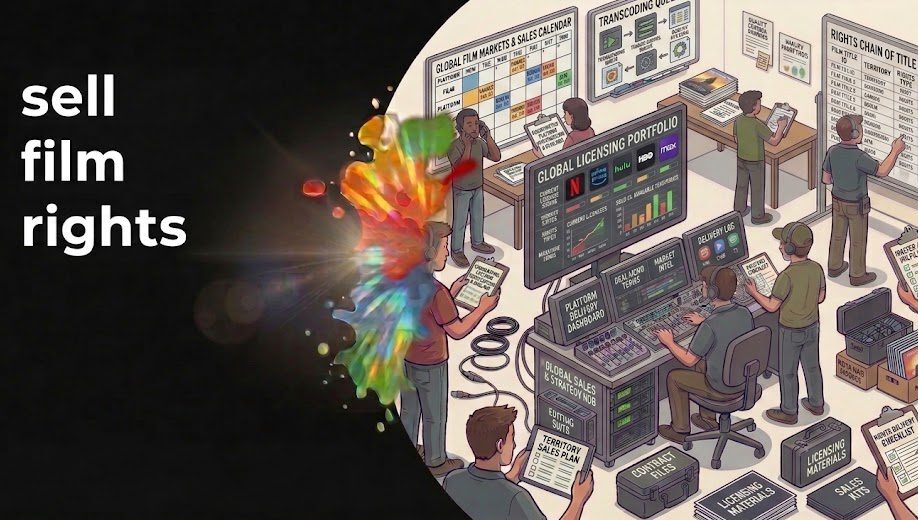
Here’s what the trade press won’t spell out: knowing where to sell film rights online and actually closing a deal are two completely different problems. The platforms exist. The buyers exist. The gap between them—the one that costs independent producers 6-18 months of wasted runway—is information asymmetry. Who’s actively buying right now? What territories are still open? Which streaming platforms are in acquisition mode this quarter versus in a spending freeze? That intelligence is what this guide is actually about.
Selling film rights online has genuinely changed since 2020. The old playbook—attach a sales agent, show up at AFM with a one-sheet, wait for the phone to ring—still works for top-tier packages. But for the vast majority of independent productions, the deal pathway now runs through a combination of digital marketplaces, online film markets, direct streaming platform portals, and intelligence-driven outreach tools that let you target buyers before they go public with what they want. And the Fragmentation Paradox makes this harder than it should be: 600,000+ companies operating across the global entertainment supply chain, with no central directory, no real-time status updates, and no obvious way to know who’s in the room before you knock.
This guide ranks the 9 best platforms and channels for selling film rights online in 2026—by deal quality, buyer access, and the realistic revenue potential each one delivers for your specific project type.
Table of Contents
- The Online Film Rights Landscape in 2026
- Vitrina.ai — Best for Direct Buyer Intelligence & Warm Introductions
- Cannes Marché du Film Online — Best for International Rights Sales
- American Film Market (AFM) — Best for US & North American Rights
- MIPCOM & MIPTV Online — Best for TV & Streaming Rights
- Cinando — Best for Festival-to-Distribution Pipeline
- Slated — Best for Connecting with US Investors & Buyers
- Filmhub — Best for Streaming Distribution Rights at Scale
- Direct Streaming Platform Portals — Highest Value, Hardest to Access
- Online Sales Agent Discovery — The Relationship Layer
- Which Platform Is Right for Your Film?
- FAQ
- Conclusion
Ask VIQI: Who’s Actively Buying Film Rights in Your Genre Right Now?
VIQI is Vitrina’s AI intelligence layer — trained on 1.6 million titles, 1.6 million+ projects, and 3 million verified entertainment professionals. Know your buyers before you pitch.
✓ 200 free credits included | ✓ No credit card required
The Online Film Rights Landscape in 2026
The film rights market operates across three distinct buyer categories—and your platform strategy should map to all three simultaneously, not one at a time. First, streaming platforms (Netflix, Amazon Prime Video, Apple TV+, Max, Disney+) buying direct acquisitions or licensing rights territory by territory. Second, traditional distributors and broadcasters purchasing theatrical, pay-TV, and home entertainment rights through presale contracts and post-completion deals. Third, digital-first buyers—AVOD/FAST platforms like Tubi, Pluto TV, Peacock Free, and Samsung TV+—licensing content on revenue-share or flat-fee models.
As Phil Hunt (CEO, Head Gear Films, with over 550 films financed) has noted publicly, the independent film landscape shifted dramatically away from traditional presales in the post-streaming era—not because the buyers disappeared, but because the channels through which rights get sold have multiplied and fragmented. The major film markets still matter enormously. But between markets, the deals that actually move happen through direct relationships, intelligence tools, and online platforms that didn’t exist five years ago.
Understanding which channel reaches which buyer type—and at what stage of your project—is the difference between a rights sale that happens in weeks versus one that drags through months of cold outreach. Our guide on using digital platforms to sell film rights for funding covers the capital-stack implications of different rights structures in detail.
1. Vitrina.ai — Best for Direct Buyer Intelligence & Warm Introductions
Vitrina.ai is the global entertainment supply chain platform connecting 300,000+ companies—production houses, sales agents, distributors, streaming platforms, and financiers—across a verified database of 1.6 million+ projects and 3 million professionals. For producers trying to sell film rights online, the platform solves both sides of the Fragmentation Paradox: it tells you who’s actively acquiring in your genre and territory right now, and it gives you a verified, direct channel to reach them.
The intelligence layer matters more than the directory. Most platforms give you a list of companies. Vitrina gives you context: which companies closed acquisition deals in the last 90 days, what genres they’re targeting, which executives are the actual decision-makers, and what their acquisition history looks like across 1.6 million tracked titles. That’s the difference between cold outreach and a warm, informed approach.
Trusted by Netflix, Warner Bros, Paramount, and Google TV for supply chain intelligence, Vitrina’s VIQI AI assistant lets you query the database conversationally—”Which European distributors bought thriller features under $2M in the past six months?”—and get specific, sourced answers rather than generic company lists. For rights sellers, that’s a fundamentally different tool than anything else in this list.
Best for:
- Identifying active buyers in specific territories or genres before approaching them
- Getting warm introductions through Vitrina Concierge to streaming acquisition executives
- Producers who’ve exhausted their existing network and need to expand systematically
Phil Hunt (CEO, Head Gear Films) breaks down how the rights-selling landscape has shifted in the post-streaming era—and what independent producers need to understand about finding buyers today:
2. Cannes Marché du Film Online — Best for International Rights Sales
The Cannes Marché du Film remains the single most important rights market globally for theatrical and international streaming deals—and since 2020 it has maintained a robust online infrastructure that gives accredited participants access to the market’s tools year-round, not just during the two weeks in May. The Marché’s online platform hosts a searchable database of projects available for acquisition, facilitates official screening submissions, and provides contact access to the 12,000+ buyers, distributors, and sales agents who attend annually.
Here’s the timing reality that matters: decision-makers commit to their Cannes meeting schedules 6-8 weeks before the market opens. If you’re uploading your one-sheet the week before, you’ve already missed the primary window. The online tools are most valuable when used in the lead-up—submitting your project, requesting meetings, and getting your materials in front of buyers who are still building their acquisition lists.
For international rights sales specifically—UK, France, Germany, Japan, Australia, South Korea, and other major territories—Cannes is where the relationships that underpin presale agreements get initiated. The online platform extends that window. But it doesn’t replace the relationship layer; it sets it up.
Accelerate Your Rights Sale — Track Who’s Buying in Your Territory Today
Trusted by Netflix, Warner Bros, Paramount, and Google TV. Access 140,000+ verified buyers and track 159,223 active projects with real-time acquisition intelligence.
✓ 200 free credits | ✓ No credit card required | ✓ Cancel anytime
3. American Film Market (AFM) — Best for US & North American Rights
Every November, over 7,000 industry professionals converge on Santa Monica for the American Film Market—the primary venue for North American rights transactions on independent films. The AFM’s online portal, AFM Connect, gives registered participants access to the market’s project database and buyer contact network outside of the physical market dates. For US distribution rights, this is still the reference market.
But the AFM’s real value—and this is the part that doesn’t get captured in any online tool—is the concentration of buyers in a single location over five days. Deals that take months via email get done in 20-minute meetings in Santa Monica hotel suites. The online platform extends accessibility. It doesn’t replicate that deal velocity. Use AFM Connect to identify targets and initiate contact; use the market itself to close.
For North American streaming rights specifically, AFM is where you’ll encounter acquisition executives from Lionsgate, IFC Films, Gravitas Ventures, 1091 Pictures, and similar mid-tier distributors who are actively building their digital release slates. These aren’t the Netflix direct-acquisition conversations—those happen through separate channels—but they’re real deals with real buyers at real prices.

Your AI Assistant, Agent, and Analyst for the Business of Entertainment
VIQI AI helps you plan content acquisitions, raise production financing, and find and connect with the right partners worldwide.
- List the top commissioners at the BBC
- List the post-production and VFX decision-makers at Netflix
- List the development leaders at Sony Pictures
- List the scripted programming heads at HBO
- Find active co-producers and financiers for scripted projects
- Find equity and gap financing companies in North America
- Find top film financiers in Europe
- Find production houses that can co-produce or finance unscripted series
- Who is backing animation projects in Europe right now
- Who is Netflix’s top production partners for Sports Docs
- Who is Commissioning factual content in the NORDICS
- Who is acquiring unscripted formats for the North American market
- Show me recent drama projects available for pre-buy
- Show me Japanese Anime Distributors
- Show me true-crime buyers from Asia
- Show me documentary pre-buyers
- I am looking for production partners for a YA drama set in Brazil
- I am looking for producers with proven track record in mid-budget features
- I am looking for Turkish distributors with successful international sales
- I am looking for OTT platforms actively acquiring finished series for the LATAM region
- I am seeking localization companies offer subtitling services in multiple Asian languages
- I am seeking partners in animation production for children's content
- I am seeking USA based post-production companies with sound facilities
- I am seeking VFX partners to composite background images and AI generated content
4. MIPCOM & MIPTV Online — Best for TV & Streaming Rights
MIPCOM (October, Cannes) and MIPTV (April, Cannes) are the dominant global markets for television and streaming rights transactions—the places where OSN, Arte, ZDF, BBC Studios, TF1, MBC Group, and hundreds of other broadcasters and streaming platforms buy content. The online marketplace at MIPCOM 2024 listed over 13,000 programmes from 100+ countries, accessible to accredited buyers and sellers through the MIPWorld digital platform year-round.
If you’re selling TV format rights, multi-episode series rights, or co-production rights rather than single-film theatrical deals, MIPCOM/MIPTV is a more targeted venue than AFM or Cannes. The buyer mix skews toward broadcasters and SVOD platforms focused on series, formats, and non-theatrical content. And the online tools let you present your project to buyers across 100+ territories without waiting for the annual market event to pitch.
For MENA territory rights specifically, platforms like OSN (covering 23 countries across the Middle East and North Africa) do significant acquisition business at MIPCOM. Rolla Karam, SVP Content at OSN, has noted that the platform’s content strategy balances international acquisitions with regional original productions—making it an active buyer for the right projects at the right price points.
5. Cinando — Best for Festival-to-Distribution Pipeline
Cinando is the Cannes-affiliated industry database used by 35,000+ professionals across production, sales, distribution, and financing. It’s not a marketplace in the transactional sense—it’s an intelligence layer. Professionals use it to research projects in festivals and markets, screen titles remotely, track what’s available in which territories, and contact rights holders directly. For producers with festival-circuit films ready for distribution, Cinando is how buyers find you.
But. And this is the part worth understanding clearly: Cinando’s value is passive. You’re listed, you can be found, screeners can be requested. That’s very different from proactively targeting buyers who are actively acquiring right now in your genre. The smartest approach pairs Cinando visibility with active outreach through intelligence tools like Vitrina—you’re discoverable when buyers come looking, and you’re also proactively reaching buyers who haven’t searched yet.
6. Slated — Best for Connecting with US Investors & Co-Production Buyers
Slated occupies a specific niche in the online film rights ecosystem: it’s a US-focused platform connecting filmmakers with investors, co-producers, and buyers through a data-scored project evaluation model. Projects are assigned a “package score” and a predicted performance score based on comparable titles—which can be a double-edged sword. A strong score opens doors to Slated’s investor and buyer network. A weak score actively signals caution to potential partners.
For rights sales, Slated is most useful at the earlier stages—attaching co-producers, securing completion financing, or finding US distribution partners who are simultaneously investing. It’s less useful for sellers of completed films with an established distribution need. Think of it as the right tool for development-stage rights sales rather than post-completion licensing.
7. Filmhub — Best for Streaming Distribution Rights at Scale
Filmhub operates at the intersection of rights sales and digital distribution—their model is technically aggregation, but the outcome is a streaming rights license across 150+ platforms simultaneously. No upfront fee. A 20% revenue share on everything they place. For completed films without existing distribution, this is the fastest path to licensing your streaming rights across SVOD, AVOD, and FAST channels in multiple territories, with zero cash outlay required upfront.
The limitation worth naming directly: Filmhub’s model doesn’t get you into premium SVOD platforms through a negotiated licensing deal. Your film becomes part of a bulk submission pipeline. For maximizing the value of your streaming rights—rather than simply placing them somewhere—Filmhub is a floor, not a ceiling. Use it for the long tail of platforms; pursue direct deals for the top tier.
8. Direct Streaming Platform Portals — Highest Value, Hardest to Access
Netflix, Amazon Prime Video, Apple TV+, and other major streamers maintain formal content submission portals—but be clear-eyed about what those portals actually deliver. Netflix’s portal, for example, is designed for established production companies with existing relationships, not cold unsolicited submissions from independent producers. Amazon’s content submissions system works similarly. These portals aren’t a shortcut around the relationship layer; they’re a formalization of it.
The deals that get done directly with streamers happen through sales agents who have pre-existing acquisition relationships, at film markets where acquisitions executives are actively hunting, or through warm introductions from trusted industry contacts. As reported by Deadline, Netflix and Amazon have increasingly concentrated their acquisition activity on films with demonstrable audience signals—festival performance, social traction, or pre-existing IP recognition—rather than cold submissions regardless of quality.
The most reliable path to a direct streaming deal is the one covered in our guide on licensing film rights for US streaming distribution: establish your film’s audience signals first, identify the specific acquisition executive at your target platform, and approach through a warm introduction channel rather than a cold portal submission.
9. Online Sales Agent Discovery — The Relationship Layer You Can’t Skip
The most underrated “platform” for selling film rights online is actually the constellation of sales agent websites, LinkedIn profiles, and festival contact databases that let you identify and approach international sales agents—the professionals who already have the buyer relationships you’re trying to build. A good sales agent at a company like Head Gear Films, WestEnd Films, Protagonist Pictures, or Beta Cinema brings a Rolodex of distributor relationships in 40-60 territories that would take a producer years to build independently.
The challenge: identifying which agents are actively seeking new titles in your genre, what their current slate looks like, and whether your project fits their acquisition criteria. That intelligence-gathering used to happen entirely through personal networks and market attendance. Now it can be done online—systematically, quickly, and without waiting for the next AFM. According to Variety, the independent film sales agent market has consolidated significantly since 2022, with the top agencies handling an increasing share of international rights transactions—which makes identifying the right agent more important, not less.
For a detailed framework on approaching sales agents and structuring the agreement, our guide on negotiating film distribution contracts covers what to ask for, what to push back on, and what the standard deal structure actually looks like in 2026.
Get Direct Introductions to Film Rights Buyers — Without the Cold Outreach
Vitrina Concierge makes verified warm introductions to streaming acquisition executives and distribution buyers who are actively seeking projects like yours. No cold submissions. No waiting for the next market.
- LA producer → Netflix UK, Fifth Season, Fox Entertainment (48 hours)
- Korean studio → Netflix Adult Animation (week one)
- MENA studio → Legendary Pictures (direct access)
Which Platform Is Right for Your Film?
The honest answer: you shouldn’t be choosing one. The producers who close deals fastest in 2026 are using these channels in parallel, not sequentially. But if you’re resource-constrained and need to prioritize, here’s how the decision tree actually works.
Completed film, no distribution: Vitrina for buyer intelligence + Filmhub for streaming rights coverage + one targeted film market (Cannes or AFM depending on season). That combination covers immediate digital revenue, builds your visibility with premium buyers, and gives you a live market opportunity without requiring you to attend everything.
Project in development or production: Cinando for visibility + Cannes Marché for presale conversations + Slated if you need US co-production partners. Presales are harder to secure than they were five years ago—Phil Hunt’s public commentary on the collapse of traditional presale revenue windows is worth internalizing before you build your financing model around them. But for the right project with the right package, presale MGs from 2-5 territories can still de-risk your capital stack meaningfully.
TV series or format rights: MIPCOM/MIPTV is your primary venue. Supplement with Vitrina to identify buyers in specific territories who’ve been active in your genre in the past 12 months. And our guide on media rights marketplaces for acquisition leads in 2026 covers the streaming-specific buyer landscape for series content in detail.
Frequently Asked Questions
Where is the best place to sell film rights online?
There’s no single “best” platform — the right channel depends on your film’s stage, genre, and target buyer. For intelligence-driven buyer discovery, Vitrina.ai gives you real-time data on who’s actively acquiring in your genre. For international rights, Cannes Marché du Film and AFM remain the primary transaction venues, with online tools extending access year-round. For streaming rights at scale, Filmhub offers the widest platform reach with no upfront cost. Most producers working serious deals use several of these in combination.
Can I sell film rights directly to Netflix online?
Netflix does not accept direct unsolicited submissions from independent producers. Their acquisition process runs through established sales agents, approved production companies, or warm introductions from trusted industry contacts. Netflix’s content submission portal exists but functions as a formality for projects already in active conversation — not a cold-submission channel. The practical path to a Netflix deal is: attach a sales agent with existing Netflix relationships, build audience signal data through festivals and streaming performance, then approach through a warm introduction rather than a portal submission.
What is the difference between selling film rights and using a distributor?
Selling film rights means transferring or licensing the right to distribute, broadcast, or stream your film — either exclusively or non-exclusively, for a defined territory and time period — in exchange for a fee, minimum guarantee (MG), or revenue share. Using a distributor typically means granting them rights (often exclusively) in exchange for their commitment to release and market your film. A distributor deal is effectively a rights sale packaged with a release commitment. The distinction matters for your recoupment waterfall: direct rights licensing to a streaming platform pays you directly, while a distribution deal routes revenue through the distributor’s accounting first.
What are film presales and how do they work online?
A film presale is a commitment from a distributor to pay a Minimum Guarantee (MG) for distribution rights in a specific territory, made before the film is completed. Typically, 10% is paid on signature and 90% on delivery. These contracts can be used as collateral for production loans — banks typically lend 70-90% of the MG value against them. Online, presale conversations are initiated through Cinando, Cannes Marché, and AFM databases, with deals formalized during market meetings. The best presale packages combine a strong script, recognized cast or director, and a reputable sales agent with existing distributor relationships.
How much can I earn selling film rights online?
Revenue varies enormously by project, platform, and deal structure. Direct streaming acquisitions from Netflix or Apple TV+ range from $500K to $10M+ for a worldwide buyout, but these are reserved for films with clear commercial potential. Territory-by-territory presale MGs range from €20K-€150K for individual European territories and up to $500K+ for major markets like Japan or Germany depending on package strength. AVOD and FAST channel revenue-share deals generate much smaller amounts — often $500-$5,000 per year per platform for catalogue titles. The highest-value outcomes come from direct streaming deals; aggregation platforms deliver accessibility, not premium pricing.
Do I need a sales agent to sell film rights online?
Not always — but the deals with the best terms usually involve one. A sales agent brings established relationships with distributors in 40-60 territories, knowledge of current MG price points, and credibility with buyers that accelerates deal close. For premium SVOD platforms like Netflix or Apple, a sales agent’s existing relationship is practically required. For digital-first platforms like Tubi, Pluto TV, and FAST channels, you can reach buyers directly through aggregators or intelligence platforms without agent involvement. The agent earns 10-15% commission on deals closed — a worthwhile cost if their relationship access materially improves the deal terms or shortens the sales cycle.
Which film rights are most valuable to sell?
Worldwide streaming rights — sold as a single territory-inclusive deal to a major SVOD platform — typically generate the highest single-transaction value. But selling worldwide rights at once also eliminates all future upside. The strategic question is whether to sell worldwide to one platform now versus selling individual territory rights to multiple buyers over time (retaining more total revenue but requiring more work). For most independent films, the hybrid approach — selling US rights to one buyer, European rights territory by territory, and APAC rights through a regional deal — generates more total revenue than a worldwide buyout at independent film pricing levels.
How do I find buyers for my film rights in specific territories?
The traditional answer is: attend the relevant film market and network. The 2026 answer is: use intelligence platforms like Vitrina to identify which distributors and platforms have been actively acquiring in your target territory in the past 12 months, what genres they favour, and who the relevant acquisition executive is — then approach proactively through a verified contact rather than a market cold-call. This approach compresses what used to take 3-6 months of market relationship-building into a targeted outreach campaign you can execute in weeks, with measurably better hit rates than cold submissions.
Conclusion: The Platforms Are Multiplying — The Intelligence Gap Is Shrinking
Knowing where to sell film rights online in 2026 isn’t the hard part. The platforms are there: Vitrina for buyer intelligence, Cannes and AFM for international deal-making, MIPCOM for TV and streaming rights, Cinando for festival-to-distribution visibility, Filmhub for streaming rights at scale. What’s changed—and what still trips up producers who learned the market pre-streaming—is the intelligence layer sitting above all of those platforms. Who’s buying right now. What they’ve closed in the last quarter. What their acquisition criteria actually are versus what their website says.
That’s the Fragmentation Paradox at work: 600,000+ companies in the industry, but the actual decision-makers are a small, relationship-gated network. The producers who close deals fastest aren’t the ones with the best films or the most market attendance. They’re the ones with the best intelligence about who to talk to and when—and the right channels to reach them without burning months on cold approaches that were never going to land.
- Use intelligence first, platforms second: Know who’s actively buying in your genre and territory before you submit anywhere. Tools like Vitrina’s VIQI compress months of research into hours.
- Market timing matters: Decision-makers lock their meeting schedules 6-8 weeks before Cannes and AFM. Start your outreach two months before the market, not two weeks.
- Presales are harder but not dead: A strong package with recognized talent and commercial genre can still generate MG commitments from 2-5 territories before production. The market has tightened, not closed.
- Aggregation is a floor, not a ceiling: Filmhub gets you on 150+ platforms with no upfront cost. Direct streaming deals get you material revenue. The two strategies aren’t mutually exclusive — run them in parallel.
- Warm beats cold, every time: The single biggest accelerator in the rights-selling timeline is a warm introduction versus a cold submission. Sales agents, Concierge services, and industry network platforms all exist to deliver that edge.
Find Who’s Buying Film Rights in Your Territory — Start Selling Smarter
Trusted by Netflix, Warner Bros, Paramount, and Google TV. Join 300,000+ entertainment companies using Vitrina to track deals, identify buyers, and accelerate rights sales across 1.6 million+ projects globally.
✓ 200 free credits | ✓ No credit card required | ✓ Cancel anytime
Want direct introductions to acquisition executives? Explore Concierge Service →