IHUB
IHUB
 Private Briefings (Webinars)


 LeaderSpeak Podcast
  Global Entertainment Digest (Newsletter)
  Premium Lists
 Premium Reports
 Membership Benefits
 About Vitrina
 Our Story
By Vitrina Research Team | Published: August 3, 2026 | 8 min read
Deal intelligence platforms exist to give entertainment financiers a structural advantage. The proposition is straightforward: instead of relying on relationships, festival circuits, and trade press to discover projects, track deals, and vet partners, you have a platform that does this continuously and at scale. Yet most finance teams that invest in these platforms report the same experience after 90 days. The dashboard is full of data, the alerts are constant, and the team is still making decisions the same way they were before.
The structural nature of the problem shows up in adjacent data. Wrapbook’s 2026 State of Production Finance and Accounting Report, a primary survey of 100 active finance and accounting professionals, conducted by Propeller Insights, found that more than 80% of production accounting teams still rely on email and manual data entry to complete core tasks, and 64% cite disconnected systems as the biggest barrier to accurately predicting cash flow (Wrapbook / PR Newswire, March 2026). This is not a technology adoption problem. Teams are adopting tools. The tools are not solving the right problems.
This article diagnoses five specific reasons deal intelligence platforms fail entertainment financiers, structural failures that are independent of which platform you choose. Then it explains what verified AI-driven data actually changes, and what to look for when evaluating whether a platform has crossed from data aggregation into genuine decision intelligence.
Vitrina VIQI is built differently, verified data on 300,000+ M&E companies, not self-reported profiles.
Key Takeaways
- The five structural failures in deal intelligence platforms are: unverified data, information overload without prioritization, workflow silos, researcher-first UX, and AI claims that exceed current capability.
- More than 80% of production finance teams still rely on manual data entry for core tasks (Wrapbook 2026 survey, n=100), deal intelligence platforms are not solving the right problems.
- The distinction between data aggregation and decision intelligence is where most platforms fail: surfacing information is not the same as surfacing actionable signals.
- Verified AI-driven data closes the gap by automating ingestion from external sources, classifying signals by relevance to the financier’s specific mandate, and connecting to the finance workflow.
- Vitrina VIQI is trained on 1.6M titles, 300,000+ companies, and 5M entertainment professionals, verified proprietary data, not user submissions.
Quick Answer
Entertainment financiers struggle with deal intelligence platforms because most surface unverified data without prioritization, operate as silos disconnected from the finance workflow, and carry AI features that exceed their actual capability. Verified AI-driven platforms close these gaps by automating ingestion from external sources and surfacing signals relevant to a specific investment mandate.
Table of Contents
- The Promise vs. The Reality of Deal Intelligence Platforms
- Reason 1: The Data Is Unverified and Self-Reported
- Reason 2: The Platform Tracks Everything but Surfaces Nothing Actionable
- Reason 3: Deal Intelligence Is Siloed from the Finance Workflow
- Reason 4: The Interface Was Built for Researchers, Not Decision-Makers
- Reason 5: AI Claims Don’t Match Current Capabilities
- How Verified AI-Driven Data Changes the Equation
- A Quick Diagnostic for Finance Teams
- How Vitrina VIQI Addresses the Core Failures
- Conclusion
- FAQ
The Promise vs. The Reality of Film and TV Deal Intelligence Platforms
The theoretical value proposition is clear. A finance team with continuous intelligence across global project development, co-production activity, and deal flow has a measurable advantage over teams relying on relationship networks and trade press. The practical reality is different. Most teams using deal intelligence platforms describe the same experience: a dashboard that surfaces a high volume of information with no clear mechanism for distinguishing what matters from what doesn’t. The platform is monitoring the market. It is not monitoring their mandate.
Picture a specific scenario. A financier opens the platform to prepare for a greenlight meeting. They find 40 new project alerts since last week. Company profiles were last updated eight months ago. The “trending” section surfaces the same projects being covered in Variety and Deadline, information they already have. The platform has done exactly what it was designed to do. It aggregated market data. What it failed to do is tell the financier which of those 40 alerts is relevant to their current mandate, their active deal conversations, or the specific co-production terms under discussion in that greenlight meeting. The gap between what was promised and what was delivered is not a product defect. It is a design category problem.
Key Stat
More than 80% of production accounting teams still rely on email and manual data entry to complete core tasks, and 64% cite disconnected systems as the biggest barrier to accurately predicting cash flow. Source: Wrapbook 2026 State of Production Finance and Accounting Report, PR Newswire.
Data aggregation and decision intelligence are not the same capability. Most platforms built between 2015 and 2022 were designed to aggregate. They solved a real problem at the time: entertainment industry data was scattered, inconsistent, and hard to find in one place. Aggregation was the right first step. But the finance teams who adopted those platforms in 2022 have outgrown what aggregation alone can deliver. Platforms built or rebuilt with AI-driven data ingestion and mandate-level filtering are beginning to close the gap toward genuine decision intelligence. The five failure modes below trace exactly where and how that gap persists.
For context on how entertainment finance conditions evolved in the period when most of these platforms were built, see film and TV production financing trends, strategies, and 2025 forecasts.
Reason 1: The Data Is Unverified and Self-Reported
This is the foundational failure. According to the Wrapbook 2026 survey, 64% of production finance professionals cite disconnected and inaccurate data systems as a core operational barrier, and the root cause is usually the same: most deal intelligence platforms built their databases by inviting companies to create and maintain their own profiles. The incentive structure for companies to keep those profiles accurate is weak. A production company that has pivoted from theatrical to streaming, changed its name, or closed a fund is unlikely to log back into a third-party platform to update those changes.
For a financier, the consequence is specific. A platform showing a co-producer with an active slate and three projects in development may be showing a snapshot from 18 months ago. The company may have since completed those projects, lost key staff, or shifted its financing model entirely. Any deal structure built on that profile is built on outdated intelligence. This isn’t a minor accuracy issue. It is the kind of error that surfaces in due diligence, costs relationships, and wastes weeks of legal preparation on a co-production partner that no longer matches the deal criteria.
The distinction to draw is structural. Verified data means the platform has a systematic mechanism for cross-referencing company profiles against external authoritative sources: production announcements, company registries, festival databases, and deal reporting. This is structurally different from prompting companies to maintain their own profiles. The verification layer is what determines whether the platform is a genuine intelligence tool or a directory with a paid login. For a detailed look at how AI deal intelligence reduces acquisition risk through verified data sourcing, see how AI deal intelligence reduces acquisition risk.
Reason 2: Does Your Platform Track Everything but Surface Nothing Actionable?
The second failure mode is information volume without signal prioritization. A deal intelligence platform monitoring the global film and TV market will surface thousands of new data points per week: announcements, co-production deals, distribution agreements, cast attachments, festival selections, and financing rounds. For a finance team with a specific mandate, say, equity positions in English-language drama under $15M with confirmed UK co-production eligibility, the vast majority of those data points are noise. The platform is technically correct. It is practically useless.
Most platforms handle this with search filters and saved searches. The problem is that filters require the financier to know what they’re looking for in advance. Real decision intelligence means the platform learns the mandate and surfaces signals proactively. Not waiting for the user to run a search, but flagging a project that matches the mandate when it enters a new development stage. The distinction sounds subtle. The operational difference is enormous: one approach is reactive, the other is predictive.
Key Stat
Feature film production rose 19% year over year in Q1 2026, with growth concentrated in sub-$40M productions as post-strike financing unlocked. At this volume of new projects entering development, manual signal filtering is no longer operationally feasible for active finance teams. Source: ProdPro Q1 2026 Industry Insights Report.
Alert fatigue is the operational result. When a platform surfaces 40 alerts per week, the response pattern is predictable: a weekly email digest the team skims, followed by manual filtering to find anything matching the current mandate. That is not intelligence. It is a more expensive version of reading the trades. The finance teams most frustrated with their current platforms are usually experiencing this pattern, not because the platform is broken, but because it was never designed to prioritize signals, only to surface them.
Reason 3: Deal Intelligence Is Siloed from the Finance Workflow
Even a well-designed, well-maintained deal intelligence platform fails if it operates as a standalone tool disconnected from where the finance team actually works. A financier who discovers a promising project in the intelligence platform still has to manually export that information to their deal management system, update their CRM, share it with their legal team, and track the follow-up. Each transfer is a friction point where data goes stale, context gets lost, and the advantage of real-time intelligence dissipates. The platform gave the team a signal. The workflow lost it.
The silo problem is particularly acute at the greenlight stage. A project that clears initial screening criteria needs to move through a diligence workflow involving legal review, financial modeling, and partner verification simultaneously. A deal intelligence platform that cannot connect to those downstream workflows means the team is back to email threads and shared spreadsheets to coordinate the decision. The intelligence advantage evaporates the moment the data leaves the platform.
The solution is not a single “all-in-one” platform. Those rarely do any one workflow particularly well. It is a deal intelligence platform with a live API that connects to the tools already in use: CRM, financial modeling, legal contracts. The integration question should be on the evaluation checklist from day one, not discovered after the contract is signed. For a structured look at what integration depth means in practice, see the eight AI film tracking factors for finance teams.
Verified Intelligence Across 159,223 M&E Companies, Start Free
Vitrina VIQI gives entertainment financiers AI-powered deal intelligence built on verified data, not user-submitted profiles. Search the full database free.
Reason 4: The Interface Was Built for Researchers, Not Decision-Makers
Most deal intelligence platforms were originally designed for research analysts, people whose primary task is to compile comprehensive information on a specific company, project, or market segment. The interface reflects this origin: deep individual company profiles, extensive historical credit databases, and detailed deal term archives. This is genuinely useful for a research task with a defined scope and ample time. It is the wrong design for a finance executive who needs a specific answer in five minutes.
A finance executive preparing for a co-production conversation has a different task. They need a specific picture of one company’s current slate, its recent financing activity, and its open co-production positions, assembled quickly, not through 45 minutes of cross-referencing sub-databases. The platform needs to present a decision-relevant summary, not a comprehensive dossier. Most platforms built for research depth have not been redesigned for decision speed. The UX remains researcher-first even when the user base has shifted toward decision-makers.
The most significant UX shift introduced by AI is the ability to query a platform in plain language. “Show me European co-producers with confirmed Eurimages credits since 2021 who are actively seeking English-language partners.” Receive a relevant, ranked result. Done. Platforms that still require the user to construct Boolean search queries, navigate layered filter menus, or cross-reference multiple sub-databases have a design generation gap that no amount of data quality improvement fixes. The query interface is a structural redesign question, not a feature update.
Reason 5: Do AI Claims Actually Match Current Platform Capabilities?
The most recent failure mode is the gap between AI marketing language and AI implementation reality. From 2022 onward, every deal intelligence platform added AI to its product description: AI-powered matching, AI-driven recommendations, predictive analytics. Most of these features are one of three things. Standard ML-based search ranking that was already present and relabeled. LLM wrappers that generate summaries from the platform’s existing data. Or aspirational features that are partially implemented and prominently marketed before they are operationally ready.
The consequence for financiers: a team that invests in a platform based on AI-powered signal detection may discover the “AI” is a relevance ranking algorithm applied to a search result. This is not worthless. Better than alphabetical sorting. But it is not predictive analytics, and it is not the proactive mandate-level intelligence the marketing implied. The mismatch between expectation and capability is a primary reason finance teams abandon platforms within the first year.
Key Stat
The generative AI market in media and entertainment is projected to grow from $2.24 billion in 2025 to $21.2 billion by 2035, at a CAGR of 25.2%. With that growth rate, the gap between AI marketing claims and implemented AI capability will widen before it narrows, making evaluation discipline more important, not less. Source: Precedence Research, 2025.
The practical test is simple. Require a live demonstration of any AI feature against your specific use case. A platform with genuine AI implementation will demonstrate it on current data in a live demo environment. A platform with aspirational AI will redirect to case studies, roadmap slides, or pre-configured demo instances that don’t reflect your actual data context. This single test separates real capability from marketing. For a complete framework for evaluating AI film tracking features, see the eight AI film tracking factors finance teams should evaluate.
How Verified AI-Driven Data Changes the Equation
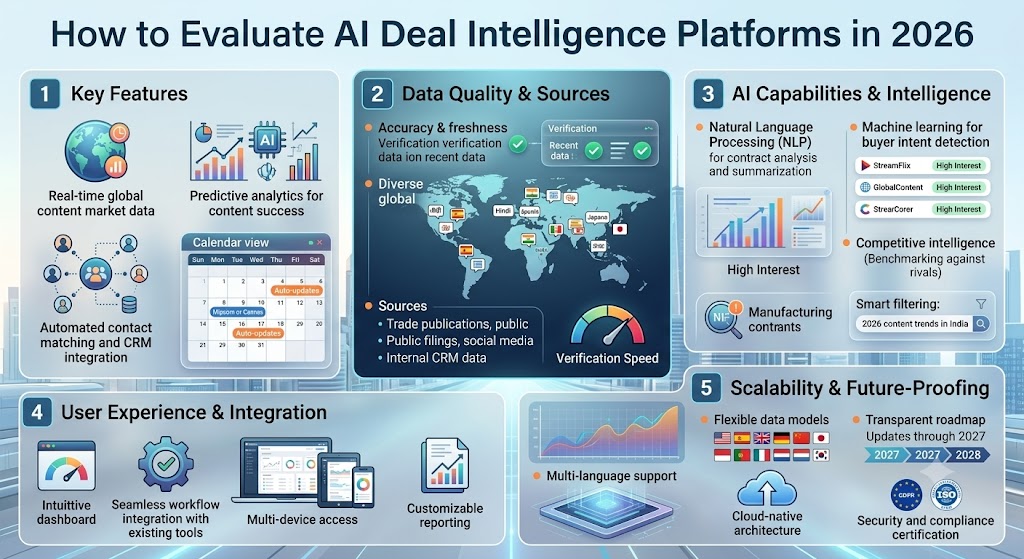
Three conditions determine whether a deal intelligence platform has crossed from data aggregation into genuine decision intelligence. First, verified data sourced from external authoritative sources rather than user submissions. Second, AI classification applied to that data to surface signals relevant to a specific mandate rather than generic market alerts. Third, integration with the downstream finance workflow rather than operation as a standalone research tool. A platform meeting all three conditions is a different product category from one meeting only the first. Most platforms today meet the first partially and the second and third rarely.
Verified data means the platform has a systematic mechanism for ingesting information from production announcements, company registries, deal reporting, and festival databases, and cross-referencing that data to confirm accuracy before surfacing it to users. This is structurally different from building a self-reported directory and adding a search layer. The verification architecture requires ongoing investment in data sourcing and quality control. It cannot be retrofitted onto a self-reported database quickly, which is why most legacy platforms have not made the transition. For a structured comparison of how platforms differ on this dimension, see the best media deal intelligence tools for 2026.
AI mandate-level classification means the platform learns what a finance team is specifically looking for, budget range, territory, format, co-production eligibility, financing stage, and applies that filter automatically to incoming data. The alert becomes: “a project matching your mandate entered pre-production today.” Not: “40 new projects were announced this week.” That specificity is the difference that closes the signal-to-noise gap generating the alert fatigue described in Reason 2. It requires the platform to maintain both a verified data layer and a mandate profiling layer simultaneously. We’ve found that platforms which have invested in one but not both still leave finance teams sorting through noise.
See What Verified AI Deal Intelligence Looks Like in Practice
Vitrina VIQI is trained on 1.6M titles, 300,000+ companies, and 5M entertainment professionals. Query in natural language. Get verified results. No user-submitted data.
A Quick Diagnostic for Finance Teams
Use these five questions to assess whether a deal intelligence platform you’re currently using or evaluating has crossed from data aggregation into genuine decision intelligence.
| Symptom | Root Cause | What Verified AI Solves |
|---|---|---|
| Company profiles feel stale | User-submitted, no verification layer | Automated ingestion from authoritative sources |
| Too many alerts, none actionable | No mandate-level signal filtering | AI classification against your specific criteria |
| Team still uses email to coordinate deals | Platform is siloed from finance workflow | Live API integration with CRM and deal management |
| Prep for meetings takes 30+ minutes per project | Research-first UX, not decision-first | Natural language queries with ranked, relevant results |
| AI features only work in vendor demos | Aspirational AI, not implemented capability | Live demo against your actual use case on current data |
If two or more of these symptoms describe your current platform experience, the issue is structural rather than a configuration problem. Reconfiguring alerts and updating saved searches will not close the gap. For a detailed scoring matrix across each of these dimensions, see the full guide to evaluating film project tracking tools in 2026.
How Vitrina VIQI Addresses the Core Failures
Vitrina VIQI’s dataset is sourced from production announcements, festival databases, trade reporting, and company registries, not user-submitted profiles. The 300,000+ M&E companies indexed in VIQI carry verified company data, and the 1.6M titles tracked include project-level intelligence on financing stage, territory, and talent attachments drawn from sourced external data. This directly addresses Reason 1. The difference is not marginal. A company profile updated through external source ingestion reflects the company’s actual current state, not the state it chose to represent when it last logged in to update its profile. For a full walkthrough of how financing teams use this data operationally, see how financing teams use VIQI.
VIQI’s Gen-AI engine supports natural language queries. A financier can ask: “show me co-producers in Ireland with Eurimages credits active since 2022 who are developing English-language drama”, and receive results drawn directly from the verified dataset. This is the UX shift described in Reason 4: decision-speed query results rather than research-depth navigation through layered menus. The signal prioritization layer means a finance team reviews results relevant to their stated mandate, not 40 undifferentiated weekly alerts. For a comparison of how VIQI positions against other intelligence tools, see the best media deal intelligence tools for 2026, or explore the VIQI platform directly.
Where VIQI doesn’t fully close every failure mode: the silo problem described in Reason 3 requires integration work that depends on your existing tech stack, and VIQI’s API capabilities are best assessed by your technical team against your specific systems. Predictive mandate-level alerting at the most advanced level and NLP contract extraction, a related capability not covered in this article, are areas where VIQI is developing rather than fully deployed. Finance teams should assess these capabilities against their specific timeline rather than relying solely on current marketing materials. That honest disclosure is intentional. A platform that oversells its current state is recreating Reason 5 in its own sales process.
Conclusion
A financier who has struggled with deal intelligence platforms has most likely encountered one or more of the five structural failures described here: unverified data, unfiltered signal volume, workflow silos, researcher-first UX, and AI capability gaps. That experience is not a reflection of the wrong platform choice. Most platforms were built to aggregate data, not to deliver decision intelligence. Those are different design goals, and they produce different tools. The gap is real, it is measurable, and it is the reason finance teams across the industry report the same frustration independently of which platform they’re using.
The practical implication is clear. Evaluate platforms against the specific failures described in this article, not against the feature list in a vendor’s sales deck. Ask to see verified data sourcing with a concrete example. Ask to see mandate-level filtering in a live demo on current data. Ask about API integration depth with your existing stack. The platforms that can answer those questions live, without redirecting to a roadmap or a case study, are genuinely different from those that cannot. That difference is worth the extra diligence before you sign.
FAQ
What is a film and TV deal intelligence platform?
A film and TV deal intelligence platform is a software tool that aggregates and organizes data on entertainment industry deal activity: project development, co-production agreements, distribution deals, financing rounds, and company profiles. Finance teams use these platforms to identify investment opportunities, vet partners, and track market activity across global markets. The category ranges from self-reported company directories with search functionality to AI-driven intelligence systems with verified data sourcing and mandate-level filtering. The distinction between those two ends of the spectrum is significant for a decision-making workflow.
Why do entertainment financiers struggle with deal intelligence tools?
Entertainment financiers struggle with deal intelligence tools for five structural reasons: unverified, self-reported data that goes stale; information overload without signal prioritization; platforms siloed from the actual finance workflow; interfaces designed for researchers rather than decision-makers; and AI features that are marketed ahead of their actual implementation. The Wrapbook 2026 survey of 100 production finance professionals found that 64% cite disconnected systems as their biggest barrier to accurate forecasting, a direct reflection of these platform failures. Addressing the frustration requires identifying which of these structural failures applies to the current tool, not switching platforms without a diagnostic framework.
What is the difference between data aggregation and decision intelligence?
Data aggregation means collecting and organizing information from multiple sources into a searchable database. Decision intelligence means applying filtering, classification, and mandate-level relevance scoring to that data so a user receives only the signals that match their specific criteria. Most deal intelligence platforms built before 2022 are aggregation tools. Decision intelligence requires a verified data layer, an AI classification layer, and an integration layer connecting to the downstream workflow. A financier experiencing alert fatigue and stale profiles is experiencing aggregation without the intelligence layer that converts volume into relevance. For a deeper look at this distinction in context, see how to evaluate film project tracking tools in 2026.
How does AI improve deal intelligence for entertainment financiers?
Genuine AI implementation in deal intelligence platforms improves the financier experience across three dimensions. Natural language query capability replaces Boolean filter construction, a finance executive can describe what they’re looking for in plain language and receive ranked results. Mandate-level signal classification means the platform filters incoming data against a defined investment profile, surfacing only relevant signals rather than full market feeds. And automated data ingestion from external authoritative sources replaces self-reported profile maintenance, keeping company and project data current without depending on companies to update their own records. With the generative AI market in media and entertainment projected to grow at 25.2% CAGR through 2035 (Precedence Research, 2025), the gap between genuine and aspirational AI implementation will require active evaluation discipline from buyers.
What makes Vitrina VIQI different from other entertainment deal intelligence platforms?
Vitrina VIQI is trained on 1.6M titles, 300,000+ companies, and 5M entertainment professionals, with all data verified through external source ingestion rather than user submissions. The platform supports natural language queries against the full verified dataset, which directly addresses both the data quality failure and the researcher-first UX failure described in this article. VIQI covers 300,000+ M&E companies globally with verified company-level data. The honest limitation: deep workflow integration and advanced predictive alerting are capabilities still in development, and finance teams with complex existing tech stacks should assess API integration requirements before committing. Explore the VIQI platform directly to test its current capability against your specific queries.
About the Author
Vitrina Research Team
The Vitrina Research Team produces intelligence-led analysis on media and entertainment industry structure, deal activity, and market trends. Our research draws on VIQI’s proprietary dataset of 300,000+ M&E companies worldwide.
Get Deal Intelligence That Actually Works, Free on Vitrina
Search 300,000+ verified M&E companies with AI-powered natural language queries. No credit card. No sales call. Start in under two minutes.