IHUB
IHUB
 Private Briefings (Webinars)


 LeaderSpeak Podcast
  Global Entertainment Digest (Newsletter)
  Premium Lists
 Membership Benefits
 About Vitrina
 Our Story
By the Vitrina Research Team | Published: October 2026 | Reviewed by Vitrina’s Entertainment Supply Chain Analysts, drawing on verified data across 159,223 M&E companies worldwide.
⚡ Quick Answer
A reliable entertainment vendor due-diligence scorecard scores each candidate across five weighted categories—financial stability, operational capacity, quality track record, compliance and insurance, and communication—on a 1–5 scale, then multiplies each score by its category weight. Vendors scoring below 3.0 overall, or failing any single compliance item outright, should not move forward regardless of price or availability.
Vetting a vendor on reputation alone is how production budgets get burned. A VFX house with a great reel can still be three projects over capacity. A localization studio with competitive rates can still be missing the E&O documentation your distributor requires before delivery. The gap between “looks good in the pitch” and “will actually deliver on schedule and hold up legally” is exactly what a structured scorecard is built to close.
This guide gives you an editable, weighted scorecard for vetting entertainment vendors—VFX and animation studios, post-production houses, localization and dubbing partners, equipment and facilities providers—plus the scoring logic behind it and the red flags that should override a good score every time.
Verify a vendor’s track record before you score them—search Vitrina’s 159,223-company database for deal history and prior credits.
What You’ll Learn
Key Takeaways
- ✦
Score vendors across five weighted categories—financial stability, operational capacity, quality track record, compliance/insurance, and communication—not gut feel or reel quality alone.
- ✦
Compliance and insurance is a pass/fail gate, not a weighted score. Standard entertainment E&O coverage runs $1M per claim/$3M aggregate—a vendor who can’t confirm this in writing is a hard stop, regardless of their score elsewhere.
- ✦
Capacity claims need verification, not trust. Ask for current active-project load, not just a client list—a vendor at capacity will slip your schedule regardless of their track record.
Why Vendor Due Diligence Fails Without a Framework
Most vendor vetting in entertainment happens informally: a referral, a reel, a rate card, a gut-check call. That process works until it doesn’t—and when it fails, it tends to fail at the worst possible moment, mid-schedule, with a delivery date already committed to a distributor or platform.
The structural problem is that the information that actually predicts vendor reliability—current capacity, financial stability, insurance status, real (not curated) client references—rarely surfaces in a pitch meeting. A scorecard forces that information into the open before a contract is signed, not after a deadline is missed.
Key Stat
Standard entertainment E&O insurance requires limits of $1 million per claim and $3 million aggregate, and productions facing litigation over content errors are not eligible for coverage after the fact—meaning a vendor’s insurance status has to be confirmed before signing, not after a dispute (Kelly Insurance Group, 2026).
The Weighted Scorecard: Five Categories, One Score
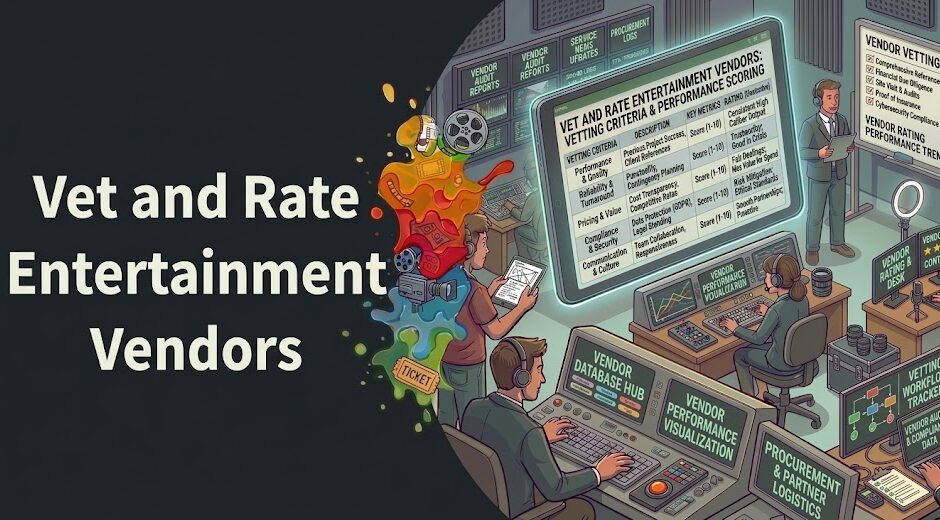
Score each vendor 1 (poor) to 5 (excellent) per category, multiply by the weight, then sum the weighted scores for a total out of 5.0. Copy this table into a spreadsheet and reuse it for every vendor comparison.
| Category | Weight | What to Check | Score (1–5) |
|---|---|---|---|
| Financial stability | 20% | Years in operation, payment terms requested, any public signs of financial distress (layoffs, delayed payroll reports) | □ |
| Operational capacity | 25% | Current active-project load vs. team size; realistic delivery date given existing commitments, not just quoted turnaround | □ |
| Quality track record | 25% | Verified past deliverables in your genre/format, direct reference calls (not just a client logo list) | □ |
| Compliance & insurance | 20% | E&O coverage confirmed in writing, contractor classification compliance, data security practices for unreleased material | □ |
| Communication & responsiveness | 10% | Response time during the vetting process itself—the most honest preview of how they’ll communicate mid-production | □ |
Worked example: a vendor scoring 4 on financial stability (0.20 × 4 = 0.80), 3 on capacity (0.25 × 3 = 0.75), 5 on quality (0.25 × 5 = 1.25), 5 on compliance (0.20 × 5 = 1.00), and 4 on communication (0.10 × 4 = 0.40) totals 4.20 out of 5.0—a strong candidate worth prioritizing, assuming no red flags below apply.
Vitrina Membership
Verify Vendor Track Records Across 159,223 Companies
Check a vendor’s prior deal history, co-production credits, and company background before you score them—not after you’ve already signed.
How to Score Each Category
The scorecard only works if the scoring itself is evidence-based rather than impression-based. Here’s what separates a real 4 from an inflated one in each category.
Financial Stability
Ask directly about payment terms. A vendor requesting unusually large upfront deposits (50%+ before any work begins) or offering steep discounts for full prepayment is often signaling cash-flow pressure, not generosity. Cross-reference years in operation against team size—a studio that has rapidly scaled headcount in the past 12 months carries different risk than one with stable, long-tenured staff.
Operational Capacity
Ask the vendor directly: “What else are you currently delivering, and when do those projects wrap?” A vendor unwilling to answer this, or who answers vaguely, is a capacity risk regardless of how strong their past work is. Capacity problems are the single most common cause of missed delivery dates—not lack of skill.
Quality Track Record
A client logo list proves nothing on its own—ask for two or three direct reference contacts from projects similar in scope and genre to yours, and actually call them. Ask the reference one question that matters more than any other: “Would you hire them again on a tight deadline?”
Compliance & Insurance
Request E&O documentation in writing before scoring this category at all—a verbal confirmation is not a score input. Also ask how the vendor classifies its crew and freelance staff: worker misclassification litigation against production companies and high-volume content studios has increased sharply, with crew strikes and class actions over 1099 contractor status reported through 2025–2026 (HQ Simple, 2026)—and a vendor’s labor practices can become your liability if the relationship is structured as a joint employer. For vendors handling unreleased footage, scripts, or music, also confirm their data security practices: how is material transferred, stored, and who has access.
Communication & Responsiveness
Track actual response times during the vetting conversation itself. A vendor who takes a week to answer a scoping question during the sales process, when they’re trying to win your business, will not communicate faster once the contract is signed.
Red Flags That Override the Score
Some issues shouldn’t be averaged into a weighted total—they should disqualify a vendor outright, no matter how strong the rest of their scorecard looks.
- Cannot produce E&O documentation in writing. No exceptions—this is a contractual and legal exposure, not a negotiable preference.
- Refuses to name current active clients or projects. A legitimate capacity concern will rarely be hidden this aggressively; it usually signals the vendor doesn’t want you comparing notes with someone already experiencing delays.
- No clear answer on data security for unreleased material. Especially relevant for VFX, localization, and post houses handling pre-release footage or scripts.
- Reference checks reveal a pattern of missed deadlines. One late delivery can be circumstance; two independent references citing the same issue is a pattern.
How Vitrina Supports Vendor Due Diligence
The scorecard above depends on accurate inputs—and the hardest inputs to verify independently are a vendor’s actual deal history and current activity level. Vitrina’s database of 159,223 verified M&E companies lets you check a vendor’s prior credits, co-production history, and company background before you take their self-reported client list at face value. For vendors where reference calls aren’t returning fast enough, Vitrina’s Concierge service can help surface verified contacts and prior deal activity directly. For localization and dubbing vendors specifically, see our itemized quote comparison guide for category-specific pricing benchmarks.
VENDOR INTELLIGENCE
Which Vendors Are Actually Taking New Work Right Now?
Ask VIQI which VFX studios, post houses, and localization vendors have current capacity in your genre and budget range—before you spend time scoring vendors who are already overbooked.
Conclusion
A weighted scorecard doesn’t replace judgment—it structures it, so a strong reel or a persuasive pitch meeting can’t paper over a capacity problem or a missing insurance certificate. Run every vendor through the same five categories, treat compliance as a pass/fail gate rather than a weighted input, and verify capacity and reference claims directly rather than taking them on faith. The vendors who pass that process consistently are the ones worth building a long-term relationship with.
Frequently Asked Questions
What is a vendor due-diligence scorecard in entertainment?
A vendor due-diligence scorecard is a weighted scoring framework used to evaluate entertainment service vendors—VFX studios, post-production houses, localization partners, equipment providers—across categories like financial stability, operational capacity, quality track record, compliance and insurance, and communication, producing a single comparable score across candidates.
How much weight should insurance and compliance carry in vendor scoring?
Compliance and insurance should function as a pass/fail gate rather than a purely weighted input. A vendor who cannot confirm Errors & Omissions coverage in writing, typically $1 million per claim and $3 million aggregate for entertainment productions, should be disqualified regardless of how strong their score is in other categories.
How do I verify a vendor’s claimed capacity?
Ask the vendor directly what else they are currently delivering and when those projects wrap, rather than relying on a general capability statement. Vague or evasive answers to this specific question are the strongest early signal of a capacity risk, which is the most common cause of missed delivery dates in vendor relationships.
Should I trust a vendor’s client logo list as proof of quality?
A client logo list on its own proves very little, since it does not indicate project scope, satisfaction, or whether the engagement was repeated. Request two or three direct reference contacts from projects comparable in scope and genre to yours, and ask specifically whether they would hire the vendor again on a tight deadline.
About the Author
Vitrina Research Team
The Vitrina Research Team produces intelligence-led analysis on media and entertainment industry structure, deal activity, and vendor ecosystems. Our research draws on Vitrina’s proprietary dataset of 159,223 M&E companies worldwide.
Start Vetting Vendors With Verified Data
Search prior credits, deal history, and company background across 159,223 verified entertainment companies before you fill out the scorecard.