IHUB
IHUB
 Private Briefings (Webinars)


 LeaderSpeak Podcast
  Global Entertainment Digest (Newsletter)
  Premium Lists
 Membership Benefits
 About Vitrina
 Our Story
Introduction
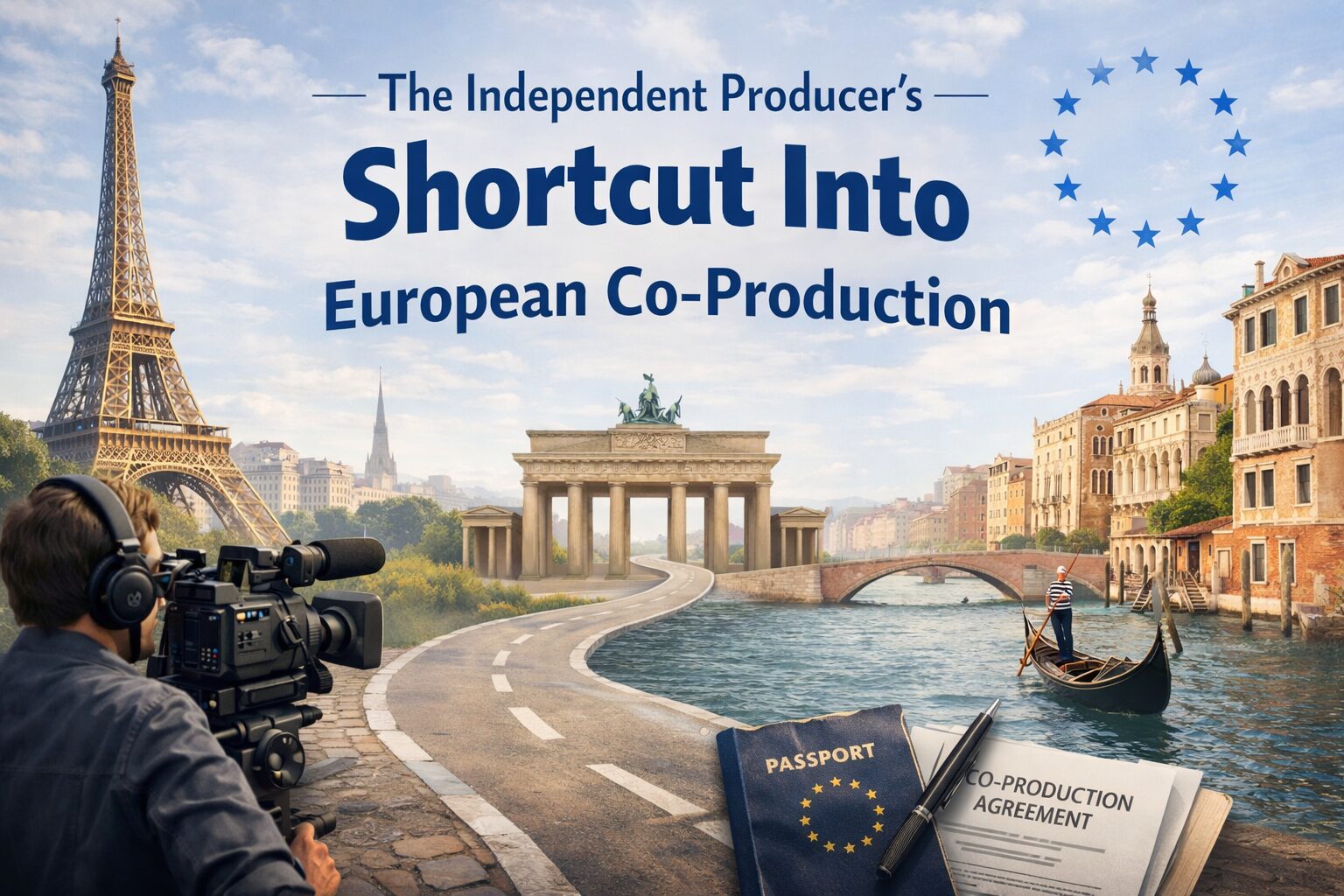
For independent producers working on culturally specific stories, finding the right European co-production partners isn’t simply a matter of knowing the right people. It requires an understanding of which production companies have a mandate for cross-cultural narratives, which film commissions actively support public-interest projects, and how tax credit structures across multiple territories can be aligned into a coherent financing model. That’s a lot to navigate — especially without an established network in every target market.
This is the story of how one independent producer did exactly that, and what the experience reveals about the new realities of independent film financing in Europe.
In This Case Study:
- Introduction: The Independent Producer’s Shortcut Into European Co-Production
- The Challenge: Building a Cross-Border Co-Production Model for a Story That Mattered
- Why European Co-Production Partnerships Are Hard to Build From the Outside
- The Vitrina Concierge Approach: Precision Matchmaking at the European Level
- The Result: Named Partners, Real Conversations, Concrete Next Steps
- What This Case Study Tells Us About the Future of Independent Film Development
- About the European Co-Production Landscape Referenced in This Case Study
- About Vitrina Concierge
The Challenge: Building a Cross-Border Co-Production Model for a Story That Mattered
An independent producer had developed a compelling biopic centred on an Afghan-Swedish footballer — a figure whose life story sits at the intersection of migration, identity, and athletic resilience. The project carried genuine cultural weight, drawing on narratives that are increasingly central to conversations about European identity and representation.
But cultural resonance alone doesn’t close financing deals.
The producer needed to identify European co-production partners with a track record in culturally significant narrative films, connect with film commissions whose mandates aligned with cross-border and multicultural stories, and structure tax credit arrangements across multiple territories — all while keeping the project moving forward.
This is one of the most technically demanding phases of independent film development. European co-production financing typically involves navigating bilateral co-production treaties, matching minimum spend thresholds across territories, and presenting a project to public funding bodies in a way that speaks to their regional and cultural priorities. Each country’s film commission operates with different objectives, funding cycles, and content criteria.
Without the right intelligence — on who is actively co-producing what, who holds the decision-making mandate, and how to position a project for each specific audience — this process can take years, or simply stall.
Why European Co-Production Partnerships Are Hard to Build From the Outside
European film financing is not a single market. It is a network of national and regional systems — each with its own public broadcasters, film institutes, regional funds, and private co-producers — that occasionally connect through bilateral treaties and pan-European mechanisms like Eurimages or the Creative Europe MEDIA programme.
For an outsider approaching this ecosystem, the challenge isn’t a lack of information. It’s the quality and currency of that information. Publicly available data on which production companies are actively seeking co-production partners, and for what kind of content, is often outdated, incomplete, or buried in festival announcements and trade press.
What producers actually need is a clear picture of the market as it exists right now: which companies are in active development, which film commissions have open funding windows, and which decision-makers have the authority — and the appetite — to move quickly on a project with international ambitions.
This is the intelligence gap that Vitrina Concierge is designed to close.
Financing
Playbook
Download the 2026 LeaderSpeak Financing Playbook
Includes the full 30-point producer self-check, plus direct insight from HeadGear, Peachtree, Myriad, Goldfinch, 91 Film Studios, and Lee & Thompson.
Download the Full Playbook →The Vitrina Concierge Approach: Precision Matchmaking at the European Level
When the producer engaged Vitrina’s Concierge team, the process began with a structured analysis of the European production landscape as it related to this specific project. Vitrina’s platform draws on data covering more than 400,000 film and television projects and over 100,000 production and distribution companies globally, with real-time signals on deal activity, co-production history, and company mandates.
For this biopic, the Concierge team focused on two parallel objectives:
Identifying production companies with a demonstrated history of co-producing culturally significant narratives. This meant going beyond a simple list of Scandinavian or Irish production companies and identifying the specific organisations — and the specific individuals within them — who had the mandate, the appetite, and the co-production infrastructure to engage on a project like this.
Mapping film commissions in target territories whose public funding objectives aligned with the project’s profile. Film commissions in Scandinavia, Ireland, and other European territories operate with explicit mandates around cultural diversity, international co-production, and public-interest storytelling. The Concierge team identified which commissions were most likely to view this project as strategically aligned with those objectives.
The outreach strategy was built around this intelligence. Rather than sending a generic pitch, the team positioned the project differently for each target audience — emphasising the aspects of the story, the creative team, or the financing structure that were most relevant to each specific partner. The goal was not simply to get a response, but to initiate substantive conversations with decision-makers who had a genuine reason to engage.
The Result: Named Partners, Real Conversations, Concrete Next Steps
The approach worked quickly and concretely. Within a short period of targeted outreach, the producer secured active engagements with some of the most significant players in European independent film:
- Nimbus Film (Denmark) — one of Denmark’s most respected independent production companies, with a strong track record in Scandinavian co-productions and internationally successful drama.
- Swedish Film Institute — Sweden’s primary public film funding body, which plays a central role in supporting culturally significant Swedish and Nordic productions.
- Metronome Productions (Sweden) — a major Swedish production company with extensive experience in Nordic and European co-productions.
- Nordisk Film (Norway) — part of one of the oldest and most established film groups in the Nordic region, with broad co-production experience across genres.
- Key stakeholders in Ireland — a territory with a well-developed co-production infrastructure and tax credit schemes (Section 481) that make it an attractive partner for European productions.
These were not introductory emails that went unanswered. Discussions progressed to formal next steps, with several of these entities moving toward co-development conversations and tax credit alignment — the substantive work that precedes a co-production agreement.
VITRINA CONCIERGE
Partner-Outreach Managed by Vitrina.
We reach matched contacts every month for your film financing requirements — right company, right decision-maker, right message.
Start with Vitrina ConciergeWhat This Case Study Tells Us About the Future of Independent Film Development
A few things stand out from this case study that are worth reflecting on for anyone working in independent film development or production.
Cultural relevance is a genuine asset — but only if it’s communicated in the right language for each audience. The story at the heart of this project had real resonance: an Afghan-Swedish footballer whose biography connects migration, identity, and sport. That’s a story with clear public-interest dimensions, which matters when you’re approaching film commissions with public funding mandates. But communicating that relevance effectively requires understanding what each specific funder or co-producer is trying to achieve — and framing the project accordingly.
The Scandinavian and Irish film ecosystems are more accessible than producers sometimes assume. The Swedish Film Institute, Nordisk Film, and Ireland’s Section 481 scheme are not impenetrable institutions. They have active co-production mandates and are regularly seeking international projects that align with their objectives. The challenge is identifying the right entry points and the right timing — which requires current, accurate market intelligence rather than outdated contact lists.
Speed matters in development. One of the most striking aspects of this case was how quickly meaningful conversations were initiated. For independent producers working under financial and time pressure, the ability to move from project ready to active co-production discussions in a compressed timeframe is not a luxury — it’s a competitive necessity.
Precision outreach outperforms volume outreach. The Concierge approach is not about sending a project to every production company in Europe and hoping for a response. It’s about identifying the specific organisations and individuals who have both the mandate and the motivation to engage — and then reaching out with messaging that speaks directly to their priorities. The difference in response quality, and in the pace at which conversations develop, is significant.
About the European Co-Production Landscape Referenced in This Case Study
For producers less familiar with the specific organisations mentioned above:
The Swedish Film Institute (SFI) is Sweden’s national film policy body, responsible for supporting the development, production, distribution, and exhibition of Swedish film. It operates several funding mechanisms relevant to co-productions, including support for films with significant Swedish cultural content.
Nimbus Film is a Copenhagen-based production company founded in 1991. It has produced a substantial body of award-winning Danish and Nordic film and television, with a strong focus on character-driven drama and documentary.
Metronome Productions is one of Sweden’s largest independent production companies, producing both film and television with a broad European co-production network.
Nordisk Film is a subsidiary of the Egmont Group and one of the oldest film companies in the world, operating production, distribution, and cinema businesses across the Nordic region.
Ireland’s Section 481 tax credit provides a 32% tax credit on qualifying Irish production expenditure, making Ireland one of Europe’s most competitive production territories for international co-productions.
VITRINA CONCIERGE
Right Company. Right Decision-Maker. Right Message.
Vitrina Concierge reaches matched financiers on your behalf, every month — built around your project's structure and stage.
Explore Vitrina Concierge Outreach SolutionsVitrina Concierge is Vitrina’s premium AI-powered business development service for film and television companies. It combines Vitrina’s global entertainment supply chain intelligence with targeted outreach managed by a specialist team — enabling producers, distributors, and studios to identify and engage the right partners, buyers, and financiers with speed and precision.