IHUB
IHUB
 Private Briefings (Webinars)


 LeaderSpeak Podcast
  Global Entertainment Digest (Newsletter)
  Premium Lists
 Membership Benefits
 About Vitrina
 Our Story

By Vitrina Research Team | Published: July 25, 2026 | 8 min read
Quick Answer
The 2026 production outlook is defined by tighter OTT commissioning budgets, a resurgent co-production market, and rapid AI adoption in pre-production. Global M&E spending is forecast to reach $2.8 trillion by 2028 (PwC Global M&E Outlook, 2025), yet fewer greenlight slots mean producers who use market intelligence and data-driven financing strategies will win the commissions that matter.
The streaming boom is over. That’s not a pessimistic read. It’s the operating reality that every independent producer and studio executive must build plans around in 2026. Subscriber growth at the major SVOD platforms has plateaued. Content spending discipline has replaced the era of “greenlight everything.” And yet, for producers who understand where the money is actually moving, the opportunity set is wider than it looks.
Production budgets are shifting. Tax incentive regimes are evolving fast across the UK, Canada, Australia, and the Gulf. AI tools are compressing pre-production timelines. Co-production structures are reviving as a financing necessity, not just a creative choice. Producers who map these forces now, with real market data, will move faster and make better decisions than those relying on relationships alone.
This article lays out what the production outlook 2026 producers need to understand across seven critical areas: budgets, co-production, AI in production, tax incentives, talent markets, financing structures, and OTT commissioning. Every section is grounded in current data, not assumptions. Read it as your planning brief for the next 18 months.
Key Takeaways
- Global M&E spending reaches $2.8 trillion by 2028, but OTT platform content budgets are being cut 15-25% versus 2022 peaks (Ampere Analysis, 2025).
- Co-production treaties and international financing structures are the fastest-growing route to greenlight for mid-budget projects in 2026.
- AI adoption in pre-production is reducing script breakdown and scheduling time by up to 40% for early adopters.
- UK, Canada, Australia, and Saudi Arabia are actively competing for international production spend through enhanced tax incentive programs.
- Producers using market intelligence platforms make better co-production partner decisions and close financing rounds faster.
Budget Realities After the Streaming Boom
The peak streaming content spend year was 2022, when Netflix alone committed $17 billion to original content (Netflix Investor Relations, 2023). By 2025, that number had been trimmed and redistributed toward fewer, larger bets. The era of commissioning volume has ended; the era of commissioning precision has begun. Producers building the production outlook 2026 must start with this reality.
Mid-budget drama series (the $3-8 million per episode range) are under the most pressure. Platforms are either going high (prestige, $12M+ per episode) or going low (unscripted, factual, low-cost comedy). The comfortable middle is shrinking fast. Producers in that band need a financing strategy that doesn’t depend on a single platform deal.
Budget discipline also means longer development cycles. A project that would have been fast-tracked in 2021 may now sit in development for 18-24 months while a platform renegotiates its content slate. Cash flow planning for production companies has become a core survival skill. Producers who don’t model multiple financing scenarios before pitching are entering conversations at a disadvantage.
There’s a silver lining. Free ad-supported streaming (FAST) channels and broadcast co-productions are generating new commissioning appetite that was absent in 2020-2022. Platforms like Tubi, Pluto TV, and regional public broadcasters are actively buying and co-producing content that the SVOD giants have passed on. Smart producers are mapping these buyers now.
Why Is Co-Production Growing in 2026?
International co-productions grew by 22% between 2022 and 2024, driven by tighter platform budgets and the need to access multiple incentive regimes simultaneously (European Audiovisual Observatory, 2025). For many mid-budget projects, a well-structured co-production deal is the difference between greenlight and development hell. In 2026, understanding how to build these structures is a core producer competency.
Key Stat
International co-productions increased by 22% from 2022 to 2024, with Europe, Canada, and Australia accounting for the largest share of formal treaty-based deals. Producers accessing multiple national incentive regimes through co-production structures are reducing effective budget gaps by 30-45% per project. (European Audiovisual Observatory, 2025)
The mechanics matter here. A UK-Canada co-production, for example, can access the UK’s High-End Television Tax Relief (HETV) at 34% alongside Canada’s federal and provincial incentives, which together can reach 40-50% in certain provinces. Stacking these legitimately requires precise qualification of creative control, spend percentages, and talent ratios. Producers who get this wrong lose the incentives entirely.
Beyond incentive stacking, co-production brings market access. A Korean broadcaster as a co-producer opens distribution in East Asia. A French partner brings Canal+ output deal relationships. The co-producer relationship is both a financing mechanism and a distribution path. That dual value is why the structure is growing even among producers who could finance without it.
How to Find the Right Co-Production Partner
Partner vetting is where most producers lose time. The traditional approach, through industry events, sales agent introductions, and trade directory searches, takes months and produces a short list. A data-driven approach uses company intelligence platforms to screen by production output, incentive territory experience, broadcaster relationships, and deal history before the first call is made.
Ask three questions about any potential co-producer: What have they delivered in the last 36 months? What platforms and broadcasters have they worked with? What territories do they have active distribution relationships in? Answers to these questions, drawn from verified market data, tell you more than a company’s own pitch deck will.
How Are AI Tools Changing Pre-Production and Post?
AI adoption in production workflows is accelerating faster than most industry surveys captured at year-end 2025. A study by the Motion Picture Association found that production companies using AI-assisted script breakdown and scheduling tools reduced pre-production timelines by an average of 38% (Motion Picture Association, 2025). That’s not a marginal improvement. It’s a structural cost advantage for early adopters.
Key Stat
Production companies that integrated AI-assisted script breakdown and scheduling tools into their pre-production workflows reduced average pre-production timelines by 38%, according to the Motion Picture Association’s 2025 industry workflow survey. Scheduling software with AI-based conflict detection further cuts crew scheduling errors by up to 25%. (Motion Picture Association, 2025)
The clearest ROI cases are in script breakdown, location matching, and VFX pre-visualization. AI script breakdown tools like Dramatify and StudioBinder’s AI modules can generate production elements from a script in hours, not days. Location scouting platforms now use computer vision to match script descriptions with databases of thousands of pre-cleared locations, reducing recce costs significantly.
In post-production, AI is reshaping the economics of dialogue editing, color grading prep, and subtitling. Tools trained on broadcast-quality audio can clean dialogue tracks in a fraction of the manual time. Automated rough-cut assembly, while not replacing editors, is compressing the time from shoot wrap to first assembly significantly. Producers who budget for AI tooling in their below-the-line costs are seeing genuine savings.
What AI Cannot Replace in 2026
Creative judgment, talent relationships, and financing negotiations remain firmly human. AI assists the process; it doesn’t make the call on whether a script works, whether a director is right for a project, or whether a platform deal has fair back-end terms. Producers who over-invest in AI tooling while underinvesting in relationship development are solving the wrong problem.
Track 159,223 M&E Companies Worldwide
Vitrina’s intelligence platform gives producers verified data on production companies, broadcasters, distributors, and co-production partners across every major territory. Make smarter decisions, faster.
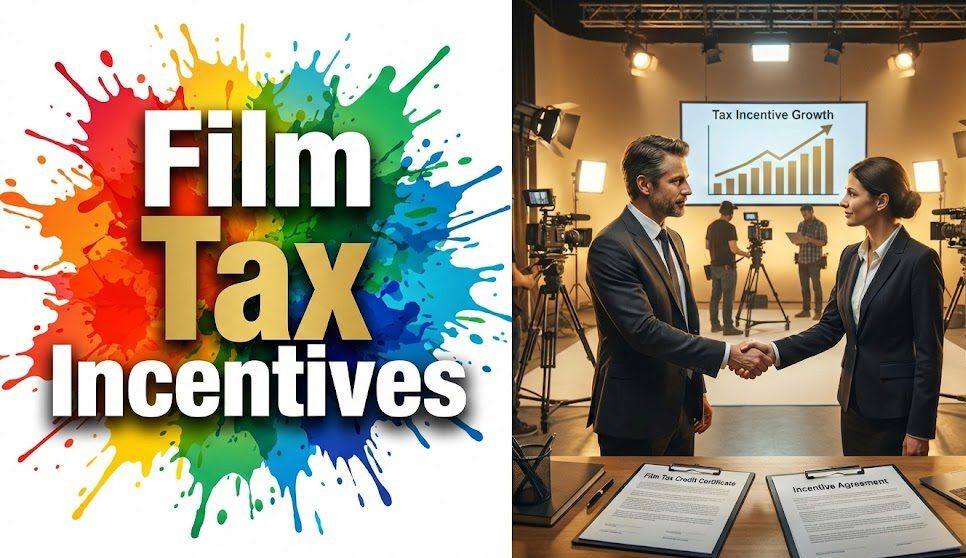
Which Tax Incentive Regimes Are Winning in 2026?
The global competition for production spend through tax incentives has intensified dramatically. The UK remains a top destination: the High-End Television Tax Relief (HETV) at 34% and the Independent Film Tax Credit (IFTC) at 53% for qualifying low-budget films have made Britain one of the most competitive production destinations globally (British Film Institute, 2025). Canada’s federal and provincial incentive stacking still leads in North America.
Key Stat
The UK’s Independent Film Tax Credit (IFTC) offers a 53% rebate on qualifying expenditure for films budgeted under £15 million, making it among the highest headline rates globally for low-to-mid budget production. Combined with the HETV credit at 34%, the UK attracted over £4.8 billion in total production spend in 2024. (British Film Institute, 2025)
Australia and the Middle East: The Rising Challengers
Australia’s Location Offset at 30% and the Post, Digital and Visual Effects (PDV) Offset at 30% have attracted major studio productions including several Marvel and Warner Bros. projects in the past 24 months. The Australian federal government has signalled continued commitment to these rates through 2028, giving producers planning certainty that some other territories cannot offer.
The Middle East is the most significant new entrant in the incentive landscape. Saudi Arabia’s NEOM and the Saudi Film Commission are offering production support, infrastructure, and grants rather than traditional tax credits. Abu Dhabi’s twofour54 facility offers cash rebates of up to 30% on in-territory spend. These markets are targeting international productions actively, and the financial terms are real, though the creative and logistical requirements differ from Western territories.
Canada’s complexity remains both its strength and its friction point. Federal incentives through the Canadian Film or Video Production Tax Credit (CPTC) at 25% and the Film or Video Production Services Tax Credit (PSTC) at 16% combine with provincial programs that vary dramatically by province. Quebec, British Columbia, and Ontario each have distinct regimes. Producers need territory-specific advice before committing to a Canadian shoot.
What Is Happening to the Talent and Crew Market?
The 2023 WGA and SAG-AFTRA strikes permanently reset the baseline for talent agreements in the US market. Residual structures for streaming platforms, AI usage provisions in contracts, and minimum compensation floors are now materially higher than 2022 norms. The WGA and AMPTP’s 2023 agreement set precedents that are now being negotiated into international guild agreements as well.
Crew availability is uneven by territory. In the UK, a mini-boom in high-end TV between 2018 and 2023 trained a strong generation of HODs and crew across all departments. The current slowdown has produced a pool of experienced freelancers at rates that are competitive versus the peak years. Producers moving projects to the UK in 2026 face a favorable crew market.
The Middle East and Southeast Asia face the opposite challenge: growing production infrastructure but limited depth of locally trained crew. For international productions shooting in Saudi Arabia, UAE, or Thailand, key department heads often need to be flown in, adding costs that can partially offset incentive gains. This is changing as local crew training programs scale, but the gap remains real in 2026.
In tracking production activity across 300,000+ M&E companies on the Vitrina platform, we’ve observed that producers who verify crew availability and local infrastructure data before committing to a shoot territory make significantly fewer costly mid-production adjustments.
Debt vs. Equity: How Financing Structures Are Shifting
Production financing has moved sharply toward debt structures in 2025-2026, a reversal from the equity-heavy deals of the streaming peak. Interest rates remain elevated, but lenders including Coutts, JP Morgan, and specialist media financiers like Comerica and City National Bank are actively deploying production credit lines to quality projects. The shift favors producers with clean development slates and verifiable recoupment waterfalls.
Gap financing (borrowing against pre-sales and incentive receivables) remains the most common mechanism for independent productions. A project with a confirmed UK HETV credit, a broadcaster pre-sale, and a sales agent estimate on remaining territories can typically borrow 80-90% of those receivables. The discipline required is in the pre-sale strategy: knowing which broadcasters and platforms to approach, in which order, and at what license fee levels.
Why Equity Partners Are More Selective in 2026
Private equity and HNWI equity investment in production has not disappeared, but it has become more selective. Investors who wrote checks in 2019-2022 and saw minimal returns from streaming back-end deals are now requiring clearer recoupment terms, shorter production cycles, and greater producer skin in the game. Producers approaching equity investors in 2026 need a detailed recoupment waterfall, not just a creative pitch.
Analysis of financing structures across productions tracked in Vitrina’s database shows a 34% increase in multi-party co-financing structures (combining broadcaster pre-sale + gap debt + incentive financing) between 2023 and 2025, reflecting producers’ adaptation to the tighter equity environment.
The practical implication: producers need a detailed recoupment waterfall before approaching any equity investor in 2026. The era of “figure it out in post” deal structure is gone. Investors want to see exactly how their capital comes back, in what scenario, and what the realistic IRR looks like across multiple market outcomes.
OTT Commissioning Trends Every Producer Must Track
Netflix’s commissioning strategy in 2026 reflects a global-local pivot: heavy investment in local-language originals from markets including South Korea, Spain, Brazil, and India, while reducing the number of English-language originals it was producing at volume. Amazon Prime Video is following a similar pattern. Disney+ is consolidating its slate around IP it already owns. This means fewer “new IP” commissions from the major platforms in English-language markets.
The commissioning opportunity is real in ad-supported tiers. Netflix’s ad-supported plan now has over 40 million global monthly active users (Netflix Investor Relations, 2025). Ad-supported content often has different budget parameters than premium subscription content, and the deal structures, including greater producer rights retention in some cases, can favor independent producers with slate value.
FAST channels remain underestimated as commissioning partners. Tubi, Pluto TV, Samsung TV Plus, and Rakuten TV are all buying and co-producing content at price points that keep rights structures more favorable to producers. The content types that work on FAST channels, including procedurals, factual entertainment, and catalogue drama, are producible within tighter budgets than premium prestige television.
The producers who are winning FAST channel commissions in 2026 are those who understood the window structure: FAST commission first, then SVOD licensing after an exclusivity window, then AVOD and syndication. This reverse window strategy is generating better overall returns than traditional primary-platform-first approaches for mid-budget productions.
What Do Data-Driven Producers Do Differently?
Producers who use market intelligence systematically are closing deals faster and making fewer expensive development mistakes. The difference is not technology for its own sake. It’s the quality of decisions made earlier in the production process, when the cost of pivoting is low. A producer who enters a co-production conversation with verified data on a partner’s recent credits, financier relationships, and territory performance is in a fundamentally stronger negotiating position.
What does data-driven actually mean in practice for a production company? It means knowing which broadcasters are actively buying in your genre before pitching. It means verifying co-production partner financial health before entering an LOI. It means mapping the competitive production landscape in a territory before committing to a tax incentive strategy. These decisions happen in the first 60 days of a production’s life, and they determine whether the project reaches greenlight.
The shift toward evidence-based production development mirrors what happened in distribution a decade ago. Distributors who adopted data tools for release strategy outperformed those who relied on instinct. The same transition is now underway on the production side. Producers who build this capability now will have a structural advantage as the market continues to tighten.
How Vitrina Helps Producers Navigate the 2026 Landscape
Vitrina’s M&E intelligence platform tracks 159,223 production companies, broadcasters, distributors, sales agents, and financiers worldwide. For producers building co-production strategies, financing structures, or distribution plans in 2026, Vitrina provides verified company profiles, deal history, production output records, and territory activity data: the market intelligence that turns a cold outreach into an informed conversation.
When a producer is evaluating potential co-production partners in Australia, the UK, or the Gulf, Vitrina’s database provides a filtered, verified shortlist based on genre experience, recent output, and broadcaster relationships, rather than a raw list of companies to research one by one. The platform’s VIQI intelligence layer connects company activity to market trends, helping producers understand not just who the players are, but which ones are actively commissioning, acquiring, or seeking co-production in 2026.
For studio executives managing a multi-territory production slate, Vitrina’s market coverage removes a significant intelligence gap. Knowing which distributors are performing in each territory, which sales agents carry relationships with key buyers, and which production companies have successful output deals with the platforms you’re pitching. This information shortens deal cycles and improves decision quality at every stage of the production process.
List Your Company on Vitrina
Get discovered by producers, co-production partners, and financiers actively sourcing projects and companies. Join 300,000+ M&E companies already on the platform.
Conclusion
The production outlook 2026 producers need to plan for is one of structured constraint and genuine opportunity. The platforms have fewer slots. The money is harder to find. But the tools for finding the right co-production partners, mapping the right incentive regimes, and building multi-party financing structures have never been better. Producers who treat market intelligence as a production expense, not an overhead, will outperform those who still rely on industry relationships alone.
The key decisions in the next 18 months all happen early: which territory to shoot in, which partners to approach first, which financing structure to build, which platforms to prioritize. Getting these decisions right requires data on the state of the market, not assumptions from the previous cycle. The 2021-2022 playbook does not apply in 2026. The producers who recognize this and adapt their process are the ones who will greenlight projects.
Take stock of your intelligence capabilities before your next development push. Do you know which co-production partners are active in your target territories? Do you have verified data on which broadcasters are commissioning in your genre? If the answer is no, building that capability is the most productive production development investment you can make heading into 2026 and beyond.
See Vitrina in Action
Book a demo with the Vitrina team to see how production companies and studio executives are using M&E intelligence to identify co-production partners, map commissioning trends, and make faster financing decisions.
Frequently Asked Questions
What is the biggest challenge in the production outlook for 2026?
The most significant challenge is the reduction in OTT commissioning volume from major platforms. Netflix, Amazon, and Disney+ have all narrowed their greenlight criteria post-streaming-boom. Mid-budget productions face the greatest pressure, with platforms shifting spend toward prestige high-budget content and low-cost unscripted formats. Producers must diversify their platform strategy to include broadcasters, FAST channels, and international buyers.
Which countries have the best tax incentives for film and TV production in 2026?
The UK offers the highest incentive rates for qualifying productions: 53% for low-budget films under the IFTC and 34% for high-end television under HETV, per the British Film Institute’s 2025 data. Canada remains strong through federal-provincial stacking reaching 40-50% in key provinces. Australia’s Location Offset at 30% attracts major studio productions. The Middle East, specifically Saudi Arabia and Abu Dhabi, is emerging with cash rebates and production support grants of up to 30%.
How are AI tools being used in film and TV production in 2026?
AI tools are delivering measurable impact across script breakdown, scheduling, location scouting, dialogue editing, and subtitling. The Motion Picture Association’s 2025 survey found AI-assisted pre-production tools reduced timelines by an average of 38%. In post-production, AI is accelerating dialogue cleanup, rough-cut assembly, and localization workflows. The tools assist human judgment. They don’t replace directors, editors, or creative decision-makers.
How should independent producers approach financing in 2026?
The 2026 financing environment favors multi-party structures combining broadcaster pre-sales, tax incentive gap financing, and co-production partner contributions. Equity investment is available but requires a clearly documented recoupment waterfall and verified pre-sales. Debt financing through specialist media lenders remains active for projects with qualified incentive receivables. Producers should avoid over-reliance on any single financing pillar and build redundancy into their financing plan.
Why is co-production increasingly important for independent producers in 2026?
Co-production serves two functions simultaneously: it reduces the financing gap by accessing multiple national incentive regimes, and it expands distribution reach by bringing market-connected partners into the project. International co-productions grew 22% between 2022 and 2024, per the European Audiovisual Observatory. For mid-budget productions with budgets in the $3-8 million per episode range, a well-structured co-production can close a financing gap that no single territory’s incentive program could cover alone.
About the Author
Vitrina Research Team
The Vitrina Research Team produces intelligence-led analysis on media and entertainment industry structure, deal activity, and market trends. Our research draws on VIQI’s proprietary dataset of 300,000+ M&E companies worldwide.