IHUB
IHUB
 Private Briefings (Webinars)


 LeaderSpeak Podcast
  Global Entertainment Digest (Newsletter)
  Premium Lists
 Membership Benefits
 About Vitrina
 Our Story
By Vitrina Research Team | Published: July 21, 2026 | Updated: July 21, 2026 | 9 min read
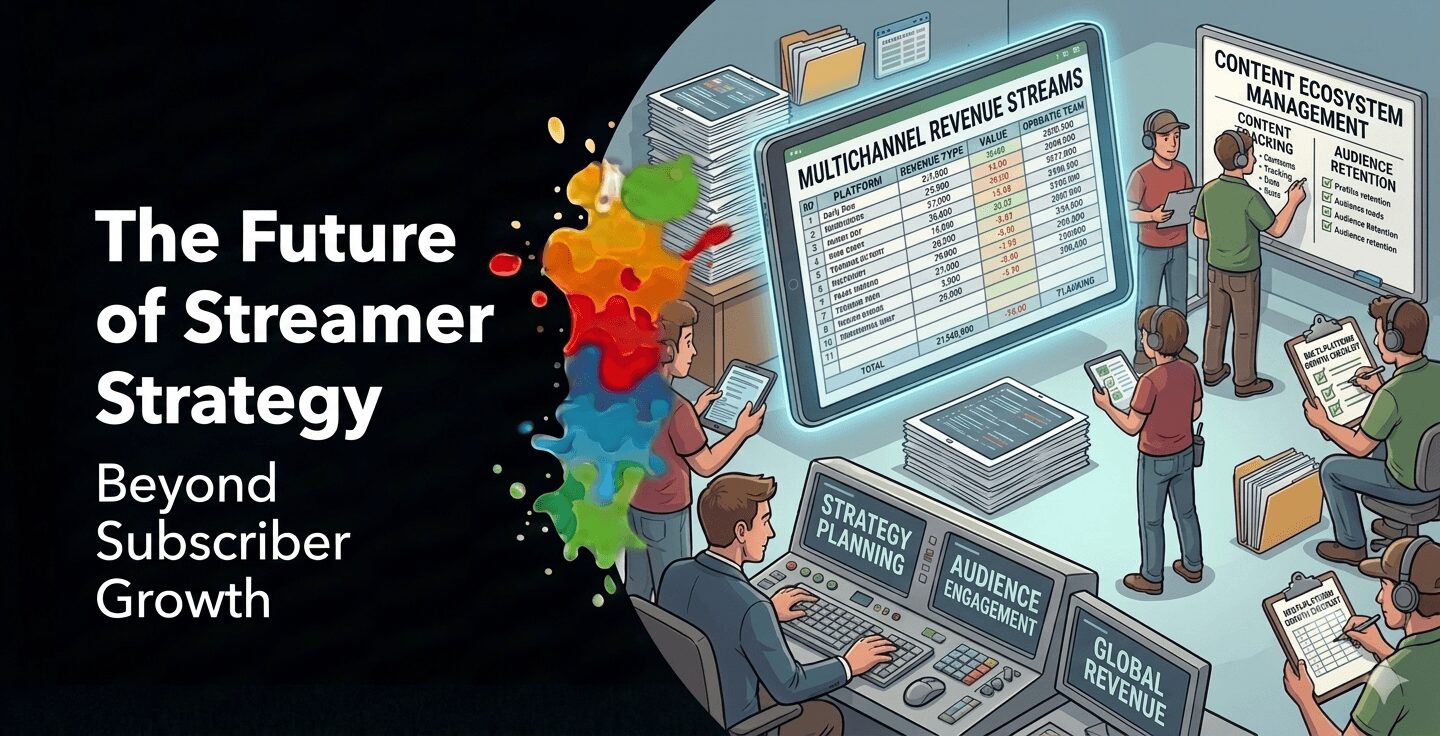
The Future of Streamer Strategy Beyond Subscriber Growth
The subscriber count era is over. Every major streaming platform – Netflix, Disney+, Amazon Prime Video, and Apple TV+ – publicly pivoted from growth-at-all-costs to profitability between 2023 and 2025. Global streaming revenue is projected to reach $159 billion in 2026 according to Statista’s Digital Media Outlook, yet the platforms chasing that revenue are competing on entirely different terms than they were three years ago.
Subscriber count was always a proxy metric – a stand-in for something more fundamental: the ability to monetize attention sustainably. Now that the measurement has shifted to average revenue per user (ARPU), engagement hours, ad-tier adoption, and operating margins, the strategic playbook every streamer runs has changed completely. What comes next isn’t a single new strategy but a cluster of simultaneous pivots: advertising, licensing, live events, gaming, commerce, and ecosystem bundling.
For media executives, content companies, and investors, the implications are direct. Which platforms are spending, which are licensing out, and which are building ecosystems that need partners? The future streamer strategy isn’t just a platform question – it’s a supply chain question. This piece is a companion to our analysis of OTT market strategy trends for executives and our coverage of how streamer strategies are changing global entertainment.
Key Takeaways
- Subscriber growth has plateaued in mature markets: North America and Western Europe combined added fewer than 8 million net new streaming subscribers in 2025, pushing platforms to monetize existing bases more deeply (Antenna, 2025).
- Advertising is now a structural revenue pillar, not a fallback tier. Netflix’s ad-supported plan surpassed 40 million monthly active users globally within two years of launch (Netflix, Q4 2024).
- Content quality concentration is replacing volume commissioning. The top 10% of titles now drive over 70% of total viewing hours on major SVOD platforms (Nielsen Streaming Report, 2025).
- Licensing and co-production partnerships are growing as streamers seek cost efficiency. International co-productions now represent 35% of Netflix’s new scripted slate outside North America (Variety, 2025).
- VIQI by Vitrina maps 300,000+ M&E companies across 190+ territories, giving content companies and distributors the intelligence to identify streaming partners aligned with the post-subscriber-war landscape.
Quick Answer
The future of streamer strategy centers on six pivots: ARPU growth over subscriber count, advertising as a primary revenue engine, quality-concentrated content investment, international licensing partnerships, platform-as-ecosystem plays (gaming, commerce, live events), and bundling. Netflix’s ad tier reaching 40 million MAUs (Netflix, Q4 2024) signals that monetization depth, not subscriber breadth, defines the next competitive era.
Why Subscriber Count Is No Longer the Primary Success Metric
Subscriber count made sense as the primary metric when platforms were in pure land-grab mode. But Wall Street stopped rewarding raw subscriber additions around 2022 when Netflix reported its first quarterly decline in over a decade. According to Variety, that single earnings miss wiped $50 billion from Netflix’s market capitalization in a single trading session – a signal that the market had already decided subscriber growth was the wrong measurement.
The reason is structural. A subscriber in a tier-one market paying $15.99 per month generates fundamentally different economics from a subscriber in a developing market on a mobile-only plan at $2.99. When Netflix reported 301 million paid subscribers in Q1 2025, analysts immediately disaggregated that figure by region and plan type to understand actual revenue quality. The raw subscriber number had become close to meaningless without that context.
The metrics that matter now are ARPU (average revenue per user), engagement hours per subscriber per week, subscriber churn rate by cohort, and operating income margin. These four numbers tell you whether a streaming platform is building a sustainable business or simply accumulating users it cannot profitably serve. Every platform reporting earnings in 2025 and 2026 leads with these figures, not subscriber count alone.
The Pivot to Profitability: ARPU, Engagement, and Retention
Netflix’s global ARPU reached $17.30 per month in Q4 2024, up from $11.67 just two years earlier (Netflix earnings, Q4 2024) – a 48% increase driven by price increases in premium markets and a growing mix of ad-tier subscribers who generate additional advertising revenue on top of their subscription fee. This dual-monetization model is the clearest example of what the profitability pivot actually looks like in practice.
Key Stat
Netflix’s global average revenue per user (ARPU) rose to $17.30 per month in Q4 2024, a 48% increase over two years, driven by price increases and the dual-monetization model of ad-supported tiers generating subscription plus advertising revenue simultaneously. (Netflix Earnings Report, Q4 2024)
Engagement is the other half of the equation. Netflix measures engagement in hours viewed per subscriber per month, not just whether a subscriber logs in. When a subscriber watches 20+ hours per month, churn probability drops sharply. The platform’s internal research, cited by Bloomberg, shows that subscribers who engage with at least three different content categories are dramatically less likely to cancel than single-genre viewers. That insight drives content investment decisions directly.
Retention strategy has become more sophisticated as a result. Platforms now invest in “anchor content” – titles specifically designed to pull back dormant subscribers for a defined window. Sports rights serve this function particularly well. Amazon’s NFL Thursday Night Football package and Netflix’s live sports experiments both function as recurring re-engagement mechanisms, not just content plays. The economics only work when you can quantify the churn reduction value alongside the rights cost.
Is Advertising Becoming the Core Growth Engine for Streamers?
Advertising has moved from an optional tier to a structural revenue pillar across the streaming industry. Netflix’s ad-supported plan surpassed 40 million global monthly active users by Q4 2024, according to the company’s own earnings disclosure – a figure it took the platform just two years to reach from a standing start. At average CPMs of $40-60 in the US market, that subscriber base generates advertising revenue that meaningfully supplements subscription fees.
Key Stat
Netflix’s ad-supported tier crossed 40 million global monthly active users within two years of its November 2022 launch. In the US, streaming advertising CPMs range from $40 to $60 per thousand impressions, compared to $15-25 for linear television equivalents, making streaming ad inventory structurally more valuable. (Netflix Q4 2024; Variety, 2025)
Disney+ and Hulu’s combined advertising business generated over $5 billion in US ad revenue in 2025 according to Variety’s industry analysis. Disney’s advantage is its dual-platform position: Hulu reaches general audiences while Disney+ reaches family and franchise viewers, allowing advertisers to run coordinated campaigns across two distinct audience segments through a single buying relationship. This structural advantage is difficult for newer entrants to replicate quickly.
What’s consistently clear from conversations with media executives is that ad-tier economics are not simply lower-tier subscription revenue. They represent a fundamentally different business model requiring a different organizational capability set – programmatic ad sales teams, first-party data infrastructure, advertiser relationship management, and brand safety compliance. Platforms that underinvested in these capabilities at launch are still catching up.
The advertising opportunity also reshapes content value calculations. A prestige drama watched by 5 million engaged subscribers generates meaningful advertising revenue at $50 CPMs. A broad reality format watched by 20 million less-engaged viewers may generate even more, despite lower production costs. This dynamic is already influencing the content mix streamers commission – and what content suppliers find ready buyers for.
Content Strategy in the Post-Growth Era: Quality Over Quantity
The most visible consequence of the profitability pivot is the collapse of volume-commissioning strategies. Netflix released roughly 700 original titles in 2022 at peak commissioning velocity. By 2025, that figure had contracted meaningfully. According to the Nielsen Streaming Report 2025, the top 10% of titles on major SVOD platforms account for over 70% of total viewing hours – a concentration that renders the long tail of content economically marginal.
Key Stat
The top 10% of titles on major SVOD platforms drive over 70% of total viewing hours, according to the Nielsen Streaming Report 2025. This viewing concentration means that a streaming library of 500 titles may generate nearly identical engagement as one of 5,000 titles – if the top performers are the same. The economic case for volume commissioning has collapsed.
The shift from quantity to quality doesn’t mean streamers are commissioning fewer titles overall – it means they’re concentrating spend per title on a smaller slate. Average per-episode budgets for Netflix’s top-tier scripted drama have risen even as the total number of projects commissioned has declined. A $25 million per episode sci-fi series greenlit in 2026 that performs may be worth more strategically than ten $3 million per episode dramas that each find modest audiences.
For content suppliers and independent producers, this shift has two distinct implications. First, competition for top-tier commissions has intensified. Second, the market for mid-budget content is increasingly served by licensing rather than original commissions, as streamers prefer to license proven titles at predictable costs rather than fund development risk on mid-tier projects. Licensing revenue opportunities are growing as a direct result of commission concentration at the top end.
Are Partnerships and Licensing Becoming Core Streamer Strategy?
Licensing and co-production partnerships have moved from opportunistic tactics to core strategic levers for major streamers. International co-productions now represent 35% of Netflix’s new scripted slate outside North America, according to Variety – a significant increase from the company’s early original-first strategy. The economics are compelling: co-productions share development and production costs while retaining global distribution rights that would cost more to acquire after production.
Analysis of streaming platform content strategies across the Vitrina intelligence database shows that studios and production companies with demonstrated co-production track records in at least two international territories receive materially faster response times from streaming platform development executives than single-market producers. The ability to bring a foreign broadcaster or regional streamer as a co-financier to a pitch has become a meaningful competitive advantage in greenlight conversations.
The licensing market is also expanding as a result of platform consolidation pressures. Smaller streamers and FAST channels need content they can acquire rather than produce. The PwC Global Entertainment and Media Outlook 2025-2029 projects that FAST platform advertising revenue will grow at 18% CAGR through 2029, reaching approximately $12 billion globally. That growth needs to be filled with licensed content, not original production – creating a meaningful secondary market for content libraries.
Position Your Content for the Next Era of Streaming
VIQI maps 300,000+ M&E companies across 190+ territories so you can find the right streaming partners as the industry shifts from growth to profitability.
The Platform-as-Ecosystem Play: Gaming, Commerce, and Live Events
The most ambitious streamers are not trying to win a video subscription battle – they’re building entertainment ecosystems where video is one of several revenue-generating engagement surfaces. Amazon Prime Video is the template: it sits inside a $139-per-year Prime bundle that also includes e-commerce shipping benefits, Prime Gaming, Amazon Music, and Prime Reading. Video retention becomes the mechanism by which Amazon holds subscribers inside a much larger commercial ecosystem.
Netflix’s move into gaming has been slower to generate measurable engagement at scale, but the strategic logic is clear. According to Bloomberg, Netflix Games has published over 100 titles since its 2021 launch, yet fewer than 1% of Netflix subscribers play games on the platform regularly. The gaming bet is more about IP extension and subscriber stickiness for highly engaged users than it is about generating gaming revenue at scale in the short term.
Live events represent the clearest near-term ecosystem expansion opportunity. Netflix’s live comedy specials, live sports experiments, and the WWE Raw deal (which brings weekly live professional wrestling to the platform globally) all serve the same function: appointment viewing that creates subscriber urgency around live dates. According to reporting from Bloomberg, WWE Raw’s first month on Netflix drove measurable spikes in new sign-ups in markets where the promotion has historically performed well.
Commerce integration is the longest-horizon play but potentially the most transformative for content suppliers. Shoppable content – where viewers can purchase items seen on screen directly within the streaming interface – is being piloted by both Amazon and Peacock. If it reaches meaningful conversion rates, it creates an entirely new revenue-sharing model between streamers and content producers whose shows feature products audiences want to buy.
What Does the Future Streamer Strategy Mean for Content Creators and Distributors?
The six strategic pivots – ARPU focus, advertising expansion, quality concentration, licensing growth, ecosystem building, and live events – create a specific set of implications for everyone on the content supply side. Some of these implications are opportunities; others require genuine adaptation to remain relevant as a supplier or distributor.
Opportunities for Independent Producers and Studios
The licensing market is growing. As major streamers concentrate original spend on top-tier tentpole content, mid-budget and proven-format programming is increasingly acquired rather than produced in-house. Producers with strong format libraries and demonstrated performance data are positioned well for this environment. According to Harvard Business Review’s analysis of streaming economics, content suppliers with verified viewership data from prior platform releases negotiate licensing deals at 20-35% higher rates than those without performance proof points.
Challenges for Content Distributors
Traditional distribution models built around output deals with a small number of large buyers are under pressure. As streamers develop more direct relationships with producers globally and licensing windows compress, the role of the distributor changes from gatekeeper to value-added connector. Distributors who can bring packaged slates with co-production financing attached, or who can connect content to emerging FAST and AVOD buyers, have clearer value propositions than those relying solely on traditional output deal relationships.
The Data Imperative for All Suppliers
Every content decision streamers make is now data-backed. Greenlight conversations increasingly require suppliers to bring audience intent data, comparable title performance benchmarks, and territory-specific engagement projections alongside creative pitch materials. Content companies that invest in their own audience intelligence capabilities are better positioned to participate in platform conversations as genuine strategic partners rather than simply as production suppliers.
How VIQI Helps Content Companies Adapt to the Future of Streaming
The post-subscriber-war streaming landscape rewards companies that can identify the right partners, the right platforms, and the right territories ahead of the competition. VIQI (Vitrina Intelligence) is built specifically for this environment. It indexes 300,000+ M&E companies across 190+ territories, covering streaming platforms, production companies, distributors, broadcasters, and licensing agents – with the capability to filter by content category, territory, deal history, and company type simultaneously.
For a content company evaluating which streaming platforms are actively acquiring in a specific genre and territory, VIQI surfaces that intelligence directly. Rather than relying on trade press that reports deals after they close, VIQI users can identify platform acquisition patterns in real time – seeing which streamers have recently taken deals in adjacent content categories and which territories a platform is actively expanding into. That lead time matters when competition for platform slots is intensifying.
VIQI also surfaces licensing and co-production partner opportunities across the full global M&E supply chain. As licensing becomes a more central strategic lever for both platforms and producers, identifying which companies have established licensing relationships in target territories – and who the decision-makers are – is critical business development intelligence. VIQI makes that research measurable and repeatable rather than dependent on conference contacts and network memory.
Conclusion: The Era of Smarter Streaming Has Begun
The subscriber count era ended not with a single announcement but with a gradual repricing of what streaming success actually means. The platforms that understood this transition earliest – Netflix with its ARPU focus, Amazon with its ecosystem logic, Disney with its bundle strategy – are now structurally differentiated from competitors still chasing raw user growth. The future streamer strategy is not one strategy but a portfolio of simultaneous pivots, all pointing toward the same goal: monetizing attention more deeply rather than simply capturing more of it.
For content companies, studios, and distributors, the implications are immediate. The buyers have changed their criteria. Licensing markets are expanding. Co-production partnerships are accelerating. And the premium on intelligence – knowing which platforms are spending where, and what content they need – has never been higher. The companies that will win the next phase of this industry are those that treat business development as an intelligence function, not a relationship-only game.
The streaming industry of 2026 rewards precision: precise content investment, precise audience targeting, precise partnership selection. That precision requires data – about platforms, about co-production partners, about licensing markets, and about where the next acquisition opportunity actually sits. The companies investing in that intelligence capability today are building the competitive moat that will define market position through the rest of the decade.
Frequently Asked Questions
1
Why did streaming platforms stop focusing on subscriber growth?
Platforms pivoted when investor expectations shifted following Netflix’s Q1 2022 subscriber decline, which erased $50 billion in market value overnight. Wall Street began rewarding profitability metrics over raw subscriber additions. Since then, platforms compete on ARPU, engagement hours, and operating margin rather than total subscriber counts.
2
How large is the streaming advertising market in 2026?
Netflix’s ad-supported tier reached 40 million global monthly active users by Q4 2024. Disney+ and Hulu together generated over $5 billion in US ad revenue in 2025 (Variety). US streaming CPMs of $40-60 per thousand impressions compare favorably to linear TV’s $15-25 range, making streaming ad inventory structurally valuable and driving continued advertiser investment into the format.
3
What is ARPU and why does it matter for streaming strategy?
ARPU stands for average revenue per user – the total revenue generated divided by the number of subscribers. It matters because a platform with 100 million subscribers at $17 ARPU generates more revenue than one with 200 million subscribers at $5 ARPU. Netflix’s ARPU reached $17.30 per month globally in Q4 2024, reflecting price increases and ad-tier monetization above the base subscription fee.
4
How are licensing and co-productions changing content acquisition strategies?
Co-productions now represent 35% of Netflix’s new scripted slate outside North America (Variety, 2025), up significantly from the original-first strategy of 2018-2021. Platforms use co-productions to share development costs while retaining global rights. Simultaneously, the FAST and AVOD licensing market – projected to reach $12 billion by 2029 at 18% CAGR (PwC, 2025) – is absorbing mid-budget content that streamers prefer to license rather than produce.
5
What does future streamer strategy mean for independent content companies?
Independent studios and producers benefit from the growing licensing market, expanded co-production opportunities, and the increasing FAST/AVOD segment’s demand for affordable content. The challenge is that top-tier commission slots are more competitive than ever. Companies with verified performance data from prior deals negotiate 20-35% better licensing rates (Harvard Business Review) and win co-production conversations more frequently than those without documented audience proof points.
About the Author
Vitrina Research Team
The Vitrina Research Team produces intelligence-led analysis on media and entertainment industry structure, deal activity, and market trends. Our research draws on VIQI’s proprietary dataset of 300,000+ M&E companies worldwide across streaming, production, distribution, licensing, and broadcast sectors.